THE
REPRODUCTIVE
SYSTEM
Science 10 - Group 1
Subject Teacher:
Ma’am Mitchelle Aureli S. Cerdaña
Leader: Monina Yumi Camarino
Asst. Leader: Diane Lesley Deocares
•Althius Vjon Akol
•Daren Mae Abella
•Joanna Marie Livera
•Jonel Serilo
•Lianne Nicole Agana
•Mary Queen Galvan
•Noel Gelilang Jr.
Group 1 - Members:
For most living creatures,
reproduction is basically a
normal process controlled by
hormones. Even though human
reproduction is also controlled
by hormones, the process is
rather more complicated.
What influence these decisions are
your values, emotions, expectations,
and goals. However, like any other
living things, humans depend on
reproduction for the survival of the
species. If people stop to reproduce,
the human species would become
extinct.
Reproductive
System
WHAT IS REPRODUCTIVE
SYSTEM?
The system involved in sexual
reproduction is called the reproductive
system. It's made up of internal and
external organs, tissues, glands, and parts
that work together to produce offspring.
MALE REPRODUCTIVE SYSTEM
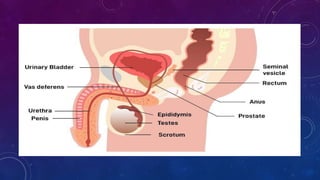
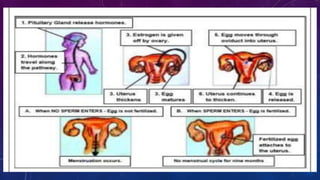
The male reproductive system includes the
external genitals (the penis, testes and the
scrotum) and internal parts, including the
prostate gland, vas deferens and urethra.
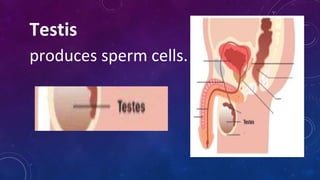
Testis
produces sperm cells.
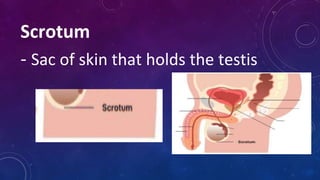
Scrotum
- Sac of skin that holds the testis
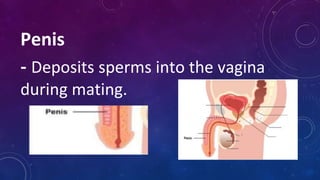
Penis
- Deposits sperms into the vagina
during mating.
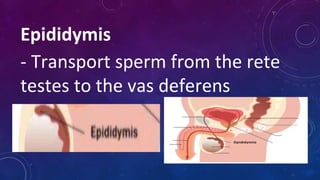
Epididymis
- Transport sperm from the rete
testes to the vas deferens
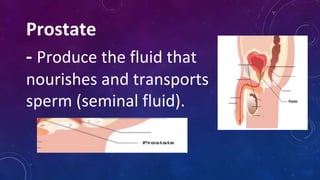
Prostate
- Produce the fluid that
nourishes and transports
sperm (seminal fluid).
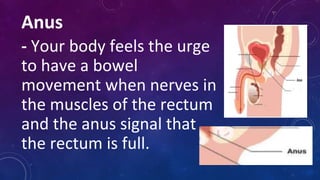
Anus
- Your body feels the urge
to have a bowel
movement when nerves in
the muscles of the rectum
and the anus signal that
the rectum is full.
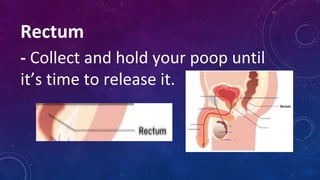
Rectum
- Collect and hold your poop until
it’s time to release it.
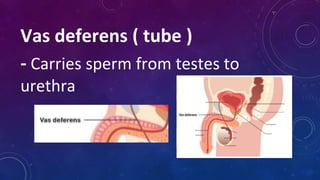
Vas deferens ( tube )
- Carries sperm from testes to
urethra
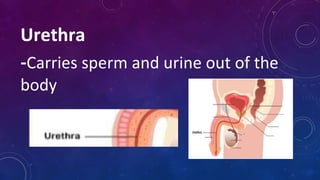
Urethra
-Carries sperm and urine out of the
body
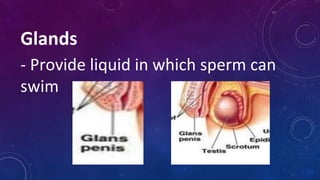
Glands
- Provide liquid in which sperm can
swim
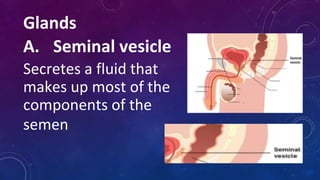
Glands
A. Seminal vesicle
Secretes a fluid that
makes up most of the
components of the
semen
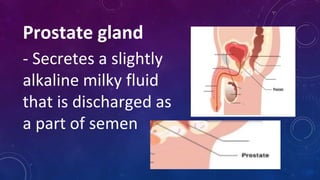
Prostate gland
- Secretes a slightly
alkaline milky fluid
that is discharged as
a part of semen
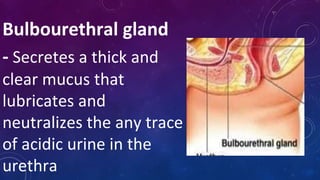
Bulbourethral gland
- Secretes a thick and
clear mucus that
lubricates and
neutralizes the any trace
of acidic urine in the
urethra
THE FEMALE REPRODUCTIVE
SYSTEM
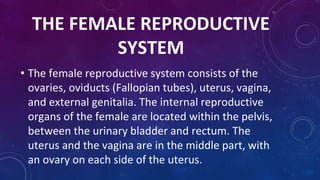
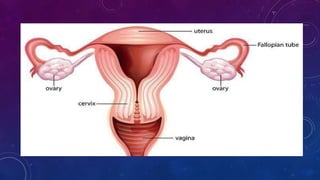
• The female reproductive system consists of the
ovaries, oviducts (Fallopian tubes), uterus, vagina,
and external genitalia. The internal reproductive
organs of the female are located within the pelvis,
between the urinary bladder and rectum. The
uterus and the vagina are in the middle part, with
an ovary on each side of the uterus.
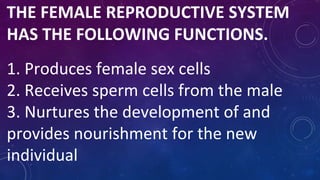
THE FEMALE REPRODUCTIVE SYSTEM
HAS THE FOLLOWING FUNCTIONS.
1. Produces female sex cells
2. Receives sperm cells from the male
3. Nurtures the development of and
provides nourishment for the new
individual
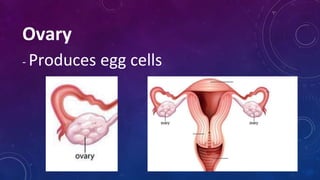
Ovary
- Produces egg cells
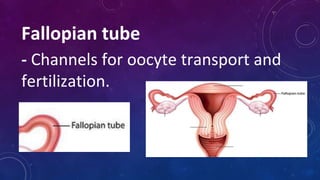
Fallopian tube
- Channels for oocyte transport and
fertilization.
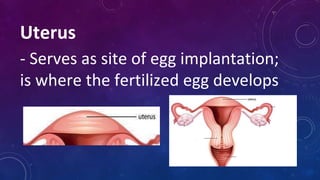
Uterus
- Serves as site of egg implantation;
is where the fertilized egg develops
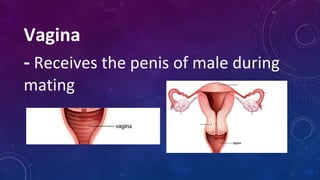
Vagina
- Receives the penis of male during
mating
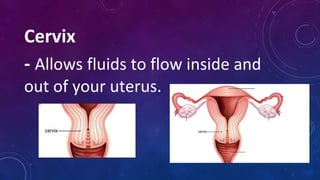
Cervix
- Allows fluids to flow inside and
out of your uterus.
Puberty involves the onset
of sexual maturity and the
ability to reproduce. When
a female reaches puberty,
egg cells start to develop in
her ovaries that produce
the sex cells. It is also the
time when the body
develops the capacity to
conceive.
THE ROLE OF
HORMONES
IN FEMALE AND MALE
REPRODUCTIVE
SYSTEM
THE ROLE OF
HORMONES IN
MALE
REPRODUCTIVE
SYSTEM
THE ROLE IN HORMONES IN MALE
REPRODUCTIVE SYSTEM
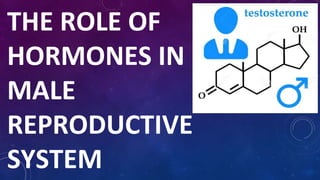
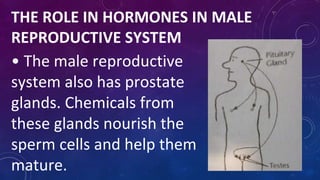
• The male reproductive
system also has prostate
glands. Chemicals from
these glands nourish the
sperm cells and help them
mature.
THE ROLE IN HORMONES IN MALE
REPRODUCTIVE SYSTEM
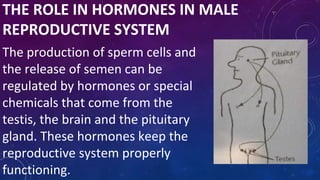
The production of sperm cells and
the release of semen can be
regulated by hormones or special
chemicals that come from the
testis, the brain and the pituitary
gland. These hormones keep the
reproductive system properly
functioning.
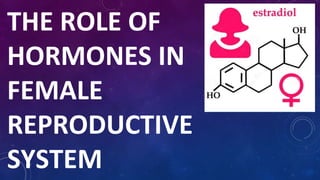
THE ROLE OF
HORMONES IN
FEMALE
REPRODUCTIVE
SYSTEM
THE ROLE IN HORMONES IN FEMALE
REPRODUCTIVE SYSTEM
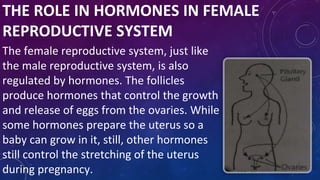
The female reproductive system, just like
the male reproductive system, is also
regulated by hormones. The follicles
produce hormones that control the growth
and release of eggs from the ovaries. While
some hormones prepare the uterus so a
baby can grow in it, still, other hormones
still control the stretching of the uterus
during pregnancy.
🔑 KEY CONCEPT :
Hormones play an important role in
both male and female reproductive
systems. The pituitary gland controls
the functions of both the testes and
the ovaries. These hormones keep
the reproductive system properly
functioning.
FEEDBACK MECHANISMS
INVOLVED IN
REGULATING PROCESSES
IN THE FEMALE
REPRODUCTIVE SYSTEM
THE MENSTRUAL CYCLE
• We have learned that, on average, an ovary
releases only one egg every 28 days. Now, what
controls this timing? Hormones control many of
the changes in the reproductive system.
Remember that hormones are chemicals that
affect certain body organs. The monthly
changes that take place in the female
reproductive system are called menstruation.
THE MENSTRUAL CYCLE
• This cycle occurs every month from the first
onset which could happen when a female is
between 10 to 13 years old. The monthly
cycle continues for about 40 years. Refer to
Figure 11 for a clearer explanation of the
different events that take place in the cycle.
Just follow numbers 1-10 in proper order.
TO SUMMARIZE, THE IMPORTANT EVENTS
DURING THE MENSTRUAL CYCLE ARE AS
FOLLOWS:
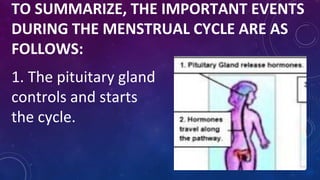
1. The pituitary gland
controls and starts
the cycle.
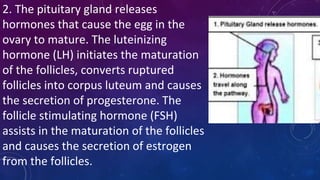
2. The pituitary gland releases
hormones that cause the egg in the
ovary to mature. The luteinizing
hormone (LH) initiates the maturation
of the follicles, converts ruptured
follicles into corpus luteum and causes
the secretion of progesterone. The
follicle stimulating hormone (FSH)
assists in the maturation of the follicles
and causes the secretion of estrogen
from the follicles.
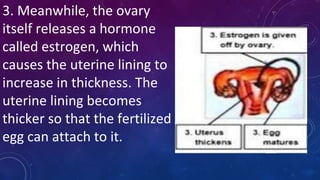
3. Meanwhile, the ovary
itself releases a hormone
called estrogen, which
causes the uterine lining to
increase in thickness. The
uterine lining becomes
thicker so that the fertilized
egg can attach to it.
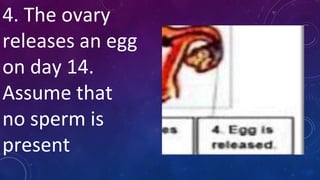
4. The ovary
releases an egg
on day 14.
Assume that
no sperm is
present
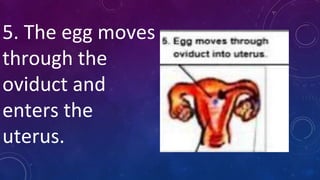
5. The egg moves
through the
oviduct and
enters the
uterus.
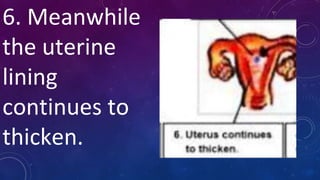
6. Meanwhile
the uterine
lining
continues to
thicken.
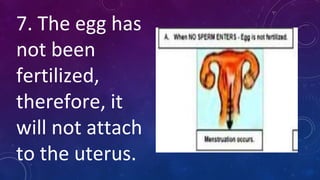
7. The egg has
not been
fertilized,
therefore, it
will not attach
to the uterus.
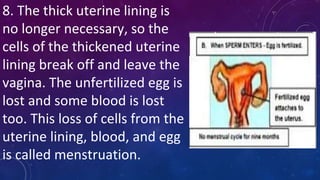
8. The thick uterine lining is
no longer necessary, so the
cells of the thickened uterine
lining break off and leave the
vagina. The unfertilized egg is
lost and some blood is lost
too. This loss of cells from the
uterine lining, blood, and egg
is called menstruation.
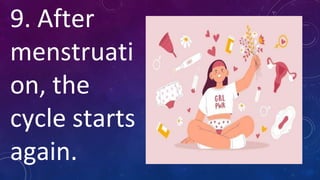
9. After
menstruati
on, the
cycle starts
again.
DID YOU KNOW THAT
MENSTRUAL CRAMPS ARE
THE RESULTS OF THE
STRONG CONTRACTIONS
OF THE UTERINE WALL
THAT OCCUR BEFORE AND
DURING MENSTRUATION?
The cramps can be caused by
excessive secretion of
prostaglandins. Shedding of
the endometrium of the uterus
results in the inflammation in
the endometrial layer of the
uterus and prostaglandins are
produced as a consequence of
the inflammation.
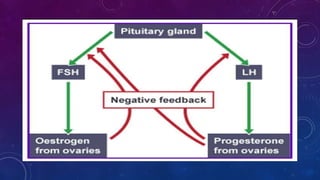
A feedback mechanism is the process through
which the level of one substance influences the
level of another substance. A negative feedback
affects the production of hormones in the
menstrual cycle. High levels of one hormone
may inhibit the production of another
hormone.
FEEDBACK MECHANISMS IN
MENSTRUAL CYCLE:
1. Follicle stimulating hormone (FSH) stimulates the
ovaries to release estrogen. High levels of estrogen
then prevent the further production of FSH.
2. Estrogen also stimulates the release of luteinizing
hormone (LH) from the pituitary gland, which in
turn controls the production of progesterone. High
levels of progesterone then inhibit the further
release of LH.
NERVOUS SYSTEM
WORKING TOGETHER
WITH ENDOCRINE
SYSTEM TO MAINTAIN
HOMEOSTASIS
Both the nervous system
and endocrine system are
important in enabling the
body to maintain
homeostasis.
WHAT IS HOMEOSTASIS?
Homeostasis is the state reached when each
part of the body functions in equilibrium
with other parts. This is attained through the
regulation of the bodily functions by the
endocrine and nervous systems.
Most body systems maintain homeostasis by using
feedback mechanisms. When the brain receives
messages from the body about an internal change in
one of its systems, it works to restore the system to its
normal state. The levels of hormones in the body are
controlled by feedback. It is important that the amount
of hormones in our body is kept at the right level. The
endocrine system plays an important part in
homeostasis.
To achieve homeostasis, the nervous and
endocrine systems maintain a normal range of
the following variables:
• Body temperature
Amount of water in the body
Amount of metabolic wastes in the cell
Blood calcium level
Hormones in the blood
QUESTIONS:
• What might happen to a person whose nervous and endocrine
systems fail to maintain homeostasis?
• Suppose a boy skipped his lunch for the day. How will the
hormones (glucagon) from his pancreas help his body to cope
when his blood sugar level drops below normal?
• Suppose a girl ate too many sweets such as candies and
chocolates. How will the hormones (insulin) from her pancreas
help her body cope with a possible blood sugar level rise above
normal?
• How do the nervous and endocrine systems respond
to an increase in environmental temperature to
achieve homeostasis?
How do the nervous, endocrine, and reproductive
systems perform their coordinated functions in
various functions such as pregnancy and childbirth,
menstrual cycle, breastfeeding, and sexual
intercourse?
QUESTIONS:
SUMMARY/SYNTHESIS/FEEDBACK:
• Hormones affect various processes in the body as they
regulate the functioning various or issues, and cells.
Hormones greatly growth, dipping of organs, tissues,
reproductive functions. These chemicals play an
essentrance, emotions, arence of disorders such as
diabetes, thyroid disease, grontial role in the cal
dysfunction. Hormones act sultery small amounts. An
increase or secrease in the said amount may result in a
body disorder due to hormonal imbalance. influence
SUMMARY/SYNTHESIS/FUNCTION:
• The Reproductive System is a collection of organs
in an organism that function together for sexual
reproduction. The male reproductive organs are the
penis, the testicles, the epididymis, the vas deferens,
and the prostate gland. The female reproductive
organs are the vagina, uterus (womb), Fallopian
tubes, and ovaries.
SUMMARY/SYNTHESIS /FUNCTION:
• Hormones play an important role in both male and
female reproductive systems. The pituitary gland
controls the functions of both the testes and the
ovaries. These hormones keep the reproductive
system properly functioning.
SUMMARY/SYNTHESIS /FUNCTION:
• Hormones secreted by the ovaries and a small gland in
the brain called the pituitary gland control the menstrual
cycle.
• Feedback mechanism is the process through which the
level of one substance influences the level of another
substance. A negative feedback affects the production of
hormones in the menstrual cycle. High levels of one
hormone may inhibit the production of another hormone.
SUMMARY/SYNTHESIS/FUNCTION:
• Homeostasis is the state reached when each part of the
body functions in equilibrium with other parts. This is
attained through the regulation of the bodily functions by
the endocrine and nervous systems.
”
“
Thank you so much for
listening! 웃
! ENERGIZER !
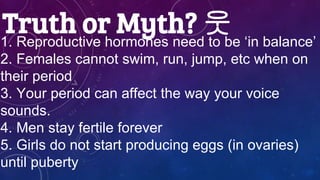
1. Reproductive hormones need to be ‘in balance’
2. Females cannot swim, run, jump, etc when on
their period
3. Your period can affect the way your voice
sounds.
4. Men stay fertile forever
5. Girls do not start producing eggs (in ovaries)
until puberty
Truth or Myth? 웃
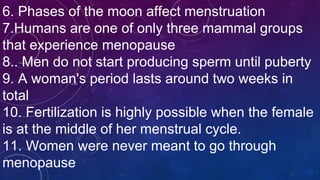
6. Phases of the moon affect menstruation
7.Humans are one of only three mammal groups
that experience menopause
8.. Men do not start producing sperm until puberty
9. A woman's period lasts around two weeks in
total
10. Fertilization is highly possible when the female
is at the middle of her menstrual cycle.
11. Women were never meant to go through
menopause
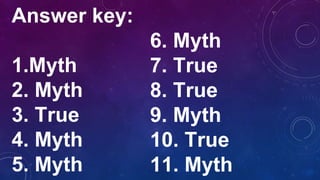
Answer key:
1.Myth
2. Myth
3. True
4. Myth
5. Myth
6. Myth
7. True
8. True
9. Myth
10. True
11. Myth

Reproduction system (10 Amazonite) -----

  • 1.
    THE REPRODUCTIVE SYSTEM Science 10 -Group 1 Subject Teacher: Ma’am Mitchelle Aureli S. Cerdaña
  • 2.
    Leader: Monina YumiCamarino Asst. Leader: Diane Lesley Deocares •Althius Vjon Akol •Daren Mae Abella •Joanna Marie Livera •Jonel Serilo •Lianne Nicole Agana •Mary Queen Galvan •Noel Gelilang Jr. Group 1 - Members:
  • 3.
    For most livingcreatures, reproduction is basically a normal process controlled by hormones. Even though human reproduction is also controlled by hormones, the process is rather more complicated.
  • 4.
    What influence thesedecisions are your values, emotions, expectations, and goals. However, like any other living things, humans depend on reproduction for the survival of the species. If people stop to reproduce, the human species would become extinct.
  • 5.
  • 6.
    WHAT IS REPRODUCTIVE SYSTEM? Thesystem involved in sexual reproduction is called the reproductive system. It's made up of internal and external organs, tissues, glands, and parts that work together to produce offspring.
  • 7.
    MALE REPRODUCTIVE SYSTEM Themale reproductive system includes the external genitals (the penis, testes and the scrotum) and internal parts, including the prostate gland, vas deferens and urethra.
  • 9.
  • 10.
    Scrotum - Sac ofskin that holds the testis
  • 11.
    Penis - Deposits spermsinto the vagina during mating.
  • 12.
    Epididymis - Transport spermfrom the rete testes to the vas deferens
  • 13.
    Prostate - Produce thefluid that nourishes and transports sperm (seminal fluid).
  • 14.
    Anus - Your bodyfeels the urge to have a bowel movement when nerves in the muscles of the rectum and the anus signal that the rectum is full.
  • 15.
    Rectum - Collect andhold your poop until it’s time to release it.
  • 16.
    Vas deferens (tube ) - Carries sperm from testes to urethra
  • 17.
    Urethra -Carries sperm andurine out of the body
  • 18.
    Glands - Provide liquidin which sperm can swim
  • 19.
    Glands A. Seminal vesicle Secretesa fluid that makes up most of the components of the semen
  • 20.
    Prostate gland - Secretesa slightly alkaline milky fluid that is discharged as a part of semen
  • 21.
    Bulbourethral gland - Secretesa thick and clear mucus that lubricates and neutralizes the any trace of acidic urine in the urethra
  • 22.
    THE FEMALE REPRODUCTIVE SYSTEM •The female reproductive system consists of the ovaries, oviducts (Fallopian tubes), uterus, vagina, and external genitalia. The internal reproductive organs of the female are located within the pelvis, between the urinary bladder and rectum. The uterus and the vagina are in the middle part, with an ovary on each side of the uterus.
  • 23.
    THE FEMALE REPRODUCTIVESYSTEM HAS THE FOLLOWING FUNCTIONS. 1. Produces female sex cells 2. Receives sperm cells from the male 3. Nurtures the development of and provides nourishment for the new individual
  • 25.
  • 26.
    Fallopian tube - Channelsfor oocyte transport and fertilization.
  • 27.
    Uterus - Serves assite of egg implantation; is where the fertilized egg develops
  • 28.
    Vagina - Receives thepenis of male during mating
  • 29.
    Cervix - Allows fluidsto flow inside and out of your uterus.
  • 30.
    Puberty involves theonset of sexual maturity and the ability to reproduce. When a female reaches puberty, egg cells start to develop in her ovaries that produce the sex cells. It is also the time when the body develops the capacity to conceive.
  • 32.
    THE ROLE OF HORMONES INFEMALE AND MALE REPRODUCTIVE SYSTEM
  • 33.
    THE ROLE OF HORMONESIN MALE REPRODUCTIVE SYSTEM
  • 34.
    THE ROLE INHORMONES IN MALE REPRODUCTIVE SYSTEM • The male reproductive system also has prostate glands. Chemicals from these glands nourish the sperm cells and help them mature.
  • 35.
    THE ROLE INHORMONES IN MALE REPRODUCTIVE SYSTEM The production of sperm cells and the release of semen can be regulated by hormones or special chemicals that come from the testis, the brain and the pituitary gland. These hormones keep the reproductive system properly functioning.
  • 36.
    THE ROLE OF HORMONESIN FEMALE REPRODUCTIVE SYSTEM
  • 37.
    THE ROLE INHORMONES IN FEMALE REPRODUCTIVE SYSTEM The female reproductive system, just like the male reproductive system, is also regulated by hormones. The follicles produce hormones that control the growth and release of eggs from the ovaries. While some hormones prepare the uterus so a baby can grow in it, still, other hormones still control the stretching of the uterus during pregnancy.
  • 38.
    🔑 KEY CONCEPT: Hormones play an important role in both male and female reproductive systems. The pituitary gland controls the functions of both the testes and the ovaries. These hormones keep the reproductive system properly functioning.
  • 39.
    FEEDBACK MECHANISMS INVOLVED IN REGULATINGPROCESSES IN THE FEMALE REPRODUCTIVE SYSTEM
  • 40.
    THE MENSTRUAL CYCLE •We have learned that, on average, an ovary releases only one egg every 28 days. Now, what controls this timing? Hormones control many of the changes in the reproductive system. Remember that hormones are chemicals that affect certain body organs. The monthly changes that take place in the female reproductive system are called menstruation.
  • 41.
    THE MENSTRUAL CYCLE •This cycle occurs every month from the first onset which could happen when a female is between 10 to 13 years old. The monthly cycle continues for about 40 years. Refer to Figure 11 for a clearer explanation of the different events that take place in the cycle. Just follow numbers 1-10 in proper order.
  • 42.
    TO SUMMARIZE, THEIMPORTANT EVENTS DURING THE MENSTRUAL CYCLE ARE AS FOLLOWS: 1. The pituitary gland controls and starts the cycle.
  • 43.
    2. The pituitarygland releases hormones that cause the egg in the ovary to mature. The luteinizing hormone (LH) initiates the maturation of the follicles, converts ruptured follicles into corpus luteum and causes the secretion of progesterone. The follicle stimulating hormone (FSH) assists in the maturation of the follicles and causes the secretion of estrogen from the follicles.
  • 44.
    3. Meanwhile, theovary itself releases a hormone called estrogen, which causes the uterine lining to increase in thickness. The uterine lining becomes thicker so that the fertilized egg can attach to it.
  • 45.
    4. The ovary releasesan egg on day 14. Assume that no sperm is present
  • 46.
    5. The eggmoves through the oviduct and enters the uterus.
  • 47.
  • 48.
    7. The egghas not been fertilized, therefore, it will not attach to the uterus.
  • 49.
    8. The thickuterine lining is no longer necessary, so the cells of the thickened uterine lining break off and leave the vagina. The unfertilized egg is lost and some blood is lost too. This loss of cells from the uterine lining, blood, and egg is called menstruation.
  • 50.
  • 52.
    DID YOU KNOWTHAT MENSTRUAL CRAMPS ARE THE RESULTS OF THE STRONG CONTRACTIONS OF THE UTERINE WALL THAT OCCUR BEFORE AND DURING MENSTRUATION?
  • 53.
    The cramps canbe caused by excessive secretion of prostaglandins. Shedding of the endometrium of the uterus results in the inflammation in the endometrial layer of the uterus and prostaglandins are produced as a consequence of the inflammation.
  • 54.
    A feedback mechanismis the process through which the level of one substance influences the level of another substance. A negative feedback affects the production of hormones in the menstrual cycle. High levels of one hormone may inhibit the production of another hormone.
  • 56.
    FEEDBACK MECHANISMS IN MENSTRUALCYCLE: 1. Follicle stimulating hormone (FSH) stimulates the ovaries to release estrogen. High levels of estrogen then prevent the further production of FSH. 2. Estrogen also stimulates the release of luteinizing hormone (LH) from the pituitary gland, which in turn controls the production of progesterone. High levels of progesterone then inhibit the further release of LH.
  • 57.
    NERVOUS SYSTEM WORKING TOGETHER WITHENDOCRINE SYSTEM TO MAINTAIN HOMEOSTASIS
  • 58.
    Both the nervoussystem and endocrine system are important in enabling the body to maintain homeostasis.
  • 59.
    WHAT IS HOMEOSTASIS? Homeostasisis the state reached when each part of the body functions in equilibrium with other parts. This is attained through the regulation of the bodily functions by the endocrine and nervous systems.
  • 60.
    Most body systemsmaintain homeostasis by using feedback mechanisms. When the brain receives messages from the body about an internal change in one of its systems, it works to restore the system to its normal state. The levels of hormones in the body are controlled by feedback. It is important that the amount of hormones in our body is kept at the right level. The endocrine system plays an important part in homeostasis.
  • 61.
    To achieve homeostasis,the nervous and endocrine systems maintain a normal range of the following variables: • Body temperature Amount of water in the body Amount of metabolic wastes in the cell Blood calcium level Hormones in the blood
  • 62.
    QUESTIONS: • What mighthappen to a person whose nervous and endocrine systems fail to maintain homeostasis? • Suppose a boy skipped his lunch for the day. How will the hormones (glucagon) from his pancreas help his body to cope when his blood sugar level drops below normal? • Suppose a girl ate too many sweets such as candies and chocolates. How will the hormones (insulin) from her pancreas help her body cope with a possible blood sugar level rise above normal?
  • 63.
    • How dothe nervous and endocrine systems respond to an increase in environmental temperature to achieve homeostasis? How do the nervous, endocrine, and reproductive systems perform their coordinated functions in various functions such as pregnancy and childbirth, menstrual cycle, breastfeeding, and sexual intercourse? QUESTIONS:
  • 64.
    SUMMARY/SYNTHESIS/FEEDBACK: • Hormones affectvarious processes in the body as they regulate the functioning various or issues, and cells. Hormones greatly growth, dipping of organs, tissues, reproductive functions. These chemicals play an essentrance, emotions, arence of disorders such as diabetes, thyroid disease, grontial role in the cal dysfunction. Hormones act sultery small amounts. An increase or secrease in the said amount may result in a body disorder due to hormonal imbalance. influence
  • 65.
    SUMMARY/SYNTHESIS/FUNCTION: • The ReproductiveSystem is a collection of organs in an organism that function together for sexual reproduction. The male reproductive organs are the penis, the testicles, the epididymis, the vas deferens, and the prostate gland. The female reproductive organs are the vagina, uterus (womb), Fallopian tubes, and ovaries.
  • 66.
    SUMMARY/SYNTHESIS /FUNCTION: • Hormonesplay an important role in both male and female reproductive systems. The pituitary gland controls the functions of both the testes and the ovaries. These hormones keep the reproductive system properly functioning.
  • 67.
    SUMMARY/SYNTHESIS /FUNCTION: • Hormonessecreted by the ovaries and a small gland in the brain called the pituitary gland control the menstrual cycle. • Feedback mechanism is the process through which the level of one substance influences the level of another substance. A negative feedback affects the production of hormones in the menstrual cycle. High levels of one hormone may inhibit the production of another hormone.
  • 68.
    SUMMARY/SYNTHESIS/FUNCTION: • Homeostasis isthe state reached when each part of the body functions in equilibrium with other parts. This is attained through the regulation of the bodily functions by the endocrine and nervous systems.
  • 69.
    ” “ Thank you somuch for listening! 웃
  • 70.
  • 71.
    1. Reproductive hormonesneed to be ‘in balance’ 2. Females cannot swim, run, jump, etc when on their period 3. Your period can affect the way your voice sounds. 4. Men stay fertile forever 5. Girls do not start producing eggs (in ovaries) until puberty Truth or Myth? 웃
  • 72.
    6. Phases ofthe moon affect menstruation 7.Humans are one of only three mammal groups that experience menopause 8.. Men do not start producing sperm until puberty 9. A woman's period lasts around two weeks in total 10. Fertilization is highly possible when the female is at the middle of her menstrual cycle. 11. Women were never meant to go through menopause
  • 73.
    Answer key: 1.Myth 2. Myth 3.True 4. Myth 5. Myth 6. Myth 7. True 8. True 9. Myth 10. True 11. Myth