Mrs. Nelson
 Thestudy of how genetic principles apply to
 an entire population of organisms.

 Population:
            A group of organisms of the
 same species that live in a specific area.

 Species:A group of organisms that can
 interbreed and produce fertile offspring.

 To
   study the genetics of a
 population, scientists must collect a
 population sample.
A population sample is random collection of
 organisms of same species used to represent
 the entire population.


 Population
           genetics involves studying the
 frequency at which certain alleles occur in a
 population.
 Undercertain conditions, the frequency of
 the dominant and recessive alleles will stay
 the same from one generation to the next.

 Undercertain conditions, p and q will stay
 the same.
 The  term “allele frequency” refers to how
  common an allele is in a population.
 Many traits in a population are controlled by
  two alleles – dominant and recessive allele.
 Scientists assign: (variables to represent alleles)
       p= dominant allele
       q= recessive allele
 For any population, p + q = 1
 Allele frequencies can be written as a
  decimal or percentage.
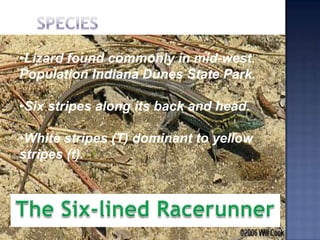
•Lizard found commonly in mid-west.
Population Indiana Dunes State Park.

•Six stripes along its back and head.

•White stripes (T) dominant to yellow
stripes (t).
 In this population of racerunners, 110/200
  alleles are dominant.

 110/200   = 0.55 or 55%

 The  frequency of the dominant allele is
  assigned a variable (p).

 Therefore   in this population, p = 0.55 or 55%
 In this population of racerunners, 90/200
  alleles are recessive.

 90/200   = 0.45 or 45%

 The  frequency of the recessive allele is
  assigned a variable (q).

 Therefore,   in this population q = 0.45 or 45%
   Scientists monitor frequency of the dominant and
    recessive allele in a population year after year.
   In other words, scientists may monitor the values of p
    and q for a population over several generations.
   If the values of p and q…
          -remain the same the population is not
          evolving according to scientists.
          -change then scientist say the group is
          evolving.
   Evolution- “genetic change” amongst population
   Scientist argue all populations will evolve unless
    “certain conditions” are upheld within the group
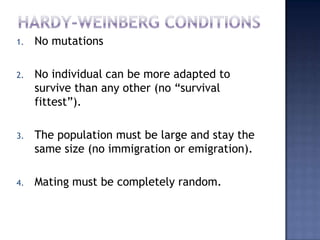
1.   No mutations

2.   No individual can be more adapted to
     survive than any other (no “survival
     fittest”).

3.   The population must be large and stay the
     same size (no immigration or emigration).

4.   Mating must be completely random.
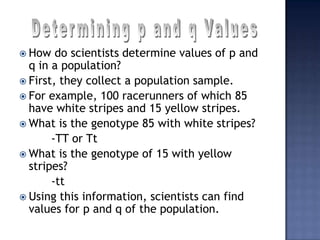
 How   do scientists determine values of p and
  q in a population?
 First, they collect a population sample.
 For example, 100 racerunners of which 85
  have white stripes and 15 yellow stripes.
 What is the genotype 85 with white stripes?
       -TT or Tt
 What is the genotype of 15 with yellow
  stripes?
       -tt
 Using this information, scientists can find
  values for p and q of the population.
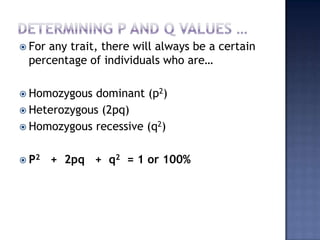
 Forany trait, there will always be a certain
 percentage of individuals who are…

 Homozygous  dominant (p2)
 Heterozygous (2pq)
 Homozygous recessive (q2)


 P2    + 2pq + q2 = 1 or 100%
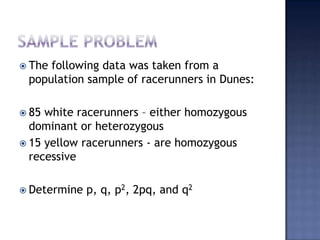
 Thefollowing data was taken from a
 population sample of racerunners in Dunes:

 85 white racerunners – either homozygous
  dominant or heterozygous
 15 yellow racerunners - are homozygous
  recessive

 Determine   p, q, p2, 2pq, and q2
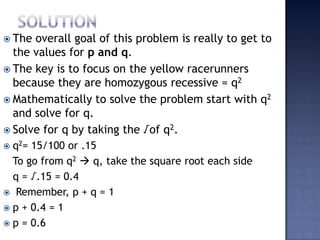
 The overall goal of this problem is really to get to
  the values for p and q.
 The key is to focus on the yellow racerunners
  because they are homozygous recessive = q2
 Mathematically to solve the problem start with q2
  and solve for q.
 Solve for q by taking the √of q2.
 q2= 15/100 or .15
  To go from q2  q, take the square root each side
  q = √.15 = 0.4
 Remember, p + q = 1
 p + 0.4 = 1
 p = 0.6
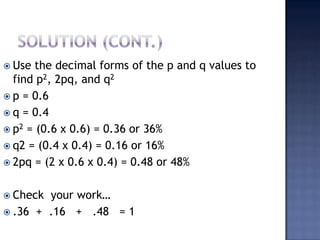
 Use  the decimal forms of the p and q values to
  find p2, 2pq, and q2
 p = 0.6
 q = 0.4
 p2 = (0.6 x 0.6) = 0.36 or 36%
 q2 = (0.4 x 0.4) = 0.16 or 16%
 2pq = (2 x 0.6 x 0.4) = 0.48 or 48%


 Check your work…
 .36 + .16 + .48 = 1

Population geneticsfc

  • 1.
  • 2.
     Thestudy ofhow genetic principles apply to an entire population of organisms.  Population: A group of organisms of the same species that live in a specific area.  Species:A group of organisms that can interbreed and produce fertile offspring.  To study the genetics of a population, scientists must collect a population sample.
  • 3.
    A population sampleis random collection of organisms of same species used to represent the entire population.  Population genetics involves studying the frequency at which certain alleles occur in a population.
  • 4.
     Undercertain conditions,the frequency of the dominant and recessive alleles will stay the same from one generation to the next.  Undercertain conditions, p and q will stay the same.
  • 5.
     The term “allele frequency” refers to how common an allele is in a population.  Many traits in a population are controlled by two alleles – dominant and recessive allele.  Scientists assign: (variables to represent alleles) p= dominant allele q= recessive allele  For any population, p + q = 1  Allele frequencies can be written as a decimal or percentage.
  • 6.
    •Lizard found commonlyin mid-west. Population Indiana Dunes State Park. •Six stripes along its back and head. •White stripes (T) dominant to yellow stripes (t).
  • 7.
     In thispopulation of racerunners, 110/200 alleles are dominant.  110/200 = 0.55 or 55%  The frequency of the dominant allele is assigned a variable (p).  Therefore in this population, p = 0.55 or 55%
  • 8.
     In thispopulation of racerunners, 90/200 alleles are recessive.  90/200 = 0.45 or 45%  The frequency of the recessive allele is assigned a variable (q).  Therefore, in this population q = 0.45 or 45%
  • 9.
    Scientists monitor frequency of the dominant and recessive allele in a population year after year.  In other words, scientists may monitor the values of p and q for a population over several generations.  If the values of p and q… -remain the same the population is not evolving according to scientists. -change then scientist say the group is evolving.  Evolution- “genetic change” amongst population  Scientist argue all populations will evolve unless “certain conditions” are upheld within the group
  • 10.
    1. No mutations 2. No individual can be more adapted to survive than any other (no “survival fittest”). 3. The population must be large and stay the same size (no immigration or emigration). 4. Mating must be completely random.
  • 11.
     How do scientists determine values of p and q in a population?  First, they collect a population sample.  For example, 100 racerunners of which 85 have white stripes and 15 yellow stripes.  What is the genotype 85 with white stripes? -TT or Tt  What is the genotype of 15 with yellow stripes? -tt  Using this information, scientists can find values for p and q of the population.
  • 12.
     Forany trait,there will always be a certain percentage of individuals who are…  Homozygous dominant (p2)  Heterozygous (2pq)  Homozygous recessive (q2)  P2 + 2pq + q2 = 1 or 100%
  • 13.
     Thefollowing datawas taken from a population sample of racerunners in Dunes:  85 white racerunners – either homozygous dominant or heterozygous  15 yellow racerunners - are homozygous recessive  Determine p, q, p2, 2pq, and q2
  • 14.
     The overallgoal of this problem is really to get to the values for p and q.  The key is to focus on the yellow racerunners because they are homozygous recessive = q2  Mathematically to solve the problem start with q2 and solve for q.  Solve for q by taking the √of q2.  q2= 15/100 or .15 To go from q2  q, take the square root each side q = √.15 = 0.4  Remember, p + q = 1  p + 0.4 = 1  p = 0.6
  • 15.
     Use the decimal forms of the p and q values to find p2, 2pq, and q2  p = 0.6  q = 0.4  p2 = (0.6 x 0.6) = 0.36 or 36%  q2 = (0.4 x 0.4) = 0.16 or 16%  2pq = (2 x 0.6 x 0.4) = 0.48 or 48%  Check your work…  .36 + .16 + .48 = 1