Representation of knowledge
• The Representation of Knowledge: Semantic
  organization –Associationistic approach
• Semantic memory model – Set theoretical model –
  Semantic feature – Feature Comparison model –
  Network model – Propositional model networks.
  Representation of Knowledge – Neurocognitivie
  consideration    –    Connectionism     and the
  Representation of Knowledge.
Introduction
• Science is organized knowledge
• Knowledge is “the storage, integration and
  organization of information in memory.”
• some estimates place the no. of words a person know
  the meaning of at 20,000 to 40000.
• Words derive their vitality not from some intrinsic
  worth, but from the concepts and relationships that
  they reflect.
How is knowledge stored in memory ?
• For e.g. a bus schedule can be represented in the form
  of a map or a timetable.
• On the one hand, a timetable provides quick and easy
  access to the arrival time for each bus, but does little
  for finding where a particular stop is situated.
• On the other hand, a map provides a detailed picture
  of each bus stop's location, but cannot efficiently
  communicate bus schedules.
• Both forms of representation are useful, but it is
  important to select the representation most
  appropriate for the task at hand.
Components of Representation of Knowledge

 Cognitive scientists are concerned with
 • Content of knowledge representation
 • Structure of knowledge representation
 • Process of retrieval
       Two perspectives
 • Associationism – the doctrine that there are
   functional relationships between psychological
   phenomenon.
 • Connectionism – a theory of the mind that posits
   a large set of simple units connected in a parallel
   distributed network, (PDP).
Semantic organization of knowledge
• Normally conceptualized (as in clustering model) as a
  grouping or clustering of elements that are alike in
  meaning – For e.g. Rajendra prasad, V.V.giri, Zail
  singh, R.Venkatraman, Abdul kalam, pratibha patel.
• The above group can be further classified as : Rajendra
  prasad, Zail singh, Pratibha patel (North Indians);
  V.V.giri, R.Venkatraman, Abdul kalam (South
  Indians)
• Further semantic models deal with relationship of
  concepts to one another – For e.g. Kalam was a rocket
  scientist, Kalam is a tamilian, Kalam has a bizarre
  hairstyle, kalam is a muslim etc.
Associationist approach
• View of human intellectual function as a
  network of associations connected to other
  associations and to other associations and so
  on.
• Gordon bower believed organization of
  semantic entities in memory has much more
  powerful influence on memory and recall.
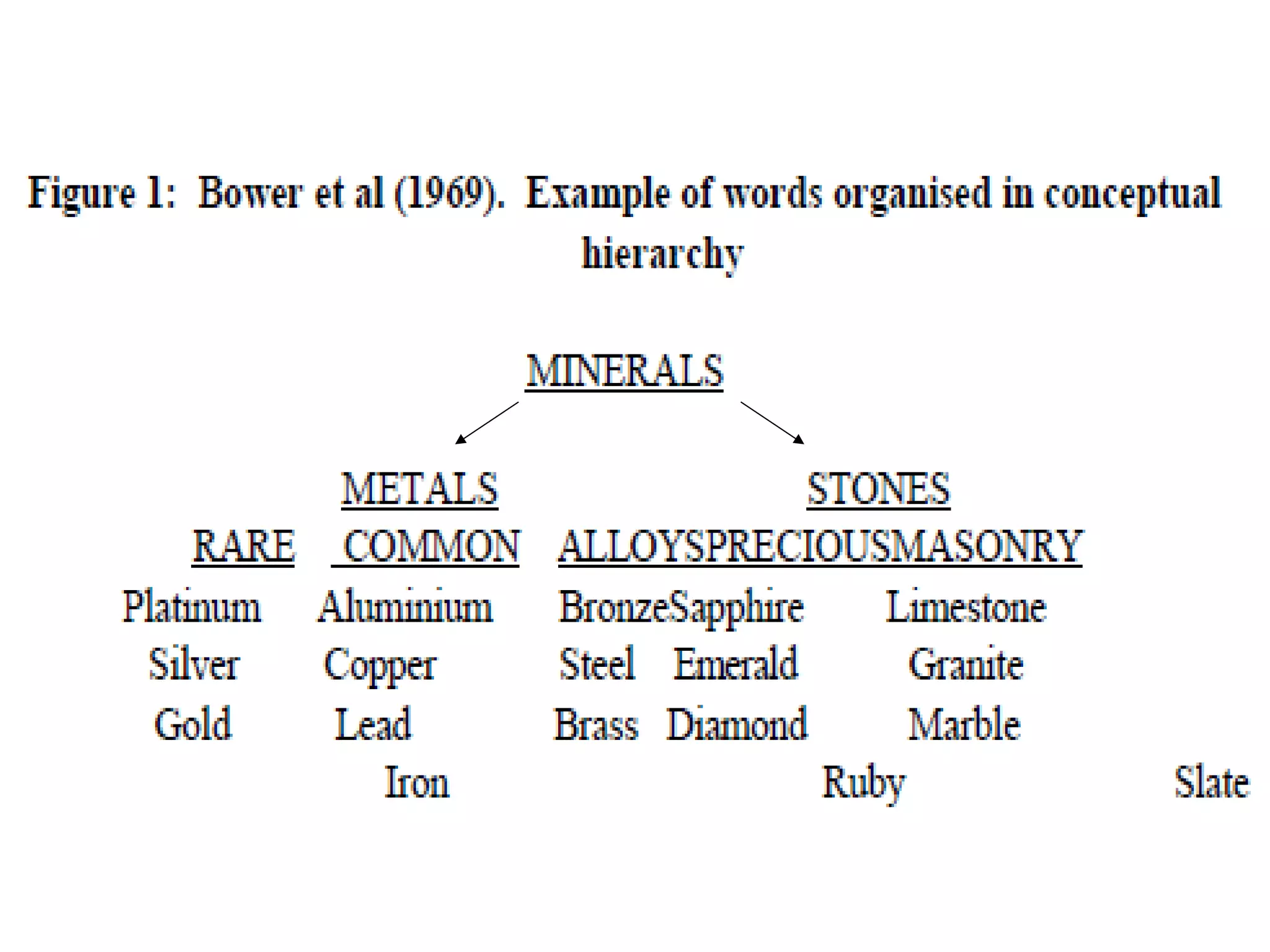
• Experiment – constructed several conceptual
  hierarchies and demonstrated the potent
  influence on recall of organizational variables.
• Bower et at (1969) also demonstrated the
  power of organisation.
• Subjects had 112 words to learn, presented in
  4 trials, 28 words a trial.
• Half the subjects were presented with the
  words organised into conceptual hierarchies
  (see Figure 1), the other half were simply
  shown lists of words.
• They found that subjects presented with the
  organised lists remembered around 47%
  more words than subjects presented a list of
  words without organisation
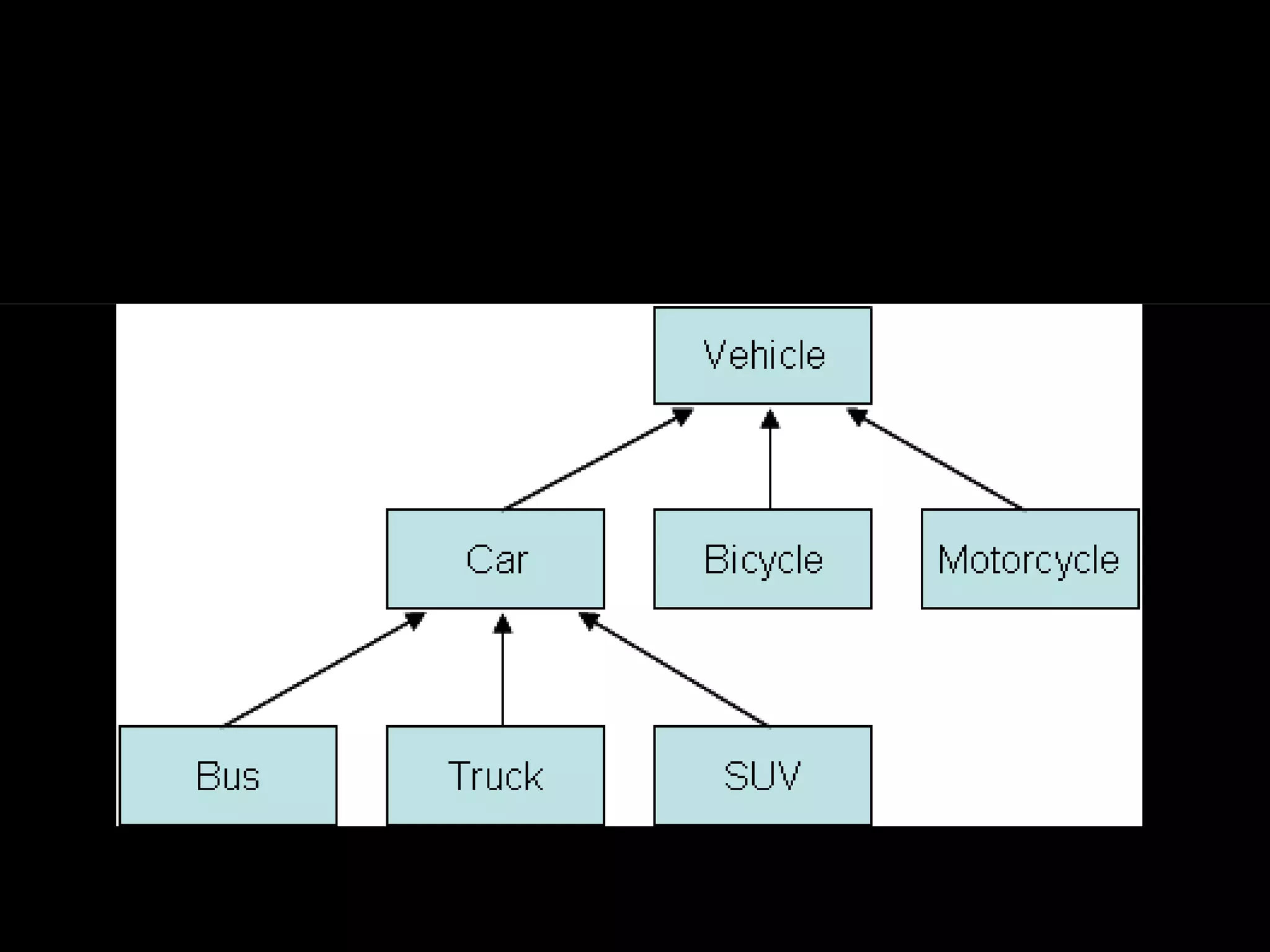
conceptual hierarchies for the
       word vehicle
Semantic memory :cognitive models
• A semantic network is a method of representing
  knowledge as a system of connections between
  concepts in memory
• knowledge is organized based on meaning, such
  that semantically related concepts are
  interconnected.
  1. Set-theoretical model
  2. Feature Comparison Model
  3. Network models
     1. Collins & quillian
     2. Spreading activation theory – Collins and loftus
  4. Propositional networks
     1. HAM
     2. ACT*
Set-theoretical model
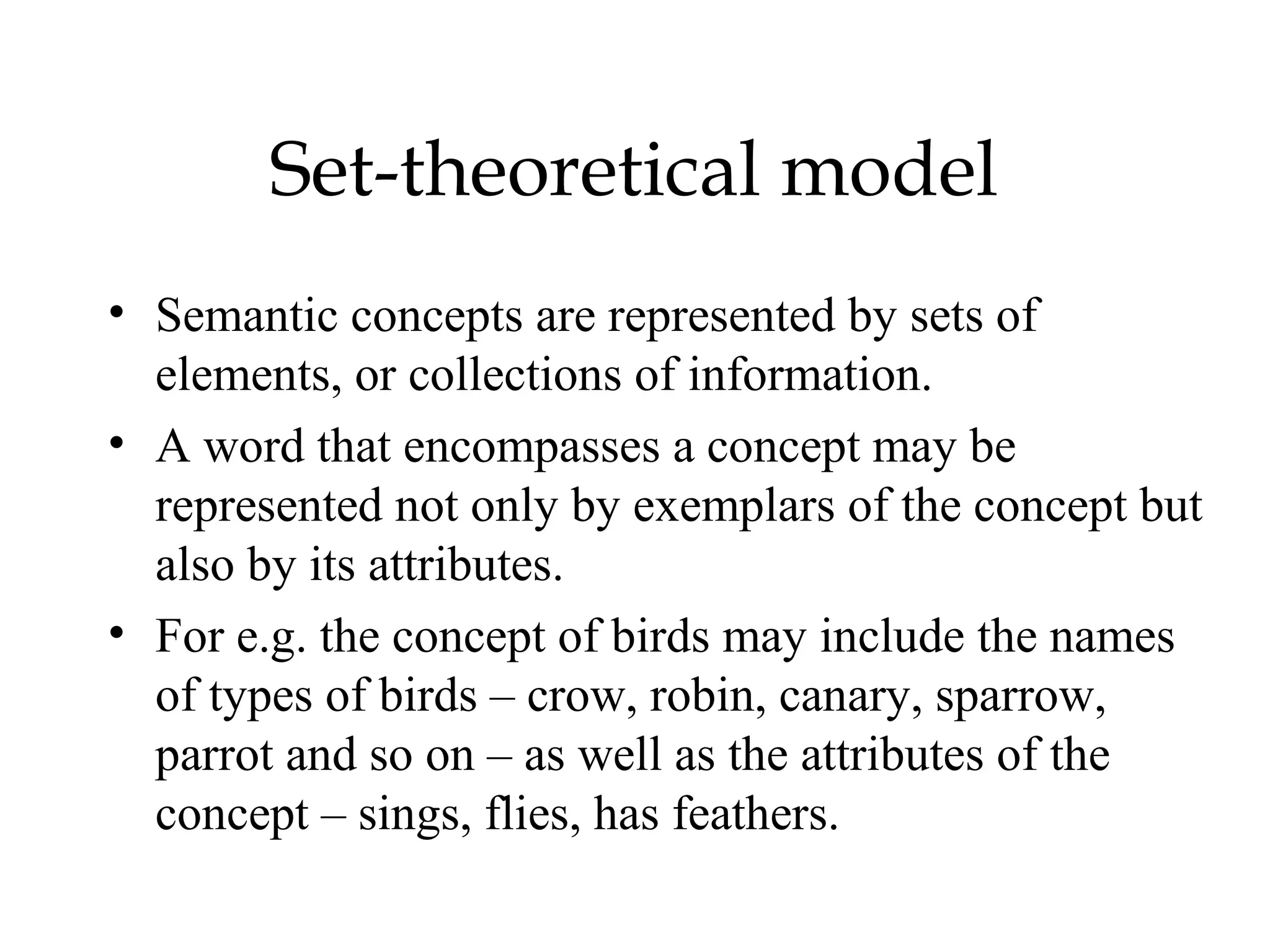
• Semantic concepts are represented by sets of
  elements, or collections of information.
• A word that encompasses a concept may be
  represented not only by exemplars of the concept but
  also by its attributes.
• For e.g. the concept of birds may include the names
  of types of birds – crow, robin, canary, sparrow,
  parrot and so on – as well as the attributes of the
  concept – sings, flies, has feathers.
Set-theoretical model
• Memory consists of numerous sets of attributes
  and retrieval involves verification – a search
  through two or more sets of information to find
  overlapping exemplars.
• Verification of propositions (e.g. robin is a bird) is
  done by comparing the attributes of one set (robin)
  with the attributes of another (bird)
• The degree of overlap of attributes forms the basis
  for a decision about the validity of the proposition.
• More the distance between the sets, greater the
  reaction time in making a decision.
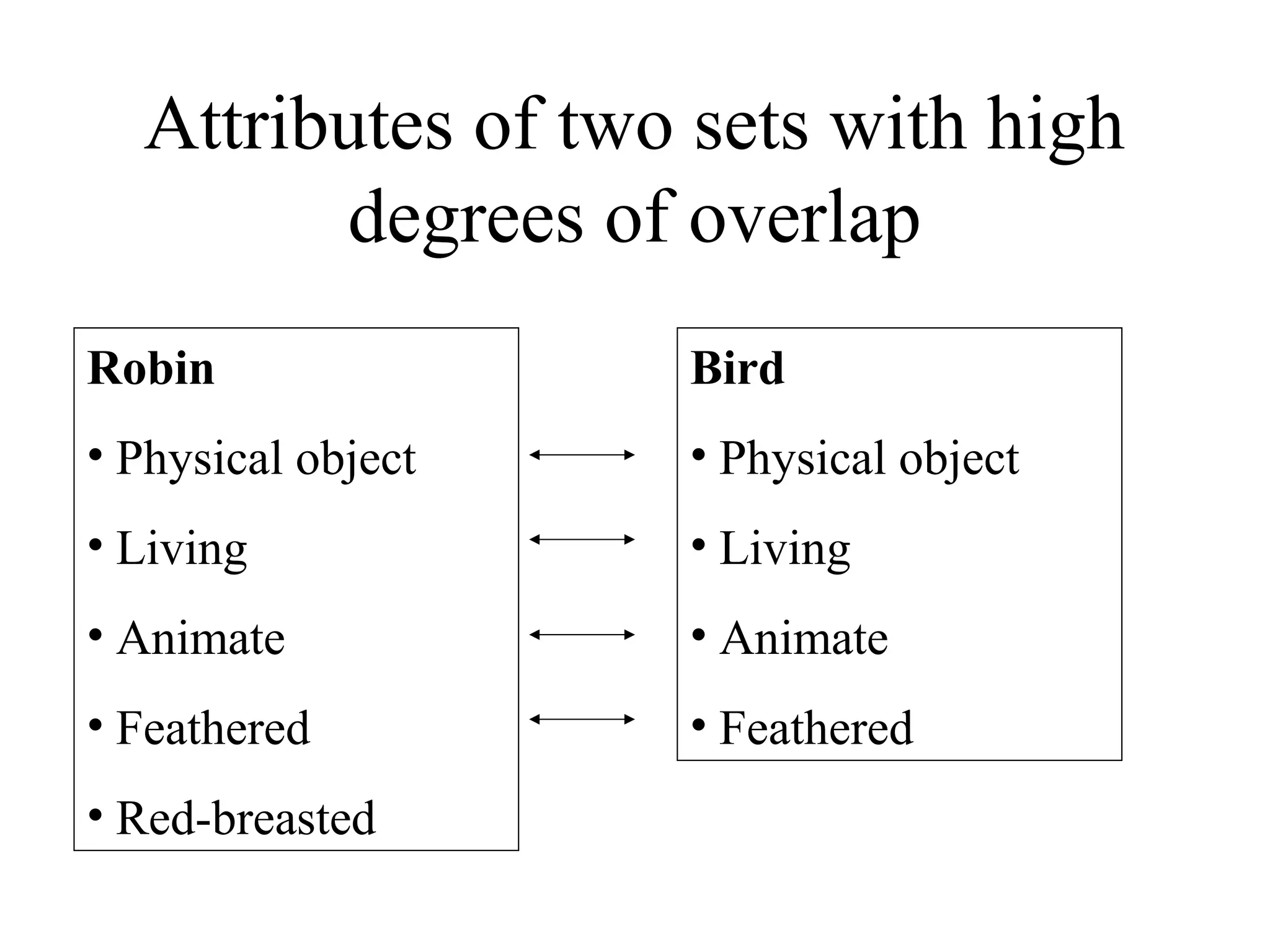
Attributes of two sets with high
        degrees of overlap
Robin               Bird
• Physical object   • Physical object
• Living            • Living
• Animate           • Animate
• Feathered         • Feathered
• Red-breasted
Universal affirmative (UA) and
  particular affirmative (PA)
• UA  all members of one catehory are
  subsumed in another category which is
  represented as “All S are P” ( e.g. all
  canaries are birds)
• PA  only a portion of the members of one
  category make up the member of another
  category.; represented as “some S are P”
  (e.g. some animals are birds)
Feature Comparison Model
        Smith, Shoben and Rips (1974)
• Assumes that “the meaning of a word is NOT an
  unanalyzable unit but rather can be represented
  as a set of semantic features”.
• A broad set of features related to any word
  varies along a continuum from very important
  to trivial.
• A robin – flies, has wings, is a biped, has a red
  breast, perches in trees, likes worms, is a
  harbinger of spring.
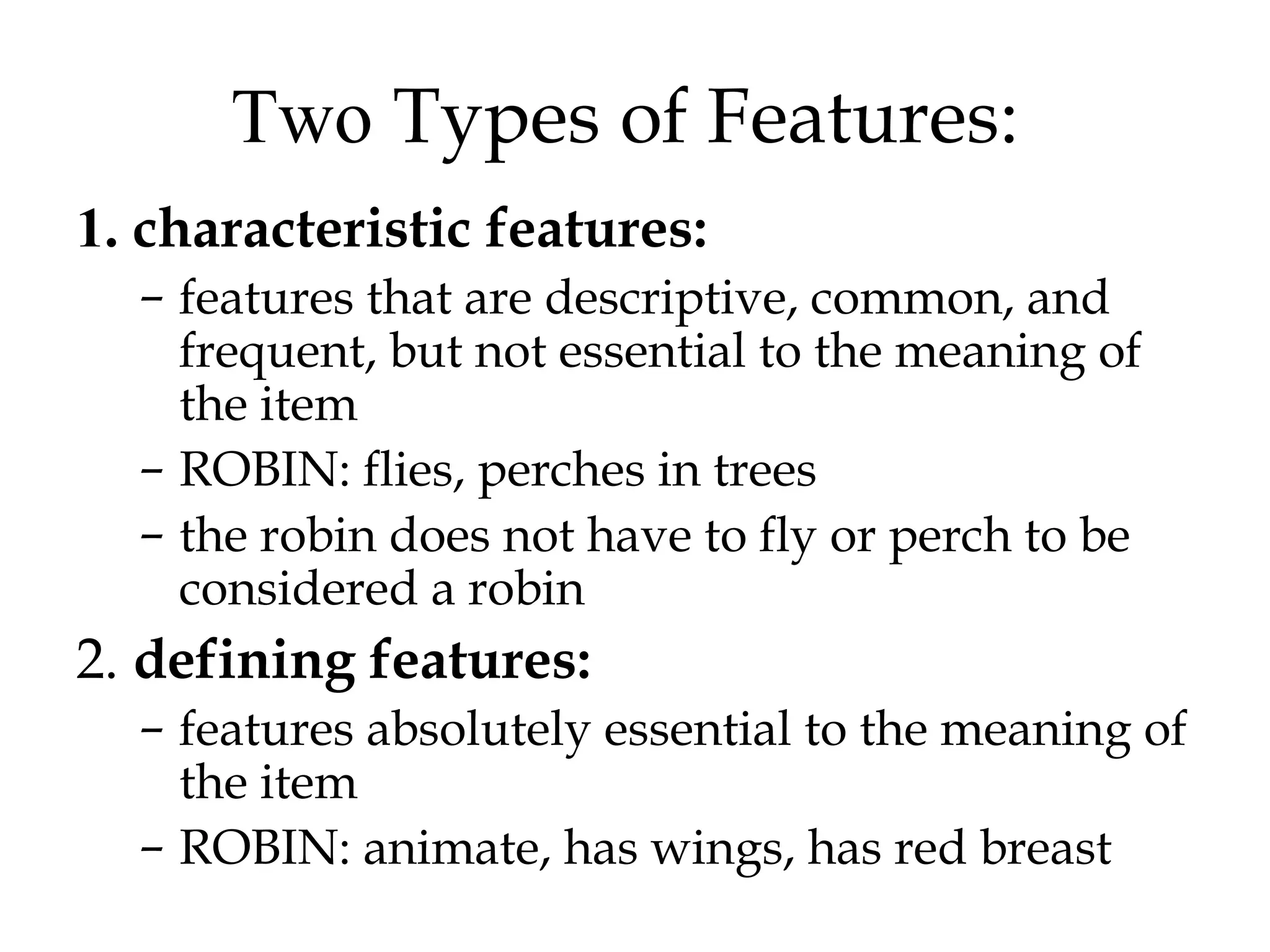
Two Types of Features:
1. characteristic features:
  – features that are descriptive, common, and
    frequent, but not essential to the meaning of
    the item
  – ROBIN: flies, perches in trees
  – the robin does not have to fly or perch to be
    considered a robin
2. defining features:
  – features absolutely essential to the meaning of
    the item
  – ROBIN: animate, has wings, has red breast
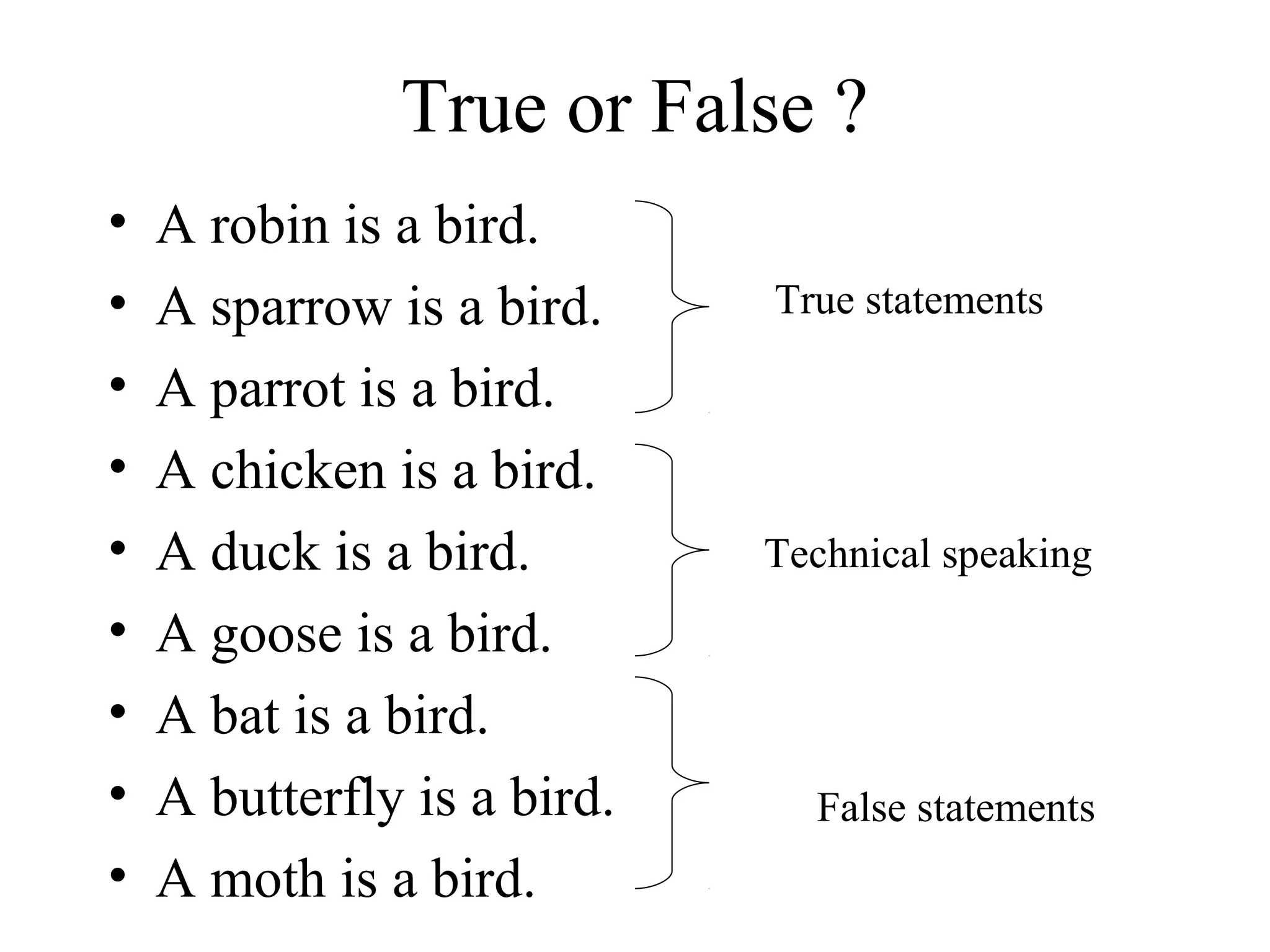
True or False ?
•   A robin is a bird.
•   A sparrow is a bird.     True statements

•   A parrot is a bird.
•   A chicken is a bird.
•   A duck is a bird.        Technical speaking
•   A goose is a bird.
•   A bat is a bird.
•   A butterfly is a bird.     False statements
•   A moth is a bird.
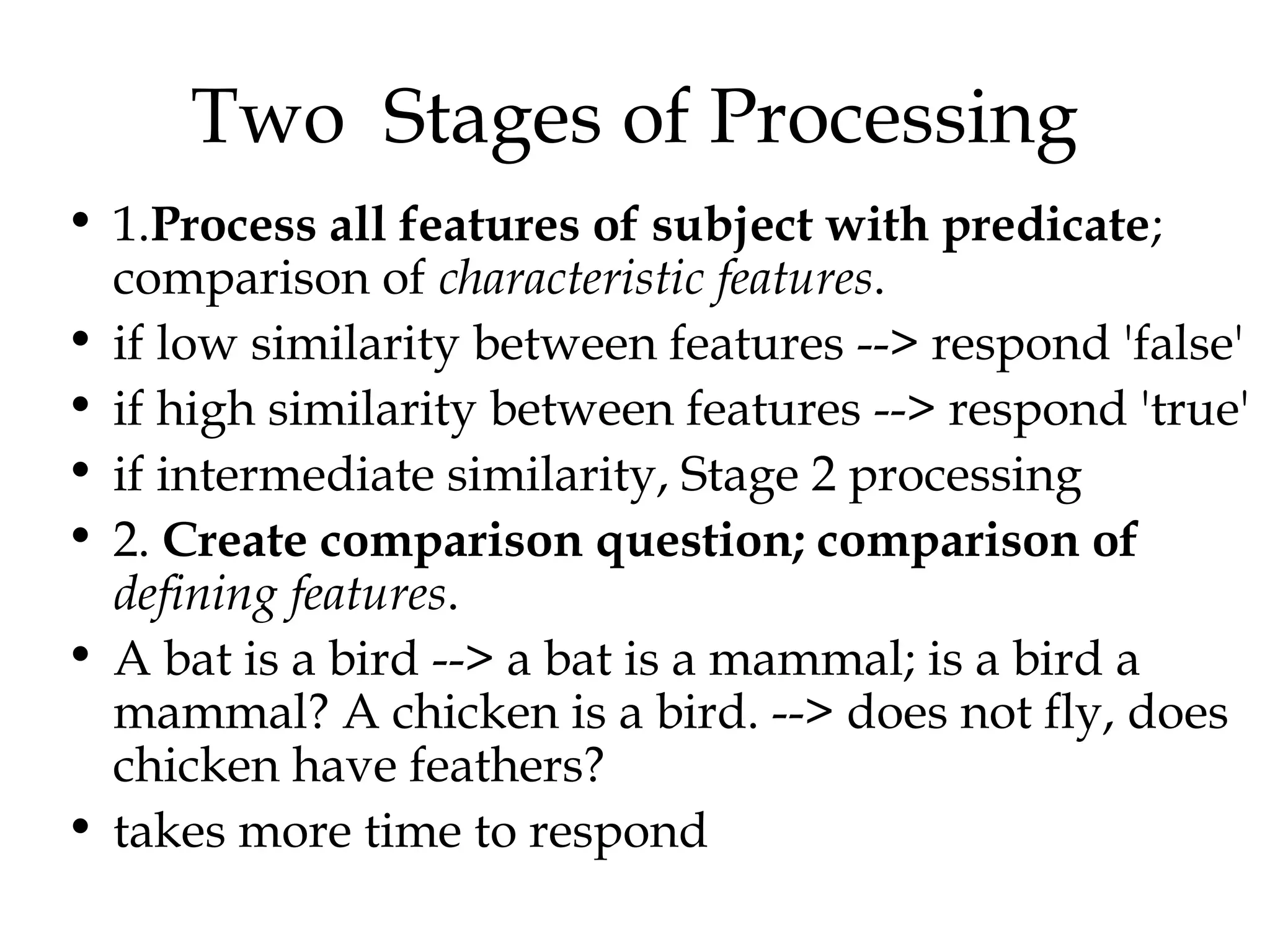
Two Stages of Processing
• 1.Process all features of subject with predicate;
  comparison of characteristic features.
• if low similarity between features --> respond 'false'
• if high similarity between features --> respond 'true'
• if intermediate similarity, Stage 2 processing
• 2. Create comparison question; comparison of
  defining features.
• A bat is a bird --> a bat is a mammal; is a bird a
  mammal? A chicken is a bird. --> does not fly, does
  chicken have feathers?
• takes more time to respond
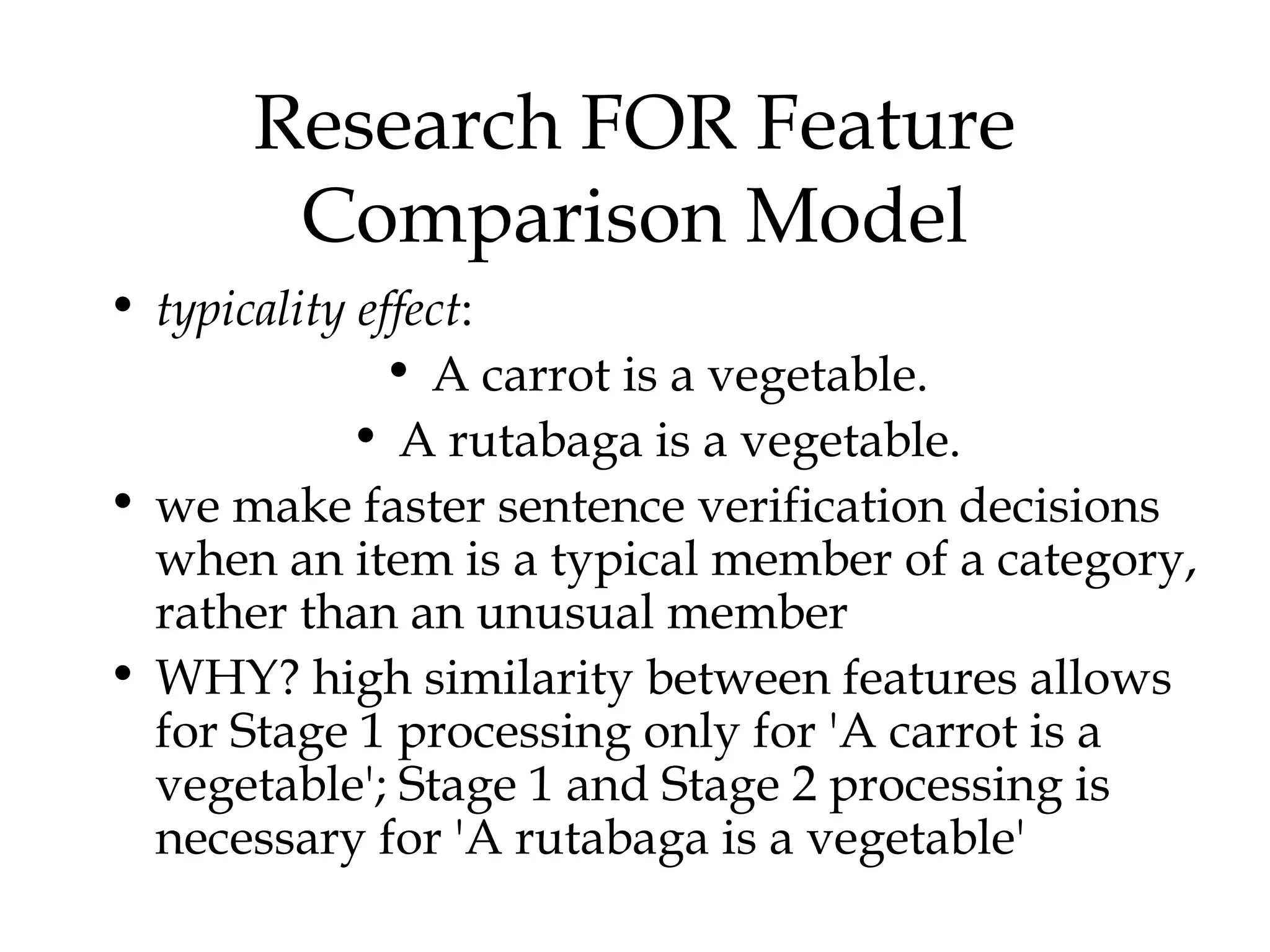
Research FOR Feature
       Comparison Model
• typicality effect:
              • A carrot is a vegetable.
            • A rutabaga is a vegetable.
• we make faster sentence verification decisions
  when an item is a typical member of a category,
  rather than an unusual member
• WHY? high similarity between features allows
  for Stage 1 processing only for 'A carrot is a
  vegetable'; Stage 1 and Stage 2 processing is
  necessary for 'A rutabaga is a vegetable'
Research AGAINST Feature
     Comparison Model:
• category size effect:
               • A poodle is a dog.
            • A squirrel is an animal.
• we make faster sentence verification decisions
  when an item is a member of a small category
• small categories contain more defining
  features; therefore, FC model would predict
  that there should be more Stage 2 processing
  for small categories and thus longer RTs
Semantic Network Models
1.   Teachable language comprehender (TLC)
2.   Spreading activation-Collins & Loftus (1975)
3.   ACT*, ACT-R
•    Characteristics:
     –   concepts represented as nodes in network
     –   nodes are linked together by pathways
     –   proposition = node 1 --- pathway --- node 2
     –   spreading activation
     –   frequently used links have greater strengths
     –   intersection search
     –   priming
Collins & Quillian (1969)
   Teachable language comprehender
• developed a model of memory based on
  semantic organisation.
• Their model was an example of a network
  model of semantic memory.
• A network is a structure consisting of a set of
  nodes with links or paths interconnecting them.
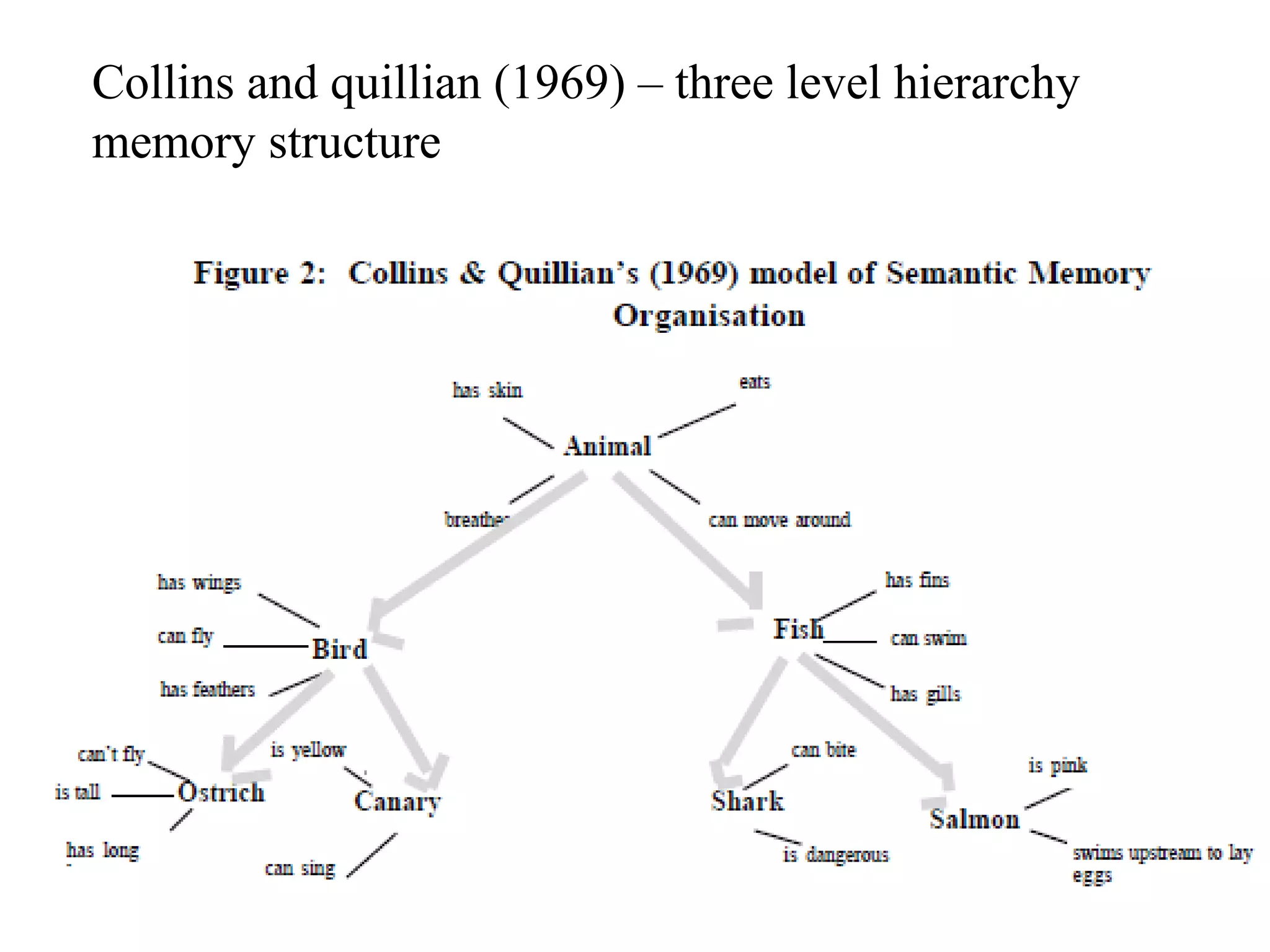
• For example, the knowledge that an ostrich is an
  animal or that a fish can swim is represented in
  a network like that shown in Figure 2.
Collins and quillian (1969) – three level hierarchy
memory structure
Spreading Activation theory
      Collins & Loftus, 1975
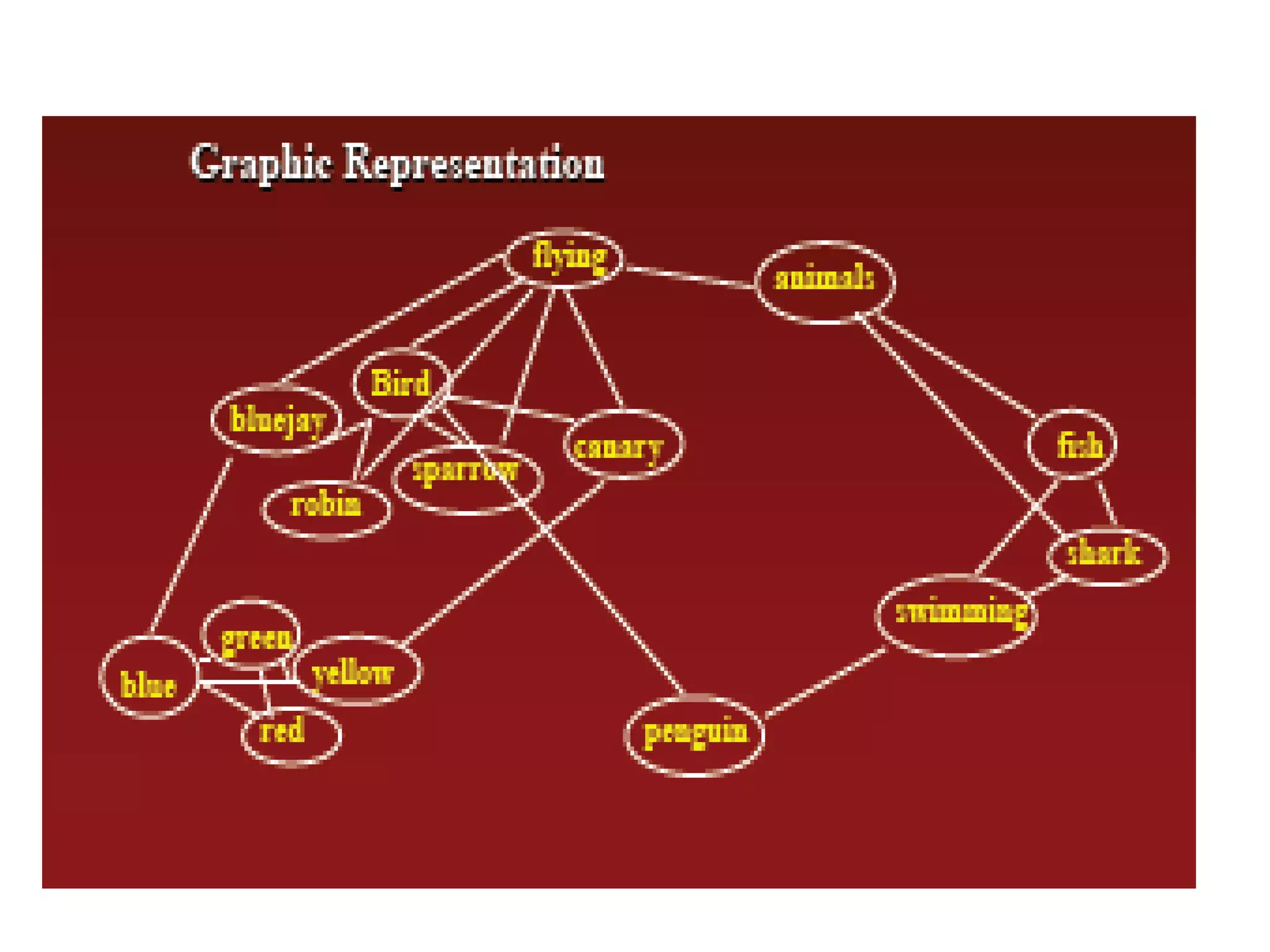
1. New assumptions:
a) Not hierarchical: length of links represent
  degree
of relatedness. Search time depends on link
  length
b) Spreading Activation: retrieval (activation)
  of one
of the links leads to partial activation of
  connected
nodes. Degree of activation decreases with the
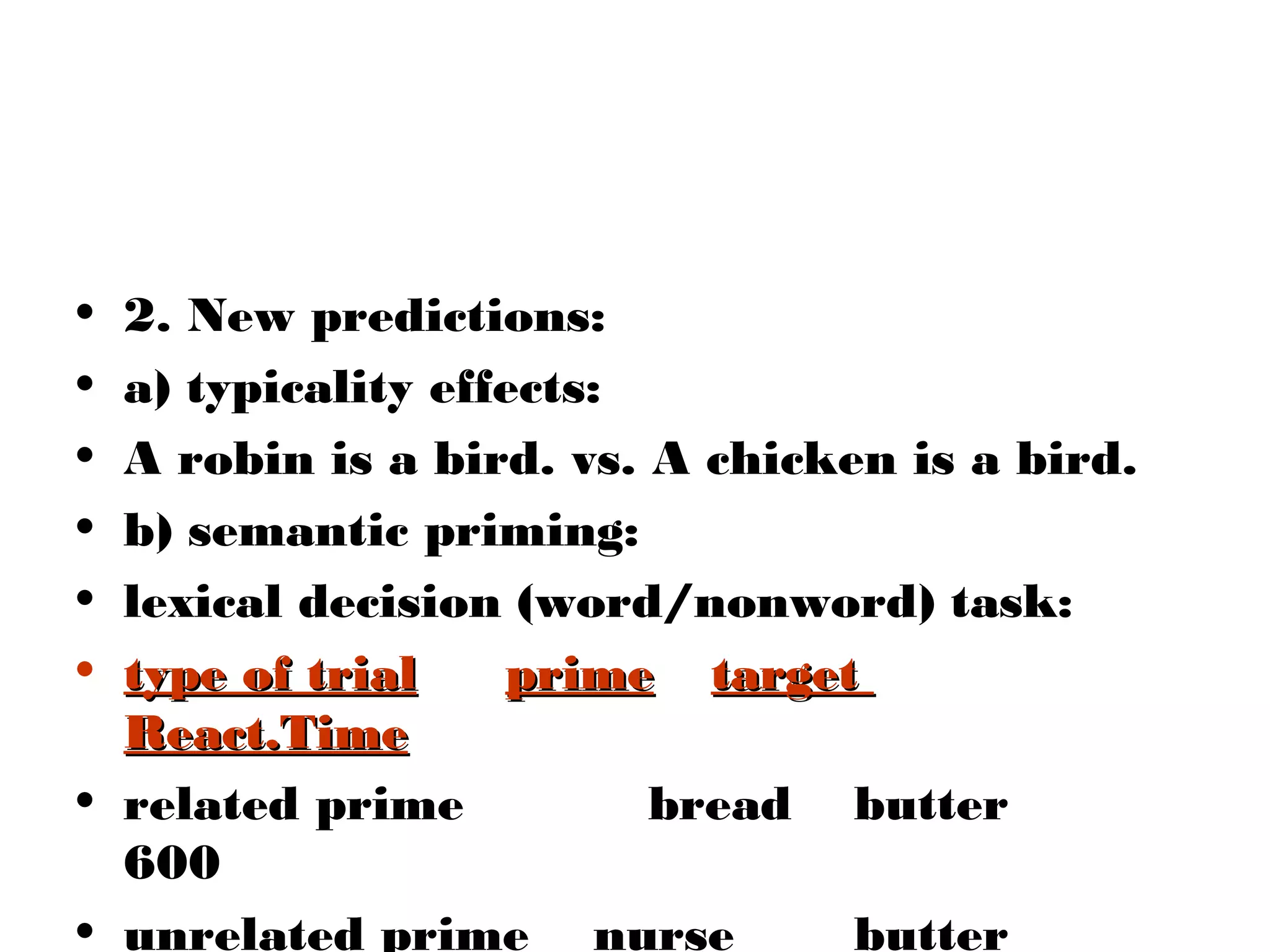
• 2. New predictions:
• a) typicality effects:
• A robin is a bird. vs. A chicken is a bird.
• b) semantic priming:
• lexical decision (word/nonword) task:
• type of trial    prime target
  React.Time
• related prime          bread butter
  600
• unrelated prime nurse          butter
Propositional networks
• HAM – human associative memory
• ACT* - Adaptive control of thought
ACT-R model (Adaptive Character of
 Thought, Revised) by John Anderson (1996, 2000)

• Anderson's model developed from the
  human associative learning (HAM) model
  proposed by Anderson and Bower (1973).
• ACT-R proposes three interactive memory
  systems that support adaptive thinking,
  including declarative knowledge,
  procedural knowledge, and working
  memory.
• The declarative knowledge component
  consists of schemata and chunks within
  schemata that encode specific declarative
  knowledge units. The procedural
  knowledge component consists of
  production rules that break down complex
  action sequences into a number of “if-then”
  steps, which enable the learner to perform
  complex actions using a series of simple
  steps.
• Declarative and procedural components are
  connected to each other, as well as a
  working memory system in which activated
  declarative and procedural units are used to
  solve problems, make decisions, and adapt
  to environmental conditions.
• ACT-R differs from earlier network models
  in that it proposes production rules, which
  are combined into production systems,
  which enable the brain to represent complex
  actions. A production rule specifies the
  action to be taken to achieve a specific goal
  and the conditions under which each action
  is taken.
For example, imagine that a person has a ring of
  five keys and needs to open an office door.
 This scenario can be represented as a simple
  production as follows:
 IF a person must open a door,
THEN he or she must insert key one and open the
  door;
IF key one fails to open the door
THEN the person must insert key two, and so on.
Production rule
• This production rule could be subdivided further
  into finer grained production rules that specify
  how to use each key until the correct key is
  identified, or none of the keys open the door.
• In addition, conditions could be added to each
  sub-step in the production sequence to assist the
  learner.
• For instance, one might add a condition
  statement, instructing the person not to attempt
  to use long, narrow keys with square heads
  because these keys often open car doors rather
  than office doors.
• Anderson states that complex cognitive activity
  can be understood and explained in terms of small
  productions, based on simple units of declarative
  and procedural knowledge. This suggests that
  learning is a systematic process of acquiring
  declarative and procedural knowledge through
  experience and using this knowledge under
  specific conditions to execute complex actions,
  which themselves are comprised of many small
  productions
CONNECTIONIST MODELS
• Connectionist models of knowledge
  representation and learning became popular in
  the 1980s and sometimes are referred to as
  neural networks or parallel distributed
  processing (PDP) models
• de-emphasize the intentional role of the
  learner, while emphasizing the role of
  experience in building neural pathways and
  connections
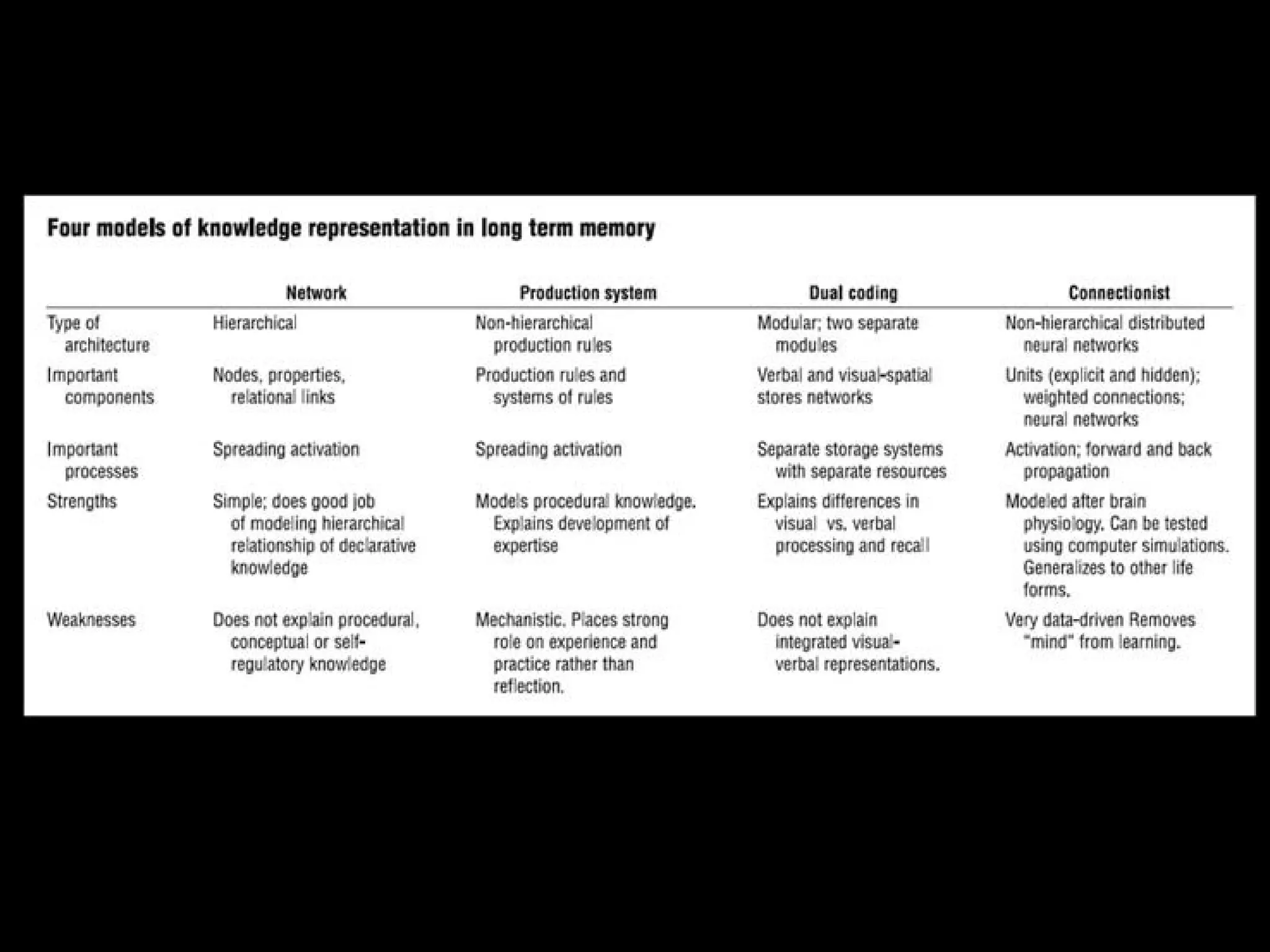
Connectionist models differ from network
 and production models in two ways.
The first difference is that previous cognitive
 models used a computer metaphor to describe
 human information processing. In this view,
 information passes through an initial sensory
 system, is acted upon in working memory,
 and represented in permanent store in long-
 term memory.
Connectionist models replaced the computer
 metaphor with a neural pathway metaphor
 modeled on the human brain. In this view,
 information is represented as patterns of
 activation across a variety of units, which
 correspond to neurons in the human brain.
• A second difference is that network and
  production models focus on the representation of
  discrete units of information within a node in
  memory (e.g., a fact or a simple production rule),
  whereas connectionist models view knowledge
  representation as continuous across a number of
  interconnected units in memory. Thus,
  information such as facts, concepts, and
  production rules are not represented within single
  nodes, but distributed across nodes.
• Connectionist models propose a rather simple
  architecture based on units, which maintain
  elementary information, typically simpler than
  corresponding nodes in network and production
  models. Multiple units are connected to create
  information that one might label as facts or
  concepts. The connectivity pattern among these
  units is of utmost importance. Any given unit may
  be connected to many other units, using a number
  of different connectivity patterns. Thus, one unit
  may be part of different knowledge
  representations much like a single light in a theatre
  marquee may be used to spell different words
• Connectionist theories have proposed different
  types of units. The most important of these are
  input units, output units, and hidden units, which
  are mediating connections between inputs and
  outputs.
• Each unit has an activation value assigned to it
  under different processing conditions. Activation
  spreads throughout the system, but depends in part
  on the connectivity pattern among units, as well as
  connection weights, which determine whether one
  unit contributes more activation than another unit.
Mental Imagery
• Imagery and Cognitive Psychology – Neuro
  cognitive Evidence – Cognitive Maps
  Storing – Retrieving –Retrieval from
  working and Permanent memory – Theories
  of retrieval – Forgetting

Representation of knowledge

  • 1.
  • 2.
    • The Representationof Knowledge: Semantic organization –Associationistic approach • Semantic memory model – Set theoretical model – Semantic feature – Feature Comparison model – Network model – Propositional model networks. Representation of Knowledge – Neurocognitivie consideration – Connectionism and the Representation of Knowledge.
  • 3.
    Introduction • Science isorganized knowledge • Knowledge is “the storage, integration and organization of information in memory.” • some estimates place the no. of words a person know the meaning of at 20,000 to 40000. • Words derive their vitality not from some intrinsic worth, but from the concepts and relationships that they reflect.
  • 4.
    How is knowledgestored in memory ? • For e.g. a bus schedule can be represented in the form of a map or a timetable. • On the one hand, a timetable provides quick and easy access to the arrival time for each bus, but does little for finding where a particular stop is situated. • On the other hand, a map provides a detailed picture of each bus stop's location, but cannot efficiently communicate bus schedules. • Both forms of representation are useful, but it is important to select the representation most appropriate for the task at hand.
  • 5.
    Components of Representationof Knowledge Cognitive scientists are concerned with • Content of knowledge representation • Structure of knowledge representation • Process of retrieval Two perspectives • Associationism – the doctrine that there are functional relationships between psychological phenomenon. • Connectionism – a theory of the mind that posits a large set of simple units connected in a parallel distributed network, (PDP).
  • 6.
    Semantic organization ofknowledge • Normally conceptualized (as in clustering model) as a grouping or clustering of elements that are alike in meaning – For e.g. Rajendra prasad, V.V.giri, Zail singh, R.Venkatraman, Abdul kalam, pratibha patel. • The above group can be further classified as : Rajendra prasad, Zail singh, Pratibha patel (North Indians); V.V.giri, R.Venkatraman, Abdul kalam (South Indians) • Further semantic models deal with relationship of concepts to one another – For e.g. Kalam was a rocket scientist, Kalam is a tamilian, Kalam has a bizarre hairstyle, kalam is a muslim etc.
  • 7.
    Associationist approach • Viewof human intellectual function as a network of associations connected to other associations and to other associations and so on. • Gordon bower believed organization of semantic entities in memory has much more powerful influence on memory and recall. • Experiment – constructed several conceptual hierarchies and demonstrated the potent influence on recall of organizational variables.
  • 8.
    • Bower etat (1969) also demonstrated the power of organisation. • Subjects had 112 words to learn, presented in 4 trials, 28 words a trial. • Half the subjects were presented with the words organised into conceptual hierarchies (see Figure 1), the other half were simply shown lists of words. • They found that subjects presented with the organised lists remembered around 47% more words than subjects presented a list of words without organisation
  • 9.
  • 11.
    Semantic memory :cognitivemodels • A semantic network is a method of representing knowledge as a system of connections between concepts in memory • knowledge is organized based on meaning, such that semantically related concepts are interconnected. 1. Set-theoretical model 2. Feature Comparison Model 3. Network models 1. Collins & quillian 2. Spreading activation theory – Collins and loftus 4. Propositional networks 1. HAM 2. ACT*
  • 12.
    Set-theoretical model • Semanticconcepts are represented by sets of elements, or collections of information. • A word that encompasses a concept may be represented not only by exemplars of the concept but also by its attributes. • For e.g. the concept of birds may include the names of types of birds – crow, robin, canary, sparrow, parrot and so on – as well as the attributes of the concept – sings, flies, has feathers.
  • 13.
    Set-theoretical model • Memoryconsists of numerous sets of attributes and retrieval involves verification – a search through two or more sets of information to find overlapping exemplars. • Verification of propositions (e.g. robin is a bird) is done by comparing the attributes of one set (robin) with the attributes of another (bird) • The degree of overlap of attributes forms the basis for a decision about the validity of the proposition. • More the distance between the sets, greater the reaction time in making a decision.
  • 14.
    Attributes of twosets with high degrees of overlap Robin Bird • Physical object • Physical object • Living • Living • Animate • Animate • Feathered • Feathered • Red-breasted
  • 15.
    Universal affirmative (UA)and particular affirmative (PA) • UA  all members of one catehory are subsumed in another category which is represented as “All S are P” ( e.g. all canaries are birds) • PA  only a portion of the members of one category make up the member of another category.; represented as “some S are P” (e.g. some animals are birds)
  • 16.
    Feature Comparison Model Smith, Shoben and Rips (1974) • Assumes that “the meaning of a word is NOT an unanalyzable unit but rather can be represented as a set of semantic features”. • A broad set of features related to any word varies along a continuum from very important to trivial. • A robin – flies, has wings, is a biped, has a red breast, perches in trees, likes worms, is a harbinger of spring.
  • 17.
    Two Types ofFeatures: 1. characteristic features: – features that are descriptive, common, and frequent, but not essential to the meaning of the item – ROBIN: flies, perches in trees – the robin does not have to fly or perch to be considered a robin 2. defining features: – features absolutely essential to the meaning of the item – ROBIN: animate, has wings, has red breast
  • 18.
    True or False? • A robin is a bird. • A sparrow is a bird. True statements • A parrot is a bird. • A chicken is a bird. • A duck is a bird. Technical speaking • A goose is a bird. • A bat is a bird. • A butterfly is a bird. False statements • A moth is a bird.
  • 19.
    Two Stages ofProcessing • 1.Process all features of subject with predicate; comparison of characteristic features. • if low similarity between features --> respond 'false' • if high similarity between features --> respond 'true' • if intermediate similarity, Stage 2 processing • 2. Create comparison question; comparison of defining features. • A bat is a bird --> a bat is a mammal; is a bird a mammal? A chicken is a bird. --> does not fly, does chicken have feathers? • takes more time to respond
  • 20.
    Research FOR Feature Comparison Model • typicality effect: • A carrot is a vegetable. • A rutabaga is a vegetable. • we make faster sentence verification decisions when an item is a typical member of a category, rather than an unusual member • WHY? high similarity between features allows for Stage 1 processing only for 'A carrot is a vegetable'; Stage 1 and Stage 2 processing is necessary for 'A rutabaga is a vegetable'
  • 21.
    Research AGAINST Feature Comparison Model: • category size effect: • A poodle is a dog. • A squirrel is an animal. • we make faster sentence verification decisions when an item is a member of a small category • small categories contain more defining features; therefore, FC model would predict that there should be more Stage 2 processing for small categories and thus longer RTs
  • 22.
    Semantic Network Models 1. Teachable language comprehender (TLC) 2. Spreading activation-Collins & Loftus (1975) 3. ACT*, ACT-R • Characteristics: – concepts represented as nodes in network – nodes are linked together by pathways – proposition = node 1 --- pathway --- node 2 – spreading activation – frequently used links have greater strengths – intersection search – priming
  • 23.
    Collins & Quillian(1969) Teachable language comprehender • developed a model of memory based on semantic organisation. • Their model was an example of a network model of semantic memory. • A network is a structure consisting of a set of nodes with links or paths interconnecting them. • For example, the knowledge that an ostrich is an animal or that a fish can swim is represented in a network like that shown in Figure 2.
  • 24.
    Collins and quillian(1969) – three level hierarchy memory structure
  • 25.
    Spreading Activation theory Collins & Loftus, 1975 1. New assumptions: a) Not hierarchical: length of links represent degree of relatedness. Search time depends on link length b) Spreading Activation: retrieval (activation) of one of the links leads to partial activation of connected nodes. Degree of activation decreases with the
  • 27.
    • 2. Newpredictions: • a) typicality effects: • A robin is a bird. vs. A chicken is a bird. • b) semantic priming: • lexical decision (word/nonword) task: • type of trial prime target React.Time • related prime bread butter 600 • unrelated prime nurse butter
  • 28.
    Propositional networks • HAM– human associative memory • ACT* - Adaptive control of thought
  • 29.
    ACT-R model (AdaptiveCharacter of Thought, Revised) by John Anderson (1996, 2000) • Anderson's model developed from the human associative learning (HAM) model proposed by Anderson and Bower (1973). • ACT-R proposes three interactive memory systems that support adaptive thinking, including declarative knowledge, procedural knowledge, and working memory.
  • 30.
    • The declarativeknowledge component consists of schemata and chunks within schemata that encode specific declarative knowledge units. The procedural knowledge component consists of production rules that break down complex action sequences into a number of “if-then” steps, which enable the learner to perform complex actions using a series of simple steps.
  • 31.
    • Declarative andprocedural components are connected to each other, as well as a working memory system in which activated declarative and procedural units are used to solve problems, make decisions, and adapt to environmental conditions.
  • 32.
    • ACT-R differsfrom earlier network models in that it proposes production rules, which are combined into production systems, which enable the brain to represent complex actions. A production rule specifies the action to be taken to achieve a specific goal and the conditions under which each action is taken.
  • 33.
    For example, imaginethat a person has a ring of five keys and needs to open an office door. This scenario can be represented as a simple production as follows: IF a person must open a door, THEN he or she must insert key one and open the door; IF key one fails to open the door THEN the person must insert key two, and so on.
  • 34.
    Production rule • Thisproduction rule could be subdivided further into finer grained production rules that specify how to use each key until the correct key is identified, or none of the keys open the door. • In addition, conditions could be added to each sub-step in the production sequence to assist the learner. • For instance, one might add a condition statement, instructing the person not to attempt to use long, narrow keys with square heads because these keys often open car doors rather than office doors.
  • 35.
    • Anderson statesthat complex cognitive activity can be understood and explained in terms of small productions, based on simple units of declarative and procedural knowledge. This suggests that learning is a systematic process of acquiring declarative and procedural knowledge through experience and using this knowledge under specific conditions to execute complex actions, which themselves are comprised of many small productions
  • 38.
    CONNECTIONIST MODELS • Connectionistmodels of knowledge representation and learning became popular in the 1980s and sometimes are referred to as neural networks or parallel distributed processing (PDP) models • de-emphasize the intentional role of the learner, while emphasizing the role of experience in building neural pathways and connections

  • 39.
    Connectionist models differfrom network and production models in two ways. The first difference is that previous cognitive models used a computer metaphor to describe human information processing. In this view, information passes through an initial sensory system, is acted upon in working memory, and represented in permanent store in long- term memory.
  • 40.
    Connectionist models replacedthe computer metaphor with a neural pathway metaphor modeled on the human brain. In this view, information is represented as patterns of activation across a variety of units, which correspond to neurons in the human brain.
  • 41.
    • A seconddifference is that network and production models focus on the representation of discrete units of information within a node in memory (e.g., a fact or a simple production rule), whereas connectionist models view knowledge representation as continuous across a number of interconnected units in memory. Thus, information such as facts, concepts, and production rules are not represented within single nodes, but distributed across nodes.
  • 42.
    • Connectionist modelspropose a rather simple architecture based on units, which maintain elementary information, typically simpler than corresponding nodes in network and production models. Multiple units are connected to create information that one might label as facts or concepts. The connectivity pattern among these units is of utmost importance. Any given unit may be connected to many other units, using a number of different connectivity patterns. Thus, one unit may be part of different knowledge representations much like a single light in a theatre marquee may be used to spell different words
  • 43.
    • Connectionist theorieshave proposed different types of units. The most important of these are input units, output units, and hidden units, which are mediating connections between inputs and outputs. • Each unit has an activation value assigned to it under different processing conditions. Activation spreads throughout the system, but depends in part on the connectivity pattern among units, as well as connection weights, which determine whether one unit contributes more activation than another unit.
  • 44.
    Mental Imagery • Imageryand Cognitive Psychology – Neuro cognitive Evidence – Cognitive Maps Storing – Retrieving –Retrieval from working and Permanent memory – Theories of retrieval – Forgetting