Adult lexical processing
Overview for this sub-topic
1) Psycholinguistics and psycholinguistic terminology
2) Approaches to lexical semantic representation
• Semantic Networks
• Prototype approach
• Exemplar approach
• Theory-based approaches
• s
1) Approaches to lexical access
• How do we rapidly access words online (i.e. whilst listening to them)
• Which cues are utilised in lexical access?
3
Psycholinguistic terminology
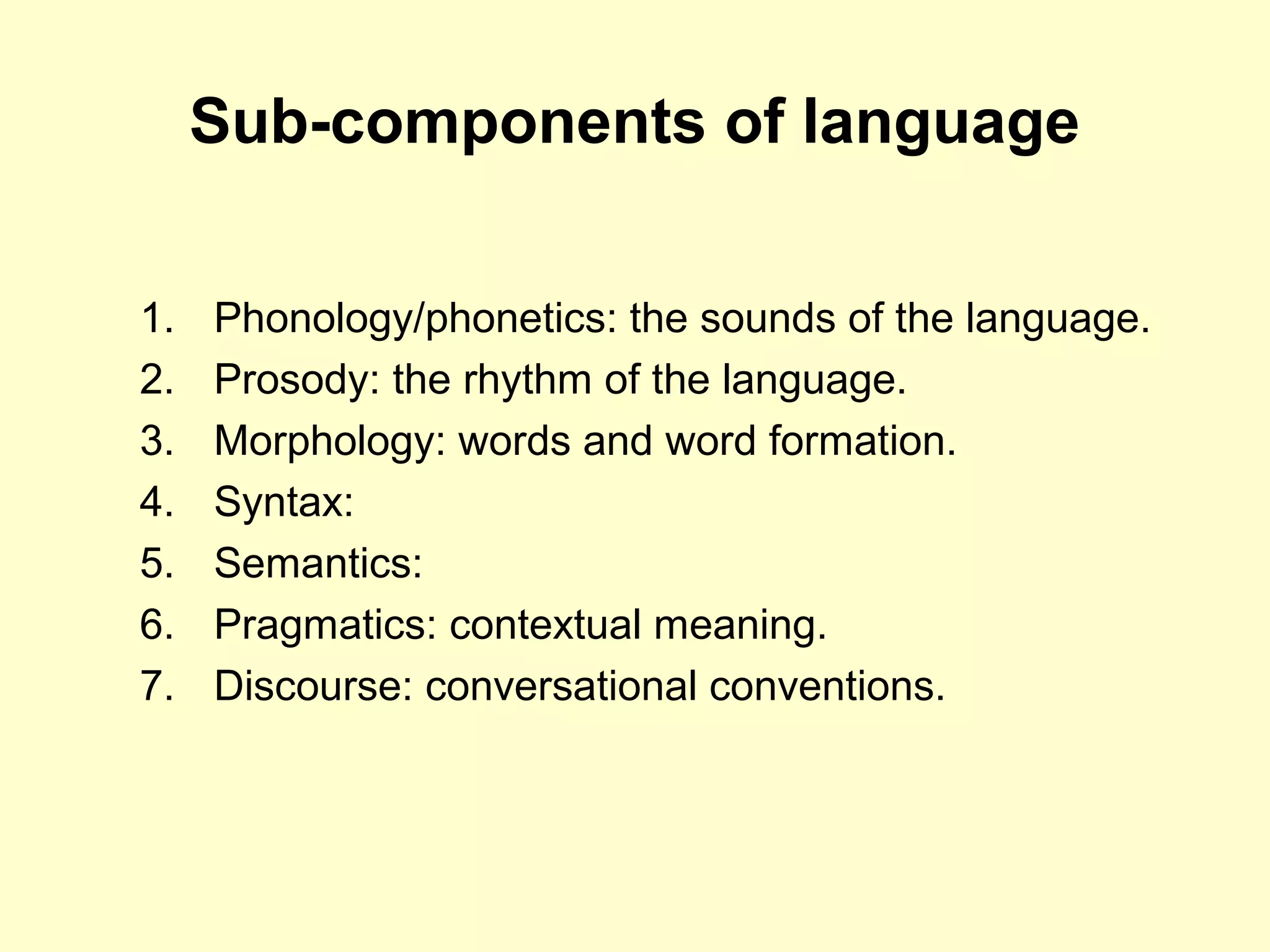
Sub-components of language
1. Phonology/phonetics: the sounds of the language.
2. Prosody: the rhythm of the language.
3. Morphology: words and word formation.
4. Syntax:
5. Semantics:
6. Pragmatics: contextual meaning.
7. Discourse: conversational conventions.
Syntax
• The form of the language.
• Syntax of the language can be broken up into
categories, phrases, and clauses.
• Categories correspond to words that have different
functions in the language.
e.g., Verb, Noun, Preposition, Adjective, Determiner.
Semantics
• The system of meaning
• E.g., the preposition with, according to the OED, has
some 40 senses. Consider some of the main ones:
1. I ate the pasta with the fork (INSTRUMENT)
2. I ate the pasta with Rufus (ACCOMPANIMENT)
3. I ate the pasta with meatballs (MODIFIER)
4. I ate the pasta with gusto (MANNNER)
5. I was delighted with the pasta (CAUSE)
Pragmatics
• Contextual meaning
• Meaning of utterance may differ in different contexts
(e.g. pointing at a bicycle outside the library whilst with
your friend can mean.......)  the speaker’s
understanding of the listener’s knowledge state /
informational needs
• Understanding of conversational convention (e.g. in
the southern UK ‘oh, it’s a bit cold in here!’ could mean
‘I’d like you to close the window’)
• Understanding of politeness conventions
What is psycholinguistics?
• The study of the acquisition, processing, and mental
representation of language.
1. To what extent is our ability to learn language innate?
2. What is the time course of information use during language
comprehension and production?
3. To what extent is different types of linguistic information
processed independently from other qualitatively different forms
of information?
4. Is processing the same in every instance – how do our goals as
language users affect our representation of events?
9
Approaches to lexical represention
The lexicon
• Our mental dictionary.
• We know about 85,000 words.
– verbs, nouns, adjectives, prepositions, functional words
– Make these on the basis of distributional regularities.
• But we must categorise concepts according to meaning.
– Semantic memory
Semantic memory
• How do we represent categories internally?
– Concept: a mental representation of a class of things or events
• Organisational principles
– Economical
• We naturally divide the world into classes of things (e.g.,
weed versus plant).
– Informative
• Divisions must be a informative (if you’re a gardener)
– Natural coherence
• Divisions must have a function.
Concepts
• How might we categorise concepts into categories?
• Propositional terms: define category membership by listing
necessary and jointly sufficient conditions.
– e.g., Bachelor (male, human, unmarried, adult)
• Analogical: define category membership by relational similarity.
– e.g., what do a butterfly and a bird have in common?
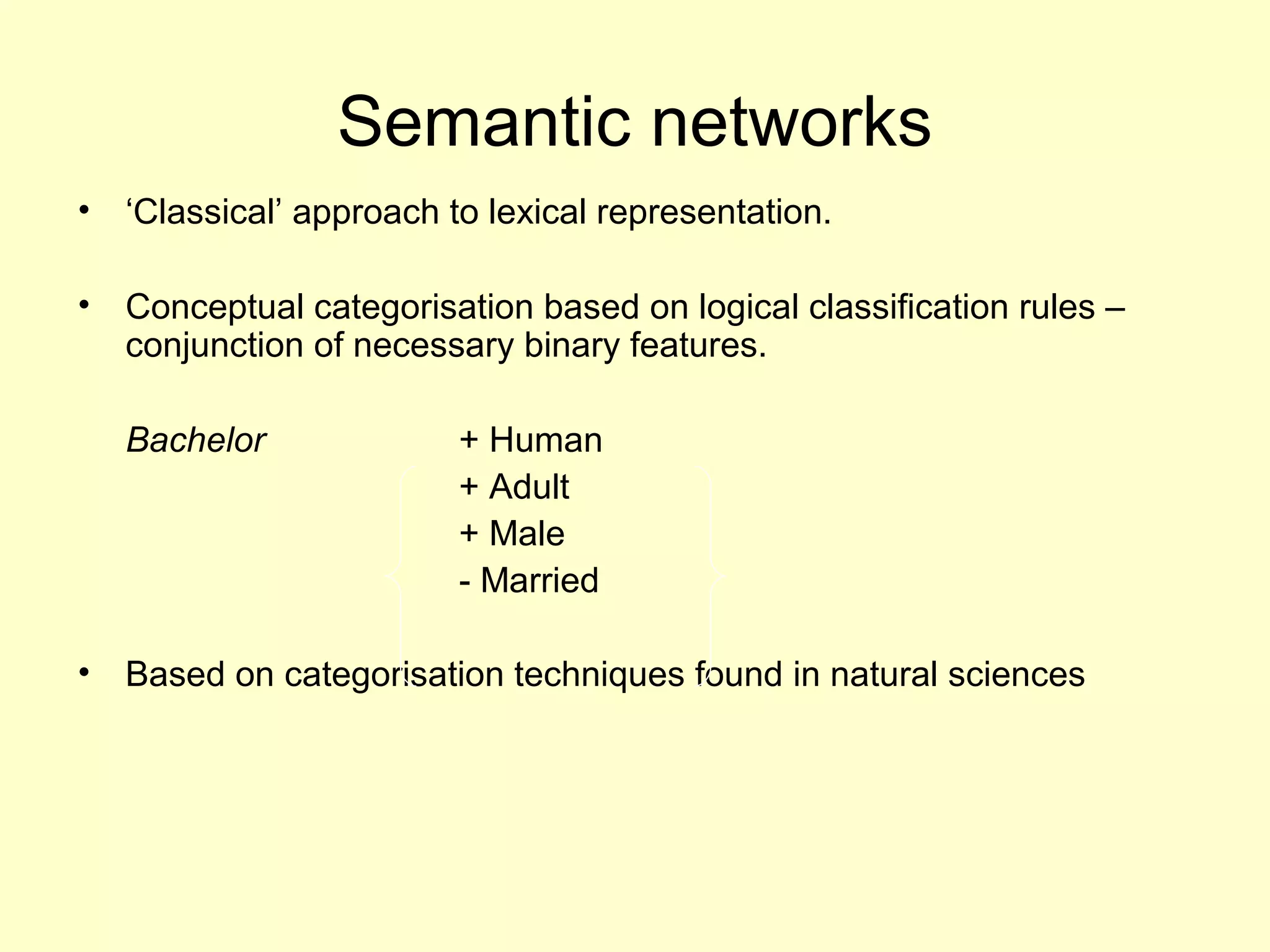
Semantic networks
• ‘Classical’ approach to lexical representation.
• Conceptual categorisation based on logical classification rules –
conjunction of necessary binary features.
Bachelor + Human
+ Adult
+ Male
- Married
• Based on categorisation techniques found in natural sciences
Semantic networks
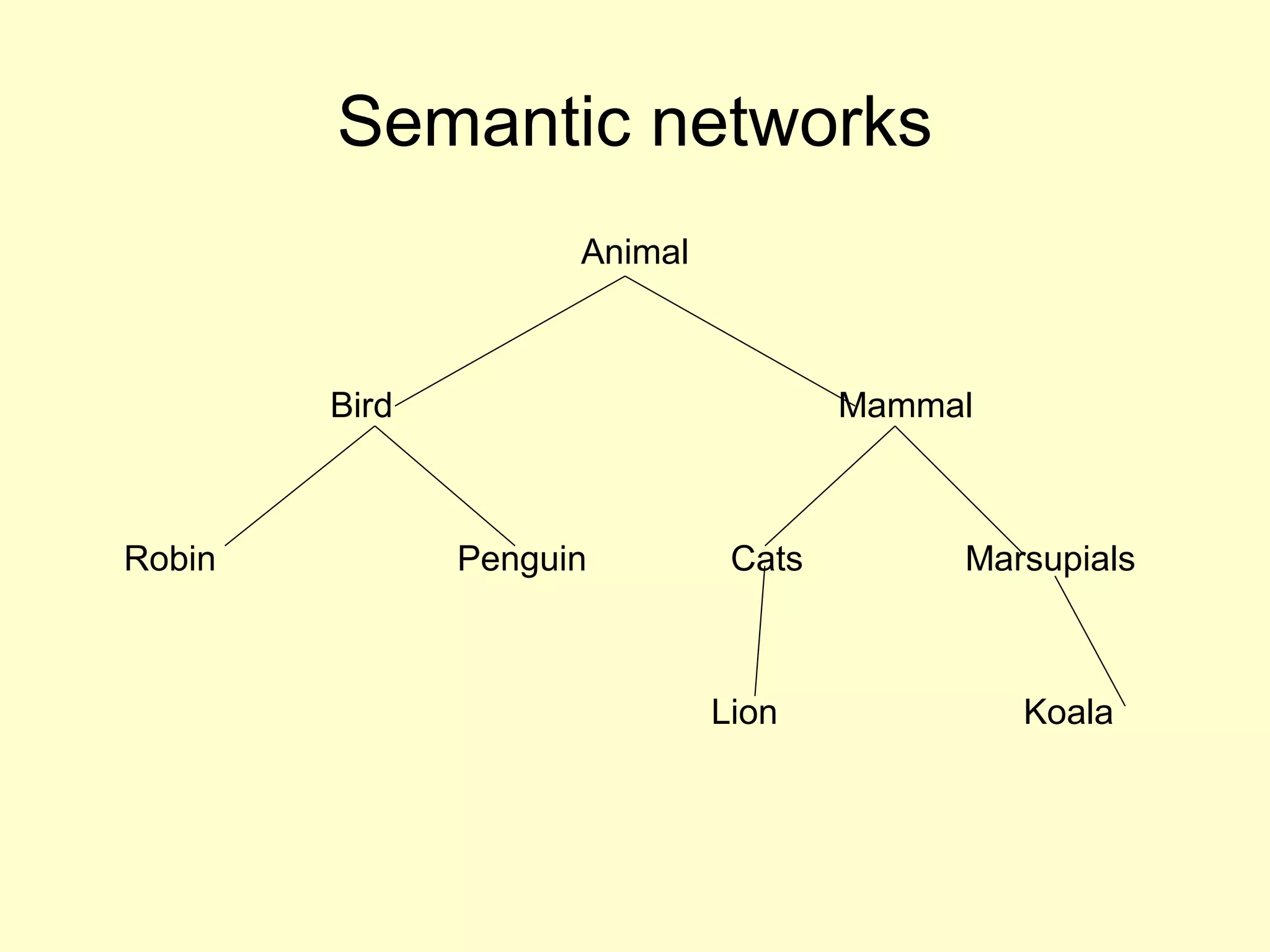
Animal
Bird Mammal
Robin Penguin Cats Marsupials
Lion Koala
Sentence verification task
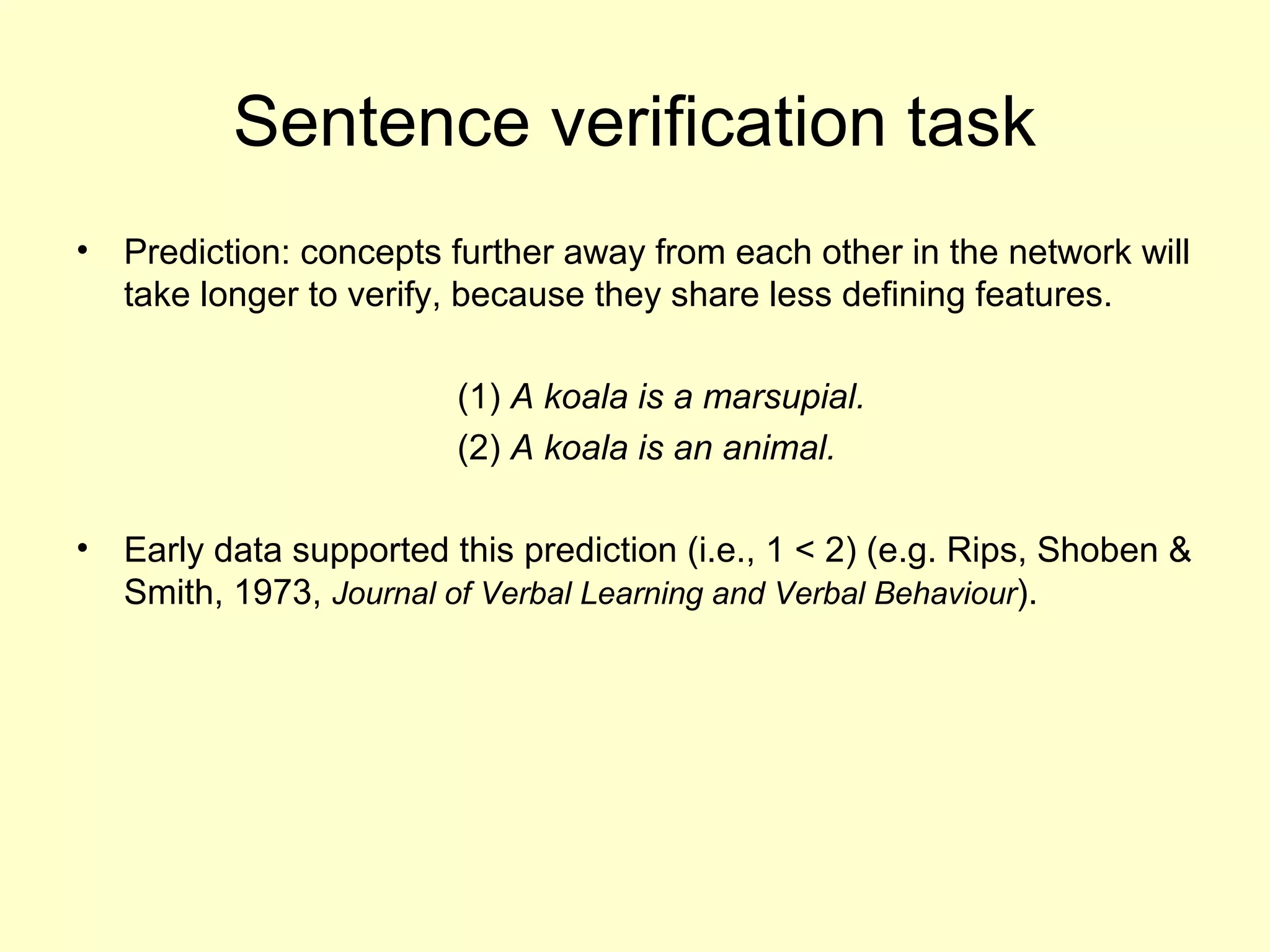
• Prediction: concepts further away from each other in the network will
take longer to verify, because they share less defining features.
(1) A koala is a marsupial.
(2) A koala is an animal.
• Early data supported this prediction (i.e., 1 < 2) (e.g. Rips, Shoben &
Smith, 1973, Journal of Verbal Learning and Verbal Behaviour).
Sentence verification task
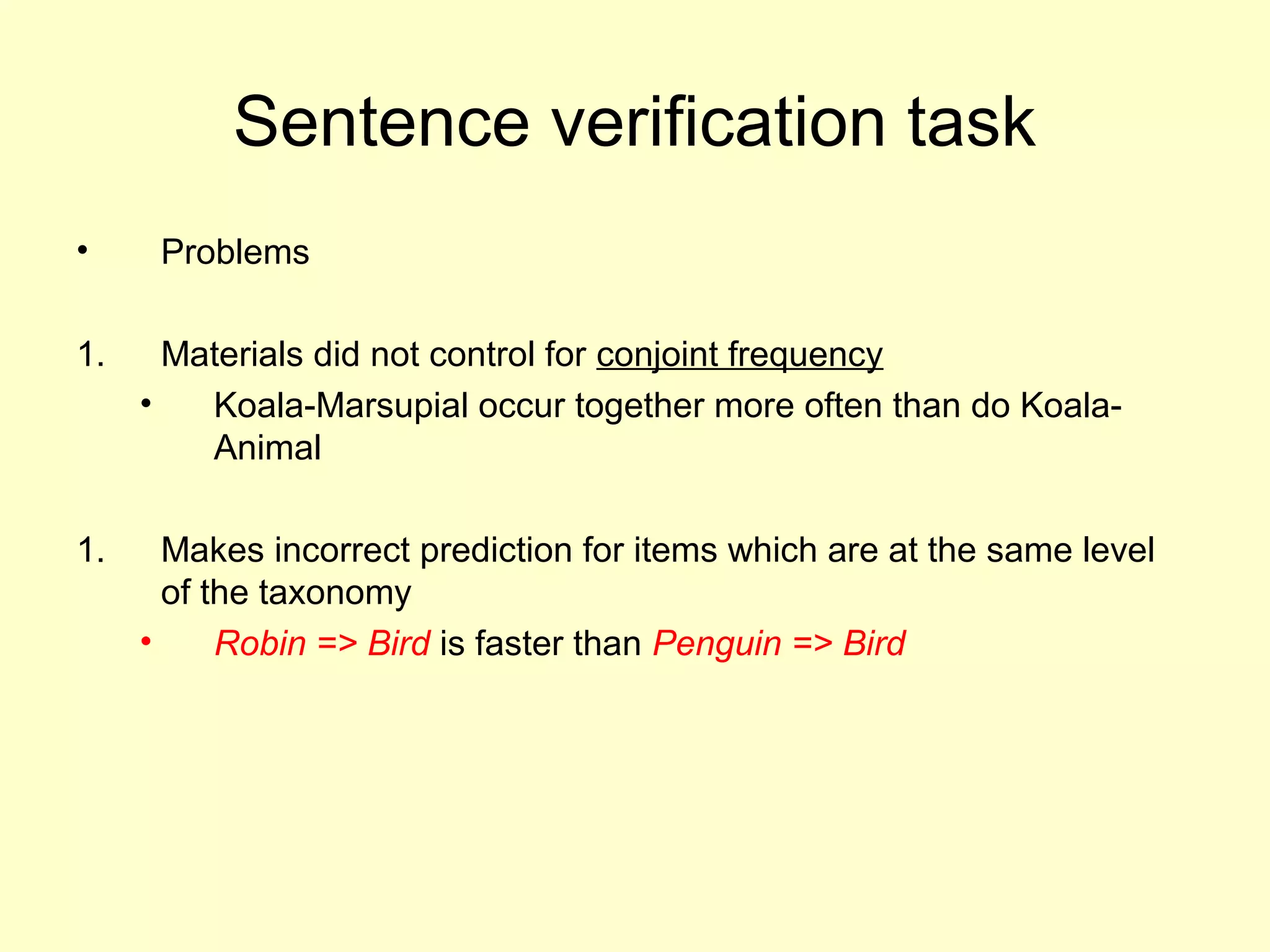
• Problems
1. Materials did not control for conjoint frequency
• Koala-Marsupial occur together more often than do Koala-
Animal
1. Makes incorrect prediction for items which are at the same level
of the taxonomy
• Robin => Bird is faster than Penguin => Bird
Semantic networks: Problems
• Some instances are better than others
– The pope is a bachelor?
• Not all concepts can be organised hierarchically (e.g., truth,
justice, law).
• Not all have defining features (e.g., ‘game’).
• No way to distinguish between defining and characteristic
features.
Prototype approach
• Concept represented by a collection of characteristic features – a
prototype (e.g. Rosch, 1975, Journal of Experimental Psychology).
• Features are not necessary – defining features of are cues to
category membership (they are probabilistic).
• Prototype is idealised – the product of abstraction over common
instances (=> may not exist).
• Category membership:
– Determined by similarity to the prototype
– Boundaries are not clear cut (‘fuzzy’)
• Some members better examples than others
• Graded category structure
Prototype approach: Empirical
evidence• Rosch & Mervis(1975, Cognitive Psychology): people more likely to
give prototype as an example of a category.
• People judge more prototypical members of a category faster than
less prototypical members.
• Category members can be equivalent but differ in prototypicality
(e.g., 7 is rated as a better example of an odd number than 45 or
679).
• Captures tendency to provide non-distinctive yet high frequency
features of concepts (e.g., bird => flies)
Problems with prototype approach
• Not all concepts have prototype characteristics
– Abstract concepts (e.g., hope, justice)
• Approach does not explain why categories cohere.
– Dyirbal: Australian aboriginal language from Nth Q’land.
– System of four Noun classifiers.
1. Bayi: males; animals
2. Balan: female; water; fire; fighting
3. Balam: nonflesh food.
4. Bala: everything not in the other classes
Balan: women, bandicoots, dogs, platypus, echidna, some snakes,
some fishes, most birds, fireflies, scorpians, crickets, the hairy mary
grub, anything connected with fire or water, sun and stars, sheilds,
some spears, some trees…
Problems with prototype approach
• So why does Balan contain animals?
– Animals belong in class 2 when, through myth or belief, are
connected to the defining features of this category.
– e.g., birds in class 2 because they are believed to be the spirits
of dead females (this is not without exception – willy wagtails are
thought to be mythical men, and so are class 1).
• Prototype approaches tells us that there are coherent categories,
not why they cohere.
• Circular logic:
– Category membership depends on similarity.
– Concepts are similar because they belong to the same category.
Exemplar approach
e.g. Medin & Schaffer, 1978, Psychological Review
• We first learn specific examples of a concept (e.g., your family dog)
• New stimuli are classified according to how closely they resemble
this exemplar.
• Features of exemplar approach
– Nonanalytical: individual examples are stored.
– No logical classification rules; no feature abstraction
– Cognitively inefficient
Exemplar approach: evidence
• Medin & Shoben (1988, Cognitive Psychology)
– Participants judged the typicality of spoons into two classes:
SPOON & LARGE SPOON.
– Typicality was mediated by a third variable – material
– Metal spoons => SPOON, Wooden spoons => LARGE SPOON
– Suggests judgments based on stored instances.
• Barsalou (1995, Journal of Experimental Psychology)
– Categorisation of tropical fish (4 similar, 1 atypical looking)
– Equal freq: judgments based on ‘similar’ prototype.
– Unequal freq: judgments based on ‘atypical’ prototype.
– Instability of categories  “graded structures do not reflect invariant
structures associated with categories but instead reflect people's
dynamic ability to construct concepts.”
Exemplar approach: problems
• Exemplar approach is a little sparse
1. Offers no account of how categories are formed, beyond
memorisation.
2. Exemplar models are vague about what an exemplar might
be.
– Do we store each new example separately?
– Alternatively, do we keep track of the frequency with which
each example occurs?
– Clearly some abstraction process must occur, but the
approach is too vague about this.
Theory-based approaches
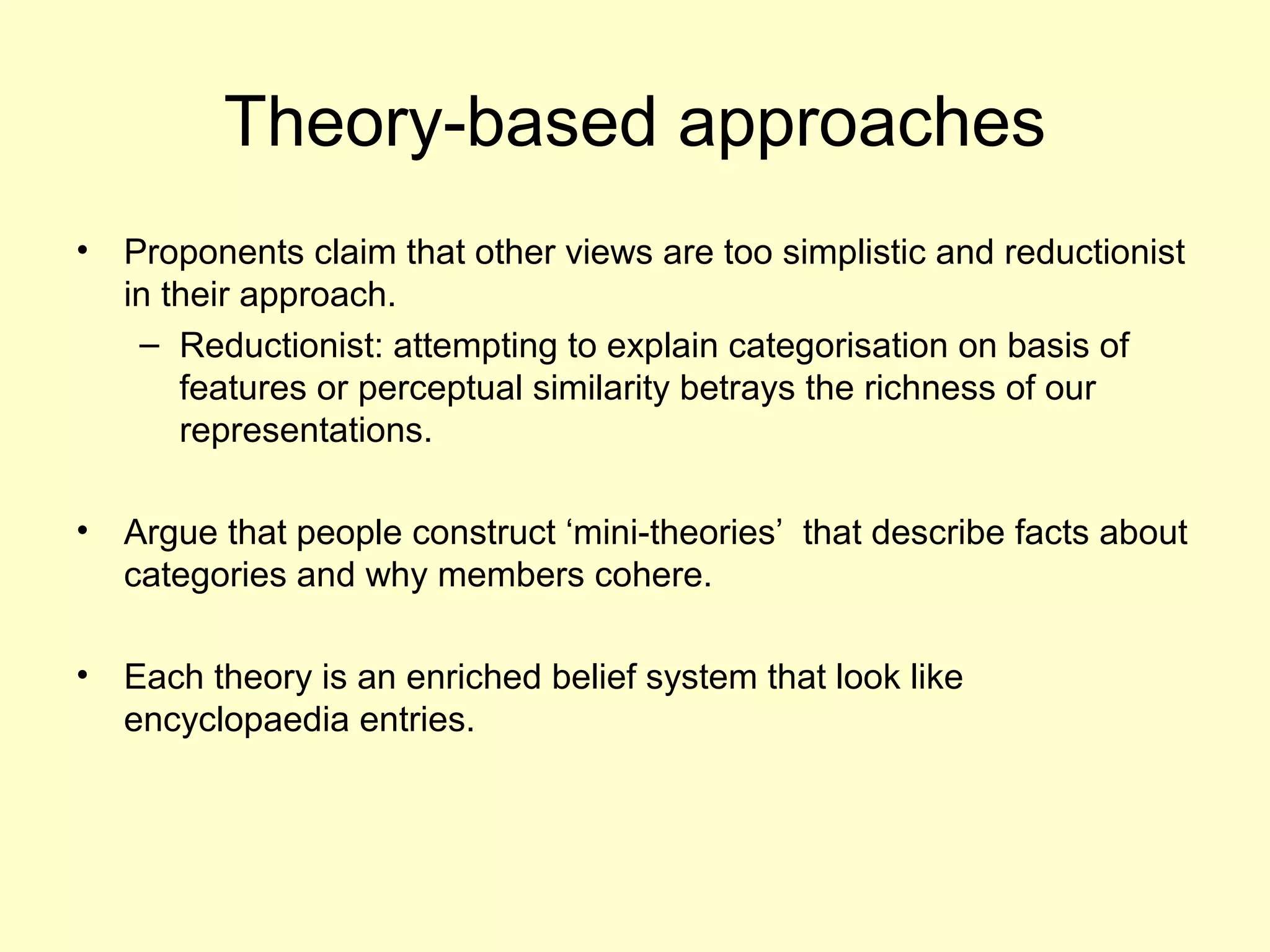
• Proponents claim that other views are too simplistic and reductionist
in their approach.
– Reductionist: attempting to explain categorisation on basis of
features or perceptual similarity betrays the richness of our
representations.
• Argue that people construct ‘mini-theories’ that describe facts about
categories and why members cohere.
• Each theory is an enriched belief system that look like
encyclopaedia entries.
Theory-based approaches
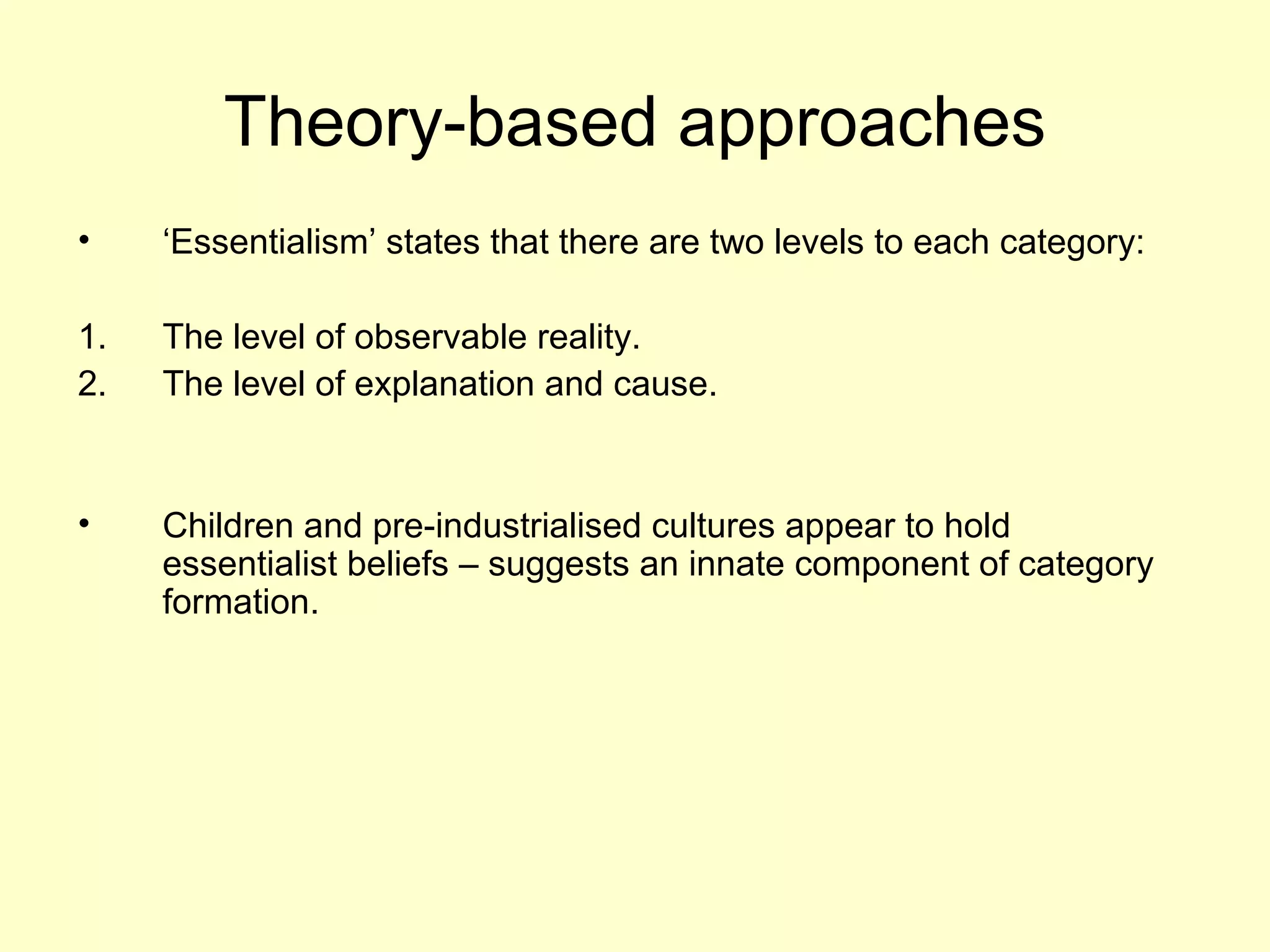
• ‘Essentialism’ states that there are two levels to each category:
1. The level of observable reality.
2. The level of explanation and cause.
• Children and pre-industrialised cultures appear to hold
essentialist beliefs – suggests an innate component of category
formation.
Theory-based approaches
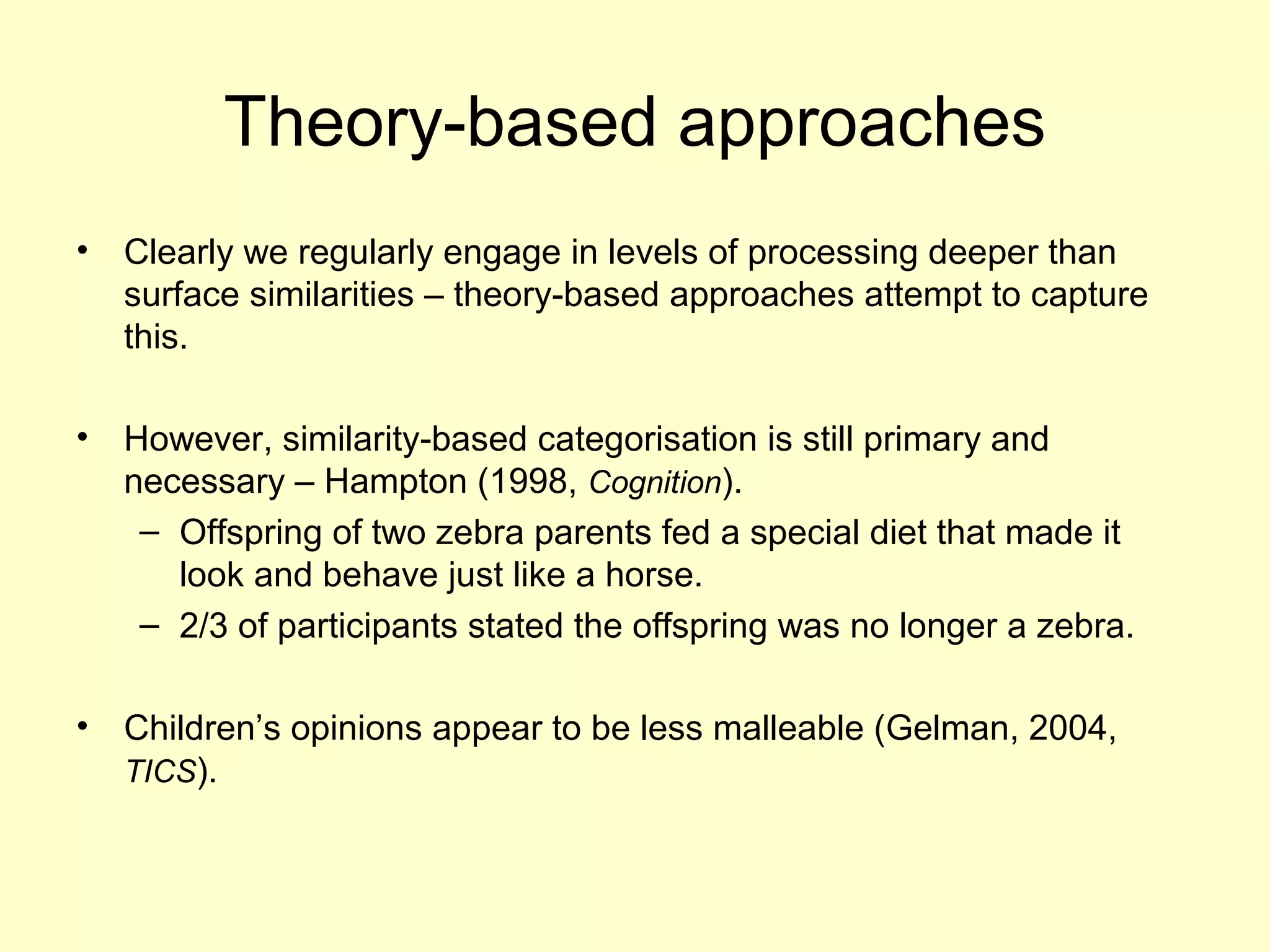
• Clearly we regularly engage in levels of processing deeper than
surface similarities – theory-based approaches attempt to capture
this.
• However, similarity-based categorisation is still primary and
necessary – Hampton (1998, Cognition).
– Offspring of two zebra parents fed a special diet that made it
look and behave just like a horse.
– 2/3 of participants stated the offspring was no longer a zebra.
• Children’s opinions appear to be less malleable (Gelman, 2004,
TICS).
Theory-based approaches
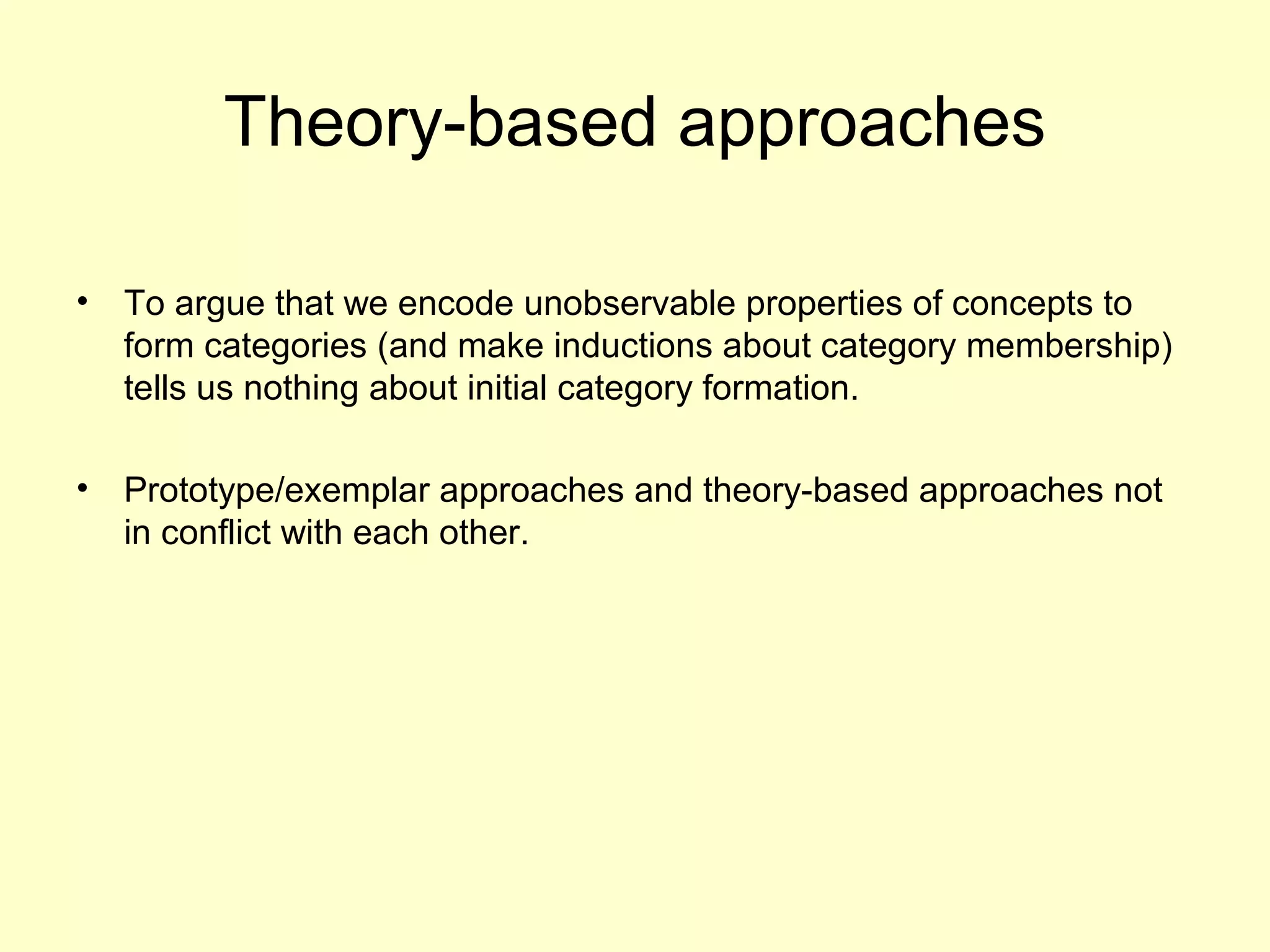
• To argue that we encode unobservable properties of concepts to
form categories (and make inductions about category membership)
tells us nothing about initial category formation.
• Prototype/exemplar approaches and theory-based approaches not
in conflict with each other.
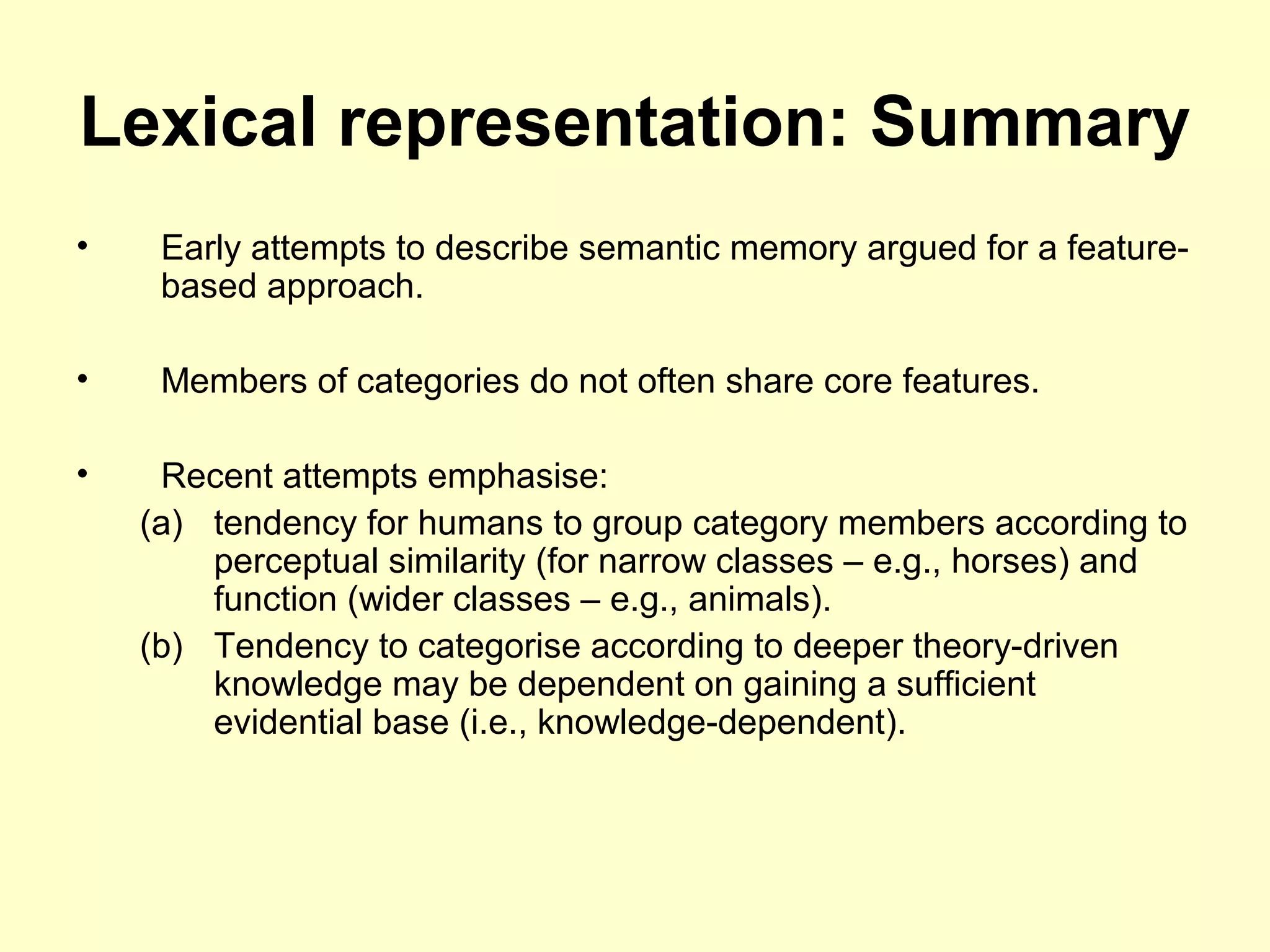
Lexical representation: Summary
• Early attempts to describe semantic memory argued for a feature-
based approach.
• Members of categories do not often share core features.
• Recent attempts emphasise:
(a) tendency for humans to group category members according to
perceptual similarity (for narrow classes – e.g., horses) and
function (wider classes – e.g., animals).
(b) Tendency to categorise according to deeper theory-driven
knowledge may be dependent on gaining a sufficient
evidential base (i.e., knowledge-dependent).
30
Approaches to lexical access
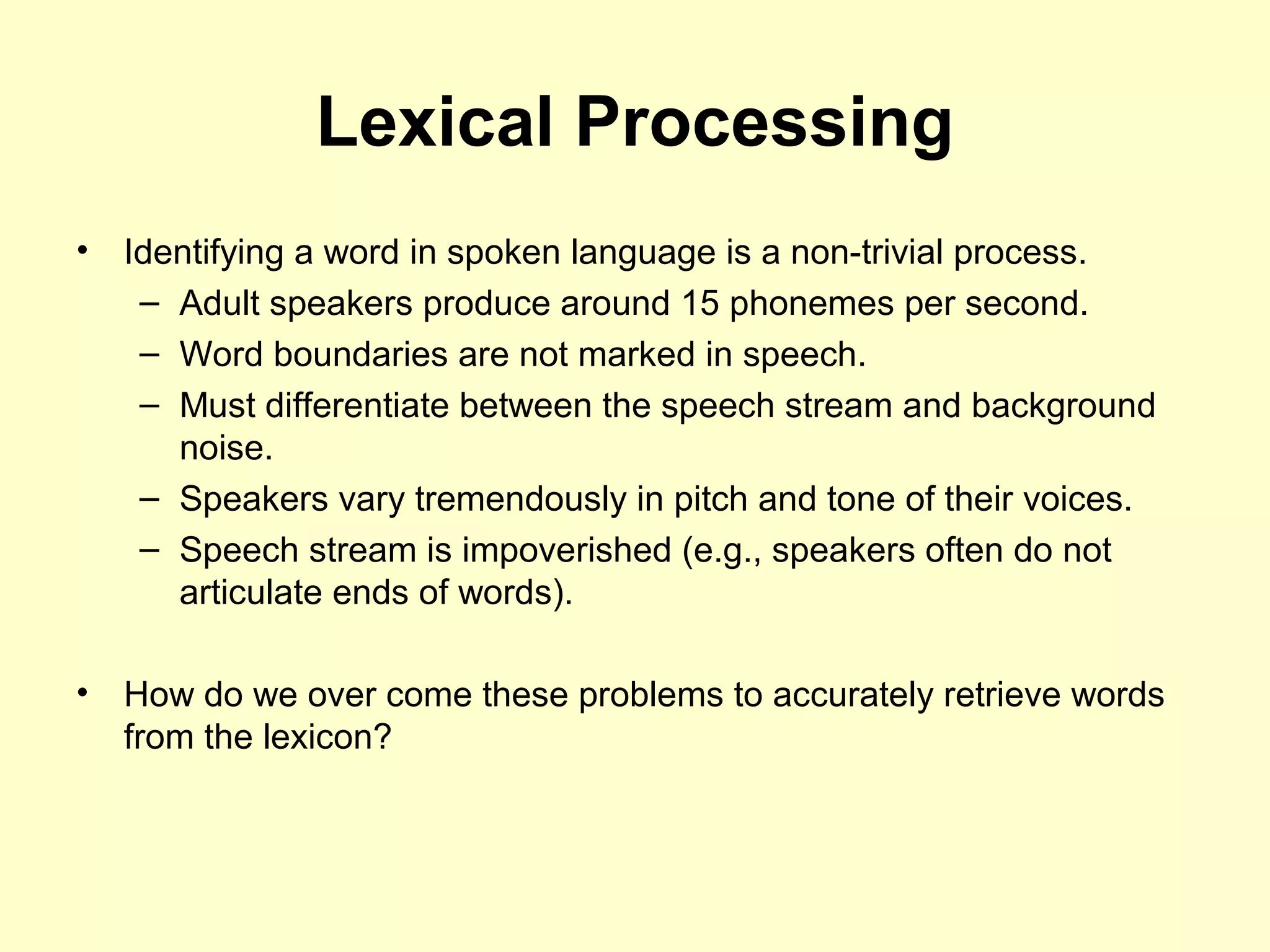
Lexical Processing
• Identifying a word in spoken language is a non-trivial process.
– Adult speakers produce around 15 phonemes per second.
– Word boundaries are not marked in speech.
– Must differentiate between the speech stream and background
noise.
– Speakers vary tremendously in pitch and tone of their voices.
– Speech stream is impoverished (e.g., speakers often do not
articulate ends of words).
• How do we over come these problems to accurately retrieve words
from the lexicon?
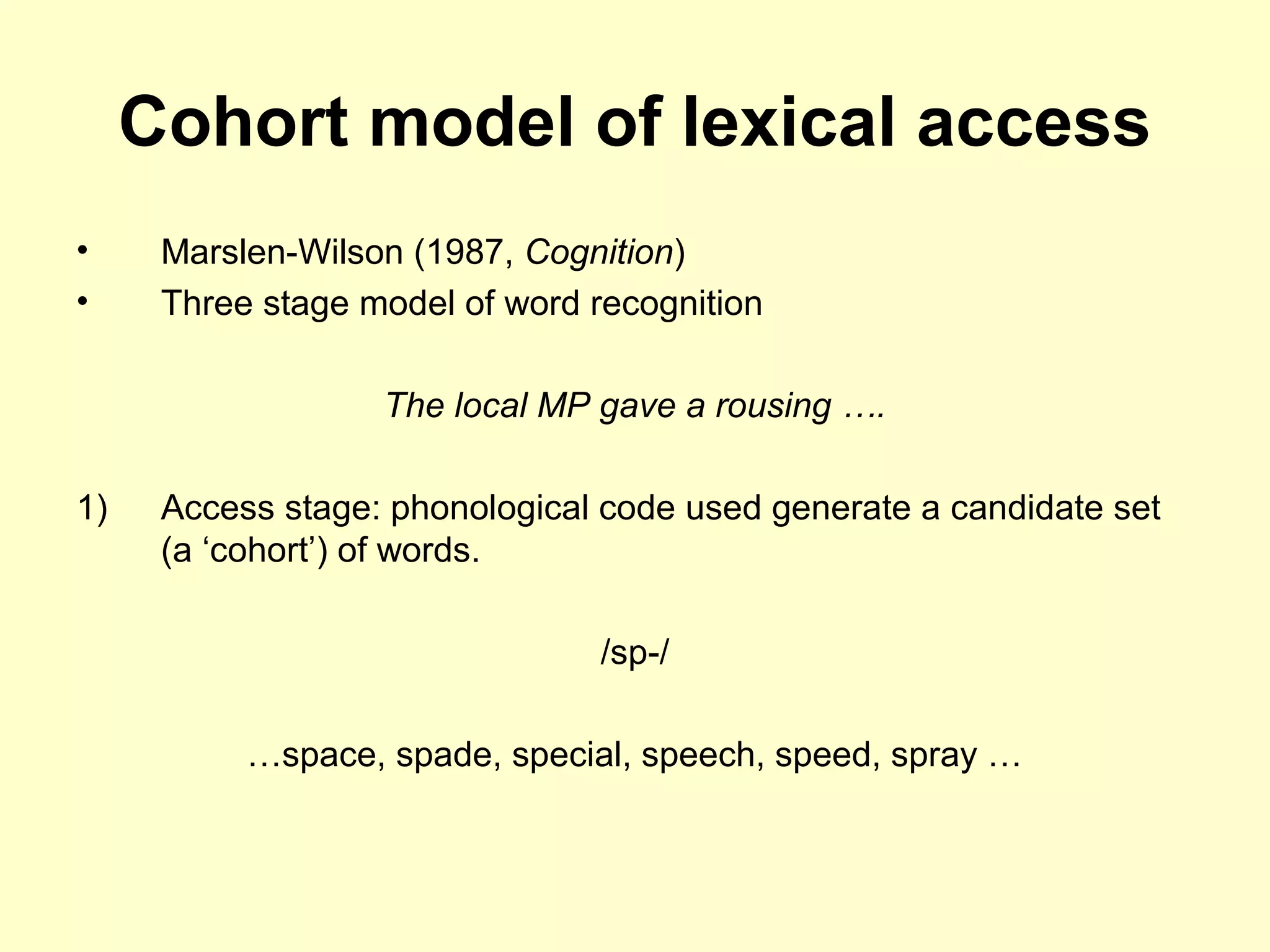
Cohort model of lexical access
• Marslen-Wilson (1987, Cognition)
• Three stage model of word recognition
The local MP gave a rousing ….
1) Access stage: phonological code used generate a candidate set
(a ‘cohort’) of words.
/sp-/
…space, spade, special, speech, speed, spray …
Cohort model of lexical access
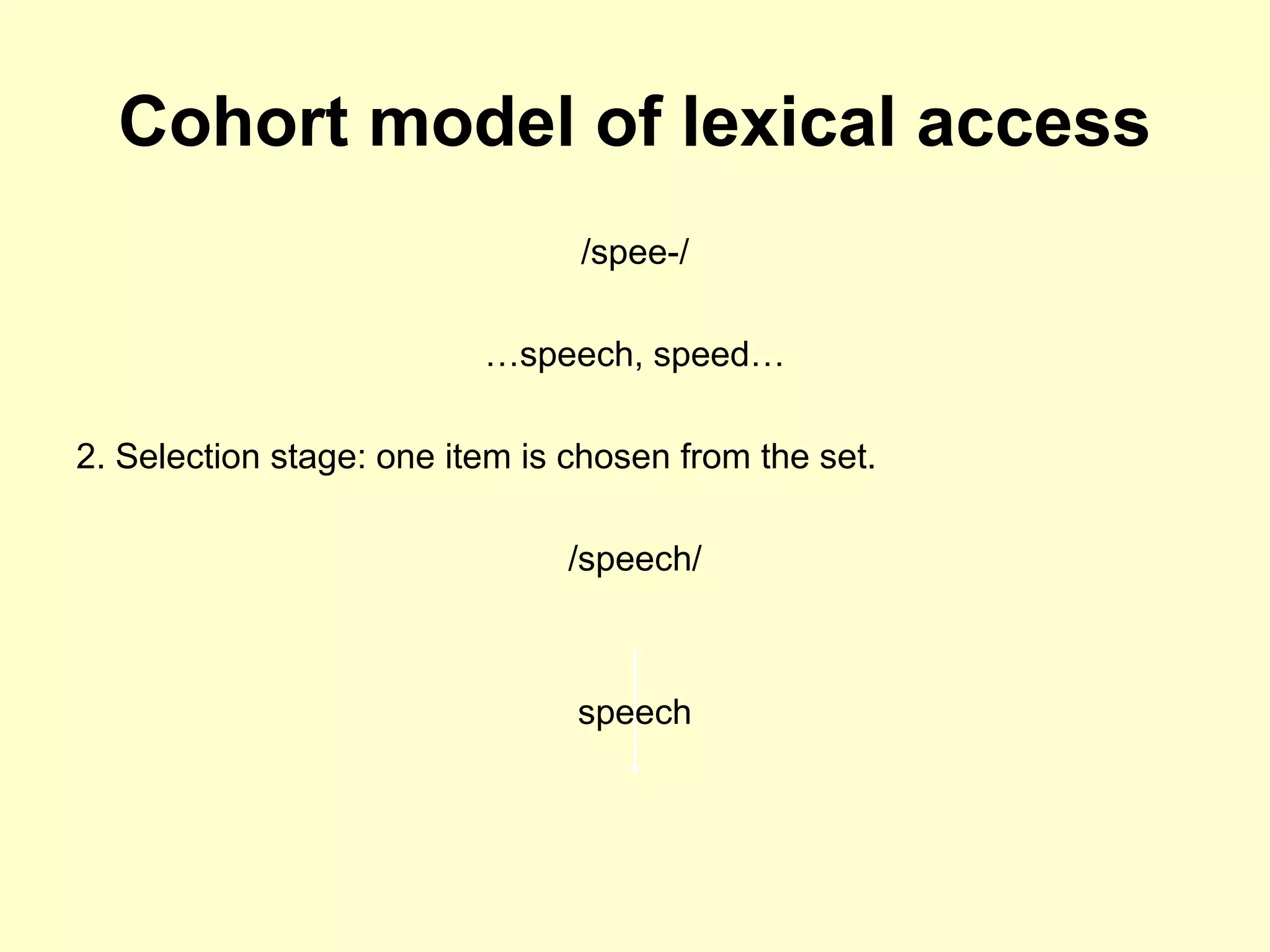
/spee-/
…speech, speed…
2. Selection stage: one item is chosen from the set.
/speech/
speech
Cohort model of lexical access
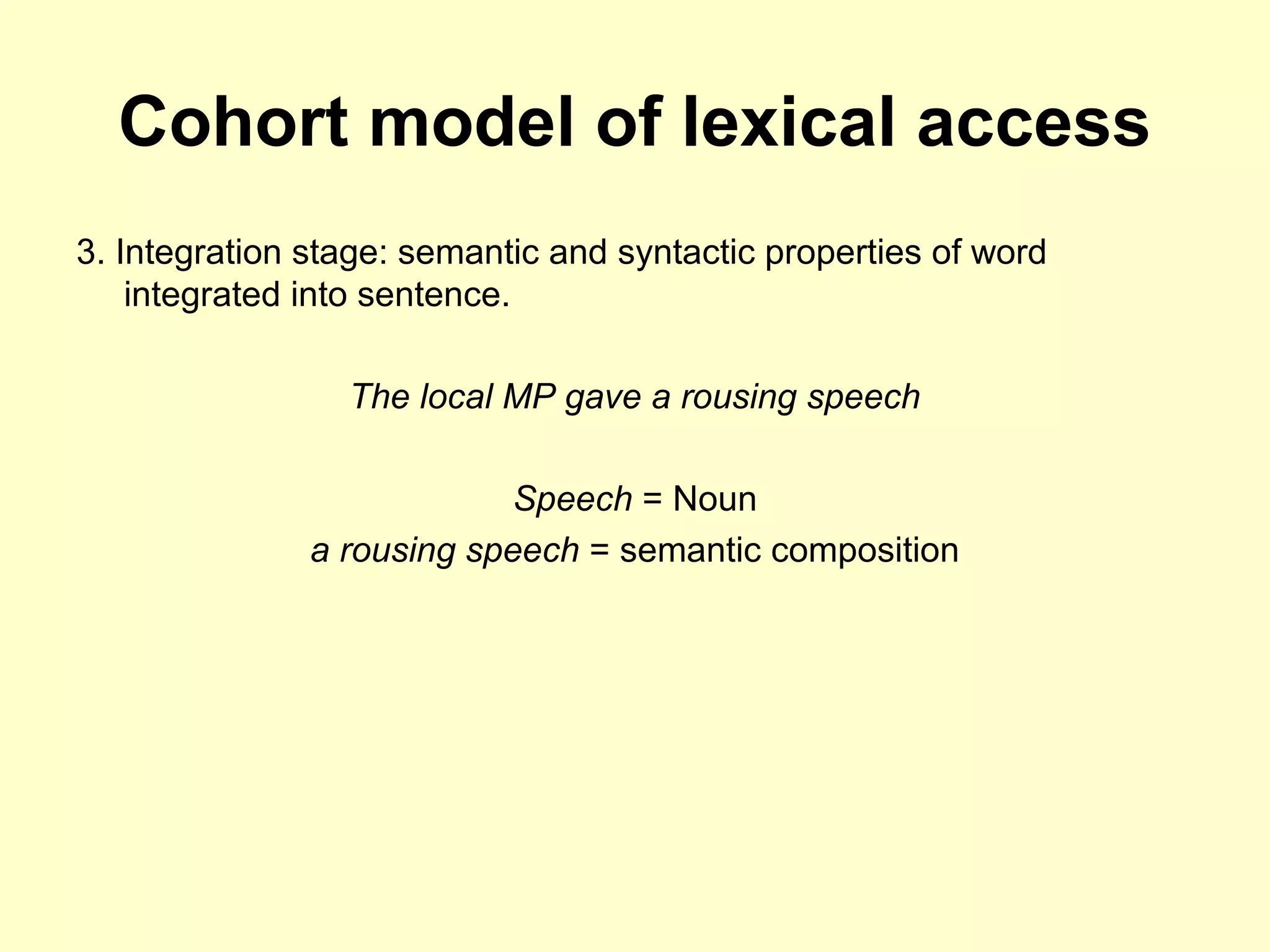
3. Integration stage: semantic and syntactic properties of word
integrated into sentence.
The local MP gave a rousing speech
Speech = Noun
a rousing speech = semantic composition
Cohort model of lexical access
Access Stage
Phonological code generates candidate set
Selection Stage
One item chosen from set
Integration stage
Syntactic & semantic properties integrated into sentence
Prelexical
Postlexical
Cohort model of lexical access
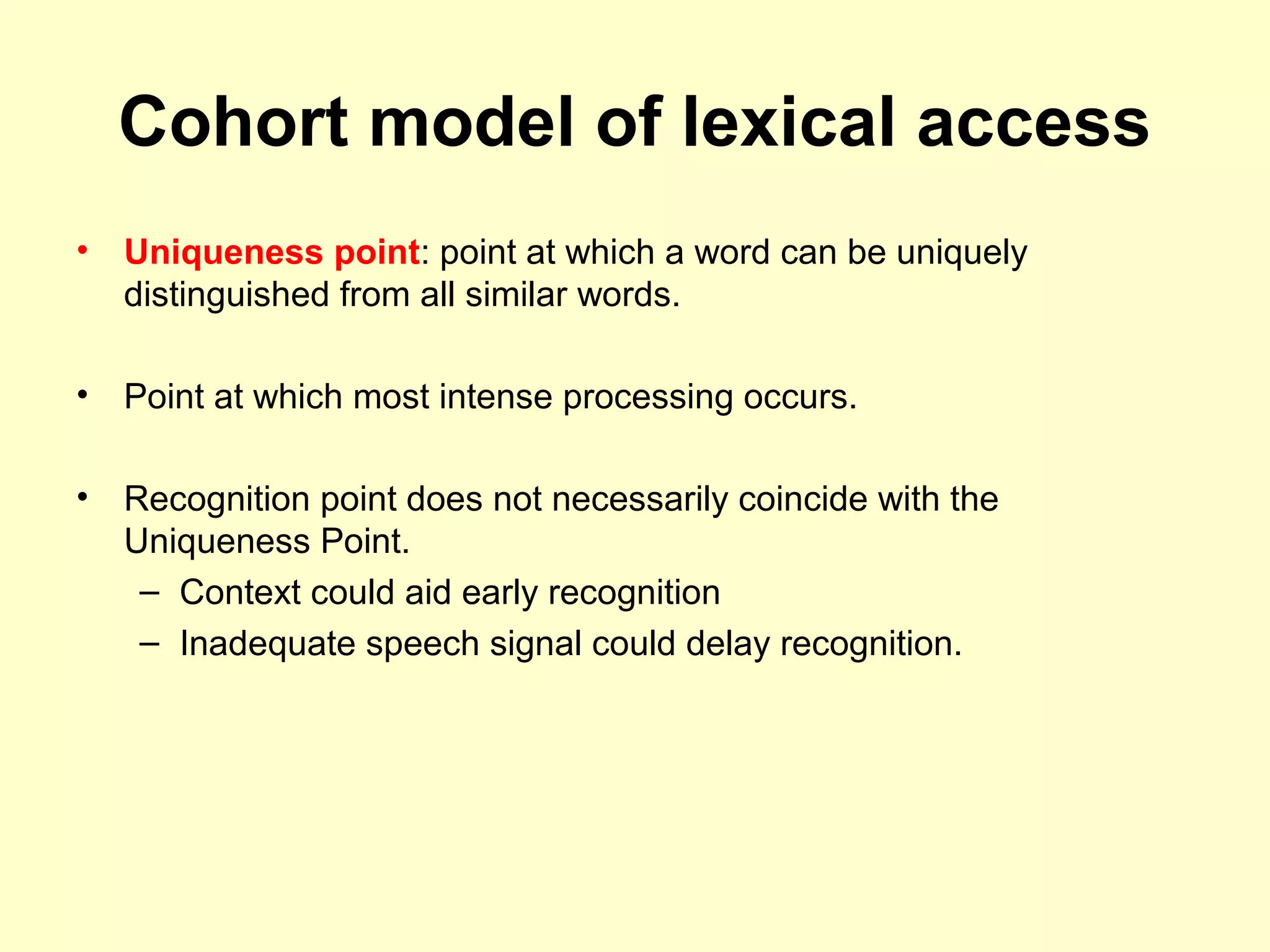
• Uniqueness point: point at which a word can be uniquely
distinguished from all similar words.
• Point at which most intense processing occurs.
• Recognition point does not necessarily coincide with the
Uniqueness Point.
– Context could aid early recognition
– Inadequate speech signal could delay recognition.
Cohortmodel of lexical access
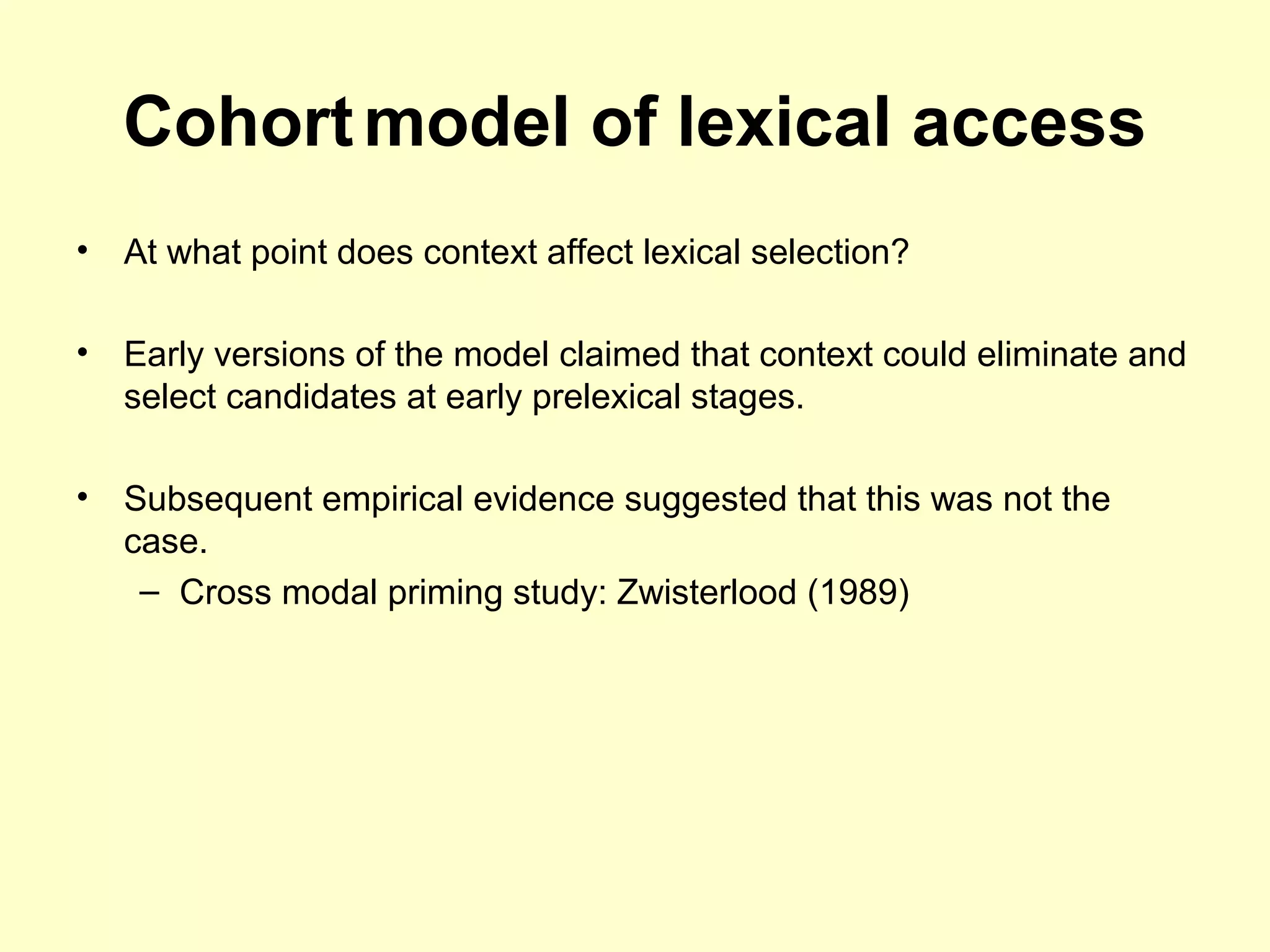
• At what point does context affect lexical selection?
• Early versions of the model claimed that context could eliminate and
select candidates at early prelexical stages.
• Subsequent empirical evidence suggested that this was not the
case.
– Cross modal priming study: Zwisterlood (1989)
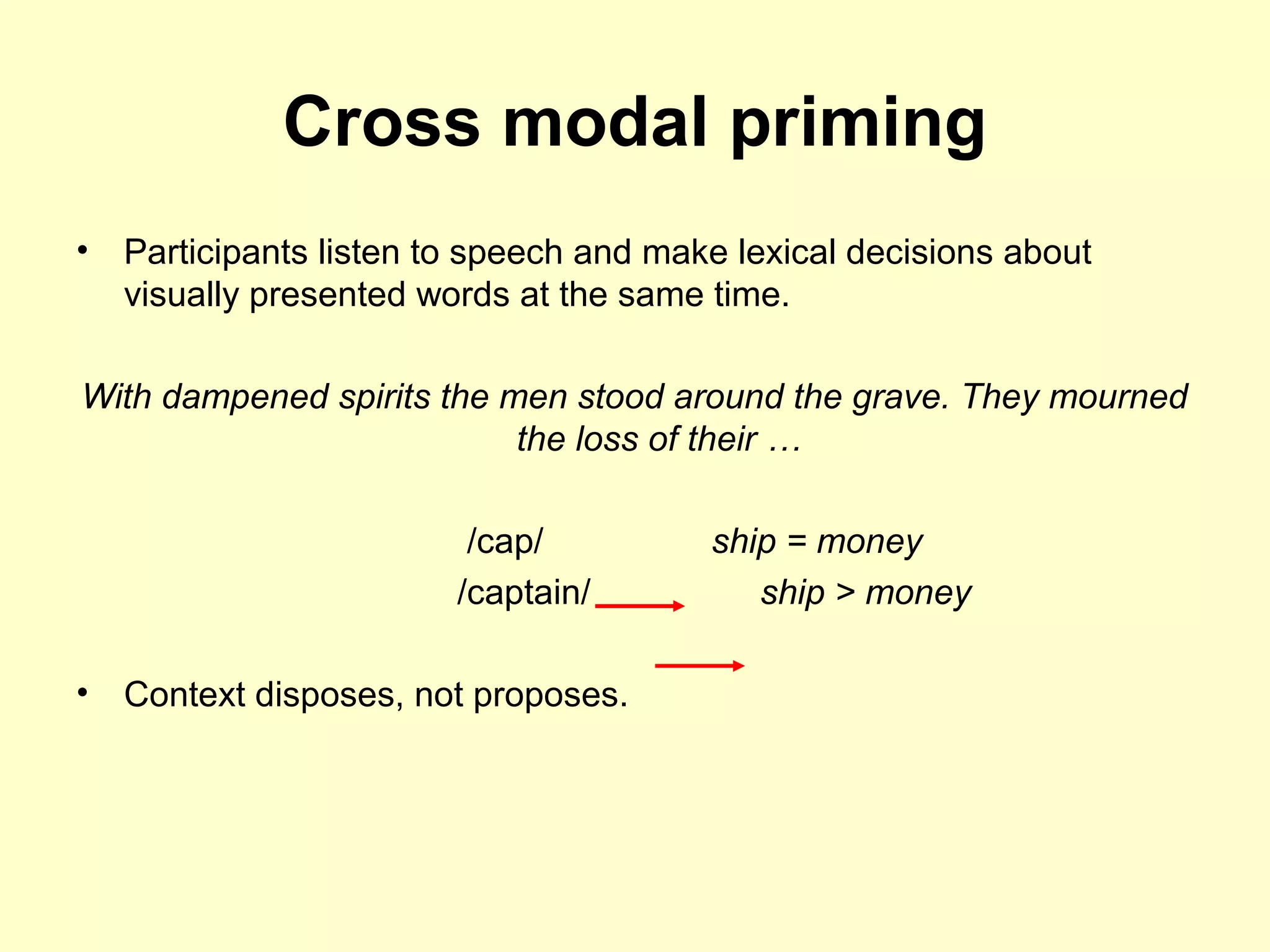
Cross modal priming
• Participants listen to speech and make lexical decisions about
visually presented words at the same time.
With dampened spirits the men stood around the grave. They mourned
the loss of their …
/cap/ ship = money
/captain/ ship > money
• Context disposes, not proposes.
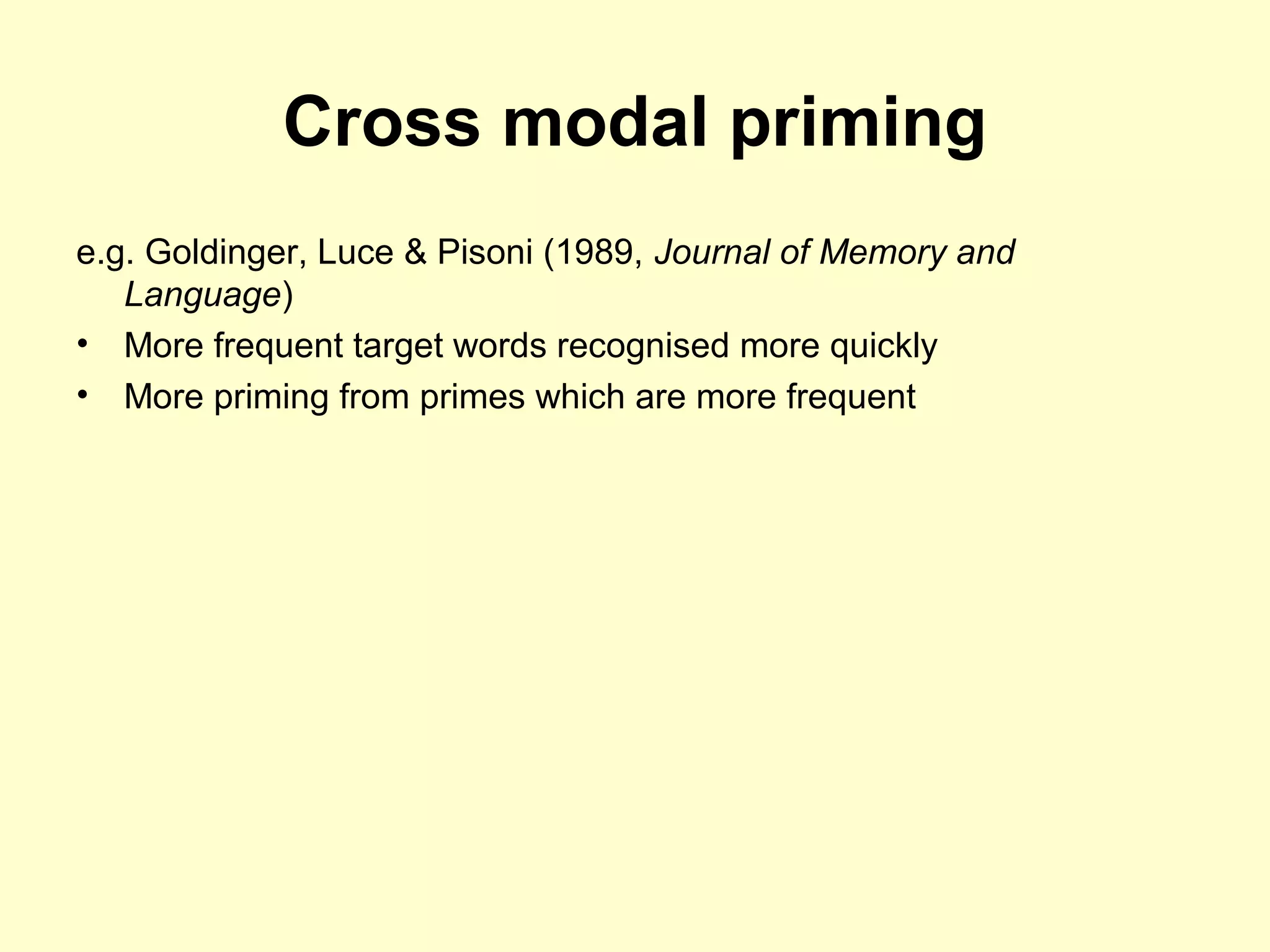
Cross modal priming
e.g. Goldinger, Luce & Pisoni (1989, Journal of Memory and
Language)
• More frequent target words recognised more quickly
• More priming from primes which are more frequent
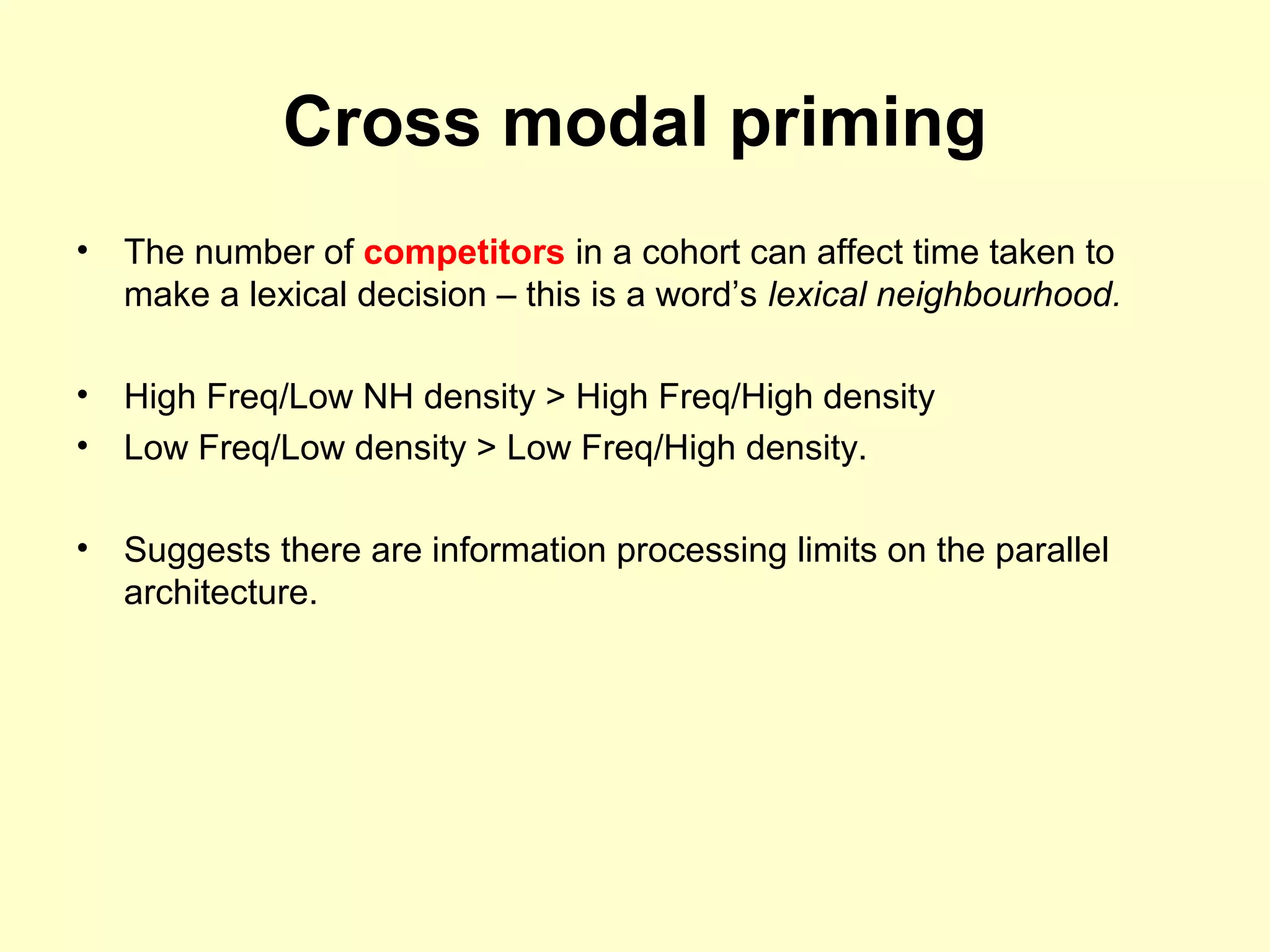
Cross modal priming
• The number of competitors in a cohort can affect time taken to
make a lexical decision – this is a word’s lexical neighbourhood.
• High Freq/Low NH density > High Freq/High density
• Low Freq/Low density > Low Freq/High density.
• Suggests there are information processing limits on the parallel
architecture.
Connectionist models
• Connectionist models have built on the advances made by varying
versions of the Cohort Model (e.g. Gaskell & Marslen-Wilson, 1997,
Language and Cognitive Processes).
• Aim of modelling these effects is to explicitly define concepts
outlined in verbal theories.
• If the model can produce the same effects as human experimental
data, we have complimentary evidence to suggest our verbal
theories are on the right track.
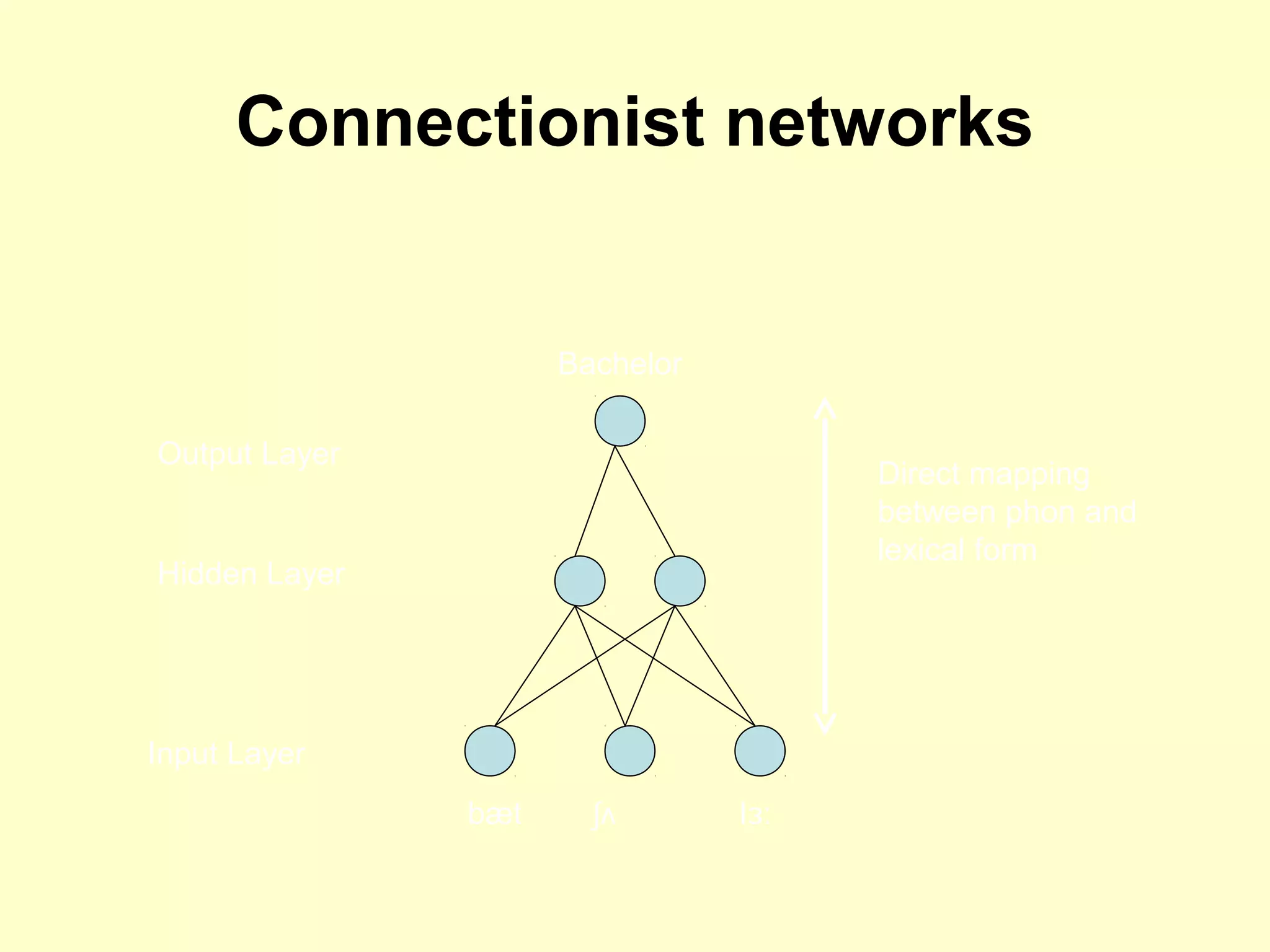
Connectionist networks
Input Layer
Hidden Layer
Output Layer
bæt lʃʌ ɜː
Bachelor
Direct mapping
between phon and
lexical form
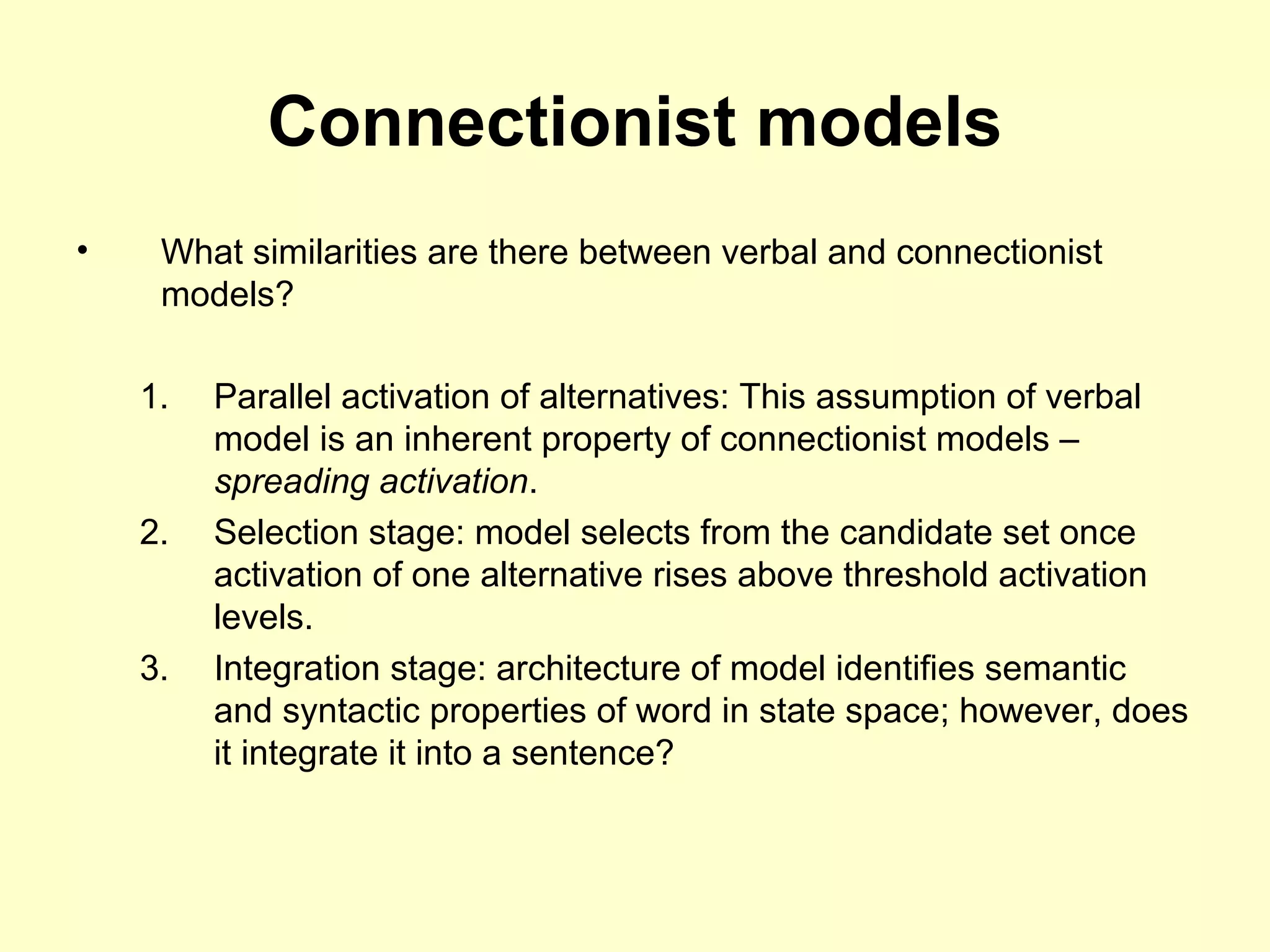
Connectionist models
• What similarities are there between verbal and connectionist
models?
1. Parallel activation of alternatives: This assumption of verbal
model is an inherent property of connectionist models –
spreading activation.
2. Selection stage: model selects from the candidate set once
activation of one alternative rises above threshold activation
levels.
3. Integration stage: architecture of model identifies semantic
and syntactic properties of word in state space; however, does
it integrate it into a sentence?
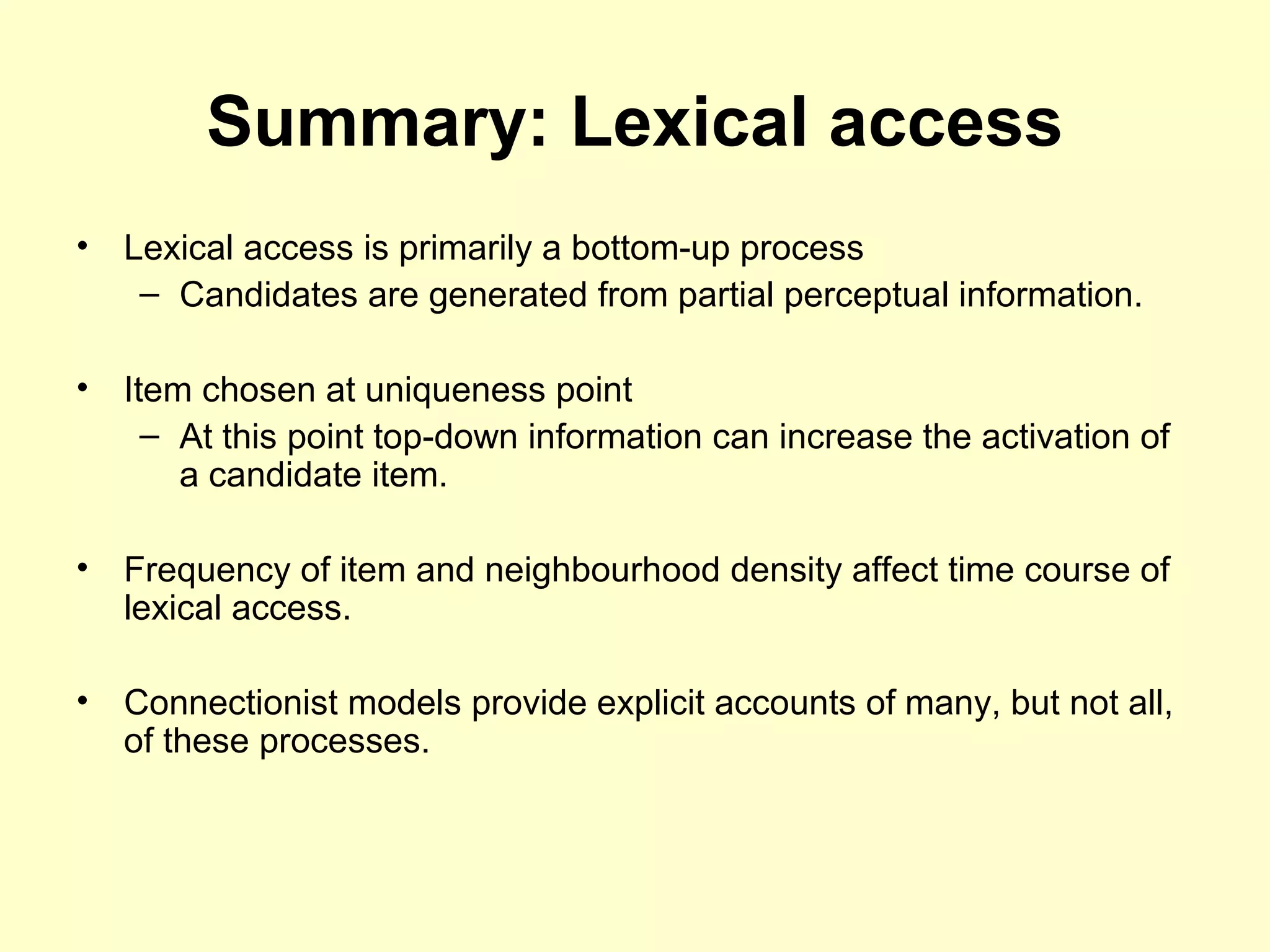
Summary: Lexical access
• Lexical access is primarily a bottom-up process
– Candidates are generated from partial perceptual information.
• Item chosen at uniqueness point
– At this point top-down information can increase the activation of
a candidate item.
• Frequency of item and neighbourhood density affect time course of
lexical access.
• Connectionist models provide explicit accounts of many, but not all,
of these processes.
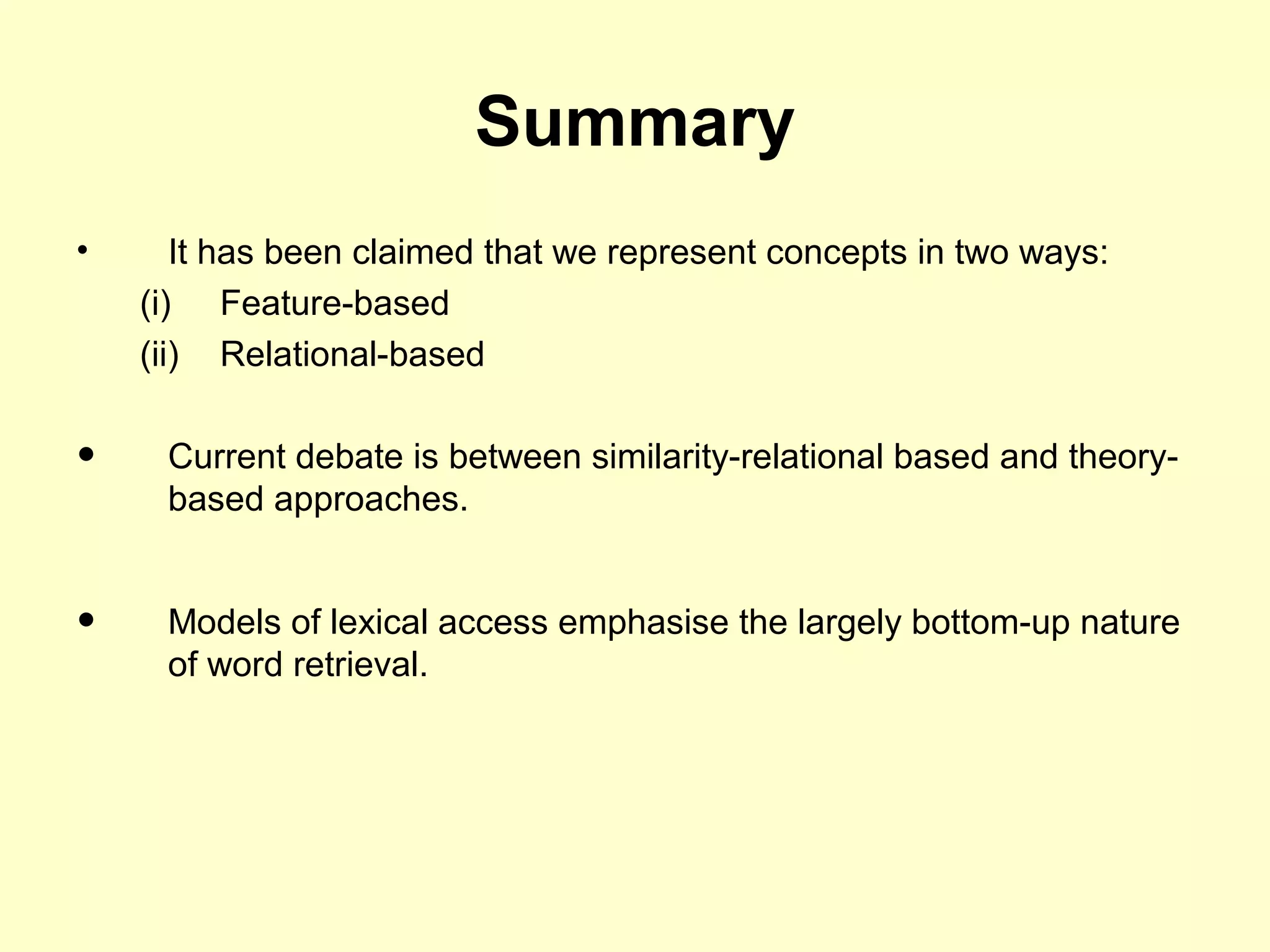
Summary
• It has been claimed that we represent concepts in two ways:
(i) Feature-based
(ii) Relational-based
• Current debate is between similarity-relational based and theory-
based approaches.
• Models of lexical access emphasise the largely bottom-up nature
of word retrieval.

Sp616 adult lexical processing for students

  • 1.
  • 2.
    Overview for thissub-topic 1) Psycholinguistics and psycholinguistic terminology 2) Approaches to lexical semantic representation • Semantic Networks • Prototype approach • Exemplar approach • Theory-based approaches • s 1) Approaches to lexical access • How do we rapidly access words online (i.e. whilst listening to them) • Which cues are utilised in lexical access?
  • 3.
  • 4.
    Sub-components of language 1.Phonology/phonetics: the sounds of the language. 2. Prosody: the rhythm of the language. 3. Morphology: words and word formation. 4. Syntax: 5. Semantics: 6. Pragmatics: contextual meaning. 7. Discourse: conversational conventions.
  • 5.
    Syntax • The formof the language. • Syntax of the language can be broken up into categories, phrases, and clauses. • Categories correspond to words that have different functions in the language. e.g., Verb, Noun, Preposition, Adjective, Determiner.
  • 6.
    Semantics • The systemof meaning • E.g., the preposition with, according to the OED, has some 40 senses. Consider some of the main ones: 1. I ate the pasta with the fork (INSTRUMENT) 2. I ate the pasta with Rufus (ACCOMPANIMENT) 3. I ate the pasta with meatballs (MODIFIER) 4. I ate the pasta with gusto (MANNNER) 5. I was delighted with the pasta (CAUSE)
  • 7.
    Pragmatics • Contextual meaning •Meaning of utterance may differ in different contexts (e.g. pointing at a bicycle outside the library whilst with your friend can mean.......)  the speaker’s understanding of the listener’s knowledge state / informational needs • Understanding of conversational convention (e.g. in the southern UK ‘oh, it’s a bit cold in here!’ could mean ‘I’d like you to close the window’) • Understanding of politeness conventions
  • 8.
    What is psycholinguistics? •The study of the acquisition, processing, and mental representation of language. 1. To what extent is our ability to learn language innate? 2. What is the time course of information use during language comprehension and production? 3. To what extent is different types of linguistic information processed independently from other qualitatively different forms of information? 4. Is processing the same in every instance – how do our goals as language users affect our representation of events?
  • 9.
  • 10.
    The lexicon • Ourmental dictionary. • We know about 85,000 words. – verbs, nouns, adjectives, prepositions, functional words – Make these on the basis of distributional regularities. • But we must categorise concepts according to meaning. – Semantic memory
  • 11.
    Semantic memory • Howdo we represent categories internally? – Concept: a mental representation of a class of things or events • Organisational principles – Economical • We naturally divide the world into classes of things (e.g., weed versus plant). – Informative • Divisions must be a informative (if you’re a gardener) – Natural coherence • Divisions must have a function.
  • 12.
    Concepts • How mightwe categorise concepts into categories? • Propositional terms: define category membership by listing necessary and jointly sufficient conditions. – e.g., Bachelor (male, human, unmarried, adult) • Analogical: define category membership by relational similarity. – e.g., what do a butterfly and a bird have in common?
  • 13.
    Semantic networks • ‘Classical’approach to lexical representation. • Conceptual categorisation based on logical classification rules – conjunction of necessary binary features. Bachelor + Human + Adult + Male - Married • Based on categorisation techniques found in natural sciences
  • 14.
    Semantic networks Animal Bird Mammal RobinPenguin Cats Marsupials Lion Koala
  • 15.
    Sentence verification task •Prediction: concepts further away from each other in the network will take longer to verify, because they share less defining features. (1) A koala is a marsupial. (2) A koala is an animal. • Early data supported this prediction (i.e., 1 < 2) (e.g. Rips, Shoben & Smith, 1973, Journal of Verbal Learning and Verbal Behaviour).
  • 16.
    Sentence verification task •Problems 1. Materials did not control for conjoint frequency • Koala-Marsupial occur together more often than do Koala- Animal 1. Makes incorrect prediction for items which are at the same level of the taxonomy • Robin => Bird is faster than Penguin => Bird
  • 17.
    Semantic networks: Problems •Some instances are better than others – The pope is a bachelor? • Not all concepts can be organised hierarchically (e.g., truth, justice, law). • Not all have defining features (e.g., ‘game’). • No way to distinguish between defining and characteristic features.
  • 18.
    Prototype approach • Conceptrepresented by a collection of characteristic features – a prototype (e.g. Rosch, 1975, Journal of Experimental Psychology). • Features are not necessary – defining features of are cues to category membership (they are probabilistic). • Prototype is idealised – the product of abstraction over common instances (=> may not exist). • Category membership: – Determined by similarity to the prototype – Boundaries are not clear cut (‘fuzzy’) • Some members better examples than others • Graded category structure
  • 19.
    Prototype approach: Empirical evidence•Rosch & Mervis(1975, Cognitive Psychology): people more likely to give prototype as an example of a category. • People judge more prototypical members of a category faster than less prototypical members. • Category members can be equivalent but differ in prototypicality (e.g., 7 is rated as a better example of an odd number than 45 or 679). • Captures tendency to provide non-distinctive yet high frequency features of concepts (e.g., bird => flies)
  • 20.
    Problems with prototypeapproach • Not all concepts have prototype characteristics – Abstract concepts (e.g., hope, justice) • Approach does not explain why categories cohere. – Dyirbal: Australian aboriginal language from Nth Q’land. – System of four Noun classifiers. 1. Bayi: males; animals 2. Balan: female; water; fire; fighting 3. Balam: nonflesh food. 4. Bala: everything not in the other classes Balan: women, bandicoots, dogs, platypus, echidna, some snakes, some fishes, most birds, fireflies, scorpians, crickets, the hairy mary grub, anything connected with fire or water, sun and stars, sheilds, some spears, some trees…
  • 21.
    Problems with prototypeapproach • So why does Balan contain animals? – Animals belong in class 2 when, through myth or belief, are connected to the defining features of this category. – e.g., birds in class 2 because they are believed to be the spirits of dead females (this is not without exception – willy wagtails are thought to be mythical men, and so are class 1). • Prototype approaches tells us that there are coherent categories, not why they cohere. • Circular logic: – Category membership depends on similarity. – Concepts are similar because they belong to the same category.
  • 22.
    Exemplar approach e.g. Medin& Schaffer, 1978, Psychological Review • We first learn specific examples of a concept (e.g., your family dog) • New stimuli are classified according to how closely they resemble this exemplar. • Features of exemplar approach – Nonanalytical: individual examples are stored. – No logical classification rules; no feature abstraction – Cognitively inefficient
  • 23.
    Exemplar approach: evidence •Medin & Shoben (1988, Cognitive Psychology) – Participants judged the typicality of spoons into two classes: SPOON & LARGE SPOON. – Typicality was mediated by a third variable – material – Metal spoons => SPOON, Wooden spoons => LARGE SPOON – Suggests judgments based on stored instances. • Barsalou (1995, Journal of Experimental Psychology) – Categorisation of tropical fish (4 similar, 1 atypical looking) – Equal freq: judgments based on ‘similar’ prototype. – Unequal freq: judgments based on ‘atypical’ prototype. – Instability of categories  “graded structures do not reflect invariant structures associated with categories but instead reflect people's dynamic ability to construct concepts.”
  • 24.
    Exemplar approach: problems •Exemplar approach is a little sparse 1. Offers no account of how categories are formed, beyond memorisation. 2. Exemplar models are vague about what an exemplar might be. – Do we store each new example separately? – Alternatively, do we keep track of the frequency with which each example occurs? – Clearly some abstraction process must occur, but the approach is too vague about this.
  • 25.
    Theory-based approaches • Proponentsclaim that other views are too simplistic and reductionist in their approach. – Reductionist: attempting to explain categorisation on basis of features or perceptual similarity betrays the richness of our representations. • Argue that people construct ‘mini-theories’ that describe facts about categories and why members cohere. • Each theory is an enriched belief system that look like encyclopaedia entries.
  • 26.
    Theory-based approaches • ‘Essentialism’states that there are two levels to each category: 1. The level of observable reality. 2. The level of explanation and cause. • Children and pre-industrialised cultures appear to hold essentialist beliefs – suggests an innate component of category formation.
  • 27.
    Theory-based approaches • Clearlywe regularly engage in levels of processing deeper than surface similarities – theory-based approaches attempt to capture this. • However, similarity-based categorisation is still primary and necessary – Hampton (1998, Cognition). – Offspring of two zebra parents fed a special diet that made it look and behave just like a horse. – 2/3 of participants stated the offspring was no longer a zebra. • Children’s opinions appear to be less malleable (Gelman, 2004, TICS).
  • 28.
    Theory-based approaches • Toargue that we encode unobservable properties of concepts to form categories (and make inductions about category membership) tells us nothing about initial category formation. • Prototype/exemplar approaches and theory-based approaches not in conflict with each other.
  • 29.
    Lexical representation: Summary •Early attempts to describe semantic memory argued for a feature- based approach. • Members of categories do not often share core features. • Recent attempts emphasise: (a) tendency for humans to group category members according to perceptual similarity (for narrow classes – e.g., horses) and function (wider classes – e.g., animals). (b) Tendency to categorise according to deeper theory-driven knowledge may be dependent on gaining a sufficient evidential base (i.e., knowledge-dependent).
  • 30.
  • 31.
    Lexical Processing • Identifyinga word in spoken language is a non-trivial process. – Adult speakers produce around 15 phonemes per second. – Word boundaries are not marked in speech. – Must differentiate between the speech stream and background noise. – Speakers vary tremendously in pitch and tone of their voices. – Speech stream is impoverished (e.g., speakers often do not articulate ends of words). • How do we over come these problems to accurately retrieve words from the lexicon?
  • 32.
    Cohort model oflexical access • Marslen-Wilson (1987, Cognition) • Three stage model of word recognition The local MP gave a rousing …. 1) Access stage: phonological code used generate a candidate set (a ‘cohort’) of words. /sp-/ …space, spade, special, speech, speed, spray …
  • 33.
    Cohort model oflexical access /spee-/ …speech, speed… 2. Selection stage: one item is chosen from the set. /speech/ speech
  • 34.
    Cohort model oflexical access 3. Integration stage: semantic and syntactic properties of word integrated into sentence. The local MP gave a rousing speech Speech = Noun a rousing speech = semantic composition
  • 35.
    Cohort model oflexical access Access Stage Phonological code generates candidate set Selection Stage One item chosen from set Integration stage Syntactic & semantic properties integrated into sentence Prelexical Postlexical
  • 36.
    Cohort model oflexical access • Uniqueness point: point at which a word can be uniquely distinguished from all similar words. • Point at which most intense processing occurs. • Recognition point does not necessarily coincide with the Uniqueness Point. – Context could aid early recognition – Inadequate speech signal could delay recognition.
  • 37.
    Cohortmodel of lexicalaccess • At what point does context affect lexical selection? • Early versions of the model claimed that context could eliminate and select candidates at early prelexical stages. • Subsequent empirical evidence suggested that this was not the case. – Cross modal priming study: Zwisterlood (1989)
  • 38.
    Cross modal priming •Participants listen to speech and make lexical decisions about visually presented words at the same time. With dampened spirits the men stood around the grave. They mourned the loss of their … /cap/ ship = money /captain/ ship > money • Context disposes, not proposes.
  • 39.
    Cross modal priming e.g.Goldinger, Luce & Pisoni (1989, Journal of Memory and Language) • More frequent target words recognised more quickly • More priming from primes which are more frequent
  • 40.
    Cross modal priming •The number of competitors in a cohort can affect time taken to make a lexical decision – this is a word’s lexical neighbourhood. • High Freq/Low NH density > High Freq/High density • Low Freq/Low density > Low Freq/High density. • Suggests there are information processing limits on the parallel architecture.
  • 41.
    Connectionist models • Connectionistmodels have built on the advances made by varying versions of the Cohort Model (e.g. Gaskell & Marslen-Wilson, 1997, Language and Cognitive Processes). • Aim of modelling these effects is to explicitly define concepts outlined in verbal theories. • If the model can produce the same effects as human experimental data, we have complimentary evidence to suggest our verbal theories are on the right track.
  • 42.
    Connectionist networks Input Layer HiddenLayer Output Layer bæt lʃʌ ɜː Bachelor Direct mapping between phon and lexical form
  • 43.
    Connectionist models • Whatsimilarities are there between verbal and connectionist models? 1. Parallel activation of alternatives: This assumption of verbal model is an inherent property of connectionist models – spreading activation. 2. Selection stage: model selects from the candidate set once activation of one alternative rises above threshold activation levels. 3. Integration stage: architecture of model identifies semantic and syntactic properties of word in state space; however, does it integrate it into a sentence?
  • 44.
    Summary: Lexical access •Lexical access is primarily a bottom-up process – Candidates are generated from partial perceptual information. • Item chosen at uniqueness point – At this point top-down information can increase the activation of a candidate item. • Frequency of item and neighbourhood density affect time course of lexical access. • Connectionist models provide explicit accounts of many, but not all, of these processes.
  • 45.
    Summary • It hasbeen claimed that we represent concepts in two ways: (i) Feature-based (ii) Relational-based • Current debate is between similarity-relational based and theory- based approaches. • Models of lexical access emphasise the largely bottom-up nature of word retrieval.