





Hideyo Noguchi, 1911: Syphillis (delusions,
grandiosity, impulsivity, altered thought
structure) is due to bacterium.
Emil Kraeplin, 1919: dementia praecox
(paranoia, grandiose delusions, auditory
hallucinations, abnormal emotional reg.,
bizarre thoughts)—partly genetic
Eugen Bleuler, 1911: key is dissociative
thinking; also delusions, hallucinations,
affective disturbance, autism.


Why does one twin become
schizophrenic and the other does not?
•
•
•
•

Lower birth weight
More physiological distress
More submissive, tearful, sensitive
Impaired motor coordination



Genes scattered across all but 8
chromosomes have been implicated
Most important:
•
•
•
•
•



Neuregulin 1: NMDA, GABA, & Ach receptors
Dysbindin: synaptic plasticity
Catechol-O-methyl transferase: DA metabol.
G72: regulates glutamatergic activity
Others: myelination, glial function

Paternal age: more cell divisions in
sperm


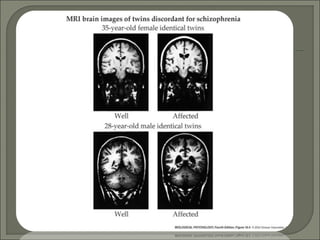
Larger ventricles
• Subgroup: inverse correlation between ventricle

size and response to drugs


Hippocampus, amygdala,
parahippocamp.
• Smaller in affected twin (static trait)
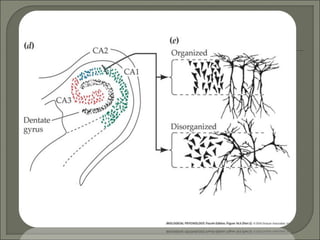
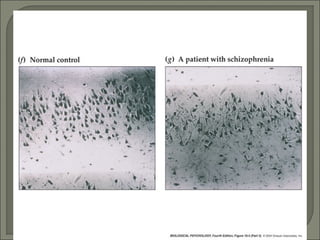
• Disordered hippocampal pyramidal cells
 Correlation between cell disorder and severity
 May be due to maternal influenza in 2nd trimester
• Also in entorhinal, cingulate, parahippocampal

cortex


Increased loss of gray matter in
adolescence




Shrinkage of cerebellar vermis
Thicker corpus callosum
Frontal lobes
•
•
•
•

Abnormal neuronal migration in one study
Dendrites have fewer spines
But no major structural abnormalities
Measures of frontal function impaired


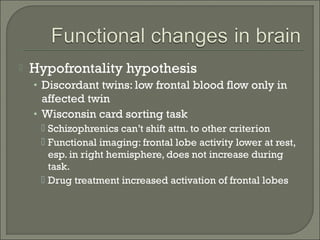
Hypofrontality hypothesis
• Discordant twins: low frontal blood flow only in

affected twin
• Wisconsin card sorting task
 Schizophrenics can’t shift attn. to other criterion
 Functional imaging: frontal lobe activity lower at rest,
esp. in right hemisphere, does not increase during
task.
 Drug treatment increased activation of frontal lobes




LSD, mescaline  confusion, delirium,
disorientation, visual hallucinations.
But schizophrenic hallucinations are
mostly auditory
Schizophrenics given LSD say it’s
different from their symptoms






Amphetamine (very high doses) 
paranoia, delusions, auditory
hallucination
Also exacerbates symptoms of schiz.
Effects blocked by DA antagonist
chlorpromazine
Phenothiazines (incl. chlorprom.) & all
other typical neuroleptics block D2
receptors and alleviate (+) symptoms.






Clozapine blocks 5-HT2A receptors > D2
As effective as typical neuroleptics on (+)
symptoms, more effective on (-)
symptoms
Fewer motor side effects (tardive
dyskinesia)
Actually increase DA release in frontal
cortex
• L-DOPA can even be beneficial



Problem with DA hypothesis: time course
Phencyclidine (PCP): dissociative
anesthetic 
• Auditory hallucinations
• Depersonalization
• Delusions
• Noncompetitive NMDA antagonist (blocks Ca2+

channel)


2 weeks PCP in monkeys  schiz.-like
symptoms
• Including poor performance on frontal lobe-

sensitive task




Dose- & time-sensitive
Ketamine (NMDA antag) similar effects
So, why not give glutamate agonists to
treat schizophrenia?????


Seizures!! (also excitotoxicity)



Try mGluR agonists: 8 subtypes of mGluR
• Some modulate glutamate release
• Others modulate dopamine systems
Schizophrenia

Schizophrenia

  • 2.
       Hideyo Noguchi, 1911:Syphillis (delusions, grandiosity, impulsivity, altered thought structure) is due to bacterium. Emil Kraeplin, 1919: dementia praecox (paranoia, grandiose delusions, auditory hallucinations, abnormal emotional reg., bizarre thoughts)—partly genetic Eugen Bleuler, 1911: key is dissociative thinking; also delusions, hallucinations, affective disturbance, autism.
  • 5.
     Why does onetwin become schizophrenic and the other does not? • • • • Lower birth weight More physiological distress More submissive, tearful, sensitive Impaired motor coordination
  • 7.
      Genes scattered acrossall but 8 chromosomes have been implicated Most important: • • • • •  Neuregulin 1: NMDA, GABA, & Ach receptors Dysbindin: synaptic plasticity Catechol-O-methyl transferase: DA metabol. G72: regulates glutamatergic activity Others: myelination, glial function Paternal age: more cell divisions in sperm
  • 8.
     Larger ventricles • Subgroup:inverse correlation between ventricle size and response to drugs
  • 12.
     Hippocampus, amygdala, parahippocamp. • Smallerin affected twin (static trait) • Disordered hippocampal pyramidal cells  Correlation between cell disorder and severity  May be due to maternal influenza in 2nd trimester • Also in entorhinal, cingulate, parahippocampal cortex
  • 16.
     Increased loss ofgray matter in adolescence
  • 18.
       Shrinkage of cerebellarvermis Thicker corpus callosum Frontal lobes • • • • Abnormal neuronal migration in one study Dendrites have fewer spines But no major structural abnormalities Measures of frontal function impaired
  • 19.
     Hypofrontality hypothesis • Discordanttwins: low frontal blood flow only in affected twin • Wisconsin card sorting task  Schizophrenics can’t shift attn. to other criterion  Functional imaging: frontal lobe activity lower at rest, esp. in right hemisphere, does not increase during task.  Drug treatment increased activation of frontal lobes
  • 21.
       LSD, mescaline confusion, delirium, disorientation, visual hallucinations. But schizophrenic hallucinations are mostly auditory Schizophrenics given LSD say it’s different from their symptoms
  • 22.
        Amphetamine (very highdoses)  paranoia, delusions, auditory hallucination Also exacerbates symptoms of schiz. Effects blocked by DA antagonist chlorpromazine Phenothiazines (incl. chlorprom.) & all other typical neuroleptics block D2 receptors and alleviate (+) symptoms.
  • 24.
        Clozapine blocks 5-HT2Areceptors > D2 As effective as typical neuroleptics on (+) symptoms, more effective on (-) symptoms Fewer motor side effects (tardive dyskinesia) Actually increase DA release in frontal cortex • L-DOPA can even be beneficial
  • 26.
      Problem with DAhypothesis: time course Phencyclidine (PCP): dissociative anesthetic  • Auditory hallucinations • Depersonalization • Delusions • Noncompetitive NMDA antagonist (blocks Ca2+ channel)
  • 29.
     2 weeks PCPin monkeys  schiz.-like symptoms • Including poor performance on frontal lobe- sensitive task    Dose- & time-sensitive Ketamine (NMDA antag) similar effects So, why not give glutamate agonists to treat schizophrenia?????
  • 30.
     Seizures!! (also excitotoxicity)  TrymGluR agonists: 8 subtypes of mGluR • Some modulate glutamate release • Others modulate dopamine systems

Editor's Notes