











Existential
Psychotherapy
Dr.V.Veera Balaji Kumar, PhD
Health Psychologist
Learning ObjectivesLearning Objectives
This presentation will focus on
 An overview of existential psychotherapy
 The history of existential psychotherapy
 Applications of existential psychotherapy
 Treatment techniques associated with
existential psychotherapy
No single founder - Many
sources
 existential therapy ‘cannot be traced to a single
authoritative source’ - no Freud or Rogers, to
give the approach a common theoretical and
practical basis.
 existential approaches to therapy have emerged
spontaneously – and, at times, independently – in
diverse parts of western Europe and
subsequently the United States.
 the philosophical field on which it is based is,
itself, enormously diverse.
Nietzche
 He who has a why to live can
bear with any how
 That which does not kill me,
makes me stronger
Key existential philosophers
 Kierkegaard, Søren (1813–55): Danish
philosopher & father of modern existentialism.
 Criticised the lack of passion and the conformity of
nineteenth century Christendom,
 Argued that human beings needed to turn towards
their own subjective truths, and make a personal
leap of faith towards God.
 Buber, Martin (1878–1965): Jewish philosopher
and theologian. Emphasised the relational nature
of human existence, and the distinction between
‘I–Thou’ and ‘I–It’ modes of relating.
Key existential philosophers
 Nietzsche, Friedrich (1844–1900): German
philosopher. Attacked the slavish, herd mentality
of conventional Christianity, and preached an
atheistic gospel of aspiration towards the
Übermensch: the autonomous superman who
creates his or her own values and morality, and
lives an earthly life of passion and power.
 Jaspers, Karl (1883–1969): German psychiatrist-
turned-philosopher, whose important idea of
unavoidable ‘boundary situations’ that human
beings face.
Key existential philosophers
 Heidegger, Martin (1889–1976): German
philosopher, influential -existential thinker.
 Earlier work emphasised resolution in the face of
anxiety, guilt and death, whilst later work placed
greater emphasis on language and an openness
towards Being.
 Sartre, Jean-Paul (1905–80): French novelist
philosopher, playwright and social critic.
 Emphasised the freedom at the heart of human
existence and the angst, meaninglessness and
nausea that it evokes.
Key existential philosophers
 Marcel, Gabriel (1889–1973): French
philosopher, playwright and Christian.
 Emphasised mysteriousness and immeasurability
of existence,
 and the importance of fidelity and openness to
others, as well as the primacy of hope.
 Camus, Albert (1913–60): French novelist and
philosopher. Emphasised the absurdity of human
existence, but the possibility of creating meaning in
a meaningless world.
History of ExistentialismHistory of Existentialism
What existentialism is …
 A philosophical view that emphasizes
the importance of existence, including
one's responsibility for one's own
psychological existence.
Existentialism continued …
 Is NOT a technical approach to counseling that
offers new rules for therapy.
 Psychoanalysis – use of transference, free-
association
 Behaviorism – stimulus/response, +reinforcement/-
reinforcement/punishment
- It is a frame-of-reference or way of viewing and
understanding a client’s suffering
History of ExistentialismHistory of Existentialism
““Existence precedes essence”Existence precedes essence”
SartreSartre
““Truth dwells in the inner man”Truth dwells in the inner man”
AugustineAugustine
Existential thinking has occurred throughout
history
Exemplified by Augustine, Scotus, Pascal,
Kierkegaard, Nietzsche
Existential View
of Human Nature
 Assumption One: As humans, our basic
conflict is between ourselves and the
“givens” of our existence.
 It’s not from instinctual drives (ego & superego)
 It’s not from significant adults in one’s early life
(need for acceptance and approval)
 It’s this anxiety we experience when we are
confronted with the givens of our existence
Existential View of
Human Nature
 Assumption Two: Existing in the world brings
about both normal and neurotic anxiety. “Anxiety
arises from our personal need to survive, to
preserve our being, and to assert our being (Corsini
& Wedding, 2005, p. 271)
 Anxiety occurs as we try to deal with important
life themes:
 living and dying
 freedom, responsibility, & choice
 isolation & loving
 meaning & meaninglessness.
Existential View of
Human Nature
 Assumption Three: As humans we
have the capacity for self-awareness.
 The greater our self-awareness, the
greater our possibilities for freedom.
 We can increase our capacity to live life
fully.
Existential View of
Human Nature
 Assumption Four: If a person is to be understood
and helped to understand him/herself. That person
must be understood from the perspective of the
here-and-now.
 The past is important only insofar as it is part of
one’s current existence.
 There are no attempts to uncover what happened in
the past, instead there is a focus on experiences
in the present.
Existential View of
Human Nature
 Assumption Five: The significance of our
existence (who we are) is never fixed. We are
always re-creating ourselves, evolving,
and becoming (Corey, 2005).
 The essence of who we are is never fixed until
we die.
 Resistance to using theorotypes or labels
Existence as Verb-like
 Existentialists conceive human existence as not a
noun-like thing, but a verb-like happening.
 human existence is fundamentally dynamic in
nature, that it is a flux, an unfolding event, a path
(Jaspers, 1986) or a process.
 Indeed, the very word ‘exist’ comes from the Latin
verb ‘existere’, which means to stand out or
emerge.
 Existence, then, can be conceived of as an
upsurge (Sartre, 1943/1958): a becoming, a
bursting forth into the world
A phenomenological exercise
 Reflect, for a minute, on what you are
experiencing as you listen my words.
 Initially, you may perceive yourself as a thing-like
self encountering another thing: my lecture.
 If you try to bracket this natural attitude, however,
and simply focus on what you are experiencing,
you may come to see that your experiencing is a
listening-to-my-words-now, or a wondering-what-
 this-is-all-about, rather than a fixed thing
encountering another fixed thing
A phenomenological exercise
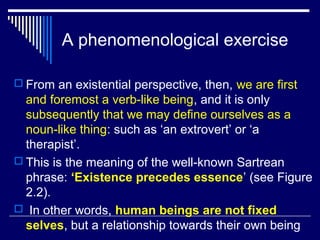
 From an existential perspective, then, we are first
and foremost a verb-like being, and it is only
subsequently that we may define ourselves as a
noun-like thing: such as ‘an extrovert’ or ‘a
therapist’.
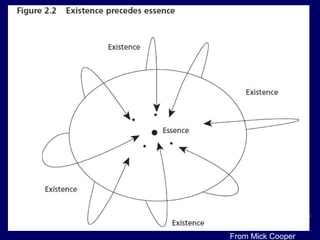
 This is the meaning of the well-known Sartrean
phrase: ‘Existence precedes essence’ (see Figure
2.2).
 In other words, human beings are not fixed
selves, but a relationship towards their own being
From Mick Cooper
Basic ConceptsBasic Concepts
Existential psychotherapy
is “an encounter with one’s
own existence in an
immediate and
quintessential form”
May (1967)
Existential PsychotherapyExistential Psychotherapy
 Not a specific technique, more
philosophical in nature
 Focuses on issues central to human
existence
 Task of therapy is to facilitate
genuineness
 Emphasis is on the phenomenological
moment between therapist and client
Existential Psychotherapy -Existential Psychotherapy -
OverviewOverview
 “Endeavour to understand the man as he really is”.
 Existential approach is all about exploring meaning
and values, and living authentically – in accordance
with one's own ideals, priorities and values.
 It views human beings as creature of continual
change and transformation, living finite lives in a
context of personal strengths and weaknesses as
well as opportunities and limitations created by the
environment.
Heidegger’s Two Basic
Patterns of Being
 Inauthentic mode
 Giving oneself over to externally
derived definitions,
“everydayness”
 Authentic (ontological) mode
 Recognizing one’s uniqueness,
remaining true to self
Existential Psychotherapy:Existential Psychotherapy:
The Basic “I-Am” Experience”The Basic “I-Am” Experience”
“I am now living and I could take my
life”
“The idea of suicide has saved many
lives”
Nietzsche
Existential psychotherapy seeks a
deeper and more discerning type of
therapy
Existential Psychotherapy:
The Basic “I-Am” Experience”
(continued)
The “I am” experience is not a solution
in itself
It is a precondition for a solution
An ontological experience
 Ontis = to be
 Logical = the science of
Existential Psychotherapy:
The Basic “I-Am” Experience”
(continued)
 Nonbeing is illustrated in the
experience of
 fear of death,
destructive hostility,
 severe anxiety and
 critical sickness
EXISTENTIAL MODEL OF ANXIETY
Anxiety is moreAnxiety is more
basic than fearbasic than fear
Anxiety arises from our personal need to
survive, to preserve our being, and to assert
our being
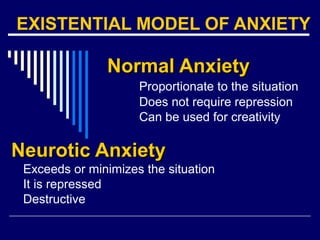
EXISTENTIAL MODEL OF ANXIETY
Normal AnxietyNormal Anxiety
Proportionate to the situation
Does not require repression
Can be used for creativity
Neurotic AnxietyNeurotic Anxiety
Exceeds or minimizes the situation
It is repressed
Destructive
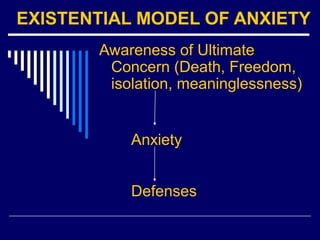
EXISTENTIAL MODEL OF ANXIETY
Awareness of Ultimate
Concern (Death, Freedom,
isolation, meaninglessness)
Anxiety
Defenses
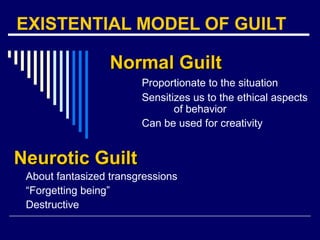
EXISTENTIAL MODEL OF GUILT
Normal GuiltNormal Guilt
Proportionate to the situation
Sensitizes us to the ethical aspects
of behavior
Can be used for creativity
Neurotic GuiltNeurotic Guilt
About fantasized transgressions
“Forgetting being”
Destructive
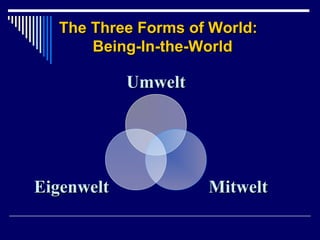
The Three Forms of World:The Three Forms of World:
Being-In-the-WorldBeing-In-the-World
UmweltUmwelt
MitweltMitweltEigenweltEigenwelt
The Three Forms of World:The Three Forms of World:
Being-In-the-WorldBeing-In-the-World
 Umwelt = world around; biological
world
 Mitwelt = with world; world of one’s
fellow human beings
 Eigenwelt = own world; relationship
to one’s self
Basic concepts
 Sensing being as real
 Understanding of a person as a being in
the world
 Differentiating ego from being
 Considering the fact of non-being death
and termination
 Viewing anxiety and guilt as ontological.
Focus
 On the relationships a person has both with
himself and with the world around him.
 When the relationships are not navigated
effectively psychological disturbance occurs.
 Well-being can be negotiated gradually by coming
to terms with life, the world and oneself.
 A person may be enjoying relatively healthy
functioning, yet still experience ‘Existential angst’
- existential vacuum – a realization that his life is
meaningless.
Objectives
 Four-part framework of client’s existence :
 Physical dimension
 Social dimension
 Psychological or personal dimension
 Spiritual dimension
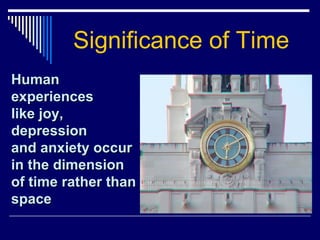
Significance of Time
HumanHuman
experiencesexperiences
like joy,like joy,
depressiondepression
and anxiety occurand anxiety occur
in the dimensionin the dimension
of time rather thanof time rather than
spacespace
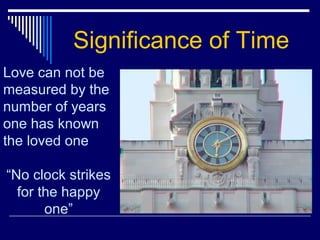
Significance of Time
Love can not be
measured by the
number of years
one has known
the loved one
“No clock strikes
for the happy
one”
Human Capacity to Transcend
the Immediate Situation
Transcendere means “to climb over and
beyond”
Existing involves a continual emerging
A transcending of one’s past and present
must occur in order to reach the future
This capacity might be neurobiologically
based
The phenomenological
method
 A key contribution - as developed by the German
philosopher Edmund Husserl (1859–1938).
 adopted a standpoint of radical doubt, arguing that all
we can know is what we experience: the ‘inner
evidence’ that is given to us intuitively in our
conscious experiencing of things.
 In other words, to truly know ourselves and our world,
we need to turn our attention to our conscious,
lived-experiences.
The phenomenological
method
 Three interrelated steps. The first of these steps is
the rule of ‘epoché’, whereby we are urged to ‘set
aside our initial biases and prejudices of things, to
suspend our expectations and assumptions,
 in short, to bracket all such temporarily and as far as it
is possible so that we can focus on the primary data of
our experience’.
 Husserl urges us to set aside our ‘natural attitude’ –
that objects in the external world are objectively present
in space &time – and instead focus solely on our
immediate and present experiencing of them
The phenomenological
method
 The second step in the phenomenological method,
is the ‘rule of description’, the essence of which is
‘Describe, don’t explain’ (Ihde, 1986: 34).
 Here, we are urged to refrain from producing
explanations, hypotheses or theories as to what
we are experiencing, and
 instead to stay with the lived-experiences as
they actually are.
The phenomenological
method
 Finally, there is the ‘rule of horizontalisation’,
which ‘further urges us to avoid placing any initial
hierarchies of significance or importance upon
the items of our descriptions, and
 instead to treat each initially as having equal
value or significance’
The ExistentialThe Existential
TheoryTheory
of Personalityof Personality
Existentialists
Suggest we do not possess a personality
rather we embody an experience
Ontology = science of being
Normalcy is seen as a failure in becoming
Neurosis is tantamount to avoidance, i.e.
neurotic individuals are living in the every day
rather than dealing with the challenges of
ultimate concerns
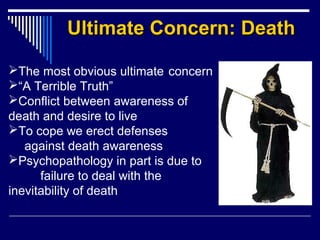
Ultimate Concern: DeathUltimate Concern: Death
The most obvious ultimate concern
“A Terrible Truth”
Conflict between awareness of
death and desire to live
To cope we erect defenses
against death awareness
Psychopathology in part is due to
failure to deal with the
inevitability of death
Ultimate Concern: FreedomUltimate Concern: Freedom
Humans areHumans are
“condemned to freedom”“condemned to freedom”
SARTRE
Ultimate Concern: FreedomUltimate Concern: Freedom
Refers to fact that humans
are the authors of their
own world
We are responsible for our
own choices
Conflict is between
groundlessness and
desire for ground/structure
Ultimate Concern: FreedomUltimate Concern: Freedom
Implications for therapy
 Responsibility
 Willing
 Impulsivity
 Compulsivity
 Decision
Ultimate Concern: IsolationUltimate Concern: Isolation
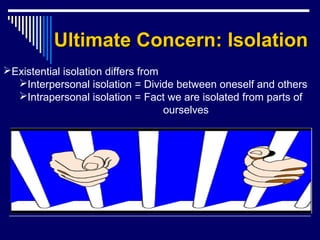
Existential isolation differs from
Interpersonal isolation = Divide between oneself and others
Intrapersonal isolation = Fact we are isolated from parts of
ourselves
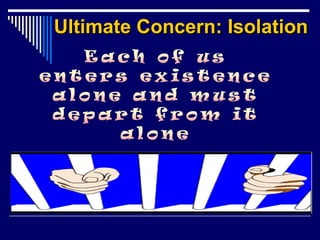
Ultimate Concern: IsolationUltimate Concern: Isolation
Ultimate Concern:Ultimate Concern:
MeaninglessnessMeaninglessness
Ultimate Concern:Ultimate Concern:
MeaninglessnessMeaninglessness
Meaning creates hierarchal
order of our values
Tells us how to live not why we
live
Conflict stems from “How does a
being who requires meaning
find meaning in a universe
that has no meaning”
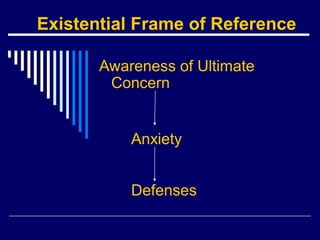
Existential Frame of Reference
Awareness of Ultimate
Concern
Anxiety
Defenses
Existential Frame of Reference
Specialness
Despite rationality we often believe
the laws of biology are not
applicable to us
Ultimate Rescuer
Belief in a personal omnipotent
servant to guard and protect us
History ofHistory of
Existential PsychotherapyExistential Psychotherapy
Fundamental questions leading to the
development of existential psychotherapy
included
 Where was the actual immediate person
to whom these things were happening?
 Are we seeing patients as they really are, or
are we simply seeing a projection of our
theories about them?
History ofHistory of
Existential PsychotherapyExistential Psychotherapy
In 1958 existential psychotherapy
introduced to the US with publication of
Existence: A New Dimension in Psychiatry
and Psychology by Rollo May, Ernest
Angel, and Henri Ellenberger
Yalom published the first comprehensive
textbook in existential psychiatry entitled
Existential Psychotherapy in 1981
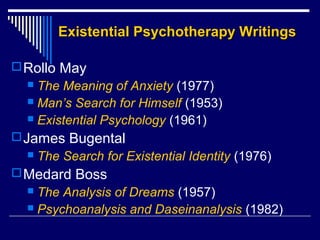
Existential Psychotherapy WritingsExistential Psychotherapy Writings
Rollo May
 The Meaning of Anxiety (1977)
 Man’s Search for Himself (1953)
 Existential Psychology (1961)
James Bugental
 The Search for Existential Identity (1976)
Medard Boss
 The Analysis of Dreams (1957)
 Psychoanalysis and Daseinanalysis (1982)
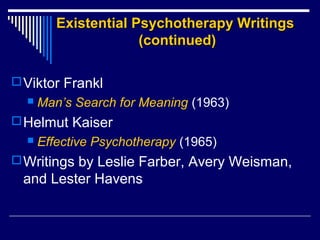
Existential Psychotherapy WritingsExistential Psychotherapy Writings
(continued)(continued)
Viktor Frankl
 Man’s Search for Meaning (1963)
Helmut Kaiser
 Effective Psychotherapy (1965)
Writings by Leslie Farber, Avery Weisman,
and Lester Havens
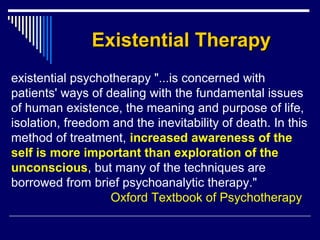
Existential TherapyExistential Therapy
existential psychotherapy "...is concerned with
patients' ways of dealing with the fundamental issues
of human existence, the meaning and purpose of life,
isolation, freedom and the inevitability of death. In this
method of treatment, increased awareness of the
self is more important than exploration of the
unconscious, but many of the techniques are
borrowed from brief psychoanalytic therapy."
Oxford Textbook of Psychotherapy
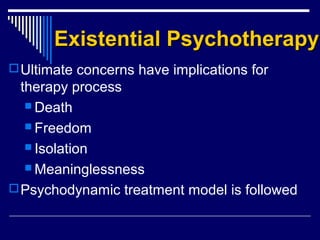
Existential PsychotherapyExistential Psychotherapy
Ultimate concerns have implications for
therapy process
 Death
 Freedom
 Isolation
 Meaninglessness
Psychodynamic treatment model is followed
Examples of how “every day” concerns
have “ontological underpinnings”
Fear of flying
 might represent ultimate concerns
regarding death
Difficulty adjusting after a divorce
 might relate to loneliness concerns
Existential Approach
is an Attitude
Therapist is a guide
Therapist is a symbol that an existential
ordeal can be faced and survived
The relationship heals when the
therapist is a companion as the client
confronts existence and all it entails
Existential PsychotherapyExistential Psychotherapy
Ultimate concerns create boundary situations
Boundary situations are experiences which force
individuals to confront an existential situation
 Examples might be the diagnosis of a terminal
illness or death of a family member or friend
Psychotherapy can address existential isolation
Jung suggested 30% of patients seek treatment
because of personal meaninglessness
Existential GroupExistential Group
PsychotherapyPsychotherapy
Patients learn how their behavior
 Is viewed by others
 Makes others feel
 Creates opinions others have of
them
 Influences their opinions of self
Comparing
Existential
Psychotherapy
to
Other
Theories
Psychodynamic  Existentialists reject predetermined
explanatory systems concerning
human ordeal
 Conflict viewed as grounded in the
human predicament, not suppressed
instincts
 Existentialists are not drawn to
concepts (e.g. Jung’s archetype,
collective unconscious)
Key Differences with Other
Approaches
Gestalt  Less emphasis on technical
contrivance in an existential model
 Gestalt approaches exemplify more
optimism
Cognitive
and
Behavioral
 Existentialists view these systems
as oversimplifying human
experience
 CBT has a more circumscribed plan
for change
Key Differences with Other
Approaches
Comparison of Existential TheoryComparison of Existential Theory
to Humanistic Approachesto Humanistic Approaches
 Humanistic therapies overlap considerably
with existential approaches
 Both emphasize growth and fulfillment of the
self
 Goals are for self mastery, self-examination
and creativity
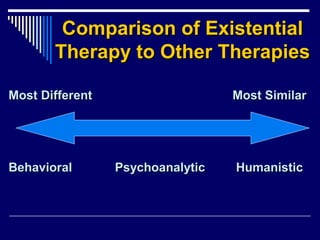
Comparison of ExistentialComparison of Existential
Therapy to Other TherapiesTherapy to Other Therapies
Most DifferentMost Different Most SimilarMost Similar
BehavioralBehavioral PsychoanalyticPsychoanalytic HumanisticHumanistic
Other Key Contrasts of ExistentialOther Key Contrasts of Existential
Theory Compared to Other SystemsTheory Compared to Other Systems
Existentialists reject concept of the person as
propelled by drives and instincts
Existentialists feel Jungians quickly avoid the
patient’s immediate crises by being to focused
on theory
Client-centered therapists do not confront the
patient directly and firmly
Applications of
Existential Therapy
The clinical setting determines the
applicability of the existential approach
Most applicable when patients are dealing
with a phase of life issue or a boundary
situation
A comprehensive existential approach is
most feasible in long term therapy
Evidence for ET
 Systematic, corroborative evidence for ET is
relatively limited
 Difficult to create controlled experimental designs to
test the approach
 Much of the research supporting ET uses
qualitative/phenomenological methods
 ET is supported by the research behind “common
factors”
Evidence for ET
 ET was used to treat patients with schizophrenia
and compared to conventional approaches
 less re-hospitalization and psychopathology
 Improved independence and functioning
 Qualitative research has validated the importance
of presence, self-reflection, and consideration of
alternatives in therapy
 Studies have shown transcendence essential to
change

Existential therapy Dr veera balaji kumar

  • 1.
  • 2.
    Learning ObjectivesLearning Objectives Thispresentation will focus on  An overview of existential psychotherapy  The history of existential psychotherapy  Applications of existential psychotherapy  Treatment techniques associated with existential psychotherapy
  • 3.
    No single founder- Many sources  existential therapy ‘cannot be traced to a single authoritative source’ - no Freud or Rogers, to give the approach a common theoretical and practical basis.  existential approaches to therapy have emerged spontaneously – and, at times, independently – in diverse parts of western Europe and subsequently the United States.  the philosophical field on which it is based is, itself, enormously diverse.
  • 4.
    Nietzche  He whohas a why to live can bear with any how  That which does not kill me, makes me stronger
  • 5.
    Key existential philosophers Kierkegaard, Søren (1813–55): Danish philosopher & father of modern existentialism.  Criticised the lack of passion and the conformity of nineteenth century Christendom,  Argued that human beings needed to turn towards their own subjective truths, and make a personal leap of faith towards God.  Buber, Martin (1878–1965): Jewish philosopher and theologian. Emphasised the relational nature of human existence, and the distinction between ‘I–Thou’ and ‘I–It’ modes of relating.
  • 6.
    Key existential philosophers Nietzsche, Friedrich (1844–1900): German philosopher. Attacked the slavish, herd mentality of conventional Christianity, and preached an atheistic gospel of aspiration towards the Übermensch: the autonomous superman who creates his or her own values and morality, and lives an earthly life of passion and power.  Jaspers, Karl (1883–1969): German psychiatrist- turned-philosopher, whose important idea of unavoidable ‘boundary situations’ that human beings face.
  • 7.
    Key existential philosophers Heidegger, Martin (1889–1976): German philosopher, influential -existential thinker.  Earlier work emphasised resolution in the face of anxiety, guilt and death, whilst later work placed greater emphasis on language and an openness towards Being.  Sartre, Jean-Paul (1905–80): French novelist philosopher, playwright and social critic.  Emphasised the freedom at the heart of human existence and the angst, meaninglessness and nausea that it evokes.
  • 8.
    Key existential philosophers Marcel, Gabriel (1889–1973): French philosopher, playwright and Christian.  Emphasised mysteriousness and immeasurability of existence,  and the importance of fidelity and openness to others, as well as the primacy of hope.  Camus, Albert (1913–60): French novelist and philosopher. Emphasised the absurdity of human existence, but the possibility of creating meaning in a meaningless world.
  • 9.
  • 10.
    What existentialism is…  A philosophical view that emphasizes the importance of existence, including one's responsibility for one's own psychological existence.
  • 11.
    Existentialism continued … Is NOT a technical approach to counseling that offers new rules for therapy.  Psychoanalysis – use of transference, free- association  Behaviorism – stimulus/response, +reinforcement/- reinforcement/punishment - It is a frame-of-reference or way of viewing and understanding a client’s suffering
  • 12.
    History of ExistentialismHistoryof Existentialism ““Existence precedes essence”Existence precedes essence” SartreSartre ““Truth dwells in the inner man”Truth dwells in the inner man” AugustineAugustine Existential thinking has occurred throughout history Exemplified by Augustine, Scotus, Pascal, Kierkegaard, Nietzsche
  • 13.
    Existential View of HumanNature  Assumption One: As humans, our basic conflict is between ourselves and the “givens” of our existence.  It’s not from instinctual drives (ego & superego)  It’s not from significant adults in one’s early life (need for acceptance and approval)  It’s this anxiety we experience when we are confronted with the givens of our existence
  • 14.
    Existential View of HumanNature  Assumption Two: Existing in the world brings about both normal and neurotic anxiety. “Anxiety arises from our personal need to survive, to preserve our being, and to assert our being (Corsini & Wedding, 2005, p. 271)  Anxiety occurs as we try to deal with important life themes:  living and dying  freedom, responsibility, & choice  isolation & loving  meaning & meaninglessness.
  • 15.
    Existential View of HumanNature  Assumption Three: As humans we have the capacity for self-awareness.  The greater our self-awareness, the greater our possibilities for freedom.  We can increase our capacity to live life fully.
  • 16.
    Existential View of HumanNature  Assumption Four: If a person is to be understood and helped to understand him/herself. That person must be understood from the perspective of the here-and-now.  The past is important only insofar as it is part of one’s current existence.  There are no attempts to uncover what happened in the past, instead there is a focus on experiences in the present.
  • 17.
    Existential View of HumanNature  Assumption Five: The significance of our existence (who we are) is never fixed. We are always re-creating ourselves, evolving, and becoming (Corey, 2005).  The essence of who we are is never fixed until we die.  Resistance to using theorotypes or labels
  • 18.
    Existence as Verb-like Existentialists conceive human existence as not a noun-like thing, but a verb-like happening.  human existence is fundamentally dynamic in nature, that it is a flux, an unfolding event, a path (Jaspers, 1986) or a process.  Indeed, the very word ‘exist’ comes from the Latin verb ‘existere’, which means to stand out or emerge.  Existence, then, can be conceived of as an upsurge (Sartre, 1943/1958): a becoming, a bursting forth into the world
  • 19.
    A phenomenological exercise Reflect, for a minute, on what you are experiencing as you listen my words.  Initially, you may perceive yourself as a thing-like self encountering another thing: my lecture.  If you try to bracket this natural attitude, however, and simply focus on what you are experiencing, you may come to see that your experiencing is a listening-to-my-words-now, or a wondering-what-  this-is-all-about, rather than a fixed thing encountering another fixed thing
  • 20.
    A phenomenological exercise From an existential perspective, then, we are first and foremost a verb-like being, and it is only subsequently that we may define ourselves as a noun-like thing: such as ‘an extrovert’ or ‘a therapist’.  This is the meaning of the well-known Sartrean phrase: ‘Existence precedes essence’ (see Figure 2.2).  In other words, human beings are not fixed selves, but a relationship towards their own being
  • 21.
  • 22.
    Basic ConceptsBasic Concepts Existentialpsychotherapy is “an encounter with one’s own existence in an immediate and quintessential form” May (1967)
  • 23.
    Existential PsychotherapyExistential Psychotherapy Not a specific technique, more philosophical in nature  Focuses on issues central to human existence  Task of therapy is to facilitate genuineness  Emphasis is on the phenomenological moment between therapist and client
  • 24.
    Existential Psychotherapy -ExistentialPsychotherapy - OverviewOverview  “Endeavour to understand the man as he really is”.  Existential approach is all about exploring meaning and values, and living authentically – in accordance with one's own ideals, priorities and values.  It views human beings as creature of continual change and transformation, living finite lives in a context of personal strengths and weaknesses as well as opportunities and limitations created by the environment.
  • 25.
    Heidegger’s Two Basic Patternsof Being  Inauthentic mode  Giving oneself over to externally derived definitions, “everydayness”  Authentic (ontological) mode  Recognizing one’s uniqueness, remaining true to self
  • 26.
    Existential Psychotherapy:Existential Psychotherapy: TheBasic “I-Am” Experience”The Basic “I-Am” Experience” “I am now living and I could take my life” “The idea of suicide has saved many lives” Nietzsche Existential psychotherapy seeks a deeper and more discerning type of therapy
  • 27.
    Existential Psychotherapy: The Basic“I-Am” Experience” (continued) The “I am” experience is not a solution in itself It is a precondition for a solution An ontological experience  Ontis = to be  Logical = the science of
  • 28.
    Existential Psychotherapy: The Basic“I-Am” Experience” (continued)  Nonbeing is illustrated in the experience of  fear of death, destructive hostility,  severe anxiety and  critical sickness
  • 29.
    EXISTENTIAL MODEL OFANXIETY Anxiety is moreAnxiety is more basic than fearbasic than fear Anxiety arises from our personal need to survive, to preserve our being, and to assert our being
  • 30.
    EXISTENTIAL MODEL OFANXIETY Normal AnxietyNormal Anxiety Proportionate to the situation Does not require repression Can be used for creativity Neurotic AnxietyNeurotic Anxiety Exceeds or minimizes the situation It is repressed Destructive
  • 31.
    EXISTENTIAL MODEL OFANXIETY Awareness of Ultimate Concern (Death, Freedom, isolation, meaninglessness) Anxiety Defenses
  • 32.
    EXISTENTIAL MODEL OFGUILT Normal GuiltNormal Guilt Proportionate to the situation Sensitizes us to the ethical aspects of behavior Can be used for creativity Neurotic GuiltNeurotic Guilt About fantasized transgressions “Forgetting being” Destructive
  • 33.
    The Three Formsof World:The Three Forms of World: Being-In-the-WorldBeing-In-the-World UmweltUmwelt MitweltMitweltEigenweltEigenwelt
  • 34.
    The Three Formsof World:The Three Forms of World: Being-In-the-WorldBeing-In-the-World  Umwelt = world around; biological world  Mitwelt = with world; world of one’s fellow human beings  Eigenwelt = own world; relationship to one’s self
  • 35.
    Basic concepts  Sensingbeing as real  Understanding of a person as a being in the world  Differentiating ego from being  Considering the fact of non-being death and termination  Viewing anxiety and guilt as ontological.
  • 36.
    Focus  On therelationships a person has both with himself and with the world around him.  When the relationships are not navigated effectively psychological disturbance occurs.  Well-being can be negotiated gradually by coming to terms with life, the world and oneself.  A person may be enjoying relatively healthy functioning, yet still experience ‘Existential angst’ - existential vacuum – a realization that his life is meaningless.
  • 37.
    Objectives  Four-part frameworkof client’s existence :  Physical dimension  Social dimension  Psychological or personal dimension  Spiritual dimension
  • 38.
    Significance of Time HumanHuman experiencesexperiences likejoy,like joy, depressiondepression and anxiety occurand anxiety occur in the dimensionin the dimension of time rather thanof time rather than spacespace
  • 39.
    Significance of Time Lovecan not be measured by the number of years one has known the loved one “No clock strikes for the happy one”
  • 40.
    Human Capacity toTranscend the Immediate Situation Transcendere means “to climb over and beyond” Existing involves a continual emerging A transcending of one’s past and present must occur in order to reach the future This capacity might be neurobiologically based
  • 41.
    The phenomenological method  Akey contribution - as developed by the German philosopher Edmund Husserl (1859–1938).  adopted a standpoint of radical doubt, arguing that all we can know is what we experience: the ‘inner evidence’ that is given to us intuitively in our conscious experiencing of things.  In other words, to truly know ourselves and our world, we need to turn our attention to our conscious, lived-experiences.
  • 42.
    The phenomenological method  Threeinterrelated steps. The first of these steps is the rule of ‘epoché’, whereby we are urged to ‘set aside our initial biases and prejudices of things, to suspend our expectations and assumptions,  in short, to bracket all such temporarily and as far as it is possible so that we can focus on the primary data of our experience’.  Husserl urges us to set aside our ‘natural attitude’ – that objects in the external world are objectively present in space &time – and instead focus solely on our immediate and present experiencing of them
  • 43.
    The phenomenological method  Thesecond step in the phenomenological method, is the ‘rule of description’, the essence of which is ‘Describe, don’t explain’ (Ihde, 1986: 34).  Here, we are urged to refrain from producing explanations, hypotheses or theories as to what we are experiencing, and  instead to stay with the lived-experiences as they actually are.
  • 44.
    The phenomenological method  Finally,there is the ‘rule of horizontalisation’, which ‘further urges us to avoid placing any initial hierarchies of significance or importance upon the items of our descriptions, and  instead to treat each initially as having equal value or significance’
  • 45.
  • 46.
    Existentialists Suggest we donot possess a personality rather we embody an experience Ontology = science of being Normalcy is seen as a failure in becoming Neurosis is tantamount to avoidance, i.e. neurotic individuals are living in the every day rather than dealing with the challenges of ultimate concerns
  • 47.
  • 48.
    Ultimate Concern: DeathUltimateConcern: Death The most obvious ultimate concern “A Terrible Truth” Conflict between awareness of death and desire to live To cope we erect defenses against death awareness Psychopathology in part is due to failure to deal with the inevitability of death
  • 49.
    Ultimate Concern: FreedomUltimateConcern: Freedom Humans areHumans are “condemned to freedom”“condemned to freedom” SARTRE
  • 50.
    Ultimate Concern: FreedomUltimateConcern: Freedom Refers to fact that humans are the authors of their own world We are responsible for our own choices Conflict is between groundlessness and desire for ground/structure
  • 51.
    Ultimate Concern: FreedomUltimateConcern: Freedom Implications for therapy  Responsibility  Willing  Impulsivity  Compulsivity  Decision
  • 52.
    Ultimate Concern: IsolationUltimateConcern: Isolation Existential isolation differs from Interpersonal isolation = Divide between oneself and others Intrapersonal isolation = Fact we are isolated from parts of ourselves
  • 53.
  • 54.
  • 55.
    Ultimate Concern:Ultimate Concern: MeaninglessnessMeaninglessness Meaningcreates hierarchal order of our values Tells us how to live not why we live Conflict stems from “How does a being who requires meaning find meaning in a universe that has no meaning”
  • 56.
    Existential Frame ofReference Awareness of Ultimate Concern Anxiety Defenses
  • 57.
    Existential Frame ofReference Specialness Despite rationality we often believe the laws of biology are not applicable to us Ultimate Rescuer Belief in a personal omnipotent servant to guard and protect us
  • 58.
    History ofHistory of ExistentialPsychotherapyExistential Psychotherapy Fundamental questions leading to the development of existential psychotherapy included  Where was the actual immediate person to whom these things were happening?  Are we seeing patients as they really are, or are we simply seeing a projection of our theories about them?
  • 59.
    History ofHistory of ExistentialPsychotherapyExistential Psychotherapy In 1958 existential psychotherapy introduced to the US with publication of Existence: A New Dimension in Psychiatry and Psychology by Rollo May, Ernest Angel, and Henri Ellenberger Yalom published the first comprehensive textbook in existential psychiatry entitled Existential Psychotherapy in 1981
  • 60.
    Existential Psychotherapy WritingsExistentialPsychotherapy Writings Rollo May  The Meaning of Anxiety (1977)  Man’s Search for Himself (1953)  Existential Psychology (1961) James Bugental  The Search for Existential Identity (1976) Medard Boss  The Analysis of Dreams (1957)  Psychoanalysis and Daseinanalysis (1982)
  • 61.
    Existential Psychotherapy WritingsExistentialPsychotherapy Writings (continued)(continued) Viktor Frankl  Man’s Search for Meaning (1963) Helmut Kaiser  Effective Psychotherapy (1965) Writings by Leslie Farber, Avery Weisman, and Lester Havens
  • 63.
    Existential TherapyExistential Therapy existentialpsychotherapy "...is concerned with patients' ways of dealing with the fundamental issues of human existence, the meaning and purpose of life, isolation, freedom and the inevitability of death. In this method of treatment, increased awareness of the self is more important than exploration of the unconscious, but many of the techniques are borrowed from brief psychoanalytic therapy." Oxford Textbook of Psychotherapy
  • 64.
    Existential PsychotherapyExistential Psychotherapy Ultimateconcerns have implications for therapy process  Death  Freedom  Isolation  Meaninglessness Psychodynamic treatment model is followed
  • 65.
    Examples of how“every day” concerns have “ontological underpinnings” Fear of flying  might represent ultimate concerns regarding death Difficulty adjusting after a divorce  might relate to loneliness concerns
  • 66.
    Existential Approach is anAttitude Therapist is a guide Therapist is a symbol that an existential ordeal can be faced and survived The relationship heals when the therapist is a companion as the client confronts existence and all it entails
  • 67.
    Existential PsychotherapyExistential Psychotherapy Ultimateconcerns create boundary situations Boundary situations are experiences which force individuals to confront an existential situation  Examples might be the diagnosis of a terminal illness or death of a family member or friend Psychotherapy can address existential isolation Jung suggested 30% of patients seek treatment because of personal meaninglessness
  • 68.
    Existential GroupExistential Group PsychotherapyPsychotherapy Patientslearn how their behavior  Is viewed by others  Makes others feel  Creates opinions others have of them  Influences their opinions of self
  • 69.
  • 70.
    Psychodynamic  Existentialistsreject predetermined explanatory systems concerning human ordeal  Conflict viewed as grounded in the human predicament, not suppressed instincts  Existentialists are not drawn to concepts (e.g. Jung’s archetype, collective unconscious) Key Differences with Other Approaches
  • 71.
    Gestalt  Lessemphasis on technical contrivance in an existential model  Gestalt approaches exemplify more optimism Cognitive and Behavioral  Existentialists view these systems as oversimplifying human experience  CBT has a more circumscribed plan for change Key Differences with Other Approaches
  • 72.
    Comparison of ExistentialTheoryComparison of Existential Theory to Humanistic Approachesto Humanistic Approaches  Humanistic therapies overlap considerably with existential approaches  Both emphasize growth and fulfillment of the self  Goals are for self mastery, self-examination and creativity
  • 73.
    Comparison of ExistentialComparisonof Existential Therapy to Other TherapiesTherapy to Other Therapies Most DifferentMost Different Most SimilarMost Similar BehavioralBehavioral PsychoanalyticPsychoanalytic HumanisticHumanistic
  • 74.
    Other Key Contrastsof ExistentialOther Key Contrasts of Existential Theory Compared to Other SystemsTheory Compared to Other Systems Existentialists reject concept of the person as propelled by drives and instincts Existentialists feel Jungians quickly avoid the patient’s immediate crises by being to focused on theory Client-centered therapists do not confront the patient directly and firmly
  • 76.
    Applications of Existential Therapy Theclinical setting determines the applicability of the existential approach Most applicable when patients are dealing with a phase of life issue or a boundary situation A comprehensive existential approach is most feasible in long term therapy
  • 77.
    Evidence for ET Systematic, corroborative evidence for ET is relatively limited  Difficult to create controlled experimental designs to test the approach  Much of the research supporting ET uses qualitative/phenomenological methods  ET is supported by the research behind “common factors”
  • 78.
    Evidence for ET ET was used to treat patients with schizophrenia and compared to conventional approaches  less re-hospitalization and psychopathology  Improved independence and functioning  Qualitative research has validated the importance of presence, self-reflection, and consideration of alternatives in therapy  Studies have shown transcendence essential to change