Knowledge management in organizations M  INFS 5072   Week 4: Meta knowledge (knowledge about knowledge)
Today Part one: Ontology  and  epistemology Ontology Epistemology Logical positivist vs. constructivist epistemologies Ontology ,  epistemology and knowledge management
Today Part Two: knowledge about knowledge Procedural vs. declarative knowledge Explicit vs. tacit knowledge  Application: Traditional teaching vs. experiential learning
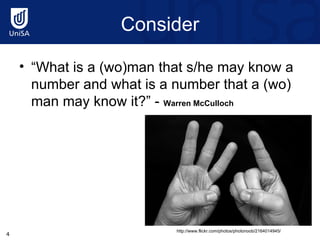
Consider “ What is a (wo)man that s/he may know a number and what is a number that a (wo) man may know it?” -  Warren McCulloch http://www.flickr.com/photos/photonoob/2164014945/
Ontology
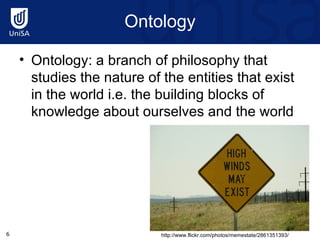
Ontology Ontology: a branch of philosophy that studies the nature of the entities that exist in the world i.e. the building blocks of knowledge about ourselves and the world http://www.flickr.com/photos/memestate/2861351393/
Ontological questions Q: Is the outside world, and everything in it, objectively ‘real’ or a (social) ‘construct’ of our senses and minds? http://www.flickr.com/photos/olahus/237785510/
Ontological questions Q: What are the fundamental things that exist? Q: How do objects or people persist over time? If I give this lecture on meta knowledge next year and change some slides is it the same lecture?
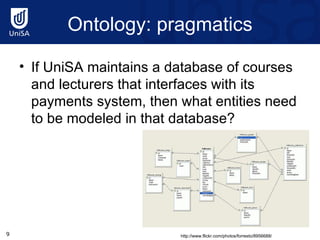
Ontology: pragmatics If UniSA maintains a database of courses and lecturers that interfaces with its payments system, then what entities need to be modeled in that database? http://www.flickr.com/photos/forresto/8956688/
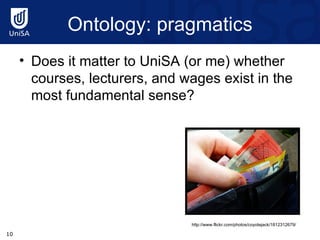
Ontology: pragmatics Does it matter to UniSA (or me) whether courses, lecturers, and wages exist in the most fundamental sense? http://www.flickr.com/photos/coyotejack/1812312679/
Epistemology
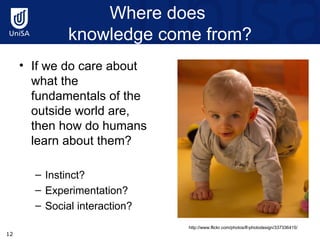
Where does  knowledge come from? If we do care about what the fundamentals of the outside world are, then how do humans learn about them? Instinct? Experimentation? Social interaction? http://www.flickr.com/photos/lf-photodesign/337336415/
Epistemology Epistemology: a branch of philosophy that studies the nature of knowledge, its presuppositions and foundations, its extent and validity and  how it is acquired http://www.flickr.com/photos/sketch22/2933169920/
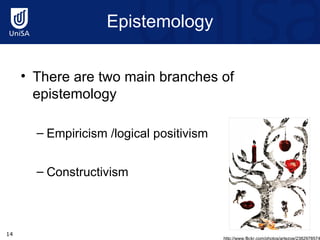
Epistemology There are two main branches of epistemology Empiricism /logical positivism Constructivism http://www.flickr.com/photos/artezoe/2382978574/
Epistemology: empiricism The only source of knowledge is experience Experiments and observation are the main instruments for acquisition of knowledge Knowledge accurately reflects the world and is verifiable http://www.flickr.com/photos/mosmi/49145544/
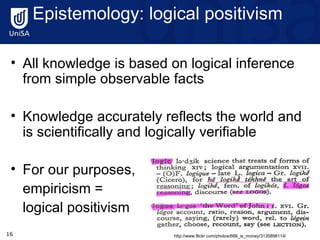
Epistemology: logical positivism   All knowledge is based on logical inference from simple observable facts Knowledge accurately reflects the world and is scientifically and logically verifiable  For our purposes,  empiricism =  logical positivism http://www.flickr.com/photos/666_is_money/3135898114/
Epistemology: constructivism Our beliefs and perceptions of the world are human constructs Knowledge is personally and socially constructed  Knowledge is personally and culturally relative http://www.flickr.com/photos/georgiesharp/160731642/
Example of logical positivism and constructivism To a logical positivist, these lecture slides probably exist in the world and you build an internal representation of them that mirrors reality  But to a constructivist, you each construct personal meaning about the world from the lecture. The meaning you construct will differ from your neighbour’s depending upon your previous experience and values
Ontology  and epistemology
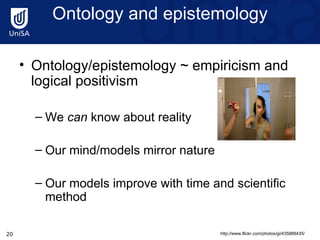
Ontology and epistemology Ontology/epistemology ~ empiricism and logical positivism  We  can  know about reality  Our mind/models mirror nature Our models improve with time and scientific method http://www.flickr.com/photos/gi/435888435/
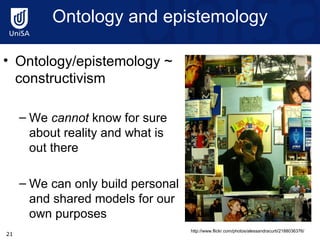
Ontology and epistemology Ontology/epistemology ~ constructivism We  cannot  know for sure about reality and what is out there  We can only build personal and shared models for our own purposes http://www.flickr.com/photos/alessandracurti/2188036376/
Implications of  epistemology  and ontology  for  knowledge management
Social and scientific cultures  Logical positivism tends to dominate the scientific research culture Constructivism tends to dominate the social sciences research culture As knowledge management overlaps both cultures, there is persistent tension between them in the literature and to a lesser extent in practice
Logical positivists  and knowledge management  Logical positivists will tend to believe that knowledge can be stored in freestanding media such as documents and computer programs  They will tend to believe that such knowledge is more universally applicable i.e. less limited by context
Logical positivists  and knowledge management  Logical positivists will tend to believe that knowledge management should focus more on computers than social networks and that knowledge management systems should facilitate storing and retrieving explicit knowledge
Constructivists and knowledge management  Constructivists will tend to believe that knowledge only exists in peoples’ heads (situated in an environment and context)  and cannot be stored in freestanding external representations, such as documents or computer programs They will also tend to think that the applicability of such knowledge is limited by cultural contexts
Constructivists and knowledge management  Constructivists will tend to believe that knowledge management should be people-centric  So constructivists will tend to believe knowledge management systems should facilitate communication between people rather than make freestanding documents or other forms of knowledge representation available to them
Knowing that  vs. knowing how
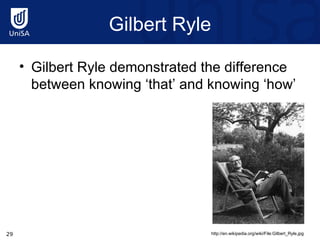
Gilbert  Ryle Gilbert  Ryle demonstrated the difference between knowing ‘that’ and knowing ‘how’  http://en.wikipedia.org/wiki/File:Gilbert_Ryle.jpg
Ryle : Knowing that Knowing ‘that’ something is true demonstrates that you posses knowledge E.g. Knowing ‘that’ George W. Bush was president of the United States  shows that you know a historical fact  (it does not show that you know how to apply that fact in the context of a task) Knowing ‘that’ is broadly compatible with logical positivism
Ryle : Knowing that Knowing ‘that’ can be referred to as declarative knowledge  Declarative knowledge can be expressed in sentences in a natural language, such as English, or a formal language such as mathematics or logic Declarative knowledge is broadly compatible with logical positivism
Ryle : Knowing how Knowing ‘how’ to do something demonstrates that you posses practical intelligence E.g. Knowing ‘how’  to implement a knowledge management system that will satisfy all the stakeholders in an organisation  demonstrates practical intelligence Knowing ‘how’ is a behaviouristic measure i.e. your intelligence can be measured by your behaviour
Ryle : knowing how Knowing ‘how’ can be referred to as procedural knowledge Procedural knowledge is the knowledge exercised in the performance of some task e.g. riding a bicycle Procedural knowledge is broadly compatible with constructivism
Separating  declarative from   procedural knowledge? In practice declarative and procedural knowledge can be hard to separate: Q: What was the middle initial of the pervious US president? A: ‘W’ To respond to a procedural task (i.e. answering a question), I needed to be able to access declarative knowledge (i.e. ‘W’)
Separating  declarative from   procedural knowledge? Q: What was the middle initial of the pervious US president? A: ‘W’ I also needed to possess and apply a good deal of contextual knowledge about what ‘pervious’ means in this context
Example of declarative and   procedural knowledge  These lecture slides contain declarative knowledge The lecturer provides procedural knowledge in performing the lecture  You provide procedural knowledge in making your meaning from the lecture
Explicit vs.  tacit knowledge
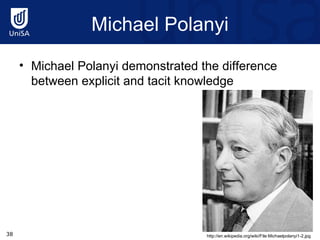
Michael Polanyi Michael Polanyi  demonstrated the difference between explicit and tacit knowledge http://en.wikipedia.org/wiki/File:Michaelpolanyi1-2.jpg
Polanyi : explicit knowledge Explicit knowledge is knowledge which you can explain or put into words or diagrams or computer programs Explicit knowledge tends to be meaningless without the necessary context provided by tacit knowledge (hang on we will get to tacit knowledge …)
Polanyi : explicit knowledge Explicit knowledge is easy to share … you can use language, books or podcasts … …  but people only understand the explicit knowledge you share with them if they possess the appropriate tacit knowledge to provide a meaningful context Explicit knowledge is broadly compatible with logical positivism and declarative knowledge
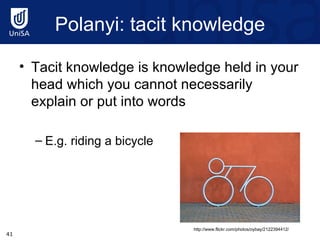
Polanyi : tacit knowledge Tacit knowledge is knowledge held in your head which you cannot necessarily explain or put into words E.g. riding a bicycle http://www.flickr.com/photos/oybay/2122394412/
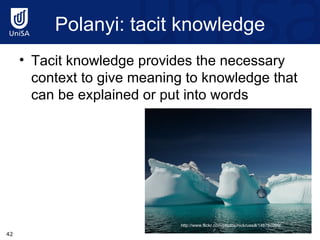
Polanyi : tacit knowledge Tacit knowledge provides the necessary context to give meaning to knowledge that can be explained or put into words http://www.flickr.com/photos/nickrussill/146760299/
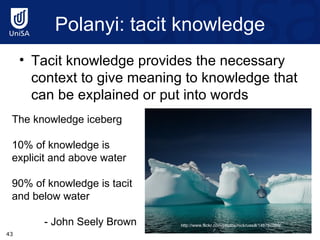
Polanyi : tacit knowledge Tacit knowledge provides the necessary context to give meaning to knowledge that can be explained or put into words http://www.flickr.com/photos/nickrussill/146760299/ The knowledge iceberg 10% of knowledge is explicit and above water 90% of knowledge is tacit and below water - John Seely Brown
Polanyi : tacit knowledge Tacit knowledge is very hard to share because it is hard to call to mind, put into language and communicate Communicating tacit knowledge requires trust and shared culture  Tacit knowledge is broadly compatible with constructivism and procedural knowledge
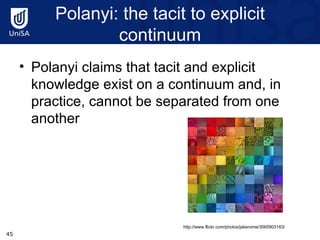
Polanyi: the tacit to explicit continuum Polanyi claims that tacit and explicit knowledge exist on a continuum and, in practice, cannot be separated from one another http://www.flickr.com/photos/jakerome/3065903183/
Implications of tacit and explicit knowledge “ Much harder to grasp is the concept of tacit knowledge, or the know-how contained in people's heads. The challenge inherent with tacit knowledge is figuring out how to recognize, generate, share and manage it. While IT in the form of e-mail, groupware, instant messaging and related technologies can help facilitate the dissemination of tacit knowledge, identifying tacit knowledge in the first place is a major hurdle for most organizations.” Source: http://www.cio.com/article/40343/Knowledge_Management_Definition_and_Solutions  Knowledge management systems that rely on explicit knowledge can fail if tacit knowledge is ignored or is not available
Example of tacit and explicit knowledge These lecture slides mediate explicit knowledge while the lecture itself is procedural, the lecture adds to the explicit knowledge by setting it into a tacit context (body language, gesture, tone of voice …) The experience  is  different for internal and external students and (I believe) everyone constructs their own meaning from it
Social capital and tacit  and explicit knowledge Social capital acknowledges that ‘‘social relationships have value’’ (Putnam, 2000, p.18) “ According to Burt, social capital can be thought of as ‘‘know-who’’; it is about ‘‘everyone you now know, everyone you knew and everyone who knows you even though you do not know them’’ (Burt, 1992)” (Smedlund, 2008, p 63) Procedural knowledge: Knowing how Explicit knowledge: Knowing that Social capital: Knowing who Tacit knowledge: Understanding how, that and who
Cultural capital and tacit  and explicit knowledge Cultural capital was invented by Bourdieu and describes forms of knowledge, skills, education, and advantages that a person has, which give them a higher status in society (Swartz,1998) Cultural capital: Knowing that the right knowledge confers power Procedural knowledge: Knowing how Explicit knowledge: Knowing that Social capital: Knowing who Tacit knowledge: Understanding how, that and who In some societies a dominant class is able to impose its definition of reality upon all other classes.  Cultural capital can be found attached to organizations. In computing for many years IBM, which was the largest player in the sector, was said to be ‘the environment’. So the norms for the sector i.e. much of its tacit knowledge about culture rolled out from IBM
Case study/application: Traditional teaching vs.  experiential learning
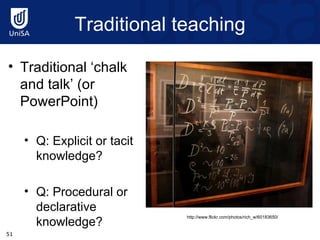
Traditional teaching http://www.flickr.com/photos/rich_w/60183650/ Traditional ‘chalk and talk’ (or PowerPoint) Q: Explicit or tacit knowledge? Q: Procedural or declarative knowledge?
Experiential learning “ Experiential learning is the process of making meaning from direct experience” (constructivism)  en.wikipedia.org/wiki/Experiential_learning “ Learning by doing” (constructivism, procedural knowledge)  www.unesco.org/education/educprog/lwf/doc/portfolio/definitions.htm
Experiential learning “…  describes an environment in which learning is driven by a process of enquiry owned by the student. Starting with a ‘scenario’ and with the guidance of a facilitator, students identify their own issues and questions. They then examine the resources they need to research the topic, thereby acquiring the requisite knowledge. Knowledge so gained is more readily retained because it has been acquired by experience and in relation to a real problem. It is essential that our students are educated for knowledge creation, lifelong learning and leadership. They will take on leading roles in their future working environments: directing change, asking important questions, solving problems and developing new knowledge.”  - CEEBL (2007)
Experiential learning “ Although the … learner may primarily 'learn for themselves what is already known', there is potential for a direct feedback loop between the lecturer’s research and that of the student, thereby contributing directly to new knowledge. This is a virtuous outcome, binding teaching and research much closer together and enabling the same skills to be used for both.” - Browne and Shurville (2006)
Teaching-research nexus This feedback loop between the research of the lecturer and that of the students is an example of the ‘teaching-research nexus’, which makes the construction of new knowledge meaningful and relevant for both parties The teaching-research nexus helps to build tacit contexts to give meaning to explicit knowledge and help researchers to broaden their understanding of the meaning of their work
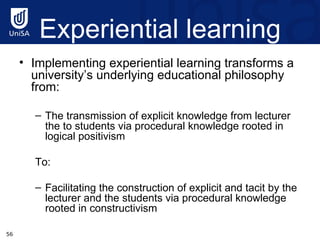
Experiential learning Implementing experiential learning transforms a university’s underlying educational philosophy from:  The transmission of explicit knowledge from lecturer the to students via procedural knowledge rooted in logical positivism  To:  Facilitating the construction of explicit and tacit by the lecturer and the students via procedural knowledge rooted in constructivism
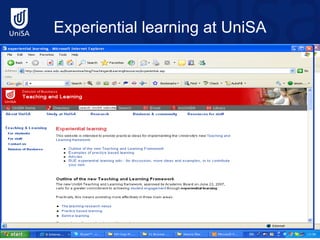
Experiential learning at UniSA
Philosophy and your education at UniSA and beyond I hope that this example shows that philosophical knowledge about knowledge (meta knowledge) can be applicable in your own current experience of knowledge management, which is being constructed by learning about knowledge management in organizations through a combination of transmission teaching and experiential learning I hope it also shows that meta knowledge can contribute to an understanding the transformation of organizations
References References Burt, R. (1992),  Structural Holes: The Social Structure of Competition , Harvard University Press, Cambridge, MA,  Centre for Excellence in Enquiry-Based Learning (2007), What is Enquiry-Based Learning? http://www.campus.manchester.ac.uk/ceebl/ebl/. Accessed 24 June 2007. Putnam, R. (2000),  Bowling Alone: The Collapse and Revival of American Community , Simon & Schuster, New York, NY,  Swartz,D. (1998),  Culture and Power: The Sociology of Pierre Bourdieu , University of Chicago Press ISBN 0226785955  Further reading Carver, R, King, R, Hannum, W & Fowler, B 2007, Towards a model of experiential e-learning,  Journal of Online Learning and Teaching,  vol. 3, no. 3, September.  Pearson, CAL & Beasley, CJ 1998, From aeroplanes to stoves: Using experiential learning in a management course, in  Teaching and Learning in Changing Times, Proceedings of the 7th Annual Teaching Learning Forum,  eds B Black & N Stanley,The University of Western Australia.  http://www.unisa.edu.au/businessteaching/TeachingandLearningResources/experiential.asp Essential reading: Browne, T. and Shurville, S. (2007) Educating Minds for the Knowledge Economy. Journal of Organisational Transformation and Social Change, Volume 4, Issue 1, pp 3-12.  Smedlund, A. (2008) The knowledge system of a firm: social capital for explicit, tacit and potential knowledge, Journal of Knowledge Management, Vol. 12, No. 1 pp. 63-77
Next week:  socio-technical theory

Lecture 4 Meta Knowledge

  • 1.
    Knowledge management inorganizations M INFS 5072 Week 4: Meta knowledge (knowledge about knowledge)
  • 2.
    Today Part one:Ontology and epistemology Ontology Epistemology Logical positivist vs. constructivist epistemologies Ontology , epistemology and knowledge management
  • 3.
    Today Part Two:knowledge about knowledge Procedural vs. declarative knowledge Explicit vs. tacit knowledge Application: Traditional teaching vs. experiential learning
  • 4.
    Consider “ Whatis a (wo)man that s/he may know a number and what is a number that a (wo) man may know it?” - Warren McCulloch http://www.flickr.com/photos/photonoob/2164014945/
  • 5.
  • 6.
    Ontology Ontology: abranch of philosophy that studies the nature of the entities that exist in the world i.e. the building blocks of knowledge about ourselves and the world http://www.flickr.com/photos/memestate/2861351393/
  • 7.
    Ontological questions Q:Is the outside world, and everything in it, objectively ‘real’ or a (social) ‘construct’ of our senses and minds? http://www.flickr.com/photos/olahus/237785510/
  • 8.
    Ontological questions Q:What are the fundamental things that exist? Q: How do objects or people persist over time? If I give this lecture on meta knowledge next year and change some slides is it the same lecture?
  • 9.
    Ontology: pragmatics IfUniSA maintains a database of courses and lecturers that interfaces with its payments system, then what entities need to be modeled in that database? http://www.flickr.com/photos/forresto/8956688/
  • 10.
    Ontology: pragmatics Doesit matter to UniSA (or me) whether courses, lecturers, and wages exist in the most fundamental sense? http://www.flickr.com/photos/coyotejack/1812312679/
  • 11.
  • 12.
    Where does knowledge come from? If we do care about what the fundamentals of the outside world are, then how do humans learn about them? Instinct? Experimentation? Social interaction? http://www.flickr.com/photos/lf-photodesign/337336415/
  • 13.
    Epistemology Epistemology: abranch of philosophy that studies the nature of knowledge, its presuppositions and foundations, its extent and validity and how it is acquired http://www.flickr.com/photos/sketch22/2933169920/
  • 14.
    Epistemology There aretwo main branches of epistemology Empiricism /logical positivism Constructivism http://www.flickr.com/photos/artezoe/2382978574/
  • 15.
    Epistemology: empiricism Theonly source of knowledge is experience Experiments and observation are the main instruments for acquisition of knowledge Knowledge accurately reflects the world and is verifiable http://www.flickr.com/photos/mosmi/49145544/
  • 16.
    Epistemology: logical positivism All knowledge is based on logical inference from simple observable facts Knowledge accurately reflects the world and is scientifically and logically verifiable For our purposes, empiricism = logical positivism http://www.flickr.com/photos/666_is_money/3135898114/
  • 17.
    Epistemology: constructivism Ourbeliefs and perceptions of the world are human constructs Knowledge is personally and socially constructed Knowledge is personally and culturally relative http://www.flickr.com/photos/georgiesharp/160731642/
  • 18.
    Example of logicalpositivism and constructivism To a logical positivist, these lecture slides probably exist in the world and you build an internal representation of them that mirrors reality But to a constructivist, you each construct personal meaning about the world from the lecture. The meaning you construct will differ from your neighbour’s depending upon your previous experience and values
  • 19.
    Ontology andepistemology
  • 20.
    Ontology and epistemologyOntology/epistemology ~ empiricism and logical positivism We can know about reality Our mind/models mirror nature Our models improve with time and scientific method http://www.flickr.com/photos/gi/435888435/
  • 21.
    Ontology and epistemologyOntology/epistemology ~ constructivism We cannot know for sure about reality and what is out there We can only build personal and shared models for our own purposes http://www.flickr.com/photos/alessandracurti/2188036376/
  • 22.
    Implications of epistemology and ontology for knowledge management
  • 23.
    Social and scientificcultures Logical positivism tends to dominate the scientific research culture Constructivism tends to dominate the social sciences research culture As knowledge management overlaps both cultures, there is persistent tension between them in the literature and to a lesser extent in practice
  • 24.
    Logical positivists and knowledge management Logical positivists will tend to believe that knowledge can be stored in freestanding media such as documents and computer programs They will tend to believe that such knowledge is more universally applicable i.e. less limited by context
  • 25.
    Logical positivists and knowledge management Logical positivists will tend to believe that knowledge management should focus more on computers than social networks and that knowledge management systems should facilitate storing and retrieving explicit knowledge
  • 26.
    Constructivists and knowledgemanagement Constructivists will tend to believe that knowledge only exists in peoples’ heads (situated in an environment and context) and cannot be stored in freestanding external representations, such as documents or computer programs They will also tend to think that the applicability of such knowledge is limited by cultural contexts
  • 27.
    Constructivists and knowledgemanagement Constructivists will tend to believe that knowledge management should be people-centric So constructivists will tend to believe knowledge management systems should facilitate communication between people rather than make freestanding documents or other forms of knowledge representation available to them
  • 28.
    Knowing that vs. knowing how
  • 29.
    Gilbert RyleGilbert Ryle demonstrated the difference between knowing ‘that’ and knowing ‘how’ http://en.wikipedia.org/wiki/File:Gilbert_Ryle.jpg
  • 30.
    Ryle : Knowingthat Knowing ‘that’ something is true demonstrates that you posses knowledge E.g. Knowing ‘that’ George W. Bush was president of the United States shows that you know a historical fact (it does not show that you know how to apply that fact in the context of a task) Knowing ‘that’ is broadly compatible with logical positivism
  • 31.
    Ryle : Knowingthat Knowing ‘that’ can be referred to as declarative knowledge Declarative knowledge can be expressed in sentences in a natural language, such as English, or a formal language such as mathematics or logic Declarative knowledge is broadly compatible with logical positivism
  • 32.
    Ryle : Knowinghow Knowing ‘how’ to do something demonstrates that you posses practical intelligence E.g. Knowing ‘how’ to implement a knowledge management system that will satisfy all the stakeholders in an organisation demonstrates practical intelligence Knowing ‘how’ is a behaviouristic measure i.e. your intelligence can be measured by your behaviour
  • 33.
    Ryle : knowinghow Knowing ‘how’ can be referred to as procedural knowledge Procedural knowledge is the knowledge exercised in the performance of some task e.g. riding a bicycle Procedural knowledge is broadly compatible with constructivism
  • 34.
    Separating declarativefrom procedural knowledge? In practice declarative and procedural knowledge can be hard to separate: Q: What was the middle initial of the pervious US president? A: ‘W’ To respond to a procedural task (i.e. answering a question), I needed to be able to access declarative knowledge (i.e. ‘W’)
  • 35.
    Separating declarativefrom procedural knowledge? Q: What was the middle initial of the pervious US president? A: ‘W’ I also needed to possess and apply a good deal of contextual knowledge about what ‘pervious’ means in this context
  • 36.
    Example of declarativeand procedural knowledge These lecture slides contain declarative knowledge The lecturer provides procedural knowledge in performing the lecture You provide procedural knowledge in making your meaning from the lecture
  • 37.
    Explicit vs. tacit knowledge
  • 38.
    Michael Polanyi MichaelPolanyi demonstrated the difference between explicit and tacit knowledge http://en.wikipedia.org/wiki/File:Michaelpolanyi1-2.jpg
  • 39.
    Polanyi : explicitknowledge Explicit knowledge is knowledge which you can explain or put into words or diagrams or computer programs Explicit knowledge tends to be meaningless without the necessary context provided by tacit knowledge (hang on we will get to tacit knowledge …)
  • 40.
    Polanyi : explicitknowledge Explicit knowledge is easy to share … you can use language, books or podcasts … … but people only understand the explicit knowledge you share with them if they possess the appropriate tacit knowledge to provide a meaningful context Explicit knowledge is broadly compatible with logical positivism and declarative knowledge
  • 41.
    Polanyi : tacitknowledge Tacit knowledge is knowledge held in your head which you cannot necessarily explain or put into words E.g. riding a bicycle http://www.flickr.com/photos/oybay/2122394412/
  • 42.
    Polanyi : tacitknowledge Tacit knowledge provides the necessary context to give meaning to knowledge that can be explained or put into words http://www.flickr.com/photos/nickrussill/146760299/
  • 43.
    Polanyi : tacitknowledge Tacit knowledge provides the necessary context to give meaning to knowledge that can be explained or put into words http://www.flickr.com/photos/nickrussill/146760299/ The knowledge iceberg 10% of knowledge is explicit and above water 90% of knowledge is tacit and below water - John Seely Brown
  • 44.
    Polanyi : tacitknowledge Tacit knowledge is very hard to share because it is hard to call to mind, put into language and communicate Communicating tacit knowledge requires trust and shared culture Tacit knowledge is broadly compatible with constructivism and procedural knowledge
  • 45.
    Polanyi: the tacitto explicit continuum Polanyi claims that tacit and explicit knowledge exist on a continuum and, in practice, cannot be separated from one another http://www.flickr.com/photos/jakerome/3065903183/
  • 46.
    Implications of tacitand explicit knowledge “ Much harder to grasp is the concept of tacit knowledge, or the know-how contained in people's heads. The challenge inherent with tacit knowledge is figuring out how to recognize, generate, share and manage it. While IT in the form of e-mail, groupware, instant messaging and related technologies can help facilitate the dissemination of tacit knowledge, identifying tacit knowledge in the first place is a major hurdle for most organizations.” Source: http://www.cio.com/article/40343/Knowledge_Management_Definition_and_Solutions Knowledge management systems that rely on explicit knowledge can fail if tacit knowledge is ignored or is not available
  • 47.
    Example of tacitand explicit knowledge These lecture slides mediate explicit knowledge while the lecture itself is procedural, the lecture adds to the explicit knowledge by setting it into a tacit context (body language, gesture, tone of voice …) The experience is different for internal and external students and (I believe) everyone constructs their own meaning from it
  • 48.
    Social capital andtacit and explicit knowledge Social capital acknowledges that ‘‘social relationships have value’’ (Putnam, 2000, p.18) “ According to Burt, social capital can be thought of as ‘‘know-who’’; it is about ‘‘everyone you now know, everyone you knew and everyone who knows you even though you do not know them’’ (Burt, 1992)” (Smedlund, 2008, p 63) Procedural knowledge: Knowing how Explicit knowledge: Knowing that Social capital: Knowing who Tacit knowledge: Understanding how, that and who
  • 49.
    Cultural capital andtacit and explicit knowledge Cultural capital was invented by Bourdieu and describes forms of knowledge, skills, education, and advantages that a person has, which give them a higher status in society (Swartz,1998) Cultural capital: Knowing that the right knowledge confers power Procedural knowledge: Knowing how Explicit knowledge: Knowing that Social capital: Knowing who Tacit knowledge: Understanding how, that and who In some societies a dominant class is able to impose its definition of reality upon all other classes. Cultural capital can be found attached to organizations. In computing for many years IBM, which was the largest player in the sector, was said to be ‘the environment’. So the norms for the sector i.e. much of its tacit knowledge about culture rolled out from IBM
  • 50.
    Case study/application: Traditionalteaching vs. experiential learning
  • 51.
    Traditional teaching http://www.flickr.com/photos/rich_w/60183650/Traditional ‘chalk and talk’ (or PowerPoint) Q: Explicit or tacit knowledge? Q: Procedural or declarative knowledge?
  • 52.
    Experiential learning “Experiential learning is the process of making meaning from direct experience” (constructivism) en.wikipedia.org/wiki/Experiential_learning “ Learning by doing” (constructivism, procedural knowledge) www.unesco.org/education/educprog/lwf/doc/portfolio/definitions.htm
  • 53.
    Experiential learning “… describes an environment in which learning is driven by a process of enquiry owned by the student. Starting with a ‘scenario’ and with the guidance of a facilitator, students identify their own issues and questions. They then examine the resources they need to research the topic, thereby acquiring the requisite knowledge. Knowledge so gained is more readily retained because it has been acquired by experience and in relation to a real problem. It is essential that our students are educated for knowledge creation, lifelong learning and leadership. They will take on leading roles in their future working environments: directing change, asking important questions, solving problems and developing new knowledge.” - CEEBL (2007)
  • 54.
    Experiential learning “Although the … learner may primarily 'learn for themselves what is already known', there is potential for a direct feedback loop between the lecturer’s research and that of the student, thereby contributing directly to new knowledge. This is a virtuous outcome, binding teaching and research much closer together and enabling the same skills to be used for both.” - Browne and Shurville (2006)
  • 55.
    Teaching-research nexus Thisfeedback loop between the research of the lecturer and that of the students is an example of the ‘teaching-research nexus’, which makes the construction of new knowledge meaningful and relevant for both parties The teaching-research nexus helps to build tacit contexts to give meaning to explicit knowledge and help researchers to broaden their understanding of the meaning of their work
  • 56.
    Experiential learning Implementingexperiential learning transforms a university’s underlying educational philosophy from: The transmission of explicit knowledge from lecturer the to students via procedural knowledge rooted in logical positivism To: Facilitating the construction of explicit and tacit by the lecturer and the students via procedural knowledge rooted in constructivism
  • 57.
  • 58.
    Philosophy and youreducation at UniSA and beyond I hope that this example shows that philosophical knowledge about knowledge (meta knowledge) can be applicable in your own current experience of knowledge management, which is being constructed by learning about knowledge management in organizations through a combination of transmission teaching and experiential learning I hope it also shows that meta knowledge can contribute to an understanding the transformation of organizations
  • 59.
    References References Burt,R. (1992), Structural Holes: The Social Structure of Competition , Harvard University Press, Cambridge, MA, Centre for Excellence in Enquiry-Based Learning (2007), What is Enquiry-Based Learning? http://www.campus.manchester.ac.uk/ceebl/ebl/. Accessed 24 June 2007. Putnam, R. (2000), Bowling Alone: The Collapse and Revival of American Community , Simon & Schuster, New York, NY, Swartz,D. (1998), Culture and Power: The Sociology of Pierre Bourdieu , University of Chicago Press ISBN 0226785955 Further reading Carver, R, King, R, Hannum, W & Fowler, B 2007, Towards a model of experiential e-learning, Journal of Online Learning and Teaching, vol. 3, no. 3, September. Pearson, CAL & Beasley, CJ 1998, From aeroplanes to stoves: Using experiential learning in a management course, in Teaching and Learning in Changing Times, Proceedings of the 7th Annual Teaching Learning Forum, eds B Black & N Stanley,The University of Western Australia. http://www.unisa.edu.au/businessteaching/TeachingandLearningResources/experiential.asp Essential reading: Browne, T. and Shurville, S. (2007) Educating Minds for the Knowledge Economy. Journal of Organisational Transformation and Social Change, Volume 4, Issue 1, pp 3-12. Smedlund, A. (2008) The knowledge system of a firm: social capital for explicit, tacit and potential knowledge, Journal of Knowledge Management, Vol. 12, No. 1 pp. 63-77
  • 60.
    Next week: socio-technical theory