Amnesia
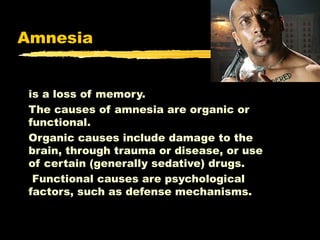
is a loss of memory.
The causes of amnesia are organic or
functional.
Organic causes include damage to the
brain, through trauma or disease, or use
of certain (generally sedative) drugs.
Functional causes are psychological
factors, such as defense mechanisms.
For ms of amnesia
In anterograde amnesia, new events contained in the
immediate memory are not transferred to the permanent
as long-term memory.
Retrograde amnesia is the distinct inability to recall some
memory or memories of the past, beyond ordinary
forgetfulness.
Mixed retrograde and anterograde amnesia may be a
motorcyclist unable to recall driving his motorbike prior to
his head injury (retrograde amnesia), nor can he recall the
hospital ward where he is told he had conversations with
family over the next two days (anterograde amnesia).
Types and causes of
amnesia
Post-tr aumatic amnesia is generally due to a
head injury (e.g. a fall, a knock on the head).
Traumatic amnesia is often transient, but may be
permanent of either anterograde, retrograde, or
mixed type
Dissociative amnesia results from a
psychological cause.
Repr essed memor y Posthypnotic
amnesia
Dissociative Fugue
Lacunar amnesia
Childhood amnesia
Repr essed memor y
refers to the inability to recall information,
usually about stressful or traumatic events
in persons' lives, such as a violent attack or
rape.
The memory is stored in long term memory,
but access to it is impaired because of
psychological defense mechanisms.
Persons retain the capacity to learn new
information and there may be some later
partial or complete recovery of memory.
Infantile Amnesia
common inability to remember events that
occurred prior to the age of 3 – 4 years old
(unless we saw them on tape or they were
repeated described to us).
Some less likely explanations.
Too much time has passed for remembering.
Infant memories are “repressed” (a Freudian point
of view).
Infants do not form good memories.
Types and causes of
amnesia
Tr ansient global amnesia is a welldescribed medical and clinical phenomenon.
Symptoms typically last for less than a day and
there is often no clear precipitating factor nor
any other neurological deficits. The cause is
not clear, hypotheses include transient
reduced blood flow, possible seizure or an
atypical type of migraine.
Patients are typically amnestic of events more
than a few minutes in the past, though
immediate recall is usually preserved.
Types and causes of
amnesia
Source amnesia is a memory disorder in which someone
can recall certain information, but they do not know where
or how they obtained the information.
Memory distrust syndrome is a term invented by the
psychologist Gisli Gudjonsson to describe a situation
where someone is unable to trust their own memory.
Blackout phenomenon can be caused by excessive
short-term alcohol consumption, with the amnesia being of
the anterograde type.
Improve Your Memory
 Study repeatedly to boost recall
 Spend more time rehearsing or actively
thinking about the material
 Make material personally meaningful
 Use mnemonic devices
 associate with peg words--something
already stored
 make up story
 chunk--acronyms
Improve Your Memory
 Activate retrieval cues--mentally
recreate situation and mood
 Recall events while they are fresh-before you encounter misinformation
 Minimize interference
 Test your own knowledge
 rehearse
 determine what you do not yet know
Improve Your Memory
 Activate retrieval cues--mentally
recreate situation and mood
 Recall events while they are fresh-before you encounter misinformation
 Minimize interference
 Test your own knowledge
 rehearse
 determine what you do not yet know

Amnesia

  • 1.
    Amnesia is a lossof memory. The causes of amnesia are organic or functional. Organic causes include damage to the brain, through trauma or disease, or use of certain (generally sedative) drugs. Functional causes are psychological factors, such as defense mechanisms.
  • 2.
    For ms ofamnesia In anterograde amnesia, new events contained in the immediate memory are not transferred to the permanent as long-term memory. Retrograde amnesia is the distinct inability to recall some memory or memories of the past, beyond ordinary forgetfulness. Mixed retrograde and anterograde amnesia may be a motorcyclist unable to recall driving his motorbike prior to his head injury (retrograde amnesia), nor can he recall the hospital ward where he is told he had conversations with family over the next two days (anterograde amnesia).
  • 3.
    Types and causesof amnesia Post-tr aumatic amnesia is generally due to a head injury (e.g. a fall, a knock on the head). Traumatic amnesia is often transient, but may be permanent of either anterograde, retrograde, or mixed type Dissociative amnesia results from a psychological cause. Repr essed memor y Posthypnotic amnesia Dissociative Fugue Lacunar amnesia Childhood amnesia
  • 4.
    Repr essed memory refers to the inability to recall information, usually about stressful or traumatic events in persons' lives, such as a violent attack or rape. The memory is stored in long term memory, but access to it is impaired because of psychological defense mechanisms. Persons retain the capacity to learn new information and there may be some later partial or complete recovery of memory.
  • 5.
    Infantile Amnesia common inabilityto remember events that occurred prior to the age of 3 – 4 years old (unless we saw them on tape or they were repeated described to us). Some less likely explanations. Too much time has passed for remembering. Infant memories are “repressed” (a Freudian point of view). Infants do not form good memories.
  • 6.
    Types and causesof amnesia Tr ansient global amnesia is a welldescribed medical and clinical phenomenon. Symptoms typically last for less than a day and there is often no clear precipitating factor nor any other neurological deficits. The cause is not clear, hypotheses include transient reduced blood flow, possible seizure or an atypical type of migraine. Patients are typically amnestic of events more than a few minutes in the past, though immediate recall is usually preserved.
  • 7.
    Types and causesof amnesia Source amnesia is a memory disorder in which someone can recall certain information, but they do not know where or how they obtained the information. Memory distrust syndrome is a term invented by the psychologist Gisli Gudjonsson to describe a situation where someone is unable to trust their own memory. Blackout phenomenon can be caused by excessive short-term alcohol consumption, with the amnesia being of the anterograde type.
  • 8.
    Improve Your Memory Study repeatedly to boost recall  Spend more time rehearsing or actively thinking about the material  Make material personally meaningful  Use mnemonic devices  associate with peg words--something already stored  make up story  chunk--acronyms
  • 9.
    Improve Your Memory Activate retrieval cues--mentally recreate situation and mood  Recall events while they are fresh-before you encounter misinformation  Minimize interference  Test your own knowledge  rehearse  determine what you do not yet know
  • 10.
    Improve Your Memory Activate retrieval cues--mentally recreate situation and mood  Recall events while they are fresh-before you encounter misinformation  Minimize interference  Test your own knowledge  rehearse  determine what you do not yet know