Concepts and Categories
Functions of ConceptsBy dividing the world into classes of things to decrease the amount of information we need to learn, perceive, remember, and recognize: cognitive economyThey permit us to make accurate predictionsCategorization serves a communication purpose
Is there a preferred levelof conceptualization?
SuperordinateSuperordinate levelFurniturePreferred levelBASIC LEVELBasicChairSubordinate levelSubordinateWindsor
What’s special about the basic level1) most abstract level at which objects have similar shapes
What’s special about the basic level2) development		First words are learned at the basic level (e.g., 	doggy, car, ball)3) Language		natural level at which objects are named		languages first acquire basic level terms
most general	BASIC	most specificmaximize accuracylittle predictive powermaximize predictive powerlittle accuracy
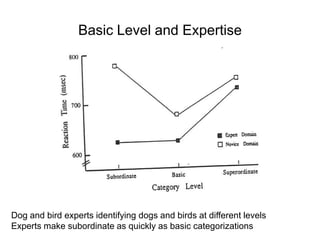
Basic Level and ExpertiseDog and bird experts identifying dogs and birds at different levelsExperts make subordinate as quickly as basic categorizations
Organization of Concepts
Prototype and Exemplar ModelsHow do we represent concepts? How do we classify items?Example representations:prototypeexemplarschemata
prototype
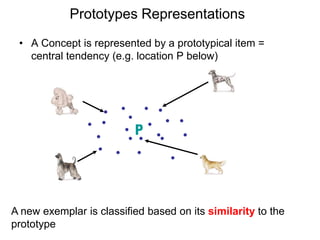
Prototypes RepresentationsA Concept is represented by a prototypical item = central tendency (e.g. location P below)A new exemplar is classified based on its similarity to the prototype
Typicality Effectstypicalis robin a bird?is dog a mammal?is diamond a precious stone?atypicalis ostrich a bird?is a whale a mammal?is turquoise a precious stone?slower verification times for atypical items
Is this a “cat”?Is this a “chair”?Is this a “dog”?
Graded StructureTypical items are similar to a prototypeTypicality effects are naturally predictedatypicalPtypical
Classification of PrototypePrototype are often easy to classify and remembereven if the prototype is never seen during learningPosner & Keele DEMO:
Problem with Prototype ModelsAll information about individual exemplars is lostcategory sizevariability of the exemplars correlations among attributes (e.g., only small birds sing)
Exemplar Representationscategory representation consists of storage of a number of category membersNew exemplars are compared to known exemplars – most similar item will influence classification the mostdogcat??dogdogcatdogcat
Exemplar ModelsModel can explain Prototype classification effectsPrototype is similar to most exemplars from a categoryGraded typicalityHow many exemplars is new item similar to?Effects of variabilityOverall, compared to prototype models, exemplar models better explain data from categorization experiments (Storms et al., 2000)
SchemataSchemas are large, complex units of knowledge that encode properties which are typical of instances of general categories and omit properties which are not typical of the categoriesUseful for encoding regularities in categories – express what category members have in common
Remembering Objects from a Graduate Officechairdeskskullbooks(30% of subjects falsely remember books)Brewer & Treyens (1981)
Representing SchemasOne way to represent schemas is with a slot-filler structure, where slots are attributes that are filled in with values that category members of the category typically have on various attributes.Office SchemaContains:  books, computer, shelves, deskFunction: serves as work spaceShape:  rectilinearSize: 80-200 square feetPart of: buildingAnother schemaBuilding SchemaParts: roof, wallsLocation: ground
Multimodal theories of Category KnowledgePerceptual symbols theory (Barsalou, 1999)Concepts are represented by perceptual symbolsPerceptual symbols are records of the neural states that underlie perceptionA representation is a simulation of experience
Prediction of Perceptual Symbol TheoryShould find a modality switch effect for conceptsProperty verification with modality specific properties (banana-yellow, marble-cool)Six modalities: vision, sound, touch, taste, smell, motorPecher, Zeelenberg, & Barsalou, 2003
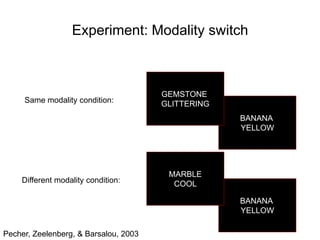
Experiment: Modality switchGEMSTONE GLITTERINGSame modality condition:BANANA YELLOWMARBLECOOLDifferent modality condition:BANANA YELLOWPecher, Zeelenberg, & Barsalou, 2003
Results of ExperimentExp 1: sentence presentationExp 2: word pair presentationPecher, Zeelenberg, & Barsalou, 2003
29Neural Evidence for Multimodal Mechanisms  Investigators found that when participants viewed manipulable objects such as hammers, a circuit in the brain that underlies the grasping of manipulable objects became active.
 This circuit did not become active when buildings, animals, or faces were observed.(Chao & Martin, 2000)

Concepts and categories.ppt

  • 1.
  • 2.
    Functions of ConceptsBydividing the world into classes of things to decrease the amount of information we need to learn, perceive, remember, and recognize: cognitive economyThey permit us to make accurate predictionsCategorization serves a communication purpose
  • 3.
    Is there apreferred levelof conceptualization?
  • 4.
    SuperordinateSuperordinate levelFurniturePreferred levelBASICLEVELBasicChairSubordinate levelSubordinateWindsor
  • 5.
    What’s special aboutthe basic level1) most abstract level at which objects have similar shapes
  • 6.
    What’s special aboutthe basic level2) development First words are learned at the basic level (e.g., doggy, car, ball)3) Language natural level at which objects are named languages first acquire basic level terms
  • 7.
    most general BASIC most specificmaximizeaccuracylittle predictive powermaximize predictive powerlittle accuracy
  • 8.
    Basic Level andExpertiseDog and bird experts identifying dogs and birds at different levelsExperts make subordinate as quickly as basic categorizations
  • 9.
  • 10.
    Prototype and ExemplarModelsHow do we represent concepts? How do we classify items?Example representations:prototypeexemplarschemata
  • 11.
  • 12.
    Prototypes RepresentationsA Conceptis represented by a prototypical item = central tendency (e.g. location P below)A new exemplar is classified based on its similarity to the prototype
  • 13.
    Typicality Effectstypicalis robina bird?is dog a mammal?is diamond a precious stone?atypicalis ostrich a bird?is a whale a mammal?is turquoise a precious stone?slower verification times for atypical items
  • 14.
    Is this a“cat”?Is this a “chair”?Is this a “dog”?
  • 15.
    Graded StructureTypical itemsare similar to a prototypeTypicality effects are naturally predictedatypicalPtypical
  • 16.
    Classification of PrototypePrototypeare often easy to classify and remembereven if the prototype is never seen during learningPosner & Keele DEMO:
  • 19.
    Problem with PrototypeModelsAll information about individual exemplars is lostcategory sizevariability of the exemplars correlations among attributes (e.g., only small birds sing)
  • 20.
    Exemplar Representationscategory representationconsists of storage of a number of category membersNew exemplars are compared to known exemplars – most similar item will influence classification the mostdogcat??dogdogcatdogcat
  • 21.
    Exemplar ModelsModel canexplain Prototype classification effectsPrototype is similar to most exemplars from a categoryGraded typicalityHow many exemplars is new item similar to?Effects of variabilityOverall, compared to prototype models, exemplar models better explain data from categorization experiments (Storms et al., 2000)
  • 22.
    SchemataSchemas are large,complex units of knowledge that encode properties which are typical of instances of general categories and omit properties which are not typical of the categoriesUseful for encoding regularities in categories – express what category members have in common
  • 23.
    Remembering Objects froma Graduate Officechairdeskskullbooks(30% of subjects falsely remember books)Brewer & Treyens (1981)
  • 24.
    Representing SchemasOne wayto represent schemas is with a slot-filler structure, where slots are attributes that are filled in with values that category members of the category typically have on various attributes.Office SchemaContains: books, computer, shelves, deskFunction: serves as work spaceShape: rectilinearSize: 80-200 square feetPart of: buildingAnother schemaBuilding SchemaParts: roof, wallsLocation: ground
  • 25.
    Multimodal theories ofCategory KnowledgePerceptual symbols theory (Barsalou, 1999)Concepts are represented by perceptual symbolsPerceptual symbols are records of the neural states that underlie perceptionA representation is a simulation of experience
  • 26.
    Prediction of PerceptualSymbol TheoryShould find a modality switch effect for conceptsProperty verification with modality specific properties (banana-yellow, marble-cool)Six modalities: vision, sound, touch, taste, smell, motorPecher, Zeelenberg, & Barsalou, 2003
  • 27.
    Experiment: Modality switchGEMSTONEGLITTERINGSame modality condition:BANANA YELLOWMARBLECOOLDifferent modality condition:BANANA YELLOWPecher, Zeelenberg, & Barsalou, 2003
  • 28.
    Results of ExperimentExp1: sentence presentationExp 2: word pair presentationPecher, Zeelenberg, & Barsalou, 2003
  • 29.
    29Neural Evidence forMultimodal Mechanisms Investigators found that when participants viewed manipulable objects such as hammers, a circuit in the brain that underlies the grasping of manipulable objects became active.
  • 30.
    This circuitdid not become active when buildings, animals, or faces were observed.(Chao & Martin, 2000)

Editor's Notes

  • #20 Variability of exemplarsRulers and pizza exampleMost pizzas are 12 inches wide but can vary from 2 to 30 inchesMost rulers are 12 inches across and can vary much less than pizzasExperiment: when participants are asked whether a new object 19 inches wide is a pizza or a ruler, most participants said it probably corresponded to a pizza. A prototype theory cannot explain this finding because 19 inches is equally distant to both the pizza and ruler prototype (both 12 inches). However, in an exemplar theory, the 19 inch overlaps with more pizza exemplars because there are more pizza exemplars experienced (and represented in memory) that are around 19 inches wide.