Reporting an Independent 
Sample t-test 
Note – that the reporting format shown in this learning module 
is for APA. For other formats consult specific format guides. 
It is also recommended to consult the latest APA manual to 
compare what is described in this learning module with the 
most updated formats for APA.
Reporting the Study using APA
Reporting the Study using APA 
• You can report data from your own experiments by 
using the template below.
Reporting the Study using APA 
• You can report data from your own experiments by 
using the template below. 
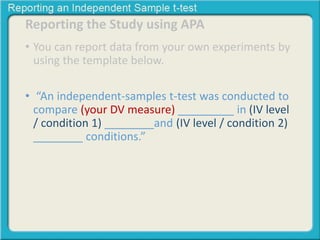
• “An independent-samples t-test was conducted to 
compare (your DV measure) _________ in (IV level 
/ condition 1) ________and (IV level / condition 2) 
________ conditions.”
Reporting the Study using APA 
• Here is an example:
Reporting the Study using APA 
• Here is an example: 
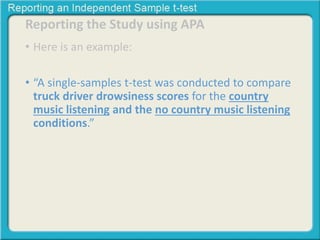
• “A single-samples t-test was conducted to compare 
truck driver drowsiness scores for the country 
music listening and the no country music listening 
conditions.”
Reporting the Study using APA 
• Here is an example: 
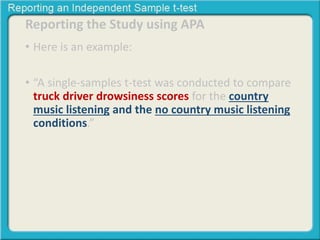
• “A single-samples t-test was conducted to compare 
truck driver drowsiness scores for the country 
music listening and the no country music listening 
conditions.”
Reporting the Study using APA 
• Here is an example: 
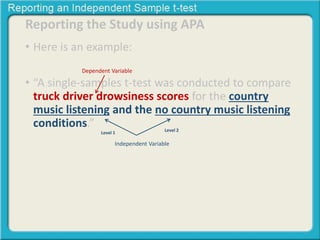
Dependent Variable 
• “A single-samples t-test was conducted to compare 
truck driver drowsiness scores for the country 
music listening and the no country music listening 
conditions.” 
Level 2 
Level 1 
Independent Variable
Reporting Results using APA
Reporting Results using APA 
• You want to tell your reader whether or not there 
was a significant difference between condition 
means. You can report data from your own 
experiments by using the template below.
Reporting Results using APA 
• You want to tell your reader whether or not there 
was a significant difference between condition 
means. You can report data from your own 
experiments by using the template below. 
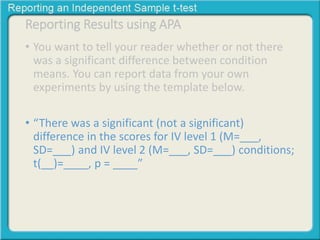
• “There was a significant (not a significant) 
difference in the scores for IV level 1 (M=___, 
SD=___) and IV level 2 (M=___, SD=___) conditions; 
t(__)=____, p = ____”
Reporting Results using APA 
• Just fill in the blanks by using in this case the SPSS 
output
Reporting Results using APA 
• Just fill in the blanks by using in this case the SPSS 
output 
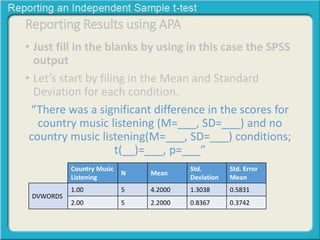
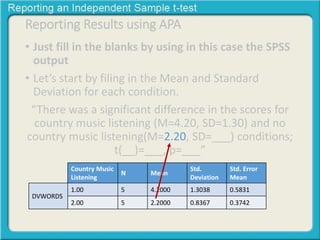
• Let’s start by filing in the Mean and Standard 
Deviation for each condition.
Reporting Results using APA 
• Just fill in the blanks by using in this case the SPSS 
output 
• Let’s start by filing in the Mean and Standard 
Deviation for each condition. 
“There was a significant difference in the scores for 
country music listening (M=___, SD=___) and no 
country music listening(M=___, SD=___) conditions; 
t(__)=___, p=___” 
Country Music 
Listening 
N Mean 
Std. 
Deviation 
Std. Error 
Mean 
DVWORDS 
1.00 5 4.2000 1.3038 0.5831 
2.00 5 2.2000 0.8367 0.3742
Reporting Results using APA 
• Just fill in the blanks by using in this case the SPSS 
output 
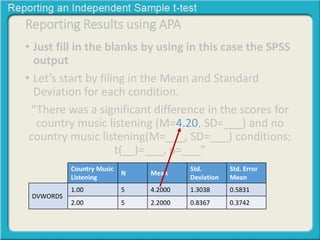
• Let’s start by filing in the Mean and Standard 
Deviation for each condition. 
“There was a significant difference in the scores for 
country music listening (M=4.20, SD=___) and no 
country music listening(M=___, SD=___) conditions; 
t(__)=___, p=___” 
Country Music 
Listening 
N Mean 
Std. 
Deviation 
Std. Error 
Mean 
DVWORDS 
1.00 5 4.2000 1.3038 0.5831 
2.00 5 2.2000 0.8367 0.3742
Reporting Results using APA 
• Just fill in the blanks by using in this case the SPSS 
output 
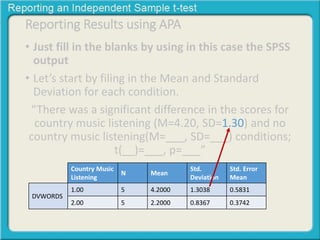
• Let’s start by filing in the Mean and Standard 
Deviation for each condition. 
“There was a significant difference in the scores for 
country music listening (M=4.20, SD=1.30) and no 
country music listening(M=___, SD=___) conditions; 
t(__)=___, p=___” 
Country Music 
Listening 
N Mean 
Std. 
Deviation 
Std. Error 
Mean 
DVWORDS 
1.00 5 4.2000 1.3038 0.5831 
2.00 5 2.2000 0.8367 0.3742
Reporting Results using APA 
• Just fill in the blanks by using in this case the SPSS 
output 
• Let’s start by filing in the Mean and Standard 
Deviation for each condition. 
“There was a significant difference in the scores for 
country music listening (M=4.20, SD=1.30) and no 
country music listening(M=2.20, SD=___) conditions; 
t(__)=___, p=___” 
Country Music 
Listening 
N Mean 
Std. 
Deviation 
Std. Error 
Mean 
DVWORDS 
1.00 5 4.2000 1.3038 0.5831 
2.00 5 2.2000 0.8367 0.3742
Reporting Results using APA 
• Just fill in the blanks by using in this case the SPSS 
output 
• Let’s start by filing in the Mean and Standard 
Deviation for each condition. 
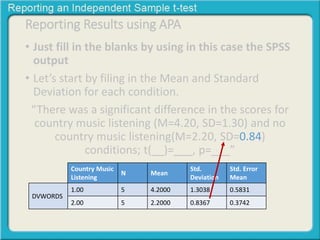
“There was a significant difference in the scores for 
country music listening (M=4.20, SD=1.30) and no 
country music listening(M=2.20, SD=0.84) 
conditions; t(__)=___, p=___” 
Country Music 
Listening 
N Mean 
Std. 
Deviation 
Std. Error 
Mean 
DVWORDS 
1.00 5 4.2000 1.3038 0.5831 
2.00 5 2.2000 0.8367 0.3742
Reporting Results using APA 
• Just fill in the blanks by using in this case the SPSS 
output 
• Let’s start by filing in the Mean and Standard 
Deviation for each condition. 
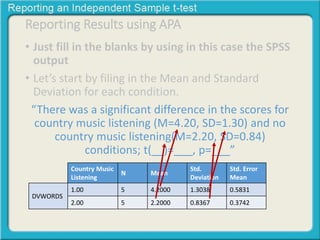
“There was a significant difference in the scores for 
country music listening (M=4.20, SD=1.30) and no 
country music listening(M=2.20, SD=0.84) 
conditions; t(__)=___, p=___” 
Country Music 
Listening 
N Mean 
Std. 
Deviation 
Std. Error 
Mean 
DVWORDS 
1.00 5 4.2000 1.3038 0.5831 
2.00 5 2.2000 0.8367 0.3742
Reporting Results using APA 
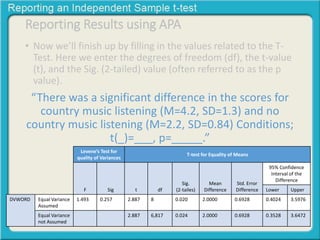
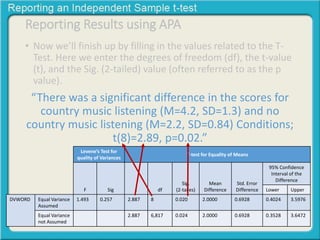
• Now we’ll finish up by filling in the values related to the T-Test. 
Here we enter the degrees of freedom (df), the t-value 
(t), and the Sig. (2-tailed) value (often referred to as the p 
value).
Reporting Results using APA 
• Now we’ll finish up by filling in the values related to the T-Test. 
Here we enter the degrees of freedom (df), the t-value 
(t), and the Sig. (2-tailed) value (often referred to as the p 
value). 
“There was a significant difference in the scores for 
country music listening (M=4.2, SD=1.3) and no 
country music listening (M=2.2, SD=0.84) Conditions; 
t(_)=___, p=_____.” 
Levene’s Test for 
quality of Variances 
T-test for Equality of Means 
F Sig t df 
Sig. 
(2-tailes) 
Mean 
Difference 
Std. Error 
Difference 
95% Confidence 
Interval of the 
Difference 
Lower Upper 
DVWORD Equal Variance 
Assumed 
1.493 0.257 2.887 8 0.020 2.0000 0.6928 0.4024 3.5976 
Equal Variance 
not Assumed 
2.887 6,817 0.024 2.0000 0.6928 0.3528 3.6472
Reporting Results using APA 
• Now we’ll finish up by filling in the values related to the T-Test. 
Here we enter the degrees of freedom (df), the t-value 
(t), and the Sig. (2-tailed) value (often referred to as the p 
value). 
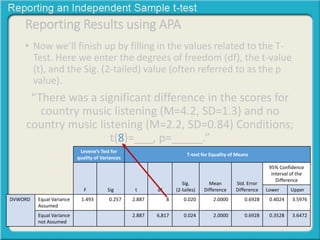
“There was a significant difference in the scores for 
country music listening (M=4.2, SD=1.3) and no 
country music listening (M=2.2, SD=0.84) Conditions; 
t(8)=___, p=_____.” 
Levene’s Test for 
quality of Variances 
T-test for Equality of Means 
F Sig t df 
Sig. 
(2-tailes) 
Mean 
Difference 
Std. Error 
Difference 
95% Confidence 
Interval of the 
Difference 
Lower Upper 
DVWORD Equal Variance 
Assumed 
1.493 0.257 2.887 8 0.020 2.0000 0.6928 0.4024 3.5976 
Equal Variance 
not Assumed 
2.887 6,817 0.024 2.0000 0.6928 0.3528 3.6472
Reporting Results using APA 
• Now we’ll finish up by filling in the values related to the T-Test. 
Here we enter the degrees of freedom (df), the t-value 
(t), and the Sig. (2-tailed) value (often referred to as the p 
value). 
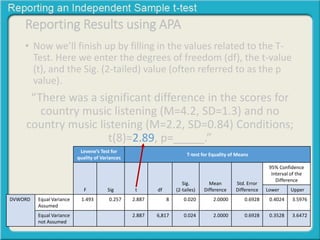
“There was a significant difference in the scores for 
country music listening (M=4.2, SD=1.3) and no 
country music listening (M=2.2, SD=0.84) Conditions; 
t(8)=2.89, p=_____.” 
Levene’s Test for 
quality of Variances 
T-test for Equality of Means 
F Sig t df 
Sig. 
(2-tailes) 
Mean 
Difference 
Std. Error 
Difference 
95% Confidence 
Interval of the 
Difference 
Lower Upper 
DVWORD Equal Variance 
Assumed 
1.493 0.257 2.887 8 0.020 2.0000 0.6928 0.4024 3.5976 
Equal Variance 
not Assumed 
2.887 6,817 0.024 2.0000 0.6928 0.3528 3.6472
Reporting Results using APA 
• Now we’ll finish up by filling in the values related to the T-Test. 
Here we enter the degrees of freedom (df), the t-value 
(t), and the Sig. (2-tailed) value (often referred to as the p 
value). 
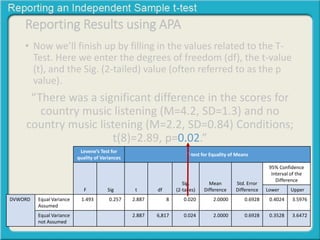
“There was a significant difference in the scores for 
country music listening (M=4.2, SD=1.3) and no 
country music listening (M=2.2, SD=0.84) Conditions; 
t(8)=2.89, p=0.02.” 
Levene’s Test for 
quality of Variances 
T-test for Equality of Means 
F Sig t df 
Sig. 
(2-tailes) 
Mean 
Difference 
Std. Error 
Difference 
95% Confidence 
Interval of the 
Difference 
Lower Upper 
DVWORD Equal Variance 
Assumed 
1.493 0.257 2.887 8 0.020 2.0000 0.6928 0.4024 3.5976 
Equal Variance 
not Assumed 
2.887 6,817 0.024 2.0000 0.6928 0.3528 3.6472
Reporting Results using APA 
• Now we’ll finish up by filling in the values related to the T-Test. 
Here we enter the degrees of freedom (df), the t-value 
(t), and the Sig. (2-tailed) value (often referred to as the p 
value). 
“There was a significant difference in the scores for 
country music listening (M=4.2, SD=1.3) and no 
country music listening (M=2.2, SD=0.84) Conditions; 
t(8)=2.89, p=0.02.” 
Levene’s Test for 
quality of Variances 
T-test for Equality of Means 
F Sig t df 
Sig. 
(2-tailes) 
Mean 
Difference 
Std. Error 
Difference 
95% Confidence 
Interval of the 
Difference 
Lower Upper 
DVWORD Equal Variance 
Assumed 
1.493 0.257 2.887 8 0.020 2.0000 0.6928 0.4024 3.5976 
Equal Variance 
not Assumed 
2.887 6,817 0.024 2.0000 0.6928 0.3528 3.6472
Once the blanks are full…
Once the blanks are full… 
• You have a sentence that looks very scientific but 
was actually very simple to produce.
Once the blanks are full… 
• You have a sentence that looks very scientific but 
was actually very simple to produce. 
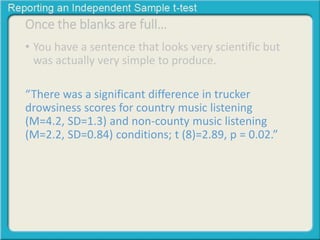
“There was a significant difference in trucker 
drowsiness scores for country music listening 
(M=4.2, SD=1.3) and non-county music listening 
(M=2.2, SD=0.84) conditions; t (8)=2.89, p = 0.02.”

Reporting an independent sample t test

  • 1.
    Reporting an Independent Sample t-test Note – that the reporting format shown in this learning module is for APA. For other formats consult specific format guides. It is also recommended to consult the latest APA manual to compare what is described in this learning module with the most updated formats for APA.
  • 2.
  • 3.
    Reporting the Studyusing APA • You can report data from your own experiments by using the template below.
  • 4.
    Reporting the Studyusing APA • You can report data from your own experiments by using the template below. • “An independent-samples t-test was conducted to compare (your DV measure) _________ in (IV level / condition 1) ________and (IV level / condition 2) ________ conditions.”
  • 5.
    Reporting the Studyusing APA • Here is an example:
  • 6.
    Reporting the Studyusing APA • Here is an example: • “A single-samples t-test was conducted to compare truck driver drowsiness scores for the country music listening and the no country music listening conditions.”
  • 7.
    Reporting the Studyusing APA • Here is an example: • “A single-samples t-test was conducted to compare truck driver drowsiness scores for the country music listening and the no country music listening conditions.”
  • 8.
    Reporting the Studyusing APA • Here is an example: Dependent Variable • “A single-samples t-test was conducted to compare truck driver drowsiness scores for the country music listening and the no country music listening conditions.” Level 2 Level 1 Independent Variable
  • 9.
  • 10.
    Reporting Results usingAPA • You want to tell your reader whether or not there was a significant difference between condition means. You can report data from your own experiments by using the template below.
  • 11.
    Reporting Results usingAPA • You want to tell your reader whether or not there was a significant difference between condition means. You can report data from your own experiments by using the template below. • “There was a significant (not a significant) difference in the scores for IV level 1 (M=___, SD=___) and IV level 2 (M=___, SD=___) conditions; t(__)=____, p = ____”
  • 12.
    Reporting Results usingAPA • Just fill in the blanks by using in this case the SPSS output
  • 13.
    Reporting Results usingAPA • Just fill in the blanks by using in this case the SPSS output • Let’s start by filing in the Mean and Standard Deviation for each condition.
  • 14.
    Reporting Results usingAPA • Just fill in the blanks by using in this case the SPSS output • Let’s start by filing in the Mean and Standard Deviation for each condition. “There was a significant difference in the scores for country music listening (M=___, SD=___) and no country music listening(M=___, SD=___) conditions; t(__)=___, p=___” Country Music Listening N Mean Std. Deviation Std. Error Mean DVWORDS 1.00 5 4.2000 1.3038 0.5831 2.00 5 2.2000 0.8367 0.3742
  • 15.
    Reporting Results usingAPA • Just fill in the blanks by using in this case the SPSS output • Let’s start by filing in the Mean and Standard Deviation for each condition. “There was a significant difference in the scores for country music listening (M=4.20, SD=___) and no country music listening(M=___, SD=___) conditions; t(__)=___, p=___” Country Music Listening N Mean Std. Deviation Std. Error Mean DVWORDS 1.00 5 4.2000 1.3038 0.5831 2.00 5 2.2000 0.8367 0.3742
  • 16.
    Reporting Results usingAPA • Just fill in the blanks by using in this case the SPSS output • Let’s start by filing in the Mean and Standard Deviation for each condition. “There was a significant difference in the scores for country music listening (M=4.20, SD=1.30) and no country music listening(M=___, SD=___) conditions; t(__)=___, p=___” Country Music Listening N Mean Std. Deviation Std. Error Mean DVWORDS 1.00 5 4.2000 1.3038 0.5831 2.00 5 2.2000 0.8367 0.3742
  • 17.
    Reporting Results usingAPA • Just fill in the blanks by using in this case the SPSS output • Let’s start by filing in the Mean and Standard Deviation for each condition. “There was a significant difference in the scores for country music listening (M=4.20, SD=1.30) and no country music listening(M=2.20, SD=___) conditions; t(__)=___, p=___” Country Music Listening N Mean Std. Deviation Std. Error Mean DVWORDS 1.00 5 4.2000 1.3038 0.5831 2.00 5 2.2000 0.8367 0.3742
  • 18.
    Reporting Results usingAPA • Just fill in the blanks by using in this case the SPSS output • Let’s start by filing in the Mean and Standard Deviation for each condition. “There was a significant difference in the scores for country music listening (M=4.20, SD=1.30) and no country music listening(M=2.20, SD=0.84) conditions; t(__)=___, p=___” Country Music Listening N Mean Std. Deviation Std. Error Mean DVWORDS 1.00 5 4.2000 1.3038 0.5831 2.00 5 2.2000 0.8367 0.3742
  • 19.
    Reporting Results usingAPA • Just fill in the blanks by using in this case the SPSS output • Let’s start by filing in the Mean and Standard Deviation for each condition. “There was a significant difference in the scores for country music listening (M=4.20, SD=1.30) and no country music listening(M=2.20, SD=0.84) conditions; t(__)=___, p=___” Country Music Listening N Mean Std. Deviation Std. Error Mean DVWORDS 1.00 5 4.2000 1.3038 0.5831 2.00 5 2.2000 0.8367 0.3742
  • 20.
    Reporting Results usingAPA • Now we’ll finish up by filling in the values related to the T-Test. Here we enter the degrees of freedom (df), the t-value (t), and the Sig. (2-tailed) value (often referred to as the p value).
  • 21.
    Reporting Results usingAPA • Now we’ll finish up by filling in the values related to the T-Test. Here we enter the degrees of freedom (df), the t-value (t), and the Sig. (2-tailed) value (often referred to as the p value). “There was a significant difference in the scores for country music listening (M=4.2, SD=1.3) and no country music listening (M=2.2, SD=0.84) Conditions; t(_)=___, p=_____.” Levene’s Test for quality of Variances T-test for Equality of Means F Sig t df Sig. (2-tailes) Mean Difference Std. Error Difference 95% Confidence Interval of the Difference Lower Upper DVWORD Equal Variance Assumed 1.493 0.257 2.887 8 0.020 2.0000 0.6928 0.4024 3.5976 Equal Variance not Assumed 2.887 6,817 0.024 2.0000 0.6928 0.3528 3.6472
  • 22.
    Reporting Results usingAPA • Now we’ll finish up by filling in the values related to the T-Test. Here we enter the degrees of freedom (df), the t-value (t), and the Sig. (2-tailed) value (often referred to as the p value). “There was a significant difference in the scores for country music listening (M=4.2, SD=1.3) and no country music listening (M=2.2, SD=0.84) Conditions; t(8)=___, p=_____.” Levene’s Test for quality of Variances T-test for Equality of Means F Sig t df Sig. (2-tailes) Mean Difference Std. Error Difference 95% Confidence Interval of the Difference Lower Upper DVWORD Equal Variance Assumed 1.493 0.257 2.887 8 0.020 2.0000 0.6928 0.4024 3.5976 Equal Variance not Assumed 2.887 6,817 0.024 2.0000 0.6928 0.3528 3.6472
  • 23.
    Reporting Results usingAPA • Now we’ll finish up by filling in the values related to the T-Test. Here we enter the degrees of freedom (df), the t-value (t), and the Sig. (2-tailed) value (often referred to as the p value). “There was a significant difference in the scores for country music listening (M=4.2, SD=1.3) and no country music listening (M=2.2, SD=0.84) Conditions; t(8)=2.89, p=_____.” Levene’s Test for quality of Variances T-test for Equality of Means F Sig t df Sig. (2-tailes) Mean Difference Std. Error Difference 95% Confidence Interval of the Difference Lower Upper DVWORD Equal Variance Assumed 1.493 0.257 2.887 8 0.020 2.0000 0.6928 0.4024 3.5976 Equal Variance not Assumed 2.887 6,817 0.024 2.0000 0.6928 0.3528 3.6472
  • 24.
    Reporting Results usingAPA • Now we’ll finish up by filling in the values related to the T-Test. Here we enter the degrees of freedom (df), the t-value (t), and the Sig. (2-tailed) value (often referred to as the p value). “There was a significant difference in the scores for country music listening (M=4.2, SD=1.3) and no country music listening (M=2.2, SD=0.84) Conditions; t(8)=2.89, p=0.02.” Levene’s Test for quality of Variances T-test for Equality of Means F Sig t df Sig. (2-tailes) Mean Difference Std. Error Difference 95% Confidence Interval of the Difference Lower Upper DVWORD Equal Variance Assumed 1.493 0.257 2.887 8 0.020 2.0000 0.6928 0.4024 3.5976 Equal Variance not Assumed 2.887 6,817 0.024 2.0000 0.6928 0.3528 3.6472
  • 25.
    Reporting Results usingAPA • Now we’ll finish up by filling in the values related to the T-Test. Here we enter the degrees of freedom (df), the t-value (t), and the Sig. (2-tailed) value (often referred to as the p value). “There was a significant difference in the scores for country music listening (M=4.2, SD=1.3) and no country music listening (M=2.2, SD=0.84) Conditions; t(8)=2.89, p=0.02.” Levene’s Test for quality of Variances T-test for Equality of Means F Sig t df Sig. (2-tailes) Mean Difference Std. Error Difference 95% Confidence Interval of the Difference Lower Upper DVWORD Equal Variance Assumed 1.493 0.257 2.887 8 0.020 2.0000 0.6928 0.4024 3.5976 Equal Variance not Assumed 2.887 6,817 0.024 2.0000 0.6928 0.3528 3.6472
  • 26.
    Once the blanksare full…
  • 27.
    Once the blanksare full… • You have a sentence that looks very scientific but was actually very simple to produce.
  • 28.
    Once the blanksare full… • You have a sentence that looks very scientific but was actually very simple to produce. “There was a significant difference in trucker drowsiness scores for country music listening (M=4.2, SD=1.3) and non-county music listening (M=2.2, SD=0.84) conditions; t (8)=2.89, p = 0.02.”