Reporting a Single Sample t-test 
Learning Module
Note – the reporting format shown in this learning 
module is for APA. For other formats consult specific 
format guides.
Note – the reporting format shown in this learning 
module is for APA. For other formats consult specific 
format guides. 
It is also recommended to consult the latest APA 
manual to compare what is described in this learning 
module with the most updated formats for APA.
Reporting the Study using APA
You can report data from your own experience by using 
the template below.
You can report data from your own experience by using 
the template below. 
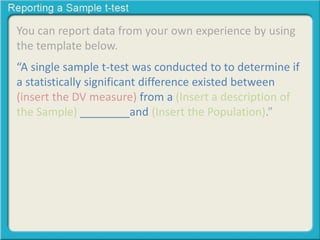
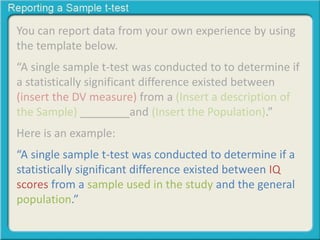
“A single sample t-test was conducted to to determine if 
a statistically significant difference existed between 
(insert the DV measure) from a (Insert a description of 
the Sample) ________and (Insert the Population).”
You can report data from your own experience by using 
the template below. 
“A single sample t-test was conducted to to determine if 
a statistically significant difference existed between 
(insert the DV measure) from a (Insert a description of 
the Sample) ________and (Insert the Population).” 
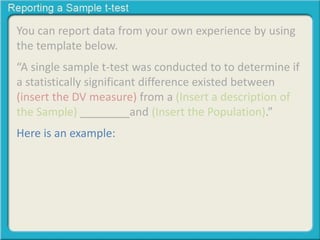
Here is an example:
You can report data from your own experience by using 
the template below. 
“A single sample t-test was conducted to to determine if 
a statistically significant difference existed between 
(insert the DV measure) from a (Insert a description of 
the Sample) ________and (Insert the Population).” 
Here is an example: 
“A single sample t-test was conducted to determine if a 
statistically significant difference existed between IQ 
scores from a sample used in the study and the general 
population.”
Reporting Results using APA
Here is how the results for a single-sample t-test are 
reported in APA.
Here is how the results for a single-sample t-test are 
reported in APA. 
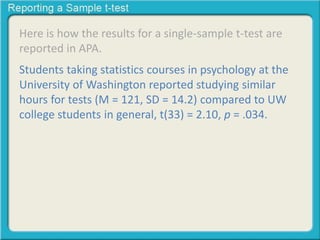
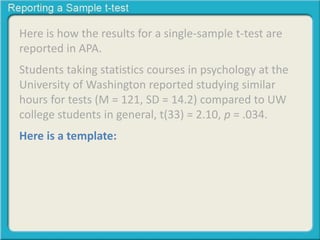
Students taking statistics courses in psychology at the 
University of Washington reported studying similar 
hours for tests (M = 121, SD = 14.2) compared to UW 
college students in general, t(33) = 2.10, p = .034.
Here is how the results for a single-sample t-test are 
reported in APA. 
Students taking statistics courses in psychology at the 
University of Washington reported studying similar 
hours for tests (M = 121, SD = 14.2) compared to UW 
college students in general, t(33) = 2.10, p = .034. 
Here is a template:
Here is how the results for a single-sample t-test are 
reported in APA. 
Students taking statistics courses in psychology at the 
University of Washington reported studying similar 
hours for tests (M = 121, SD = 14.2) compared to UW 
college students in general, t(33) = 2.10, p = .034. 
Here is a template: 
[Describe the single sample] [Report the results] (M = 
[ ], SD = [ ]) than [Insert population], t( ) = [ ], p = [ ].
Here is how the results for a single-sample t-test are 
reported in APA. 
Students taking statistics courses in psychology at the 
University of Washington reported studying similar 
hours for tests (M = 121, SD = 14.2) compared to UW 
college students in general, t(33) = 2.10, p = .034. 
Here is a template: 
[Describe the single sample] [Report the results] (M = 
[ ], SD = [ ]) than [Insert population], t( ) = [ ], p = [ ]. 
Just fill in the blanks by using the SPSS output.
Let’s start by filling in the Mean and Standard Deviation 
for each condition.
Let’s start by filling in the Mean and Standard Deviation 
for each condition. 
Persons who eat broccoli regularly received statistically 
significantly higher IQ scores (M = [ ], SD = [ ]) than 
the general population, t( ) = [ ], p = [ ].
Let’s start by filling in the Mean and Standard Deviation 
for each condition. 
Persons who eat broccoli regularly received statistically 
significantly higher IQ scores (M = [ ], SD = [ ]) than 
the general population, t( ) = [ ], p = [ ].
Let’s start by filling in the Mean and Standard Deviation 
for each condition. 
Persons who eat broccoli regularly received statistically 
significantly higher IQ scores (M = [120], SD = [ ]) than 
the general population, t( ) = [ ], p = [ ].
Let’s start by filling in the Mean and Standard Deviation 
for each condition. 
Persons who eat broccoli regularly received statistically 
significantly higher IQ scores (M = [120], SD = [ ]) than 
the general population, t( ) = [ ], p = [ ].
Let’s start by filling in the Mean and Standard Deviation 
for each condition. 
Persons who eat broccoli regularly received statistically 
significantly higher IQ scores (M = [120], SD = [ ]) than 
the general population, t( ) = [ ], p = [ ].
Let’s start by filling in the Mean and Standard Deviation 
for each condition. 
Persons who eat broccoli regularly received statistically 
significantly higher IQ scores (M = [120], SD = [12.2]) 
than the general population, t( ) = [ ], p = [ ].
Let’s start by filling in the Mean and Standard Deviation 
for each condition. 
Persons who eat broccoli regularly received statistically 
significantly higher IQ scores (M = [120], SD = [12.2]) 
than the general population, t( ) = [ ], p = [ ]. 
Degrees of 
freedom (N-1)
Let’s start by filling in the Mean and Standard Deviation 
for each condition. 
Persons who eat broccoli regularly received statistically 
significantly higher IQ scores (M = [120], SD = [12.2]) 
than the general population, t(22) = [ ], p = [ ]. 
Degrees of 
freedom (N-1)
Let’s start by filling in the Mean and Standard Deviation 
for each condition. 
Persons who eat broccoli regularly received statistically 
significantly higher IQ scores (M = [120], SD = [12.2]) 
than the general population, t(22) = [ ], p = [ ]. 
One-Sample Test 
Test Value = 100 
t df Sig. (2-tailed) Mean Difference 
95% Confidence Interval of the 
Difference 
Lower Upper 
Broccoli_Sample 7.859 22 .000 19.95652 14.6901 25.2229
Let’s start by filling in the Mean and Standard Deviation 
for each condition. 
Persons who eat broccoli regularly received statistically 
significantly higher IQ scores (M = [120], SD = [12.2]) 
than the general population, t(22) = [7.86], p = [ ]. 
One-Sample Test 
Test Value = 100 
t df Sig. (2-tailed) Mean Difference 
95% Confidence Interval of the 
Difference 
Lower Upper 
Broccoli_Sample 7.859 22 .000 19.95652 14.6901 25.2229
Let’s start by filling in the Mean and Standard Deviation 
for each condition. 
Persons who eat broccoli regularly received statistically 
significantly higher IQ scores (M = [120], SD = [12.2]) 
than the general population, t(22) = [7.86], p = [ ]. 
One-Sample Test 
Test Value = 100 
t df Sig. (2-tailed) Mean Difference 
95% Confidence Interval of the 
Difference 
Lower Upper 
Broccoli_Sample 7.859 22 .000 19.95652 14.6901 25.2229
Let’s start by filling in the Mean and Standard Deviation 
for each condition. 
Persons who eat broccoli regularly received statistically 
significantly higher IQ scores (M = [120], SD = [12.2]) 
than the general population, t(22) = [7.86], p = [0.000]. 
One-Sample Test 
Test Value = 100 
t df Sig. (2-tailed) Mean Difference 
95% Confidence Interval of the 
Difference 
Lower Upper 
Broccoli_Sample 7.859 22 .000 19.95652 14.6901 25.2229

Reporting a single sample t-test

  • 1.
    Reporting a SingleSample t-test Learning Module
  • 2.
    Note – thereporting format shown in this learning module is for APA. For other formats consult specific format guides.
  • 3.
    Note – thereporting format shown in this learning module is for APA. For other formats consult specific format guides. It is also recommended to consult the latest APA manual to compare what is described in this learning module with the most updated formats for APA.
  • 4.
  • 5.
    You can reportdata from your own experience by using the template below.
  • 6.
    You can reportdata from your own experience by using the template below. “A single sample t-test was conducted to to determine if a statistically significant difference existed between (insert the DV measure) from a (Insert a description of the Sample) ________and (Insert the Population).”
  • 7.
    You can reportdata from your own experience by using the template below. “A single sample t-test was conducted to to determine if a statistically significant difference existed between (insert the DV measure) from a (Insert a description of the Sample) ________and (Insert the Population).” Here is an example:
  • 8.
    You can reportdata from your own experience by using the template below. “A single sample t-test was conducted to to determine if a statistically significant difference existed between (insert the DV measure) from a (Insert a description of the Sample) ________and (Insert the Population).” Here is an example: “A single sample t-test was conducted to determine if a statistically significant difference existed between IQ scores from a sample used in the study and the general population.”
  • 9.
  • 10.
    Here is howthe results for a single-sample t-test are reported in APA.
  • 11.
    Here is howthe results for a single-sample t-test are reported in APA. Students taking statistics courses in psychology at the University of Washington reported studying similar hours for tests (M = 121, SD = 14.2) compared to UW college students in general, t(33) = 2.10, p = .034.
  • 12.
    Here is howthe results for a single-sample t-test are reported in APA. Students taking statistics courses in psychology at the University of Washington reported studying similar hours for tests (M = 121, SD = 14.2) compared to UW college students in general, t(33) = 2.10, p = .034. Here is a template:
  • 13.
    Here is howthe results for a single-sample t-test are reported in APA. Students taking statistics courses in psychology at the University of Washington reported studying similar hours for tests (M = 121, SD = 14.2) compared to UW college students in general, t(33) = 2.10, p = .034. Here is a template: [Describe the single sample] [Report the results] (M = [ ], SD = [ ]) than [Insert population], t( ) = [ ], p = [ ].
  • 14.
    Here is howthe results for a single-sample t-test are reported in APA. Students taking statistics courses in psychology at the University of Washington reported studying similar hours for tests (M = 121, SD = 14.2) compared to UW college students in general, t(33) = 2.10, p = .034. Here is a template: [Describe the single sample] [Report the results] (M = [ ], SD = [ ]) than [Insert population], t( ) = [ ], p = [ ]. Just fill in the blanks by using the SPSS output.
  • 15.
    Let’s start byfilling in the Mean and Standard Deviation for each condition.
  • 16.
    Let’s start byfilling in the Mean and Standard Deviation for each condition. Persons who eat broccoli regularly received statistically significantly higher IQ scores (M = [ ], SD = [ ]) than the general population, t( ) = [ ], p = [ ].
  • 17.
    Let’s start byfilling in the Mean and Standard Deviation for each condition. Persons who eat broccoli regularly received statistically significantly higher IQ scores (M = [ ], SD = [ ]) than the general population, t( ) = [ ], p = [ ].
  • 18.
    Let’s start byfilling in the Mean and Standard Deviation for each condition. Persons who eat broccoli regularly received statistically significantly higher IQ scores (M = [120], SD = [ ]) than the general population, t( ) = [ ], p = [ ].
  • 19.
    Let’s start byfilling in the Mean and Standard Deviation for each condition. Persons who eat broccoli regularly received statistically significantly higher IQ scores (M = [120], SD = [ ]) than the general population, t( ) = [ ], p = [ ].
  • 20.
    Let’s start byfilling in the Mean and Standard Deviation for each condition. Persons who eat broccoli regularly received statistically significantly higher IQ scores (M = [120], SD = [ ]) than the general population, t( ) = [ ], p = [ ].
  • 21.
    Let’s start byfilling in the Mean and Standard Deviation for each condition. Persons who eat broccoli regularly received statistically significantly higher IQ scores (M = [120], SD = [12.2]) than the general population, t( ) = [ ], p = [ ].
  • 22.
    Let’s start byfilling in the Mean and Standard Deviation for each condition. Persons who eat broccoli regularly received statistically significantly higher IQ scores (M = [120], SD = [12.2]) than the general population, t( ) = [ ], p = [ ]. Degrees of freedom (N-1)
  • 23.
    Let’s start byfilling in the Mean and Standard Deviation for each condition. Persons who eat broccoli regularly received statistically significantly higher IQ scores (M = [120], SD = [12.2]) than the general population, t(22) = [ ], p = [ ]. Degrees of freedom (N-1)
  • 24.
    Let’s start byfilling in the Mean and Standard Deviation for each condition. Persons who eat broccoli regularly received statistically significantly higher IQ scores (M = [120], SD = [12.2]) than the general population, t(22) = [ ], p = [ ]. One-Sample Test Test Value = 100 t df Sig. (2-tailed) Mean Difference 95% Confidence Interval of the Difference Lower Upper Broccoli_Sample 7.859 22 .000 19.95652 14.6901 25.2229
  • 25.
    Let’s start byfilling in the Mean and Standard Deviation for each condition. Persons who eat broccoli regularly received statistically significantly higher IQ scores (M = [120], SD = [12.2]) than the general population, t(22) = [7.86], p = [ ]. One-Sample Test Test Value = 100 t df Sig. (2-tailed) Mean Difference 95% Confidence Interval of the Difference Lower Upper Broccoli_Sample 7.859 22 .000 19.95652 14.6901 25.2229
  • 26.
    Let’s start byfilling in the Mean and Standard Deviation for each condition. Persons who eat broccoli regularly received statistically significantly higher IQ scores (M = [120], SD = [12.2]) than the general population, t(22) = [7.86], p = [ ]. One-Sample Test Test Value = 100 t df Sig. (2-tailed) Mean Difference 95% Confidence Interval of the Difference Lower Upper Broccoli_Sample 7.859 22 .000 19.95652 14.6901 25.2229
  • 27.
    Let’s start byfilling in the Mean and Standard Deviation for each condition. Persons who eat broccoli regularly received statistically significantly higher IQ scores (M = [120], SD = [12.2]) than the general population, t(22) = [7.86], p = [0.000]. One-Sample Test Test Value = 100 t df Sig. (2-tailed) Mean Difference 95% Confidence Interval of the Difference Lower Upper Broccoli_Sample 7.859 22 .000 19.95652 14.6901 25.2229