Analyzing Quantitative Data
Chapter 9
By : Sharafiye
Descriptive statistics can help to provide a simple
summary or overview of the data, thus allowing
researchers to gain a better overall understanding of
the data set.
Descriptive Statistics
 1- measures of frequency
 2- measures of central tendency
 3- measures of variability or dispersion
Types of descriptive statistics
Are used to indicate how often a particular behavior or
phenomenon occurs, which are presented in tables,
graphically (histograms, bar graphs or frequency
polygons).
Measures of frequency
 Frequencies, as well as measures of central tendency
are often presented in second language studies even
when they do not relate directly to the research
questions.
 They can also help researchers determine which sorts
of statistical analyses are appropriate for the data.
 Second language researchers often use one or more
measures of central tendency to provide precise
quantitative information about the typical behavior of
learners with respect to a particular phenomenon.
Measures of central tendency
 The mode is the most frequent score obtained by a
particular group of learners.
Mode
 The median is the score at the center of the
distribution that is the score that splits the group in
half.
Median
 Mean is the sum of all scores divided by the number
of observations.
Mean
 Outliers represent data that seem to be atypical of
the rest of the dataset.
Outliers
 There are also cases when it may be appropriate to
remove a subset of the data.
They measure how spread out a set of data is.
Measures Of Dispersion
 is a number that shows how scores are spread around
the mean; specifically, it is the square root of the
average squared distance of the scores from the
mean.
Standard Deviation
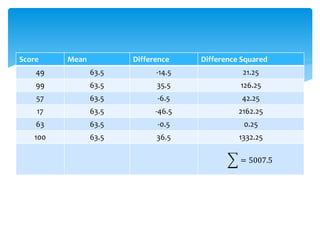
Score Mean Difference Difference Squared
49 63.5 -14.5 21.25
99 63.5 35.5 126.25
57 63.5 -6.5 42.25
17 63.5 -46.5 2162.25
63 63.5 -0.5 0.25
100 63.5 36.5 1332.25
= 5007.5
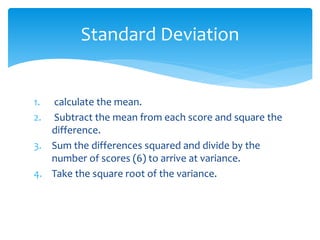
1. calculate the mean.
2. Subtract the mean from each score and square the
difference.
3. Sum the differences squared and divide by the
number of scores (6) to arrive at variance.
4. Take the square root of the variance.
Standard Deviation
 The larger the standard deviation, the more variability
there is in a particular group of scores.
 Conversely, a smaller standard deviation indicates
that the group is more homogeneous in terms of a
particular behavior.
 Measures of dispersion (particularly standard
deviations) can serve as a quality control for
measures of central tendency; the smaller the
standard deviation, the better the mean captures the
behavior of the sample.
 A distribution describes the clusterings of
scores/behaviors.
 In a normal distribution the numbers cluster around
the midpoint. There is an even and decreasing
distribution of scores in both directions.
Normal Distribution
 There is an even and decreasing distribution of scores
in both directions.
 The three measures of central tendency (mean, mode,
median) coincide at the midpoint. Thus, 50% of the scores
fall above the mean and 50% fall below the mean.
 Approximately 34% of the data lie within 1 standard
deviation of the mean. In other words, 34% of the
data are one standard deviation above the mean and
34% are one standard deviation below the mean.
 If we know that a group of scores is normally
distributed and if we know the mean and the
standard deviation, we can then determine where
individuals fall within a group of scores.
The two most common standard scores are z scores and
T scores.
Standard Scores
 The first type, z scores, uses standard deviations to
reflect the distance of a score from a mean.
 To calculate the z score we subtract the mean from
the raw score and divide the result by the standard
deviation.
Z score
 If nonnegative standard scores are needed, T scores
are commonly used. T scores are calculated by
multiplying the z score by 10 and adding 50.
T score
 The purpose of conducting statistical tests is to
provide information about the likelihood of an event
occurring by chance. The probability value that is
reported is designed to provide confidence in the
claims that are being made about the analysis of the
data.
Probability
 The general way of expressing probability is through
a percentage.
 The accepted p-value for research in second language
studies is .05.
 A p-value of .05 indicates that there is only a 5%
probability that the research findings are due to
chance, rather than to an actual relationship between
variables.
 Null hypotheses predict that there is no relationship
between two variables; thus, the statistical goal is to
test the hypothesis and reject the null relationship by
showing that there is a relationship.
 Resumptive pronouns (The man that I saw him is very
smart) will decrease with time.“
 This hypothesis predicts change in a particular
direction, that is, the occurrence will decrease over
time. We could express this hypothesis as a null
hypothesis as follows: "There is no relationship
between the use of resumptive pronouns and the
passage of time."
 Type I errors occur when a null hypothesis is rejected
when it should not have been rejected; Type II errors
occur when a null hypothesis is accepted when it
should not have been accepted.
 Statistically significant means that data is below a
certain alpha level, which basically just means that it is
considered "significant" in terms of numbers.
Meaningful significance is something that is
meaningful in real life. If something is not statistically
significant, the experiment is deemed useless.
Difference between meaningfulness
and significance
 Say that 10% of heart surgeries fail, and the desired
alpha level is 5%. This data would not be statistically
significant because it is above the alpha level-
therefore, statisticians would say it has no meaning.
However, this has meaningful significance because in
real life, 10% of failed heart surgeries bears meaning to
those that are considering it.
 Inferential statistics is to make inferences from the
particular sample to the population.
 Because we can’t gather data from all the members
of the population, we can use inferential statistics to
generalize findings to others.
Inferential Statistics
 Standard error of the mean (SEM) is the standard
deviation of sample means. The SEM gives us an idea
of how close our sample mean is to other samples
from the same population.
Standard Error Of The Mean
 Standard error of the difference between sample
means is based on the assumption that the
distribution of differences between sample means is
normal.
Standard Error Of The Difference
 The degree of freedom is the number of scores that
are not fixed.
Degrees of Freedom
 This is the value that we can use as a confidence
measure to determine whether our hypothesis can be
substantiated and become statistically significant.
Critical Values
those that predict a difference in one direction are
known as one-tailed hypotheses and require a different
critical value than do the "neutral" or two-tailed
hypotheses.
One-Tailed Versus Two-Tailed
Hypotheses
 With parametric statistics, there are sets of
assumptions that must be met before the tests can
be appropriately used.
Parametric versus nonparametric
statistics
 The data are normally distributed, and means and
standard deviations are appropriate measures of
central tendency.
 • The data (dependent variable) are interval data
(e.g., scores on a vocabulary test;
 Independence of observations-scores on one
measure do not influence scores on another
measure (e.g., a score on an oral test at Time 1 does
not bias the score on an oral test at Time 2).
Assumptions for parametric tests
 Nonparametric tests are generally used with
frequency data or when the assumptions for
parametric tests are not met
 The t-test can be used when one wants to determine
if the means of two groups are significantly different
from one another.
T-tests
 one is used when the groups are independent and the
other, known as a paired t-test, is used when the
groups are not independent, as in a pretest or
posttest situation when the focus is within a group.
Types Of T-tests
 Analysis of Variance (ANOVA) is a statistical method
used to test differences between two or more means.
Analysis of Variance
 EXAMPLE: Suppose we want to test the effect of five
different exercises. For this, we recruit 20 men and assign
one type of exercise to 4 men (5 groups). Their weights are
recorded after a few weeks.
 We may find out whether the effect of these exercises on
them is significantly different or not and this may be done
by comparing the weights of the 5 groups of 4 men each.
 In second language research, there is often a need to
consider two independent variables, for example,
instruction type and proficiency level.
 When there is more than one independent variable, the
results will show main effects and an interaction effect
which is the effect of one independent variable that is
dependent on the other independent variable.
 ANCOVA evaluates whether population means of
a dependent variable are equal across levels of a
categorical independent variable, while statistically
controlling for the effects of other continuous
variables that are not of primary interest, known
as covariates.
Analysis of Covariance
 1. to increase the precision of comparisons between
groups by accounting to variation on important
prognostic variables;
 2. to "adjust" comparisons between groups for
imbalances in important prognostic variables
between these groups.
Purposes
multivariate analysis of varianceis a statistical test
procedure for comparing multivariate (population)
means of several groups.
multivariate analysis of variance
 There are times when we might want to compare
participants' performance on more than one task.
Repeated Measures ANOVA
 Chi-square is a statistical test commonly used to
compare observed data with data we would expect
to obtain according to a specific hypothesis.
Chi Square
 is a nonparametric test of the null hypothesis that
two samples come from the same population against
an alternative hypothesis, especially that a particular
population tends to have larger values than the other.
Mann-Whitney U/Wilcoxon Rank Sums
 Kruskal-Wallis test provides the alternative non-
parametric procedure where more than
two independent samples are to be compared against
one continuous dependent variable and where the
data is on the Ordinal scale.
Kruskal-Wallis/Friedman
 statistical tables display the minimum value based on
the desired probability level and degrees of freedom
that one must have to claim significance.
Statistical tables
 There are times when we might want to determine
how much of the variation is actually due to the
independent variable in question.
strength of association
 which goes beyond the fact that there is a significant
difference and gives us an indication of how much of
the variability is due to our independent variable.
 Omega2 is the statistic used when all groups have an
equal n size.
Eta And Omega
 Effect size is a measure that gives an indication of the
strength of one's findings which enables readers to
evaluate the stability of research across samples,
operationalizations, designs, and analyses and it is not
dependent on the samples.
Effect Size
 There are times when our research questions involve
surveying a wide range of existing studies rather than
collecting original data.
 To make a meaningful comparison, effect sizes
become the main comparative tool.
Meta Analysis
 Correlational research attempts to determine the
relationship between or among variables; it does not
determine causation.
correlation
 When two sets of data are strongly linked together we say
they have a High Correlation.
 Correlation is Positive when the values increase together,
and
 Correlation is Negative when one value decreases as the
other increases
 Correlations are calculated between two sets of scores
 It’s a common means for determining the strength of
relations, a measure of the linear
correlation (dependence) between two
variables X and Y, giving a value between +1 and −1
inclusive, where 1 is total positive correlation, 0 is no
correlation, and −1 is total negative correlation.
Pearson Product-moment
Correlation
 Normal distribution.
 Independence of samples.
 Continuous measurement scale (generally interval or
sometimes ordinal if continuous).
 Linear relationship between scores for each variable
Assumptions
 is an approach for modeling the relationship between
a scalar dependent variable y and one or more
explanatory variables (or independent variable)
denoted X.
Linear Regression
 Note that the validity of regression for prediction is
dependent on the variables selected.
 It is used when we want to predict the value of a
variable based on the value of two or more other
variables. The variable we want to predict is called the
dependent variable (or sometimes, the outcome,
target or criterion variable).
Multiple Regression
 Both Spearman rho (r) and Kendall Tau are used for
correlational analyses when there is ordinal data (or
with interval data when converted to ranks).
Spearman Rho/Kendall Tau
 Factor analysis is a statistical method used to
describe variability among observed, correlated
variables in terms of a potentially lower number of
unobserved variables called factors. For example, it is
possible that variations in four observed variables
mainly reflect the variations in two unobserved
variables.
Factor Analysis

Analyzing quantitative data

  • 1.
  • 2.
    Descriptive statistics canhelp to provide a simple summary or overview of the data, thus allowing researchers to gain a better overall understanding of the data set. Descriptive Statistics
  • 3.
     1- measuresof frequency  2- measures of central tendency  3- measures of variability or dispersion Types of descriptive statistics
  • 4.
    Are used toindicate how often a particular behavior or phenomenon occurs, which are presented in tables, graphically (histograms, bar graphs or frequency polygons). Measures of frequency
  • 5.
     Frequencies, aswell as measures of central tendency are often presented in second language studies even when they do not relate directly to the research questions.
  • 6.
     They canalso help researchers determine which sorts of statistical analyses are appropriate for the data.
  • 7.
     Second languageresearchers often use one or more measures of central tendency to provide precise quantitative information about the typical behavior of learners with respect to a particular phenomenon. Measures of central tendency
  • 8.
     The modeis the most frequent score obtained by a particular group of learners. Mode
  • 9.
     The medianis the score at the center of the distribution that is the score that splits the group in half. Median
  • 10.
     Mean isthe sum of all scores divided by the number of observations. Mean
  • 11.
     Outliers representdata that seem to be atypical of the rest of the dataset. Outliers
  • 12.
     There arealso cases when it may be appropriate to remove a subset of the data.
  • 13.
    They measure howspread out a set of data is. Measures Of Dispersion
  • 14.
     is anumber that shows how scores are spread around the mean; specifically, it is the square root of the average squared distance of the scores from the mean. Standard Deviation
  • 15.
    Score Mean DifferenceDifference Squared 49 63.5 -14.5 21.25 99 63.5 35.5 126.25 57 63.5 -6.5 42.25 17 63.5 -46.5 2162.25 63 63.5 -0.5 0.25 100 63.5 36.5 1332.25 = 5007.5
  • 16.
    1. calculate themean. 2. Subtract the mean from each score and square the difference. 3. Sum the differences squared and divide by the number of scores (6) to arrive at variance. 4. Take the square root of the variance. Standard Deviation
  • 17.
     The largerthe standard deviation, the more variability there is in a particular group of scores.  Conversely, a smaller standard deviation indicates that the group is more homogeneous in terms of a particular behavior.
  • 18.
     Measures ofdispersion (particularly standard deviations) can serve as a quality control for measures of central tendency; the smaller the standard deviation, the better the mean captures the behavior of the sample.
  • 19.
     A distributiondescribes the clusterings of scores/behaviors.  In a normal distribution the numbers cluster around the midpoint. There is an even and decreasing distribution of scores in both directions. Normal Distribution
  • 20.
     There isan even and decreasing distribution of scores in both directions.
  • 21.
     The threemeasures of central tendency (mean, mode, median) coincide at the midpoint. Thus, 50% of the scores fall above the mean and 50% fall below the mean.
  • 22.
     Approximately 34%of the data lie within 1 standard deviation of the mean. In other words, 34% of the data are one standard deviation above the mean and 34% are one standard deviation below the mean.
  • 23.
     If weknow that a group of scores is normally distributed and if we know the mean and the standard deviation, we can then determine where individuals fall within a group of scores.
  • 24.
    The two mostcommon standard scores are z scores and T scores. Standard Scores
  • 25.
     The firsttype, z scores, uses standard deviations to reflect the distance of a score from a mean.  To calculate the z score we subtract the mean from the raw score and divide the result by the standard deviation. Z score
  • 26.
     If nonnegativestandard scores are needed, T scores are commonly used. T scores are calculated by multiplying the z score by 10 and adding 50. T score
  • 27.
     The purposeof conducting statistical tests is to provide information about the likelihood of an event occurring by chance. The probability value that is reported is designed to provide confidence in the claims that are being made about the analysis of the data. Probability
  • 28.
     The generalway of expressing probability is through a percentage.
  • 29.
     The acceptedp-value for research in second language studies is .05.  A p-value of .05 indicates that there is only a 5% probability that the research findings are due to chance, rather than to an actual relationship between variables.
  • 30.
     Null hypothesespredict that there is no relationship between two variables; thus, the statistical goal is to test the hypothesis and reject the null relationship by showing that there is a relationship.
  • 31.
     Resumptive pronouns(The man that I saw him is very smart) will decrease with time.“  This hypothesis predicts change in a particular direction, that is, the occurrence will decrease over time. We could express this hypothesis as a null hypothesis as follows: "There is no relationship between the use of resumptive pronouns and the passage of time."
  • 32.
     Type Ierrors occur when a null hypothesis is rejected when it should not have been rejected; Type II errors occur when a null hypothesis is accepted when it should not have been accepted.
  • 33.
     Statistically significantmeans that data is below a certain alpha level, which basically just means that it is considered "significant" in terms of numbers. Meaningful significance is something that is meaningful in real life. If something is not statistically significant, the experiment is deemed useless. Difference between meaningfulness and significance
  • 34.
     Say that10% of heart surgeries fail, and the desired alpha level is 5%. This data would not be statistically significant because it is above the alpha level- therefore, statisticians would say it has no meaning. However, this has meaningful significance because in real life, 10% of failed heart surgeries bears meaning to those that are considering it.
  • 35.
     Inferential statisticsis to make inferences from the particular sample to the population.  Because we can’t gather data from all the members of the population, we can use inferential statistics to generalize findings to others. Inferential Statistics
  • 36.
     Standard errorof the mean (SEM) is the standard deviation of sample means. The SEM gives us an idea of how close our sample mean is to other samples from the same population. Standard Error Of The Mean
  • 37.
     Standard errorof the difference between sample means is based on the assumption that the distribution of differences between sample means is normal. Standard Error Of The Difference
  • 38.
     The degreeof freedom is the number of scores that are not fixed. Degrees of Freedom
  • 39.
     This isthe value that we can use as a confidence measure to determine whether our hypothesis can be substantiated and become statistically significant. Critical Values
  • 40.
    those that predicta difference in one direction are known as one-tailed hypotheses and require a different critical value than do the "neutral" or two-tailed hypotheses. One-Tailed Versus Two-Tailed Hypotheses
  • 41.
     With parametricstatistics, there are sets of assumptions that must be met before the tests can be appropriately used. Parametric versus nonparametric statistics
  • 42.
     The dataare normally distributed, and means and standard deviations are appropriate measures of central tendency.  • The data (dependent variable) are interval data (e.g., scores on a vocabulary test;  Independence of observations-scores on one measure do not influence scores on another measure (e.g., a score on an oral test at Time 1 does not bias the score on an oral test at Time 2). Assumptions for parametric tests
  • 43.
     Nonparametric testsare generally used with frequency data or when the assumptions for parametric tests are not met
  • 44.
     The t-testcan be used when one wants to determine if the means of two groups are significantly different from one another. T-tests
  • 45.
     one isused when the groups are independent and the other, known as a paired t-test, is used when the groups are not independent, as in a pretest or posttest situation when the focus is within a group. Types Of T-tests
  • 46.
     Analysis ofVariance (ANOVA) is a statistical method used to test differences between two or more means. Analysis of Variance
  • 47.
     EXAMPLE: Supposewe want to test the effect of five different exercises. For this, we recruit 20 men and assign one type of exercise to 4 men (5 groups). Their weights are recorded after a few weeks.  We may find out whether the effect of these exercises on them is significantly different or not and this may be done by comparing the weights of the 5 groups of 4 men each.
  • 48.
     In secondlanguage research, there is often a need to consider two independent variables, for example, instruction type and proficiency level.  When there is more than one independent variable, the results will show main effects and an interaction effect which is the effect of one independent variable that is dependent on the other independent variable.
  • 49.
     ANCOVA evaluateswhether population means of a dependent variable are equal across levels of a categorical independent variable, while statistically controlling for the effects of other continuous variables that are not of primary interest, known as covariates. Analysis of Covariance
  • 50.
     1. toincrease the precision of comparisons between groups by accounting to variation on important prognostic variables;  2. to "adjust" comparisons between groups for imbalances in important prognostic variables between these groups. Purposes
  • 51.
    multivariate analysis ofvarianceis a statistical test procedure for comparing multivariate (population) means of several groups. multivariate analysis of variance
  • 52.
     There aretimes when we might want to compare participants' performance on more than one task. Repeated Measures ANOVA
  • 53.
     Chi-square isa statistical test commonly used to compare observed data with data we would expect to obtain according to a specific hypothesis. Chi Square
  • 54.
     is anonparametric test of the null hypothesis that two samples come from the same population against an alternative hypothesis, especially that a particular population tends to have larger values than the other. Mann-Whitney U/Wilcoxon Rank Sums
  • 55.
     Kruskal-Wallis testprovides the alternative non- parametric procedure where more than two independent samples are to be compared against one continuous dependent variable and where the data is on the Ordinal scale. Kruskal-Wallis/Friedman
  • 56.
     statistical tablesdisplay the minimum value based on the desired probability level and degrees of freedom that one must have to claim significance. Statistical tables
  • 57.
     There aretimes when we might want to determine how much of the variation is actually due to the independent variable in question. strength of association
  • 58.
     which goesbeyond the fact that there is a significant difference and gives us an indication of how much of the variability is due to our independent variable.  Omega2 is the statistic used when all groups have an equal n size. Eta And Omega
  • 59.
     Effect sizeis a measure that gives an indication of the strength of one's findings which enables readers to evaluate the stability of research across samples, operationalizations, designs, and analyses and it is not dependent on the samples. Effect Size
  • 60.
     There aretimes when our research questions involve surveying a wide range of existing studies rather than collecting original data.  To make a meaningful comparison, effect sizes become the main comparative tool. Meta Analysis
  • 61.
     Correlational researchattempts to determine the relationship between or among variables; it does not determine causation. correlation
  • 62.
     When twosets of data are strongly linked together we say they have a High Correlation.  Correlation is Positive when the values increase together, and  Correlation is Negative when one value decreases as the other increases  Correlations are calculated between two sets of scores
  • 63.
     It’s acommon means for determining the strength of relations, a measure of the linear correlation (dependence) between two variables X and Y, giving a value between +1 and −1 inclusive, where 1 is total positive correlation, 0 is no correlation, and −1 is total negative correlation. Pearson Product-moment Correlation
  • 64.
     Normal distribution. Independence of samples.  Continuous measurement scale (generally interval or sometimes ordinal if continuous).  Linear relationship between scores for each variable Assumptions
  • 65.
     is anapproach for modeling the relationship between a scalar dependent variable y and one or more explanatory variables (or independent variable) denoted X. Linear Regression
  • 66.
     Note thatthe validity of regression for prediction is dependent on the variables selected.
  • 67.
     It isused when we want to predict the value of a variable based on the value of two or more other variables. The variable we want to predict is called the dependent variable (or sometimes, the outcome, target or criterion variable). Multiple Regression
  • 68.
     Both Spearmanrho (r) and Kendall Tau are used for correlational analyses when there is ordinal data (or with interval data when converted to ranks). Spearman Rho/Kendall Tau
  • 69.
     Factor analysisis a statistical method used to describe variability among observed, correlated variables in terms of a potentially lower number of unobserved variables called factors. For example, it is possible that variations in four observed variables mainly reflect the variations in two unobserved variables. Factor Analysis