GENE REGULATION IN
PROKARYOTES
Year II
Biomedical Sciences
2/5/2024 1
Gene regulation
 The DNA sequence within each cell contains
the information required to synthesize
thousands of different proteins and RNA
molecules.
 Typically, a cell expresses only a fraction of its
genes.
 Different cell types in multicellular organism
arise because each type expresses a different
set of genes.
2/5/2024 2
Gene regulation
 bacterial cell lives in direct contact with its
environment, which may change dramatically in
chemical composition or temperature from one
moment to the next.
 At certain times, a particular food source may be
present, while at other times that compound is
absent
 Some molecules are absorbed from the immediate
environment or synthesized within the cell (e.g.,
lactose and tryptophan).
2/5/2024 3
 Genes may be regulated positively or
negatively.
 In positive regulation, a gene is incapable of
expression unless it receives a positive signal
of some sort.

 In negative regulation, a gene is inherently
active but is prevented from expressing itself
unless certain inhibitory factors are removed.
2/5/2024 4
Cont...
 Cells possess mechanisms that allow them to
precisely regulate their genetic information,
expressing genes only when they are needed
 When a bacterial cell encounters a potential
food source it will manufacture the enzymes
necessary to metabolize that food
2/5/2024 5
 In addition to sugars like glucose and lactose,
E. coli cells also require amino acids
 One essential amino acid is tryptophan.
 When E. coli is swimming in tryptophan it will
absorb the amino acids from the media
 When tryptophan is not present in the media
then the cell must manufacture its’ own amino
acid
2/5/2024 6
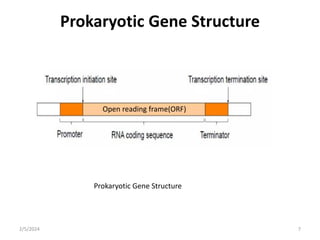
Prokaryotic Gene Structure
2/5/2024 7
Open reading frame(ORF)
Open Reading Frame (ORF)
 Open reading frame is a sequence from the
start till the first stop codon
 Ribosomes translate triplets of nucleotides
into amino acids
 Start codon is usually AUG (which is encoded
into methionine)
 Stop codons are UAA, UAG, UGA
 It is important to determine from which
nucleotide to start
2/5/2024 8
Gene regulation
 Gene regulation occurs at the level of
transcription or production of mRNA
 Prokaryotic genes are often organized such that
genes encoding related functions are clustered
together.
 This grouping of functionally related genes is
referred to as an operon.
2/5/2024 9
levels of regulation of gene expression
 A prokaryote, a unicellular organism, is totally
controlled by environmental changes
 Since transcription and translation in
prokaryotes are coupled, regulation mainly acts
at transcription level
 Prokaryotes adjust gene expression in response
to environmental conditions
2/5/2024 10
The operon
 An operon is a single transcription unit that
encodes multiple enzymes necessary for a
biochemical pathway
 Operons are transcribed to give single mRNA
molecules, each consisting of several genes.
 An operon are controlled by the Repressor or
Activator or inducer or substrate.
2/5/2024 11
The Operons
 The operon model was developed by François
Jacob and Jacques Monod (1961)
 An operon is composed of :
structural genes, control elements such as
operator sequences and regulator genes
(whose products recognize control elements).
 The expression of these genes are rapid and
synchronized.
2/5/2024 12
Cont...
 The purposes of the regulation of gene
expression in prokaryotes are remarkably well
served by the use of operons :
 All genes of an operon are coordinateley
expressed
 There is energy saving as the same set of
regulatory sequences and proteins is used for all
structural genes of the operon.
 These genes are transcribed as a polycistronic
transcript.
2/5/2024 13
Modulators of transcription
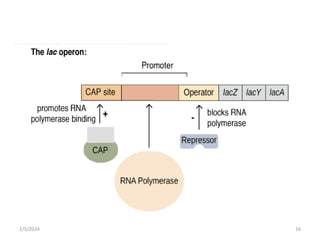
 The promoter is the site where the RNA polymerase binds
to the DNA prior to beginning transcription
 The operator typically resides adjacent to or overlaps with
the promoter and serves as the binding site for a protein,
usually a repressor .
 Repressors: mediate negative gene regulation, may
impede access of RNA polymerase to the promoter ther by
actively block transcription.
 Repressor binding is modulated by specific effectors
 The regulatory gene encodes the repressor protein
 Structural genes encode the enzymes of a particular
metabolic pathway.(eg.the Z,Y and a genes of lac operon)
2/5/2024 14
Cont...
 Activators: mediate positive gene regulation bind to
specific regulatory DNA sequences (e.g.enhancers)
o enhance the RNA polymerase -promoter interaction and
actively stimulate transcription common in eukaryotes
o Induction occurs when enzymes for a certain pathway
are produced in response to a substrate
 Inducers are small molecules that either activate or
repress transcription depending on the needs of the cell
and the availability of substrate.
 Inducers can help speed up or slow down “on” or “off”
by binding to a repressor or activator
2/5/2024 15
2/5/2024 16
The lactose operon (lac operon)
 E. coli can use either glucose, which is a monosaccharide
or lactose, which is a disaccharide.
 However, lactose needs to be hydrolysed (digested) first
So the bacterium prefers to use glucose when it can.
 The lac operon consists of the genes that encode enzymes
necessary to utilize lactose
 The E. coli bacteria only needs beta galactosidase if there
is lactose in the environment to digest
 The enzymes responsible are only synthesized when
lactose is available as the sole source of carbon
2/5/2024 17
Lac Operon genes
 Lac Operon contains 3 genes for lactose breakdown
 Structural genes involved in lactose metabolism are:
 Lac Z codes for β-galactosidase hydrolyses lactose
into glucose and galactose
 lac Y codes for β-galactoside permease that which
regulates the lactose permeability in the cell.
 lac A codes for β-galactoside transacetylase that
eliminate toxic thiogalacosides
 Lac I gene is a regulatory gene that codes for
the repressor protein
2/5/2024 18
Cont...
 The lac operon composed of :
 Regulatory sequences :
 The operator which binds the repressor protein,
 The promoter containing two binding sites, one for the
RNA polymerase, the other for CAP-cAMP complex
 -galactosidase start codon (AUG) is at position +39 to +41
 Negative control is mediated by proteins called repressors.
 Positive control is mediated by another class of regulatory,
allosteric proteins called activators that can bind to DNA and
stimulate the initiation of transcription.
2/5/2024 19
Structure of lac operon
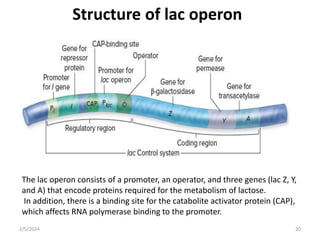
The lac operon consists of a promoter, an operator, and three genes (lac Z, Y,
and A) that encode proteins required for the metabolism of lactose.
In addition, there is a binding site for the catabolite activator protein (CAP),
which affects RNA polymerase binding to the promoter.
2/5/2024 20
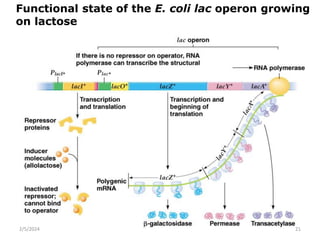
Functional state of the E. coli lac operon growing
on lactose
2/5/2024 21
Action of the repressor
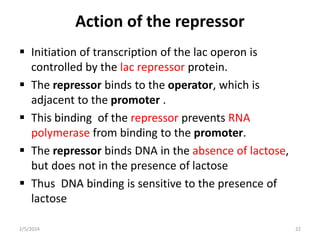
 Initiation of transcription of the lac operon is
controlled by the lac repressor protein.
 The repressor binds to the operator, which is
adjacent to the promoter .
 This binding of the repressor prevents RNA
polymerase from binding to the promoter.
 The repressor binds DNA in the absence of lactose,
but does not in the presence of lactose
 Thus DNA binding is sensitive to the presence of
lactose
2/5/2024 22
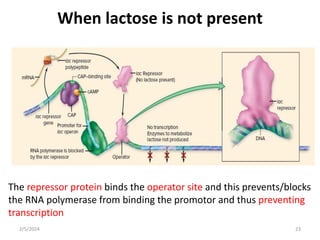
When lactose is not present
The repressor protein binds the operator site and this prevents/blocks
the RNA polymerase from binding the promotor and thus preventing
transcription
2/5/2024 23
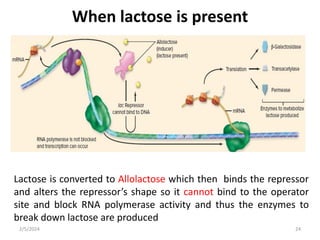
When lactose is present
Lactose is converted to Allolactose which then binds the repressor
and alters the repressor’s shape so it cannot bind to the operator
site and block RNA polymerase activity and thus the enzymes to
break down lactose are produced
2/5/2024 24
The presence of glucose prevents induction
 If bacteria are grown in the presence of both
glucose and lactose, the lac operon is not
induced.
 As glucose is used up, the lac operon is induced
and this allows lactose to be used as an energy
source
 The activator, catabolite activator protein (CAP),
is an allosteric protein which binds cAMP as an
effector.
2/5/2024 25
 cAMP acts in prokaryotic cells by binding to a
protein, the cAMP receptor protein (CRP).
 By itself, CRP is unable to bind to DNA.
However, the cAMP-CRP complex recognizes
and binds to a specific site in the lac control
region
 The level of cAMP in cells is reduced in the
presence of glucose so that no stimulation of
transcription from CAP responsive operons
takes place
2/5/2024 26
Cont...
 The concentration of glucose in the cell affect the
activity of an enzyme called adenylate cyclase
 At high glucose concentration, adenylate cyclase
activity is inhibited.
 The decrease of glucose concentration activates this
enzyme which transforms ATP into cAMP
 Increasing amount of cAMP leads to cAMP bind
catabolite activator protein (CAP) making CRP-cAMP
complex
 CRP-cAMP complex binds to binding site(promotor)
and induces expression of the lac operon
2/5/2024 27
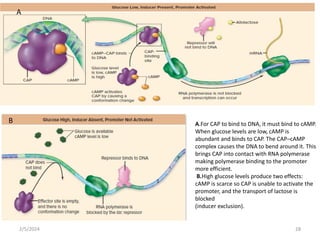
A.For CAP to bind to DNA, it must bind to cAMP.
When glucose levels are low, cAMP is
abundant and binds to CAP. The CAP–cAMP
complex causes the DNA to bend around it. This
brings CAP into contact with RNA polymerase
making polymerase binding to the promoter
more efficient.
B.High glucose levels produce two effects:
cAMP is scarce so CAP is unable to activate the
promoter, and the transport of lactose is
blocked
(inducer exclusion).
A
B
2/5/2024 28
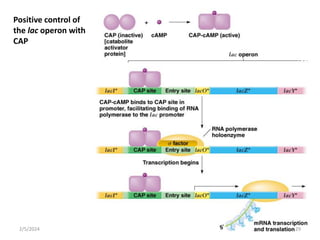
Positive control of
the lac operon with
CAP
2/5/2024 29
tryptophan (or trp ) operon
 E. coli uses several proteins encoded by a cluster of 5
genes to manufacture the amino acid tryptophan
 All 5 genes are transcribed together as a unit called
an operon, which produces a single long piece of
mRNA for all the genes(polycistronic mRNA)
 RNA polymerase binds to a promoter located at the
beginning of the first gene and proceeds down the
DNA transcribing the genes in sequence
2/5/2024 30
Cont...
 The trp operon is continuously expressed in the
absence of tryptophan and is not expressed in the
presence of tryptophan.
 The trp repressor is a helix-turn-helix protein
that binds to the operator site located adjacent
to the trp promoter
 In the absence of tryptophan, the trp repressor
does not bind to its operator, allowing
expression of the operon and production of the
enzymes necessary to make tryptophan.
2/5/2024 31
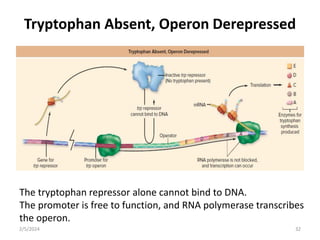
Tryptophan Absent, Operon Derepressed
The tryptophan repressor alone cannot bind to DNA.
The promoter is free to function, and RNA polymerase transcribes
the operon.
2/5/2024 32
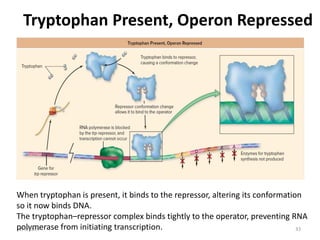
Tryptophan Present, Operon Repressed
When tryptophan is present, it binds to the repressor, altering its conformation
so it now binds DNA.
The tryptophan–repressor complex binds tightly to the operator, preventing RNA
polymerase from initiating transcription.
2/5/2024 33
Fig. 16.6
2/5/2024 34
Cont...
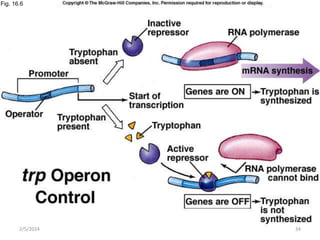
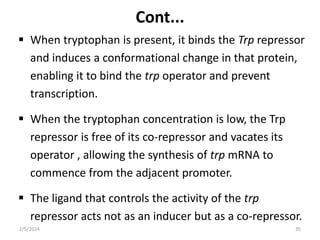
 When tryptophan is present, it binds the Trp repressor
and induces a conformational change in that protein,
enabling it to bind the trp operator and prevent
transcription.
 When the tryptophan concentration is low, the Trp
repressor is free of its co-repressor and vacates its
operator , allowing the synthesis of trp mRNA to
commence from the adjacent promoter.
 The ligand that controls the activity of the trp
repressor acts not as an inducer but as a co-repressor.
2/5/2024 35
Quorum sensing
• Quorum sensing is a cell–cell communication
process used by bacteria to coordinate gene
expression in response to changes in
population density
• This type of communication was originally
described in the marine luminescent
bacterium Vibrio fischeri.
2/5/2024 36
• V. fischeri colonize the light organ of
Euprymna scolopes.
• Inside the light organ, the bacteria grow to
high cell density and use quorum sensing to
activate expression of the luciferase operon.
The host benefits from this colonization
because it uses the bacterial-produced light to
counterilluminate itself to avoid predators.
2/5/2024 37
end
2/5/2024 38

REVISED- Gene Regulation in prokaryotic.pdf

  • 1.
    GENE REGULATION IN PROKARYOTES YearII Biomedical Sciences 2/5/2024 1
  • 2.
    Gene regulation  TheDNA sequence within each cell contains the information required to synthesize thousands of different proteins and RNA molecules.  Typically, a cell expresses only a fraction of its genes.  Different cell types in multicellular organism arise because each type expresses a different set of genes. 2/5/2024 2
  • 3.
    Gene regulation  bacterialcell lives in direct contact with its environment, which may change dramatically in chemical composition or temperature from one moment to the next.  At certain times, a particular food source may be present, while at other times that compound is absent  Some molecules are absorbed from the immediate environment or synthesized within the cell (e.g., lactose and tryptophan). 2/5/2024 3
  • 4.
     Genes maybe regulated positively or negatively.  In positive regulation, a gene is incapable of expression unless it receives a positive signal of some sort.  In negative regulation, a gene is inherently active but is prevented from expressing itself unless certain inhibitory factors are removed. 2/5/2024 4
  • 5.
    Cont...  Cells possessmechanisms that allow them to precisely regulate their genetic information, expressing genes only when they are needed  When a bacterial cell encounters a potential food source it will manufacture the enzymes necessary to metabolize that food 2/5/2024 5
  • 6.
     In additionto sugars like glucose and lactose, E. coli cells also require amino acids  One essential amino acid is tryptophan.  When E. coli is swimming in tryptophan it will absorb the amino acids from the media  When tryptophan is not present in the media then the cell must manufacture its’ own amino acid 2/5/2024 6
  • 7.
    Prokaryotic Gene Structure ProkaryoticGene Structure 2/5/2024 7 Open reading frame(ORF)
  • 8.
    Open Reading Frame(ORF)  Open reading frame is a sequence from the start till the first stop codon  Ribosomes translate triplets of nucleotides into amino acids  Start codon is usually AUG (which is encoded into methionine)  Stop codons are UAA, UAG, UGA  It is important to determine from which nucleotide to start 2/5/2024 8
  • 9.
    Gene regulation  Generegulation occurs at the level of transcription or production of mRNA  Prokaryotic genes are often organized such that genes encoding related functions are clustered together.  This grouping of functionally related genes is referred to as an operon. 2/5/2024 9
  • 10.
    levels of regulationof gene expression  A prokaryote, a unicellular organism, is totally controlled by environmental changes  Since transcription and translation in prokaryotes are coupled, regulation mainly acts at transcription level  Prokaryotes adjust gene expression in response to environmental conditions 2/5/2024 10
  • 11.
    The operon  Anoperon is a single transcription unit that encodes multiple enzymes necessary for a biochemical pathway  Operons are transcribed to give single mRNA molecules, each consisting of several genes.  An operon are controlled by the Repressor or Activator or inducer or substrate. 2/5/2024 11
  • 12.
    The Operons  Theoperon model was developed by François Jacob and Jacques Monod (1961)  An operon is composed of : structural genes, control elements such as operator sequences and regulator genes (whose products recognize control elements).  The expression of these genes are rapid and synchronized. 2/5/2024 12
  • 13.
    Cont...  The purposesof the regulation of gene expression in prokaryotes are remarkably well served by the use of operons :  All genes of an operon are coordinateley expressed  There is energy saving as the same set of regulatory sequences and proteins is used for all structural genes of the operon.  These genes are transcribed as a polycistronic transcript. 2/5/2024 13
  • 14.
    Modulators of transcription The promoter is the site where the RNA polymerase binds to the DNA prior to beginning transcription  The operator typically resides adjacent to or overlaps with the promoter and serves as the binding site for a protein, usually a repressor .  Repressors: mediate negative gene regulation, may impede access of RNA polymerase to the promoter ther by actively block transcription.  Repressor binding is modulated by specific effectors  The regulatory gene encodes the repressor protein  Structural genes encode the enzymes of a particular metabolic pathway.(eg.the Z,Y and a genes of lac operon) 2/5/2024 14
  • 15.
    Cont...  Activators: mediatepositive gene regulation bind to specific regulatory DNA sequences (e.g.enhancers) o enhance the RNA polymerase -promoter interaction and actively stimulate transcription common in eukaryotes o Induction occurs when enzymes for a certain pathway are produced in response to a substrate  Inducers are small molecules that either activate or repress transcription depending on the needs of the cell and the availability of substrate.  Inducers can help speed up or slow down “on” or “off” by binding to a repressor or activator 2/5/2024 15
  • 16.
  • 17.
    The lactose operon(lac operon)  E. coli can use either glucose, which is a monosaccharide or lactose, which is a disaccharide.  However, lactose needs to be hydrolysed (digested) first So the bacterium prefers to use glucose when it can.  The lac operon consists of the genes that encode enzymes necessary to utilize lactose  The E. coli bacteria only needs beta galactosidase if there is lactose in the environment to digest  The enzymes responsible are only synthesized when lactose is available as the sole source of carbon 2/5/2024 17
  • 18.
    Lac Operon genes Lac Operon contains 3 genes for lactose breakdown  Structural genes involved in lactose metabolism are:  Lac Z codes for β-galactosidase hydrolyses lactose into glucose and galactose  lac Y codes for β-galactoside permease that which regulates the lactose permeability in the cell.  lac A codes for β-galactoside transacetylase that eliminate toxic thiogalacosides  Lac I gene is a regulatory gene that codes for the repressor protein 2/5/2024 18
  • 19.
    Cont...  The lacoperon composed of :  Regulatory sequences :  The operator which binds the repressor protein,  The promoter containing two binding sites, one for the RNA polymerase, the other for CAP-cAMP complex  -galactosidase start codon (AUG) is at position +39 to +41  Negative control is mediated by proteins called repressors.  Positive control is mediated by another class of regulatory, allosteric proteins called activators that can bind to DNA and stimulate the initiation of transcription. 2/5/2024 19
  • 20.
    Structure of lacoperon The lac operon consists of a promoter, an operator, and three genes (lac Z, Y, and A) that encode proteins required for the metabolism of lactose. In addition, there is a binding site for the catabolite activator protein (CAP), which affects RNA polymerase binding to the promoter. 2/5/2024 20
  • 21.
    Functional state ofthe E. coli lac operon growing on lactose 2/5/2024 21
  • 22.
    Action of therepressor  Initiation of transcription of the lac operon is controlled by the lac repressor protein.  The repressor binds to the operator, which is adjacent to the promoter .  This binding of the repressor prevents RNA polymerase from binding to the promoter.  The repressor binds DNA in the absence of lactose, but does not in the presence of lactose  Thus DNA binding is sensitive to the presence of lactose 2/5/2024 22
  • 23.
    When lactose isnot present The repressor protein binds the operator site and this prevents/blocks the RNA polymerase from binding the promotor and thus preventing transcription 2/5/2024 23
  • 24.
    When lactose ispresent Lactose is converted to Allolactose which then binds the repressor and alters the repressor’s shape so it cannot bind to the operator site and block RNA polymerase activity and thus the enzymes to break down lactose are produced 2/5/2024 24
  • 25.
    The presence ofglucose prevents induction  If bacteria are grown in the presence of both glucose and lactose, the lac operon is not induced.  As glucose is used up, the lac operon is induced and this allows lactose to be used as an energy source  The activator, catabolite activator protein (CAP), is an allosteric protein which binds cAMP as an effector. 2/5/2024 25
  • 26.
     cAMP actsin prokaryotic cells by binding to a protein, the cAMP receptor protein (CRP).  By itself, CRP is unable to bind to DNA. However, the cAMP-CRP complex recognizes and binds to a specific site in the lac control region  The level of cAMP in cells is reduced in the presence of glucose so that no stimulation of transcription from CAP responsive operons takes place 2/5/2024 26
  • 27.
    Cont...  The concentrationof glucose in the cell affect the activity of an enzyme called adenylate cyclase  At high glucose concentration, adenylate cyclase activity is inhibited.  The decrease of glucose concentration activates this enzyme which transforms ATP into cAMP  Increasing amount of cAMP leads to cAMP bind catabolite activator protein (CAP) making CRP-cAMP complex  CRP-cAMP complex binds to binding site(promotor) and induces expression of the lac operon 2/5/2024 27
  • 28.
    A.For CAP tobind to DNA, it must bind to cAMP. When glucose levels are low, cAMP is abundant and binds to CAP. The CAP–cAMP complex causes the DNA to bend around it. This brings CAP into contact with RNA polymerase making polymerase binding to the promoter more efficient. B.High glucose levels produce two effects: cAMP is scarce so CAP is unable to activate the promoter, and the transport of lactose is blocked (inducer exclusion). A B 2/5/2024 28
  • 29.
    Positive control of thelac operon with CAP 2/5/2024 29
  • 30.
    tryptophan (or trp) operon  E. coli uses several proteins encoded by a cluster of 5 genes to manufacture the amino acid tryptophan  All 5 genes are transcribed together as a unit called an operon, which produces a single long piece of mRNA for all the genes(polycistronic mRNA)  RNA polymerase binds to a promoter located at the beginning of the first gene and proceeds down the DNA transcribing the genes in sequence 2/5/2024 30
  • 31.
    Cont...  The trpoperon is continuously expressed in the absence of tryptophan and is not expressed in the presence of tryptophan.  The trp repressor is a helix-turn-helix protein that binds to the operator site located adjacent to the trp promoter  In the absence of tryptophan, the trp repressor does not bind to its operator, allowing expression of the operon and production of the enzymes necessary to make tryptophan. 2/5/2024 31
  • 32.
    Tryptophan Absent, OperonDerepressed The tryptophan repressor alone cannot bind to DNA. The promoter is free to function, and RNA polymerase transcribes the operon. 2/5/2024 32
  • 33.
    Tryptophan Present, OperonRepressed When tryptophan is present, it binds to the repressor, altering its conformation so it now binds DNA. The tryptophan–repressor complex binds tightly to the operator, preventing RNA polymerase from initiating transcription. 2/5/2024 33
  • 34.
  • 35.
    Cont...  When tryptophanis present, it binds the Trp repressor and induces a conformational change in that protein, enabling it to bind the trp operator and prevent transcription.  When the tryptophan concentration is low, the Trp repressor is free of its co-repressor and vacates its operator , allowing the synthesis of trp mRNA to commence from the adjacent promoter.  The ligand that controls the activity of the trp repressor acts not as an inducer but as a co-repressor. 2/5/2024 35
  • 36.
    Quorum sensing • Quorumsensing is a cell–cell communication process used by bacteria to coordinate gene expression in response to changes in population density • This type of communication was originally described in the marine luminescent bacterium Vibrio fischeri. 2/5/2024 36
  • 37.
    • V. fischericolonize the light organ of Euprymna scolopes. • Inside the light organ, the bacteria grow to high cell density and use quorum sensing to activate expression of the luciferase operon. The host benefits from this colonization because it uses the bacterial-produced light to counterilluminate itself to avoid predators. 2/5/2024 37
  • 38.