Member :
• Audhrey Tyara M
• Fadhila Nur A
• Nur Fadhila A
• Salma Azzahra
SIMPLE FUTURE TENSE
The simple future refers to a time later
than now, and expresses facts or
certainty. In this case there is no
'attitude‘.
Simple Future has two different forms in English: "will"
and "be going to." Although the two forms can
sometimes be used interchangeably, they often express
two very different meanings. These different meanings
might seem too abstract at first, but with time and
practice, the differences will become clear. Both "will"
and "be going to" refer to a specific time in the future.
Forms
Formula :
(+) S+ Shall/Will + V1 + O
(-) S+ Shall/Will + not + V1 + O
(?) Shall/Will + S + V1 + O
The simple future is used:
1. To predict a future event:
It will rain tomorrow.
2. With I or We, to express a spontaneous decision:
I'll pay for the tickets by credit card.
3. To express willingness: I'll do the washing-up.
He'll carry your bag for you.
4. In the negative form, to express unwillingness:
The baby won't eat his soup.
I won't leave until I've seen the manager!
With I in the interrogative form
using "shall",
to make an offer
Shall I open the window?
With we in the interrogative form
using "shall", to make a suggestion:
Shall we go to the cinema tonight?
With I in the interrogative form
using "shall", to ask for advice or
instructions:
What shall I tell the boss about
this money?
With you, to give orders:
You will do exactly as I say.
With you in the
interrogative form, to give
an invitation:
Will you come to the dance
with me?
Will you marry me?
Note:In modern English will is preferred to shall. Shall
is mainly used with I and we to make an offer or
suggestion, or to ask for advice. With the other
persons (you, he, she, they) shall is only used in
literary or poetic situations, e.g. "With rings on her
fingers and bells on her toes, She shall have music
wherever she goes."
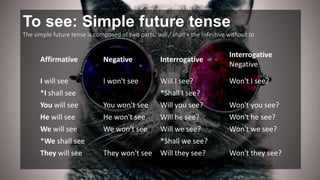
Affirmative Negative Interrogative
Interrogative
Negative
I will see I won't see Will I see? Won't I see?
*I shall see *Shall I see?
You will see You won't see Will you see? Won't you see?
He will see He won't see Will he see? Won't he see?
We will see We won't see Will we see? Won't we see?
*We shall see *Shall we see?
They will see They won't see Will they see? Won't they see?
To see: Simple future tense
The simple future tense is composed of two parts: will / shall + the infinitive without to
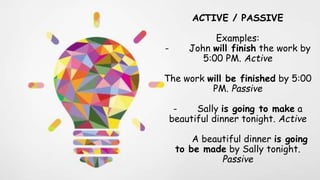
ACTIVE / PASSIVE
Examples:
- John will finish the work by
5:00 PM. Active
The work will be finished by 5:00
PM. Passive
- Sally is going to make a
beautiful dinner tonight. Active
A beautiful dinner is going
to be made by Sally tonight.
Passive
Thank You!

Simple Future Tense

  • 1.
    Member : • AudhreyTyara M • Fadhila Nur A • Nur Fadhila A • Salma Azzahra
  • 2.
    SIMPLE FUTURE TENSE Thesimple future refers to a time later than now, and expresses facts or certainty. In this case there is no 'attitude‘.
  • 3.
    Simple Future hastwo different forms in English: "will" and "be going to." Although the two forms can sometimes be used interchangeably, they often express two very different meanings. These different meanings might seem too abstract at first, but with time and practice, the differences will become clear. Both "will" and "be going to" refer to a specific time in the future. Forms
  • 4.
    Formula : (+) S+Shall/Will + V1 + O (-) S+ Shall/Will + not + V1 + O (?) Shall/Will + S + V1 + O
  • 5.
    The simple futureis used: 1. To predict a future event: It will rain tomorrow. 2. With I or We, to express a spontaneous decision: I'll pay for the tickets by credit card. 3. To express willingness: I'll do the washing-up. He'll carry your bag for you. 4. In the negative form, to express unwillingness: The baby won't eat his soup. I won't leave until I've seen the manager!
  • 6.
    With I inthe interrogative form using "shall", to make an offer Shall I open the window? With we in the interrogative form using "shall", to make a suggestion: Shall we go to the cinema tonight? With I in the interrogative form using "shall", to ask for advice or instructions: What shall I tell the boss about this money?
  • 7.
    With you, togive orders: You will do exactly as I say. With you in the interrogative form, to give an invitation: Will you come to the dance with me? Will you marry me?
  • 8.
    Note:In modern Englishwill is preferred to shall. Shall is mainly used with I and we to make an offer or suggestion, or to ask for advice. With the other persons (you, he, she, they) shall is only used in literary or poetic situations, e.g. "With rings on her fingers and bells on her toes, She shall have music wherever she goes."
  • 9.
    Affirmative Negative Interrogative Interrogative Negative Iwill see I won't see Will I see? Won't I see? *I shall see *Shall I see? You will see You won't see Will you see? Won't you see? He will see He won't see Will he see? Won't he see? We will see We won't see Will we see? Won't we see? *We shall see *Shall we see? They will see They won't see Will they see? Won't they see? To see: Simple future tense The simple future tense is composed of two parts: will / shall + the infinitive without to
  • 10.
    ACTIVE / PASSIVE Examples: -John will finish the work by 5:00 PM. Active The work will be finished by 5:00 PM. Passive - Sally is going to make a beautiful dinner tonight. Active A beautiful dinner is going to be made by Sally tonight. Passive
  • 11.