INVERSIONS
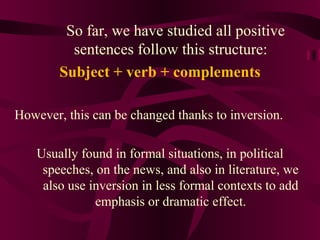
So far, we have studied all positive sentences follow this structure: Subject + verb + complements However, this can be changed thanks to inversion. Usually found in formal situations, in political speeches, on the news, and also in literature, we also use inversion in less formal contexts to add emphasis or dramatic effect.
Inversion  is used in the following cases:
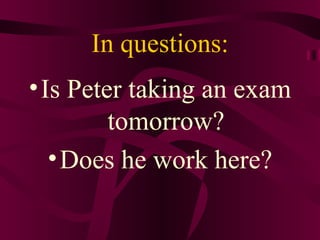
In questions: Is Peter taking an exam tomorrow? Does he work here?
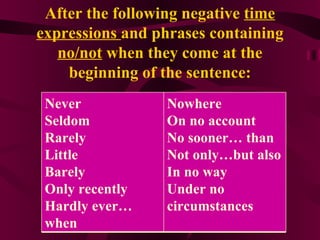
After the following negative  time expressions  and phrases containing  no/not  when they come at the beginning of the sentence: Never Seldom Rarely Little Barely Only recently Hardly ever…when Nowhere On no account No sooner… than Not only…but also In no way Under no circumstances
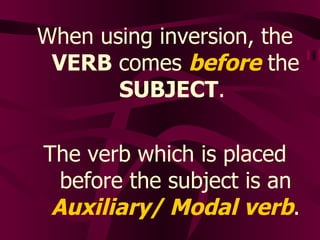
When using inversion, the  VERB  comes  before  the  SUBJECT .  The verb which is placed before the subject is an  Auxiliary/ Modal verb .
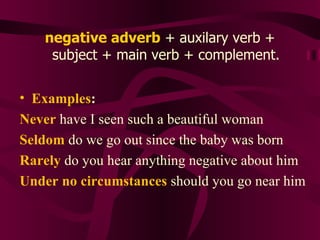
negative adverb  + auxilary verb + subject + main verb + complement. Examples : Never  have I seen such a beautiful woman Seldom  do we go out since the baby was born Rarely  do you hear anything negative about him Under no circumstances  should you go near him
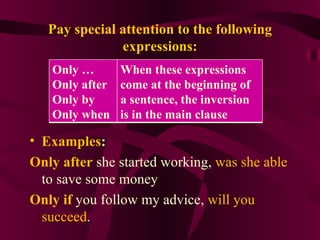
Pay special attention to the following expressions: Examples : Only after  she started working,  was she able  to save some money Only if  you follow my advice,  will you succeed . Only … Only after Only by Only when  When these expressions come at the beginning of a sentence, the inversion is in the main clause
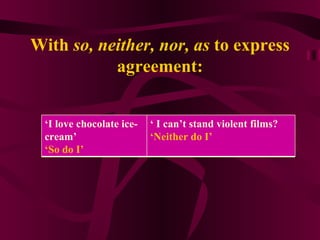
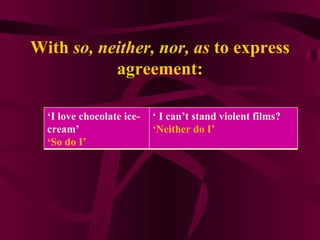
With  so, neither, nor, as  to express agreement: ‘ I love chocolate ice-cream’  ‘ So do I’  ‘  I can’t stand violent films? ‘ Neither do I’
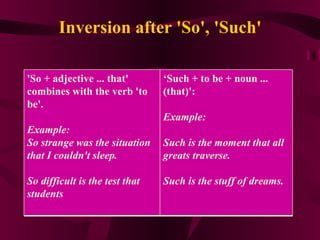
Inversion after 'So', 'Such' 'So + adjective ... that' combines with the verb 'to be'. Example: So strange was the situation that I couldn't sleep. So difficult is the test that students ‘ Such + to be + noun ... (that)': Example: Such is the moment that all greats traverse. Such is the stuff of dreams.
With  so, neither, nor, as  to express agreement: ‘ I love chocolate ice-cream’  ‘ So do I’  ‘  I can’t stand violent films? ‘ Neither do I’
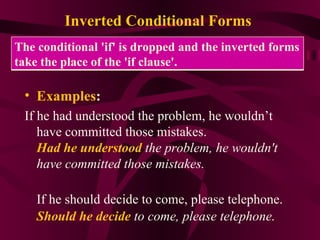
Inverted Conditional Forms   Examples : If he had understood the problem, he wouldn’t have committed those mistakes. Had he understood  the problem, he wouldn't have committed those mistakes. If he should decide to come, please telephone. Should he decide  to come, please telephone . The conditional 'if' is dropped and the inverted forms take the place of the 'if clause'.

Inversion

  • 1.
  • 2.
    So far, wehave studied all positive sentences follow this structure: Subject + verb + complements However, this can be changed thanks to inversion. Usually found in formal situations, in political speeches, on the news, and also in literature, we also use inversion in less formal contexts to add emphasis or dramatic effect.
  • 3.
    Inversion isused in the following cases:
  • 4.
    In questions: IsPeter taking an exam tomorrow? Does he work here?
  • 5.
    After the followingnegative time expressions and phrases containing no/not when they come at the beginning of the sentence: Never Seldom Rarely Little Barely Only recently Hardly ever…when Nowhere On no account No sooner… than Not only…but also In no way Under no circumstances
  • 6.
    When using inversion,the VERB comes before the SUBJECT . The verb which is placed before the subject is an Auxiliary/ Modal verb .
  • 7.
    negative adverb + auxilary verb + subject + main verb + complement. Examples : Never have I seen such a beautiful woman Seldom do we go out since the baby was born Rarely do you hear anything negative about him Under no circumstances should you go near him
  • 8.
    Pay special attentionto the following expressions: Examples : Only after she started working, was she able to save some money Only if you follow my advice, will you succeed . Only … Only after Only by Only when When these expressions come at the beginning of a sentence, the inversion is in the main clause
  • 9.
    With so,neither, nor, as to express agreement: ‘ I love chocolate ice-cream’ ‘ So do I’ ‘ I can’t stand violent films? ‘ Neither do I’
  • 10.
    Inversion after 'So','Such' 'So + adjective ... that' combines with the verb 'to be'. Example: So strange was the situation that I couldn't sleep. So difficult is the test that students ‘ Such + to be + noun ... (that)': Example: Such is the moment that all greats traverse. Such is the stuff of dreams.
  • 11.
    With so,neither, nor, as to express agreement: ‘ I love chocolate ice-cream’ ‘ So do I’ ‘ I can’t stand violent films? ‘ Neither do I’
  • 12.
    Inverted Conditional Forms Examples : If he had understood the problem, he wouldn’t have committed those mistakes. Had he understood the problem, he wouldn't have committed those mistakes. If he should decide to come, please telephone. Should he decide to come, please telephone . The conditional 'if' is dropped and the inverted forms take the place of the 'if clause'.