Reported Speech Statements
Direct speech  "I'm going to the cinema", he said.  Indirect speech  He said he was going to the cinema.
Tense change As a rule when you report something someone has said you go back a tense.
Tense change Present simple  She said, "It's cold.” Past simple  She said it was cold.
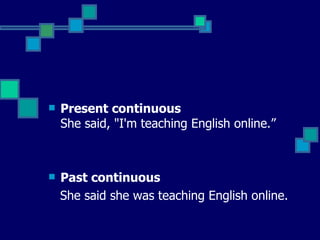
Present continuous  She said, "I'm teaching English online.” Past continuous  She said she was teaching English online.
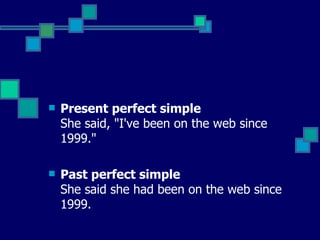
Present perfect simple  She said, "I've been on the web since 1999."   Past perfect simple   She said she had been on the web since 1999.
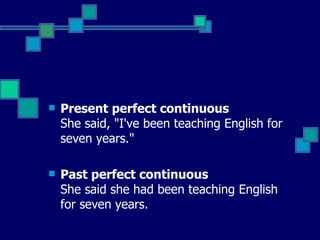
Present perfect continuous  She said, "I've been teaching English for seven years."   Past perfect continuous  She said she had been teaching English for seven years.
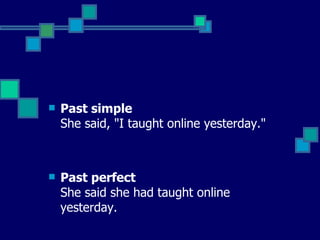
Past simple  She said, "I taught online yesterday."   Past perfect  She said she had taught online yesterday.
Past continuous  She said, "I was teaching earlier."  Past perfect continuous  She said she had been teaching earlier.
Past perfect  She said, "The lesson had already started when he arrived."   Past perfect  NO CHANGE - She said the lesson had already started when he arrived.
Past perfect continuous She said, "I'd already been teaching for five minutes."   Past perfect continuous  NO CHANGE - She said she'd already been teaching for five minutes.
Modal verb forms also sometimes change:  will   She said, "I'll teach English online tomorrow.“ would   She said she would teach English online tomorrow.
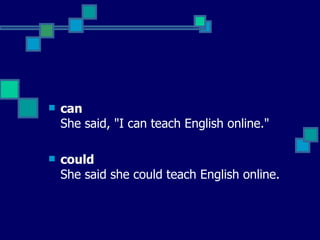
can   She said, "I can teach English online."  could   She said she could teach English online.
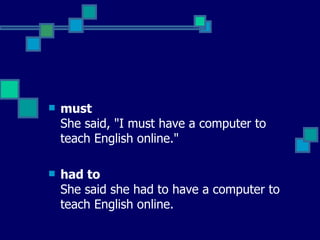
must   She said, "I must have a computer to teach English online."   had to  She said she had to have a computer to teach English online.
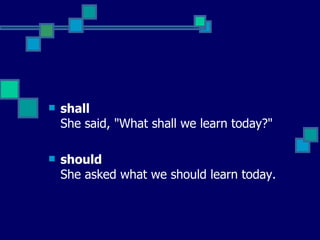
shall   She said, "What shall we learn today?"  should   She asked what we should learn today.
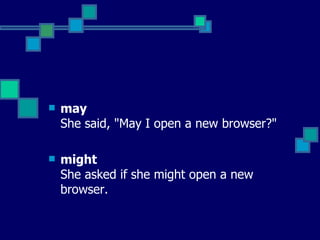
may   She said, "May I open a new browser?"   might   She asked if she might open a new browser.
Note - There is no change to  could, would, should, might and ought to. "I'm might go to the cinema", he said.  He said he might go to the cinema.
You can also use the present tense if you are talking about a future event. Direct speech (exact quote)  "Next week's lesson is on reported speech " , she said.  Indirect speech (not exact)  She said next week's lesson is on reported speech.
Time change If the reported sentence contains an expression of time, you must change it to fit in with the time of reporting.  For example we need to change words like  here  and  yesterday  if they have different meanings at the time and place of reporting.
Today "Today's lesson is on presentations."  + 24 hours - Indirect speech  She said yesterday's lesson was on presentations.
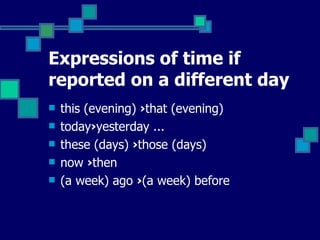
Expressions of time if reported on a different day this (evening)  › that (evening)  today › yesterday ...  these (days)  › those (days)  now  › then  (a week) ago  › (a week) before
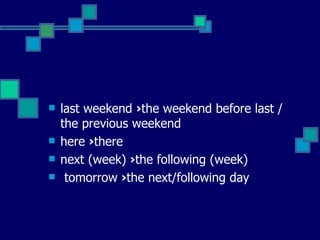
last weekend  › the weekend before last / the previous weekend  here  › there  next (week)  › the following (week) tomorrow  › the next/following day
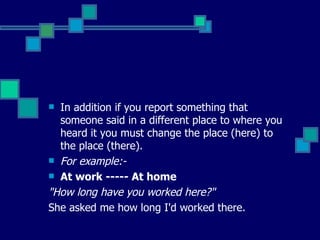
In addition if you report something that someone said in a different place to where you heard it you must change the place (here) to the place (there). For example:-  At work ----- At home "How long have you worked here?"  She asked me how long I'd worked there.
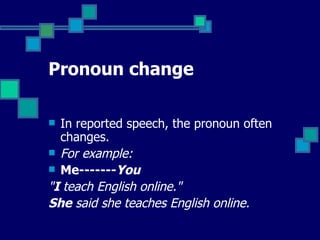
Pronoun change In reported speech, the pronoun often changes. For example:  Me------- You  " I  teach English online."  She  said she teaches English online.
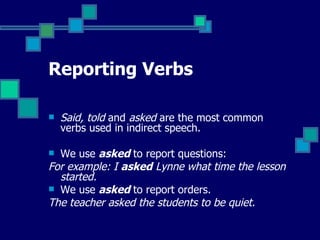
Reporting Verbs Said, told  and  asked  are the most common verbs used in indirect speech.  We use  asked  to report questions: For example: I  asked  Lynne what time the lesson started.  We use  asked  to report orders. The teacher asked the students to be quiet.
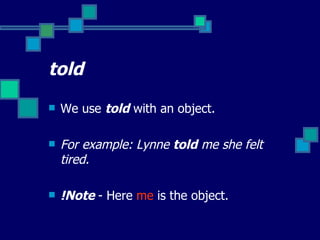
told We use  told  with an object. For example: Lynne  told  me she felt tired.  !Note  - Here  me  is the object.
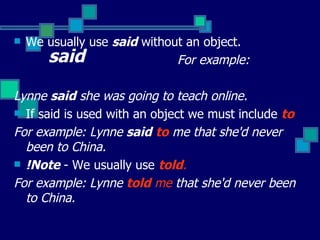
said We usually use  said  without an object. For example:  Lynne  said  she was going to teach online. If said is used with an object we must include  to  For example: Lynne  said   to  me that she'd never been to China.  !Note  - We usually use  told . For example: Lynne  told  me  that she'd never been to China.
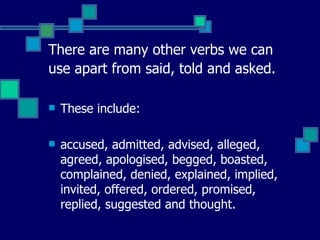
There are many other verbs we can use apart from said, told and asked.   These include: accused, admitted, advised, alleged, agreed, apologised, begged, boasted, complained, denied, explained, implied, invited, offered, ordered, promised, replied, suggested and thought.
Using them properly can make what you say much more interesting and informative.  For example: He asked me to come to the party:   = He invited me to the party.  He begged me to come to the party.  He ordered me to come to the party.  He advised me to come to the party.  He suggested I should come to the party.
 

Reported speech statements

  • 1.
  • 2.
    Direct speech "I'm going to the cinema", he said. Indirect speech He said he was going to the cinema.
  • 3.
    Tense change Asa rule when you report something someone has said you go back a tense.
  • 4.
    Tense change Presentsimple She said, "It's cold.” Past simple She said it was cold.
  • 5.
    Present continuous She said, "I'm teaching English online.” Past continuous She said she was teaching English online.
  • 6.
    Present perfect simple She said, "I've been on the web since 1999." Past perfect simple She said she had been on the web since 1999.
  • 7.
    Present perfect continuous She said, "I've been teaching English for seven years." Past perfect continuous She said she had been teaching English for seven years.
  • 8.
    Past simple She said, "I taught online yesterday." Past perfect She said she had taught online yesterday.
  • 9.
    Past continuous She said, "I was teaching earlier." Past perfect continuous She said she had been teaching earlier.
  • 10.
    Past perfect She said, "The lesson had already started when he arrived." Past perfect NO CHANGE - She said the lesson had already started when he arrived.
  • 11.
    Past perfect continuousShe said, "I'd already been teaching for five minutes." Past perfect continuous NO CHANGE - She said she'd already been teaching for five minutes.
  • 12.
    Modal verb formsalso sometimes change: will She said, "I'll teach English online tomorrow.“ would She said she would teach English online tomorrow.
  • 13.
    can She said, "I can teach English online." could She said she could teach English online.
  • 14.
    must She said, "I must have a computer to teach English online." had to She said she had to have a computer to teach English online.
  • 15.
    shall She said, "What shall we learn today?" should She asked what we should learn today.
  • 16.
    may She said, "May I open a new browser?" might She asked if she might open a new browser.
  • 17.
    Note - Thereis no change to could, would, should, might and ought to. "I'm might go to the cinema", he said. He said he might go to the cinema.
  • 18.
    You can alsouse the present tense if you are talking about a future event. Direct speech (exact quote) "Next week's lesson is on reported speech " , she said. Indirect speech (not exact) She said next week's lesson is on reported speech.
  • 19.
    Time change Ifthe reported sentence contains an expression of time, you must change it to fit in with the time of reporting. For example we need to change words like here and yesterday if they have different meanings at the time and place of reporting.
  • 20.
    Today "Today's lessonis on presentations." + 24 hours - Indirect speech She said yesterday's lesson was on presentations.
  • 21.
    Expressions of timeif reported on a different day this (evening) › that (evening) today › yesterday ... these (days) › those (days) now › then (a week) ago › (a week) before
  • 22.
    last weekend › the weekend before last / the previous weekend here › there next (week) › the following (week) tomorrow › the next/following day
  • 23.
    In addition ifyou report something that someone said in a different place to where you heard it you must change the place (here) to the place (there). For example:- At work ----- At home "How long have you worked here?" She asked me how long I'd worked there.
  • 24.
    Pronoun change Inreported speech, the pronoun often changes. For example: Me------- You " I teach English online." She said she teaches English online.
  • 25.
    Reporting Verbs Said,told and asked are the most common verbs used in indirect speech. We use asked to report questions: For example: I asked Lynne what time the lesson started. We use asked to report orders. The teacher asked the students to be quiet.
  • 26.
    told We use told with an object. For example: Lynne told me she felt tired. !Note - Here me is the object.
  • 27.
    said We usuallyuse said without an object. For example: Lynne said she was going to teach online. If said is used with an object we must include to For example: Lynne said to me that she'd never been to China. !Note - We usually use told . For example: Lynne told me that she'd never been to China.
  • 28.
    There are manyother verbs we can use apart from said, told and asked. These include: accused, admitted, advised, alleged, agreed, apologised, begged, boasted, complained, denied, explained, implied, invited, offered, ordered, promised, replied, suggested and thought.
  • 29.
    Using them properlycan make what you say much more interesting and informative. For example: He asked me to come to the party: = He invited me to the party. He begged me to come to the party. He ordered me to come to the party. He advised me to come to the party. He suggested I should come to the party.
  • 30.