WOULD
wouldWould is an auxiliary verb, a modal auxiliary verb. We use would mainly to:talkaboutthepasttalk about the future in the past expresstheconditionalmoodWe also use would for other functions, such as: expressing desire, polite requests and questions, opinion or hope, wish and regret...
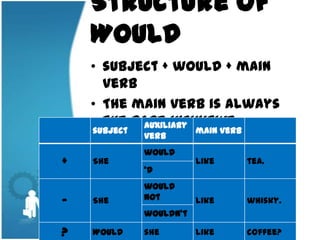
Structure of Wouldsubject + would + main verbThe main verb is always the bare infinitive (infinitive without "to").
Notice that:Would is never conjugated. It is always would or 'd (short form). The main verb is always the bare infinitive.The main verb is always the bare infinitive. We cannot say:I would to like coffee.Be careful! Would and had have the same short form 'd:He'd finished. (He had finished.) He'd like coffee. (He would like coffee.)
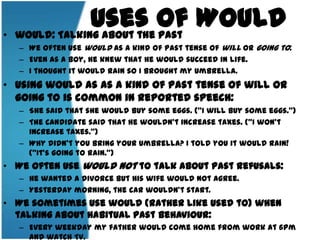
Uses of Would would: Talking about the pastWe often use would as a kind of past tense of will or going to: Even as a boy, he knew that he would succeed in life.I thought it would rain so I brought my umbrella. Using would as as a kind of past tense of will or going to is common in reported speech: She said that she would buy some eggs. ("I will buy some eggs.") The candidate said that he wouldn't increase taxes. ("I won'tincreasetaxes.")Why didn't you bring your umbrella? I told you it would rain! ("It'sgoingto rain.") We often use would not to talk about past refusals:He wanted a divorce but his wife would not agree.Yesterday morning, the car wouldn't start.We sometimes use would (rather like used to) when talking about habitual past behaviour:Every weekday my father would come home from work at 6pm and watch TV.Every summer we'd go to the seaside.
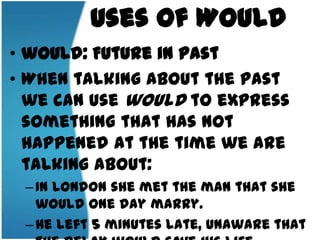
Uses of Would would: Future in pastWhen talking about the past we can use would to express something that has not happened at the time we are talking about: In London she met the man that she would one day marry. He left 5 minutes late, unaware that the delay would save his life.
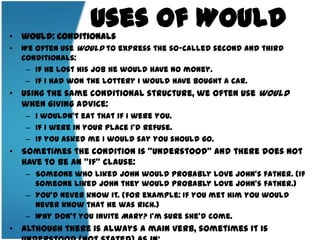
Uses of Would would: ConditionalsWe often use would to express the so-called second and third conditionals: If he lost his job he would have no money. If I had won the lottery I would have bought a car.Using the same conditional structure, we often use would when giving advice: I wouldn't eat that if I were you. If I were in your place I'd refuse. If you asked me I would say you should go. Sometimes the condition is "understood" and there does not have to be an "if" clause:Someone who liked John would probably love John's father. (If someone liked John they would probably love John's father.) You'd never know it. (for example: If you met him you would never know that he was rich.) Why don't you invite Mary? I'msureshe'd come. Although there is always a main verb, sometimes it is understood (not stated) as in:I'd like to stay. | I wish you would. (wouldstay) Do you think he'd come? | I'm sure he would. (would come) Who would help us? | John would. (wouldhelpus)
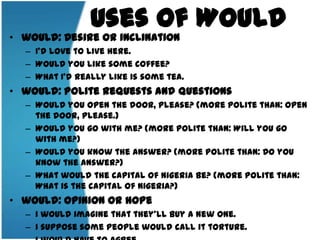
Uses of Would would: Desire or inclinationI'd love to live here.Would you like some coffee? What I'd really like is some tea. would: Polite requests and questions Would you open the door, please? (more polite than: Open the door, please.) Would you go with me? (more polite than: Will you go with me?) Would you know the answer? (more polite than: Do you know the answer?) What would the capital of Nigeria be? (more polite than: What is the capital of Nigeria?) would: Opinion or hopeI would imagine that they'll buy a new one. I suppose some people would call it torture.I would have to agree. I would expect him to come. Since you ask me I'd say the blue one is best.
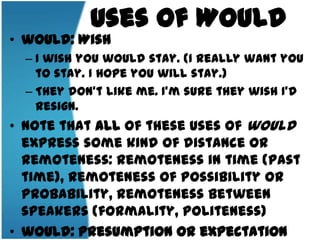
Uses of Would would: WishI wish you would stay. (I really want you to stay. I hope you will stay.) They don't like me. I'm sure they wish I'd resign. Note that all of these uses of would express some kind of distance or remoteness: remoteness in time (past time), remoteness of possibilityorprobability, remoteness between speakers (formality, politeness)would: Presumption or expectationThat would be Jo calling. I'llanswerit. We saw a police helicopter overhead yesterday morning. | Really? They would have been looking for those bank robbers.
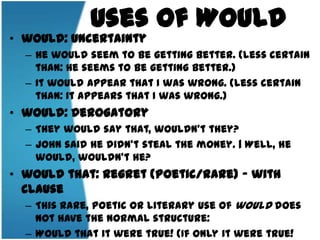
Uses of Would would: Uncertainty He would seem to be getting better. (less certain than: He seems to be getting better.) It would appear that I was wrong. (less certain than: It appears that I was wrong.) would: DerogatoryThey would say that, wouldn't they? John said he didn't steal the money. | Well, he would, wouldn't he?would that: Regret (poetic/rare) - with clause This rare, poetic or literary use of would does not have the normal structure:Would that it were true! (If only it were true! We wish that it were true!)Would that his mother had lived to see him become president.

Would

  • 1.
  • 2.
    wouldWould is anauxiliary verb, a modal auxiliary verb. We use would mainly to:talkaboutthepasttalk about the future in the past expresstheconditionalmoodWe also use would for other functions, such as: expressing desire, polite requests and questions, opinion or hope, wish and regret...
  • 3.
    Structure of Wouldsubject+ would + main verbThe main verb is always the bare infinitive (infinitive without "to").
  • 4.
    Notice that:Would isnever conjugated. It is always would or 'd (short form). The main verb is always the bare infinitive.The main verb is always the bare infinitive. We cannot say:I would to like coffee.Be careful! Would and had have the same short form 'd:He'd finished. (He had finished.) He'd like coffee. (He would like coffee.)
  • 5.
    Uses of Wouldwould: Talking about the pastWe often use would as a kind of past tense of will or going to: Even as a boy, he knew that he would succeed in life.I thought it would rain so I brought my umbrella. Using would as as a kind of past tense of will or going to is common in reported speech: She said that she would buy some eggs. ("I will buy some eggs.") The candidate said that he wouldn't increase taxes. ("I won'tincreasetaxes.")Why didn't you bring your umbrella? I told you it would rain! ("It'sgoingto rain.") We often use would not to talk about past refusals:He wanted a divorce but his wife would not agree.Yesterday morning, the car wouldn't start.We sometimes use would (rather like used to) when talking about habitual past behaviour:Every weekday my father would come home from work at 6pm and watch TV.Every summer we'd go to the seaside.
  • 6.
    Uses of Wouldwould: Future in pastWhen talking about the past we can use would to express something that has not happened at the time we are talking about: In London she met the man that she would one day marry. He left 5 minutes late, unaware that the delay would save his life.
  • 7.
    Uses of Wouldwould: ConditionalsWe often use would to express the so-called second and third conditionals: If he lost his job he would have no money. If I had won the lottery I would have bought a car.Using the same conditional structure, we often use would when giving advice: I wouldn't eat that if I were you. If I were in your place I'd refuse. If you asked me I would say you should go. Sometimes the condition is "understood" and there does not have to be an "if" clause:Someone who liked John would probably love John's father. (If someone liked John they would probably love John's father.) You'd never know it. (for example: If you met him you would never know that he was rich.) Why don't you invite Mary? I'msureshe'd come. Although there is always a main verb, sometimes it is understood (not stated) as in:I'd like to stay. | I wish you would. (wouldstay) Do you think he'd come? | I'm sure he would. (would come) Who would help us? | John would. (wouldhelpus)
  • 8.
    Uses of Wouldwould: Desire or inclinationI'd love to live here.Would you like some coffee? What I'd really like is some tea. would: Polite requests and questions Would you open the door, please? (more polite than: Open the door, please.) Would you go with me? (more polite than: Will you go with me?) Would you know the answer? (more polite than: Do you know the answer?) What would the capital of Nigeria be? (more polite than: What is the capital of Nigeria?) would: Opinion or hopeI would imagine that they'll buy a new one. I suppose some people would call it torture.I would have to agree. I would expect him to come. Since you ask me I'd say the blue one is best.
  • 9.
    Uses of Wouldwould: WishI wish you would stay. (I really want you to stay. I hope you will stay.) They don't like me. I'm sure they wish I'd resign. Note that all of these uses of would express some kind of distance or remoteness: remoteness in time (past time), remoteness of possibilityorprobability, remoteness between speakers (formality, politeness)would: Presumption or expectationThat would be Jo calling. I'llanswerit. We saw a police helicopter overhead yesterday morning. | Really? They would have been looking for those bank robbers.
  • 10.
    Uses of Wouldwould: Uncertainty He would seem to be getting better. (less certain than: He seems to be getting better.) It would appear that I was wrong. (less certain than: It appears that I was wrong.) would: DerogatoryThey would say that, wouldn't they? John said he didn't steal the money. | Well, he would, wouldn't he?would that: Regret (poetic/rare) - with clause This rare, poetic or literary use of would does not have the normal structure:Would that it were true! (If only it were true! We wish that it were true!)Would that his mother had lived to see him become president.