1
Use or disclosure of data contained on this sheet is subject to the restriction on the title page of this proposal or quotation. 1
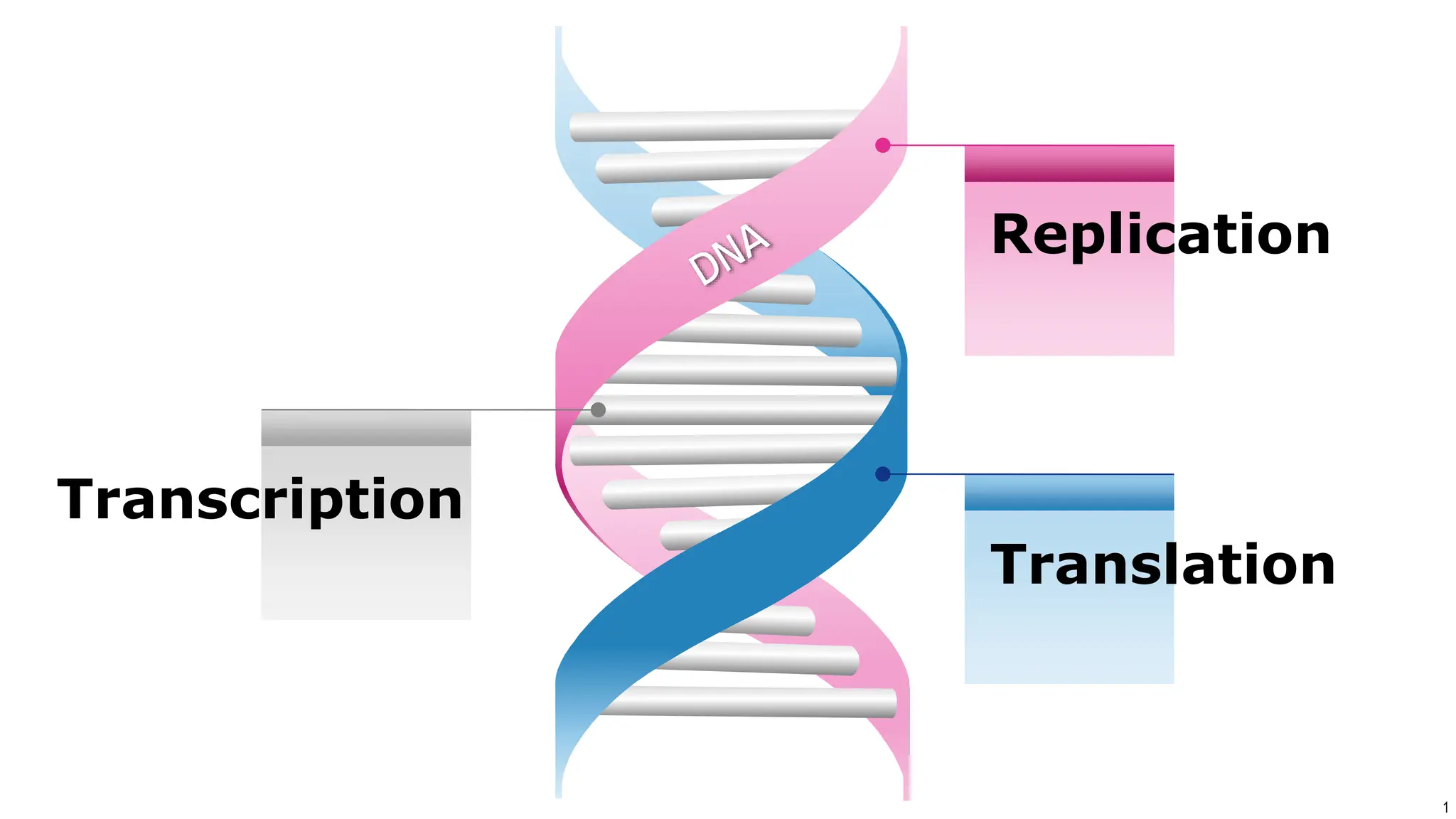
Translation
Transcription
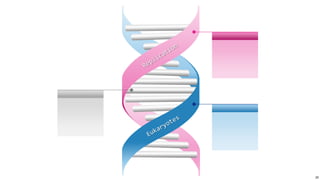
Replication
2
Use or disclosure of data contained on this sheet is subject to the restriction on the title page of this proposal or quotation. 2
DNA SYNTHESIS (REPLICATION)
Replication occurs during S-phase of the cell
cycle.
semi-conservative replication:each of the
daughter DNA molecules is composed of one
original (conserved) strand and one newly
synthesized strand.
3
Use or disclosure of data contained on this sheet is subject to the restriction on the title page of this proposal or quotation. 3
4
Use or disclosure of data contained on this sheet is subject to the restriction on the title page of this proposal or quotation. 4
5
Use or disclosure of data contained on this sheet is subject to the restriction on the title page of this proposal or quotation. 5
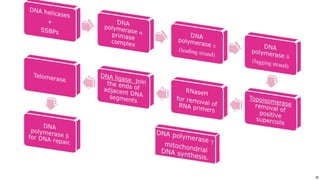
1. DNA Helicase
It catalyzes unwinding of DNA double
helix.
The separation of DNA strands requires
energy which is supplied by
hydrolyzing ATP.
6
Use or disclosure of data contained on this sheet is subject to the restriction on the title page of this proposal or quotation. 6
2.Primase
• DNA-dependent-RNA polymerase.
• It forms the primer.
7
Use or disclosure of data contained on this sheet is subject to the restriction on the title page of this proposal or quotation. 7
• DNA polymerases catalyze the formation of polynucleotide
chains.
• DNA polymerases are template-directed enzymes.
• They are only able to read the parental nucleotide sequence in
the 3` to 5` direction.
• DNA polymerases require a RNA primer
• They cannot start from scratch by adding nucleotides to a
free single stranded DNA template.
3.DNA polymerase
8
Use or disclosure of data contained on this sheet is subject to the restriction on the title page of this proposal or quotation. 8
DNA polymerases do not initiate
synthesis of DNA
Because the proofreading of the first
few nucleotides is not accurate and
they add nucleotides to an existing RNA
primer that provides the 3`-hydroxyl
residue.
Marking these nucleotides by making
the primer RNA, allows their
subsequent identification and
removal, after which the gap can be
resynthesized more accurately.
9
Use or disclosure of data contained on this sheet is subject to the restriction on the title page of this proposal or quotation. 9
4. DNA Ligase
It joins ends of two segments of DNA by
catalyzing the formation of a
phosphodiester bond.
In prokaryotes, NAD+ is required
whereas in eukaryotes ATP is required.
10
Use or disclosure of data contained on this sheet is subject to the restriction on the title page of this proposal or quotation. 10
5. DNA Topoisomerases
• Remove DNA supercoils formed
during replication
• Topoisomerase I
• Topoisomerase II (DNA Gyrase)
11
Use or disclosure of data contained on this sheet is subject to the restriction on the title page of this proposal or quotation. 11
Topoisomerases I
When a replication fork moves along a piece of DNA
(due to the action of helicases), it produces positive
supercoils a head of it, which interferes with
further movement. This problem is solved by type I
DNA topoisomerase which produces unwinding of
these positive supercoils.
It Breaks a phosphodiester bond in one DNA
strand (produces a cut or nick), allowing DNA to
rotate freely around the other strand, then it
reforms the phosphodiester bond.
12
Use or disclosure of data contained on this sheet is subject to the restriction on the title page of this proposal or quotation. 12
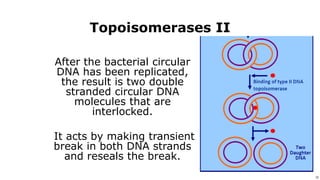
Topoisomerases II
After the bacterial circular
DNA has been replicated,
the result is two double
stranded circular DNA
molecules that are
interlocked.
It acts by making transient
break in both DNA strands
and reseals the break.
13
Use or disclosure of data contained on this sheet is subject to the restriction on the title page of this proposal or quotation. 13
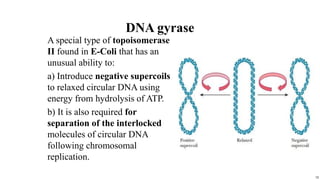
DNA gyrase
A special type of topoisomerase
II found in E-Coli that has an
unusual ability to:
a) Introduce negative supercoils
to relaxed circular DNA using
energy from hydrolysis of ATP.
b) It is also required for
separation of the interlocked
molecules of circular DNA
following chromosomal
replication.
14
Use or disclosure of data contained on this sheet is subject to the restriction on the title page of this proposal or quotation. 14
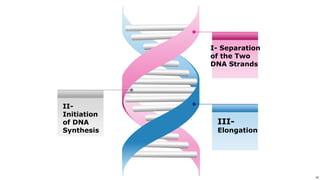
II-
Initiation
of DNA
Synthesis
III-
Elongation
I- Separation
of the Two
DNA Strands
15
Use or disclosure of data contained on this sheet is subject to the restriction on the title page of this proposal or quotation. 15
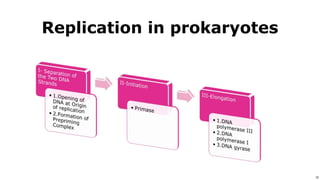
Replication in prokaryotes
16
Use or disclosure of data contained on this sheet is subject to the restriction on the title page of this proposal or quotation. 16
Opening of DNA at Origin of
replication
1. ori C a unique origin in E. Coli
chromosome (rich in AT base pairs)
serves as a starting point for replication.
It acts as binding sites for DNA binding
proteins (dna A).
2. Binding of dna A protein to ori C produces
local opening and unwinding of DNA double
helix.
17
Use or disclosure of data contained on this sheet is subject to the restriction on the title page of this proposal or quotation. 17
Formation of Prepriming Complex at the
Two Replication Forks
1. A complex of dna B and dna C
also binds to ori C to open the
duplex DNA,
dna B is a helicase that produces
progressive unwinding of DNA
double helix.
18
Use or disclosure of data contained on this sheet is subject to the restriction on the title page of this proposal or quotation. 18
2. Single strand binding (SSB) proteins
They bind cooperatively (binding of one molecule of
SSB protein makes it easier for additional molecules to
bind tightly to the DNA strand).
• In the absence of SSB proteins, the two strands can
rewind again.
Function:
1. They bind to the single strands of unwound portion
of DNA duplex and stabilize the single strands.
2. protect the single strand from nucleases that
cleave single-stranded DNA.
Thus by the action of helicase and SSB proteins a
replication fork is created.
19
Use or disclosure of data contained on this sheet is subject to the restriction on the title page of this proposal or quotation. 19
DNA polymerase III
DNA-polymerase III is only able to read
the parental nucleotide sequence in the 3`
to 5` direction (forms the new strand in
the direction 5` to 3`)
DNA-polymerase III synthesizes 20 to 50
nucleotides per second. It is highly
processive up to 50,000 nucleotides in
one cycle
20
Use or disclosure of data contained on this sheet is subject to the restriction on the title page of this proposal or quotation. 20
DNA polymerase III
Leading strand: It is copied in the direction of
the advancing replication fork and it is
synthesized in a continuous manner.
Lagging strand: It is copied discontinuously in
the opposite direction of the advancing
replication fork in the form of Okazaki
fragments. The length of these fragments
ranges from 1000 to 2000 bases.
21
Use or disclosure of data contained on this sheet is subject to the restriction on the title page of this proposal or quotation. 21
DNA polymerase III
Polymerases III has proof-
reading activity. It hydrolytically
removes the misplaced nucleotide
(act as exonuclease) and replaces it
with the correct nucleotide.
22
Use or disclosure of data contained on this sheet is subject to the restriction on the title page of this proposal or quotation. 22
DNA polymerase I
It removes the RNA primers by its
exonuclease activity then it fills the
gaps between Okazaki fragments
by DNA.
Polymerase I and II are mostly
involved in proofreading and
DNA repair.
23
Use or disclosure of data contained on this sheet is subject to the restriction on the title page of this proposal or quotation. 23
24
Use or disclosure of data contained on this sheet is subject to the restriction on the title page of this proposal or quotation. 24
25
Use or disclosure of data contained on this sheet is subject to the restriction on the title page of this proposal or quotation. 25
26
Use or disclosure of data contained on this sheet is subject to the restriction on the title page of this proposal or quotation. 26
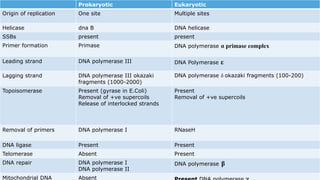
Prokaryotic Eukaryotic
Origin of replication One site Multiple sites
Helicase dna B DNA helicase
SSBs present present
Primer formation Primase DNA polymerase α primase complex
Leading strand DNA polymerase III DNA Polymerase ε
Lagging strand DNA polymerase III okazaki
fragments (1000-2000)
DNA polymerase δ okazaki fragments (100-200)
Topoisomerase Present (gyrase in E.Coli)
Removal of +ve supercoils
Release of interlocked strands
Present
Removal of +ve supercoils
Removal of primers DNA polymerase I RNaseH
DNA ligase Present Present
Telomerase Absent Present
DNA repair DNA polymerase I
DNA polymerase II
DNA polymerase β
Mitochondrial DNA Absent
27
Use or disclosure of data contained on this sheet is subject to the restriction on the title page of this proposal or quotation. 27
Telomere
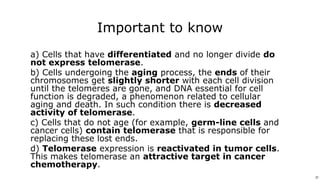
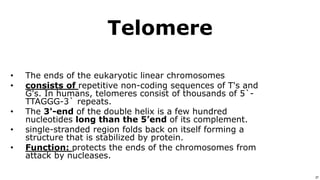
• The ends of the eukaryotic linear chromosomes
• consists of repetitive non-coding sequences of T's and
G's. In humans, telomeres consist of thousands of 5`-
TTAGGG-3` repeats.
• The 3'-end of the double helix is a few hundred
nucleotides long than the 5’end of its complement.
• single-stranded region folds back on itself forming a
structure that is stabilized by protein.
• Function: protects the ends of the chromosomes from
attack by nucleases.
28
Use or disclosure of data contained on this sheet is subject to the restriction on the title page of this proposal or quotation. 28
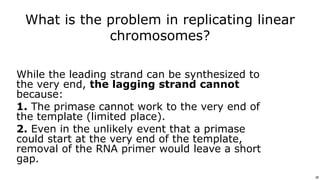
What is the problem in replicating linear
chromosomes?
While the leading strand can be synthesized to
the very end, the lagging strand cannot
because:
1. The primase cannot work to the very end of
the template (limited place).
2. Even in the unlikely event that a primase
could start at the very end of the template,
removal of the RNA primer would leave a short
gap.
29
Use or disclosure of data contained on this sheet is subject to the restriction on the title page of this proposal or quotation. 29
Telomerase
Definition: is a special kind of reverse
transcriptase.
It consists of
1. protein part (reverse transcriptase activity)
2. RNA strand (of about 150 nucleotides long).
30
Use or disclosure of data contained on this sheet is subject to the restriction on the title page of this proposal or quotation. 30
Mechanism of action
Telomerase recognizes the single-strand
3` terminus and uses its RNA molecule as
a template to elongate the parental strand
by about 100 nucleotides (the process
may be repeated).
31
Use or disclosure of data contained on this sheet is subject to the restriction on the title page of this proposal or quotation. 31
Important to know
a) Cells that have differentiated and no longer divide do
not express telomerase.
b) Cells undergoing the aging process, the ends of their
chromosomes get slightly shorter with each cell division
until the telomeres are gone, and DNA essential for cell
function is degraded, a phenomenon related to cellular
aging and death. In such condition there is decreased
activity of telomerase.
c) Cells that do not age (for example, germ-line cells and
cancer cells) contain telomerase that is responsible for
replacing these lost ends.
d) Telomerase expression is reactivated in tumor cells.
This makes telomerase an attractive target in cancer
chemotherapy.
32
Use or disclosure of data contained on this sheet is subject to the restriction on the title page of this proposal or quotation. 32
33
Use or disclosure of data contained on this sheet is subject to the restriction on the title page of this proposal or quotation. 33
DNA Repair
The replication process takes place
at high accuracy but an error can
occur for every 30,000 bases.
34
Use or disclosure of data contained on this sheet is subject to the restriction on the title page of this proposal or quotation. 34
35
Use or disclosure of data contained on this sheet is subject to the restriction on the title page of this proposal or quotation. 35
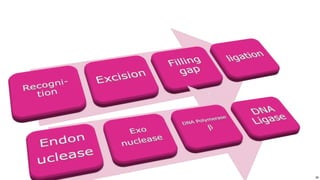
The broad steps of repair are as
follows:
1) Recognition of the lesion: This is the
function of an endonuclease, which cleaves
the damaged strand to form a cut (nick).
2) Excision of damaged DNA: The
damaged part is removed by a excision
exonuclease.
3) Filling the gap: This is catalyzed by a
DNA polymerase β.
4) Ligation: This is catalyzed by DNA
ligase.
36
Use or disclosure of data contained on this sheet is subject to the restriction on the title page of this proposal or quotation. 36
Hereditary disorders
1.Xeroderma pigmentosum
2.Werner syndrome
3.Ataxia telengectasia

replication.pptx

  • 1.
    1 Use or disclosureof data contained on this sheet is subject to the restriction on the title page of this proposal or quotation. 1 Translation Transcription Replication
  • 2.
    2 Use or disclosureof data contained on this sheet is subject to the restriction on the title page of this proposal or quotation. 2 DNA SYNTHESIS (REPLICATION) Replication occurs during S-phase of the cell cycle. semi-conservative replication:each of the daughter DNA molecules is composed of one original (conserved) strand and one newly synthesized strand.
  • 3.
    3 Use or disclosureof data contained on this sheet is subject to the restriction on the title page of this proposal or quotation. 3
  • 4.
    4 Use or disclosureof data contained on this sheet is subject to the restriction on the title page of this proposal or quotation. 4
  • 5.
    5 Use or disclosureof data contained on this sheet is subject to the restriction on the title page of this proposal or quotation. 5 1. DNA Helicase It catalyzes unwinding of DNA double helix. The separation of DNA strands requires energy which is supplied by hydrolyzing ATP.
  • 6.
    6 Use or disclosureof data contained on this sheet is subject to the restriction on the title page of this proposal or quotation. 6 2.Primase • DNA-dependent-RNA polymerase. • It forms the primer.
  • 7.
    7 Use or disclosureof data contained on this sheet is subject to the restriction on the title page of this proposal or quotation. 7 • DNA polymerases catalyze the formation of polynucleotide chains. • DNA polymerases are template-directed enzymes. • They are only able to read the parental nucleotide sequence in the 3` to 5` direction. • DNA polymerases require a RNA primer • They cannot start from scratch by adding nucleotides to a free single stranded DNA template. 3.DNA polymerase
  • 8.
    8 Use or disclosureof data contained on this sheet is subject to the restriction on the title page of this proposal or quotation. 8 DNA polymerases do not initiate synthesis of DNA Because the proofreading of the first few nucleotides is not accurate and they add nucleotides to an existing RNA primer that provides the 3`-hydroxyl residue. Marking these nucleotides by making the primer RNA, allows their subsequent identification and removal, after which the gap can be resynthesized more accurately.
  • 9.
    9 Use or disclosureof data contained on this sheet is subject to the restriction on the title page of this proposal or quotation. 9 4. DNA Ligase It joins ends of two segments of DNA by catalyzing the formation of a phosphodiester bond. In prokaryotes, NAD+ is required whereas in eukaryotes ATP is required.
  • 10.
    10 Use or disclosureof data contained on this sheet is subject to the restriction on the title page of this proposal or quotation. 10 5. DNA Topoisomerases • Remove DNA supercoils formed during replication • Topoisomerase I • Topoisomerase II (DNA Gyrase)
  • 11.
    11 Use or disclosureof data contained on this sheet is subject to the restriction on the title page of this proposal or quotation. 11 Topoisomerases I When a replication fork moves along a piece of DNA (due to the action of helicases), it produces positive supercoils a head of it, which interferes with further movement. This problem is solved by type I DNA topoisomerase which produces unwinding of these positive supercoils. It Breaks a phosphodiester bond in one DNA strand (produces a cut or nick), allowing DNA to rotate freely around the other strand, then it reforms the phosphodiester bond.
  • 12.
    12 Use or disclosureof data contained on this sheet is subject to the restriction on the title page of this proposal or quotation. 12 Topoisomerases II After the bacterial circular DNA has been replicated, the result is two double stranded circular DNA molecules that are interlocked. It acts by making transient break in both DNA strands and reseals the break.
  • 13.
    13 Use or disclosureof data contained on this sheet is subject to the restriction on the title page of this proposal or quotation. 13 DNA gyrase A special type of topoisomerase II found in E-Coli that has an unusual ability to: a) Introduce negative supercoils to relaxed circular DNA using energy from hydrolysis of ATP. b) It is also required for separation of the interlocked molecules of circular DNA following chromosomal replication.
  • 14.
    14 Use or disclosureof data contained on this sheet is subject to the restriction on the title page of this proposal or quotation. 14 II- Initiation of DNA Synthesis III- Elongation I- Separation of the Two DNA Strands
  • 15.
    15 Use or disclosureof data contained on this sheet is subject to the restriction on the title page of this proposal or quotation. 15 Replication in prokaryotes
  • 16.
    16 Use or disclosureof data contained on this sheet is subject to the restriction on the title page of this proposal or quotation. 16 Opening of DNA at Origin of replication 1. ori C a unique origin in E. Coli chromosome (rich in AT base pairs) serves as a starting point for replication. It acts as binding sites for DNA binding proteins (dna A). 2. Binding of dna A protein to ori C produces local opening and unwinding of DNA double helix.
  • 17.
    17 Use or disclosureof data contained on this sheet is subject to the restriction on the title page of this proposal or quotation. 17 Formation of Prepriming Complex at the Two Replication Forks 1. A complex of dna B and dna C also binds to ori C to open the duplex DNA, dna B is a helicase that produces progressive unwinding of DNA double helix.
  • 18.
    18 Use or disclosureof data contained on this sheet is subject to the restriction on the title page of this proposal or quotation. 18 2. Single strand binding (SSB) proteins They bind cooperatively (binding of one molecule of SSB protein makes it easier for additional molecules to bind tightly to the DNA strand). • In the absence of SSB proteins, the two strands can rewind again. Function: 1. They bind to the single strands of unwound portion of DNA duplex and stabilize the single strands. 2. protect the single strand from nucleases that cleave single-stranded DNA. Thus by the action of helicase and SSB proteins a replication fork is created.
  • 19.
    19 Use or disclosureof data contained on this sheet is subject to the restriction on the title page of this proposal or quotation. 19 DNA polymerase III DNA-polymerase III is only able to read the parental nucleotide sequence in the 3` to 5` direction (forms the new strand in the direction 5` to 3`) DNA-polymerase III synthesizes 20 to 50 nucleotides per second. It is highly processive up to 50,000 nucleotides in one cycle
  • 20.
    20 Use or disclosureof data contained on this sheet is subject to the restriction on the title page of this proposal or quotation. 20 DNA polymerase III Leading strand: It is copied in the direction of the advancing replication fork and it is synthesized in a continuous manner. Lagging strand: It is copied discontinuously in the opposite direction of the advancing replication fork in the form of Okazaki fragments. The length of these fragments ranges from 1000 to 2000 bases.
  • 21.
    21 Use or disclosureof data contained on this sheet is subject to the restriction on the title page of this proposal or quotation. 21 DNA polymerase III Polymerases III has proof- reading activity. It hydrolytically removes the misplaced nucleotide (act as exonuclease) and replaces it with the correct nucleotide.
  • 22.
    22 Use or disclosureof data contained on this sheet is subject to the restriction on the title page of this proposal or quotation. 22 DNA polymerase I It removes the RNA primers by its exonuclease activity then it fills the gaps between Okazaki fragments by DNA. Polymerase I and II are mostly involved in proofreading and DNA repair.
  • 23.
    23 Use or disclosureof data contained on this sheet is subject to the restriction on the title page of this proposal or quotation. 23
  • 24.
    24 Use or disclosureof data contained on this sheet is subject to the restriction on the title page of this proposal or quotation. 24
  • 25.
    25 Use or disclosureof data contained on this sheet is subject to the restriction on the title page of this proposal or quotation. 25
  • 26.
    26 Use or disclosureof data contained on this sheet is subject to the restriction on the title page of this proposal or quotation. 26 Prokaryotic Eukaryotic Origin of replication One site Multiple sites Helicase dna B DNA helicase SSBs present present Primer formation Primase DNA polymerase α primase complex Leading strand DNA polymerase III DNA Polymerase ε Lagging strand DNA polymerase III okazaki fragments (1000-2000) DNA polymerase δ okazaki fragments (100-200) Topoisomerase Present (gyrase in E.Coli) Removal of +ve supercoils Release of interlocked strands Present Removal of +ve supercoils Removal of primers DNA polymerase I RNaseH DNA ligase Present Present Telomerase Absent Present DNA repair DNA polymerase I DNA polymerase II DNA polymerase β Mitochondrial DNA Absent
  • 27.
    27 Use or disclosureof data contained on this sheet is subject to the restriction on the title page of this proposal or quotation. 27 Telomere • The ends of the eukaryotic linear chromosomes • consists of repetitive non-coding sequences of T's and G's. In humans, telomeres consist of thousands of 5`- TTAGGG-3` repeats. • The 3'-end of the double helix is a few hundred nucleotides long than the 5’end of its complement. • single-stranded region folds back on itself forming a structure that is stabilized by protein. • Function: protects the ends of the chromosomes from attack by nucleases.
  • 28.
    28 Use or disclosureof data contained on this sheet is subject to the restriction on the title page of this proposal or quotation. 28 What is the problem in replicating linear chromosomes? While the leading strand can be synthesized to the very end, the lagging strand cannot because: 1. The primase cannot work to the very end of the template (limited place). 2. Even in the unlikely event that a primase could start at the very end of the template, removal of the RNA primer would leave a short gap.
  • 29.
    29 Use or disclosureof data contained on this sheet is subject to the restriction on the title page of this proposal or quotation. 29 Telomerase Definition: is a special kind of reverse transcriptase. It consists of 1. protein part (reverse transcriptase activity) 2. RNA strand (of about 150 nucleotides long).
  • 30.
    30 Use or disclosureof data contained on this sheet is subject to the restriction on the title page of this proposal or quotation. 30 Mechanism of action Telomerase recognizes the single-strand 3` terminus and uses its RNA molecule as a template to elongate the parental strand by about 100 nucleotides (the process may be repeated).
  • 31.
    31 Use or disclosureof data contained on this sheet is subject to the restriction on the title page of this proposal or quotation. 31 Important to know a) Cells that have differentiated and no longer divide do not express telomerase. b) Cells undergoing the aging process, the ends of their chromosomes get slightly shorter with each cell division until the telomeres are gone, and DNA essential for cell function is degraded, a phenomenon related to cellular aging and death. In such condition there is decreased activity of telomerase. c) Cells that do not age (for example, germ-line cells and cancer cells) contain telomerase that is responsible for replacing these lost ends. d) Telomerase expression is reactivated in tumor cells. This makes telomerase an attractive target in cancer chemotherapy.
  • 32.
    32 Use or disclosureof data contained on this sheet is subject to the restriction on the title page of this proposal or quotation. 32
  • 33.
    33 Use or disclosureof data contained on this sheet is subject to the restriction on the title page of this proposal or quotation. 33 DNA Repair The replication process takes place at high accuracy but an error can occur for every 30,000 bases.
  • 34.
    34 Use or disclosureof data contained on this sheet is subject to the restriction on the title page of this proposal or quotation. 34
  • 35.
    35 Use or disclosureof data contained on this sheet is subject to the restriction on the title page of this proposal or quotation. 35 The broad steps of repair are as follows: 1) Recognition of the lesion: This is the function of an endonuclease, which cleaves the damaged strand to form a cut (nick). 2) Excision of damaged DNA: The damaged part is removed by a excision exonuclease. 3) Filling the gap: This is catalyzed by a DNA polymerase β. 4) Ligation: This is catalyzed by DNA ligase.
  • 36.
    36 Use or disclosureof data contained on this sheet is subject to the restriction on the title page of this proposal or quotation. 36 Hereditary disorders 1.Xeroderma pigmentosum 2.Werner syndrome 3.Ataxia telengectasia