ENZYMES
M A D E B Y
AY M A N M O H A M M E D H A N Y
ENZYMES
•Definition
•Enzymes are biocatalysts mainly
proteins in nature that regulate the
of all biochemical reactions.
ENZYMES
• Common Features
• All are produced by living cells and can act outside these
cells.
• They are needed in very small amounts.
• They accelerate the reaction without affecting its equilibrium
equilibrium (decrease energy of activation).
• They are not changed chemically by the end of the reaction.
• They are highly specific (act on a specific substrate or inter-
related substrates).
ENZYME SPECIFICITY
• Enzymes are highly specific in their action, interacting with one or a
few specific substrates and catalyzing only one type of chemical
reactions.
• The specificity of enzymes is due to the nature and arrangement of
the chemical groups at the catalytic site . This allows the enzyme to
unite and activate only one substrate or a small number of structurally
related substrates.
• Importance of enzyme specificity:-
• The relatively low specificity of the digestive enzymes allows only a
few enzymes to digest all foodstuffs. The high specificity of
intracellular enzymes allows metabolic pathways to work and to be
regulated more properly.
CHEMICAL NATURE
• Except for ribozymes, virtually all enzymes are protein in nature; some
are simple proteins while others are conjugated proteins (holoenzyme).
• Holoenzyme refers to the active enzyme with its nonprotein
component (cofactor), whereas the enzyme without its cofactor is
termed an apoenzyme and is inactive.
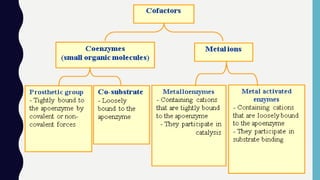
• Cofactors are organic or inorganic molecules that are required for the
activity of a certain conjugated enzymes. They participate in substrate
binding or catalysis.
ROLE OF ENZYMES IN CATALYSIS
• The role of enzyme in catalysis can be viewed from two
different aspects:-
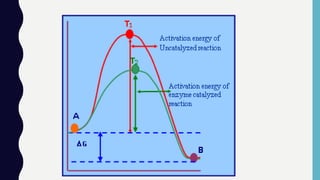
• The first treats catalysis in terms of energy changes that
occur during the reaction, that is, enzymes provide an
alternate, energetically favorable reaction pathway different
from the uncatalyzed reaction.
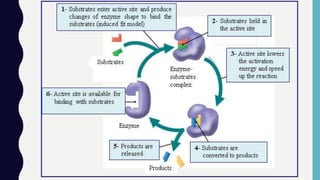
• The second aspect describes how the active site
facilitates catalysis.
HOW THE ACTIVE SITE CHEMICALLY
FACILITATES CATALYSIS?
• The amino acids at the active site are arranged in a very precise manner so
that only specific substrate or inter-related substrates can bind at the active site. Also,
the shape and the chemical environment inside the active
site permit a chemical reaction to proceed more
easily.
Usually serine, histidine, cysteine, aspartate and glutamate residues
make up active site. Enzymes are named according to the active site amino acid. For
example, trypsin is a serine protease and papain is cysteine protease.
FACTORS AFFECTING THE RATE OF
ENZYME CATALYZED REACTION
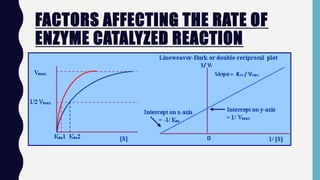
• Effect of Substrate Concentration [S]
• The substrate concentration that
produces half the maximal velocity is
termed Michaelis constant or Km .
• Smaller Km reflects higher affinity of
the enzyme for its substrate
FACTORS AFFECTING THE RATE OF
ENZYME CATALYZED REACTION
FACTORS AFFECTING THE RATE OF
ENZYME CATALYZED REACTION
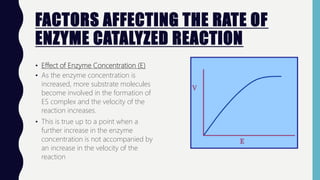
• Effect of Enzyme Concentration (E)
• As the enzyme concentration is
increased, more substrate molecules
become involved in the formation of
ES complex and the velocity of the
reaction increases.
• This is true up to a point when a
further increase in the enzyme
concentration is not accompanied by
an increase in the velocity of the
reaction
FACTORS AFFECTING THE RATE OF
ENZYME CATALYZED REACTION
• Effect of Concentration of Cofactors
[C]
• The velocity of the reaction will be
directly proportional to the
concentration of the cofactor. This is
true up to the point when each
enzyme molecule is associated with
the cofactor required. At this point
increase in cofactor concentration will
not increase the velocity of the
reaction
FACTORS AFFECTING THE RATE OF
ENZYME CATALYZED REACTION
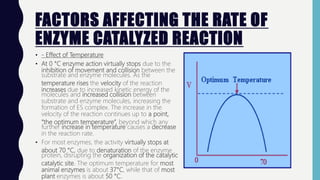
• - Effect of Temperature
• At 0 °C enzyme action virtually stops due to the
inhibition of movement and collision between the
substrate and enzyme molecules. As the
temperature rises the velocity of the reaction
increases due to increased kinetic energy of the
molecules and increased collision between
substrate and enzyme molecules, increasing the
formation of ES complex. The increase in the
velocity of the reaction continues up to a point,
“the optimum temperature”, beyond which any
further increase in temperature causes a decrease
in the reaction rate.
• For most enzymes, the activity virtually stops at
about 70 °C, due to denaturation of the enzyme
protein, disrupting the organization of the catalytic
catalytic site. The optimum temperature for most
animal enzymes is about 37°C, while that of most
plant enzymes is about 50 °C.
FACTORS AFFECTING THE RATE OF
ENZYME CATALYZED REACTION
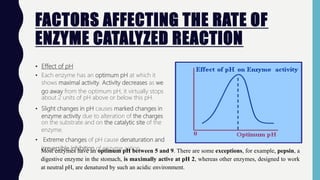
• Effect of pH
• Each enzyme has an optimum pH at which it
shows maximal activity. Activity decreases as we
go away from the optimum pH, it virtually stops
about 2 units of pH above or below this pH.
• Slight changes in pH causes marked changes in
enzyme activity due to alteration of the charges
on the substrate and on the catalytic site of the
enzyme.
• Extreme changes of pH cause denaturation and
irreversible inhibition of enzyme actionMost enzymes have an optimum pH between 5 and 9. There are some exceptions, for example, pepsin, a
digestive enzyme in the stomach, is maximally active at pH 2, whereas other enzymes, designed to work
at neutral pH, are denatured by such an acidic environment.
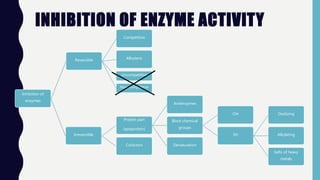
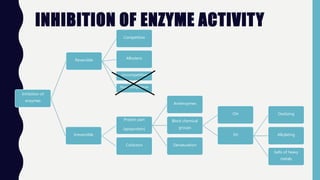
INHIBITION OF ENZYME ACTIVITY
Inhibition of
enzymes
Reversible
Competitive
Allosteric
Uncompetitive
Non compititive
Irreversible
Protein part
(apoprotein)
Antienzymes
Block chemical
groups
OH
SH
Oxidizing
Alkylating
Salts of heavy
metals
DenaturationCofactors
I- REVERSIBLE ENZYME INHIBITION
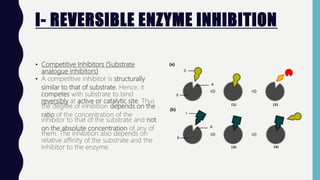
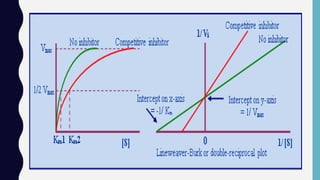
• Competitive Inhibitors (Substrate
analogue inhibitors)
• A competitive inhibitor is structurally
similar to that of substrate. Hence, it
competes with substrate to bind
reversibly at active or catalytic site. Thus
the degree of inhibition depends on the
ratio of the concentration of the
inhibitor to that of the substrate and not
on the absolute concentration of any of
them. The inhibition also depends on
relative affinity of the substrate and the
inhibitor to the enzyme.
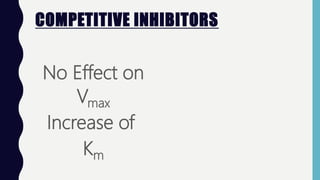
COMPETITIVE INHIBITORS
No Effect on
Vmax
Increase of
Km
EXAMPLES FOR COMPETITIVE
INHIBITORS
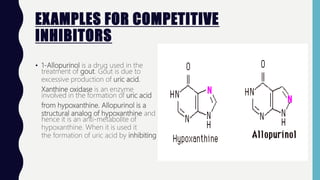
• 1-Allopurinol is a drug used in the
treatment of gout. Gout is due to
excessive production of uric acid.
Xanthine oxidase is an enzyme
involved in the formation of uric acid
from hypoxanthine. Allopurinol is a
structural analog of hypoxanthine and
hence it is an anti-metabolite of
hypoxanthine. When it is used it
the formation of uric acid by inhibiting
EXAMPLES FOR COMPETITIVE
INHIBITORS
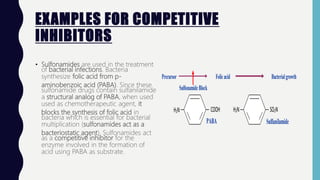
• Sulfonamides are used in the treatment
of bacterial infections. Bacteria
synthesize folic acid from p-
aminobenzoic acid (PABA). Since these
sulfonamide drugs contain sulfanilamide
a structural analog of PABA, when used
used as chemotherapeutic agent, it
blocks the synthesis of folic acid in
bacteria which is essential for bacterial
multiplication (sulfonamides act as a
bacteriostatic agent). Sulfonamides act
as a competitive inhibitor for the
enzyme involved in the formation of
acid using PABA as substrate.
PABA
H2N COOH
Sulfanilamide
H2N SO2N
Precursor Folicacid Bacterialgrowth
SulfonamideBlock
EXAMPLES FOR COMPETITIVE
INHIBITORS
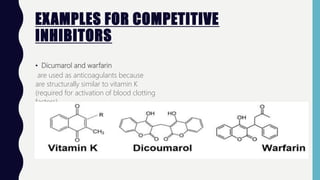
• Dicumarol and warfarin
are used as anticoagulants because
are structurally similar to vitamin K
(required for activation of blood clotting
factors).
EXAMPLES FOR COMPETITIVE
INHIBITORS
• Statins
Are competitive inhibitors of the key enzyme of cholesterol synthesis (HMG-CoA
reductase) thereby lowering plasma cholesterol levels.
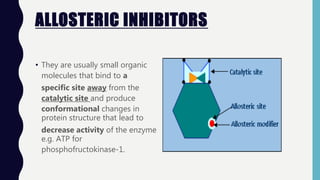
ALLOSTERIC INHIBITORS
• They are usually small organic
molecules that bind to a
specific site away from the
catalytic site and produce
conformational changes in
protein structure that lead to
decrease activity of the enzyme
e.g. ATP for
phosphofructokinase-1.
ALLOSTERIC INHIBITORS
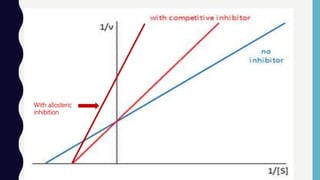
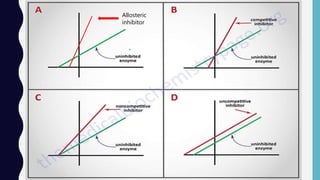
• Allosteric inhibitors
• decreases the affinity of
the enzyme to its substrate
(increase Km value) or
• decreases the maximal
catalytic activity (decrease
Vmax)
• or both
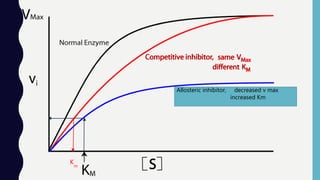
Allosteric inhibitor, decreased v max
increased Km
Km
With allosteric
inhibition
Allosteric
inhibitor
ALLOSTERIC INHIBITORS
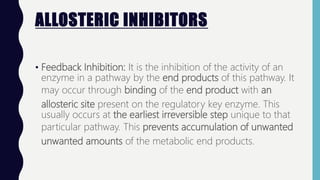
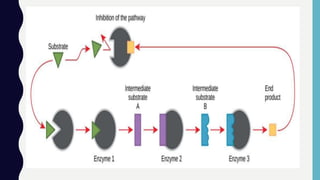
• Feedback Inhibition: It is the inhibition of the activity of an
enzyme in a pathway by the end products of this pathway. It
may occur through binding of the end product with an
allosteric site present on the regulatory key enzyme. This
usually occurs at the earliest irreversible step unique to that
particular pathway. This prevents accumulation of unwanted
unwanted amounts of the metabolic end products.
INHIBITION OF ENZYME ACTIVITY
Inhibition of
enzymes
Reversible
Competitive
Allosteric
Uncompetitive
Non compititive
Irreversible
Protein part
(apoprotein)
Antienzymes
Block chemical
groups
OH
SH
Oxidizing
Alkylating
Salts of heavy
metals
DenaturationCofactors
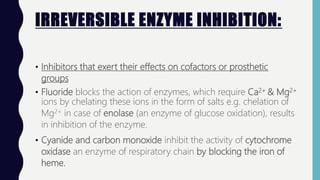
IRREVERSIBLE ENZYME INHIBITION:
• Inhibitors that exert their effects on cofactors or prosthetic
groups
• Fluoride blocks the action of enzymes, which require Ca2+ & Mg2+
ions by chelating these ions in the form of salts e.g. chelation of
Mg2+ in case of enolase (an enzyme of glucose oxidation), results
in inhibition of the enzyme.
• Cyanide and carbon monoxide inhibit the activity of cytochrome
oxidase an enzyme of respiratory chain by blocking the iron of
heme.
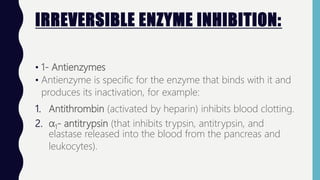
IRREVERSIBLE ENZYME INHIBITION:
• 1- Antienzymes
• Antienzyme is specific for the enzyme that binds with it and
produces its inactivation, for example:
1. Antithrombin (activated by heparin) inhibits blood clotting.
2. α1- antitrypsin (that inhibits trypsin, antitrypsin, and
elastase released into the blood from the pancreas and
leukocytes).
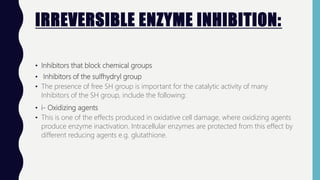
IRREVERSIBLE ENZYME INHIBITION:
• Inhibitors that block chemical groups
• Inhibitors of the sulfhydryl group
• The presence of free SH group is important for the catalytic activity of many
Inhibitors of the SH group, include the following:
• i- Oxidizing agents
• This is one of the effects produced in oxidative cell damage, where oxidizing agents
produce enzyme inactivation. Intracellular enzymes are protected from this effect by
different reducing agents e.g. glutathione.
IRREVERSIBLE ENZYME INHIBITION:
• ii- Salts of heavy metals
• The positively charged heavy metal ions e.g. Hg2+
combine with the negatively charged sulfur of the SH
group (Enz-S- Hg -S-Enz).
• iii- Alkylating agents
• Iodoactate reacts with the SH group of the enzyme
catalytic site
IRREVERSIBLE ENZYME INHIBITION:
•Inhibitors that block hydroxyl groups
•Aspirin produces acetylation of the hydroxyl
group of serine at the active site of
cyclooxygenase enzyme (responsible for
prostaglandin synthesis), explaining the anti
inflammatory and antipyretic actions of aspirin.
REGULATION OF ENZYME ACTIVITY
•I. Changing the absolute amount of the
enzyme present.
•II. Changing the catalytic activity of the
enzyme.
•III. Compartmentation of enzymes.
REGULATION OF ENZYME ACTIVITY
• I- Changing the Absolute Amount of the Enzyme Present
• 1- Control of Enzyme Synthesis
• Inducers are substances, which stimulate gene expression into proteins. In
case of enzymes, the inducers may be the substrate of the enzyme or
hormones.
• Repressors are substances, which inhibit gene expression into proteins. In
case of enzymes, the repressor may be a metabolic product of the enzyme or
hormones.
• 2- Control of Enzyme Degradation
• This is performed by controlling the rate of synthesis or activity of the enzyme
enzyme responsible for their degradation
REGULATION OF ENZYME ACTIVITY
• II. Changing the Catalytic Activity of the Enzyme.
•
• 1- Activation of Zymogens (Proenzymes)
• Many enzymes are formed in the form of proenzymes or zymogens. In this form they are
inactive. Activation requires proteolysis (removal of a part of the polypeptide chain which
masks the active site or substrate site). A good example is the formation of digestive
proteolytic enzymes as zymogens inside the cells to prevent digestion of cellular proteins.
When these zymogens are released to the gut they are activated to digest food proteins.
Many of these enzymes after activation can activate its zymogen in a process termed
autocatalytic activation (autocatalysis).
• Another good example is the activation of different blood clotting factors. Many of these
factors are formed as zymogens and activated by specific proteases.
REGULATION OF ENZYME ACTIVITY
• 2- Allosteric Modifiers (Inhibitors and Activators)
• Allosteric inhibition is explained before. The binding of an allosteric activator with the
allosteric site produces conformational changes in the protein structure of the enzyme,
which result in increased velocity of the reaction. Many cellular metabolic reactions are
controlled in this way e.g. AMP acts as an allosteric activator for the phosphofructokinase-
(PFK-1). Allosteric activator increases the affinity of the enzyme to its substrate (decrease
Km value) or increases the maximal catalytic activity (increase Vmax) or both.
• 3- Covalent Modification
• Phosphorylation and dephosphorylation: Many enzymes are activated by
phosphorylation and inactivated by dephosphorylation and vice versa. This means that
the enzyme is present in two interconvertible forms (phosphorylated and
dephosphorylated). The phosphate groups are usually attached to the hydroxyl group of
of amino acid residues (mainly serine or tyrosine) present in the polypeptide chain of the
enzyme.
ISOENZYMES (ISOZYMES)
• These are a group of enzymes which are characterized by the
following:
• They catalyze the same reaction.
• They have different polypeptide chains which are produced by
different genes.
• They are separated by electrophoresis (have different migration rate).
• They have different affinity to the substrate.
• They are usually affected in different ways by the different activators
and inhibitors.
• They are present in the same or different cells.
LACTATE DEHYDROGENASE (LDH)
• It is tetrameric enzyme. It is formed of four protomers (subunits) of two
types H and M. The tetrameric molecule is the only active form of the
enzyme
• Isozymes of LDH Type of subunits
• 1- I1 (H4 or HHHH)
• 2- I2 (H3M1 or HHHM)
• 3- I3 (H2M2 or HHMM)
• 4- I4 (H1M3 or HMMM)
• 5- I5 (M4 or MMMM)
LACTATE DEHYDROGENASE (LDH)
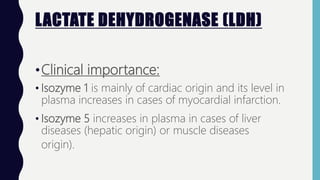
•Clinical importance:
• Isozyme 1 is mainly of cardiac origin and its level in
plasma increases in cases of myocardial infarction.
• Isozyme 5 increases in plasma in cases of liver
diseases (hepatic origin) or muscle diseases
origin).
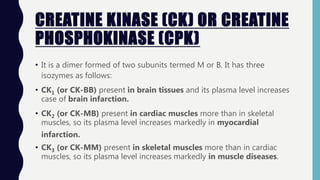
CREATINE KINASE (CK) OR CREATINE
PHOSPHOKINASE (CPK)
• It is a dimer formed of two subunits termed M or B. It has three
isozymes as follows:
• CK1 (or CK-BB) present in brain tissues and its plasma level increases
case of brain infarction.
• CK2 (or CK-MB) present in cardiac muscles more than in skeletal
muscles, so its plasma level increases markedly in myocardial
infarction.
• CK3 (or CK-MM) present in skeletal muscles more than in cardiac
muscles, so its plasma level increases markedly in muscle diseases.
Enzymes 2019
Enzymes 2019

Enzymes 2019

  • 1.
    ENZYMES M A DE B Y AY M A N M O H A M M E D H A N Y
  • 2.
    ENZYMES •Definition •Enzymes are biocatalystsmainly proteins in nature that regulate the of all biochemical reactions.
  • 3.
    ENZYMES • Common Features •All are produced by living cells and can act outside these cells. • They are needed in very small amounts. • They accelerate the reaction without affecting its equilibrium equilibrium (decrease energy of activation). • They are not changed chemically by the end of the reaction. • They are highly specific (act on a specific substrate or inter- related substrates).
  • 4.
    ENZYME SPECIFICITY • Enzymesare highly specific in their action, interacting with one or a few specific substrates and catalyzing only one type of chemical reactions. • The specificity of enzymes is due to the nature and arrangement of the chemical groups at the catalytic site . This allows the enzyme to unite and activate only one substrate or a small number of structurally related substrates. • Importance of enzyme specificity:- • The relatively low specificity of the digestive enzymes allows only a few enzymes to digest all foodstuffs. The high specificity of intracellular enzymes allows metabolic pathways to work and to be regulated more properly.
  • 5.
    CHEMICAL NATURE • Exceptfor ribozymes, virtually all enzymes are protein in nature; some are simple proteins while others are conjugated proteins (holoenzyme). • Holoenzyme refers to the active enzyme with its nonprotein component (cofactor), whereas the enzyme without its cofactor is termed an apoenzyme and is inactive. • Cofactors are organic or inorganic molecules that are required for the activity of a certain conjugated enzymes. They participate in substrate binding or catalysis.
  • 7.
    ROLE OF ENZYMESIN CATALYSIS • The role of enzyme in catalysis can be viewed from two different aspects:- • The first treats catalysis in terms of energy changes that occur during the reaction, that is, enzymes provide an alternate, energetically favorable reaction pathway different from the uncatalyzed reaction. • The second aspect describes how the active site facilitates catalysis.
  • 9.
    HOW THE ACTIVESITE CHEMICALLY FACILITATES CATALYSIS? • The amino acids at the active site are arranged in a very precise manner so that only specific substrate or inter-related substrates can bind at the active site. Also, the shape and the chemical environment inside the active site permit a chemical reaction to proceed more easily. Usually serine, histidine, cysteine, aspartate and glutamate residues make up active site. Enzymes are named according to the active site amino acid. For example, trypsin is a serine protease and papain is cysteine protease.
  • 11.
    FACTORS AFFECTING THERATE OF ENZYME CATALYZED REACTION • Effect of Substrate Concentration [S] • The substrate concentration that produces half the maximal velocity is termed Michaelis constant or Km . • Smaller Km reflects higher affinity of the enzyme for its substrate
  • 12.
    FACTORS AFFECTING THERATE OF ENZYME CATALYZED REACTION
  • 13.
    FACTORS AFFECTING THERATE OF ENZYME CATALYZED REACTION • Effect of Enzyme Concentration (E) • As the enzyme concentration is increased, more substrate molecules become involved in the formation of ES complex and the velocity of the reaction increases. • This is true up to a point when a further increase in the enzyme concentration is not accompanied by an increase in the velocity of the reaction
  • 14.
    FACTORS AFFECTING THERATE OF ENZYME CATALYZED REACTION • Effect of Concentration of Cofactors [C] • The velocity of the reaction will be directly proportional to the concentration of the cofactor. This is true up to the point when each enzyme molecule is associated with the cofactor required. At this point increase in cofactor concentration will not increase the velocity of the reaction
  • 15.
    FACTORS AFFECTING THERATE OF ENZYME CATALYZED REACTION • - Effect of Temperature • At 0 °C enzyme action virtually stops due to the inhibition of movement and collision between the substrate and enzyme molecules. As the temperature rises the velocity of the reaction increases due to increased kinetic energy of the molecules and increased collision between substrate and enzyme molecules, increasing the formation of ES complex. The increase in the velocity of the reaction continues up to a point, “the optimum temperature”, beyond which any further increase in temperature causes a decrease in the reaction rate. • For most enzymes, the activity virtually stops at about 70 °C, due to denaturation of the enzyme protein, disrupting the organization of the catalytic catalytic site. The optimum temperature for most animal enzymes is about 37°C, while that of most plant enzymes is about 50 °C.
  • 16.
    FACTORS AFFECTING THERATE OF ENZYME CATALYZED REACTION • Effect of pH • Each enzyme has an optimum pH at which it shows maximal activity. Activity decreases as we go away from the optimum pH, it virtually stops about 2 units of pH above or below this pH. • Slight changes in pH causes marked changes in enzyme activity due to alteration of the charges on the substrate and on the catalytic site of the enzyme. • Extreme changes of pH cause denaturation and irreversible inhibition of enzyme actionMost enzymes have an optimum pH between 5 and 9. There are some exceptions, for example, pepsin, a digestive enzyme in the stomach, is maximally active at pH 2, whereas other enzymes, designed to work at neutral pH, are denatured by such an acidic environment.
  • 17.
    INHIBITION OF ENZYMEACTIVITY Inhibition of enzymes Reversible Competitive Allosteric Uncompetitive Non compititive Irreversible Protein part (apoprotein) Antienzymes Block chemical groups OH SH Oxidizing Alkylating Salts of heavy metals DenaturationCofactors
  • 18.
    I- REVERSIBLE ENZYMEINHIBITION • Competitive Inhibitors (Substrate analogue inhibitors) • A competitive inhibitor is structurally similar to that of substrate. Hence, it competes with substrate to bind reversibly at active or catalytic site. Thus the degree of inhibition depends on the ratio of the concentration of the inhibitor to that of the substrate and not on the absolute concentration of any of them. The inhibition also depends on relative affinity of the substrate and the inhibitor to the enzyme.
  • 19.
    COMPETITIVE INHIBITORS No Effecton Vmax Increase of Km
  • 21.
    EXAMPLES FOR COMPETITIVE INHIBITORS •1-Allopurinol is a drug used in the treatment of gout. Gout is due to excessive production of uric acid. Xanthine oxidase is an enzyme involved in the formation of uric acid from hypoxanthine. Allopurinol is a structural analog of hypoxanthine and hence it is an anti-metabolite of hypoxanthine. When it is used it the formation of uric acid by inhibiting
  • 22.
    EXAMPLES FOR COMPETITIVE INHIBITORS •Sulfonamides are used in the treatment of bacterial infections. Bacteria synthesize folic acid from p- aminobenzoic acid (PABA). Since these sulfonamide drugs contain sulfanilamide a structural analog of PABA, when used used as chemotherapeutic agent, it blocks the synthesis of folic acid in bacteria which is essential for bacterial multiplication (sulfonamides act as a bacteriostatic agent). Sulfonamides act as a competitive inhibitor for the enzyme involved in the formation of acid using PABA as substrate. PABA H2N COOH Sulfanilamide H2N SO2N Precursor Folicacid Bacterialgrowth SulfonamideBlock
  • 23.
    EXAMPLES FOR COMPETITIVE INHIBITORS •Dicumarol and warfarin are used as anticoagulants because are structurally similar to vitamin K (required for activation of blood clotting factors).
  • 24.
    EXAMPLES FOR COMPETITIVE INHIBITORS •Statins Are competitive inhibitors of the key enzyme of cholesterol synthesis (HMG-CoA reductase) thereby lowering plasma cholesterol levels.
  • 25.
    ALLOSTERIC INHIBITORS • Theyare usually small organic molecules that bind to a specific site away from the catalytic site and produce conformational changes in protein structure that lead to decrease activity of the enzyme e.g. ATP for phosphofructokinase-1.
  • 26.
    ALLOSTERIC INHIBITORS • Allostericinhibitors • decreases the affinity of the enzyme to its substrate (increase Km value) or • decreases the maximal catalytic activity (decrease Vmax) • or both
  • 27.
    Allosteric inhibitor, decreasedv max increased Km Km
  • 28.
  • 29.
  • 30.
    ALLOSTERIC INHIBITORS • FeedbackInhibition: It is the inhibition of the activity of an enzyme in a pathway by the end products of this pathway. It may occur through binding of the end product with an allosteric site present on the regulatory key enzyme. This usually occurs at the earliest irreversible step unique to that particular pathway. This prevents accumulation of unwanted unwanted amounts of the metabolic end products.
  • 32.
    INHIBITION OF ENZYMEACTIVITY Inhibition of enzymes Reversible Competitive Allosteric Uncompetitive Non compititive Irreversible Protein part (apoprotein) Antienzymes Block chemical groups OH SH Oxidizing Alkylating Salts of heavy metals DenaturationCofactors
  • 33.
    IRREVERSIBLE ENZYME INHIBITION: •Inhibitors that exert their effects on cofactors or prosthetic groups • Fluoride blocks the action of enzymes, which require Ca2+ & Mg2+ ions by chelating these ions in the form of salts e.g. chelation of Mg2+ in case of enolase (an enzyme of glucose oxidation), results in inhibition of the enzyme. • Cyanide and carbon monoxide inhibit the activity of cytochrome oxidase an enzyme of respiratory chain by blocking the iron of heme.
  • 34.
    IRREVERSIBLE ENZYME INHIBITION: •1- Antienzymes • Antienzyme is specific for the enzyme that binds with it and produces its inactivation, for example: 1. Antithrombin (activated by heparin) inhibits blood clotting. 2. α1- antitrypsin (that inhibits trypsin, antitrypsin, and elastase released into the blood from the pancreas and leukocytes).
  • 35.
    IRREVERSIBLE ENZYME INHIBITION: •Inhibitors that block chemical groups • Inhibitors of the sulfhydryl group • The presence of free SH group is important for the catalytic activity of many Inhibitors of the SH group, include the following: • i- Oxidizing agents • This is one of the effects produced in oxidative cell damage, where oxidizing agents produce enzyme inactivation. Intracellular enzymes are protected from this effect by different reducing agents e.g. glutathione.
  • 36.
    IRREVERSIBLE ENZYME INHIBITION: •ii- Salts of heavy metals • The positively charged heavy metal ions e.g. Hg2+ combine with the negatively charged sulfur of the SH group (Enz-S- Hg -S-Enz). • iii- Alkylating agents • Iodoactate reacts with the SH group of the enzyme catalytic site
  • 37.
    IRREVERSIBLE ENZYME INHIBITION: •Inhibitorsthat block hydroxyl groups •Aspirin produces acetylation of the hydroxyl group of serine at the active site of cyclooxygenase enzyme (responsible for prostaglandin synthesis), explaining the anti inflammatory and antipyretic actions of aspirin.
  • 38.
    REGULATION OF ENZYMEACTIVITY •I. Changing the absolute amount of the enzyme present. •II. Changing the catalytic activity of the enzyme. •III. Compartmentation of enzymes.
  • 39.
    REGULATION OF ENZYMEACTIVITY • I- Changing the Absolute Amount of the Enzyme Present • 1- Control of Enzyme Synthesis • Inducers are substances, which stimulate gene expression into proteins. In case of enzymes, the inducers may be the substrate of the enzyme or hormones. • Repressors are substances, which inhibit gene expression into proteins. In case of enzymes, the repressor may be a metabolic product of the enzyme or hormones. • 2- Control of Enzyme Degradation • This is performed by controlling the rate of synthesis or activity of the enzyme enzyme responsible for their degradation
  • 40.
    REGULATION OF ENZYMEACTIVITY • II. Changing the Catalytic Activity of the Enzyme. • • 1- Activation of Zymogens (Proenzymes) • Many enzymes are formed in the form of proenzymes or zymogens. In this form they are inactive. Activation requires proteolysis (removal of a part of the polypeptide chain which masks the active site or substrate site). A good example is the formation of digestive proteolytic enzymes as zymogens inside the cells to prevent digestion of cellular proteins. When these zymogens are released to the gut they are activated to digest food proteins. Many of these enzymes after activation can activate its zymogen in a process termed autocatalytic activation (autocatalysis). • Another good example is the activation of different blood clotting factors. Many of these factors are formed as zymogens and activated by specific proteases.
  • 41.
    REGULATION OF ENZYMEACTIVITY • 2- Allosteric Modifiers (Inhibitors and Activators) • Allosteric inhibition is explained before. The binding of an allosteric activator with the allosteric site produces conformational changes in the protein structure of the enzyme, which result in increased velocity of the reaction. Many cellular metabolic reactions are controlled in this way e.g. AMP acts as an allosteric activator for the phosphofructokinase- (PFK-1). Allosteric activator increases the affinity of the enzyme to its substrate (decrease Km value) or increases the maximal catalytic activity (increase Vmax) or both. • 3- Covalent Modification • Phosphorylation and dephosphorylation: Many enzymes are activated by phosphorylation and inactivated by dephosphorylation and vice versa. This means that the enzyme is present in two interconvertible forms (phosphorylated and dephosphorylated). The phosphate groups are usually attached to the hydroxyl group of of amino acid residues (mainly serine or tyrosine) present in the polypeptide chain of the enzyme.
  • 42.
    ISOENZYMES (ISOZYMES) • Theseare a group of enzymes which are characterized by the following: • They catalyze the same reaction. • They have different polypeptide chains which are produced by different genes. • They are separated by electrophoresis (have different migration rate). • They have different affinity to the substrate. • They are usually affected in different ways by the different activators and inhibitors. • They are present in the same or different cells.
  • 43.
    LACTATE DEHYDROGENASE (LDH) •It is tetrameric enzyme. It is formed of four protomers (subunits) of two types H and M. The tetrameric molecule is the only active form of the enzyme • Isozymes of LDH Type of subunits • 1- I1 (H4 or HHHH) • 2- I2 (H3M1 or HHHM) • 3- I3 (H2M2 or HHMM) • 4- I4 (H1M3 or HMMM) • 5- I5 (M4 or MMMM)
  • 44.
    LACTATE DEHYDROGENASE (LDH) •Clinicalimportance: • Isozyme 1 is mainly of cardiac origin and its level in plasma increases in cases of myocardial infarction. • Isozyme 5 increases in plasma in cases of liver diseases (hepatic origin) or muscle diseases origin).
  • 45.
    CREATINE KINASE (CK)OR CREATINE PHOSPHOKINASE (CPK) • It is a dimer formed of two subunits termed M or B. It has three isozymes as follows: • CK1 (or CK-BB) present in brain tissues and its plasma level increases case of brain infarction. • CK2 (or CK-MB) present in cardiac muscles more than in skeletal muscles, so its plasma level increases markedly in myocardial infarction. • CK3 (or CK-MM) present in skeletal muscles more than in cardiac muscles, so its plasma level increases markedly in muscle diseases.