Oral Diagnosis-I
Review of chronic renal failure and dialysis
December 24, 2006
Dr. Suresh. C. S. BDS; MDS; MDSc (UK)
Chronic Renal Failure & Dialysis
“Overview”
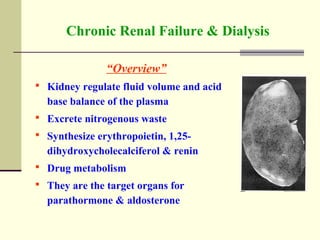
 Kidney regulate fluid volume and acid
base balance of the plasma
 Excrete nitrogenous waste
 Synthesize erythropoietin, 1,25-
dihydroxycholecalciferol & renin
 Drug metabolism
 They are the target organs for
parathormone & aldosterone
Chronic Renal Failure & Dialysis
Definition
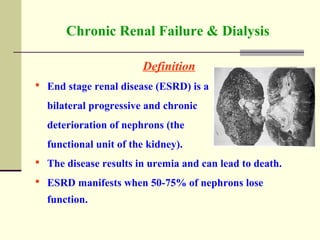
 End stage renal disease (ESRD) is a
bilateral progressive and chronic
deterioration of nephrons (the
functional unit of the kidney).
 The disease results in uremia and can lead to death.
 ESRD manifests when 50-75% of nephrons lose
function.
Chronic Renal Failure & Dialysis
Incidence & Prevalence
 In US, 8 million people have some form of kidney
disease, 360,000 have irreversible ESRD.
 Average dental practice of 2000 patients can expect
to have 2 patients with ESRD.
 ♂>♀.
 Age: 45-65.
Chronic Renal Failure & Dialysis
Etiology
 Diabetes mellitus 34%
 Hypertension 25%
 Chronic glomerulonephritis 16%
 Other causes like:
 Systemic lupus erythematosis
 AIDS, Etc
Chronic Renal Failure & Dialysis
Signs & Symptoms
 Patient appears ill & anemic
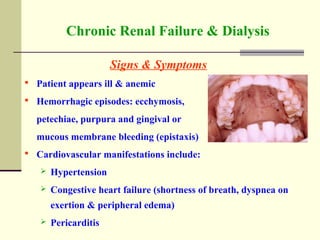
 Hemorrhagic episodes: ecchymosis,
petechiae, purpura and gingival or
mucous membrane bleeding (epistaxis)
 Cardiovascular manifestations include:
 Hypertension
 Congestive heart failure (shortness of breath, dyspnea on
exertion & peripheral edema)
 Pericarditis
Chronic Renal Failure & Dialysis
Signs & Symptoms (Cont.)
 Hyperpigmentation of the skin (retention of carotene-
like pigments normally excreted by the kidney)
 Gastrointestinal signs:
 Anorexia
 Nausea
 Vomiting
 Generalized gastroenteritis
 Peptic ulcer disease
Chronic Renal Failure & Dialysis
Signs & Symptoms (Cont.)
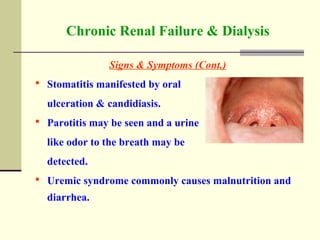
 Stomatitis manifested by oral
ulceration & candidiasis.
 Parotitis may be seen and a urine
like odor to the breath may be
detected.
 Uremic syndrome commonly causes malnutrition and
diarrhea.
Chronic Renal Failure & Dialysis
Medical Management
 The goals of treatment are to retard the progress of
disease and preserve the patient’s quality of life
 A conservative approach
 Involve decreasing the retention of nitrogenous
waste products
 Controling hypertension, fluids & electrolyte
imbalances
 Anemia associated with renal failure usually is
treated with the use of recombinant human
erythropoietin
Chronic Renal Failure & Dialysis
Medical Management (Cont.)
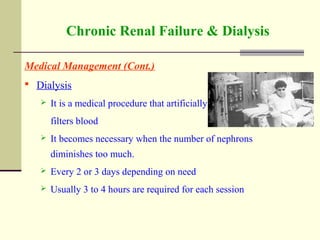
 Dialysis
 It is a medical procedure that artificially
filters blood
 It becomes necessary when the number of nephrons
diminishes too much.
 Every 2 or 3 days depending on need
 Usually 3 to 4 hours are required for each session
Chronic Renal Failure & Dialysis
Medical Management (Cont.)
 Drugs that are metabolized primarily
by the kidney should be avoided
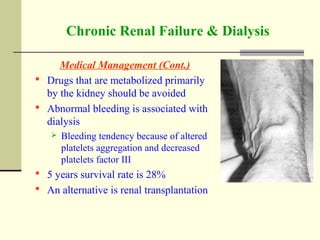
 Abnormal bleeding is associated with
dialysis
 Bleeding tendency because of altered
platelets aggregation and decreased
platelets factor III
 5 years survival rate is 28%
 An alternative is renal transplantation
Chronic Renal Failure & Dialysis
Dental Management
 Patients under conservative care
 Consultation with patient’s physician
 If patient is in advance stages, dental care may
best be provided after physician’s consultation
and in a hospital like setting.
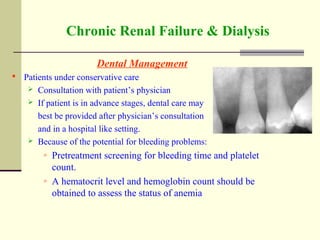
 Because of the potential for bleeding problems:
o Pretreatment screening for bleeding time and platelet
count.
o A hematocrit level and hemoglobin count should be
obtained to assess the status of anemia
Chronic Renal Failure & Dialysis
Dental Management (Cont.)
 If an orofacial infection exists, aggressive
management is necessary using culture and
sensitive tests and appropriate antibiotics
 Nephrotoxic drugs should be avoided
 Example: NSAID, Aspirin, and Tetracycline
require special dosage adjustments
Chronic Renal Failure & Dialysis
Dental Management (Cont.)
 Patients receiving dialysis
 Patients are at risk for infective endocarditis but the
reason(s) are not yet fully established.
 Infective endocarditis occurs in 2% to 9% of patients
receiving hemodialysis
 40% of patients on dialysis have congestive heart
failure
 Hemodialysis tends to aggravate bleeding tendencies
• Physical destruction of platelets
• Heparin usage
Chronic Renal Failure & Dialysis
Oral Complications & Manifestations
 Pallor of the oral mucosa secondary to anemia
 Red-Orange discoloration of the cheeks and
mucosa caused by pruritis and deposition of
carotene-like pigments
 Diminished salivary flow (parotid infections)
 Candidiasis (xerostomia)
Chronic Renal Failure & Dialysis
Oral Complications & Manifestations
(Cont.)
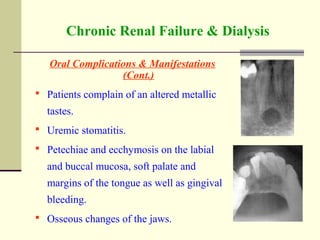
 Patients complain of an altered metallic
tastes.
 Uremic stomatitis.
 Petechiae and ecchymosis on the labial
and buccal mucosa, soft palate and
margins of the tongue as well as gingival
bleeding.
 Osseous changes of the jaws.

Renal diseases

  • 1.
    Oral Diagnosis-I Review ofchronic renal failure and dialysis December 24, 2006 Dr. Suresh. C. S. BDS; MDS; MDSc (UK)
  • 2.
    Chronic Renal Failure& Dialysis “Overview”  Kidney regulate fluid volume and acid base balance of the plasma  Excrete nitrogenous waste  Synthesize erythropoietin, 1,25- dihydroxycholecalciferol & renin  Drug metabolism  They are the target organs for parathormone & aldosterone
  • 3.
    Chronic Renal Failure& Dialysis Definition  End stage renal disease (ESRD) is a bilateral progressive and chronic deterioration of nephrons (the functional unit of the kidney).  The disease results in uremia and can lead to death.  ESRD manifests when 50-75% of nephrons lose function.
  • 4.
    Chronic Renal Failure& Dialysis Incidence & Prevalence  In US, 8 million people have some form of kidney disease, 360,000 have irreversible ESRD.  Average dental practice of 2000 patients can expect to have 2 patients with ESRD.  ♂>♀.  Age: 45-65.
  • 5.
    Chronic Renal Failure& Dialysis Etiology  Diabetes mellitus 34%  Hypertension 25%  Chronic glomerulonephritis 16%  Other causes like:  Systemic lupus erythematosis  AIDS, Etc
  • 6.
    Chronic Renal Failure& Dialysis Signs & Symptoms  Patient appears ill & anemic  Hemorrhagic episodes: ecchymosis, petechiae, purpura and gingival or mucous membrane bleeding (epistaxis)  Cardiovascular manifestations include:  Hypertension  Congestive heart failure (shortness of breath, dyspnea on exertion & peripheral edema)  Pericarditis
  • 7.
    Chronic Renal Failure& Dialysis Signs & Symptoms (Cont.)  Hyperpigmentation of the skin (retention of carotene- like pigments normally excreted by the kidney)  Gastrointestinal signs:  Anorexia  Nausea  Vomiting  Generalized gastroenteritis  Peptic ulcer disease
  • 8.
    Chronic Renal Failure& Dialysis Signs & Symptoms (Cont.)  Stomatitis manifested by oral ulceration & candidiasis.  Parotitis may be seen and a urine like odor to the breath may be detected.  Uremic syndrome commonly causes malnutrition and diarrhea.
  • 9.
    Chronic Renal Failure& Dialysis Medical Management  The goals of treatment are to retard the progress of disease and preserve the patient’s quality of life  A conservative approach  Involve decreasing the retention of nitrogenous waste products  Controling hypertension, fluids & electrolyte imbalances  Anemia associated with renal failure usually is treated with the use of recombinant human erythropoietin
  • 10.
    Chronic Renal Failure& Dialysis Medical Management (Cont.)  Dialysis  It is a medical procedure that artificially filters blood  It becomes necessary when the number of nephrons diminishes too much.  Every 2 or 3 days depending on need  Usually 3 to 4 hours are required for each session
  • 11.
    Chronic Renal Failure& Dialysis Medical Management (Cont.)  Drugs that are metabolized primarily by the kidney should be avoided  Abnormal bleeding is associated with dialysis  Bleeding tendency because of altered platelets aggregation and decreased platelets factor III  5 years survival rate is 28%  An alternative is renal transplantation
  • 12.
    Chronic Renal Failure& Dialysis Dental Management  Patients under conservative care  Consultation with patient’s physician  If patient is in advance stages, dental care may best be provided after physician’s consultation and in a hospital like setting.  Because of the potential for bleeding problems: o Pretreatment screening for bleeding time and platelet count. o A hematocrit level and hemoglobin count should be obtained to assess the status of anemia
  • 13.
    Chronic Renal Failure& Dialysis Dental Management (Cont.)  If an orofacial infection exists, aggressive management is necessary using culture and sensitive tests and appropriate antibiotics  Nephrotoxic drugs should be avoided  Example: NSAID, Aspirin, and Tetracycline require special dosage adjustments
  • 14.
    Chronic Renal Failure& Dialysis Dental Management (Cont.)  Patients receiving dialysis  Patients are at risk for infective endocarditis but the reason(s) are not yet fully established.  Infective endocarditis occurs in 2% to 9% of patients receiving hemodialysis  40% of patients on dialysis have congestive heart failure  Hemodialysis tends to aggravate bleeding tendencies • Physical destruction of platelets • Heparin usage
  • 15.
    Chronic Renal Failure& Dialysis Oral Complications & Manifestations  Pallor of the oral mucosa secondary to anemia  Red-Orange discoloration of the cheeks and mucosa caused by pruritis and deposition of carotene-like pigments  Diminished salivary flow (parotid infections)  Candidiasis (xerostomia)
  • 16.
    Chronic Renal Failure& Dialysis Oral Complications & Manifestations (Cont.)  Patients complain of an altered metallic tastes.  Uremic stomatitis.  Petechiae and ecchymosis on the labial and buccal mucosa, soft palate and margins of the tongue as well as gingival bleeding.  Osseous changes of the jaws.