.
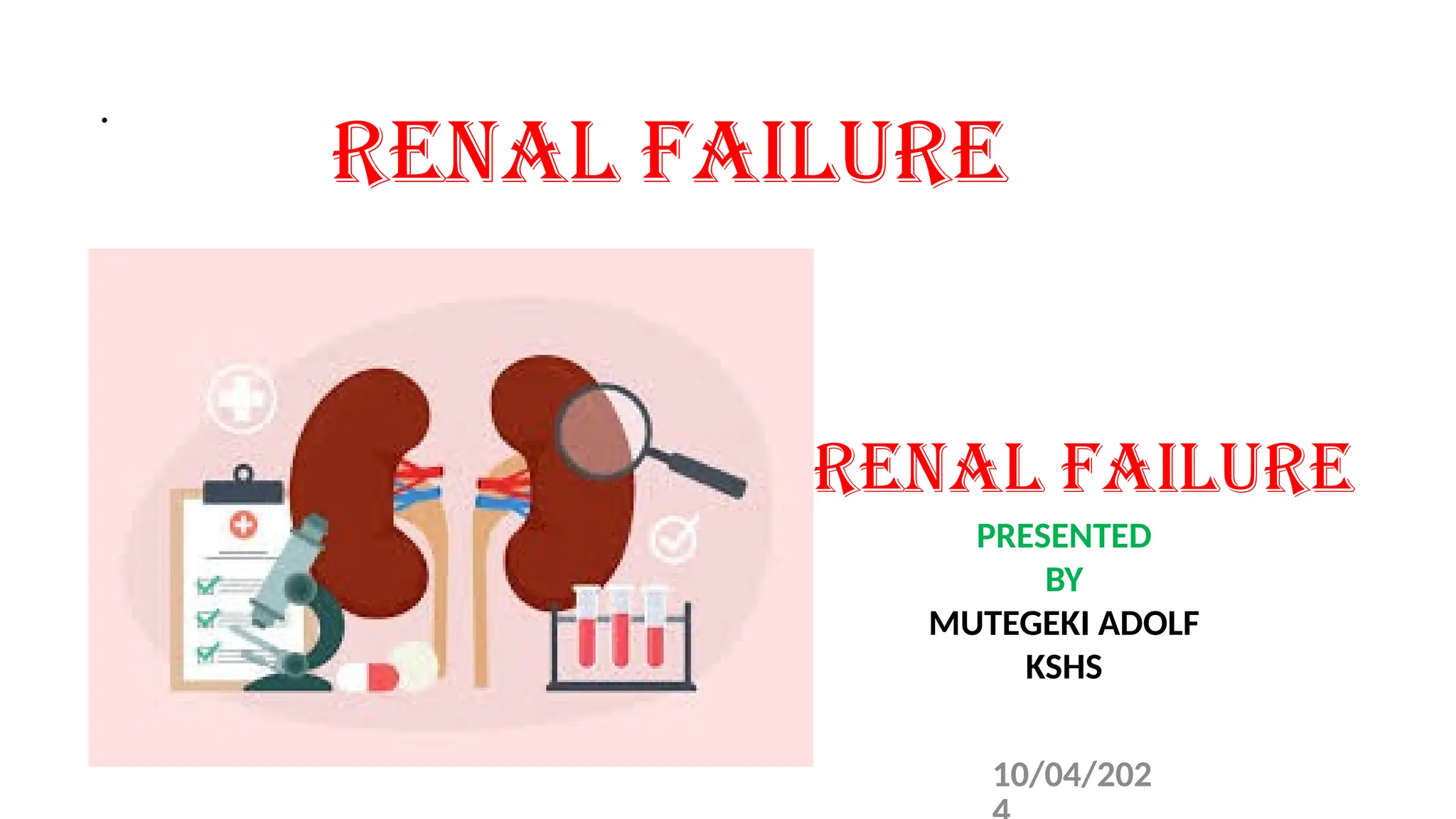
Renal failure
Renal failure
10/04/202
PRESENTED
BY
MUTEGEKI ADOLF
KSHS
DEFINITION
Renal Failure refers to the condition in which the
kidneys lose their ability to adequately filter waste
products from the blood, regulate fluid and
electrolyte balance, and maintain blood pressure.
โ€ข It can be classified into two main types:
a) acute renal failure (ARF) and
b) chronic renal failure (CRF).
โ€ขAcute Renal Failure (ARF) occurs suddenly
and is usually reversible.
โ€ขChronic Renal Failure (CRF) develops
gradually over months or years and is often
irreversible.
1.Acute Renal Failure
ARF is an acute and
potentially reversible
irritability of the kidneys to
perform their normal
functions to maintain
homeostasis.
ACUTE RENAL FAILURE (ARF) CAUSES:
โ€ขPrerenal causes: Reduced blood flow to the kidneys due to
dehydration, heart failure, shock, or severe blood loss.
โ€ขIntrinsic (renal) causes: Direct damage to the kidneys from
conditions such as acute tubular necrosis,
glomerulonephritis, toxins, or drugs (e.g., NSAIDs,
antibiotics).
โ€ขPostrenal causes: Obstruction of the urinary tract (e.g.,
kidney stones, tumors, prostate enlargement) that
prevents urine flow.
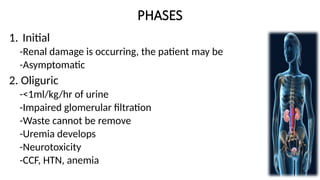
PHASES
1. Initial
-Renal damage is occurring, the patient may be
-Asymptomatic
2. Oliguric
-<1ml/kg/hr of urine
-Impaired glomerular filtration
-Waste cannot be remove
-Uremia develops
-Neurotoxicity
-CCF, HTN, anemia
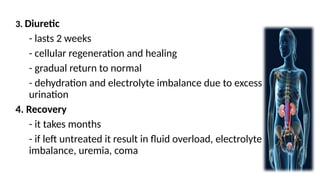
3. Diuretic
- lasts 2 weeks
- cellular regeneration and healing
- gradual return to normal
- dehydration and electrolyte imbalance due to excess
urination
4. Recovery
- it takes months
- if left untreated it result in fluid overload, electrolyte
imbalance, uremia, coma
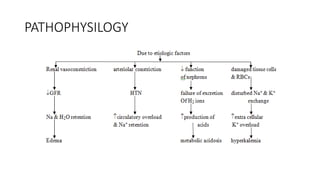
PATHOPHYSIOLOGY
โ€ข In renal failure, the kidneys fail to filter blood effectively,
leading to:
โ€ข Accumulation of waste products like urea and creatinine.
โ€ข Imbalance of electrolytes, such as sodium, potassium, and
calcium.
โ€ข Dysregulation of fluid volume, leading to fluid overload,
edema, and hypertension.
โ€ข Inadequate production of hormones (e.g., erythropoietin),
leading to anemia.
PATHOPHYSILOGY
CLINICAL PRESENTATIONS OF ARF
โ€ขSudden reduction in urine output (oliguria) or no
urine output (anuria).
โ€ขFluid overload: swelling (edema) in the legs, ankles,
or face.
โ€ขShortness of breath.
โ€ขFatigue and weakness.
โ€ขNausea and vomiting.
โ€ขConfusion, lethargy, or seizures in severe cases.
DIFFERENTIAL DIAGNOSIS
โ€ขOther renal disorders
โ€ขBiventricular heart failure
INVESTIGATIONS
โ€ขBlood tests:
โ€ขElevated levels of urea (BUN) and creatinine
(indicative of impaired kidney function).
โ€ขElectrolyte imbalances (e.g., high potassium, low
calcium).
โ€ขComplete blood count (CBC) to check for anemia.
โ€ขUrine tests:
โ€ขUrinalysis for protein, blood, or casts in urine.
โ€ขUrine output measurement.
โ€ขImaging:
โ€ขUltrasound: To detect kidney size, structural
abnormalities, or obstruction.
โ€ขCT scan/MRI: For detailed imaging of renal vasculature,
masses, or stones.
โ€ขBiopsy: Renal biopsy may be required to determine
the underlying cause, especially in
glomerulonephritis.
โ€ขGlomerular Filtration Rate (GFR): Estimates kidney
function and helps stage chronic kidney disease.
MANAGEMENT
โ€ขTreat underlying conditions e.g. dehydration
โ€ขMonitor fluid input and output
โ€ขDaily fluid requirements = 10 ml/kg + total of
losses through urine, vomitus and diarrhoea
โ€ขMonitor BP twice daily
โ€ขDaily weighing
โ€ขRestrict salt intake (<2 g or half teaspoonful daily)
โ€ขRestrict potassium intake e.g. oranges, bananas,
vegetables, meat, fizzy drinks
โ€ขModerate protein intake
โ€ขEnsure adequate calories in diet, Check urine and
electrolytes frequently
โ€ขTreat any complications (e.g. infections,
hypertension, convulsions), adjusting drug dosages
according to the clinical response where
appropriate
โ€ขIf oliguria, furosemide IV according to
response (high doses may be necessary)
โ€ขIf no response to above general measures,
worsening kidney function or anuria (urine
output less than 100 ml/24 hours)
โ€ขRefer for specialist management including
possible dialysis as soon as possible and
before the patientโ€™s ondition becomes
critical
NOTE: Do not give any drugs which may
make kidney damage worse e.g. use
gentamicin with caution
PROGNOSIS
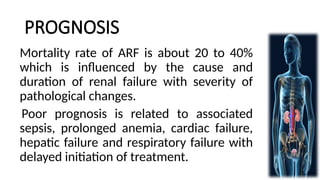
Mortality rate of ARF is about 20 to 40%
which is influenced by the cause and
duration of renal failure with severity of
pathological changes.
Poor prognosis is related to associated
sepsis, prolonged anemia, cardiac failure,
hepatic failure and respiratory failure with
delayed initiation of treatment.
CHRONIC KIDNEY DISEASE
โ€ขChronic renal failure
โ€ขEnd stage renal failure
2. Chronic Renal Failure
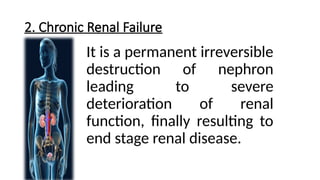
It is a permanent irreversible
destruction of nephron
leading to severe
deterioration of renal
function, finally resulting to
end stage renal disease.
ETIOLOGY
โ€ขCause below 5 years of age is mostly
congenital anomalies
โ€ขAfter 5 that is acquired glomerular disease,
hereditary disease
๏ถGlomerular disease
๏ถCongenital anomalies
๏ถObstructive uropathy
๏ถMiscellaneous
โ€ขDiabetes mellitus: Leading cause due to diabetic
nephropathy.
โ€ขHypertension: Causes damage to blood vessels in the
kidneys.
โ€ขGlomerulonephritis: Chronic inflammation of the kidney's
filtering units (glomeruli).
โ€ขPolycystic kidney disease: Genetic condition causing cysts
to develop in the kidneys.
โ€ขProlonged use of nephrotoxic drugs (e.g., analgesics,
chemotherapy agents).
โ€ขObstructive uropathy: Chronic obstruction of urine flow due
to stones, tumors, or prostate issues.
CLINICAL PRESENTATIONS OF CRF
โ€ข Fatigue and weakness.
โ€ข Loss of appetite, nausea, and vomiting.
โ€ข Swelling (edema) in the legs, face, or hands.
โ€ข High blood pressure (hypertension).
โ€ข Persistent itching (pruritus).
โ€ข Decreased urine output or frequent urination.
โ€ข Muscle cramps and bone pain due to calcium imbalances.
โ€ข Anemia leading to paleness, shortness of breath, and lethargy.
โ€ข Uremic symptoms in late stages, such as confusion, lethargy, and
pericarditis
PATHOPHYSIOLOGY
โ€ข In the early stage of disease child remains asymptomatic. Advance
renal damage will occur only in late stages.
โ€ข Increased numbers of nephrons are destructed at various degrees and
a few remain intact but hypertrophied and functional.
โ€ข This leads to insufficient adjustments in fluid and electrolyte balance.
โ€ข As the disease progress to end stage severe reduction in number of
nephrons occur and the kidney will not b able to maintain fliud and
electrolyte balance.
โ€ข The accumulation of various substances in blood result in
complications
Stages of Chronic Renal Failure
1. Diminished Renal Reserve
Normal BUN ( Blood Urea Nitrogen), and serum creatinine absence
of symptoms
2. Renal Insufficiency
GFR is about 25% of normal, BUN Creatinine levels increased
3. Renal Failure
GFR <25% of normal increasing symptoms
4. ESRD (End stage Renal Disease) or Uremia
GFR < 5-10% normal, creatinine clearance
<5-10ml/min resulting in a cumulative effect
COMPLICATIONS
โ€ข Azotemia (Uremia)
โ€ข Metabolic acidosis
โ€ข Electrolyte imbalance
โ€ข CCF
โ€ข HTN
โ€ข Severe anemia
โ€ข Growth retardation
โ€ข Delayed or absent sexual maturation
Differential diagnosis
โ€ขOther causes of chronic anaemia
โ€ขHeart failure
โ€ขProtein-energy malnutrition
โ€ขChronic liver disease
MANAGEMENT
โ€ข Conservative management
๏ƒผCorrection of reversible component of renal
dysfunction
๏ƒผPreservation of renal function
๏ƒผTreatment of metabolic and psycho-social problems
๏ƒผOptimization of growth
๏ƒผPreparation for treatment of ESRD
๏ƒผTreat for infection, accelerated hypertension, CCF,
obstruction of urine flow - to improve renal function
Dietary therapy
โ€ขLow protein diet
โ€ขSevere protein restriction may produce
protein calorie malnutrition
โ€ขDiet should consist of 100 percent RDA
(Recommended Dietary Allowance) for
calories
โ€ขProtein should be of high biological value
and should comprise 6 โ€“ 10 % of all
calories
โ€ขAvoid nephrotoxic medicines, e.g. NSAIDs,
celecoxibs, aminoglycosides, contrast agents
โ€ขPrevention of complications
โ€ขAnaemia: due to multiple causes. Consider
iron and folic supplements. Target Hb 11-12
gr/dL
โ€ขBone mineral disease: consider adding
calcium Treatment of symptoms
โ€ขBlood pressure control: Target 130/80 mmHg
(lower in children). Use ACE inhibitors as first
line antihypertensives for diabetics and
patients with proteinuria, plus low salt diet
โ€ขIn diabetics: BP control is paramount Optimal
blood sugar control (HbA1C <7%)
โ€ขProteinuria: Reduce using ACE inhibitors
and/or ARBs; target < 1 g/day
โ€ขSalt restriction in patients with hypertension and
fluid overload
โ€ขPatients with salt losing nephropathy should take
a liberal amount of salt and water
โ€ขIf the GFR falls <10ml/min/1.73m2
, potassium
intake should be restricted.(hyperkalemia may
develop)
โ€ขVit D is essential to raise the serum calcium and
suppress parathormone secretion.
โ€ขIf fluid retention/oliguria, furosemide
tablet according to response (high doses
may be necessary)
โ€ขDialysis for end stage cases
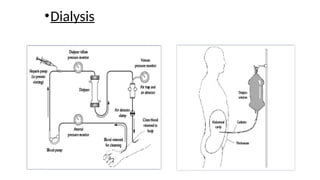
โ€ขDialysis
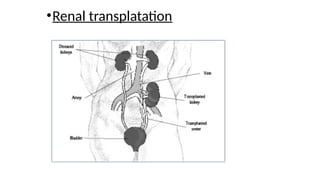
โ€ขRenal transplatation
,
THANK
YOU

RENAL FAILURE. reduction in the renal function.

  • 1.
  • 2.
    DEFINITION Renal Failure refersto the condition in which the kidneys lose their ability to adequately filter waste products from the blood, regulate fluid and electrolyte balance, and maintain blood pressure. โ€ข It can be classified into two main types: a) acute renal failure (ARF) and b) chronic renal failure (CRF).
  • 3.
    โ€ขAcute Renal Failure(ARF) occurs suddenly and is usually reversible. โ€ขChronic Renal Failure (CRF) develops gradually over months or years and is often irreversible.
  • 4.
    1.Acute Renal Failure ARFis an acute and potentially reversible irritability of the kidneys to perform their normal functions to maintain homeostasis.
  • 5.
    ACUTE RENAL FAILURE(ARF) CAUSES: โ€ขPrerenal causes: Reduced blood flow to the kidneys due to dehydration, heart failure, shock, or severe blood loss. โ€ขIntrinsic (renal) causes: Direct damage to the kidneys from conditions such as acute tubular necrosis, glomerulonephritis, toxins, or drugs (e.g., NSAIDs, antibiotics). โ€ขPostrenal causes: Obstruction of the urinary tract (e.g., kidney stones, tumors, prostate enlargement) that prevents urine flow.
  • 6.
    PHASES 1. Initial -Renal damageis occurring, the patient may be -Asymptomatic 2. Oliguric -<1ml/kg/hr of urine -Impaired glomerular filtration -Waste cannot be remove -Uremia develops -Neurotoxicity -CCF, HTN, anemia
  • 7.
    3. Diuretic - lasts2 weeks - cellular regeneration and healing - gradual return to normal - dehydration and electrolyte imbalance due to excess urination 4. Recovery - it takes months - if left untreated it result in fluid overload, electrolyte imbalance, uremia, coma
  • 8.
    PATHOPHYSIOLOGY โ€ข In renalfailure, the kidneys fail to filter blood effectively, leading to: โ€ข Accumulation of waste products like urea and creatinine. โ€ข Imbalance of electrolytes, such as sodium, potassium, and calcium. โ€ข Dysregulation of fluid volume, leading to fluid overload, edema, and hypertension. โ€ข Inadequate production of hormones (e.g., erythropoietin), leading to anemia.
  • 9.
  • 10.
    CLINICAL PRESENTATIONS OFARF โ€ขSudden reduction in urine output (oliguria) or no urine output (anuria). โ€ขFluid overload: swelling (edema) in the legs, ankles, or face. โ€ขShortness of breath. โ€ขFatigue and weakness. โ€ขNausea and vomiting. โ€ขConfusion, lethargy, or seizures in severe cases.
  • 11.
    DIFFERENTIAL DIAGNOSIS โ€ขOther renaldisorders โ€ขBiventricular heart failure
  • 12.
    INVESTIGATIONS โ€ขBlood tests: โ€ขElevated levelsof urea (BUN) and creatinine (indicative of impaired kidney function). โ€ขElectrolyte imbalances (e.g., high potassium, low calcium). โ€ขComplete blood count (CBC) to check for anemia. โ€ขUrine tests: โ€ขUrinalysis for protein, blood, or casts in urine. โ€ขUrine output measurement.
  • 13.
    โ€ขImaging: โ€ขUltrasound: To detectkidney size, structural abnormalities, or obstruction. โ€ขCT scan/MRI: For detailed imaging of renal vasculature, masses, or stones. โ€ขBiopsy: Renal biopsy may be required to determine the underlying cause, especially in glomerulonephritis. โ€ขGlomerular Filtration Rate (GFR): Estimates kidney function and helps stage chronic kidney disease.
  • 14.
    MANAGEMENT โ€ขTreat underlying conditionse.g. dehydration โ€ขMonitor fluid input and output โ€ขDaily fluid requirements = 10 ml/kg + total of losses through urine, vomitus and diarrhoea โ€ขMonitor BP twice daily โ€ขDaily weighing โ€ขRestrict salt intake (<2 g or half teaspoonful daily)
  • 15.
    โ€ขRestrict potassium intakee.g. oranges, bananas, vegetables, meat, fizzy drinks โ€ขModerate protein intake โ€ขEnsure adequate calories in diet, Check urine and electrolytes frequently โ€ขTreat any complications (e.g. infections, hypertension, convulsions), adjusting drug dosages according to the clinical response where appropriate
  • 16.
    โ€ขIf oliguria, furosemideIV according to response (high doses may be necessary) โ€ขIf no response to above general measures, worsening kidney function or anuria (urine output less than 100 ml/24 hours) โ€ขRefer for specialist management including possible dialysis as soon as possible and before the patientโ€™s ondition becomes critical
  • 17.
    NOTE: Do notgive any drugs which may make kidney damage worse e.g. use gentamicin with caution
  • 18.
    PROGNOSIS Mortality rate ofARF is about 20 to 40% which is influenced by the cause and duration of renal failure with severity of pathological changes. Poor prognosis is related to associated sepsis, prolonged anemia, cardiac failure, hepatic failure and respiratory failure with delayed initiation of treatment.
  • 19.
    CHRONIC KIDNEY DISEASE โ€ขChronicrenal failure โ€ขEnd stage renal failure
  • 20.
    2. Chronic RenalFailure It is a permanent irreversible destruction of nephron leading to severe deterioration of renal function, finally resulting to end stage renal disease.
  • 21.
    ETIOLOGY โ€ขCause below 5years of age is mostly congenital anomalies โ€ขAfter 5 that is acquired glomerular disease, hereditary disease ๏ถGlomerular disease ๏ถCongenital anomalies ๏ถObstructive uropathy ๏ถMiscellaneous
  • 22.
    โ€ขDiabetes mellitus: Leadingcause due to diabetic nephropathy. โ€ขHypertension: Causes damage to blood vessels in the kidneys. โ€ขGlomerulonephritis: Chronic inflammation of the kidney's filtering units (glomeruli). โ€ขPolycystic kidney disease: Genetic condition causing cysts to develop in the kidneys. โ€ขProlonged use of nephrotoxic drugs (e.g., analgesics, chemotherapy agents). โ€ขObstructive uropathy: Chronic obstruction of urine flow due to stones, tumors, or prostate issues.
  • 23.
    CLINICAL PRESENTATIONS OFCRF โ€ข Fatigue and weakness. โ€ข Loss of appetite, nausea, and vomiting. โ€ข Swelling (edema) in the legs, face, or hands. โ€ข High blood pressure (hypertension). โ€ข Persistent itching (pruritus). โ€ข Decreased urine output or frequent urination. โ€ข Muscle cramps and bone pain due to calcium imbalances. โ€ข Anemia leading to paleness, shortness of breath, and lethargy. โ€ข Uremic symptoms in late stages, such as confusion, lethargy, and pericarditis
  • 24.
    PATHOPHYSIOLOGY โ€ข In theearly stage of disease child remains asymptomatic. Advance renal damage will occur only in late stages. โ€ข Increased numbers of nephrons are destructed at various degrees and a few remain intact but hypertrophied and functional. โ€ข This leads to insufficient adjustments in fluid and electrolyte balance. โ€ข As the disease progress to end stage severe reduction in number of nephrons occur and the kidney will not b able to maintain fliud and electrolyte balance. โ€ข The accumulation of various substances in blood result in complications
  • 25.
    Stages of ChronicRenal Failure 1. Diminished Renal Reserve Normal BUN ( Blood Urea Nitrogen), and serum creatinine absence of symptoms 2. Renal Insufficiency GFR is about 25% of normal, BUN Creatinine levels increased 3. Renal Failure GFR <25% of normal increasing symptoms 4. ESRD (End stage Renal Disease) or Uremia GFR < 5-10% normal, creatinine clearance <5-10ml/min resulting in a cumulative effect
  • 26.
    COMPLICATIONS โ€ข Azotemia (Uremia) โ€ขMetabolic acidosis โ€ข Electrolyte imbalance โ€ข CCF โ€ข HTN โ€ข Severe anemia โ€ข Growth retardation โ€ข Delayed or absent sexual maturation
  • 27.
    Differential diagnosis โ€ขOther causesof chronic anaemia โ€ขHeart failure โ€ขProtein-energy malnutrition โ€ขChronic liver disease
  • 28.
    MANAGEMENT โ€ข Conservative management ๏ƒผCorrectionof reversible component of renal dysfunction ๏ƒผPreservation of renal function ๏ƒผTreatment of metabolic and psycho-social problems ๏ƒผOptimization of growth ๏ƒผPreparation for treatment of ESRD ๏ƒผTreat for infection, accelerated hypertension, CCF, obstruction of urine flow - to improve renal function
  • 29.
    Dietary therapy โ€ขLow proteindiet โ€ขSevere protein restriction may produce protein calorie malnutrition โ€ขDiet should consist of 100 percent RDA (Recommended Dietary Allowance) for calories โ€ขProtein should be of high biological value and should comprise 6 โ€“ 10 % of all calories
  • 30.
    โ€ขAvoid nephrotoxic medicines,e.g. NSAIDs, celecoxibs, aminoglycosides, contrast agents โ€ขPrevention of complications โ€ขAnaemia: due to multiple causes. Consider iron and folic supplements. Target Hb 11-12 gr/dL โ€ขBone mineral disease: consider adding calcium Treatment of symptoms
  • 31.
    โ€ขBlood pressure control:Target 130/80 mmHg (lower in children). Use ACE inhibitors as first line antihypertensives for diabetics and patients with proteinuria, plus low salt diet โ€ขIn diabetics: BP control is paramount Optimal blood sugar control (HbA1C <7%) โ€ขProteinuria: Reduce using ACE inhibitors and/or ARBs; target < 1 g/day
  • 32.
    โ€ขSalt restriction inpatients with hypertension and fluid overload โ€ขPatients with salt losing nephropathy should take a liberal amount of salt and water โ€ขIf the GFR falls <10ml/min/1.73m2 , potassium intake should be restricted.(hyperkalemia may develop) โ€ขVit D is essential to raise the serum calcium and suppress parathormone secretion.
  • 33.
    โ€ขIf fluid retention/oliguria,furosemide tablet according to response (high doses may be necessary) โ€ขDialysis for end stage cases
  • 34.
  • 35.
  • 36.