.
SUSTAINED LOW EFFICIENCY DAILY
DIALYSIS (SLEDD)
Dr. A G Almosewi
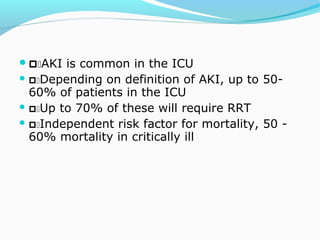
AKI is common in the ICU
 Depending on definition of AKI, up to 50-
60% of patients in the ICU
 Up to 70% of these will require RRT
 Independent risk factor for mortality, 50 -
60% mortality in critically ill
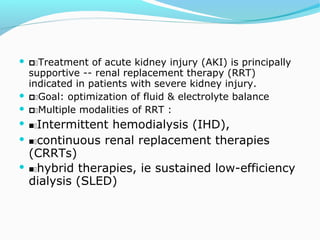
 Treatment of acute kidney injury (AKI) is principally
supportive -- renal replacement therapy (RRT)
indicated in patients with severe kidney injury.
 Goal: optimization of fluid & electrolyte balance
 Multiple modalities of RRT :
 Intermittent hemodialysis (IHD),
 continuous renal replacement therapies
(CRRTs)
 hybrid therapies, ie sustained low-efficiency
dialysis (SLED)
PD
 Least useful form of CRRT in the ICU
 Inefficient solute/volume clearance if unstable or
poor intestinal blood flow
  risk of peritonitis
 Respiratory burden

During the last 9 years, there has been an increasing
interest in the use of Sustained Low Efficiency Daily
Dialysis (SLEDD)

SLEDD has evolved as a conceptual and technical
hybrid of Continuous Renal Replacement Therapy
(CRRT) and Intermittent Haemodialysis (IHD) ,
with therapeutic aims that combine the desirable
properties of each of these component modalities

a reduced rate of ultrafiltration for optimal
haemodynamic stability

low efficiency solute removal to minimise solute
disequilibrium

sustained treatment duration to maximise dialysis
dose and attainment of ultrafiltration goal

studies to date appear to be associated with
satisfactory outcomes, demonstrating that SLEDD is
a safe, effective and convenient renal replacement
therapy for patients who were considered
inappropriate for IHD.

It is able to achieve ultrafiltration goals in patients
who are hypotensive or inotrope dependent.
BACKGROUND

There are an increasing number of patients
presenting with AKI requiring Renal Replacement
Therapy (RRT) who are considered unsuitable for
standard haemodialysis . In order to avoid
unnecessary admission of these patients to critical
care for continuous renal replacement therapy,
modification of existing therapy options has been
required to enable these patients to be managed
within the renal unit.
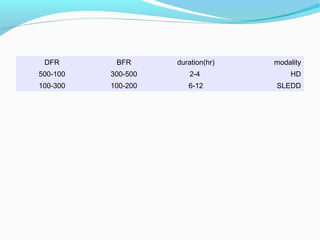
DFR BFR duration(hr) modality
500-100 300-500 2-4 HD
100-300 100-200 6-12 SLEDD
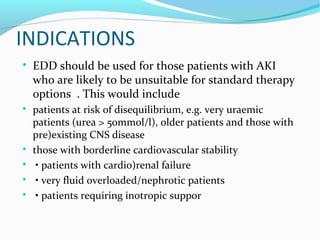
INDICATIONS

EDD should be used for those patients with AKI
who are likely to be unsuitable for standard therapy
options . This would include

patients at risk of disequilibrium, e.g. very uraemic
patients (urea > 50mmol/l), older patients and those with
pre)existing CNS disease

those with borderline cardiovascular stability

• patients with cardio)renal failure

• very fluid overloaded/nephrotic patients

• patients requiring inotropic suppor
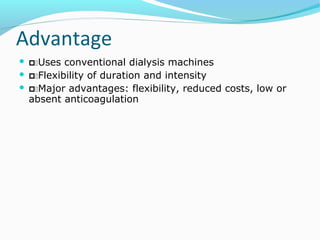
Advantage
 Uses conventional dialysis machines
 Flexibility of duration and intensity
 Major advantages: flexibility, reduced costs, low or
absent anticoagulation
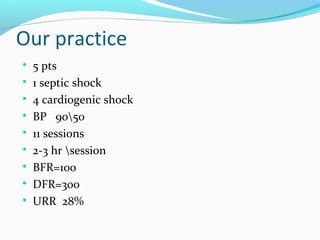
Our practice

5 pts

1 septic shock

4 cardiogenic shock

BP 9050

11 sessions

2-3 hr session

BFR=100

DFR=300

URR 28%
.
Thanks

SUSTAINED LOW EFFICIENCY DAILY DIALYSIS (SLEDD)

  • 1.
    . SUSTAINED LOW EFFICIENCYDAILY DIALYSIS (SLEDD) Dr. A G Almosewi
  • 2.
    AKI is commonin the ICU  Depending on definition of AKI, up to 50- 60% of patients in the ICU  Up to 70% of these will require RRT  Independent risk factor for mortality, 50 - 60% mortality in critically ill
  • 3.
     Treatment ofacute kidney injury (AKI) is principally supportive -- renal replacement therapy (RRT) indicated in patients with severe kidney injury.  Goal: optimization of fluid & electrolyte balance  Multiple modalities of RRT :  Intermittent hemodialysis (IHD),  continuous renal replacement therapies (CRRTs)  hybrid therapies, ie sustained low-efficiency dialysis (SLED)
  • 4.
    PD  Least usefulform of CRRT in the ICU  Inefficient solute/volume clearance if unstable or poor intestinal blood flow   risk of peritonitis  Respiratory burden
  • 5.
     During the last9 years, there has been an increasing interest in the use of Sustained Low Efficiency Daily Dialysis (SLEDD)
  • 6.
     SLEDD has evolvedas a conceptual and technical hybrid of Continuous Renal Replacement Therapy (CRRT) and Intermittent Haemodialysis (IHD) , with therapeutic aims that combine the desirable properties of each of these component modalities
  • 7.
     a reduced rateof ultrafiltration for optimal haemodynamic stability  low efficiency solute removal to minimise solute disequilibrium  sustained treatment duration to maximise dialysis dose and attainment of ultrafiltration goal
  • 8.
     studies to dateappear to be associated with satisfactory outcomes, demonstrating that SLEDD is a safe, effective and convenient renal replacement therapy for patients who were considered inappropriate for IHD.
  • 9.
     It is ableto achieve ultrafiltration goals in patients who are hypotensive or inotrope dependent.
  • 10.
    BACKGROUND  There are anincreasing number of patients presenting with AKI requiring Renal Replacement Therapy (RRT) who are considered unsuitable for standard haemodialysis . In order to avoid unnecessary admission of these patients to critical care for continuous renal replacement therapy, modification of existing therapy options has been required to enable these patients to be managed within the renal unit.
  • 11.
    DFR BFR duration(hr)modality 500-100 300-500 2-4 HD 100-300 100-200 6-12 SLEDD
  • 12.
    INDICATIONS  EDD should beused for those patients with AKI who are likely to be unsuitable for standard therapy options . This would include  patients at risk of disequilibrium, e.g. very uraemic patients (urea > 50mmol/l), older patients and those with pre)existing CNS disease  those with borderline cardiovascular stability  • patients with cardio)renal failure  • very fluid overloaded/nephrotic patients  • patients requiring inotropic suppor
  • 13.
    Advantage  Uses conventionaldialysis machines  Flexibility of duration and intensity  Major advantages: flexibility, reduced costs, low or absent anticoagulation
  • 14.
    Our practice  5 pts  1septic shock  4 cardiogenic shock  BP 9050  11 sessions  2-3 hr session  BFR=100  DFR=300  URR 28%
  • 15.