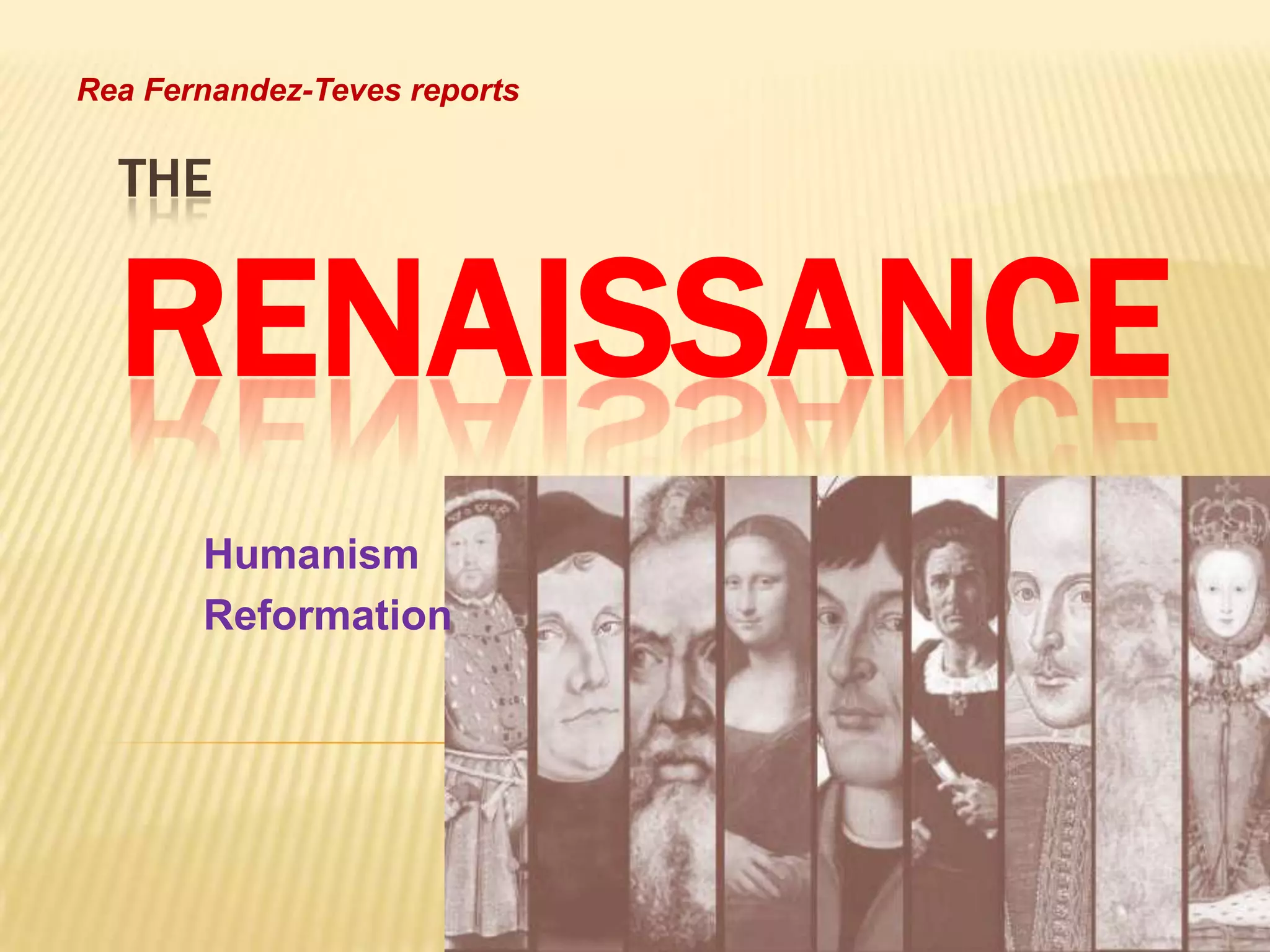
theRENAISSANCERea Fernandez-Teves reportsHumanismReformation
Revival of AntiquityRevival of Learning	It began in Italy in early 1300’s and spread to England, Germany, Netherlands, Spain and other countries in the late 1400’s.    Latin word renascere,  meaning “rebirth”
What ended the Middle Ages?dianewinans, teaching history and english in texas  for 40 years now
FACTORS THAT propelled RENAISSANCE: Scholasticism
Invention of the printing press
Findings of exploration and scientific discoveries
The degeneration of the church
The rise of free cities and rich middle class a quick view of the       works of art
The commoners became more respectable.  Thanks to:Printing PressGunpowderToilet
HUMANISMIs the most significant intellectual movement of the RenaissanceBlended concern for the history and actions of human beings with religious concerns.
Humanists–scholars and artists who studied literature and philosophy and believed these would help better understand the problems of humanity.
Understand and appreciate classical antiquity to learn how to conduct your lives.
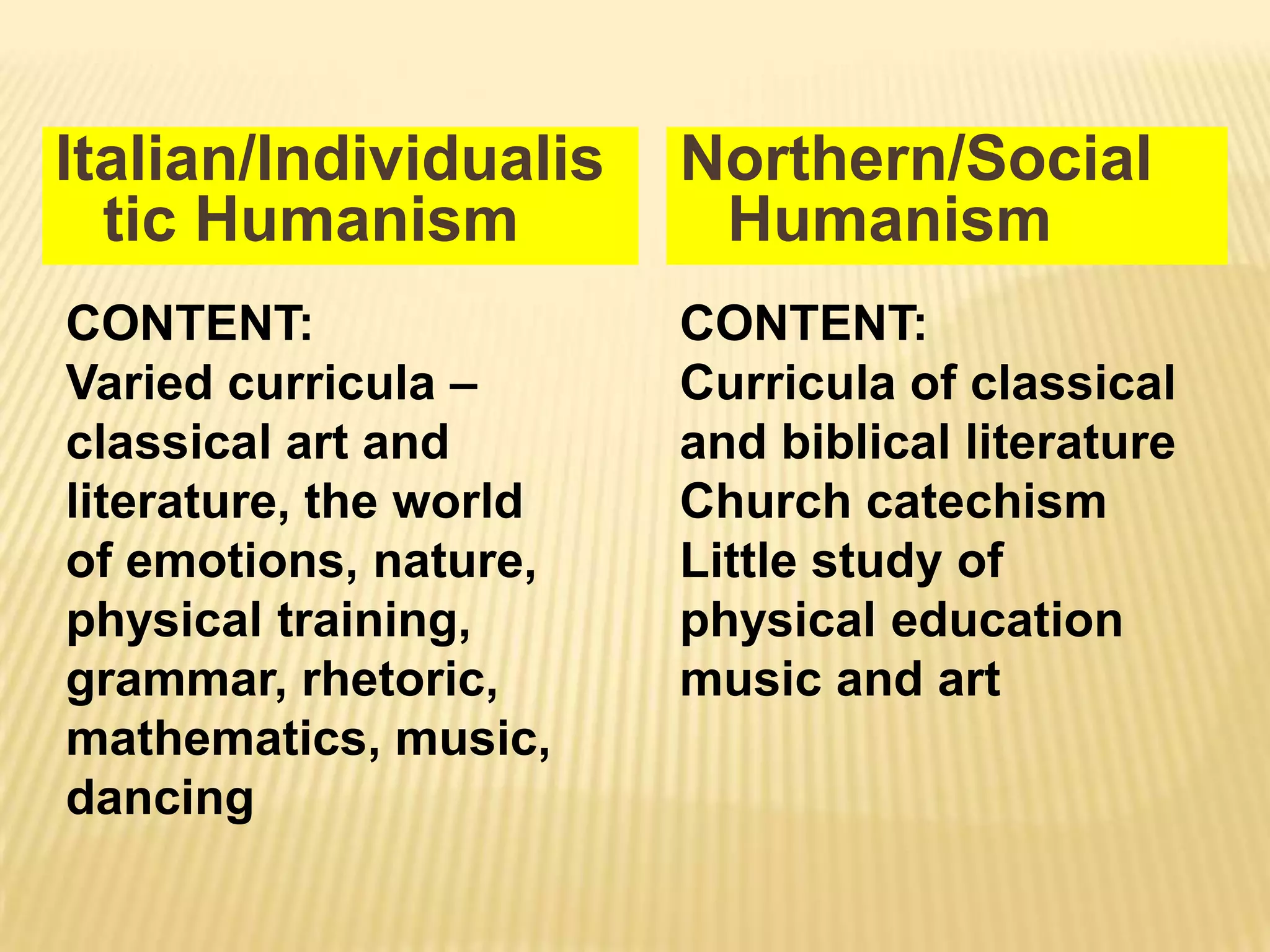
Italian/individualistic humanismNorthern/social humanismStressed personal culture, individual freedom and development as the best way toward full and rich lives	Stressed manual and social reform as the best means of providing rich and free lives for the masses as well as for the elite
Italian/Individualistic      Humanism   Northern/Social        HumanismAIMS:Academic FreedomAbundant LivingLiberal EducationAIMS:Social reformReligious and moral Literacy LiteraryDemocratic
Italian/individualistic humanismNorthern/social humanismTYPES:Literary and aestheticPhysical education, social training in manners and deportment and moral educationTYPES:Religious, moral and social education
Italian/Individualistic HumanismNorthern/Social HumanismCONTENT:Varied curricula –classical art and literature, the world of emotions, nature, physical training, grammar, rhetoric, mathematics, music, dancingCONTENT:Curricula of classical and biblical literatureChurch catechismLittle study of physical education music and art
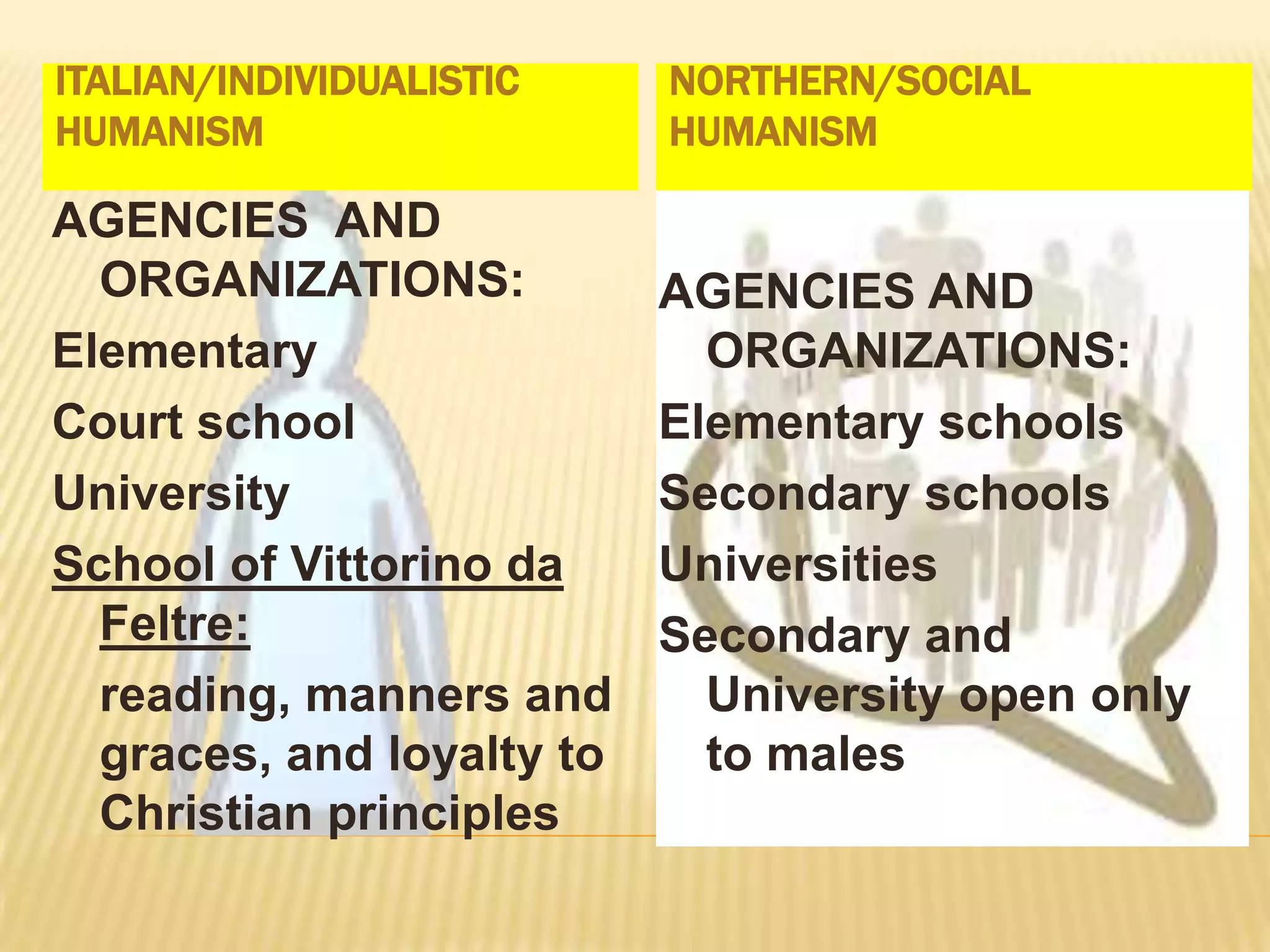
Italian/individualistic humanismNorthern/social humanismAGENCIES  AND ORGANIZATIONS:ElementaryCourt schoolUniversitySchool of VittorinodaFeltre: 	reading, manners and graces, and loyalty to Christian principlesAGENCIES AND ORGANIZATIONS:Elementary schoolsSecondary schoolsUniversitiesSecondary and University open only to males
Italian/Individualistic HumanismNorthern/SocialHumanismMETHOD:Erasmus:Individualized instructionImportance of games and exerciseSocial relevanceRepetition and masteryMotivation, praise and rewards GentlenessMETHOD:Text replacing lecturesWritten themes displacing oral discourse
VittorinodaFeltre  (1378 Feltre–1446 Mantua)Real name:  VittorinoRamboldini, Italian humanist 	and teacherEducation: Philosophy, a degree of Arts in Latin Composition and Logic and Theology. As a student he supported himself by tutoring.
Set up La Giocosa (Pleasant House), a secular boarding schoolMethods: adapting the work of the individual to his needs and capacities
developing a balance between mental activity and physical activity
developing the power to think
the inclusion of play in the curriculaVittorinodaFeltre  (1378 Feltre–1446 Mantua)
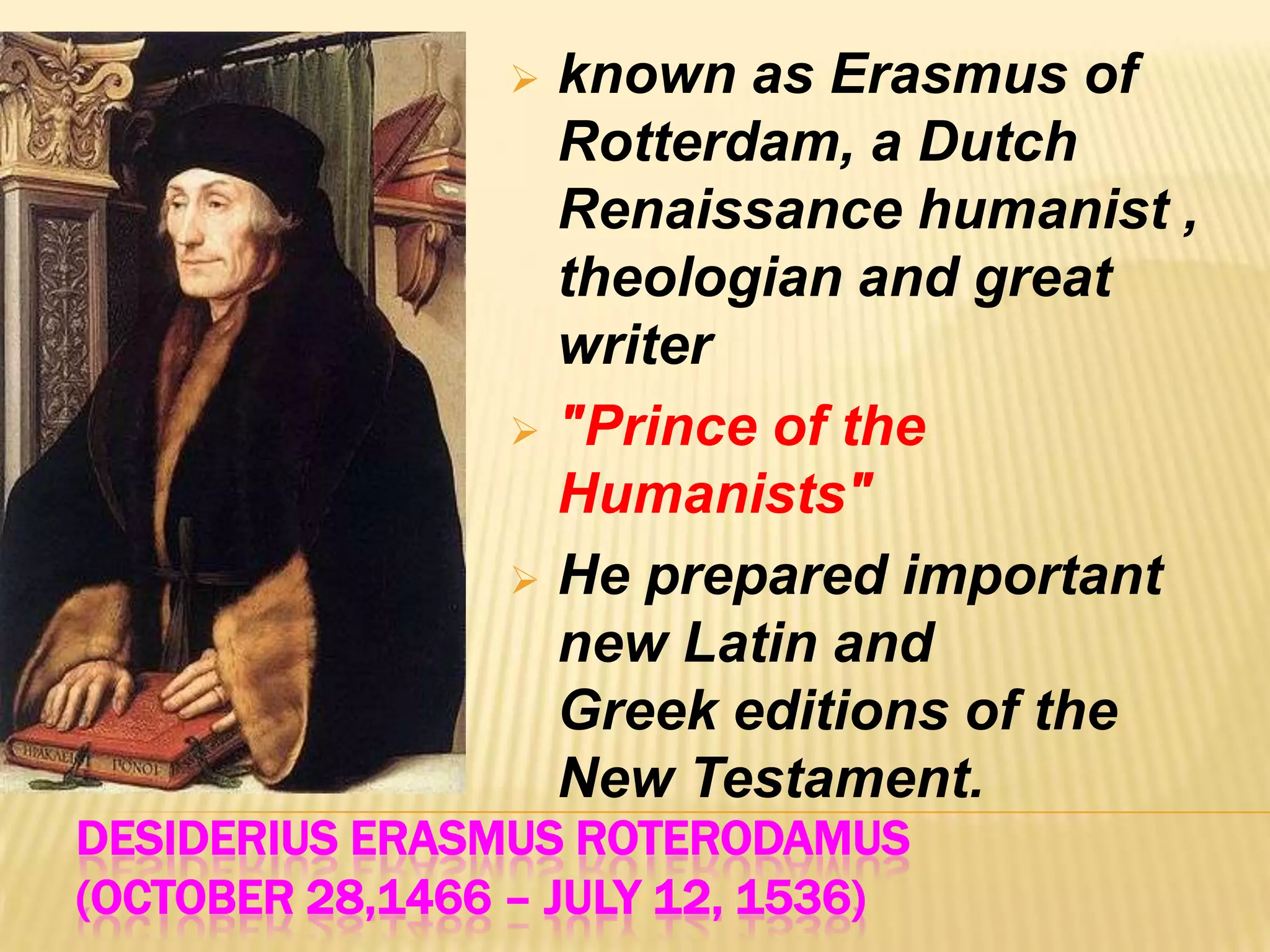
Desiderius Erasmus Roterodamus (October 28,1466 – July 12, 1536)known as Erasmus of Rotterdam, a Dutch Renaissance humanist , theologian and great writer
"Prince of the Humanists"
He prepared important new Latin and Greek editions of the New Testament.Methods: individualized instruction, importance of games and exercise, social relevance, repetition and mastery, motivation, praise and rewards, gentleness, not physical punishment “Prevention is better than cure. ““Time takes away the grief of men. ““In the kingdom of the blind, the one-eyed man is king. “Desiderius Erasmus Roterodamus (October 28,1466 – July 12, 1536)
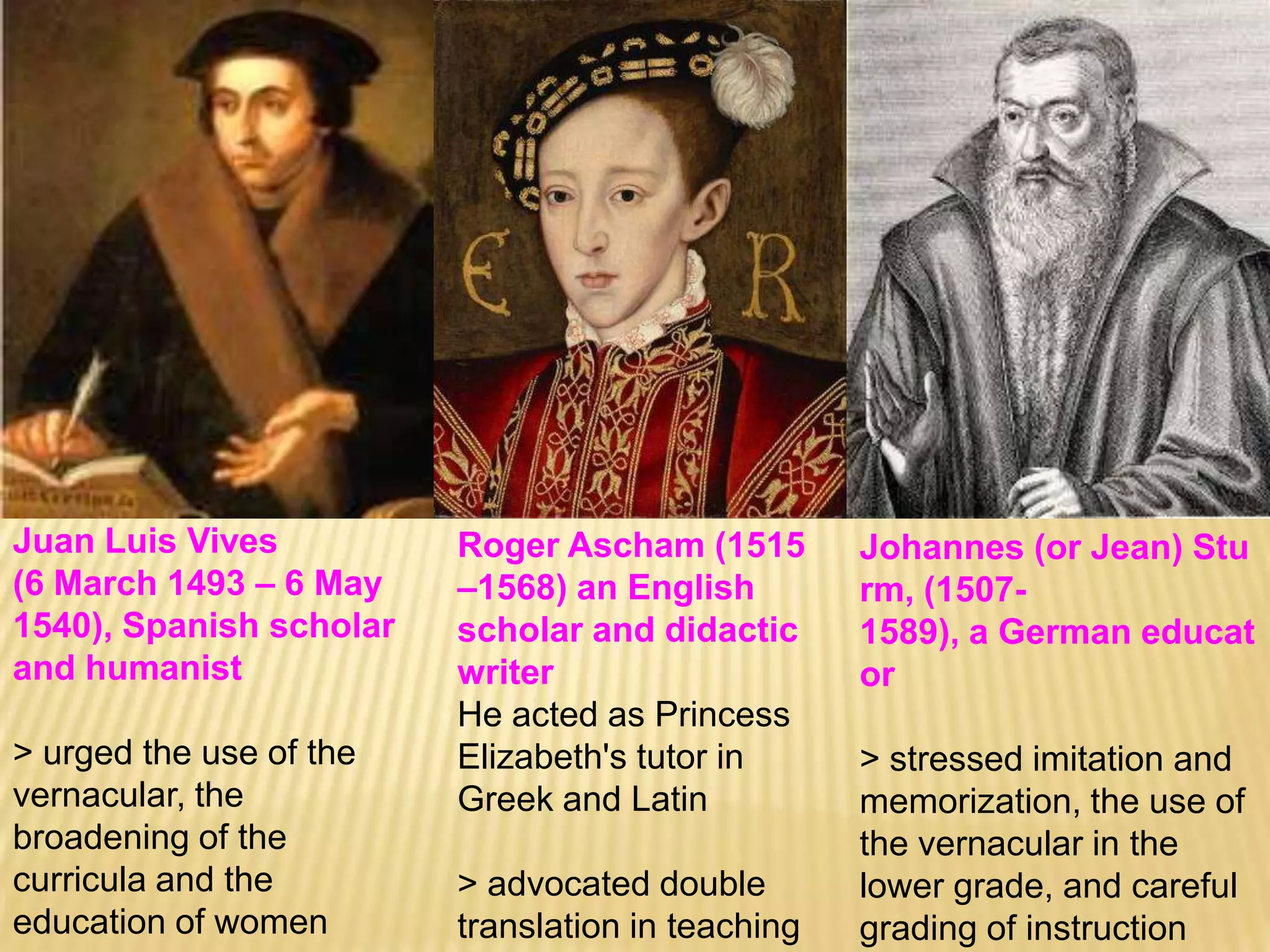
Juan Luis Vives(6 March 1493 – 6 May 1540), Spanish scholar and humanist> urged the use of the vernacular, the broadening of the curricula and the education of womenRoger Ascham (1515 –1568) an English scholar and didactic writerHe acted as Princess Elizabeth's tutor in Greek and Latin> advocated double translation in teaching languageJohannes (or Jean) Sturm, (1507-1589), a German educator> stressed imitation and memorization, the use of the vernacular in the lower grade, and careful grading of instruction
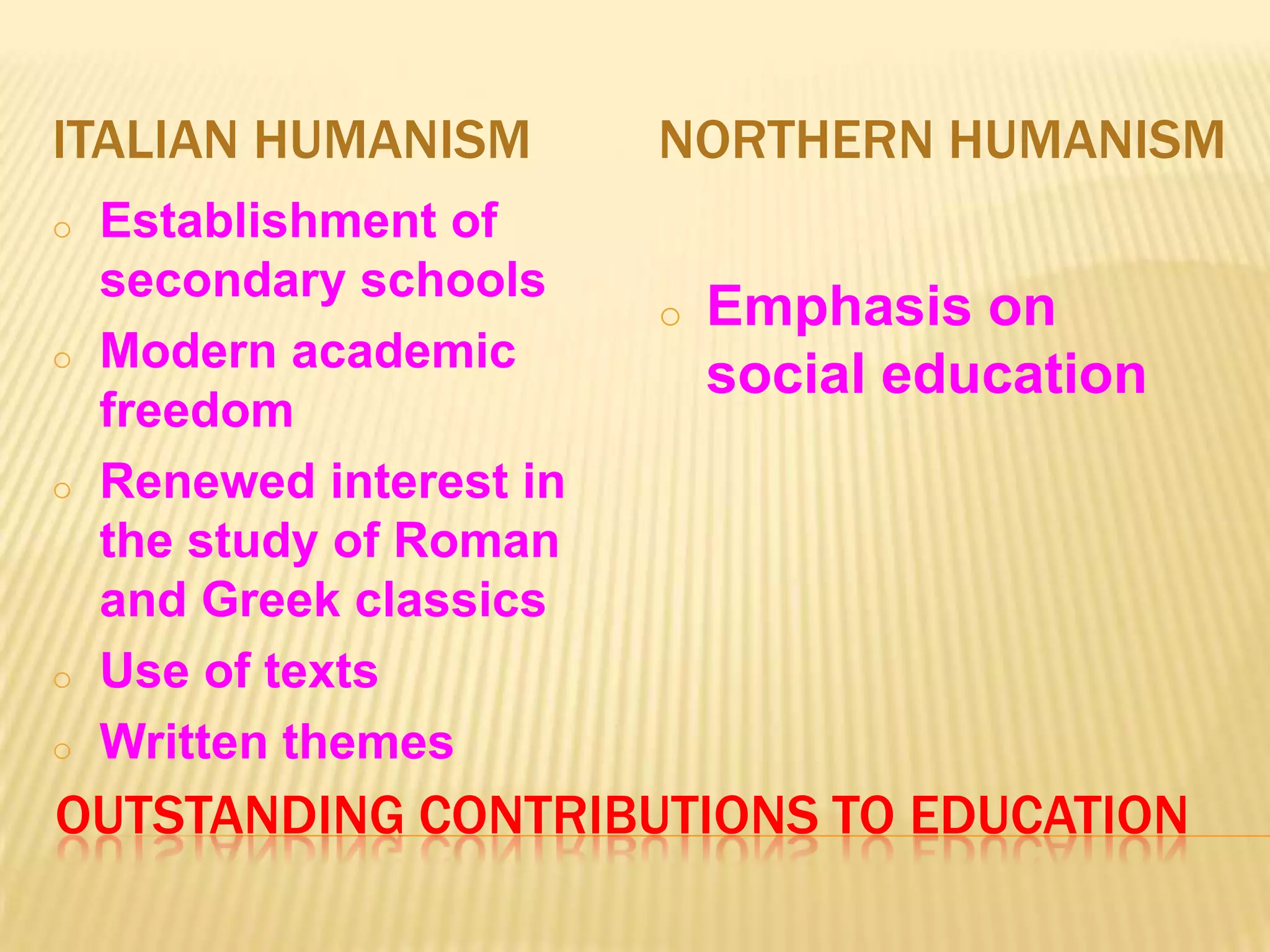
Outstanding contributions to educationItalian humanismNorthern humanismEstablishment of secondary schools
Modern academic freedom
Renewed interest in the study of Roman and Greek classics
Use of texts
Written themes

Renaissance and Education