Philosophical Movements in Education
Renaissance
- It is derived from the Latin word
‘renaistre’ meaning to be born again.
It is considered as the revival of
ancient learning brought about by
the discovery of the ‘New World’ of
Christopher Columbus, the
fascinating of Marco Polo about the
wealth and technology of the East.
(i.e. China under Kublai Khan), the
invention of the printing press and
other events during the latter part of
the medieval period.
Renaissance Period
Gutenburg Perfect Printing
C. Columbus discovered
America
HUMANISM
- it was one of the various philosophies that
flourished during the renaissance period. It is the
philosophy which holds the idea that education
aims to liberate man from the oppressive and
demanding Medieval institutions like the church
and the state, so as to enable him to fully
develop his potentials.
- It was caused by the massive corruption in the
Roman Catholic Church and the sale of indulgences.
The movement highlighted the protests of the people
who were devastated by the policies of the Roman
Catholic Church.
REFORMATION
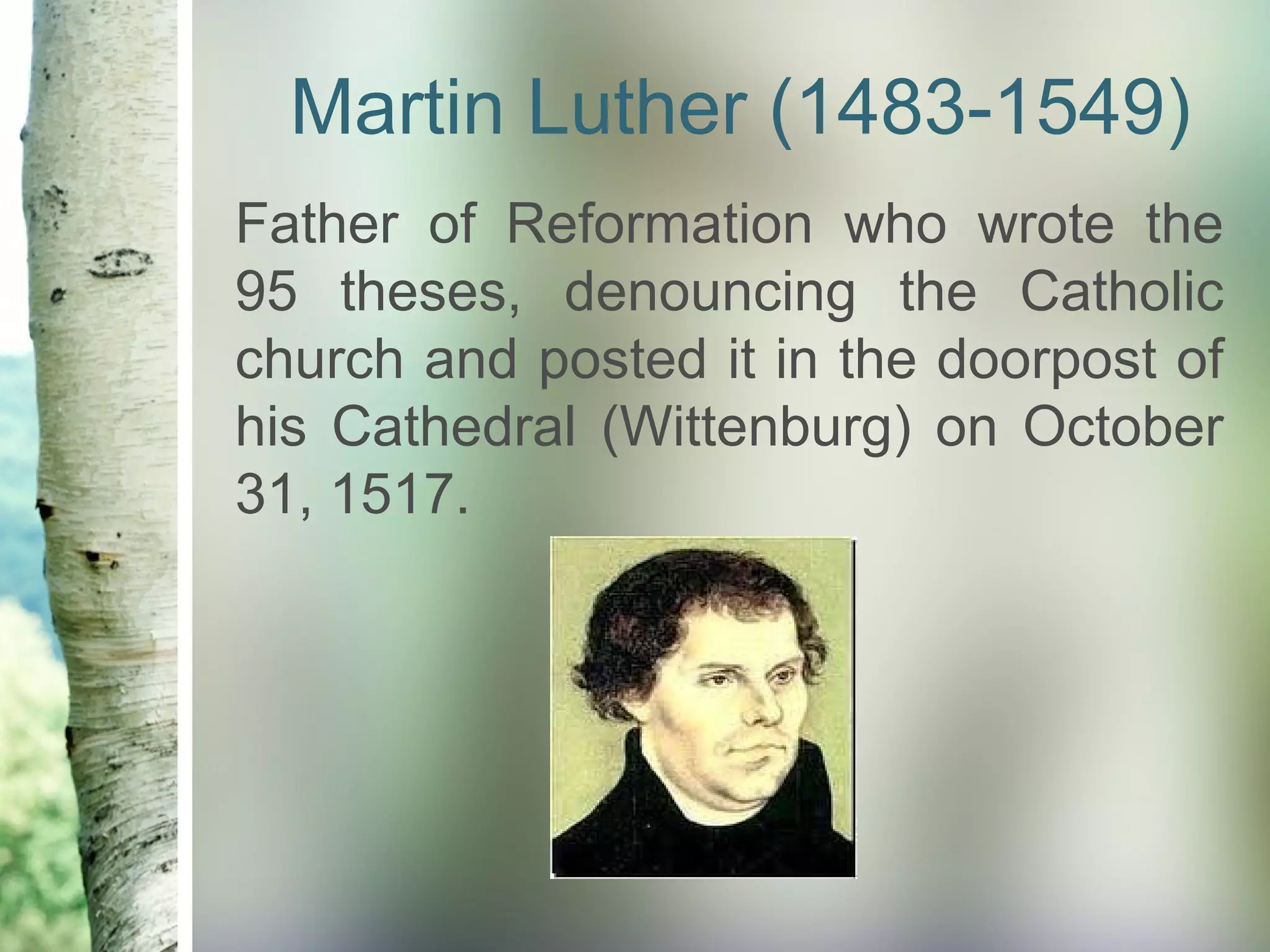
Martin Luther (1483-1549)
Father of Reformation who wrote the
95 theses, denouncing the Catholic
church and posted it in the doorpost of
his Cathedral (Wittenburg) on October
31, 1517.
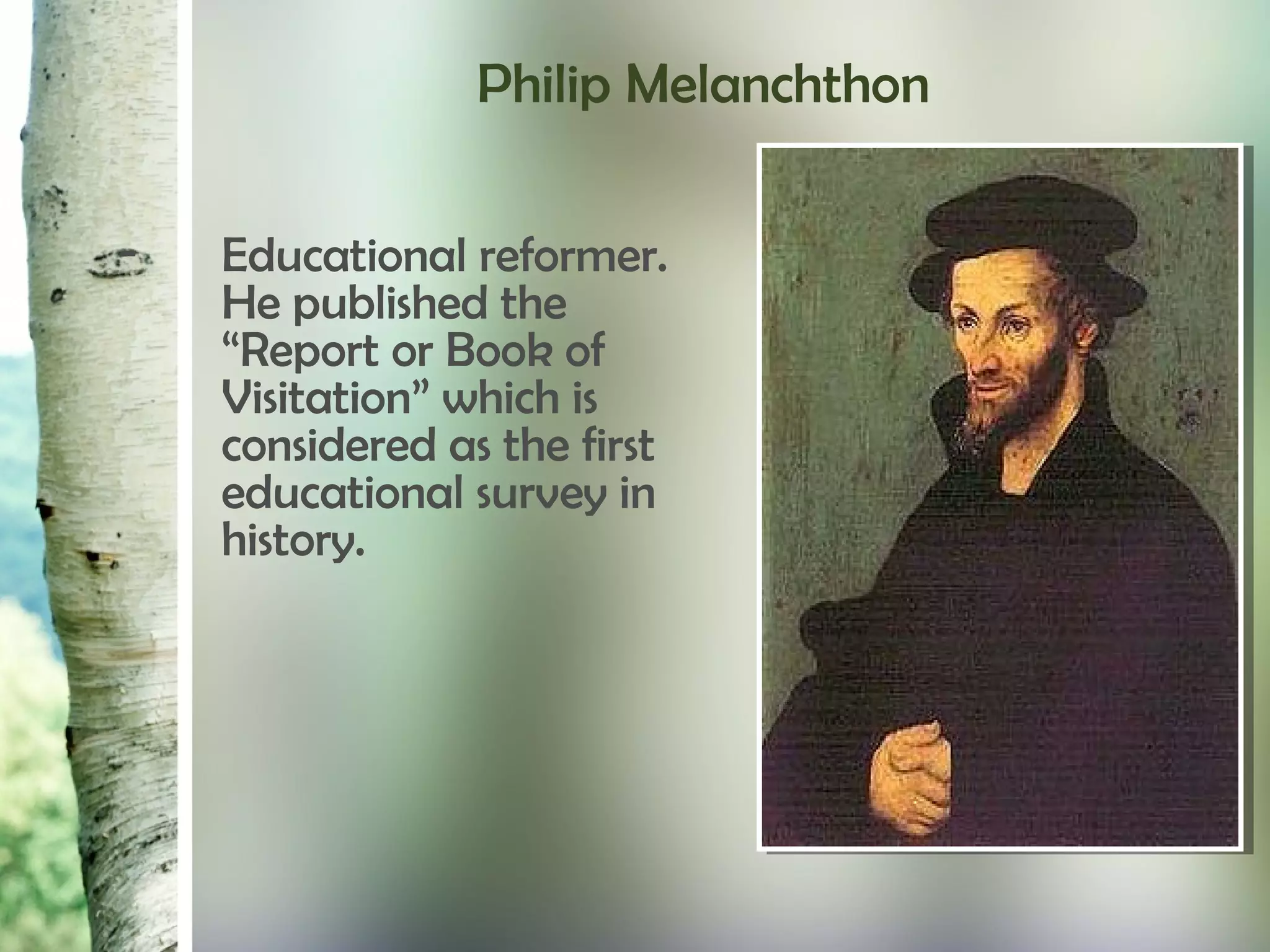
Philip Melanchthon
- Educational reformer.
He published the
“Report or Book of
Visitation” which is
considered as the first
educational survey in
history.
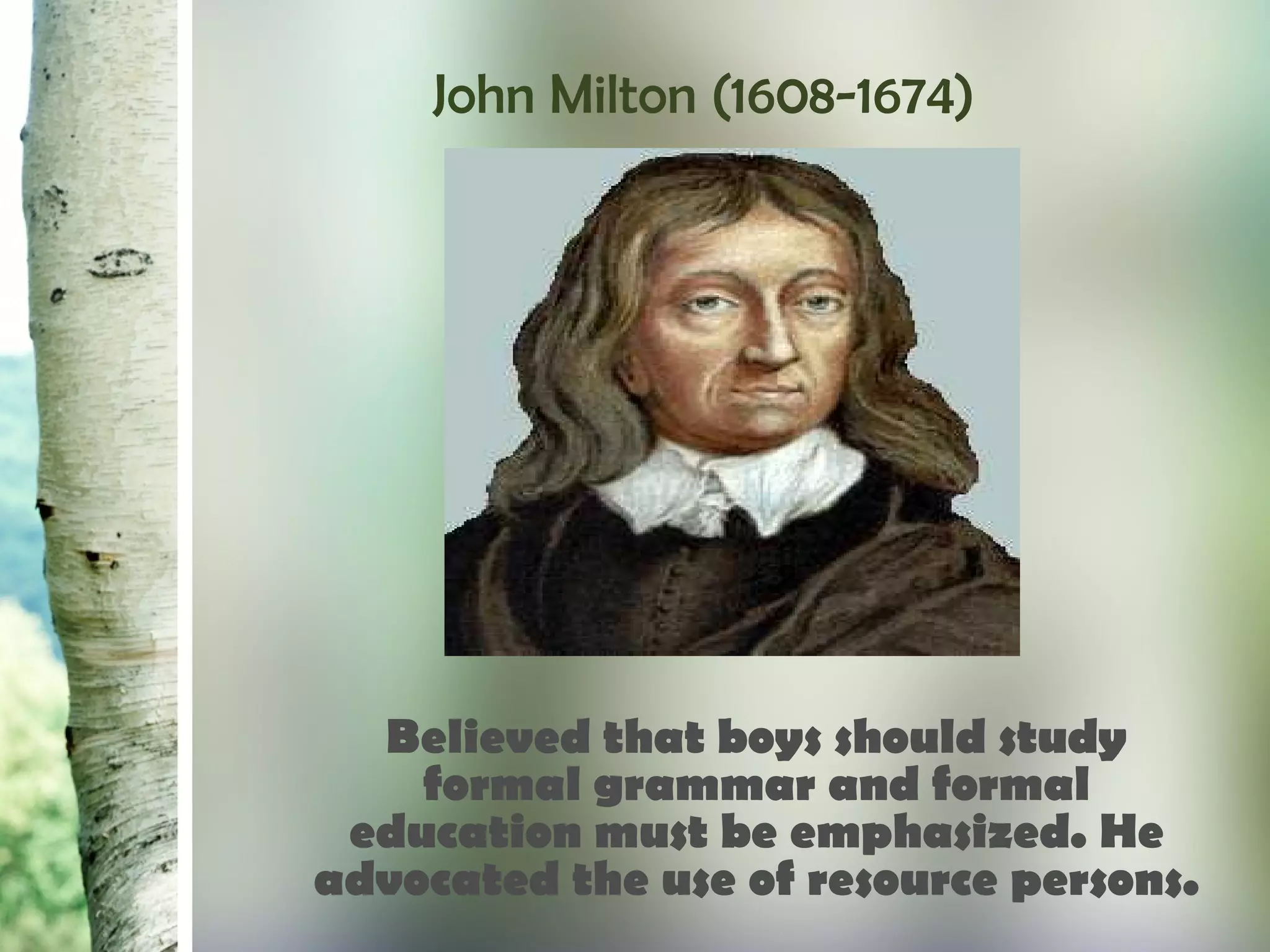
John Milton (1608-1674)
Believed that boys should study
formal grammar and formal
education must be emphasized. He
advocated the use of resource persons.
Francois Rabelais (1483-1553)
He suggested that
education should be
made attractive rather
than compulsive.
All learning should be
made pleasant.
Education should be
gained through books.
Michael de Montaigne (1533-1592)
He emphasize the
use of field
trips/educational
tours in the
teaching-learning
process.
Introduced the
concept of
finishing schools.
John Amos Comenius (1592-1670)
He wrote “Orbis
Pictus Sensualism”
of the World of
Sensible Things
Pictured which is
considered as the
first textbook on
the use of visual
aids in classroom
teaching.
He organized a
school system from
pre-school to the
university.
He also advocated
the ff:
- older children should stay longer in school, and younger ones
should stay in school only for a short period a day.
- morning hour should be devoted to for intellectual subjects while
subject for physical and aesthetic development should be given in
the afternoon.
- the level of teaching should be suited to the understanding of
children.
Francis Bacon (1561-1626)
He suggested the
use the inductive
method of
learning.
He believed that
all scientific
progress must be
based on nature.
Richard Mulcaster (1531-1611)
He argued that
education should be in
accordance with mature
of the child and its aim is
to secure the expression
and development of
childish tendencies and
not to suppress them.
He required to obtain
university training like
lawyers, minister, etc.
He developed teacher
training colleges
(Normal School).
Wolfgang Ratke (1571-1635)
He advocated that
everything should
constantly be
repeated to ensure
mastery.
He argued that
everything should
be without
compulsion and rote
learning should be
by all means be
avoided.
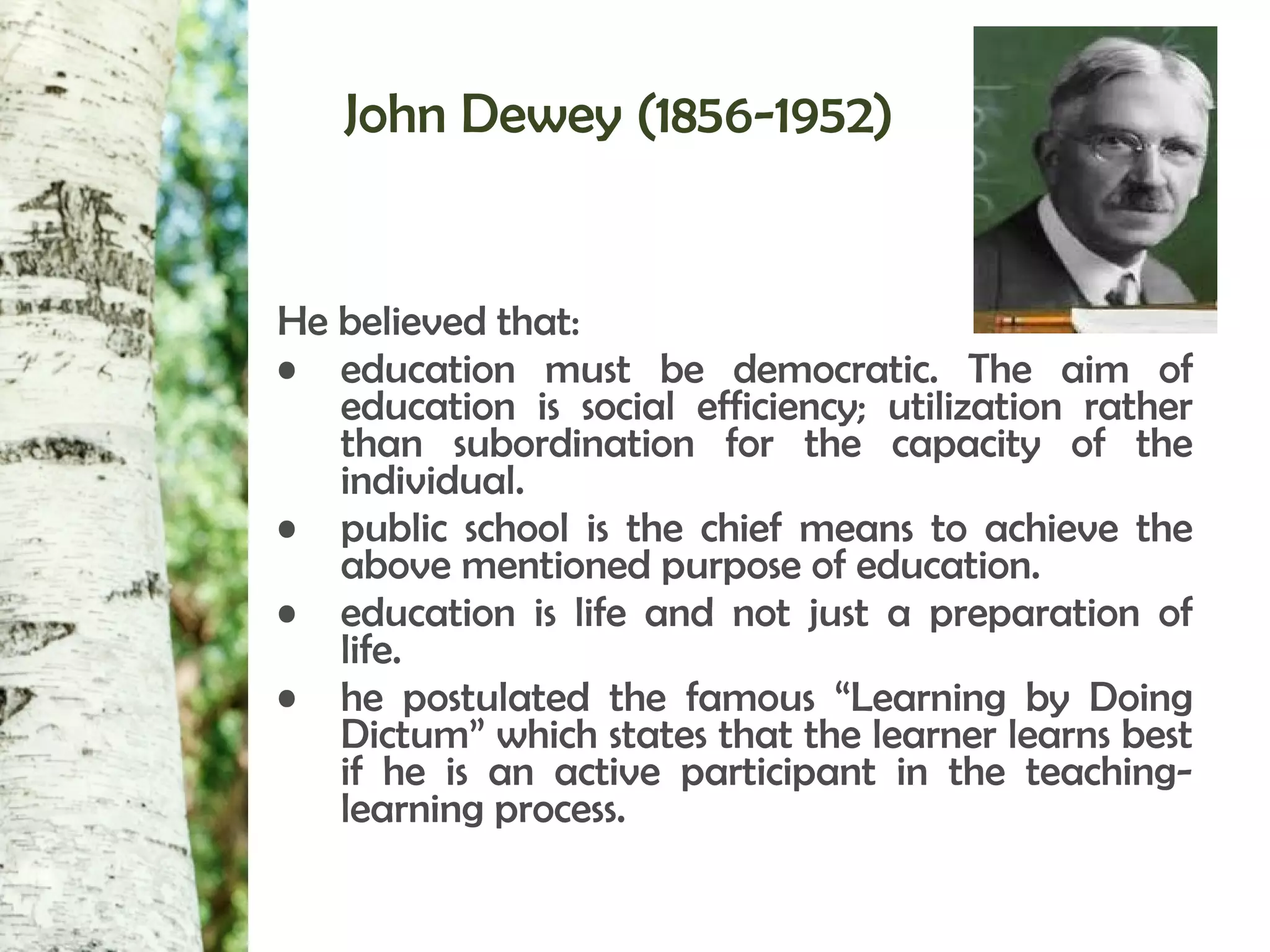
He believed that:
• education must be democratic. The aim of
education is social efficiency; utilization rather
than subordination for the capacity of the
individual.
• public school is the chief means to achieve the
above mentioned purpose of education.
• education is life and not just a preparation of
life.
• he postulated the famous “Learning by Doing
Dictum” which states that the learner learns best
if he is an active participant in the teaching-
learning process.
John Dewey (1856-1952)
NATURALISM
• is an educational philosophy which adheres to the
belief that education should be in accordance with the
nature of the child.
• all educational practices should be focused towards
the natural development of all the innate talents and
abilities of the child. The outstanding personality
involved in naturalism in education was Jean Jacques
Rousseau (1712-1778) who wrote several books on
policies and education like the Social Contract, Emile,
etc.
• Emile is considered as the “gospel of the child’s
educational freedom”.
• Rousseau believed that man at birth is naturally good,
societal influences make man evil and that the
stronger the body, the more it obeys; the weaker the
body, the more it commands.
• A philosophy is based on discipline. It advanced the
idea based on Aristotle’s faculty psychology that the
human mind is composed of several faculties such
as memory, reason, will, judgment, etc. and the
power in any faculty can be developed through
training and proper discipline.
• It advocated that mastery of mathematics and
linguistics ensures mastery of other subjects. The
foremost exponent of this philosophy was John
Locke (1632-1714) who believed that when the child
is born his mind can be compared to a “tabula rasa”,
or a blank tablet and experiences will be the ones to
write on the tablet.
DISCIPLINISM
Based on the tenets of this movement, education is
looked upon as the process geared toward the
propagation, perpetuation and amelioration of
the society and the total development of an
individual.

Philosophical Movements in Education

  • 1.
  • 2.
    Renaissance - It isderived from the Latin word ‘renaistre’ meaning to be born again. It is considered as the revival of ancient learning brought about by the discovery of the ‘New World’ of Christopher Columbus, the fascinating of Marco Polo about the wealth and technology of the East. (i.e. China under Kublai Khan), the invention of the printing press and other events during the latter part of the medieval period.
  • 3.
    Renaissance Period Gutenburg PerfectPrinting C. Columbus discovered America
  • 4.
    HUMANISM - it wasone of the various philosophies that flourished during the renaissance period. It is the philosophy which holds the idea that education aims to liberate man from the oppressive and demanding Medieval institutions like the church and the state, so as to enable him to fully develop his potentials.
  • 5.
    - It wascaused by the massive corruption in the Roman Catholic Church and the sale of indulgences. The movement highlighted the protests of the people who were devastated by the policies of the Roman Catholic Church. REFORMATION
  • 6.
    Martin Luther (1483-1549) Fatherof Reformation who wrote the 95 theses, denouncing the Catholic church and posted it in the doorpost of his Cathedral (Wittenburg) on October 31, 1517.
  • 7.
    Philip Melanchthon - Educationalreformer. He published the “Report or Book of Visitation” which is considered as the first educational survey in history.
  • 8.
    John Milton (1608-1674) Believedthat boys should study formal grammar and formal education must be emphasized. He advocated the use of resource persons.
  • 9.
    Francois Rabelais (1483-1553) Hesuggested that education should be made attractive rather than compulsive. All learning should be made pleasant. Education should be gained through books.
  • 10.
    Michael de Montaigne(1533-1592) He emphasize the use of field trips/educational tours in the teaching-learning process. Introduced the concept of finishing schools.
  • 11.
    John Amos Comenius(1592-1670) He wrote “Orbis Pictus Sensualism” of the World of Sensible Things Pictured which is considered as the first textbook on the use of visual aids in classroom teaching. He organized a school system from pre-school to the university. He also advocated the ff: - older children should stay longer in school, and younger ones should stay in school only for a short period a day. - morning hour should be devoted to for intellectual subjects while subject for physical and aesthetic development should be given in the afternoon. - the level of teaching should be suited to the understanding of children.
  • 12.
    Francis Bacon (1561-1626) Hesuggested the use the inductive method of learning. He believed that all scientific progress must be based on nature.
  • 13.
    Richard Mulcaster (1531-1611) Heargued that education should be in accordance with mature of the child and its aim is to secure the expression and development of childish tendencies and not to suppress them. He required to obtain university training like lawyers, minister, etc. He developed teacher training colleges (Normal School).
  • 14.
    Wolfgang Ratke (1571-1635) Headvocated that everything should constantly be repeated to ensure mastery. He argued that everything should be without compulsion and rote learning should be by all means be avoided.
  • 15.
    He believed that: •education must be democratic. The aim of education is social efficiency; utilization rather than subordination for the capacity of the individual. • public school is the chief means to achieve the above mentioned purpose of education. • education is life and not just a preparation of life. • he postulated the famous “Learning by Doing Dictum” which states that the learner learns best if he is an active participant in the teaching- learning process. John Dewey (1856-1952)
  • 16.
    NATURALISM • is aneducational philosophy which adheres to the belief that education should be in accordance with the nature of the child. • all educational practices should be focused towards the natural development of all the innate talents and abilities of the child. The outstanding personality involved in naturalism in education was Jean Jacques Rousseau (1712-1778) who wrote several books on policies and education like the Social Contract, Emile, etc. • Emile is considered as the “gospel of the child’s educational freedom”. • Rousseau believed that man at birth is naturally good, societal influences make man evil and that the stronger the body, the more it obeys; the weaker the body, the more it commands.
  • 17.
    • A philosophyis based on discipline. It advanced the idea based on Aristotle’s faculty psychology that the human mind is composed of several faculties such as memory, reason, will, judgment, etc. and the power in any faculty can be developed through training and proper discipline. • It advocated that mastery of mathematics and linguistics ensures mastery of other subjects. The foremost exponent of this philosophy was John Locke (1632-1714) who believed that when the child is born his mind can be compared to a “tabula rasa”, or a blank tablet and experiences will be the ones to write on the tablet. DISCIPLINISM
  • 18.
    Based on thetenets of this movement, education is looked upon as the process geared toward the propagation, perpetuation and amelioration of the society and the total development of an individual.