FOUNDATION OF
EDUCATION
Presentation No 01
Education in Primitive societies
Presented to: Mrs Farzana Yousaf
Presented by: Farwa Naz
Fareeha Ilyas
To give us a knowledge of the
past;
To enable us to better understand
the future; and
To give us a means of predicting
the future.
The three (3) – fold purpose of history:
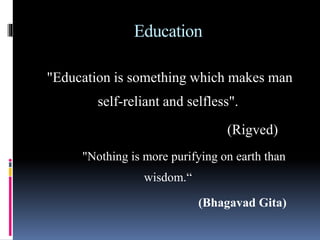
Education
"Education is something which makes man
self-reliant and selfless".
(Rigved)
"Nothing is more purifying on earth than
wisdom.“
(Bhagavad Gita)
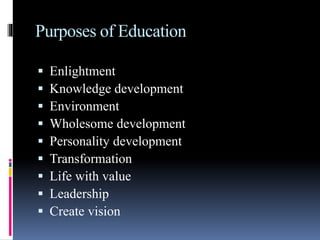
Purposes of Education
 Enlightment
 Knowledge development
 Environment
 Wholesome development
 Personality development
 Transformation
 Life with value
 Leadership
 Create vision
PRIMITIVE
EDUCATION
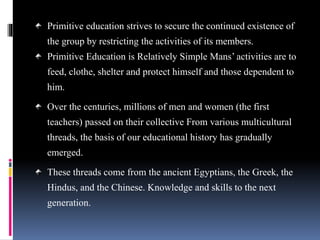
Primitive education strives to secure the continued existence of
the group by restricting the activities of its members.
Primitive Education is Relatively Simple Mans’ activities are to
feed, clothe, shelter and protect himself and those dependent to
him.
Over the centuries, millions of men and women (the first
teachers) passed on their collective From various multicultural
threads, the basis of our educational history has gradually
emerged.
These threads come from the ancient Egyptians, the Greek, the
Hindus, and the Chinese. Knowledge and skills to the next
generation.
Types
Two (2) types of primitive education:
1. Practical – included the simple forms
of domestic, vocational, physical,
moral and military training.
2. Theoretical – covered the religious,
musical and literary.
Physical training – enable the primitive
men to satisfy their need for food and
shelter; spiritual or ceremonial training.
Social knowledge – to learn customs,
taboos and traditions for harmonious
living.
Content
Unconscious imitation
Observation
Simple telling and demonstration
Trial and error
Methods
EGYPTIAN
EDUCATION
Egypt . . .
is one of the earliest civilizations settled by
a Hamitic people who inhabited the valley
of the Nile 20,000 years ago, and with a
recorded history reaching back to the fifth
millennium B.C.
Egyptian culture – was dependent on the
activity of the Nile.
A unified system of government was
developed until it was ruled by dynasties of
pharaoh kings .
GREEK
EDUCATION
Greeks . . .
gave the era higher culture and
enlightenment.
Two principal components:
1. Aryan
2. Germanic
became the first and greatest sportsmen.
Greek boys went to school, but girls did
not.
Girls in wealthier families might have been
taught to read but, most stayed at home and
learned how to do housework.
This was not the same everywhere, though.
In Sparta, for example, girls had more
freedom and they were taught how to fight.
ROMAN
EDUCATION
Rome . . .
traces her beginnings to 753 B.C.
before Christ, she had expanded into a
massive, imperial colossus.
for more than two and a half
centuries, the city was the queen of the
Mediterranean.
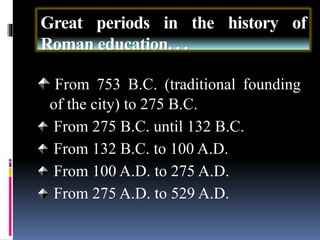
Great periods in the history of
Roman education. . .
From 753 B.C. (traditional founding
of the city) to 275 B.C.
From 275 B.C. until 132 B.C.
From 132 B.C. to 100 A.D.
From 100 A.D. to 275 A.D.
From 275 A.D. to 529 A.D.
Education in primitive societies

Education in primitive societies

  • 2.
  • 3.
    Presentation No 01 Educationin Primitive societies Presented to: Mrs Farzana Yousaf Presented by: Farwa Naz Fareeha Ilyas
  • 4.
    To give usa knowledge of the past; To enable us to better understand the future; and To give us a means of predicting the future. The three (3) – fold purpose of history:
  • 5.
    Education "Education is somethingwhich makes man self-reliant and selfless". (Rigved) "Nothing is more purifying on earth than wisdom.“ (Bhagavad Gita)
  • 6.
    Purposes of Education Enlightment  Knowledge development  Environment  Wholesome development  Personality development  Transformation  Life with value  Leadership  Create vision
  • 7.
  • 8.
    Primitive education strivesto secure the continued existence of the group by restricting the activities of its members. Primitive Education is Relatively Simple Mans’ activities are to feed, clothe, shelter and protect himself and those dependent to him. Over the centuries, millions of men and women (the first teachers) passed on their collective From various multicultural threads, the basis of our educational history has gradually emerged. These threads come from the ancient Egyptians, the Greek, the Hindus, and the Chinese. Knowledge and skills to the next generation.
  • 9.
    Types Two (2) typesof primitive education: 1. Practical – included the simple forms of domestic, vocational, physical, moral and military training. 2. Theoretical – covered the religious, musical and literary.
  • 10.
    Physical training –enable the primitive men to satisfy their need for food and shelter; spiritual or ceremonial training. Social knowledge – to learn customs, taboos and traditions for harmonious living. Content
  • 11.
    Unconscious imitation Observation Simple tellingand demonstration Trial and error Methods
  • 12.
  • 13.
    Egypt . .. is one of the earliest civilizations settled by a Hamitic people who inhabited the valley of the Nile 20,000 years ago, and with a recorded history reaching back to the fifth millennium B.C. Egyptian culture – was dependent on the activity of the Nile. A unified system of government was developed until it was ruled by dynasties of pharaoh kings .
  • 14.
  • 15.
    Greeks . .. gave the era higher culture and enlightenment. Two principal components: 1. Aryan 2. Germanic became the first and greatest sportsmen.
  • 16.
    Greek boys wentto school, but girls did not. Girls in wealthier families might have been taught to read but, most stayed at home and learned how to do housework. This was not the same everywhere, though. In Sparta, for example, girls had more freedom and they were taught how to fight.
  • 17.
  • 18.
    Rome . .. traces her beginnings to 753 B.C. before Christ, she had expanded into a massive, imperial colossus. for more than two and a half centuries, the city was the queen of the Mediterranean.
  • 19.
    Great periods inthe history of Roman education. . . From 753 B.C. (traditional founding of the city) to 275 B.C. From 275 B.C. until 132 B.C. From 132 B.C. to 100 A.D. From 100 A.D. to 275 A.D. From 275 A.D. to 529 A.D.