also known as IF SENTENCES
- are sentences that express condition and
consequence
COMPONENTS
OF A CONDITIONAL SENTENCE
1. AN IF CLAUSE
- one that expresses the condition,
introduced by the word “if”
2. THE MAIN CLAUSE
- one that expresses the consequence,
uses the words can, will, may, might, could,
would
Example: If you cry, you will look ugly.
or You will look ugly if you cry.
Zero Conditional
First Conditional
Second Conditional
Third Conditional
is a structure used to talk about things which are
always true -- scientific facts, general truths
Example:
If you heat water at 100 degrees, it boils.
Pattern:
If + present simple , present simple.
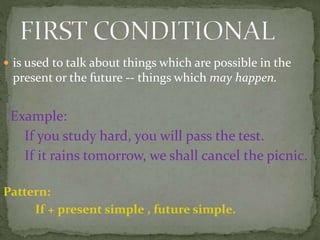
 is used to talk about things which are possible in the
present or the future -- things which may happen.
Example:
If you study hard, you will pass the test.
If it rains tomorrow, we shall cancel the picnic.
Pattern:
If + present simple , future simple.
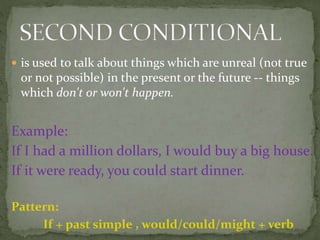
 is used to talk about things which are unreal (not true
or not possible) in the present or the future -- things
which don't or won't happen.
Example:
If I had a million dollars, I would buy a big house.
If it were ready, you could start dinner.
Pattern:
If + past simple , would/could/might + verb
is used to talk about things which DID NOT
HAPPEN in the past. It is often used to express
criticism or regret.
Example:
If I had studied harder, I would have passed
the exam.
If he hadn’t fallen asleep while driving, he
would not have crashed his car.
Pattern:
If + past perfect, would/could/might + have +
past participle
Let’s Practice. Which among the
sentences is zero, first, second, and
third conditional?
1. If you were nicer to him, he would
lend you money.
2. You die if you don’t eat.
3. If I had been late, I would have lost
my job.
4. If you need my umbrella, I will lend
it to you.

Conditional Sentences

  • 1.
    also known asIF SENTENCES - are sentences that express condition and consequence
  • 2.
    COMPONENTS OF A CONDITIONALSENTENCE 1. AN IF CLAUSE - one that expresses the condition, introduced by the word “if” 2. THE MAIN CLAUSE - one that expresses the consequence, uses the words can, will, may, might, could, would Example: If you cry, you will look ugly. or You will look ugly if you cry.
  • 3.
  • 4.
    is a structureused to talk about things which are always true -- scientific facts, general truths Example: If you heat water at 100 degrees, it boils. Pattern: If + present simple , present simple.
  • 5.
     is usedto talk about things which are possible in the present or the future -- things which may happen. Example: If you study hard, you will pass the test. If it rains tomorrow, we shall cancel the picnic. Pattern: If + present simple , future simple.
  • 6.
     is usedto talk about things which are unreal (not true or not possible) in the present or the future -- things which don't or won't happen. Example: If I had a million dollars, I would buy a big house. If it were ready, you could start dinner. Pattern: If + past simple , would/could/might + verb
  • 7.
    is used totalk about things which DID NOT HAPPEN in the past. It is often used to express criticism or regret. Example: If I had studied harder, I would have passed the exam. If he hadn’t fallen asleep while driving, he would not have crashed his car. Pattern: If + past perfect, would/could/might + have + past participle
  • 8.
    Let’s Practice. Whichamong the sentences is zero, first, second, and third conditional? 1. If you were nicer to him, he would lend you money. 2. You die if you don’t eat. 3. If I had been late, I would have lost my job. 4. If you need my umbrella, I will lend it to you.