DESIDERIUS ERASMUS Born: October 27, 1466/1469 Died: July 12, 1539 Humanist and  Cosmopolitan Educator Presentation by Maureen Bucci and Meaghan Patterson
Biography of Erasmus Born Geerit Gerritszoon  Latinized name Desiderius Erasmus Born end of October, ~1466 in Rotterdam,  the Netherlands Illegitimacy Attended primary school at age 6 Cathedral school at Utrecht
Early Education St. Lebwin’s school at Deventer operated by the Brethren of the Common Life  Reading, writing, arithmetic, and religion Religious studies emphasized the Gospels, writings of the Church fathers, and the lives of the saints Spent 9 years at St. Lebwin’s school Identified as a gifted student
Secondary Education Death of parents  Entered Augustinian priory at Steyn Continued his advanced studies Augustinian education defended compatibility of Greek and Roman knowledge with Christianity. At 23 he was ordained a priest under the Augustinian religious order
Advanced Education Entered the University of Paris to study languages and Scripture Supported himself by tutoring Interested in teaching Noblest of professions Teachers are able to expose the youth to the “best literature and love of Christ” (Gutek pg. 100). Erasmus’s Philosophy of education: Best literature = Greek and Latin classics True Christian morality
Later Years - Traveler 1498 - England - Located at Oxford University Independent scholar, moving from city to city Intellectual centers of England, France, Italy, Germany, and Switzerland  Lively conversations with humanist scholars 1511 - Professor at Cambridge  1536 - Died July 12 at the age of 69 in Basel, Switzerland
Guess these famous quotes… Some of these quotes you will have heard before, but you probably did not know that Erasmus was the one who said it! Prevention is better than cure. Women, can't live with them, can't live without them. The most disadvantageous peace is better than the most just war.  A good portion of speaking will consist in knowing how to lie.   If you keep thinking about what you want to do or what you hope will happen, you don't do it, and it won't happen.   He who allows oppression shares the crime.  The nearer people approach old age the closer they return to a semblance of childhood, until the time comes for them to depart this life, again like children, neither tired of living nor aware of death. A nail is driven out by another nail. Habit is overcome by habit.
HISTORICAL CONTEXT Renaissance… French for “rebirth” Cultural movement that began in Florence, Italy, and spanned the 14th through 17th centuries Eventually spread throughout Europe Its influence affected literature, philosophy, art, politics, science, and religion http://player.discoveryeducation.com/index.cfm?guidAssetId=2084650f-5daa-4c56-b05e-859ee30f4333
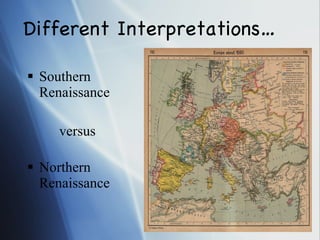
Different Interpretations… Southern Renaissance versus Northern Renaissance
Different Interpretations… Northern Renaissance More of Europe Emphasized science and tech Pushed for social reform based on Christian ideals Began later -- ended in 1650 Religiously diverse  Rise in Protestantism and saw more religious division More universities Christian Humanism Southern Renaissance Italy Emphasized arts and culture Rise in commercialism due to Mediterranean Sea close by 1350-1550 Catholic church prevented study of science and technologies Few universities Humanism
Religion during Middle Ages… Catholic Church was the ONLY church Influential in government -- high ranking members often sat on the king’s council Had its own laws -- Canon Law established Pope was the head -- God’s representative on Earth Small churches replaced by grandiose cathedrals  Pilgrimages became popular Monasteries and convents saw an increase in monks and nuns Became corrupt -- charged taxes and accepted gifts from people to guarantee a spot in heaven (indulgences) allowed the Church a great deal of influence, especially over the kings, who would do whatever the church wanted them to do “ Fools are without number.”
Demise of the influence Catholic Church… Towards the end of the Middle Ages (1309-77) At the pressing of king of France, Pope Clement V moved papacy to Avignon People began to see the church as the “puppet” of the government instead of being an influential power. 1378 -- cardinals were forced to elect an Italian pope (Urban VI) who moved the papacy back to Rome Italians cardinals stood behind new pope French cardinals did not Elected their own pope and moved their papacy back to Avignon causing great confusion for the believers Both sides declared the other heretical The Great Schism developed “ Nothing is as peevish and pedantic as men's judgments of one another.”
The end of the Great Schism Council of Constance (1414-1418) Had three objectives Bring unity back to the church Eradicate heresies Reform corruption “ Great abundance of riches cannot be gathered and kept by any man without sin.” Deposed the popes Elected Martin V and restored papacy in Rome but the damage to the Catholic Church was already done
Religion during Renaissance… People began to realize the corruption taking place within the church Martin Luther’s criticism of the church and its practices “ Luther was guilty of two great crimes - he struck the Pope in his crown, and the monks in their belly.”  People began to realize their own human dignity as opposed to one particular church’s viewpoint Religion became more individualized People became less interested in the life of the soul (and the sale of indulgences) and more interested in living a fruitful life on earth. BIRTH OF HUMANISM “ It is the chiefest point of happiness that a man is willing to be what he is.”
CONTEXT OF FAITH Humanists… Believed that God holds people above everything else because humans have the free will to choose Recognized that human’s are made in God’s image “ By a Carpenter mankind was made, and only by that  Carpenter can mankind be remade.” Encouraged humans to share their God-given talents and abilities “ No one respects a talent that is concealed.”
ERAMSUS’ HUMANISM Erasmus was a Christian humanist… Gutek says that this means Erasmus “believed that the revival of interest in the classics and classical style would contribute to a reexamination of the Bible as the pure source of God’s revelation, free from the accretions of Medieval scholasticism” (page 95). Erasmus, though Catholic, criticized certain practices of the church, including the elaborate rituals and ceremonies.  He believed in reformation of the Church from within Wanted to hold firm to Catholic doctrine In fact, his last words before he died were, “Dear God”
If people who live agreeably are Epicureans, none are more truly Epicurean than the righteous and godly. And if it's names that bother us, no one better deserves the name of Epicurean than the revered founder and head of the Christian philosophy Christ, for in Greek epikouros means "helper." He alone…when Satan ruled in the world unchallenged, brought timely aid to perishing humanity…he alone shows the most enjoyable life of all and the one most full of true pleasure. CONTEXT OF FAITH…
Philosophy of HUMANISM Initially meant a scholar or teacher of Latin literature Renaissance humanism… involved grammar, rhetoric, philosophy, poetry, and history studied through the lens of Latin and Greek authors
RENAISSANCE HUMANISM Opposed the previous era’s philosophy of Scholasticism in which… Thomas Aquinas successfully synthesized the works of Aristotle with Christianity We now know this as the “medieval synthesis” Scholastics tended to look only at science and philosophy and did not devote (according to the humanists) enough attention to other literary and cultural texts
RENAISSANCE HUMANISTS Believed that the fall of the Roman Empire was one of the worst periods in European history because it led to the dissolution of that culture and the decline of intellectualism Thought that the only way out of this loss of intellectualism was to find and reintroduce the lost classic texts  Literally searched through monastic libraries trying to find and reintroduce the ancient classical texts, particularly those of Plato Tended to study the works of Plato instead of Aristotle who was studied by the scholastics
RENAISSANCE HUMANISTS Became very critical of political and religious structures and urged for active reform John Wycliffe, theology professor at Oxford, preached about growing materialism in the church Jan Hus, a Bohemian, also sought religious reformation Erasmus, a Catholic and a “caustic critic” Also wanted religious reformation, but wanted to “remain within the institutional and theological framework of a universal Christian church” (Gutek 96).
RENAISSANCE HUMANISTS According to Gutek… Became experts in translating the ancient classical texts Made judgments about the authenticity and interpretation of these texts Carried on intellectual and academic debates Wrote for those who shared their expertise Became an elite group of intellectuals who thought of themselves as guardians of knowledge (page 97)
As the guardians of knowledge… Renaissance humanists established a new kind of school and way of educating to add to the existing monastic, parish, and cathedral schools and universities The classical humanist school  The classical humanist educator
Classical Humanist School According to Gutek… Stressed curriculum based on Greek and Latin classics Combined secondary and preparatory education Developed into institutions that prepared upper class children, mostly male, into Europe’s educated elite An example of a humanist school Established by Italian educator, Vittorino da Feltre, to educate the children of the duke and his court officials Sought to prepare well-rounded persons who could assume leadership positions as civil servants, administrators, and diplomats.
A Classical Humanist Educator Erasmus believed in studying the classical texts, which “contained almost everything worth knowing” (Gutek 102). biblical study was important to form an educated person Studying Latin was indispensable teachers should be scholars and examples of intellect and speaking for their young charges  in introducing children to correct language at an early age in systematic note-taking, which we still use today in memorization and understanding of content, theme, and meaning in the elitism that an education brings
A Classical Humanist Educator Erasmus wrote the “Declamation on the Subject of Early Liberal Education for Children” Addressed parents and educators Urges parents to invest time, money, and effort into the proper education of their children, particularly the boys Claimed that education should begin at the earliest age possible because “ Man's mind is so formed that it is far more susceptible to falsehood than to truth.” but good education can make all the difference
A Classical Humanist Educator Erasmus… Criticized the practice of handing over the upbringing and education of children to boarding schools Criticized schools that had become “torture chambers” Encouraged teachers to be more humane Believed that teachers should be filled with love yet not accepting of laziness or indifference
Comparison with Quintilian Quintilian (35-95 C.E.) Early childhood education Parental involvement Careful selection of tutors Bilingual, Greek and Latin Reading, Writing, Literature, Grammar, Arithmetic Rhetorical emphasis focused on real life situations Emphasized liberal arts Erasmus (1466-1536) Early childhood education Correct speaking at home Teacher is a model Greek, Latin, and own vernacular Liberal arts stressed Memorization with understanding
Connection to Modern Education Teachers continue to create an atmosphere of love and acceptance in the classroom before children will be able to learn Teachers continue to push their students to excel beginning at an early age Teachers continue to be examples for their students in both intellect and morals Catholic schools use the Bible and the teachings of Jesus as the foundation for all of the other subjects
Erasmus’s Writings 1509 - In Praise of Folly 1516 - The Education of the Christian Prince 1516 - New Testament in Greek 1518 - Colloquies
In Praise of Folly Return to simple and pure Christianity Attacked all who hypocritical and corrupt (Theologians, Monks, Lawyers, Merchants, and the Catholic Church) Excerpt: . . . Perhaps it would be wise to pass over the theologians in silence. That short-tempered and supercilious crew is unpleasant to deal with. . . . They will proclaim me a heretic. With this thunderbolt they terrify the people they don't like. Their opinion of themselves is so great that they behave as if they were already in heaven; they look down pityingly on other men as so many worms. A wall of imposing definitions, conclusions, corollaries, and explicit and implicit propositions protects them. They are full of big words and newly-invented terms. . . .  http://www.historyguide.org/intellect/erasmus. html
The Education of the Christian Prince Political education of those who were born to rule  Prudent, gentle, and humane ruler Subjects location, economy, demography, history, traditions, customs Humanistic education Religious principles Role model Supervisory role over the schools and teachers Educated in peacekeeping to avoid war Urged peaceful adjudication to resolve international conflicts
Early Christian writings Original Greek  (New Testament) Original Hebrew  (Old Testament)
Colloquies Conversational dialogues Educational power of conversation Translated example: SYLVIUS, JOHN   Sy.  What makes you run so, John ?  Jo.  What makes a Hare run before the Dogs, as they use to say ?  Sy.  What Proverb is this ?  Jo.  Because unless I am there in Time, before the Bill is called over, I am sure to be whipp'd.  Sy.  You need not be afraid of that, it is but a little past five: Look upon the Clock, the Hand is not come to the half Hour Point yet.  Jo.  Ay, but I can scarce trust to Clocks, they go wrong sometimes….
Erasmus’ Method of Presentation Guide to Instruction  (Gutek, pg. 103) Discuss the biography of the classical author whose text was being studied. Identify the genre or type of work. Discuss the theme or plot, especially the representation of time, place and events. Comment on the author’s writing style. Comment on the moral applications of the literary piece. Extrapolate the cultural and philosophical implications of the work.
References  Williams, Kathleen, editor.  Twentieth Century Interpretations of 'The Praise of Folly': A Collection of Critical Essays . Englewood Cliffs, NJ: Prentice-Hall, 1969. 122p.PA8515 .W5 Erasmus, Desiderius. (2005). Retrieved October 9, 2009, from Discovery Education: http://streaming.discoveryeducation.com/  All About the Renaissance. (2004). Retrieved September 29, 2009 from Discovery Education: http://streaming.discoveryeducation.com/  Desiderius Erasmus. Goldhil. (2001). Retrieved October 18, 2009, from Discovery Education: http://streaming.discoveryeducation.com/ http://www.newadvent.org/cathen/05510b.htm http://www.historyguide.org/intellect/erasmus.html http://www. all-about-renaissance-faires . com/renaissance_info/catholic_church_in_the_renaissance .htm http://www. vlib . us/medieval/lectures/great_schism .html "Council of Constance."  The Columbia Encyclopedia, Sixth Edition . 2008. Retrieved October 17, 2009 from Encyclopedia.com:  http://www.encyclopedia.com/doc/1E1-ConstncCo.html http://library. thinkquest .org/C006522/religion/overview.php http://www. historyguide .org/intellect/humanism.html http://en. wikipedia .org/wiki/Desiderius_Erasmus http://en. wikipedia .org/wiki/Renaissance http://en. wikipedia .org/wiki/Humanism http://en. wikipedia .org/wiki/Renaissance_humanism Gutek, Gerald Lee.  Historical and philosophical foundations of educations: a biographical introduction; 4 th  edition.

Erasmus Presentation

  • 1.
    DESIDERIUS ERASMUS Born:October 27, 1466/1469 Died: July 12, 1539 Humanist and Cosmopolitan Educator Presentation by Maureen Bucci and Meaghan Patterson
  • 2.
    Biography of ErasmusBorn Geerit Gerritszoon Latinized name Desiderius Erasmus Born end of October, ~1466 in Rotterdam, the Netherlands Illegitimacy Attended primary school at age 6 Cathedral school at Utrecht
  • 3.
    Early Education St.Lebwin’s school at Deventer operated by the Brethren of the Common Life Reading, writing, arithmetic, and religion Religious studies emphasized the Gospels, writings of the Church fathers, and the lives of the saints Spent 9 years at St. Lebwin’s school Identified as a gifted student
  • 4.
    Secondary Education Deathof parents Entered Augustinian priory at Steyn Continued his advanced studies Augustinian education defended compatibility of Greek and Roman knowledge with Christianity. At 23 he was ordained a priest under the Augustinian religious order
  • 5.
    Advanced Education Enteredthe University of Paris to study languages and Scripture Supported himself by tutoring Interested in teaching Noblest of professions Teachers are able to expose the youth to the “best literature and love of Christ” (Gutek pg. 100). Erasmus’s Philosophy of education: Best literature = Greek and Latin classics True Christian morality
  • 6.
    Later Years -Traveler 1498 - England - Located at Oxford University Independent scholar, moving from city to city Intellectual centers of England, France, Italy, Germany, and Switzerland Lively conversations with humanist scholars 1511 - Professor at Cambridge 1536 - Died July 12 at the age of 69 in Basel, Switzerland
  • 7.
    Guess these famousquotes… Some of these quotes you will have heard before, but you probably did not know that Erasmus was the one who said it! Prevention is better than cure. Women, can't live with them, can't live without them. The most disadvantageous peace is better than the most just war. A good portion of speaking will consist in knowing how to lie. If you keep thinking about what you want to do or what you hope will happen, you don't do it, and it won't happen. He who allows oppression shares the crime. The nearer people approach old age the closer they return to a semblance of childhood, until the time comes for them to depart this life, again like children, neither tired of living nor aware of death. A nail is driven out by another nail. Habit is overcome by habit.
  • 8.
    HISTORICAL CONTEXT Renaissance…French for “rebirth” Cultural movement that began in Florence, Italy, and spanned the 14th through 17th centuries Eventually spread throughout Europe Its influence affected literature, philosophy, art, politics, science, and religion http://player.discoveryeducation.com/index.cfm?guidAssetId=2084650f-5daa-4c56-b05e-859ee30f4333
  • 9.
    Different Interpretations… SouthernRenaissance versus Northern Renaissance
  • 10.
    Different Interpretations… NorthernRenaissance More of Europe Emphasized science and tech Pushed for social reform based on Christian ideals Began later -- ended in 1650 Religiously diverse Rise in Protestantism and saw more religious division More universities Christian Humanism Southern Renaissance Italy Emphasized arts and culture Rise in commercialism due to Mediterranean Sea close by 1350-1550 Catholic church prevented study of science and technologies Few universities Humanism
  • 11.
    Religion during MiddleAges… Catholic Church was the ONLY church Influential in government -- high ranking members often sat on the king’s council Had its own laws -- Canon Law established Pope was the head -- God’s representative on Earth Small churches replaced by grandiose cathedrals Pilgrimages became popular Monasteries and convents saw an increase in monks and nuns Became corrupt -- charged taxes and accepted gifts from people to guarantee a spot in heaven (indulgences) allowed the Church a great deal of influence, especially over the kings, who would do whatever the church wanted them to do “ Fools are without number.”
  • 12.
    Demise of theinfluence Catholic Church… Towards the end of the Middle Ages (1309-77) At the pressing of king of France, Pope Clement V moved papacy to Avignon People began to see the church as the “puppet” of the government instead of being an influential power. 1378 -- cardinals were forced to elect an Italian pope (Urban VI) who moved the papacy back to Rome Italians cardinals stood behind new pope French cardinals did not Elected their own pope and moved their papacy back to Avignon causing great confusion for the believers Both sides declared the other heretical The Great Schism developed “ Nothing is as peevish and pedantic as men's judgments of one another.”
  • 13.
    The end ofthe Great Schism Council of Constance (1414-1418) Had three objectives Bring unity back to the church Eradicate heresies Reform corruption “ Great abundance of riches cannot be gathered and kept by any man without sin.” Deposed the popes Elected Martin V and restored papacy in Rome but the damage to the Catholic Church was already done
  • 14.
    Religion during Renaissance…People began to realize the corruption taking place within the church Martin Luther’s criticism of the church and its practices “ Luther was guilty of two great crimes - he struck the Pope in his crown, and the monks in their belly.” People began to realize their own human dignity as opposed to one particular church’s viewpoint Religion became more individualized People became less interested in the life of the soul (and the sale of indulgences) and more interested in living a fruitful life on earth. BIRTH OF HUMANISM “ It is the chiefest point of happiness that a man is willing to be what he is.”
  • 15.
    CONTEXT OF FAITHHumanists… Believed that God holds people above everything else because humans have the free will to choose Recognized that human’s are made in God’s image “ By a Carpenter mankind was made, and only by that Carpenter can mankind be remade.” Encouraged humans to share their God-given talents and abilities “ No one respects a talent that is concealed.”
  • 16.
    ERAMSUS’ HUMANISM Erasmuswas a Christian humanist… Gutek says that this means Erasmus “believed that the revival of interest in the classics and classical style would contribute to a reexamination of the Bible as the pure source of God’s revelation, free from the accretions of Medieval scholasticism” (page 95). Erasmus, though Catholic, criticized certain practices of the church, including the elaborate rituals and ceremonies. He believed in reformation of the Church from within Wanted to hold firm to Catholic doctrine In fact, his last words before he died were, “Dear God”
  • 17.
    If people wholive agreeably are Epicureans, none are more truly Epicurean than the righteous and godly. And if it's names that bother us, no one better deserves the name of Epicurean than the revered founder and head of the Christian philosophy Christ, for in Greek epikouros means "helper." He alone…when Satan ruled in the world unchallenged, brought timely aid to perishing humanity…he alone shows the most enjoyable life of all and the one most full of true pleasure. CONTEXT OF FAITH…
  • 18.
    Philosophy of HUMANISMInitially meant a scholar or teacher of Latin literature Renaissance humanism… involved grammar, rhetoric, philosophy, poetry, and history studied through the lens of Latin and Greek authors
  • 19.
    RENAISSANCE HUMANISM Opposedthe previous era’s philosophy of Scholasticism in which… Thomas Aquinas successfully synthesized the works of Aristotle with Christianity We now know this as the “medieval synthesis” Scholastics tended to look only at science and philosophy and did not devote (according to the humanists) enough attention to other literary and cultural texts
  • 20.
    RENAISSANCE HUMANISTS Believedthat the fall of the Roman Empire was one of the worst periods in European history because it led to the dissolution of that culture and the decline of intellectualism Thought that the only way out of this loss of intellectualism was to find and reintroduce the lost classic texts Literally searched through monastic libraries trying to find and reintroduce the ancient classical texts, particularly those of Plato Tended to study the works of Plato instead of Aristotle who was studied by the scholastics
  • 21.
    RENAISSANCE HUMANISTS Becamevery critical of political and religious structures and urged for active reform John Wycliffe, theology professor at Oxford, preached about growing materialism in the church Jan Hus, a Bohemian, also sought religious reformation Erasmus, a Catholic and a “caustic critic” Also wanted religious reformation, but wanted to “remain within the institutional and theological framework of a universal Christian church” (Gutek 96).
  • 22.
    RENAISSANCE HUMANISTS Accordingto Gutek… Became experts in translating the ancient classical texts Made judgments about the authenticity and interpretation of these texts Carried on intellectual and academic debates Wrote for those who shared their expertise Became an elite group of intellectuals who thought of themselves as guardians of knowledge (page 97)
  • 23.
    As the guardiansof knowledge… Renaissance humanists established a new kind of school and way of educating to add to the existing monastic, parish, and cathedral schools and universities The classical humanist school The classical humanist educator
  • 24.
    Classical Humanist SchoolAccording to Gutek… Stressed curriculum based on Greek and Latin classics Combined secondary and preparatory education Developed into institutions that prepared upper class children, mostly male, into Europe’s educated elite An example of a humanist school Established by Italian educator, Vittorino da Feltre, to educate the children of the duke and his court officials Sought to prepare well-rounded persons who could assume leadership positions as civil servants, administrators, and diplomats.
  • 25.
    A Classical HumanistEducator Erasmus believed in studying the classical texts, which “contained almost everything worth knowing” (Gutek 102). biblical study was important to form an educated person Studying Latin was indispensable teachers should be scholars and examples of intellect and speaking for their young charges in introducing children to correct language at an early age in systematic note-taking, which we still use today in memorization and understanding of content, theme, and meaning in the elitism that an education brings
  • 26.
    A Classical HumanistEducator Erasmus wrote the “Declamation on the Subject of Early Liberal Education for Children” Addressed parents and educators Urges parents to invest time, money, and effort into the proper education of their children, particularly the boys Claimed that education should begin at the earliest age possible because “ Man's mind is so formed that it is far more susceptible to falsehood than to truth.” but good education can make all the difference
  • 27.
    A Classical HumanistEducator Erasmus… Criticized the practice of handing over the upbringing and education of children to boarding schools Criticized schools that had become “torture chambers” Encouraged teachers to be more humane Believed that teachers should be filled with love yet not accepting of laziness or indifference
  • 28.
    Comparison with QuintilianQuintilian (35-95 C.E.) Early childhood education Parental involvement Careful selection of tutors Bilingual, Greek and Latin Reading, Writing, Literature, Grammar, Arithmetic Rhetorical emphasis focused on real life situations Emphasized liberal arts Erasmus (1466-1536) Early childhood education Correct speaking at home Teacher is a model Greek, Latin, and own vernacular Liberal arts stressed Memorization with understanding
  • 29.
    Connection to ModernEducation Teachers continue to create an atmosphere of love and acceptance in the classroom before children will be able to learn Teachers continue to push their students to excel beginning at an early age Teachers continue to be examples for their students in both intellect and morals Catholic schools use the Bible and the teachings of Jesus as the foundation for all of the other subjects
  • 30.
    Erasmus’s Writings 1509- In Praise of Folly 1516 - The Education of the Christian Prince 1516 - New Testament in Greek 1518 - Colloquies
  • 31.
    In Praise ofFolly Return to simple and pure Christianity Attacked all who hypocritical and corrupt (Theologians, Monks, Lawyers, Merchants, and the Catholic Church) Excerpt: . . . Perhaps it would be wise to pass over the theologians in silence. That short-tempered and supercilious crew is unpleasant to deal with. . . . They will proclaim me a heretic. With this thunderbolt they terrify the people they don't like. Their opinion of themselves is so great that they behave as if they were already in heaven; they look down pityingly on other men as so many worms. A wall of imposing definitions, conclusions, corollaries, and explicit and implicit propositions protects them. They are full of big words and newly-invented terms. . . .  http://www.historyguide.org/intellect/erasmus. html
  • 32.
    The Education ofthe Christian Prince Political education of those who were born to rule Prudent, gentle, and humane ruler Subjects location, economy, demography, history, traditions, customs Humanistic education Religious principles Role model Supervisory role over the schools and teachers Educated in peacekeeping to avoid war Urged peaceful adjudication to resolve international conflicts
  • 33.
    Early Christian writingsOriginal Greek (New Testament) Original Hebrew (Old Testament)
  • 34.
    Colloquies Conversational dialoguesEducational power of conversation Translated example: SYLVIUS, JOHN Sy. What makes you run so, John ? Jo. What makes a Hare run before the Dogs, as they use to say ? Sy. What Proverb is this ? Jo. Because unless I am there in Time, before the Bill is called over, I am sure to be whipp'd. Sy. You need not be afraid of that, it is but a little past five: Look upon the Clock, the Hand is not come to the half Hour Point yet. Jo. Ay, but I can scarce trust to Clocks, they go wrong sometimes….
  • 35.
    Erasmus’ Method ofPresentation Guide to Instruction (Gutek, pg. 103) Discuss the biography of the classical author whose text was being studied. Identify the genre or type of work. Discuss the theme or plot, especially the representation of time, place and events. Comment on the author’s writing style. Comment on the moral applications of the literary piece. Extrapolate the cultural and philosophical implications of the work.
  • 36.
    References Williams,Kathleen, editor. Twentieth Century Interpretations of 'The Praise of Folly': A Collection of Critical Essays . Englewood Cliffs, NJ: Prentice-Hall, 1969. 122p.PA8515 .W5 Erasmus, Desiderius. (2005). Retrieved October 9, 2009, from Discovery Education: http://streaming.discoveryeducation.com/ All About the Renaissance. (2004). Retrieved September 29, 2009 from Discovery Education: http://streaming.discoveryeducation.com/ Desiderius Erasmus. Goldhil. (2001). Retrieved October 18, 2009, from Discovery Education: http://streaming.discoveryeducation.com/ http://www.newadvent.org/cathen/05510b.htm http://www.historyguide.org/intellect/erasmus.html http://www. all-about-renaissance-faires . com/renaissance_info/catholic_church_in_the_renaissance .htm http://www. vlib . us/medieval/lectures/great_schism .html "Council of Constance." The Columbia Encyclopedia, Sixth Edition . 2008. Retrieved October 17, 2009 from Encyclopedia.com: http://www.encyclopedia.com/doc/1E1-ConstncCo.html http://library. thinkquest .org/C006522/religion/overview.php http://www. historyguide .org/intellect/humanism.html http://en. wikipedia .org/wiki/Desiderius_Erasmus http://en. wikipedia .org/wiki/Renaissance http://en. wikipedia .org/wiki/Humanism http://en. wikipedia .org/wiki/Renaissance_humanism Gutek, Gerald Lee. Historical and philosophical foundations of educations: a biographical introduction; 4 th edition.