SUMMARY OF RENAISSANCE
Early And High Renaissance In Italy; Humanism, Neo-Platonism.
SUMMARY OF THE RENAISSANCE


  13th Century
• Christian painting and sculpture were just beginning to break
  away from the restraints of the dogma and conventions of the
  earlier medieval period.
SUMMARY OF THE RENAISSANCE


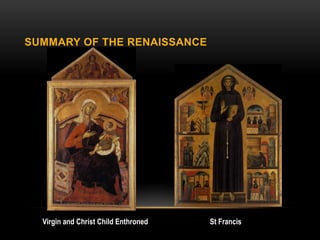
  Virgin and Christ Child Enthroned   St Francis
SUMMARY OF THE RENAISSANCE


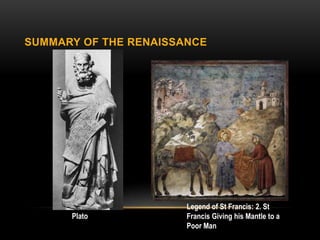
                       Legend of St Francis: 2. St
      Plato            Francis Giving his Mantle to a
                       Poor Man
SUMMARY OF THE RENAISSANCE


  14th Century
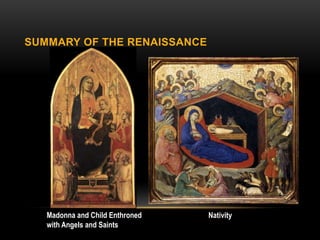
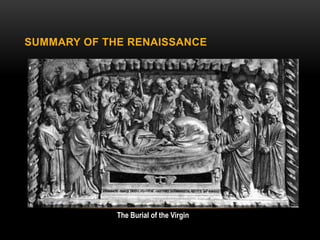
• Once attention had been drawn to human emotion, it was only
  natural that interest in the human being himself and in his
  physical surroundings should follow.
SUMMARY OF THE RENAISSANCE


   Madonna and Child Enthroned   Nativity
   with Angels and Saints
SUMMARY OF THE RENAISSANCE


             The Burial of the Virgin
SUMMARY OF THE RENAISSANCE

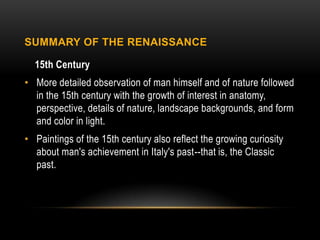
  15th Century
• More detailed observation of man himself and of nature followed
  in the 15th century with the growth of interest in anatomy,
  perspective, details of nature, landscape backgrounds, and form
  and color in light.
• Paintings of the 15th century also reflect the growing curiosity
  about man's achievement in Italy's past--that is, the Classic
  past.
SUMMARY OF THE RENAISSANCE


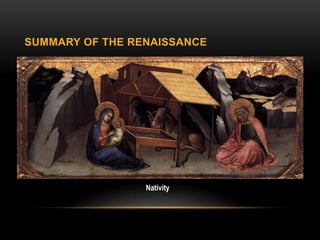
                 Nativity
SUMMARY OF THE RENAISSANCE


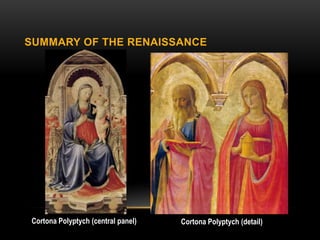
 Cortona Polyptych (central panel)   Cortona Polyptych (detail)
SUMMARY OF THE RENAISSANCE


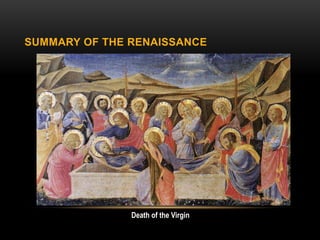
               Death of the Virgin
SUMMARY OF THE RENAISSANCE

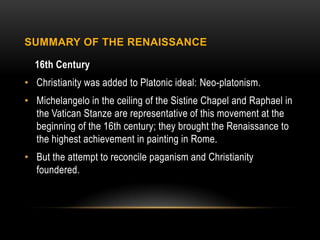
  16th Century
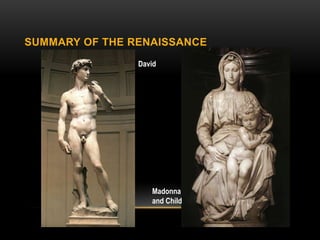
• Christianity was added to Platonic ideal: Neo-platonism.
• Michelangelo in the ceiling of the Sistine Chapel and Raphael in
  the Vatican Stanze are representative of this movement at the
  beginning of the 16th century; they brought the Renaissance to
  the highest achievement in painting in Rome.
• But the attempt to reconcile paganism and Christianity
  foundered.
SUMMARY OF THE RENAISSANCE
                David


                   Madonna
                   and Child
SUMMARY OF THE RENAISSANCE


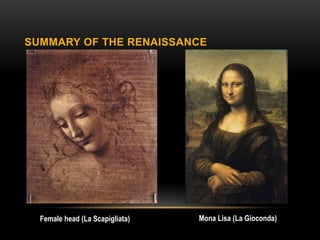
  Female head (La Scapigliata)   Mona Lisa (La Gioconda)
SUMMARY OF THE RENAISSANCE

Humanism
• Humanism was the basic concept of the Italian Renaissance.
• This concept can be identified with a belief in the power of
  learning and science to produce "the complete man".
• The Humanists saw no conflict between the New Learning--the
  newly rediscovered wisdom of the ancient world--and the
  authority of the Church.
SUMMARY OF THE RENAISSANCE

Neo-Platonism
• Neo-Platonism in the Renaissance was the philosophy based on the
  teachings and doctrines of a group of thinkers of the early Christian
  era who endeavored to reconcile the teachings of Plato with Christian
  concepts.
• The Neo-Platonists, being at the same time both lovers of the pagan
  past with its Platonic ideals of physical beauty, and being
  Christians, wanted to fuse this pagan idealism with Christian doctrine.
• The Neo-Platonists conceived of the Christian religion as an eternal
  doctrine existing even before the advent of historical Christianity.

Summary of renaissance

  • 1.
    SUMMARY OF RENAISSANCE EarlyAnd High Renaissance In Italy; Humanism, Neo-Platonism.
  • 2.
    SUMMARY OF THERENAISSANCE 13th Century • Christian painting and sculpture were just beginning to break away from the restraints of the dogma and conventions of the earlier medieval period.
  • 3.
    SUMMARY OF THERENAISSANCE Virgin and Christ Child Enthroned St Francis
  • 4.
    SUMMARY OF THERENAISSANCE Legend of St Francis: 2. St Plato Francis Giving his Mantle to a Poor Man
  • 5.
    SUMMARY OF THERENAISSANCE 14th Century • Once attention had been drawn to human emotion, it was only natural that interest in the human being himself and in his physical surroundings should follow.
  • 6.
    SUMMARY OF THERENAISSANCE Madonna and Child Enthroned Nativity with Angels and Saints
  • 7.
    SUMMARY OF THERENAISSANCE The Burial of the Virgin
  • 8.
    SUMMARY OF THERENAISSANCE 15th Century • More detailed observation of man himself and of nature followed in the 15th century with the growth of interest in anatomy, perspective, details of nature, landscape backgrounds, and form and color in light. • Paintings of the 15th century also reflect the growing curiosity about man's achievement in Italy's past--that is, the Classic past.
  • 9.
    SUMMARY OF THERENAISSANCE Nativity
  • 10.
    SUMMARY OF THERENAISSANCE Cortona Polyptych (central panel) Cortona Polyptych (detail)
  • 11.
    SUMMARY OF THERENAISSANCE Death of the Virgin
  • 12.
    SUMMARY OF THERENAISSANCE 16th Century • Christianity was added to Platonic ideal: Neo-platonism. • Michelangelo in the ceiling of the Sistine Chapel and Raphael in the Vatican Stanze are representative of this movement at the beginning of the 16th century; they brought the Renaissance to the highest achievement in painting in Rome. • But the attempt to reconcile paganism and Christianity foundered.
  • 13.
    SUMMARY OF THERENAISSANCE David Madonna and Child
  • 14.
    SUMMARY OF THERENAISSANCE Female head (La Scapigliata) Mona Lisa (La Gioconda)
  • 15.
    SUMMARY OF THERENAISSANCE Humanism • Humanism was the basic concept of the Italian Renaissance. • This concept can be identified with a belief in the power of learning and science to produce "the complete man". • The Humanists saw no conflict between the New Learning--the newly rediscovered wisdom of the ancient world--and the authority of the Church.
  • 16.
    SUMMARY OF THERENAISSANCE Neo-Platonism • Neo-Platonism in the Renaissance was the philosophy based on the teachings and doctrines of a group of thinkers of the early Christian era who endeavored to reconcile the teachings of Plato with Christian concepts. • The Neo-Platonists, being at the same time both lovers of the pagan past with its Platonic ideals of physical beauty, and being Christians, wanted to fuse this pagan idealism with Christian doctrine. • The Neo-Platonists conceived of the Christian religion as an eternal doctrine existing even before the advent of historical Christianity.