Historical Benchmarks in the Origins and Evolution of American Public Education Thomas J. Delaney, Ed.S., M.A. School and Society University of Minnesota September 26, 2006
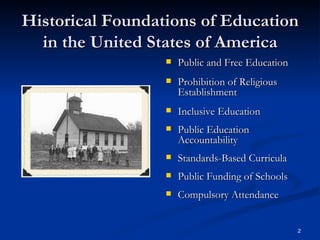
Historical Foundations of Education in the United States of America Public and Free Education Prohibition of Religious Establishment Inclusive Education Public Education Accountability Standards-Based Curricula Public Funding of Schools Compulsory Attendance
The Classical Foundations  (4th cent. B.C.E. – 5th cent. C.E.) A clear sense of essential values and  virtues . Educational needs vary by  class . Education by and in the  community —following the child’s  stages of development . For leaders: the  Liberal Arts  - learning that frees the mind.
The Classical Foundations - Virtue  (4th cent. B.C.E. – 5th cent. C.E.) Essential values and virtues ( Greek and Roman ). Values—fame, honor, competition, wealth. Virtues—courage, justice, strength, physical beauty. Power of Reason—to know the good, true, and beautiful. Power of Learning—overcome ignorance, know oneself. The  Christian  revision in values and virtues. Values—eternal life, community, conversion, poverty. Virtues—faith, hope, love, joy, peace, mercy, generosity.
The Classical Foundations - Classism   (4th cent. B.C.E. – 5th cent. C.E.) Educational needs vary by  class : Society sorted by inner characteristics. Ability and interest. Inner character corresponds to social classes:  Workers, farmers, craftsmen.  Guardians, administrators, soldiers.  Philosophers, rulers, royal house.
The Classical Foundations - Developmentalism  (4th cent. B.C.E. – 5th cent. C.E.) Education by and in the community—following the child’s  stages of development . Schema from  Plato’s Republic : Childhood to age 17-18 :  preliminary  education—through play and instruction in grammar, calculations, etc. Up to age 20 :  physical  training Ages 20-30 : unified  vision —bringing together earlier studies Ages 30-35 :  dialectic —testing who can depart from the senses and turn to the good (reality). Ages 35-50 :  practical  experience—war, public office. Age 50 and beyond :  rule  the city, and lift the minds of others to the light and the good (philosophy).
The Classical Foundations  – Organization of Learning  (4th cent. B.C.E. – 5th cent. C.E.) Pythagoras: Number  is the  fundamental property of the mind  and the universe, giving symmetrical order to the universe and regularity to planetary motions. Classical liberal arts curriculum: Trivium (from Humanity)  grammar, rhetoric, dialectic (logic) Quadrivium (from the Divine) arithmetic (algebra) number at rest geometry spatial relations at rest music number in motion astronomy spatial relations in motion
Public and Free Education Forebear : Plato (427-347 BCE) Artifact :  Republic  (circa 380 BCE) Principle : Schooling should serve the common good, and therefore should be the responsibility of the public. Later Outcome : Land Ordinance of 1785 Controversy :  Social Class  - Inequalities and divisions within the public education system that allow certain segments of the public greater opportunity and resources than other segments.
Medieval Developments (6th -  13th cent. C.E.) Christians: Preservation (e.g. Plato, Plotinus) and destruction (e.g. Aristotle) of  literary sources . Dispersion  of the Roman aristocracy. Monasteries Benedict of Nursia (d. 547),  Rule of St. Benedict. Synthesis of Eastern and Western monasticism. Model for monastic development thereafter. Monastery and Cathedral Schools Rabanus Maurus (German, d. 856),  Education of the Clergy. Founded  schools within monasteries . Continuing the curriculum of the  seven liberal arts .
Medieval Developments (6th -  13th cent. C.E.) Independent Universities Peter Abelard (Parisian, d. 1142),  Sic et Non. Scholastic Method : examine conflicting texts and observations to determine the truth. Thomas Aquinas (Parisian, d. 1274),  Summa Theologica, Summa contra Gentiles, etc. Employed Aristotle’s method of investigation with theological inquiry. Two  forms of education :  Educatio    virtue and character  Disciplina    formal instruction.
The Renaissance and Classical Restoration  (14th - 15th cent. C.E.) Wealth  not tied to the land (nor nobility, code of chivalry, and church). Merchants, trade guilds, explorers, artists. Interest in the  humanist  implications of Greek and Latin classics (newly available). Education for women: Christine de Pisan (French, d. 1425),  A Medieval Woman’s Mirror of Honor. Education in the practical virtues for women.
The Renaissance and Classical Restoration  (14th - 15th cent. C.E.) Classical Schools Vittorino da Feltre (Italian, d. 1446). Combining Christian and classical education in the seven  liberal arts . Departing from recitation and scholasticism to encourage drafting of  original compositions  by students. Following the  child’s natural development , using  incentives  rather than punishment.
Discovery and Reformation  (16th - 17th cent. CE) Classical Schools (cont.) Revolutions in Thought: Scientific—solar system, geology, warfare. Social—end of chivalry, English republic, rising middle class. Religious—divided Christendom, bible reading widespread. Classical Education: Desiderius Erasmus (Dutch, d. 1536),  Education of a Christian Prince. Juan Luis Vives (Spanish, d. 1540),  On the Instruction of a Christian Woman.
Discovery and Reformation  (16th - 17th cent. CE) Michel de Montaigne (French, d. 1592),  Essays . Rejected scholastic methods, focused on reading  classics . Advocating  education for peace, civic duties, critical thinking. Aiming to educate the  whole person , not merely the mind. John Amos Comenius (Moravian, d. 1670),  Orbis sensualium pictus. Instruction using pictures  as well as texts. Universal education  for all—boys and girls—in joyful learning. Francis Bacon (English, d. 1626),  The Advancement of Learning . Education built on  observation of   nature —challenging current beliefs.
Discovery and Reformation  (16th - 17th cent. CE) The Reformation   Martin Luther (German, d. 1546),  An Appeal to the German Nobility. Universal literacy  for reading the bible Vocational education  for economic advancement and social peace. (Note: Christian virtue in hard work and prosperity.) Elementary schools  in German,  secondary schools  using classical curriculum.
Discovery and Reformation  (16th - 17th cent. CE) The Reformation   Ignatius Loyola (Spanish, d. 1556),  Spiritual Exercises . Classical and  humanistic education  for the elite. Detailed method for  personal reform of life . John Calvin (Swiss, d. 1564)  Institutes of Christian Religion . Education for righteous living— social   reform .
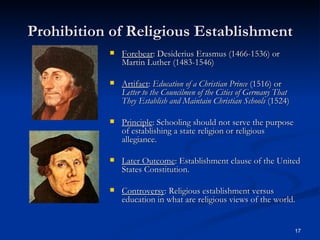
Prohibition of Religious Establishment Forebear : Desiderius Erasmus (1466-1536) or Martin Luther (1483-1546) Artifact :  Education of a Christian Prince  (1516) or  Letter to the Councilmen of the Cities of Germany That They Establish and Maintain Christian Schools  (1524) Principle : Schooling should not serve the purpose of establishing a state religion or religious allegiance. Later Outcome : Establishment clause of the United States Constitution. Controversy : Religious establishment versus education in what are religious views of the world.
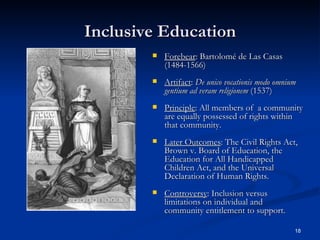
Inclusive Education Forebear : Bartolom é  de Las Casas (1484-1566) Artifact :  De unico vocationis modo omnium gentium ad veram religionem  (1537) Principle : All members of  a community are equally possessed of rights within that community. Later Outcomes : The Civil Rights Act, Brown v. Board of Education, the Education for All Handicapped Children Act, and the Universal Declaration of Human Rights. Controversy : Inclusion versus limitations on individual and community entitlement to support.
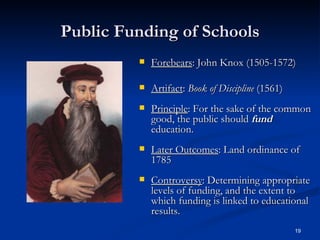
Public Funding of Schools Forebears : John Knox (1505-1572) Artifact :  Book of Discipline  (1561) Principle : For the sake of the common good, the public should  fund  education. Later Outcomes : Land ordinance of 1785 Controversy : Determining appropriate levels of funding, and the extent to which funding is linked to educational results.
The American Colonial Experience (1607-1783 CE) Education is a  local public responsibility , focused on the school—thus extending the European liberal arts curriculum. Schools belong to the  community —not to families. Old Deluder Laws, 1642, 1647. Schooling is  decentralized—governed locally. New England—Puritan, pervasive, intensive Middle colonies—diverse, variable Southern colonies—upper class only
The American Colonial Experience (1607-1783 CE) New England : As little distance as possible between the individual and the bible ( Protestant ideals ). John Cotton’s catechism—3,000,000 copies sold. Cotton Mather—de-emphasize Greek and Latin classics, emphasize  Christian morals and ideas . New England Primer , 1727—much negative content,  heavy moral   emphasis —3,000,000 copies published.
The American Colonial Experience (1607-1783 CE) Middle Colonies Ben Franklin’s  Proposals Related to the Education of Youth in Pennsylvania , 1749. Private academies funded by  fees and   endowments . Deist—divine laws known by  reason , not revelation; imitate Jesus and Socrates. Moralist—build individual  character . Empiricist —emphasizing observation, experimentation, applied research. Utilitarian  and practical—economic advancement. Optimistic —progress in human character through education.
The American Colonial Experience (1607-1783 CE) Middle Colonies (cont.) Thomas Jefferson,  Bill for the More General Diffusion of Knowledge,  1779.  Schools within  walking distance . Publicly funded  for boys and girls for 3 years. Examinations  to determine best boys in each class for further publicly funded schooling—through 4 years of college. School mission to  build society .
The American Colonial Experience (1607-1783 CE) Southern Colonies Organized around  household  as much as community. Family funded  as much as publicly funded. Highly variable  place to place. Explicit  exclusion  of education for Black Americans.
Compulsory Attendance Forebears : Frederick II of Prussia (1712-1786).  Artifact :  Landschulreglement  (1763) Principle : Attendance of youth at schools is necessary for a good society and is therefore a matter of law. Later Outcome : Massachusetts Compulsory Attendance Act of 1852 Controversy : Autonomy and the appropriate age through which to require attendance at school.
The Enlightenment  (18th - 20th cent. CE)  Modern  scientific  worldview: Optimistic, endless discovery, mastery of nature. Secular nation-state  government: Democratic, monarchic, fascist, communist, totalitarian.
The Enlightenment  (18th - 20th cent. CE)  Rational Education (not limited by religion) John Locke (English, d. 1704),  Some Thoughts Concerning Education. Companionship,  good habits ,  teacher as model  of  virtue . Vernacular  more important than Latin.
The Enlightenment  (18th - 20th cent. CE)  Rational Education (cont.) August Herman Francke (German, d. 1727). Benevolent education—opened hundreds of  schools for low and middle class children . Claude Helvetius (French, d. 1771),  On the Mind. Schools administered by the state  rather than the church. Include  children of all cultures. Instituted  standards   for teachers .
The Enlightenment  (18th - 20th cent. CE)  Natural Education Jean Jacques Rousseau (Swiss, d. 1778),  Emile. Humans are naturally good but  corrupted by society . Education should follow the  natural interests of the child . Educator models  curiosity, observation, virtue. Natural sequence of learning : physical sensation during infancy, bodily coordination during boyhood, self-directed thinking during pre-adolescence, social learning during adolescence.
The Enlightenment  (18th - 20th cent. CE)  Natural Education (cont.) Johann Heinrich Pestalozzi (Swiss, d. 1827),  How Gertrude Teaches Her Children . Established a school for  poor children  on his farm. Education for  whole child : vocational, moral, intellectual. School should resemble  family , teacher resemble parents. “General Method”: Develop the  innate goodness  of children through love and security. “Special Method”: group instruction and object learning to develop children’s  innate powers  to perceive, think, and create.
The National Experience  (1783-1876 CE) Schooling is a  national responsibility  and must reflect the  national   character —thus it is  universal ,  compulsory , and  Protestant .  Schools are  publicly funded  . Northwest Ordinances of 1785 and 1787. Morrill Act, 1862.
The National Experience  (1783-1876 CE) Schools belong to the  public —not to churches.  Disestablishment clause, 1st Amendment, 1791 Schools are engines of  assimilation . Horace Mann,  Twelve Annual Reports,  1837-1848  Common Schools movement, 1840s
The National Experience  (1783-1876 CE) Mrs. Howland,  The Infant School Manual,  1830s  Emotional value of music—harmony, pleasure,  character -building (reminiscent of Plato). Conservative Protestant vs. Enlightenment/Jeffersonian.
The National Experience  (1783-1876 CE) Horace Mann and the  Common School Bring order and  reform  to haphazard schools already established. Promote  accessibility  for all to education. Supported by  taxation , not fees. Controlled by  government . Non-denominational  Protestant—using the King James Bible. Curriculum for  general   knowledge —reading, writing, arithmetic, history, geography, political education, music, drawing (utilitarian). Curriculum for  national character —support individual conscience, avoid political controversies, reduce crime.
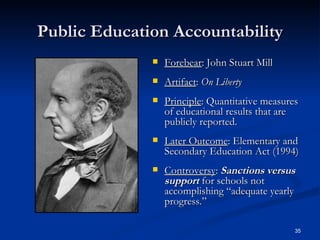
Public Education Accountability Forebear : John Stuart Mill Artifact :  On Liberty  Principle : Quantitative measures of educational results that are publicly reported. Later Outcome : Elementary and Secondary Education Act (1994) Controversy :  Sanctions   versus   support  for schools not accomplishing “adequate yearly progress.”
The Metropolitan Experience  (1876 - Present) Schooling is a  national   priority —thus it is expanding, variable, succeeding  and  failing, and contested. Preserving  national   character —The Committee of Ten report, 1893  Serving  child   development —Progressive Educational Association, 1901
The Metropolitan Experience  (1876 - Present) Four commitments of  Progressive  education: Broaden the curriculum  to include heath, vocation, family, and community life.  Derive pedagogy from  scientific evidence  on psychology and sociology.
The Metropolitan Experience  (1876 - Present) Four commitments of Progressive education (cont.): Tailor pedagogy  to the child—learning styles, developmental stages. Democratize  schooling—equal education for all.
The Metropolitan Experience  (1876 - Present) Francis W. Parker Quincy system of child-centered education (1873).  James Huff Stout “ Learning by Doing” center at Menomonie, Wisconsin (1889).  John Dewey The Laboratory School at the University of Chicago (1896). James Earl Russell Teacher training at NY Teachers College (1897).
The Metropolitan Experience  (1876 - Present) Charles Van Hise Academic and practical higher education, University of Wisconsin, Madison (1904). Marietta Johnson Child-centered education guided by inner satisfaction, the Organic School in Fairhope, MS (1907). William Wirt The “platoon system” of classroom, auditorium, and tutorials in Gary, IN (1907).
The Metropolitan Experience  (1876 - Present) Learner-Based Education   Sociological and psychological  studies of learning. Detailed  observations  of child behavior. Lev Vygotsky (Russian, d.1934).  Mental development follows  natural progression  from thought to language to reasoning. Teachers provide “scaffolding” to enable children to move to the next stage—their “ zone of proximal development .”
The Metropolitan Experience  (1876 - Present) Learner-Based Education (cont.)   Maria Montessori (Italian, d. 1952),  Spontaneous Activity in Education . Developed methods based on observations of learning in schools for  underprivileged and students with significant learning and cognitive  difficulties . Children select their own activities to develop skills and concentration, in a learning environment especially constructed to  match their stage of development .
The Metropolitan Experience  (1876 - Present) Learner-Based Education (cont.)   John Dewey (American, d. 1952),  Democracy and Education. School should be  modeled on the   community —no artificial divisions among disciplines, occupations, or age groups. Students led by curiosity and  inner purpose , in an environment intentionally  structured  to stimulate growth.  Teachers guide students by their interests to the riches of  Western tradition , as called for by learning process. Education as lever for social advancement—especially  democracy .
The Metropolitan Experience  (1876 - Present) Learner-Based Education (cont.)   Jean Piaget (French, d. 1980),  The Moral Development of the Child . Theory of  psychological development  of the child: stages of practice paralleled by stages of consciousness. Interactive process of development  with peers (vs. from authority).
The Metropolitan Experience  (1876 - Present) Serving  democracy —Jane Addams,  Democracy and Social Ethics,  1902; John Dewey,  Democracy and Education,  1916. Correcting (maintaining?)  social inequities — Brown v. Board of Education,  1954; No Child Left Behind Act, 2001. Schools are  economic  engines. Building the national labor force—NEA Cardinal Principles, 1918 Mastering the global competition— A   Nation at Risk , 1983;  Goals 2000.
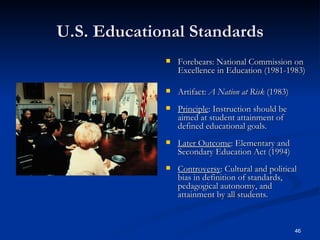
U.S. Educational Standards Forebears: National Commission on Excellence in Education (1981-1983) Artifact:  A Nation at Risk  (1983) Principle : Instruction should be aimed at student attainment of defined educational goals. Later Outcome : Elementary and Secondary Education Act (1994) Controversy : Cultural and political bias in definition of standards, pedagogical autonomy, and attainment by all students.
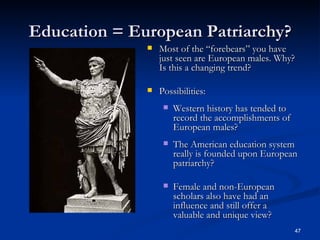
Education = European Patriarchy? Most of the “forebears” you have just seen are European males. Why? Is this a changing trend? Possibilities: Western history has tended to record the accomplishments of European males? The American education system really is founded upon European patriarchy? Female and non-European scholars also have had an influence and still offer a valuable and unique view?
So, here we are… In what historical and cultural tradition are you participating right now? How did this happen? Cultural History Personal History Why is this happening? Ought this be happening? How do you know?
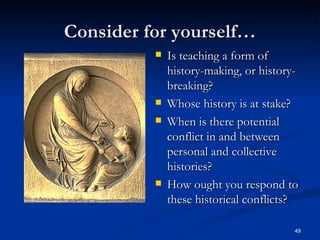
Consider for yourself… Is teaching a form of history-making, or history-breaking? Whose history is at stake? When is there potential conflict in and between personal and collective histories? How ought you respond to these historical conflicts?
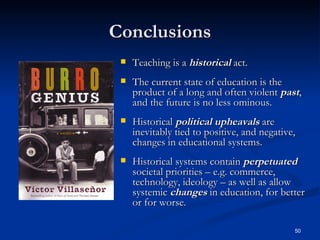
Conclusions Teaching is a  historical  act. The current state of education is the product of a long and often violent  past , and the future is no less ominous. Historical  political upheavals  are inevitably tied to positive, and negative, changes in educational systems. Historical systems contain  perpetuated  societal priorities – e.g. commerce, technology, ideology – as well as allow systemic  changes  in education, for better or for worse.
Acknowledgments Bagley, A. (2006). The virtual museum of educational iconics.  http://www.education.umn.edu/EdPA/iconics/Sponsor.html Schweigert, F. (2006). Traditions of American education. School and Society lecture, University of Minnesota, July 11, 2006. Schweigert, F. (2006). The Western European heritage of education and schooling. School and Society lecture, July 13, 2006.

School & Society PowerPoint - Sep 26

  • 1.
    Historical Benchmarks inthe Origins and Evolution of American Public Education Thomas J. Delaney, Ed.S., M.A. School and Society University of Minnesota September 26, 2006
  • 2.
    Historical Foundations ofEducation in the United States of America Public and Free Education Prohibition of Religious Establishment Inclusive Education Public Education Accountability Standards-Based Curricula Public Funding of Schools Compulsory Attendance
  • 3.
    The Classical Foundations (4th cent. B.C.E. – 5th cent. C.E.) A clear sense of essential values and virtues . Educational needs vary by class . Education by and in the community —following the child’s stages of development . For leaders: the Liberal Arts - learning that frees the mind.
  • 4.
    The Classical Foundations- Virtue (4th cent. B.C.E. – 5th cent. C.E.) Essential values and virtues ( Greek and Roman ). Values—fame, honor, competition, wealth. Virtues—courage, justice, strength, physical beauty. Power of Reason—to know the good, true, and beautiful. Power of Learning—overcome ignorance, know oneself. The Christian revision in values and virtues. Values—eternal life, community, conversion, poverty. Virtues—faith, hope, love, joy, peace, mercy, generosity.
  • 5.
    The Classical Foundations- Classism (4th cent. B.C.E. – 5th cent. C.E.) Educational needs vary by class : Society sorted by inner characteristics. Ability and interest. Inner character corresponds to social classes: Workers, farmers, craftsmen. Guardians, administrators, soldiers. Philosophers, rulers, royal house.
  • 6.
    The Classical Foundations- Developmentalism (4th cent. B.C.E. – 5th cent. C.E.) Education by and in the community—following the child’s stages of development . Schema from Plato’s Republic : Childhood to age 17-18 : preliminary education—through play and instruction in grammar, calculations, etc. Up to age 20 : physical training Ages 20-30 : unified vision —bringing together earlier studies Ages 30-35 : dialectic —testing who can depart from the senses and turn to the good (reality). Ages 35-50 : practical experience—war, public office. Age 50 and beyond : rule the city, and lift the minds of others to the light and the good (philosophy).
  • 7.
    The Classical Foundations – Organization of Learning (4th cent. B.C.E. – 5th cent. C.E.) Pythagoras: Number is the fundamental property of the mind and the universe, giving symmetrical order to the universe and regularity to planetary motions. Classical liberal arts curriculum: Trivium (from Humanity) grammar, rhetoric, dialectic (logic) Quadrivium (from the Divine) arithmetic (algebra) number at rest geometry spatial relations at rest music number in motion astronomy spatial relations in motion
  • 8.
    Public and FreeEducation Forebear : Plato (427-347 BCE) Artifact : Republic (circa 380 BCE) Principle : Schooling should serve the common good, and therefore should be the responsibility of the public. Later Outcome : Land Ordinance of 1785 Controversy : Social Class - Inequalities and divisions within the public education system that allow certain segments of the public greater opportunity and resources than other segments.
  • 9.
    Medieval Developments (6th- 13th cent. C.E.) Christians: Preservation (e.g. Plato, Plotinus) and destruction (e.g. Aristotle) of literary sources . Dispersion of the Roman aristocracy. Monasteries Benedict of Nursia (d. 547), Rule of St. Benedict. Synthesis of Eastern and Western monasticism. Model for monastic development thereafter. Monastery and Cathedral Schools Rabanus Maurus (German, d. 856), Education of the Clergy. Founded schools within monasteries . Continuing the curriculum of the seven liberal arts .
  • 10.
    Medieval Developments (6th- 13th cent. C.E.) Independent Universities Peter Abelard (Parisian, d. 1142), Sic et Non. Scholastic Method : examine conflicting texts and observations to determine the truth. Thomas Aquinas (Parisian, d. 1274), Summa Theologica, Summa contra Gentiles, etc. Employed Aristotle’s method of investigation with theological inquiry. Two forms of education : Educatio  virtue and character Disciplina  formal instruction.
  • 11.
    The Renaissance andClassical Restoration (14th - 15th cent. C.E.) Wealth not tied to the land (nor nobility, code of chivalry, and church). Merchants, trade guilds, explorers, artists. Interest in the humanist implications of Greek and Latin classics (newly available). Education for women: Christine de Pisan (French, d. 1425), A Medieval Woman’s Mirror of Honor. Education in the practical virtues for women.
  • 12.
    The Renaissance andClassical Restoration (14th - 15th cent. C.E.) Classical Schools Vittorino da Feltre (Italian, d. 1446). Combining Christian and classical education in the seven liberal arts . Departing from recitation and scholasticism to encourage drafting of original compositions by students. Following the child’s natural development , using incentives rather than punishment.
  • 13.
    Discovery and Reformation (16th - 17th cent. CE) Classical Schools (cont.) Revolutions in Thought: Scientific—solar system, geology, warfare. Social—end of chivalry, English republic, rising middle class. Religious—divided Christendom, bible reading widespread. Classical Education: Desiderius Erasmus (Dutch, d. 1536), Education of a Christian Prince. Juan Luis Vives (Spanish, d. 1540), On the Instruction of a Christian Woman.
  • 14.
    Discovery and Reformation (16th - 17th cent. CE) Michel de Montaigne (French, d. 1592), Essays . Rejected scholastic methods, focused on reading classics . Advocating education for peace, civic duties, critical thinking. Aiming to educate the whole person , not merely the mind. John Amos Comenius (Moravian, d. 1670), Orbis sensualium pictus. Instruction using pictures as well as texts. Universal education for all—boys and girls—in joyful learning. Francis Bacon (English, d. 1626), The Advancement of Learning . Education built on observation of nature —challenging current beliefs.
  • 15.
    Discovery and Reformation (16th - 17th cent. CE) The Reformation Martin Luther (German, d. 1546), An Appeal to the German Nobility. Universal literacy for reading the bible Vocational education for economic advancement and social peace. (Note: Christian virtue in hard work and prosperity.) Elementary schools in German, secondary schools using classical curriculum.
  • 16.
    Discovery and Reformation (16th - 17th cent. CE) The Reformation Ignatius Loyola (Spanish, d. 1556), Spiritual Exercises . Classical and humanistic education for the elite. Detailed method for personal reform of life . John Calvin (Swiss, d. 1564) Institutes of Christian Religion . Education for righteous living— social reform .
  • 17.
    Prohibition of ReligiousEstablishment Forebear : Desiderius Erasmus (1466-1536) or Martin Luther (1483-1546) Artifact : Education of a Christian Prince (1516) or Letter to the Councilmen of the Cities of Germany That They Establish and Maintain Christian Schools (1524) Principle : Schooling should not serve the purpose of establishing a state religion or religious allegiance. Later Outcome : Establishment clause of the United States Constitution. Controversy : Religious establishment versus education in what are religious views of the world.
  • 18.
    Inclusive Education Forebear: Bartolom é de Las Casas (1484-1566) Artifact : De unico vocationis modo omnium gentium ad veram religionem (1537) Principle : All members of a community are equally possessed of rights within that community. Later Outcomes : The Civil Rights Act, Brown v. Board of Education, the Education for All Handicapped Children Act, and the Universal Declaration of Human Rights. Controversy : Inclusion versus limitations on individual and community entitlement to support.
  • 19.
    Public Funding ofSchools Forebears : John Knox (1505-1572) Artifact : Book of Discipline (1561) Principle : For the sake of the common good, the public should fund education. Later Outcomes : Land ordinance of 1785 Controversy : Determining appropriate levels of funding, and the extent to which funding is linked to educational results.
  • 20.
    The American ColonialExperience (1607-1783 CE) Education is a local public responsibility , focused on the school—thus extending the European liberal arts curriculum. Schools belong to the community —not to families. Old Deluder Laws, 1642, 1647. Schooling is decentralized—governed locally. New England—Puritan, pervasive, intensive Middle colonies—diverse, variable Southern colonies—upper class only
  • 21.
    The American ColonialExperience (1607-1783 CE) New England : As little distance as possible between the individual and the bible ( Protestant ideals ). John Cotton’s catechism—3,000,000 copies sold. Cotton Mather—de-emphasize Greek and Latin classics, emphasize Christian morals and ideas . New England Primer , 1727—much negative content, heavy moral emphasis —3,000,000 copies published.
  • 22.
    The American ColonialExperience (1607-1783 CE) Middle Colonies Ben Franklin’s Proposals Related to the Education of Youth in Pennsylvania , 1749. Private academies funded by fees and endowments . Deist—divine laws known by reason , not revelation; imitate Jesus and Socrates. Moralist—build individual character . Empiricist —emphasizing observation, experimentation, applied research. Utilitarian and practical—economic advancement. Optimistic —progress in human character through education.
  • 23.
    The American ColonialExperience (1607-1783 CE) Middle Colonies (cont.) Thomas Jefferson, Bill for the More General Diffusion of Knowledge, 1779. Schools within walking distance . Publicly funded for boys and girls for 3 years. Examinations to determine best boys in each class for further publicly funded schooling—through 4 years of college. School mission to build society .
  • 24.
    The American ColonialExperience (1607-1783 CE) Southern Colonies Organized around household as much as community. Family funded as much as publicly funded. Highly variable place to place. Explicit exclusion of education for Black Americans.
  • 25.
    Compulsory Attendance Forebears: Frederick II of Prussia (1712-1786). Artifact : Landschulreglement (1763) Principle : Attendance of youth at schools is necessary for a good society and is therefore a matter of law. Later Outcome : Massachusetts Compulsory Attendance Act of 1852 Controversy : Autonomy and the appropriate age through which to require attendance at school.
  • 26.
    The Enlightenment (18th - 20th cent. CE) Modern scientific worldview: Optimistic, endless discovery, mastery of nature. Secular nation-state government: Democratic, monarchic, fascist, communist, totalitarian.
  • 27.
    The Enlightenment (18th - 20th cent. CE) Rational Education (not limited by religion) John Locke (English, d. 1704), Some Thoughts Concerning Education. Companionship, good habits , teacher as model of virtue . Vernacular more important than Latin.
  • 28.
    The Enlightenment (18th - 20th cent. CE) Rational Education (cont.) August Herman Francke (German, d. 1727). Benevolent education—opened hundreds of schools for low and middle class children . Claude Helvetius (French, d. 1771), On the Mind. Schools administered by the state rather than the church. Include children of all cultures. Instituted standards for teachers .
  • 29.
    The Enlightenment (18th - 20th cent. CE) Natural Education Jean Jacques Rousseau (Swiss, d. 1778), Emile. Humans are naturally good but corrupted by society . Education should follow the natural interests of the child . Educator models curiosity, observation, virtue. Natural sequence of learning : physical sensation during infancy, bodily coordination during boyhood, self-directed thinking during pre-adolescence, social learning during adolescence.
  • 30.
    The Enlightenment (18th - 20th cent. CE) Natural Education (cont.) Johann Heinrich Pestalozzi (Swiss, d. 1827), How Gertrude Teaches Her Children . Established a school for poor children on his farm. Education for whole child : vocational, moral, intellectual. School should resemble family , teacher resemble parents. “General Method”: Develop the innate goodness of children through love and security. “Special Method”: group instruction and object learning to develop children’s innate powers to perceive, think, and create.
  • 31.
    The National Experience (1783-1876 CE) Schooling is a national responsibility and must reflect the national character —thus it is universal , compulsory , and Protestant . Schools are publicly funded . Northwest Ordinances of 1785 and 1787. Morrill Act, 1862.
  • 32.
    The National Experience (1783-1876 CE) Schools belong to the public —not to churches. Disestablishment clause, 1st Amendment, 1791 Schools are engines of assimilation . Horace Mann, Twelve Annual Reports, 1837-1848 Common Schools movement, 1840s
  • 33.
    The National Experience (1783-1876 CE) Mrs. Howland, The Infant School Manual, 1830s Emotional value of music—harmony, pleasure, character -building (reminiscent of Plato). Conservative Protestant vs. Enlightenment/Jeffersonian.
  • 34.
    The National Experience (1783-1876 CE) Horace Mann and the Common School Bring order and reform to haphazard schools already established. Promote accessibility for all to education. Supported by taxation , not fees. Controlled by government . Non-denominational Protestant—using the King James Bible. Curriculum for general knowledge —reading, writing, arithmetic, history, geography, political education, music, drawing (utilitarian). Curriculum for national character —support individual conscience, avoid political controversies, reduce crime.
  • 35.
    Public Education AccountabilityForebear : John Stuart Mill Artifact : On Liberty Principle : Quantitative measures of educational results that are publicly reported. Later Outcome : Elementary and Secondary Education Act (1994) Controversy : Sanctions versus support for schools not accomplishing “adequate yearly progress.”
  • 36.
    The Metropolitan Experience (1876 - Present) Schooling is a national priority —thus it is expanding, variable, succeeding and failing, and contested. Preserving national character —The Committee of Ten report, 1893 Serving child development —Progressive Educational Association, 1901
  • 37.
    The Metropolitan Experience (1876 - Present) Four commitments of Progressive education: Broaden the curriculum to include heath, vocation, family, and community life. Derive pedagogy from scientific evidence on psychology and sociology.
  • 38.
    The Metropolitan Experience (1876 - Present) Four commitments of Progressive education (cont.): Tailor pedagogy to the child—learning styles, developmental stages. Democratize schooling—equal education for all.
  • 39.
    The Metropolitan Experience (1876 - Present) Francis W. Parker Quincy system of child-centered education (1873). James Huff Stout “ Learning by Doing” center at Menomonie, Wisconsin (1889). John Dewey The Laboratory School at the University of Chicago (1896). James Earl Russell Teacher training at NY Teachers College (1897).
  • 40.
    The Metropolitan Experience (1876 - Present) Charles Van Hise Academic and practical higher education, University of Wisconsin, Madison (1904). Marietta Johnson Child-centered education guided by inner satisfaction, the Organic School in Fairhope, MS (1907). William Wirt The “platoon system” of classroom, auditorium, and tutorials in Gary, IN (1907).
  • 41.
    The Metropolitan Experience (1876 - Present) Learner-Based Education Sociological and psychological studies of learning. Detailed observations of child behavior. Lev Vygotsky (Russian, d.1934). Mental development follows natural progression from thought to language to reasoning. Teachers provide “scaffolding” to enable children to move to the next stage—their “ zone of proximal development .”
  • 42.
    The Metropolitan Experience (1876 - Present) Learner-Based Education (cont.) Maria Montessori (Italian, d. 1952), Spontaneous Activity in Education . Developed methods based on observations of learning in schools for underprivileged and students with significant learning and cognitive difficulties . Children select their own activities to develop skills and concentration, in a learning environment especially constructed to match their stage of development .
  • 43.
    The Metropolitan Experience (1876 - Present) Learner-Based Education (cont.) John Dewey (American, d. 1952), Democracy and Education. School should be modeled on the community —no artificial divisions among disciplines, occupations, or age groups. Students led by curiosity and inner purpose , in an environment intentionally structured to stimulate growth. Teachers guide students by their interests to the riches of Western tradition , as called for by learning process. Education as lever for social advancement—especially democracy .
  • 44.
    The Metropolitan Experience (1876 - Present) Learner-Based Education (cont.) Jean Piaget (French, d. 1980), The Moral Development of the Child . Theory of psychological development of the child: stages of practice paralleled by stages of consciousness. Interactive process of development with peers (vs. from authority).
  • 45.
    The Metropolitan Experience (1876 - Present) Serving democracy —Jane Addams, Democracy and Social Ethics, 1902; John Dewey, Democracy and Education, 1916. Correcting (maintaining?) social inequities — Brown v. Board of Education, 1954; No Child Left Behind Act, 2001. Schools are economic engines. Building the national labor force—NEA Cardinal Principles, 1918 Mastering the global competition— A Nation at Risk , 1983; Goals 2000.
  • 46.
    U.S. Educational StandardsForebears: National Commission on Excellence in Education (1981-1983) Artifact: A Nation at Risk (1983) Principle : Instruction should be aimed at student attainment of defined educational goals. Later Outcome : Elementary and Secondary Education Act (1994) Controversy : Cultural and political bias in definition of standards, pedagogical autonomy, and attainment by all students.
  • 47.
    Education = EuropeanPatriarchy? Most of the “forebears” you have just seen are European males. Why? Is this a changing trend? Possibilities: Western history has tended to record the accomplishments of European males? The American education system really is founded upon European patriarchy? Female and non-European scholars also have had an influence and still offer a valuable and unique view?
  • 48.
    So, here weare… In what historical and cultural tradition are you participating right now? How did this happen? Cultural History Personal History Why is this happening? Ought this be happening? How do you know?
  • 49.
    Consider for yourself…Is teaching a form of history-making, or history-breaking? Whose history is at stake? When is there potential conflict in and between personal and collective histories? How ought you respond to these historical conflicts?
  • 50.
    Conclusions Teaching isa historical act. The current state of education is the product of a long and often violent past , and the future is no less ominous. Historical political upheavals are inevitably tied to positive, and negative, changes in educational systems. Historical systems contain perpetuated societal priorities – e.g. commerce, technology, ideology – as well as allow systemic changes in education, for better or for worse.
  • 51.
    Acknowledgments Bagley, A.(2006). The virtual museum of educational iconics. http://www.education.umn.edu/EdPA/iconics/Sponsor.html Schweigert, F. (2006). Traditions of American education. School and Society lecture, University of Minnesota, July 11, 2006. Schweigert, F. (2006). The Western European heritage of education and schooling. School and Society lecture, July 13, 2006.