PHILIPPINE
LITERATURE
  1ST YEAR HIGH SCHOOL
    ENGLISH LESSONS
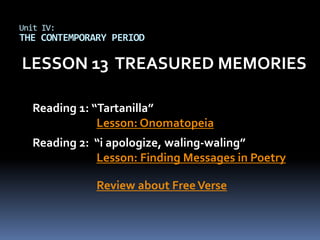
Unit IV:
THE CONTEMPORARY PERIOD

LESSON 13 TREASURED MEMORIES

  Reading 1: “Tartanilla”
              Lesson: Onomatopeia
  Reading 2: “i apologize, waling-waling”
             Lesson: Finding Messages in Poetry

              Review about Free Verse
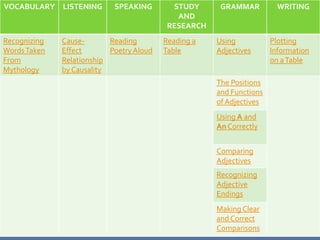
VOCABULARY    LISTENING     SPEAKING        STUDY      GRAMMAR          WRITING
                                             AND
                                           RESEARCH
Recognizing   Cause-       Reading        Reading a   Using           Plotting
Words Taken   Effect       Poetry Aloud   Table       Adjectives      Information
From          Relationship                                            on a Table
Mythology     by Causality
                                                      The Positions
                                                      and Functions
                                                      of Adjectives
                                                      Using A and
                                                      An Correctly


                                                      Comparing
                                                      Adjectives
                                                      Recognizing
                                                      Adjective
                                                      Endings
                                                      Making Clear
                                                      and Correct
                                                      Comparisons
ONOMATOPOEIA
the use of words that imitate the sounds associated
with the objects or actions they refer to

           Example:
                       bang
                       hiss
                       crackle
                       giggle
The steaks sizzled on the grill.

Clap your hands a little louder.

The water bubbled up from the sink.

Zing, went the violin strings.

The owl hooted as it sat in the tree.
Messages in poetry
 The idea about life that a poet writes about
 is called the theme or message of the poem.

      Example:
                 love      violence
                 anger     childhood
                 nature    sorrow
Free verse
a poem that has no regular rhyme or rhythm


      Many contemporary poets
           prefer to write
        in free verse for more
       freedom of expression.
Example:


       Nature
       It’s a beautiful thing
       We go outside and it’s right there
       But we do not seem to notice it
       With trees growing all around us
       Birds searing in the air
Words Taken From Mythology

     Many English expressions today
               come from
   Greek and Roman myths and legends.
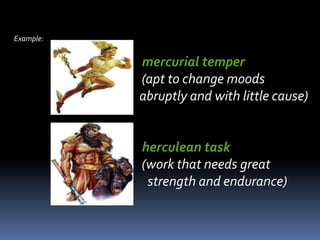
Example:


           mercurial temper
           (apt to change moods
           abruptly and with little cause)


           herculean task
           (work that needs great
            strength and endurance)
CAUSE-EFFECT RELATIONSHIP
  One event is the reason another event happens.

     Cause - the event that happens first


      Effect - result; what happens due to the cause
                (can be an event
                  or a change in behavior)
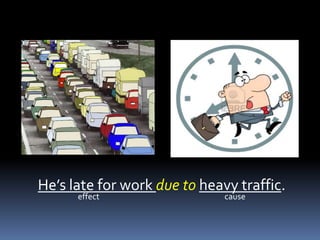
He’s late for work due to heavy traffic.
      effect                  cause
Cue words of the cause-effect relationship:

                            •   in order
      • because
                            •   that
      • therefore
                            •   so that
      • since
                            •   if - then


       Sometimes, there are no cue words.


              TIME FOR CHECKUP!
Reading poetry aloud
 Why? To communicate the ideas and feelings
          of the speaker in the poem.

How:

1. Emphasize key words and phrases
   through pitch and volume of voice.

2. Vary reading pace.
3. Read slowly and loudly enough.
   a. Pronounce words distinctly.
   b. Pause only at commas, periods, and
      break in ideas

4. Read as though you are speaking
   to someone.
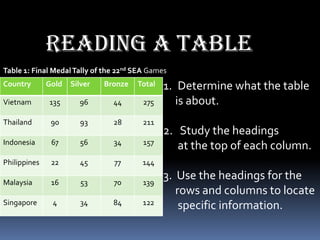
READING A TABLE
Table 1: Final Medal Tally of the 22nd SEA Games
Country       Gold   Silver   Bronze   Total   1. Determine what the table
Vietnam       135      96       44       275      is about.
Thailand       90      93       28       211
                                               2. Study the headings
Indonesia      67      56       34       157
                                                  at the top of each column.
Philippines    22      45       77      144

Malaysia       16       53      70       139
                                               3. Use the headings for the
                                                  rows and columns to locate
Singapore      4       34       84       122       specific information.
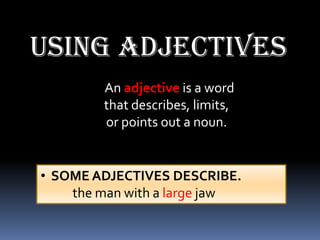
USING ADJECTIVES
        An adjective is a word
        that describes, limits,
        or points out a noun.


• SOME ADJECTIVES DESCRIBE.
    the man with a large jaw
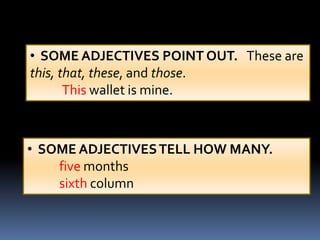
• SOME ADJECTIVES POINT OUT. These are
this, that, these, and those.
       This wallet is mine.


• SOME ADJECTIVES TELL HOW MANY.
    five months
    sixth column
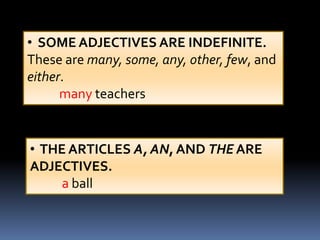
• SOME ADJECTIVES ARE INDEFINITE.
These are many, some, any, other, few, and
either.
      many teachers


• THE ARTICLES A, AN, AND THE ARE
ADJECTIVES.
     a ball
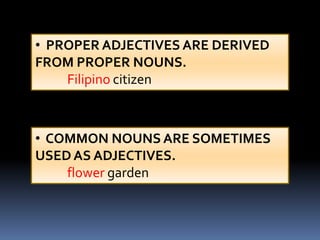
• PROPER ADJECTIVES ARE DERIVED
FROM PROPER NOUNS.
    Filipino citizen


• COMMON NOUNS ARE SOMETIMES
USED AS ADJECTIVES.
    flower garden
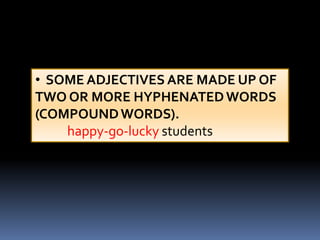
• SOME ADJECTIVES ARE MADE UP OF
TWO OR MORE HYPHENATED WORDS
(COMPOUND WORDS).
    happy-go-lucky students
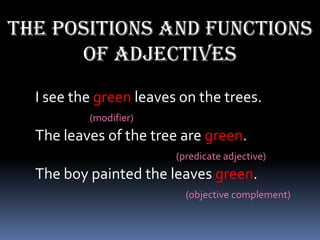
The positions and functions
      of adjectives
  I see the green leaves on the trees.
          (modifier)
  The leaves of the tree are green.
                        (predicate adjective)
  The boy painted the leaves green.
                          (objective complement)
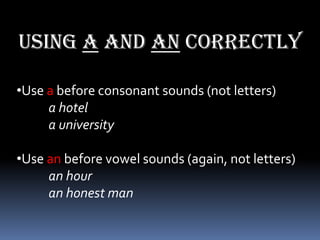
Using a and an correctly

•Use a before consonant sounds (not letters)
     a hotel
     a university

•Use an before vowel sounds (again, not letters)
     an hour
     an honest man
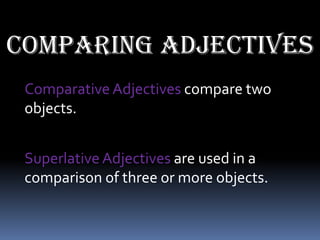
Comparing adjectives
 Comparative Adjectives compare two
 objects.


 Superlative Adjectives are used in a
 comparison of three or more objects.
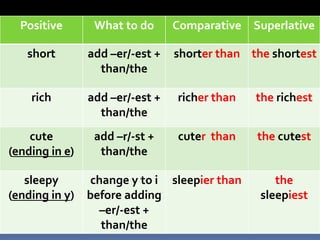
Positive       What to do      Comparative Superlative

   short        add –er/-est +   shorter than the shortest
                  than/the

    rich        add –er/-est +   richer than   the richest
                  than/the
    cute         add –r/-st +    cuter than    the cutest
(ending in e)     than/the

   sleepy        change y to i sleepier than       the
(ending in y)   before adding                   sleepiest
                  –er/-est +
                   than/the
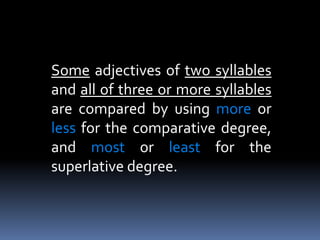
Some adjectives of two syllables
and all of three or more syllables
are compared by using more or
less for the comparative degree,
and most or least for the
superlative degree.
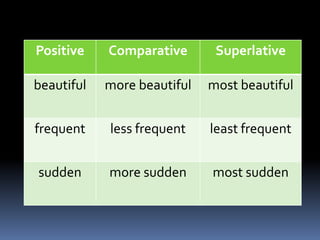
Positive    Comparative       Superlative

beautiful   more beautiful   most beautiful


frequent    less frequent    least frequent


sudden      more sudden      most sudden
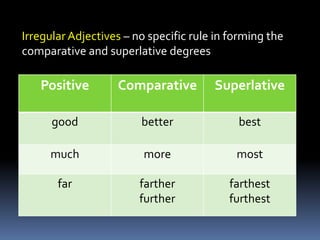
Irregular Adjectives – no specific rule in forming the
comparative and superlative degrees

   Positive        Comparative         Superlative

      good              better              best

     much                more               most

       far              farther           farthest
                        further           furthest
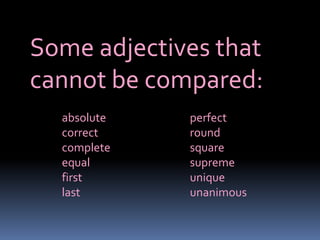
Some adjectives that
cannot be compared:
  absolute   perfect
  correct    round
  complete   square
  equal      supreme
  first      unique
  last       unanimous
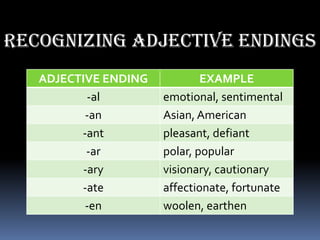
Recognizing adjective endings
   ADJECTIVE ENDING           EXAMPLE
          -al         emotional, sentimental
          -an         Asian, American
         -ant         pleasant, defiant
          -ar         polar, popular
         -ary         visionary, cautionary
         -ate         affectionate, fortunate
          -en         woolen, earthen
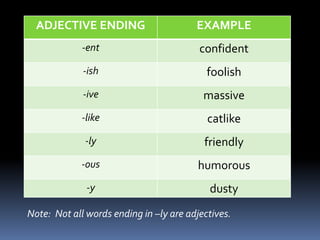
ADJECTIVE ENDING                      EXAMPLE
             -ent                        confident
             -ish                          foolish
             -ive                         massive
             -like                         catlike
             -ly                          friendly
             -ous                        humorous
              -y                           dusty
Note: Not all words ending in –ly are adjectives.
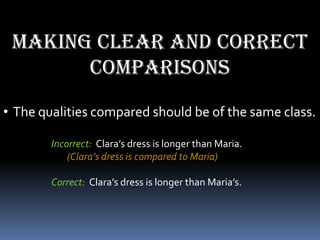
Making clear and correct
       comparisons
• The qualities compared should be of the same class.

        Incorrect: Clara’s dress is longer than Maria.
            (Clara’s dress is compared to Maria)

        Correct: Clara’s dress is longer than Maria’s.
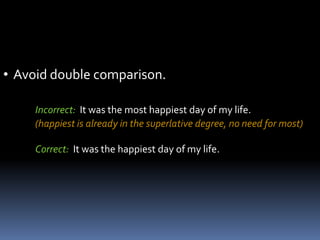
• Avoid double comparison.

     Incorrect: It was the most happiest day of my life.
     (happiest is already in the superlative degree, no need for most)

     Correct: It was the happiest day of my life.
Plotting information on a table

       An excellent way to display
       data or information in an
       organized fashion


   A table must have a title to show
   what it’s all about. There must be
   headings in the rows and columns.

          TIME FOR CHECKUP
Reference:

Language in Literature Philippine Literature Revised Edition by Ribo and Reyes
http://bigcsshop.hubpages.com/hub/100-Word-Examples-of-Onomatopoeia
http://www.notredamewelland.com/school/images/clubs/Digital-Damers_Free-Verse-
Poem.jpg&imgrefurl=http://www.notredamewelland.com/school/clubs_Digital_Dame
rs.htm&h=587&w=373&sz=54&tbnid=FAGjgb9QZAZt1M:&tbnh=90

Lesson Presentation (Edtech)

  • 1.
    PHILIPPINE LITERATURE 1STYEAR HIGH SCHOOL ENGLISH LESSONS
  • 2.
    Unit IV: THE CONTEMPORARYPERIOD LESSON 13 TREASURED MEMORIES Reading 1: “Tartanilla” Lesson: Onomatopeia Reading 2: “i apologize, waling-waling” Lesson: Finding Messages in Poetry Review about Free Verse
  • 3.
    VOCABULARY LISTENING SPEAKING STUDY GRAMMAR WRITING AND RESEARCH Recognizing Cause- Reading Reading a Using Plotting Words Taken Effect Poetry Aloud Table Adjectives Information From Relationship on a Table Mythology by Causality The Positions and Functions of Adjectives Using A and An Correctly Comparing Adjectives Recognizing Adjective Endings Making Clear and Correct Comparisons
  • 4.
    ONOMATOPOEIA the use ofwords that imitate the sounds associated with the objects or actions they refer to Example: bang hiss crackle giggle
  • 5.
    The steaks sizzledon the grill. Clap your hands a little louder. The water bubbled up from the sink. Zing, went the violin strings. The owl hooted as it sat in the tree.
  • 6.
    Messages in poetry The idea about life that a poet writes about is called the theme or message of the poem. Example: love violence anger childhood nature sorrow
  • 7.
    Free verse a poemthat has no regular rhyme or rhythm Many contemporary poets prefer to write in free verse for more freedom of expression.
  • 8.
    Example: Nature It’s a beautiful thing We go outside and it’s right there But we do not seem to notice it With trees growing all around us Birds searing in the air
  • 9.
    Words Taken FromMythology Many English expressions today come from Greek and Roman myths and legends.
  • 10.
    Example: mercurial temper (apt to change moods abruptly and with little cause) herculean task (work that needs great strength and endurance)
  • 11.
    CAUSE-EFFECT RELATIONSHIP One event is the reason another event happens. Cause - the event that happens first Effect - result; what happens due to the cause (can be an event or a change in behavior)
  • 12.
    He’s late forwork due to heavy traffic. effect cause
  • 13.
    Cue words ofthe cause-effect relationship: • in order • because • that • therefore • so that • since • if - then Sometimes, there are no cue words. TIME FOR CHECKUP!
  • 14.
    Reading poetry aloud Why? To communicate the ideas and feelings of the speaker in the poem. How: 1. Emphasize key words and phrases through pitch and volume of voice. 2. Vary reading pace.
  • 15.
    3. Read slowlyand loudly enough. a. Pronounce words distinctly. b. Pause only at commas, periods, and break in ideas 4. Read as though you are speaking to someone.
  • 17.
    READING A TABLE Table1: Final Medal Tally of the 22nd SEA Games Country Gold Silver Bronze Total 1. Determine what the table Vietnam 135 96 44 275 is about. Thailand 90 93 28 211 2. Study the headings Indonesia 67 56 34 157 at the top of each column. Philippines 22 45 77 144 Malaysia 16 53 70 139 3. Use the headings for the rows and columns to locate Singapore 4 34 84 122 specific information.
  • 18.
    USING ADJECTIVES An adjective is a word that describes, limits, or points out a noun. • SOME ADJECTIVES DESCRIBE. the man with a large jaw
  • 19.
    • SOME ADJECTIVESPOINT OUT. These are this, that, these, and those. This wallet is mine. • SOME ADJECTIVES TELL HOW MANY. five months sixth column
  • 20.
    • SOME ADJECTIVESARE INDEFINITE. These are many, some, any, other, few, and either. many teachers • THE ARTICLES A, AN, AND THE ARE ADJECTIVES. a ball
  • 21.
    • PROPER ADJECTIVESARE DERIVED FROM PROPER NOUNS. Filipino citizen • COMMON NOUNS ARE SOMETIMES USED AS ADJECTIVES. flower garden
  • 22.
    • SOME ADJECTIVESARE MADE UP OF TWO OR MORE HYPHENATED WORDS (COMPOUND WORDS). happy-go-lucky students
  • 23.
    The positions andfunctions of adjectives I see the green leaves on the trees. (modifier) The leaves of the tree are green. (predicate adjective) The boy painted the leaves green. (objective complement)
  • 24.
    Using a andan correctly •Use a before consonant sounds (not letters) a hotel a university •Use an before vowel sounds (again, not letters) an hour an honest man
  • 25.
    Comparing adjectives ComparativeAdjectives compare two objects. Superlative Adjectives are used in a comparison of three or more objects.
  • 26.
    Positive What to do Comparative Superlative short add –er/-est + shorter than the shortest than/the rich add –er/-est + richer than the richest than/the cute add –r/-st + cuter than the cutest (ending in e) than/the sleepy change y to i sleepier than the (ending in y) before adding sleepiest –er/-est + than/the
  • 27.
    Some adjectives oftwo syllables and all of three or more syllables are compared by using more or less for the comparative degree, and most or least for the superlative degree.
  • 28.
    Positive Comparative Superlative beautiful more beautiful most beautiful frequent less frequent least frequent sudden more sudden most sudden
  • 29.
    Irregular Adjectives –no specific rule in forming the comparative and superlative degrees Positive Comparative Superlative good better best much more most far farther farthest further furthest
  • 30.
    Some adjectives that cannotbe compared: absolute perfect correct round complete square equal supreme first unique last unanimous
  • 31.
    Recognizing adjective endings ADJECTIVE ENDING EXAMPLE -al emotional, sentimental -an Asian, American -ant pleasant, defiant -ar polar, popular -ary visionary, cautionary -ate affectionate, fortunate -en woolen, earthen
  • 32.
    ADJECTIVE ENDING EXAMPLE -ent confident -ish foolish -ive massive -like catlike -ly friendly -ous humorous -y dusty Note: Not all words ending in –ly are adjectives.
  • 33.
    Making clear andcorrect comparisons • The qualities compared should be of the same class. Incorrect: Clara’s dress is longer than Maria. (Clara’s dress is compared to Maria) Correct: Clara’s dress is longer than Maria’s.
  • 34.
    • Avoid doublecomparison. Incorrect: It was the most happiest day of my life. (happiest is already in the superlative degree, no need for most) Correct: It was the happiest day of my life.
  • 35.
    Plotting information ona table An excellent way to display data or information in an organized fashion A table must have a title to show what it’s all about. There must be headings in the rows and columns. TIME FOR CHECKUP
  • 36.
    Reference: Language in LiteraturePhilippine Literature Revised Edition by Ribo and Reyes http://bigcsshop.hubpages.com/hub/100-Word-Examples-of-Onomatopoeia http://www.notredamewelland.com/school/images/clubs/Digital-Damers_Free-Verse- Poem.jpg&imgrefurl=http://www.notredamewelland.com/school/clubs_Digital_Dame rs.htm&h=587&w=373&sz=54&tbnid=FAGjgb9QZAZt1M:&tbnh=90