BY: MERIAM G. CEMPRON
PHILOSOPHY OF EDUCATION
MONASTICISM
TOPICS TO BE DISCUSSED
A. ORIGIN
B. DEFINITION
C. AIMS
D. AGENDA OF EDUCATION AND CONTENT STUDIED
E. TYPES OF EDUCATION
G. METHODS OF INSTRUCTIONS
H. CONTRIBUTION TO EDUCATION
A.ORIGIN
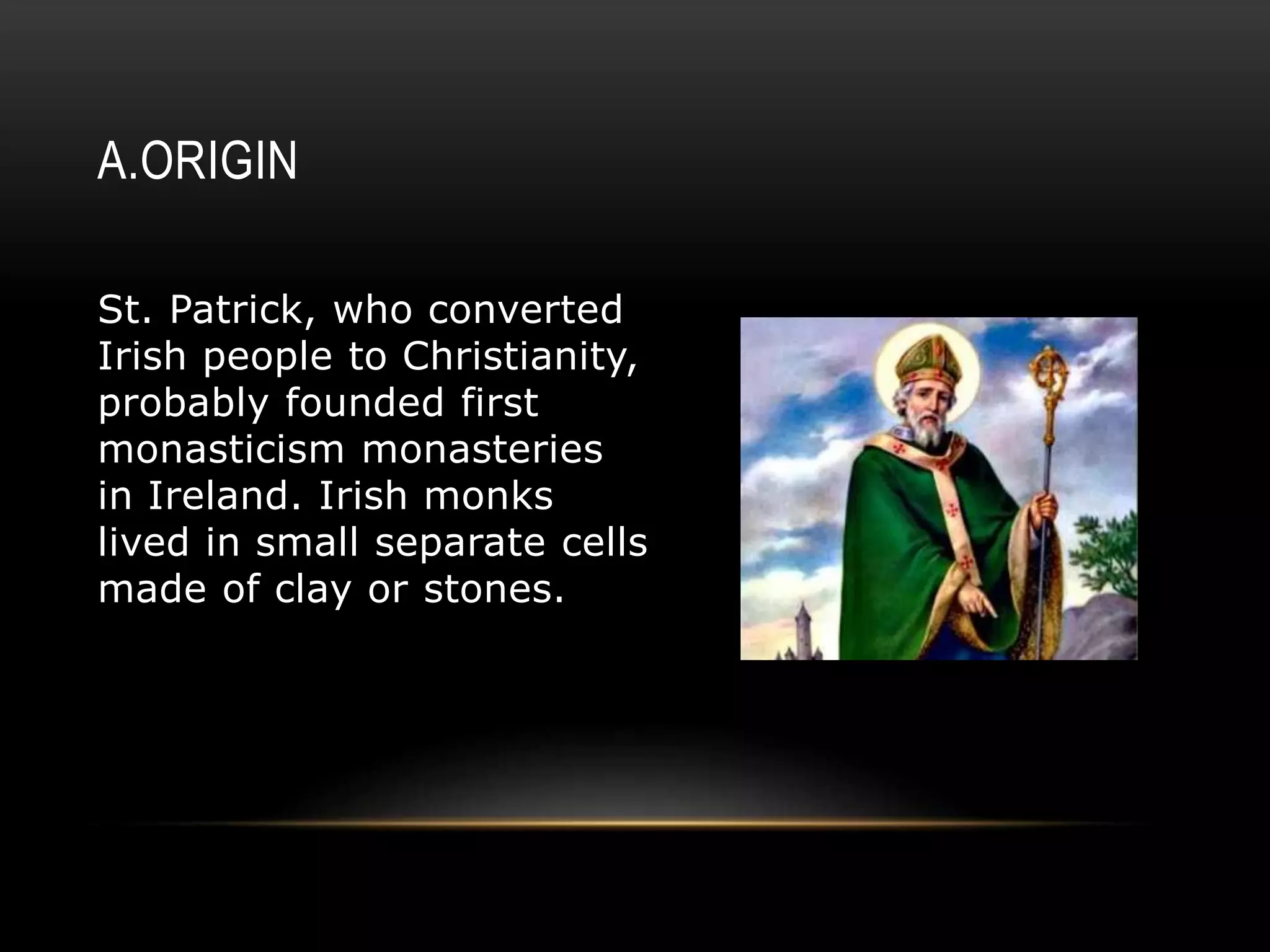
St. Patrick, who converted
Irish people to Christianity,
probably founded first
monasticism monasteries
in Ireland. Irish monks
lived in small separate cells
made of clay or stones.
A. ORIGIN St. Anthony as the
founder of Christian
monasticism. At age
20, he sold his
property, gave
proceeds to the poor,
and became a hermit
near his home in
Egypt. His days was
spent in prayer,
reading scriptures
and committing them
to memory and in
manual labor.
B. DEFINITION
Greek Word “monos”- ALONE
Sometimes “monachism”- DWELLING ALONE
-is a special form of religious community life.
People who practice monasticism separate
themselves from ordinary ways of living so they can
follow the teachings of their religion as completely as
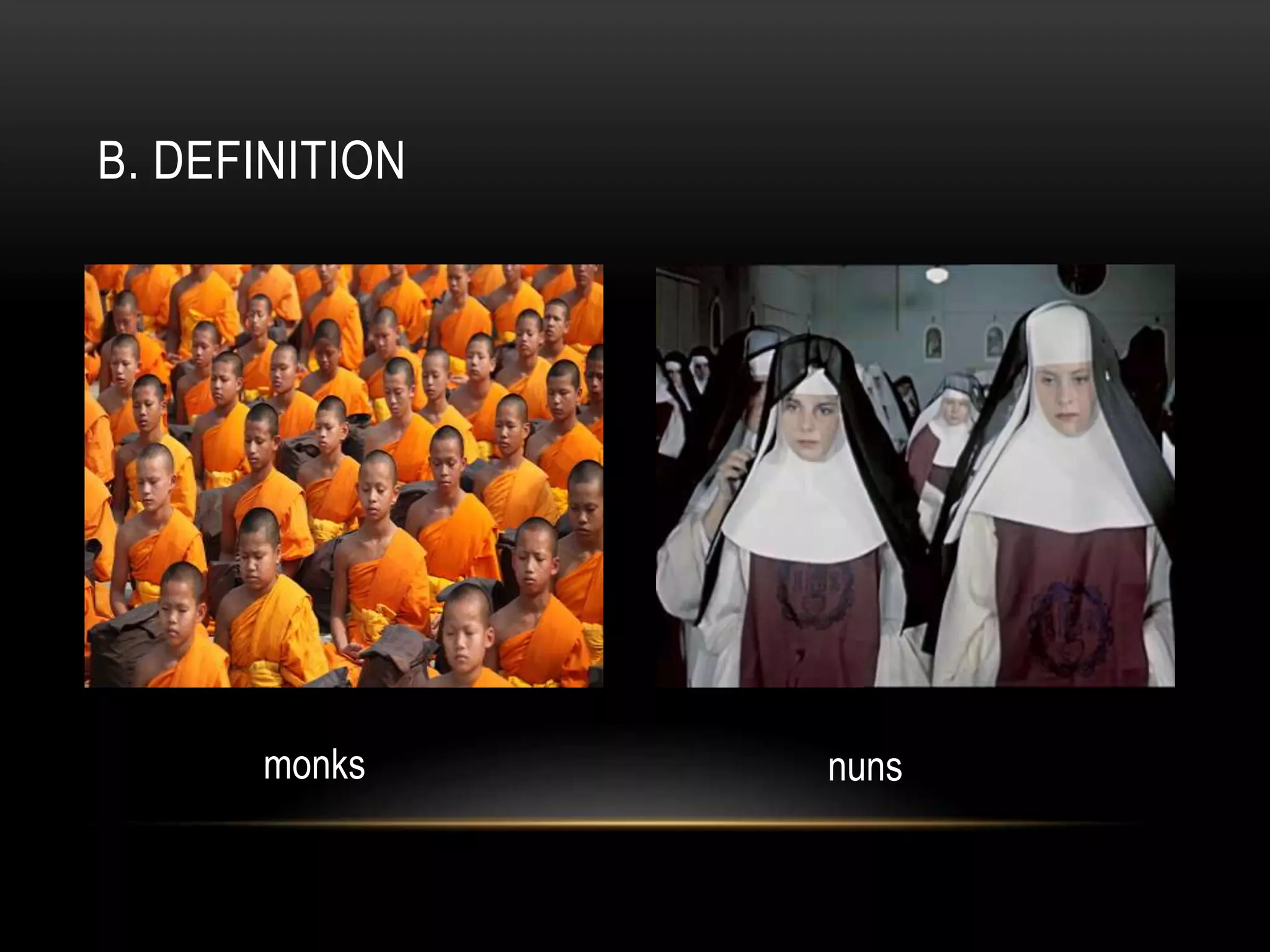
possible. Men are called MONKS women are called
NUNS.
B. DEFINITION
monks nuns
C. AIMS
1.Spiritual
The aim of monastic education is the salvation of
individual souls, a kind of moral and physical discipline
based on bodily mortification and worldly renunciation
for the sake of moral improvement.
C. AIMS
2. MORAL
 to attain the ideals of chastity, they gave up family
relationship, instead, adopted spiritual and religious
relationship.
 attain the ideals of poverty, they renounced
property, All inheritance devoted to charity.
 to attain the ideals of obedience they renounced
all self power but obeying the brothers and the will of
God.
C. AIMS
3.Spiritual Knowledge
Attain the highest spiritual knowledge
and the purest spiritual satisfaction
through meditation, contemplation, inspiration, and
asceticism.
C. AIMS
4. VIRTUE
Fasting, very little sleep, wearing coarse
clothing, and assuming painful bodily
postures measured the virtue of the monk.
World renunciation meant dying all claim
of social and human institutions.
D. AGENCIES OF EDUCATION AND CONTENTS
STUDIED
Monasteries and Monastic
schools were the only agencies for
education aside from the parish and cathedral schools.
D. AGENCIES OF EDUCATION AND CONTENTS
STUDIED
Seven Liberal Arts was THE CURRICULUM of the monastic school. It was composed of the ff:
The Trivium: (tres viae, three roads)
Grammar – language and literature
Dialect – logic or reasoning
Rhetoric – law and composition
The Quadrivium:
Geometry – geometry, geography, natural history
Arithmetic – numbers and the study of the calendar
Music – plain chant and harmony used in church
Astronomy – the heavenly bodies, chemistry and physics
E. TYPES OF EDUCATION
1.Moral and religious training
monks engaged themselves in religious contemplation,
meditation, asceticism, and religious reading and writing.
2. Literacy Education
copying manuscripts with other monasteries, collecting
manuscripts in libraries, and writing original manuscripts
concerning religion, historical events, and other matters.
3.Manual Training
monks are skilled artisans in wood, leather, and
metal, and skilled agriculturist.
F. ASPECTS OF SOCIAL ORGANIZATIONS
1.The domestic homes
the strictest hermit lived alone, in huts so placed that their
inmates could not see nor hear one another.
2.The Economics Structure
by the vows of poverty, monks promised not to possess
anything as his own or make use of it without the permission
from his superior.
3.The Political State
monks lived the same type of life; they did not constitute a
formal community and commit themselves to obey their
superior.
G. METHODS OF INSTRUCTIONS
1.Catechetical Method
the question and answer method was generally used as
the tool of teaching in monastic schools.
2.Dictation
heavily used due to scarcity of books.
3.Memorization
pupils had to memorize what was dictated to them.
G. METHODS OF INSTRUCTIONS
4.Language
Latin was the only language for learning
5.Discipline
discipline was severe. Teacher used the rod to
punish erring pupils.
6.Meditation and Contemplation/ Thoughtful Reflection
the monks believed that the deepest spiritual
experience could be gained only through divine
inspiration.
H. CONTRIBUTION TO EDUCATION
1.Preserving and spreading learning and
culture by the Christian Monasteries.
2.The monasteries opposed the vices and corruption
of the medieval world.
3.They were an influence of taming the warlike spirits
and refining the rustic customs of the teutonic people.
4.Dignity of Labor.
1. What is the goal of education in monasticism?
2. What is the role of the teacher?
3. View on the learners?
4. What are the methods or approaches in teaching?
Goals of Education
MONASTICISM
(as a midieval philosophy)
APPLICATION OF MONASTICISM
ON THE PRESENT TIME
 The salvation of individual souls, a
kind of moral and physical
discipline.
 Attain the highest spiritual
knowledge and the purest spiritual
satisfaction,
Provide the learners the highest form
of understanding not only in intellectual
aspect but also in learners behaviour
towards God, self and others.
Role of the Teacher
 engage the students in moral and
religious training
 give literacy education
 Provide manual training
 Incorporate corporal discipline
 engage the students in moral and
religious training
 give literacy education
 Provide manual training
View on the
Learner
A learner must separate himself/herself
from ordinary ways of living so they
can follow the teachings
 A learner is expected to live with
humility and service.
 follower
Methods/Approach
es of Teaching
 Catechetical Method
 Dictation
 Memorization
 Discipline
 Meditation and Contemplation
 Catechetical method
 Dictation
 Memorization
Thank you…
THE END

Monasticism philosophy of education

  • 1.
    BY: MERIAM G.CEMPRON PHILOSOPHY OF EDUCATION MONASTICISM
  • 2.
    TOPICS TO BEDISCUSSED A. ORIGIN B. DEFINITION C. AIMS D. AGENDA OF EDUCATION AND CONTENT STUDIED E. TYPES OF EDUCATION G. METHODS OF INSTRUCTIONS H. CONTRIBUTION TO EDUCATION
  • 3.
    A.ORIGIN St. Patrick, whoconverted Irish people to Christianity, probably founded first monasticism monasteries in Ireland. Irish monks lived in small separate cells made of clay or stones.
  • 4.
    A. ORIGIN St.Anthony as the founder of Christian monasticism. At age 20, he sold his property, gave proceeds to the poor, and became a hermit near his home in Egypt. His days was spent in prayer, reading scriptures and committing them to memory and in manual labor.
  • 5.
    B. DEFINITION Greek Word“monos”- ALONE Sometimes “monachism”- DWELLING ALONE -is a special form of religious community life. People who practice monasticism separate themselves from ordinary ways of living so they can follow the teachings of their religion as completely as possible. Men are called MONKS women are called NUNS.
  • 6.
  • 7.
    C. AIMS 1.Spiritual The aimof monastic education is the salvation of individual souls, a kind of moral and physical discipline based on bodily mortification and worldly renunciation for the sake of moral improvement.
  • 8.
    C. AIMS 2. MORAL to attain the ideals of chastity, they gave up family relationship, instead, adopted spiritual and religious relationship.  attain the ideals of poverty, they renounced property, All inheritance devoted to charity.  to attain the ideals of obedience they renounced all self power but obeying the brothers and the will of God.
  • 9.
    C. AIMS 3.Spiritual Knowledge Attainthe highest spiritual knowledge and the purest spiritual satisfaction through meditation, contemplation, inspiration, and asceticism.
  • 10.
    C. AIMS 4. VIRTUE Fasting,very little sleep, wearing coarse clothing, and assuming painful bodily postures measured the virtue of the monk. World renunciation meant dying all claim of social and human institutions.
  • 11.
    D. AGENCIES OFEDUCATION AND CONTENTS STUDIED Monasteries and Monastic schools were the only agencies for education aside from the parish and cathedral schools.
  • 12.
    D. AGENCIES OFEDUCATION AND CONTENTS STUDIED Seven Liberal Arts was THE CURRICULUM of the monastic school. It was composed of the ff: The Trivium: (tres viae, three roads) Grammar – language and literature Dialect – logic or reasoning Rhetoric – law and composition The Quadrivium: Geometry – geometry, geography, natural history Arithmetic – numbers and the study of the calendar Music – plain chant and harmony used in church Astronomy – the heavenly bodies, chemistry and physics
  • 13.
    E. TYPES OFEDUCATION 1.Moral and religious training monks engaged themselves in religious contemplation, meditation, asceticism, and religious reading and writing. 2. Literacy Education copying manuscripts with other monasteries, collecting manuscripts in libraries, and writing original manuscripts concerning religion, historical events, and other matters. 3.Manual Training monks are skilled artisans in wood, leather, and metal, and skilled agriculturist.
  • 14.
    F. ASPECTS OFSOCIAL ORGANIZATIONS 1.The domestic homes the strictest hermit lived alone, in huts so placed that their inmates could not see nor hear one another. 2.The Economics Structure by the vows of poverty, monks promised not to possess anything as his own or make use of it without the permission from his superior. 3.The Political State monks lived the same type of life; they did not constitute a formal community and commit themselves to obey their superior.
  • 15.
    G. METHODS OFINSTRUCTIONS 1.Catechetical Method the question and answer method was generally used as the tool of teaching in monastic schools. 2.Dictation heavily used due to scarcity of books. 3.Memorization pupils had to memorize what was dictated to them.
  • 16.
    G. METHODS OFINSTRUCTIONS 4.Language Latin was the only language for learning 5.Discipline discipline was severe. Teacher used the rod to punish erring pupils. 6.Meditation and Contemplation/ Thoughtful Reflection the monks believed that the deepest spiritual experience could be gained only through divine inspiration.
  • 17.
    H. CONTRIBUTION TOEDUCATION 1.Preserving and spreading learning and culture by the Christian Monasteries. 2.The monasteries opposed the vices and corruption of the medieval world. 3.They were an influence of taming the warlike spirits and refining the rustic customs of the teutonic people. 4.Dignity of Labor.
  • 18.
    1. What isthe goal of education in monasticism? 2. What is the role of the teacher? 3. View on the learners? 4. What are the methods or approaches in teaching?
  • 19.
    Goals of Education MONASTICISM (asa midieval philosophy) APPLICATION OF MONASTICISM ON THE PRESENT TIME  The salvation of individual souls, a kind of moral and physical discipline.  Attain the highest spiritual knowledge and the purest spiritual satisfaction, Provide the learners the highest form of understanding not only in intellectual aspect but also in learners behaviour towards God, self and others. Role of the Teacher  engage the students in moral and religious training  give literacy education  Provide manual training  Incorporate corporal discipline  engage the students in moral and religious training  give literacy education  Provide manual training View on the Learner A learner must separate himself/herself from ordinary ways of living so they can follow the teachings  A learner is expected to live with humility and service.  follower Methods/Approach es of Teaching  Catechetical Method  Dictation  Memorization  Discipline  Meditation and Contemplation  Catechetical method  Dictation  Memorization
  • 20.