RADAR AND SYNTHETIC APERTURE RADAR SYSTEM JITENDER KUMAR 07-ECE-236
OVERVIEW PRINCIPLES OF IMAGING RADAR RADAR INTERFEROMETRY FOR HEIGHT MAPPING  SIMULTANEOUS ACQUISITION REPEAT TRACK DIFFERENTIAL INTERFEROMETRY FOR CHANGE DETECTION
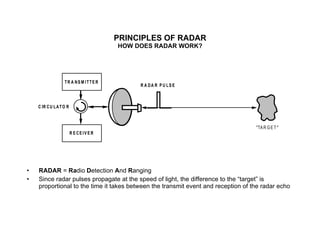
PRINCIPLES OF RADAR HOW DOES RADAR WORK? RADAR  =  Ra dio  D etection  A nd  R anging Since radar pulses propagate at the speed of light, the difference to the “target” is proportional to the time it takes between the transmit event and reception of the radar echo
PRINCIPLES OF IMAGING RADAR THE RADAR EQUATION In order to improve the signal-to-noise ratio for a fixed radar frequency, one has (among others) the following options: Increase the transmitted power.  This is usually limited by the power available from the spacecraft or aircraft. Increase the antenna gain.  This requires larger antennas, severely affecting the launch mass and volume. Increase the pulse length.  This means poorer resolution. Decrease bandwidth.  This also means poorer resolution. Fly lower.  Increases atmospheric drag, requiring more fuel for orbit maintenance. Signal modulation is a way to increase the radar pulse length without decreasing the radar range resolution All civilian spaceborne SARs, and most civilian airborne SARs use linear FM chirps as the modulation scheme.
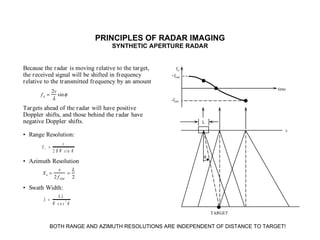
PRINCIPLES OF RADAR IMAGING SYNTHETIC APERTURE RADAR BOTH RANGE AND AZIMUTH RESOLUTIONS ARE INDEPENDENT OF DISTANCE TO TARGET! f d +f DM -f DM time TARGET L  v
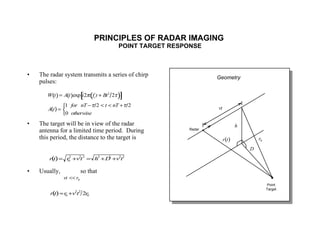
PRINCIPLES OF RADAR IMAGING  POINT TARGET RESPONSE The radar system transmits a series of chirp pulses: The target will be in view of the radar antenna for a limited time period.  During this period, the distance to the target is Usually,  so that Point Target Radar Geometry
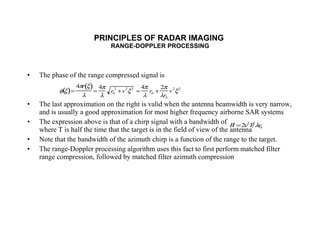
PRINCIPLES OF RADAR IMAGING  RANGE-DOPPLER PROCESSING The phase of the range compressed signal is The last approximation on the right is valid when the antenna beamwidth is very narrow, and is usually a good approximation for most higher frequency airborne SAR systems The expression above is that of a chirp signal with a bandwidth of  where T is half the time that the target is in the field of view of the antenna Note that the bandwidth of the azimuth chirp is a function of the range to the target. The range-Doppler processing algorithm uses this fact to first perform matched filter range compression, followed by matched filter azimuth compression
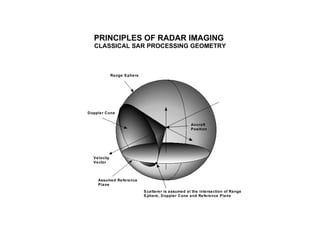
PRINCIPLES OF RADAR IMAGING  CLASSICAL SAR PROCESSING GEOMETRY insert sphere
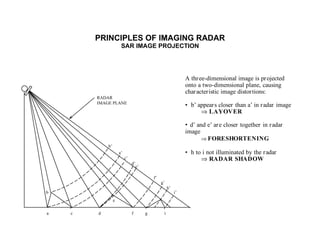
PRINCIPLES OF IMAGING RADAR SAR IMAGE PROJECTION a c d f g i b e b’ a’ c’ d’ e’ g’ h’ i’ f’ RADAR IMAGE PLANE
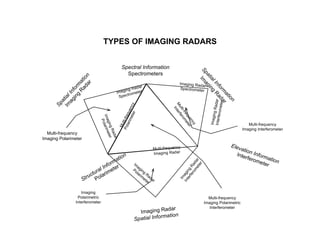
TYPES OF IMAGING RADARS Spatial Information Imaging Radar Spatial Information Imaging Radar Spatial Information Imaging Radar Elevation Information Interferometer Spectral Information Spectrometers Structural Information Polarimeter Imaging Radar Spectrometer Imaging Radar Interferometer Imaging Radar Spectrometer Imaging Radar Polarimeter Imaging Radar Polarimeter Imaging Radar Interferometer Multi-frequency Polarimeter Multi-frequency Interferometer Multi-frequency Imaging Radar Multi-frequency Imaging Polarimeter Imaging Polarimetric Interferometer Multi-frequency Imaging Interferometer Multi-frequency Imaging Polarimetric Interferometer
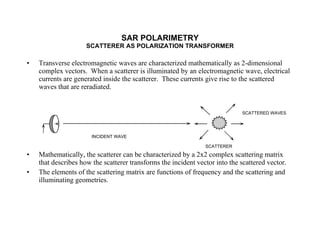
Transverse electromagnetic waves are characterized mathematically as 2-dimensional complex vectors.  When a scatterer is illuminated by an electromagnetic wave, electrical currents are generated inside the scatterer.  These currents give rise to the scattered waves that are reradiated. Mathematically, the scatterer can be characterized by a 2x2 complex scattering matrix that describes how the scatterer transforms the incident vector into the scattered vector. The elements of the scattering matrix are functions of frequency and the scattering and illuminating geometries. SAR POLARIMETRY SCATTERER AS POLARIZATION TRANSFORMER INCIDENT WAVE SCATTERER SCATTERED WAVES
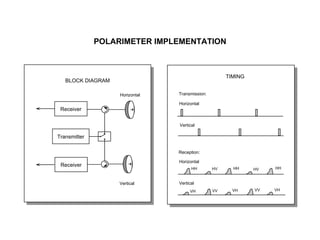
POLARIMETER IMPLEMENTATION TIMING Transmission: Horizontal Vertical Reception: Horizontal Vertical HH HH HH HV HV VH VV VH VV VH Transmitter Receiver Receiver BLOCK DIAGRAM Horizontal Vertical
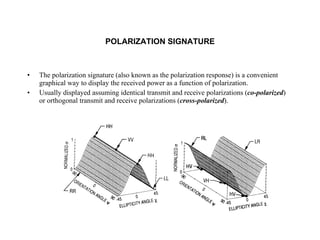
POLARIZATION SIGNATURE The polarization signature (also known as the polarization response) is a convenient graphical way to display the received power as a function of polarization. Usually displayed assuming identical transmit and receive polarizations ( co-polarized ) or orthogonal transmit and receive polarizations ( cross-polarized ).
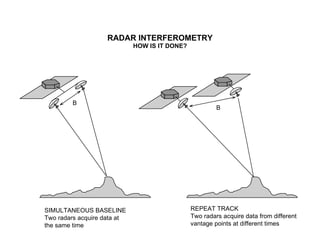
RADAR INTERFEROMETRY HOW IS IT DONE? SIMULTANEOUS BASELINE Two radars acquire data at the same time REPEAT TRACK Two radars acquire data from different  vantage points at different times B B
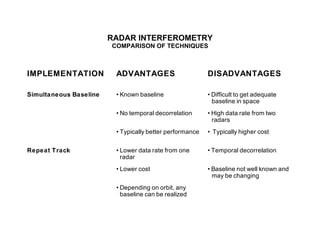
RADAR INTERFEROMETRY COMPARISON OF TECHNIQUES
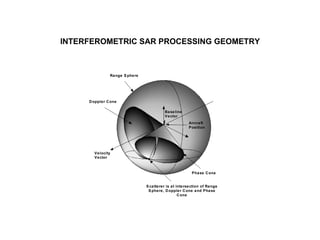
INTERFEROMETRIC SAR PROCESSING GEOMETRY insert sphere
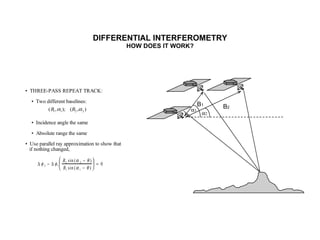
DIFFERENTIAL INTERFEROMETRY HOW DOES IT WORK? B 2 B 1    
DIFFERENTIAL INTERFEROMETRY ERROR SOURCES Uncompensated differential motion Atmospheric effects Temporal decorrelation Layover
EMERGING SAR TECHNIQUES POLARIMETRIC INTERFEROMETRY Polarimetric interferometry is implemented by measuring the full scattering matrix at each end of the interferometric baseline Currently there are no single baseline systems that can acquire this type of data During the last three days of the second SIR-C/X-SAR mission the system was operated in the repeat-pass interferometric mode, and some fully polarimetric interferometric data were acquired Using the full scattering matrix one can now solve for the optimum polarization to maximize the interferometric coherence This problem was first analyzed and reported by Cloude and Papathanassiou Using interferograms acquired with different polarization combinations, one can also for vector differential interferograms These vector differential interferograms have been shown to measure large elevation differences in forested areas, and cm-level elevation differences in agricultural fields
EMERGING SAR TECHNIQUES  TOPOGRAPHY FROM POLARIMETRY By measuring the shift in the maximum of the polarization signature, the tilt of the surface in the azimuth direction can be estimated. In vegetated areas, P-Band data are used since a tilted surface will show a similar behavior if the trunk-ground interaction term is relatively strong The accuracy with which one can measure the surface tilt is determined by the signal to noise ratio Once the surface tilts (surface slopes) are known, the slopes are integrated in the azimuth direction to find the topography as a series of azimuth profiles Ground control points are needed to find the correct absolute height, and to tie different azimuth profiles together By using data acquired in a crossing flight pattern, the topography can be derived requiring only a single ground control point While the accuracy of this technique is not as good as that of interferometry, crude digital elevation maps can be produced.

radar-ppt

  • 1.
    RADAR AND SYNTHETICAPERTURE RADAR SYSTEM JITENDER KUMAR 07-ECE-236
  • 2.
    OVERVIEW PRINCIPLES OFIMAGING RADAR RADAR INTERFEROMETRY FOR HEIGHT MAPPING SIMULTANEOUS ACQUISITION REPEAT TRACK DIFFERENTIAL INTERFEROMETRY FOR CHANGE DETECTION
  • 3.
    PRINCIPLES OF RADARHOW DOES RADAR WORK? RADAR = Ra dio D etection A nd R anging Since radar pulses propagate at the speed of light, the difference to the “target” is proportional to the time it takes between the transmit event and reception of the radar echo
  • 4.
    PRINCIPLES OF IMAGINGRADAR THE RADAR EQUATION In order to improve the signal-to-noise ratio for a fixed radar frequency, one has (among others) the following options: Increase the transmitted power. This is usually limited by the power available from the spacecraft or aircraft. Increase the antenna gain. This requires larger antennas, severely affecting the launch mass and volume. Increase the pulse length. This means poorer resolution. Decrease bandwidth. This also means poorer resolution. Fly lower. Increases atmospheric drag, requiring more fuel for orbit maintenance. Signal modulation is a way to increase the radar pulse length without decreasing the radar range resolution All civilian spaceborne SARs, and most civilian airborne SARs use linear FM chirps as the modulation scheme.
  • 5.
    PRINCIPLES OF RADARIMAGING SYNTHETIC APERTURE RADAR BOTH RANGE AND AZIMUTH RESOLUTIONS ARE INDEPENDENT OF DISTANCE TO TARGET! f d +f DM -f DM time TARGET L  v
  • 6.
    PRINCIPLES OF RADARIMAGING POINT TARGET RESPONSE The radar system transmits a series of chirp pulses: The target will be in view of the radar antenna for a limited time period. During this period, the distance to the target is Usually, so that Point Target Radar Geometry
  • 7.
    PRINCIPLES OF RADARIMAGING RANGE-DOPPLER PROCESSING The phase of the range compressed signal is The last approximation on the right is valid when the antenna beamwidth is very narrow, and is usually a good approximation for most higher frequency airborne SAR systems The expression above is that of a chirp signal with a bandwidth of where T is half the time that the target is in the field of view of the antenna Note that the bandwidth of the azimuth chirp is a function of the range to the target. The range-Doppler processing algorithm uses this fact to first perform matched filter range compression, followed by matched filter azimuth compression
  • 8.
    PRINCIPLES OF RADARIMAGING CLASSICAL SAR PROCESSING GEOMETRY insert sphere
  • 9.
    PRINCIPLES OF IMAGINGRADAR SAR IMAGE PROJECTION a c d f g i b e b’ a’ c’ d’ e’ g’ h’ i’ f’ RADAR IMAGE PLANE
  • 10.
    TYPES OF IMAGINGRADARS Spatial Information Imaging Radar Spatial Information Imaging Radar Spatial Information Imaging Radar Elevation Information Interferometer Spectral Information Spectrometers Structural Information Polarimeter Imaging Radar Spectrometer Imaging Radar Interferometer Imaging Radar Spectrometer Imaging Radar Polarimeter Imaging Radar Polarimeter Imaging Radar Interferometer Multi-frequency Polarimeter Multi-frequency Interferometer Multi-frequency Imaging Radar Multi-frequency Imaging Polarimeter Imaging Polarimetric Interferometer Multi-frequency Imaging Interferometer Multi-frequency Imaging Polarimetric Interferometer
  • 11.
    Transverse electromagnetic wavesare characterized mathematically as 2-dimensional complex vectors. When a scatterer is illuminated by an electromagnetic wave, electrical currents are generated inside the scatterer. These currents give rise to the scattered waves that are reradiated. Mathematically, the scatterer can be characterized by a 2x2 complex scattering matrix that describes how the scatterer transforms the incident vector into the scattered vector. The elements of the scattering matrix are functions of frequency and the scattering and illuminating geometries. SAR POLARIMETRY SCATTERER AS POLARIZATION TRANSFORMER INCIDENT WAVE SCATTERER SCATTERED WAVES
  • 12.
    POLARIMETER IMPLEMENTATION TIMINGTransmission: Horizontal Vertical Reception: Horizontal Vertical HH HH HH HV HV VH VV VH VV VH Transmitter Receiver Receiver BLOCK DIAGRAM Horizontal Vertical
  • 13.
    POLARIZATION SIGNATURE Thepolarization signature (also known as the polarization response) is a convenient graphical way to display the received power as a function of polarization. Usually displayed assuming identical transmit and receive polarizations ( co-polarized ) or orthogonal transmit and receive polarizations ( cross-polarized ).
  • 14.
    RADAR INTERFEROMETRY HOWIS IT DONE? SIMULTANEOUS BASELINE Two radars acquire data at the same time REPEAT TRACK Two radars acquire data from different vantage points at different times B B
  • 15.
  • 16.
    INTERFEROMETRIC SAR PROCESSINGGEOMETRY insert sphere
  • 17.
    DIFFERENTIAL INTERFEROMETRY HOWDOES IT WORK? B 2 B 1    
  • 18.
    DIFFERENTIAL INTERFEROMETRY ERRORSOURCES Uncompensated differential motion Atmospheric effects Temporal decorrelation Layover
  • 19.
    EMERGING SAR TECHNIQUESPOLARIMETRIC INTERFEROMETRY Polarimetric interferometry is implemented by measuring the full scattering matrix at each end of the interferometric baseline Currently there are no single baseline systems that can acquire this type of data During the last three days of the second SIR-C/X-SAR mission the system was operated in the repeat-pass interferometric mode, and some fully polarimetric interferometric data were acquired Using the full scattering matrix one can now solve for the optimum polarization to maximize the interferometric coherence This problem was first analyzed and reported by Cloude and Papathanassiou Using interferograms acquired with different polarization combinations, one can also for vector differential interferograms These vector differential interferograms have been shown to measure large elevation differences in forested areas, and cm-level elevation differences in agricultural fields
  • 20.
    EMERGING SAR TECHNIQUES TOPOGRAPHY FROM POLARIMETRY By measuring the shift in the maximum of the polarization signature, the tilt of the surface in the azimuth direction can be estimated. In vegetated areas, P-Band data are used since a tilted surface will show a similar behavior if the trunk-ground interaction term is relatively strong The accuracy with which one can measure the surface tilt is determined by the signal to noise ratio Once the surface tilts (surface slopes) are known, the slopes are integrated in the azimuth direction to find the topography as a series of azimuth profiles Ground control points are needed to find the correct absolute height, and to tie different azimuth profiles together By using data acquired in a crossing flight pattern, the topography can be derived requiring only a single ground control point While the accuracy of this technique is not as good as that of interferometry, crude digital elevation maps can be produced.