A relay is an electrically operated switch. Many
relays use an electromagnet to mechanically
operate a switch, but other operating principles
are also used, such as solid-state relays. Relays
are used where it is necessary to control a
circuit by a separate low-power signal, or where
several circuits must be controlled by one
signal. The first relays were used in long
distance telegraph circuits as amplifiers: they
repeated the signal coming in from one circuit
and re-transmitted it on another circuit.
American scientist Joseph Henry is
often claimed to have invented a
relay in 1835 in order to improve his
version of the electrical telegraph,
developed earlier in 1831.However,
there is little in the way of official
documentation to suggest he had
made the discovery prior to 1837.
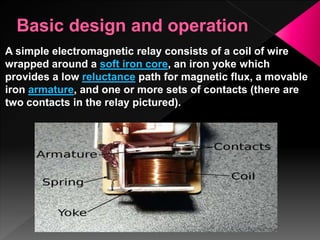
A simple electromagnetic relay consists of a coil of wire
wrapped around a soft iron core, an iron yoke which
provides a low reluctance path for magnetic flux, a movable
iron armature, and one or more sets of contacts (there are
two contacts in the relay pictured).
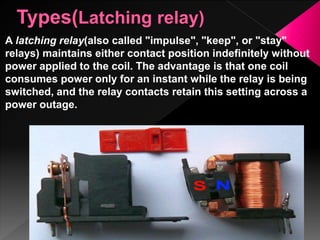
A latching relay(also called "impulse", "keep", or "stay"
relays) maintains either contact position indefinitely without
power applied to the coil. The advantage is that one coil
consumes power only for an instant while the relay is being
switched, and the relay contacts retain this setting across a
power outage.
A reed relay is a reed switch enclosed in a solenoid. The
switch has a set of contacts inside an evacuated or inert gas-
filled glass tube which protects the contacts against
atmospheric corrosion; the contacts are made
of magnetic material that makes them move under the
influence of the field of the enclosing solenoid or an external
magnet.
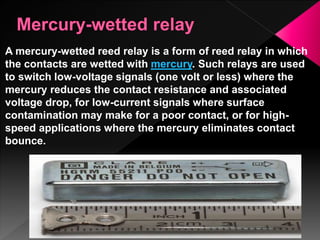
A mercury-wetted reed relay is a form of reed relay in which
the contacts are wetted with mercury. Such relays are used
to switch low-voltage signals (one volt or less) where the
mercury reduces the contact resistance and associated
voltage drop, for low-current signals where surface
contamination may make for a poor contact, or for high-
speed applications where the mercury eliminates contact
bounce.
A polarized relay places the
armature between the poles of a
permanent magnet to increase
sensitivity. Polarized relays were
used in middle 20th
Century telephone exchanges to
detect faint pulses and
correct telegraphic distortion.
A machine tool relay is a type standardized
for industrial control of machine tools,
transfer machines, and other sequential
control. They are characterized by a large
number of contacts (sometimes extendable in
the field) which are easily converted from
normally open to normally closed status,
easily replaceable coils, and a form factor that
allows compactly installing many relays in a
control panel.
Where radio transmitters and receivers share one
antenna, often a coaxial relay is used as a TR
(transmit-receive) relay, which switches the antenna
from the receiver to the transmitter. This protects
the receiver from the high power of the transmitter.
Such relays are often used in transceivers which
combine transmitter and receiver in one unit. The
relay contacts are designed not to reflect any radio
frequency power back toward the source, and to
provide very high isolation between receiver and
transmitter terminals.
Timing relays are arranged for an
intentional delay in operating their
contacts. A very short (a fraction of a
second) delay would use a copper disk
between the armature and moving blade
assembly. Current flowing in the disk
maintains magnetic field for a short
time, lengthening release time. For a
slightly longer (up to a minute) delay,
a dashpot is used.
A solid state relay or SSR is a solid state electronic
component that provides a function similar to
an electromechanical relay but does not have any moving
components, increasing long-term reliability.
A solid state contactor is a heavy-duty solid state
relay, including the necessary heat sink, used where
frequent on/off cycles are required, such as with
electric heaters, small electric motors, and lighting
loads. There are no moving parts to wear out and
there is no contact bounce due to vibration. They
are activated by AC control signals or DC control
signals from Programmable logic controller (PLCs),
PCs, Transistor-transistor logic (TTL) sources, or
other microprocessor and microcontroller controls.
A 'force-guided contacts relay' has
relay contacts that are mechanically
linked together, so that when the
relay coil is energized or de-
energized, all of the linked contacts
move together. If one set of contacts
in the relay becomes immobilized, no
other contact of the same relay will be
able to move.
A sensitive relay having its
contacts mounted in a highly
evacuated glass housing, to
permit handling radio-frequency
voltages as high as 20,000 volts
without flashover between
contacts even though contact
spacing is but a few hundredths
of an inch when open.
Since relays are switches, the
terminology applied to
switches is also applied to
relays; a relay switches one
or more poles, each of whose
contacts can be thrown by
energizing the coil.
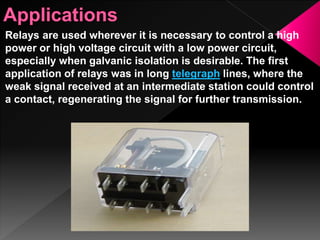
Relays are used wherever it is necessary to control a high
power or high voltage circuit with a low power circuit,
especially when galvanic isolation is desirable. The first
application of relays was in long telegraph lines, where the
weak signal received at an intermediate station could control
a contact, regenerating the signal for further transmission.
Relay
Relay
Relay

Relay

  • 2.
    A relay isan electrically operated switch. Many relays use an electromagnet to mechanically operate a switch, but other operating principles are also used, such as solid-state relays. Relays are used where it is necessary to control a circuit by a separate low-power signal, or where several circuits must be controlled by one signal. The first relays were used in long distance telegraph circuits as amplifiers: they repeated the signal coming in from one circuit and re-transmitted it on another circuit.
  • 3.
    American scientist JosephHenry is often claimed to have invented a relay in 1835 in order to improve his version of the electrical telegraph, developed earlier in 1831.However, there is little in the way of official documentation to suggest he had made the discovery prior to 1837.
  • 5.
    A simple electromagneticrelay consists of a coil of wire wrapped around a soft iron core, an iron yoke which provides a low reluctance path for magnetic flux, a movable iron armature, and one or more sets of contacts (there are two contacts in the relay pictured).
  • 6.
    A latching relay(alsocalled "impulse", "keep", or "stay" relays) maintains either contact position indefinitely without power applied to the coil. The advantage is that one coil consumes power only for an instant while the relay is being switched, and the relay contacts retain this setting across a power outage.
  • 7.
    A reed relayis a reed switch enclosed in a solenoid. The switch has a set of contacts inside an evacuated or inert gas- filled glass tube which protects the contacts against atmospheric corrosion; the contacts are made of magnetic material that makes them move under the influence of the field of the enclosing solenoid or an external magnet.
  • 8.
    A mercury-wetted reedrelay is a form of reed relay in which the contacts are wetted with mercury. Such relays are used to switch low-voltage signals (one volt or less) where the mercury reduces the contact resistance and associated voltage drop, for low-current signals where surface contamination may make for a poor contact, or for high- speed applications where the mercury eliminates contact bounce.
  • 9.
    A polarized relayplaces the armature between the poles of a permanent magnet to increase sensitivity. Polarized relays were used in middle 20th Century telephone exchanges to detect faint pulses and correct telegraphic distortion.
  • 10.
    A machine toolrelay is a type standardized for industrial control of machine tools, transfer machines, and other sequential control. They are characterized by a large number of contacts (sometimes extendable in the field) which are easily converted from normally open to normally closed status, easily replaceable coils, and a form factor that allows compactly installing many relays in a control panel.
  • 11.
    Where radio transmittersand receivers share one antenna, often a coaxial relay is used as a TR (transmit-receive) relay, which switches the antenna from the receiver to the transmitter. This protects the receiver from the high power of the transmitter. Such relays are often used in transceivers which combine transmitter and receiver in one unit. The relay contacts are designed not to reflect any radio frequency power back toward the source, and to provide very high isolation between receiver and transmitter terminals.
  • 12.
    Timing relays arearranged for an intentional delay in operating their contacts. A very short (a fraction of a second) delay would use a copper disk between the armature and moving blade assembly. Current flowing in the disk maintains magnetic field for a short time, lengthening release time. For a slightly longer (up to a minute) delay, a dashpot is used.
  • 16.
    A solid staterelay or SSR is a solid state electronic component that provides a function similar to an electromechanical relay but does not have any moving components, increasing long-term reliability.
  • 17.
    A solid statecontactor is a heavy-duty solid state relay, including the necessary heat sink, used where frequent on/off cycles are required, such as with electric heaters, small electric motors, and lighting loads. There are no moving parts to wear out and there is no contact bounce due to vibration. They are activated by AC control signals or DC control signals from Programmable logic controller (PLCs), PCs, Transistor-transistor logic (TTL) sources, or other microprocessor and microcontroller controls.
  • 19.
    A 'force-guided contactsrelay' has relay contacts that are mechanically linked together, so that when the relay coil is energized or de- energized, all of the linked contacts move together. If one set of contacts in the relay becomes immobilized, no other contact of the same relay will be able to move.
  • 20.
    A sensitive relayhaving its contacts mounted in a highly evacuated glass housing, to permit handling radio-frequency voltages as high as 20,000 volts without flashover between contacts even though contact spacing is but a few hundredths of an inch when open.
  • 21.
    Since relays areswitches, the terminology applied to switches is also applied to relays; a relay switches one or more poles, each of whose contacts can be thrown by energizing the coil.
  • 22.
    Relays are usedwherever it is necessary to control a high power or high voltage circuit with a low power circuit, especially when galvanic isolation is desirable. The first application of relays was in long telegraph lines, where the weak signal received at an intermediate station could control a contact, regenerating the signal for further transmission.