Relays
Prepared by Atheena Pandian
PRSENTATION
OVERVIEW
POINTS FOR DISCUSSION
What is Relay?
Electronic symbol
Pole and Throw
Construvtion
Simple Circuit Diagram
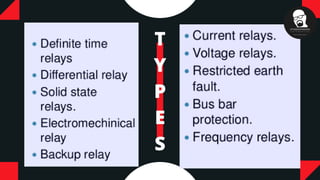
Types
Advantages
1.
2.
3.
4.
5.
6.
7.
WHAT IS
RELAY?
A relay is an electromagnetic switch operated by a
relatively small electric current that can turn on or off a
much larger electric current.
The heart of a relay is an electromagnet (a coil of wire that
becomes a temporary magnet when electricity flows
through it).
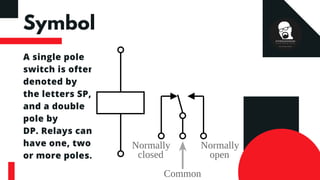
Symbol
A single pole
switch is often
denoted by
the letters SP,
and a double
pole by
DP. Relays can
have one, two
or more poles.
Common
Normally Normally
closed open
Throw and Pole
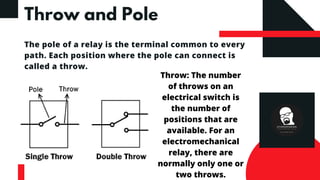
The pole of a relay is the terminal common to every
path. Each position where the pole can connect is
called a throw.
Throw: The number
of throws on an
electrical switch is
the number of
positions that are
available. For an
electromechanical
relay, there are
normally only one or
two throws.
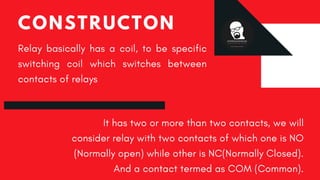
CONSTRUCTON
Relay  basically has a coil, to be specific
switching coil which switches between
contacts of relays
It has two or more than two contacts, we will
consider relay with two contacts of which one is NO
(Normally open) while other is NC(Normally Closed).
And a contact termed as COM (Common).
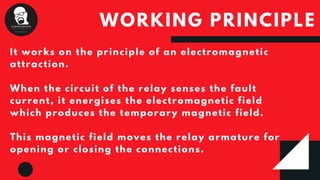
WORKING PRINCIPLE
It works on the principle of an electromagnetic
attraction.
When the circuit of the relay senses the fault
current, it energises the electromagnetic field
which produces the temporary magnetic field.
This magnetic field moves the relay armature for
opening or closing the connections.
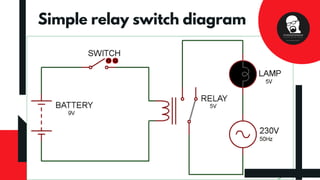
Simple relay switch diagram
T
Y
P
E
S
The advantage of relays is
that it takes a relatively
small amount of power to
operate the relay coil, but
the relay itself can be used
to control motors, heaters,
lamps or AC circuits which
themselves can draw a lot
more electrical power.
Applications
Thank You

Relay basics

  • 1.
  • 2.
    PRSENTATION OVERVIEW POINTS FOR DISCUSSION Whatis Relay? Electronic symbol Pole and Throw Construvtion Simple Circuit Diagram Types Advantages 1. 2. 3. 4. 5. 6. 7.
  • 3.
    WHAT IS RELAY? A relay is anelectromagnetic switch operated by a relatively small electric current that can turn on or off a much larger electric current. The heart of a relay is an electromagnet (a coil of wire that becomes a temporary magnet when electricity flows through it).
  • 4.
    Symbol A single pole switchis often denoted by the letters SP, and a double pole by DP. Relays can have one, two or more poles. Common Normally Normally closed open
  • 5.
    Throw and Pole Thepole of a relay is the terminal common to every path. Each position where the pole can connect is called a throw. Throw: The number of throws on an electrical switch is the number of positions that are available. For an electromechanical relay, there are normally only one or two throws.
  • 6.
    CONSTRUCTON Relay  basically hasa coil, to be specific switching coil which switches between contacts of relays It has two or more than two contacts, we will consider relay with two contacts of which one is NO (Normally open) while other is NC(Normally Closed). And a contact termed as COM (Common).
  • 7.
    WORKING PRINCIPLE It workson the principle of an electromagnetic attraction. When the circuit of the relay senses the fault current, it energises the electromagnetic field which produces the temporary magnetic field. This magnetic field moves the relay armature for opening or closing the connections.
  • 8.
  • 9.
  • 10.
    The advantage ofrelays is that it takes a relatively small amount of power to operate the relay coil, but the relay itself can be used to control motors, heaters, lamps or AC circuits which themselves can draw a lot more electrical power. Applications
  • 11.