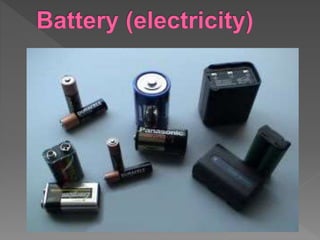
An electric battery is a device consisting
of one or more electrochemical cells with
external connections provided to power
electrical devices such
as flashlights, smartphones, and electric
cars.[1] When a battery is
supplying electric power, its positive
terminal is the cathode and its negative
terminal is the anode.
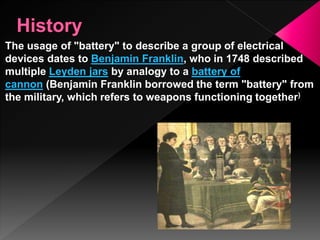
The usage of "battery" to describe a group of electrical
devices dates to Benjamin Franklin, who in 1748 described
multiple Leyden jars by analogy to a battery of
cannon (Benjamin Franklin borrowed the term "battery" from
the military, which refers to weapons functioning together)
Batteries convert chemical energy directly to electrical
energy. A battery consists of some number of voltaic cells.
Primary batteries are designed to be used
until exhausted of energy then discarded.
Their chemical reactions are generally not
reversible, so they cannot be recharged.
When the supply of reactants in the battery is
exhausted, the battery stops producing
current and is useless.
Secondary batteries can be recharged; that is,
they can have their chemical reactions
reversed by applying electric current to the
cell.
Primary batteries, or primary cells, can produce
current immediately on assembly. These are most
commonly used in portable devices that have low
current drain, are used only intermittently, or are
used well away from an alternative power source,
such as in alarm and communication circuits
where other electric power is only intermittently
available. Disposable primary cells cannot be
reliably recharged, since the chemical reactions
are not easily reversible and active materials may
not return to their original forms.
Secondary batteries, also known
as secondary cells, or rechargeable
batteries, must be charged before first
use; they are usually assembled with
active materials in the discharged state.
Rechargeable batteries are (re)charged by
applying electric current, which reverses
the chemical reactions that occur during
discharge/use. Devices to supply the
appropriate current are called chargers.
Many types of electrochemical
cells have been produced, with
varying chemical processes and
designs, including galvanic
cells, electrolytic cells, fuel
cells, flow cells and voltaic piles.
A wet cell battery has a liquid electrolyte.
Other names are flooded cell, since the
liquid covers all internal parts, or vented
cell, since gases produced during
operation can escape to the air. Wet cells
were a precursor to dry cells and are
commonly used as a learning tool
for electrochemistry.
A dry cell uses a paste electrolyte, with only enough
moisture to allow current to flow.
Molten salt batteries are
primary or secondary
batteries that use a molten
salt as electrolyte. They
operate at high
temperatures and must be
well insulated to retain heat
A reserve battery can be stored
unassembled (inactivated and
supplying no power) for a long
period (perhaps years). When the
battery is needed, then it is
assembled (e.g., by adding
electrolyte); once assembled, the
battery is charged and ready to
work.
A battery's capacity is the amount of electric charge it can
deliver at the rated voltage. The more electrode material
contained in the cell the greater its capacity.
As of 2012, lithium iron phosphate
(LiFePO
4) battery technology was the fastest-
charging/discharging, fully discharging in
10–20 seconds.
As of 2013, the world's largest battery was
in Hubei Province, China. It stored 36
megawatt-hours of electricity at a cost of
$500 million.
Battery life (and its synonym battery lifetime)
has two meanings for rechargeable batteries
but only one for non-chargeables. For
rechargeable, it can mean either the length of
time a device can run on a fully charged
battery or the number of charge/discharge
cycles possible before the cells fail to operate
satisfactorily. For a non-rechargeable these
two lives are equal since the cells last for only
one cycle by definition.
Disposable batteries typically lose 8
to 20 percent of their original charge
per year when stored at room
temperature (20–30 °C). This is
known as the "self-discharge" rate,
and is due to non-current-producing
"side" chemical reactions that occur
within the cell even when no load is
applied.
The active material on the battery plates changes chemical
composition on each charge and discharge cycle; active
material may be lost due to physical changes of volume,
further limiting the number of times the battery can be
recharged.

Battery (electricity)

  • 2.
    An electric batteryis a device consisting of one or more electrochemical cells with external connections provided to power electrical devices such as flashlights, smartphones, and electric cars.[1] When a battery is supplying electric power, its positive terminal is the cathode and its negative terminal is the anode.
  • 5.
    The usage of"battery" to describe a group of electrical devices dates to Benjamin Franklin, who in 1748 described multiple Leyden jars by analogy to a battery of cannon (Benjamin Franklin borrowed the term "battery" from the military, which refers to weapons functioning together)
  • 7.
    Batteries convert chemicalenergy directly to electrical energy. A battery consists of some number of voltaic cells.
  • 9.
    Primary batteries aredesigned to be used until exhausted of energy then discarded. Their chemical reactions are generally not reversible, so they cannot be recharged. When the supply of reactants in the battery is exhausted, the battery stops producing current and is useless. Secondary batteries can be recharged; that is, they can have their chemical reactions reversed by applying electric current to the cell.
  • 11.
    Primary batteries, orprimary cells, can produce current immediately on assembly. These are most commonly used in portable devices that have low current drain, are used only intermittently, or are used well away from an alternative power source, such as in alarm and communication circuits where other electric power is only intermittently available. Disposable primary cells cannot be reliably recharged, since the chemical reactions are not easily reversible and active materials may not return to their original forms.
  • 12.
    Secondary batteries, alsoknown as secondary cells, or rechargeable batteries, must be charged before first use; they are usually assembled with active materials in the discharged state. Rechargeable batteries are (re)charged by applying electric current, which reverses the chemical reactions that occur during discharge/use. Devices to supply the appropriate current are called chargers.
  • 13.
    Many types ofelectrochemical cells have been produced, with varying chemical processes and designs, including galvanic cells, electrolytic cells, fuel cells, flow cells and voltaic piles.
  • 14.
    A wet cellbattery has a liquid electrolyte. Other names are flooded cell, since the liquid covers all internal parts, or vented cell, since gases produced during operation can escape to the air. Wet cells were a precursor to dry cells and are commonly used as a learning tool for electrochemistry.
  • 15.
    A dry celluses a paste electrolyte, with only enough moisture to allow current to flow.
  • 16.
    Molten salt batteriesare primary or secondary batteries that use a molten salt as electrolyte. They operate at high temperatures and must be well insulated to retain heat
  • 17.
    A reserve batterycan be stored unassembled (inactivated and supplying no power) for a long period (perhaps years). When the battery is needed, then it is assembled (e.g., by adding electrolyte); once assembled, the battery is charged and ready to work.
  • 18.
    A battery's capacityis the amount of electric charge it can deliver at the rated voltage. The more electrode material contained in the cell the greater its capacity.
  • 19.
    As of 2012,lithium iron phosphate (LiFePO 4) battery technology was the fastest- charging/discharging, fully discharging in 10–20 seconds. As of 2013, the world's largest battery was in Hubei Province, China. It stored 36 megawatt-hours of electricity at a cost of $500 million.
  • 20.
    Battery life (andits synonym battery lifetime) has two meanings for rechargeable batteries but only one for non-chargeables. For rechargeable, it can mean either the length of time a device can run on a fully charged battery or the number of charge/discharge cycles possible before the cells fail to operate satisfactorily. For a non-rechargeable these two lives are equal since the cells last for only one cycle by definition.
  • 21.
    Disposable batteries typicallylose 8 to 20 percent of their original charge per year when stored at room temperature (20–30 °C). This is known as the "self-discharge" rate, and is due to non-current-producing "side" chemical reactions that occur within the cell even when no load is applied.
  • 22.
    The active materialon the battery plates changes chemical composition on each charge and discharge cycle; active material may be lost due to physical changes of volume, further limiting the number of times the battery can be recharged.