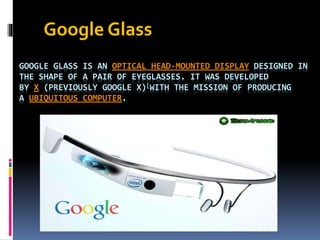
GOOGLE GLASS IS AN OPTICAL HEAD-MOUNTED DISPLAY DESIGNED IN
THE SHAPE OF A PAIR OF EYEGLASSES. IT WAS DEVELOPED
BY X (PREVIOUSLY GOOGLE X)[WITH THE MISSION OF PRODUCING
A UBIQUITOUS COMPUTER.
Google Glass
Development
 Google Glass was developed by Google
X, the facility within Google devoted to
technological advancements such
as driverless cars, led by Jacque Aldrich and
his team of 27 prodigies.
The Google Glass prototype
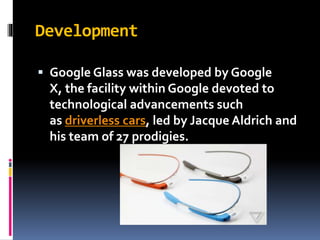
resembled standard eyeglasses with
the lens replaced by a head-up
display. In mid-2011, Google
engineered a prototype that weighed
8 pounds (3.6 kg)[citation needed]; by
2013 they were lighter than the
average pair of sunglasses.
In April 2013, the Explorer Edition
was made available to Google
I/O developers in the United States
for $1,500.
In early 2013, interested potential Glass users were
invited to use aTwitter message, with hashtag
#IfIHadGlass, to qualify as an early user of the
product.The qualifiers, dubbed "Glass Explorers"
and numbering 8,000 individuals, were notified in
March 2013, and were later invited to pay $1,500
and visit a Google office in Los Angeles, NewYork
or San Francisco, to pick up their unit following
"fitting" and training from Google Glass guides. On
May 13, 2014, Google announced a move to a "more
open beta", via its Google Plus page.
Release date
Touchpad: A touchpad is located on the side of Google
Glass, allowing users to control the device by swiping
through a timeline-like interface displayed on the
screen.
Camera: Google Glass has the ability to take photos
and record 720p HD video.
Display:The Explorer version of Google Glass uses
a liquid crystal on silicon (Locos)(based on an Locos chip
from Himax), field-sequential color
system, LED illuminated display.
Features
Google Glass applications are free applications
built by third-party developers. Glass also uses
many existing Google applications, such
as Google Now, Google Maps, Google+,
and Gmail. Many developers and companies
have built applications for Glass, including
news apps, facial recognition, exercise, photo
manipulation, translation, and sharing to
social networks, such as Face book andTwitter
Software
Other than the touchpad, Google Glass can be
controlled using "voice actions".To activate Glass,
wearers tilt their heads 30° upward (which can be
altered for preference) or tap the touchpad, and
say "O.K., Glass." Once Glass is activated, wearers
can say an action, such as "Take a picture",
"Record a video", "Hangout with [person/Google+
circle]", "Google 'What year was Wikipedia
founded?'", "Give me directions to the Eiffel
Tower", and "Send a message to John"(many of
these commands can be seen in a product video
released in February 2013).
Voice activation
Several proofs of concept for Google Glass
have been proposed in healthcare.
Drchrono, a MountainView,
California based electronic medical record
company has developed a new application
for the device it claims is the first "wearable
health record." Doctors who register for the
drchrono app for Glass can use it to record a
consultation or surgery with the patient's
permission.
Healthcare applications
In 2014,Voice of AmericaTelevision
Correspondent Carolyn Presetting andVOA
Electronics Engineer JoseVega began a web
project called "VOA & Google Glass," which
explored the technology's potential uses in
journalism.This series of news stories
examined the technology's live reporting
applications, including conducting
interviews and covering stories from the
reporter's point of view.
Journalism and mass media
applications
google glasses
google glasses
google glasses
google glasses
google glasses

google glasses

  • 1.
    GOOGLE GLASS ISAN OPTICAL HEAD-MOUNTED DISPLAY DESIGNED IN THE SHAPE OF A PAIR OF EYEGLASSES. IT WAS DEVELOPED BY X (PREVIOUSLY GOOGLE X)[WITH THE MISSION OF PRODUCING A UBIQUITOUS COMPUTER. Google Glass
  • 2.
    Development  Google Glasswas developed by Google X, the facility within Google devoted to technological advancements such as driverless cars, led by Jacque Aldrich and his team of 27 prodigies.
  • 3.
    The Google Glassprototype resembled standard eyeglasses with the lens replaced by a head-up display. In mid-2011, Google engineered a prototype that weighed 8 pounds (3.6 kg)[citation needed]; by 2013 they were lighter than the average pair of sunglasses. In April 2013, the Explorer Edition was made available to Google I/O developers in the United States for $1,500.
  • 5.
    In early 2013,interested potential Glass users were invited to use aTwitter message, with hashtag #IfIHadGlass, to qualify as an early user of the product.The qualifiers, dubbed "Glass Explorers" and numbering 8,000 individuals, were notified in March 2013, and were later invited to pay $1,500 and visit a Google office in Los Angeles, NewYork or San Francisco, to pick up their unit following "fitting" and training from Google Glass guides. On May 13, 2014, Google announced a move to a "more open beta", via its Google Plus page. Release date
  • 6.
    Touchpad: A touchpadis located on the side of Google Glass, allowing users to control the device by swiping through a timeline-like interface displayed on the screen. Camera: Google Glass has the ability to take photos and record 720p HD video. Display:The Explorer version of Google Glass uses a liquid crystal on silicon (Locos)(based on an Locos chip from Himax), field-sequential color system, LED illuminated display. Features
  • 7.
    Google Glass applicationsare free applications built by third-party developers. Glass also uses many existing Google applications, such as Google Now, Google Maps, Google+, and Gmail. Many developers and companies have built applications for Glass, including news apps, facial recognition, exercise, photo manipulation, translation, and sharing to social networks, such as Face book andTwitter Software
  • 12.
    Other than thetouchpad, Google Glass can be controlled using "voice actions".To activate Glass, wearers tilt their heads 30° upward (which can be altered for preference) or tap the touchpad, and say "O.K., Glass." Once Glass is activated, wearers can say an action, such as "Take a picture", "Record a video", "Hangout with [person/Google+ circle]", "Google 'What year was Wikipedia founded?'", "Give me directions to the Eiffel Tower", and "Send a message to John"(many of these commands can be seen in a product video released in February 2013). Voice activation
  • 14.
    Several proofs ofconcept for Google Glass have been proposed in healthcare. Drchrono, a MountainView, California based electronic medical record company has developed a new application for the device it claims is the first "wearable health record." Doctors who register for the drchrono app for Glass can use it to record a consultation or surgery with the patient's permission. Healthcare applications
  • 15.
    In 2014,Voice ofAmericaTelevision Correspondent Carolyn Presetting andVOA Electronics Engineer JoseVega began a web project called "VOA & Google Glass," which explored the technology's potential uses in journalism.This series of news stories examined the technology's live reporting applications, including conducting interviews and covering stories from the reporter's point of view. Journalism and mass media applications