[course site]
Xavier Giro-i-Nieto
xavier.giro@upc.edu
Associate Professor
Universitat Politecnica de Catalunya
Technical University of Catalonia
Reinforcement Learning
Day 7 Lecture 2
#DLUPC
2
Acknowledegments
Bellver M, Giró-i-Nieto X, Marqués F, Torres J. Hierarchical Object Detection with Deep Reinforcement Learning. In Deep
Reinforcement Learning Workshop, NIPS 2016. 2016.
3
Acknowledegments
Serena Yeung, “Deep Reinforcement Learning”. Stanford University CS231n, 2017.
4
Outline
1. Motivation
2. Architecture
3. Markov Decision Process (MDP)
4. Deep Q-learning
5. RL Frameworks
6. Learn more
5
Outline
1. Motivation
2. Architecture
3. Markov Decision Process (MDP)
4. Deep Q-learning
5. RL Frameworks
6. Learn more
6
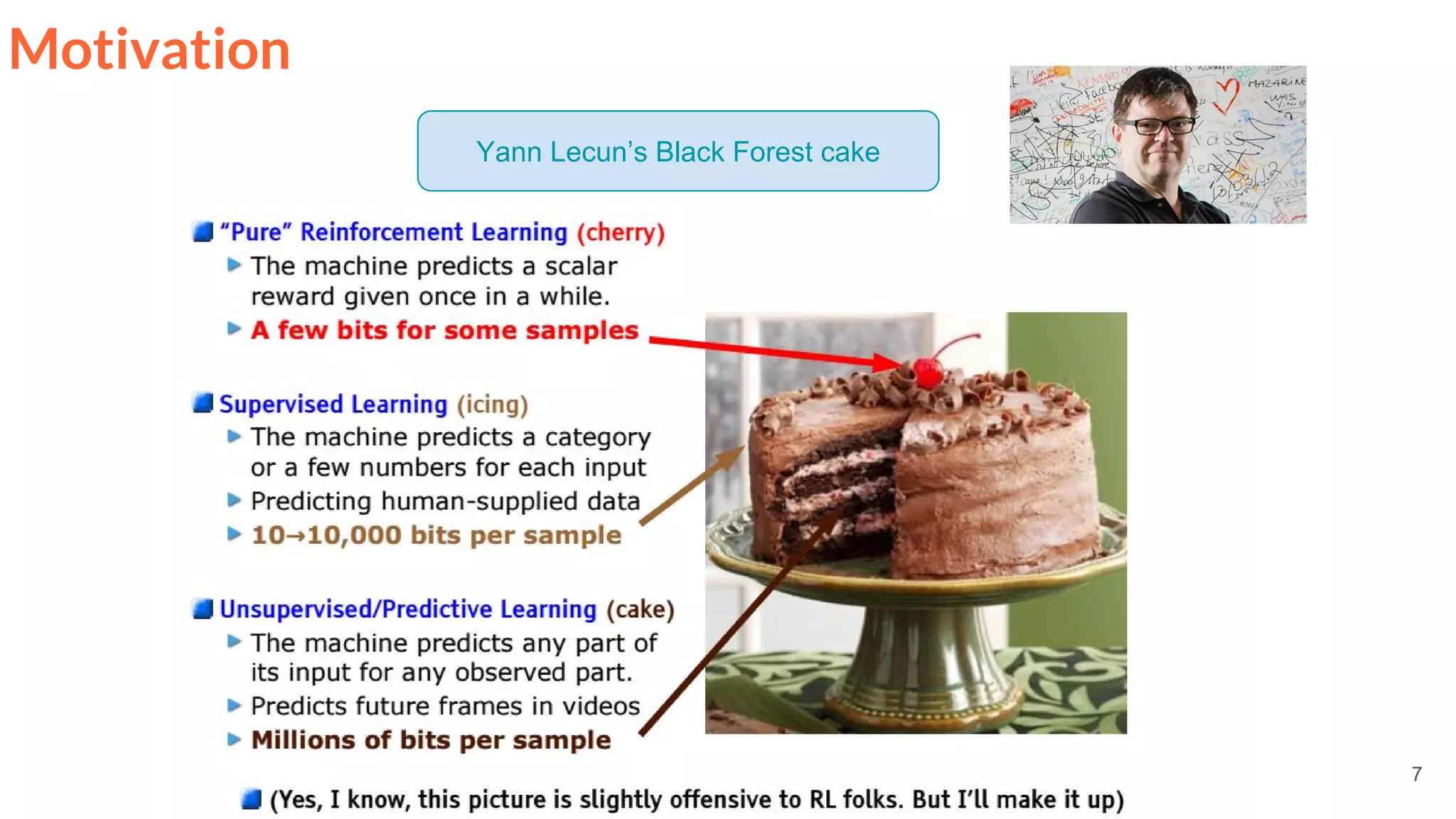
Motivation
What is Reinforcement Learning ?
“a way of programming agents by reward and punishment without needing to
specify how the task is to be achieved”
[Kaelbling, Littman, & Moore, 96]
Kaelbling, Leslie Pack, Michael L. Littman, and Andrew W. Moore. "Reinforcement learning: A survey." Journal of artificial
intelligence research 4 (1996): 237-285.
Yann Lecun’s Black Forest cake
7
Motivation
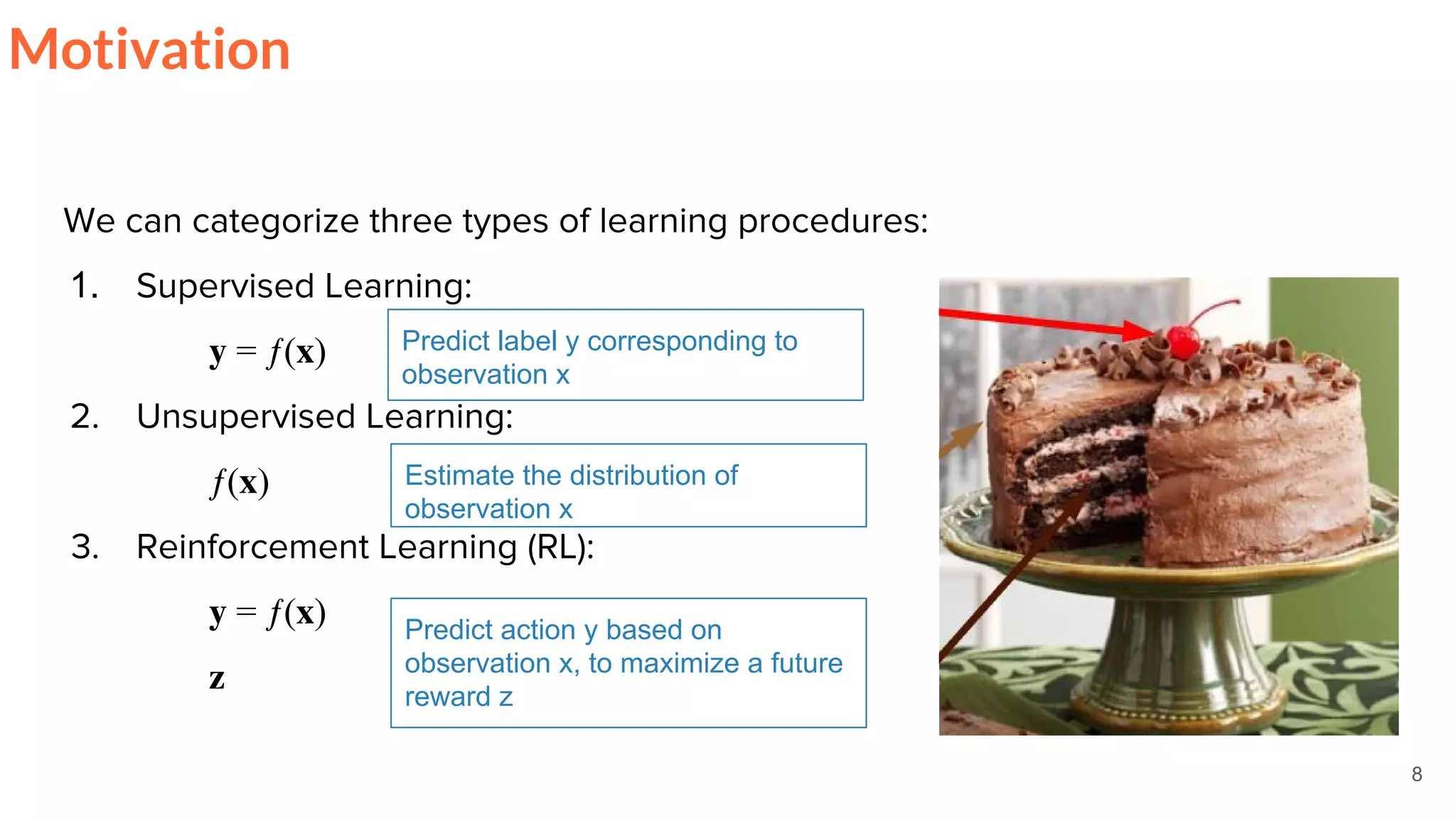
We can categorize three types of learning procedures:
1. Supervised Learning:
= ƒ( )
2. Unsupervised Learning:
ƒ( )
3. Reinforcement Learning (RL):
= ƒ( )
8
Predict label y corresponding to
observation x
Estimate the distribution of
observation x
Predict action y based on
observation x, to maximize a future
reward z
Motivation
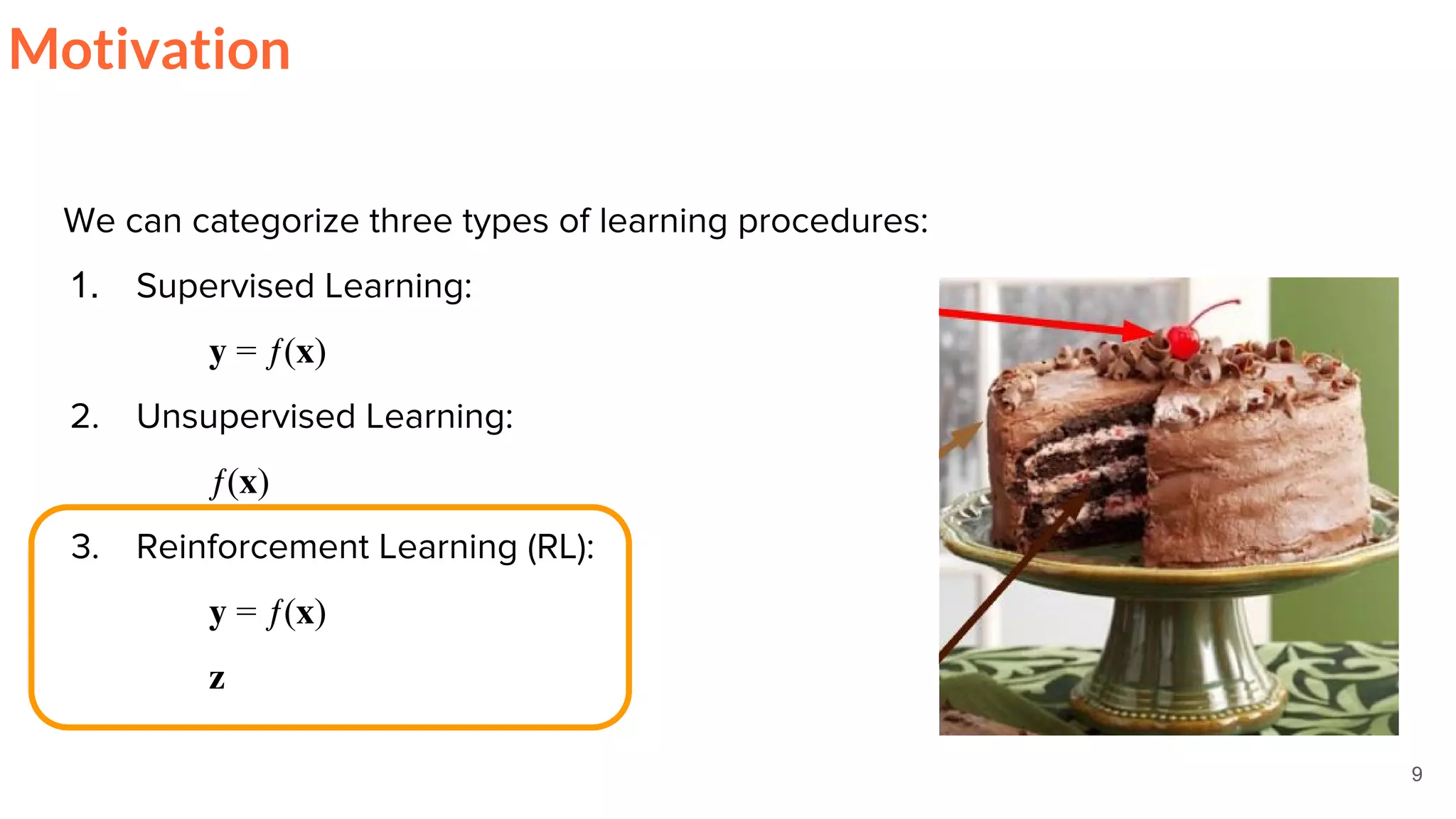
We can categorize three types of learning procedures:
1. Supervised Learning:
= ƒ( )
2. Unsupervised Learning:
ƒ( )
3. Reinforcement Learning (RL):
= ƒ( )
9
Motivation
10
Outline
1. Motivation
2. Architecture
3. Markov Decision Process (MDP)
4. Deep Q-learning
5. RL Frameworks
6. Learn more
11
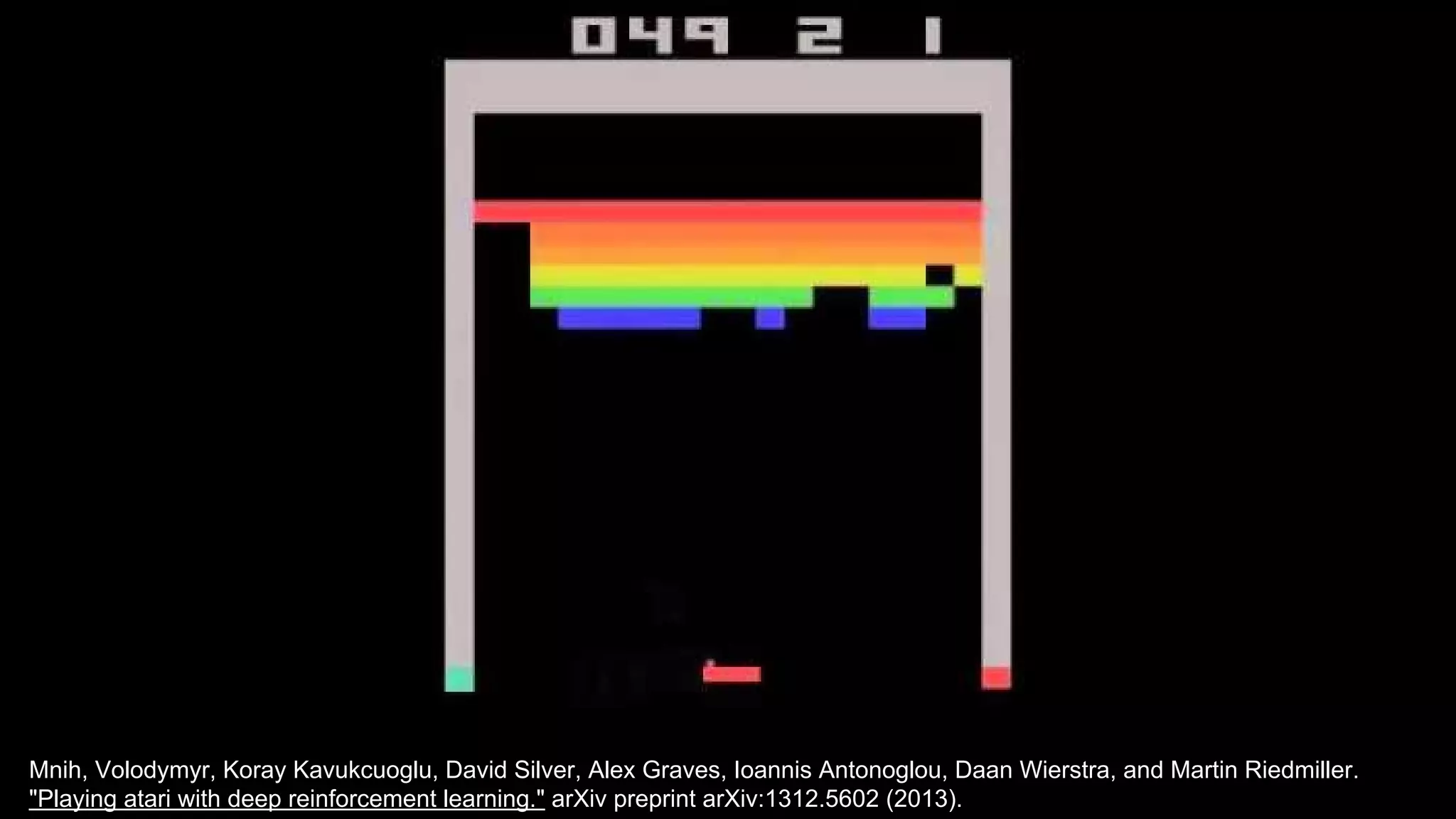
Mnih, Volodymyr, Koray Kavukcuoglu, David Silver, Alex Graves, Ioannis Antonoglou, Daan Wierstra, and Martin Riedmiller.
"Playing atari with deep reinforcement learning." arXiv preprint arXiv:1312.5602 (2013).
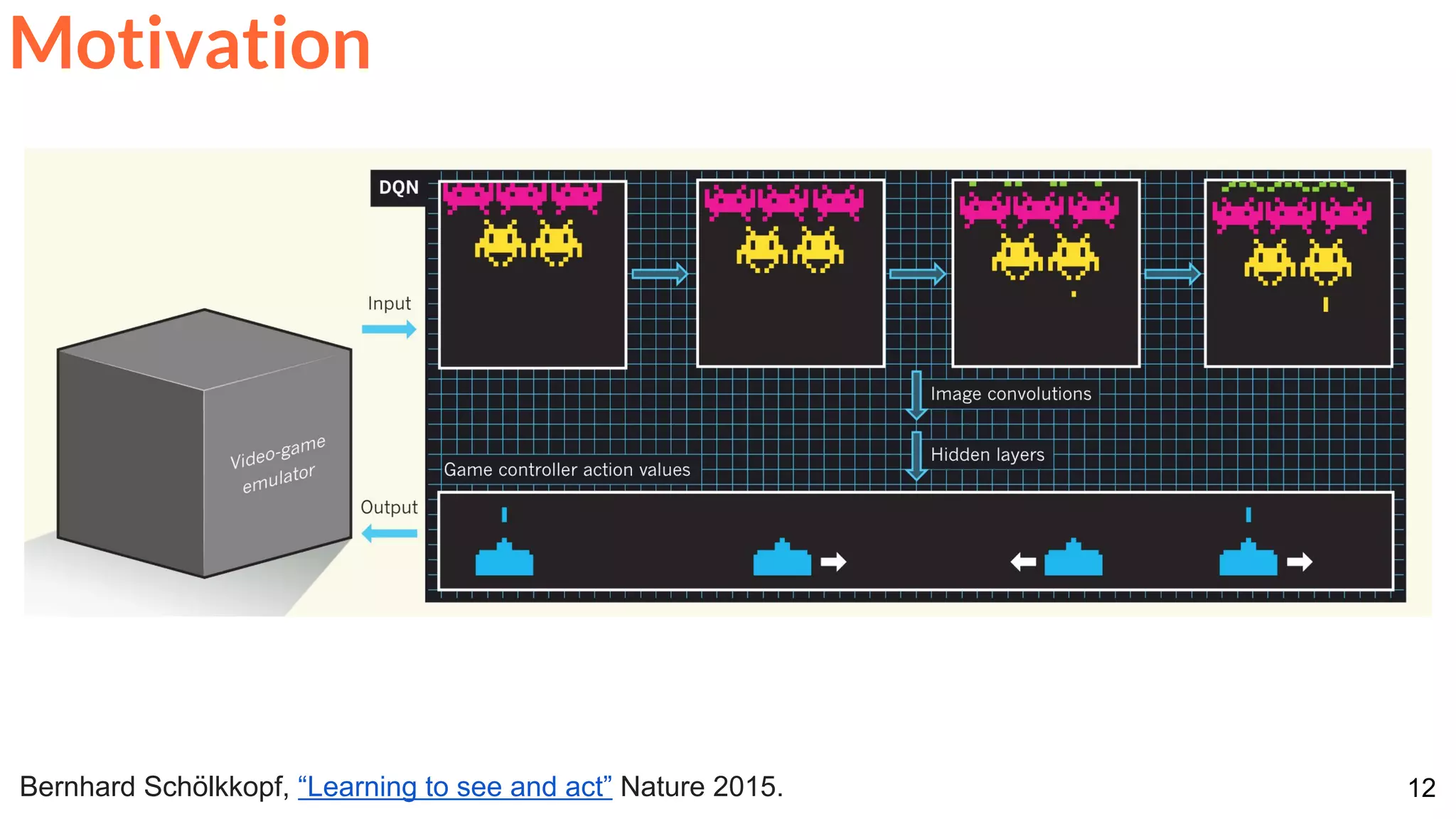
12Bernhard Schölkkopf, “Learning to see and act” Nature 2015.
Motivation
13
Outline
1. Motivation
2. Architecture
3. Markov Decision Process (MDP)
○ Policy
○ Optimal Policy
○ Value Function
○ Q-value function
○ Optimal Q-value function
○ Bellman equation
○ Value iteration algorithm
4. Deep Q-learning
5. RL Frameworks
6. Learn more
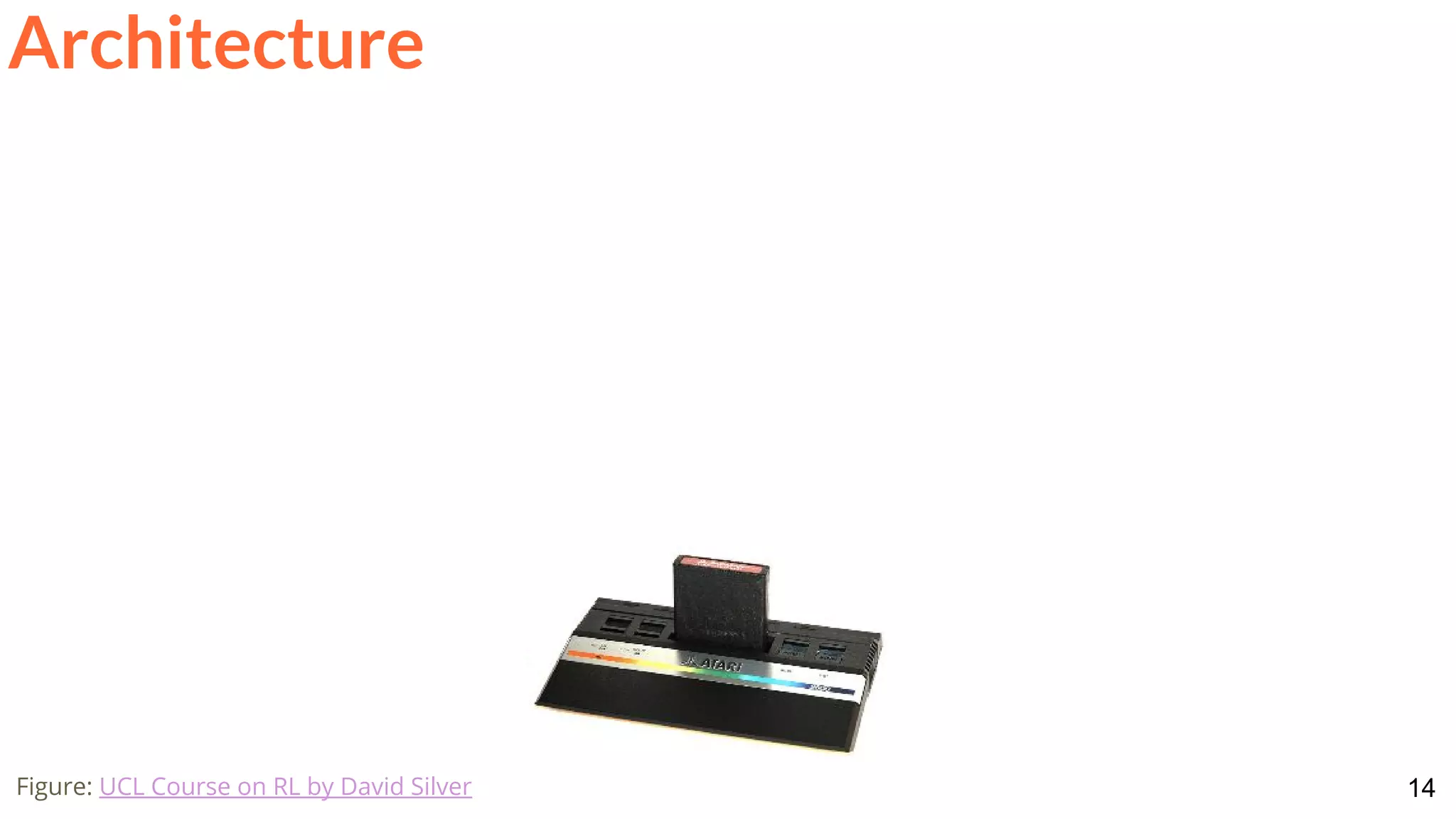
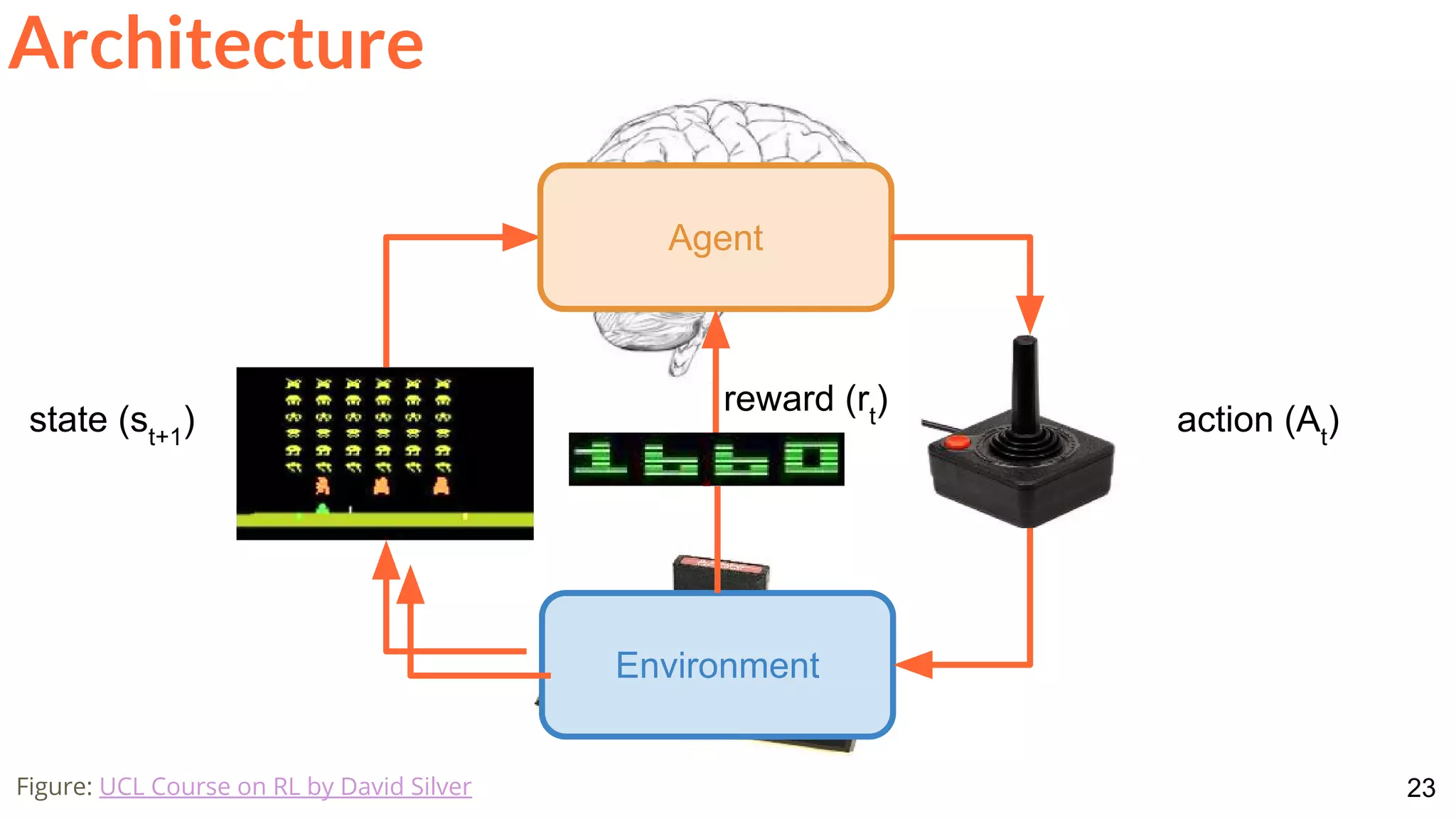
14Figure: UCL Course on RL by David Silver
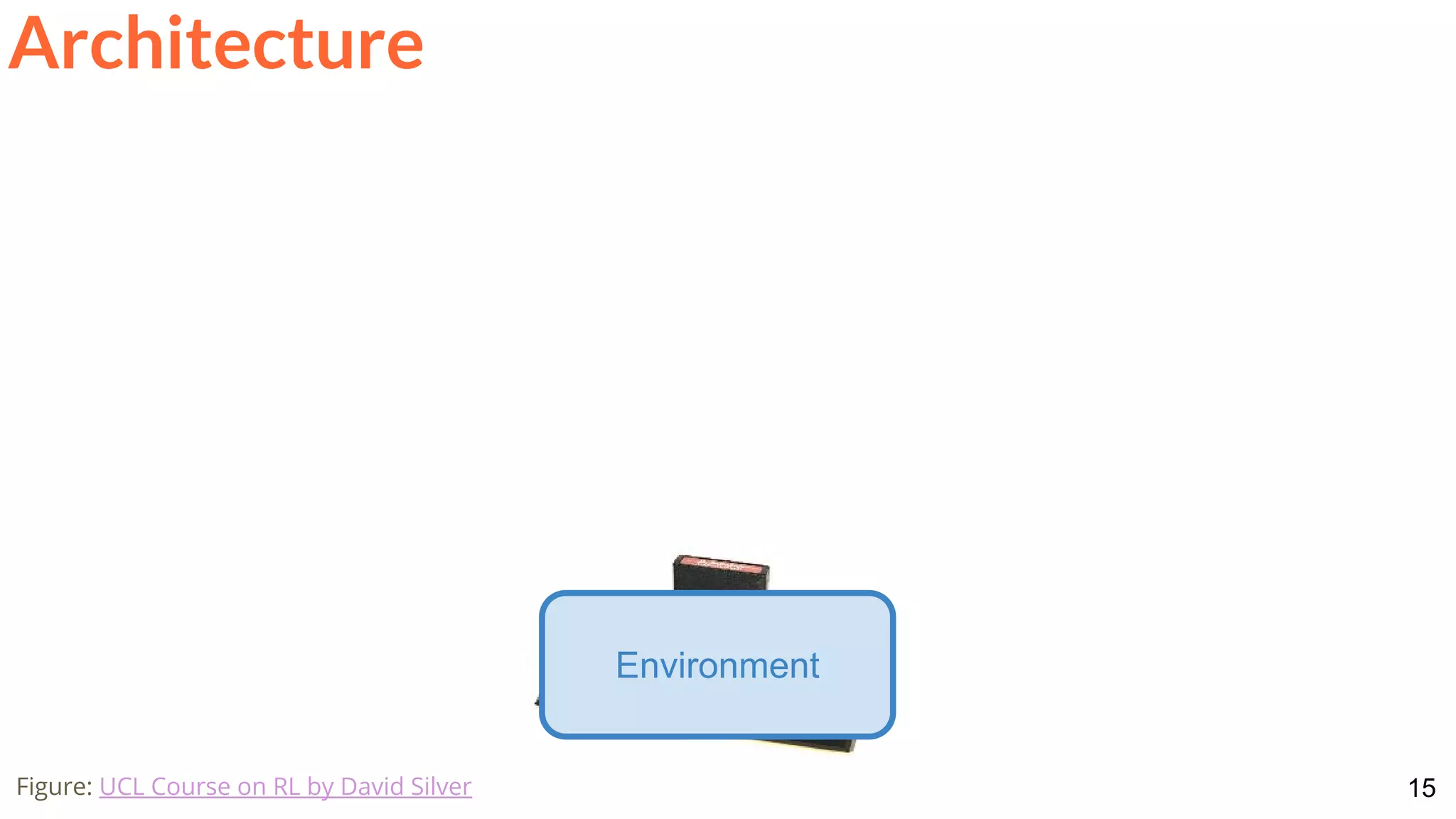
Architecture
15Figure: UCL Course on RL by David Silver
Environment
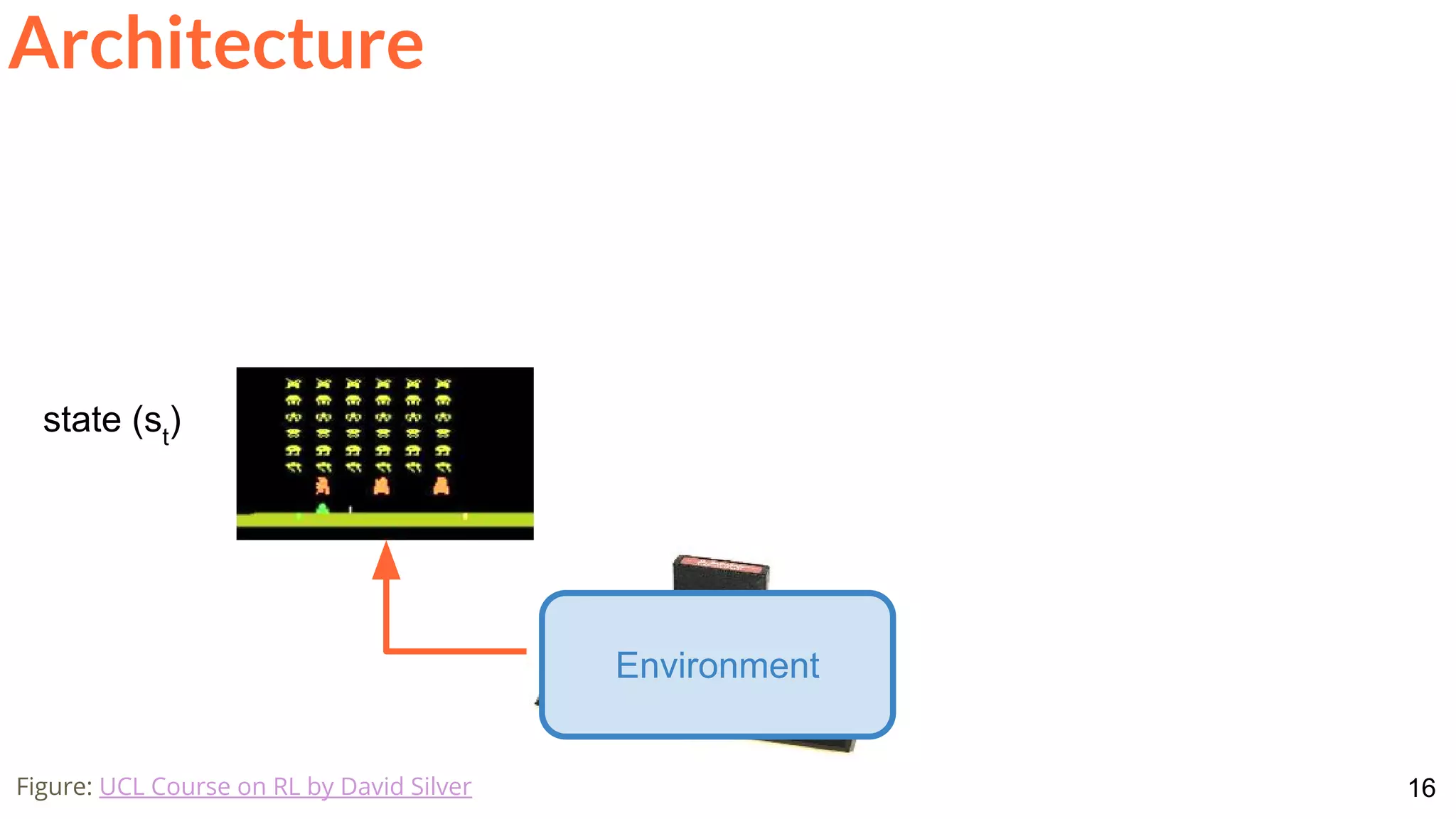
Architecture
16Figure: UCL Course on RL by David Silver
Environment
state (st
)
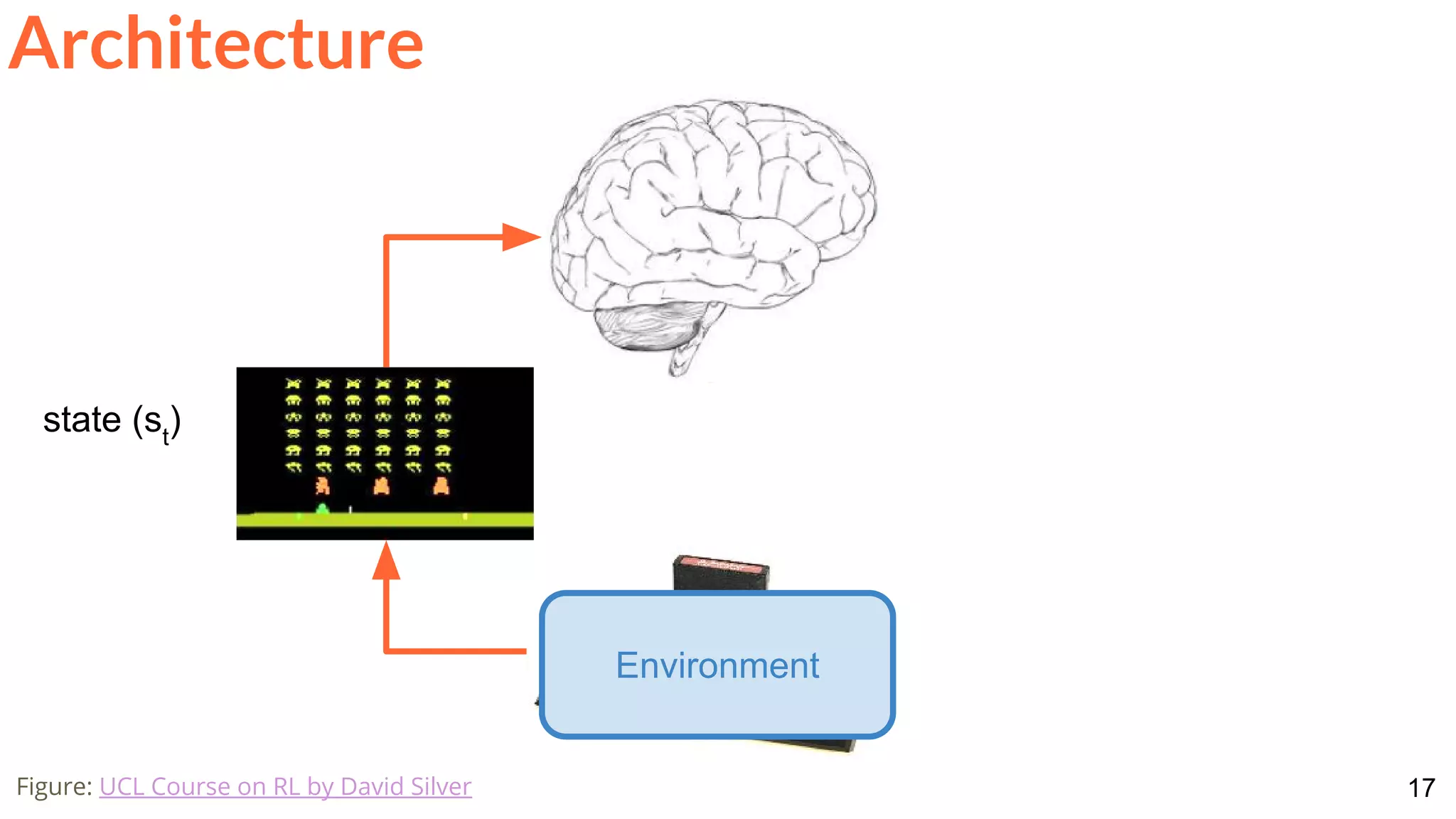
Architecture
17Figure: UCL Course on RL by David Silver
Environment
state (st
)
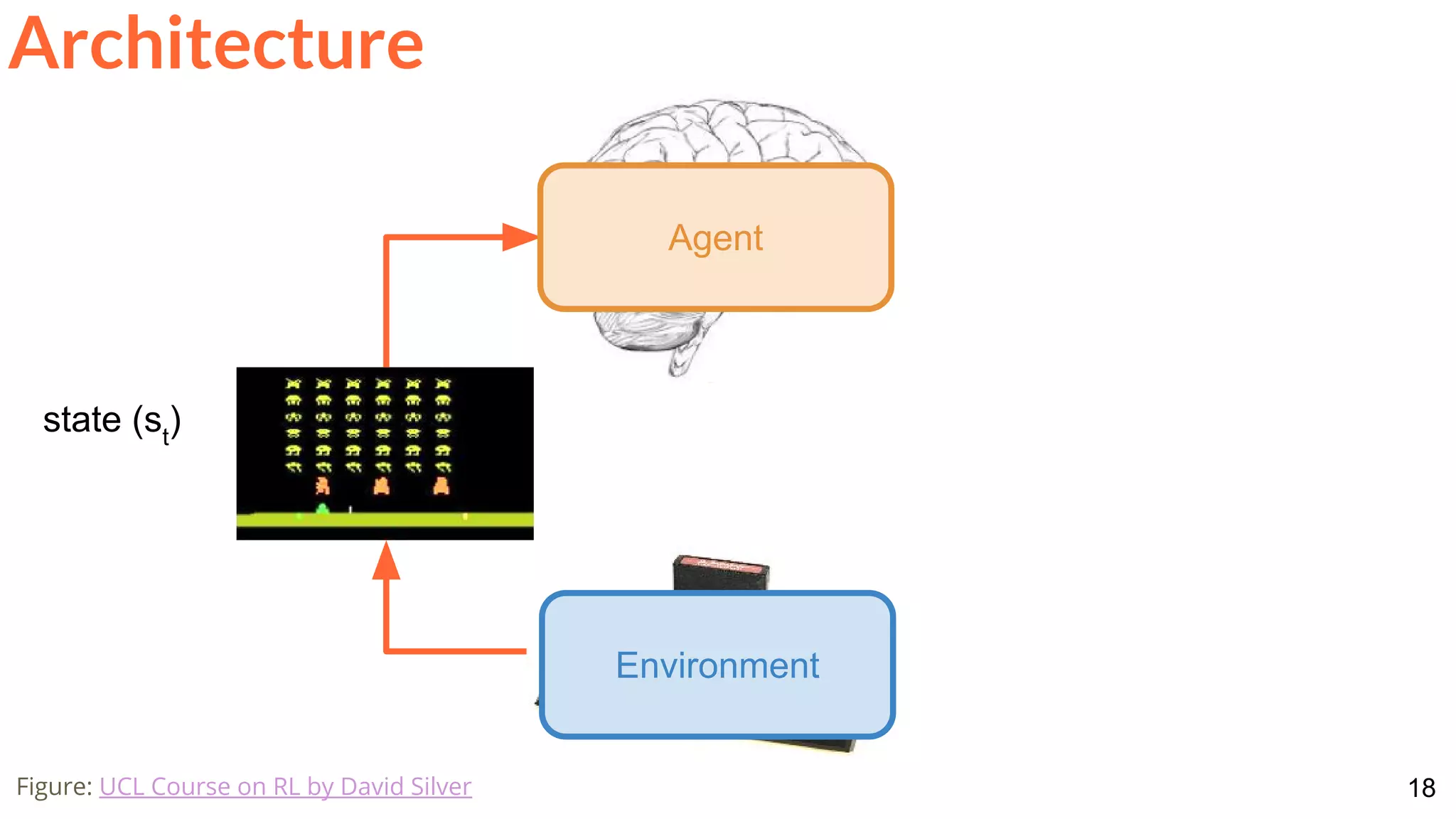
Architecture
18Figure: UCL Course on RL by David Silver
Environment
Agent
state (st
)
Architecture
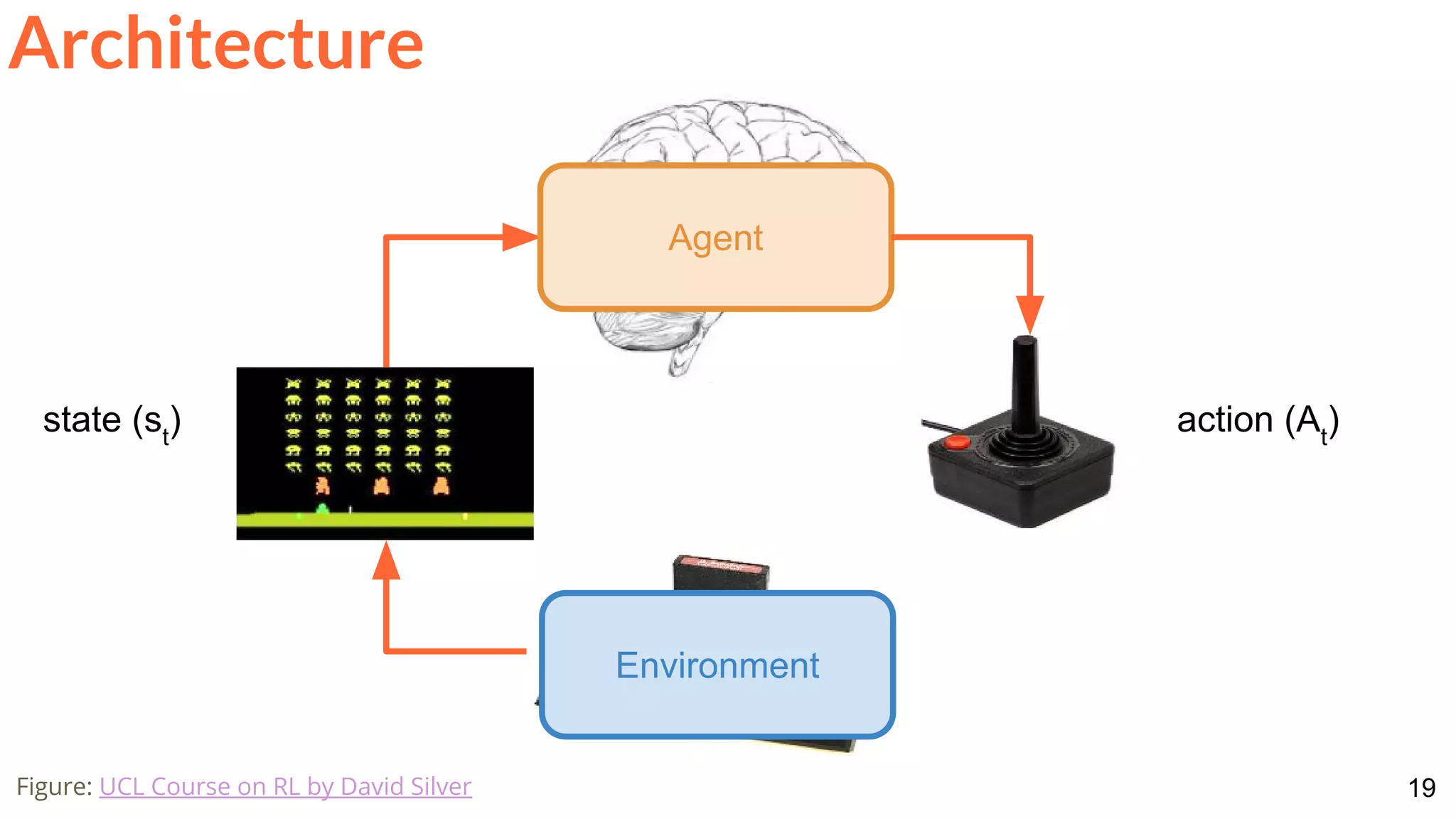
19Figure: UCL Course on RL by David Silver
Environment
Agent
action (At
)state (st
)
Architecture
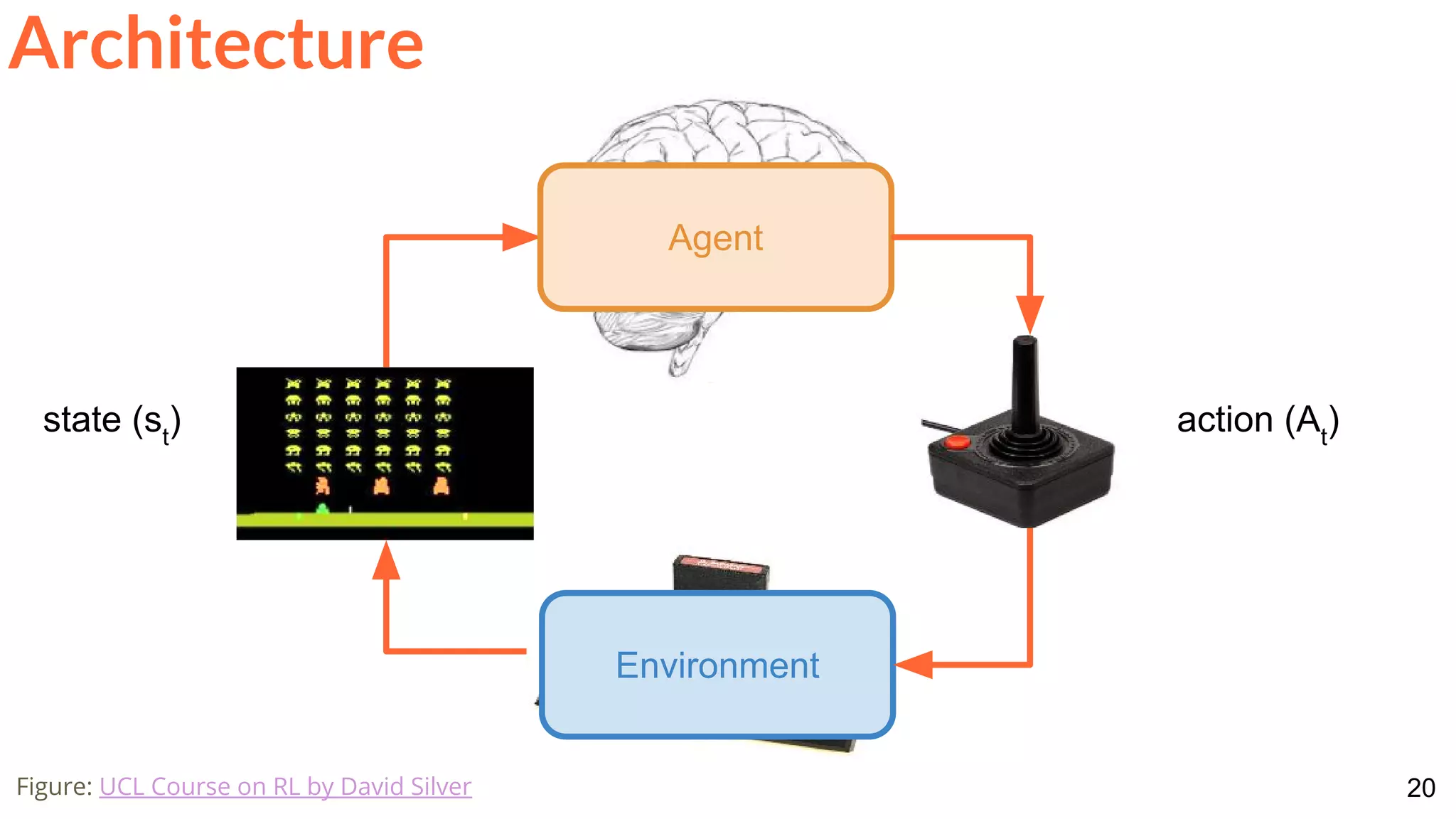
20Figure: UCL Course on RL by David Silver
Environment
Agent
action (At
)state (st
)
Architecture
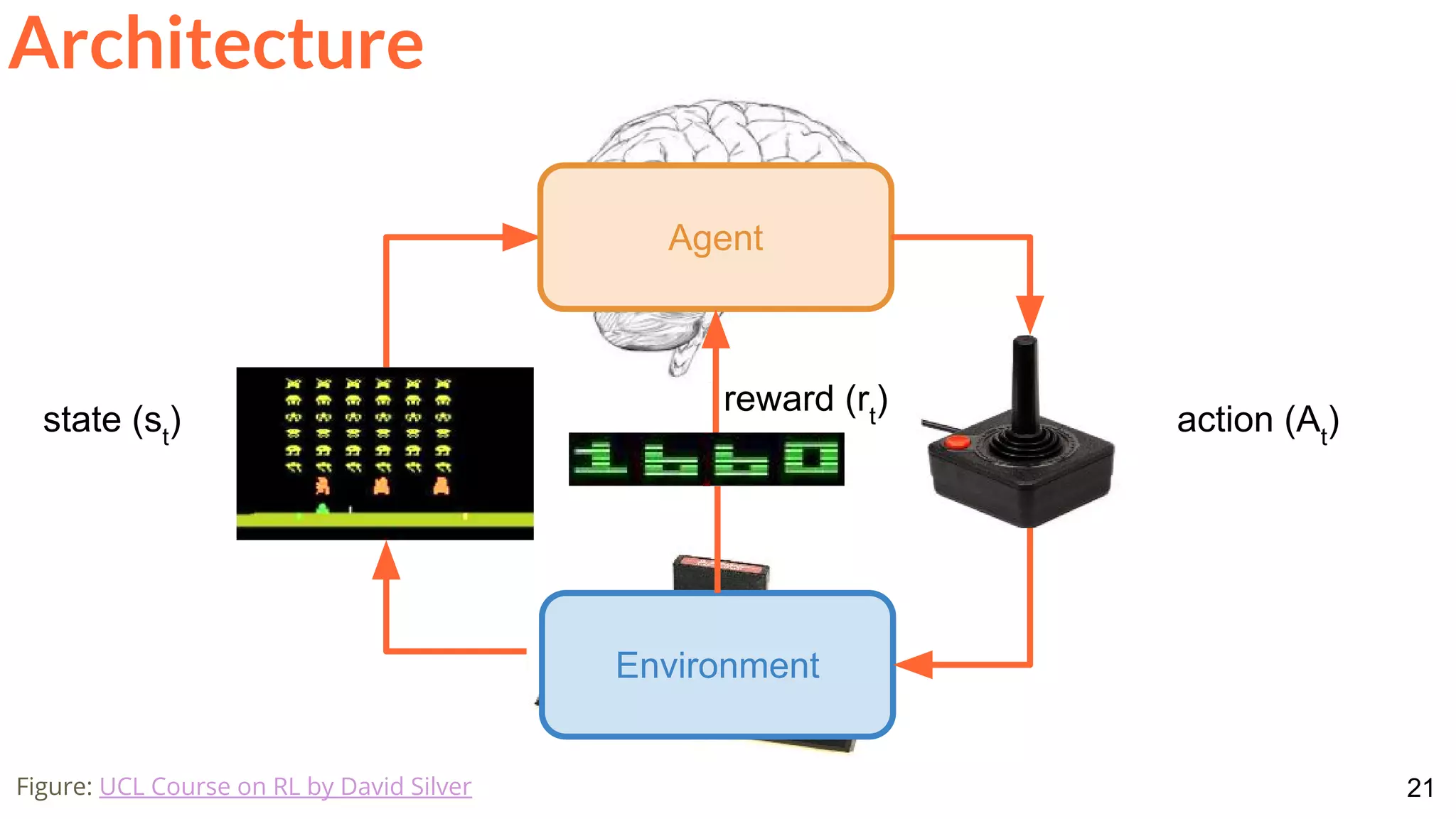
21Figure: UCL Course on RL by David Silver
Environment
Agent
action (At
)
reward (rt
)
state (st
)
Architecture
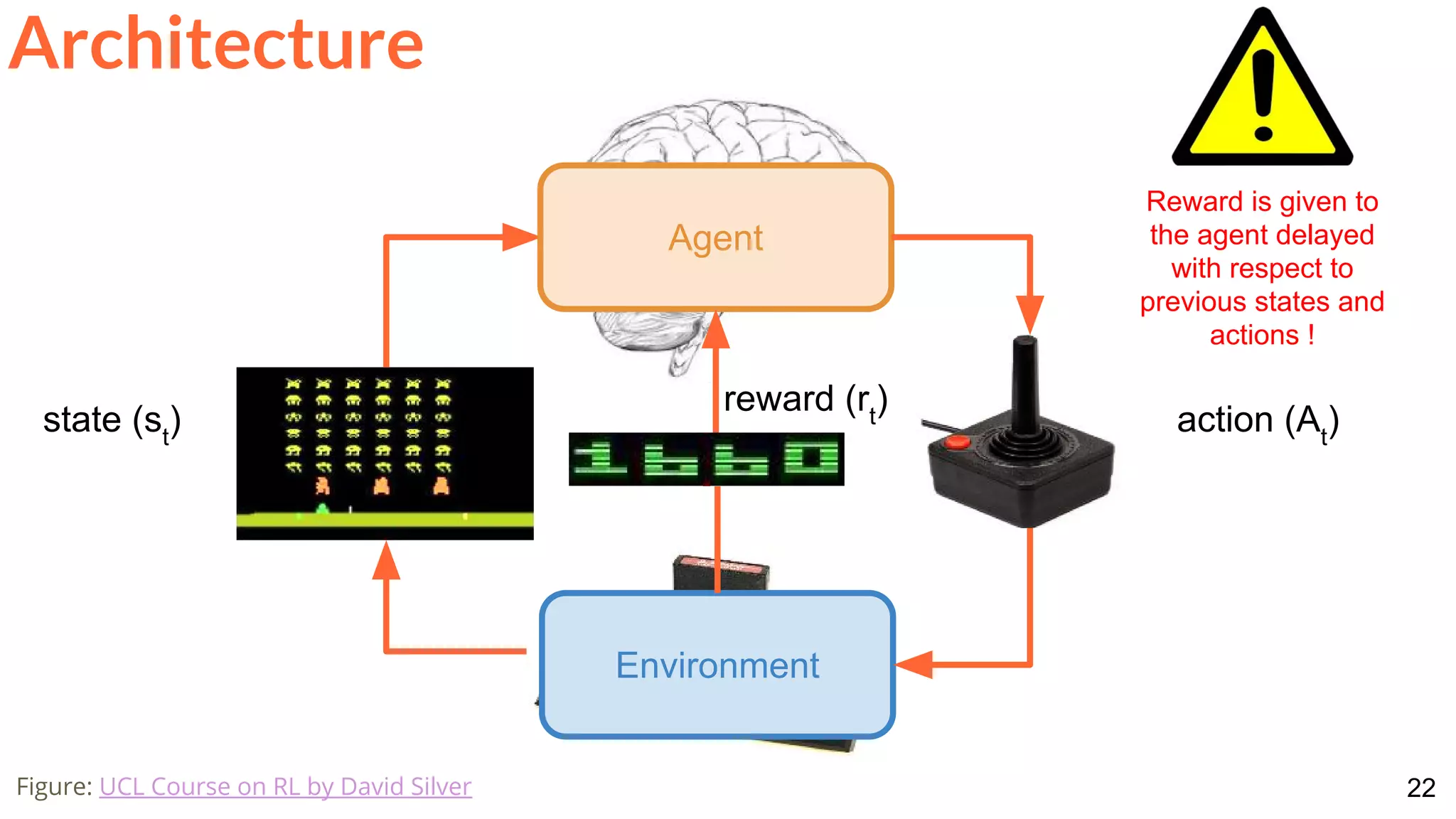
22Figure: UCL Course on RL by David Silver
Environment
Agent
action (At
)
reward (rt
)
state (st
)
Architecture
Reward is given to
the agent delayed
with respect to
previous states and
actions !
23Figure: UCL Course on RL by David Silver
Environment
Agent
action (At
)
reward (rt
)
state (st+1
)
Architecture
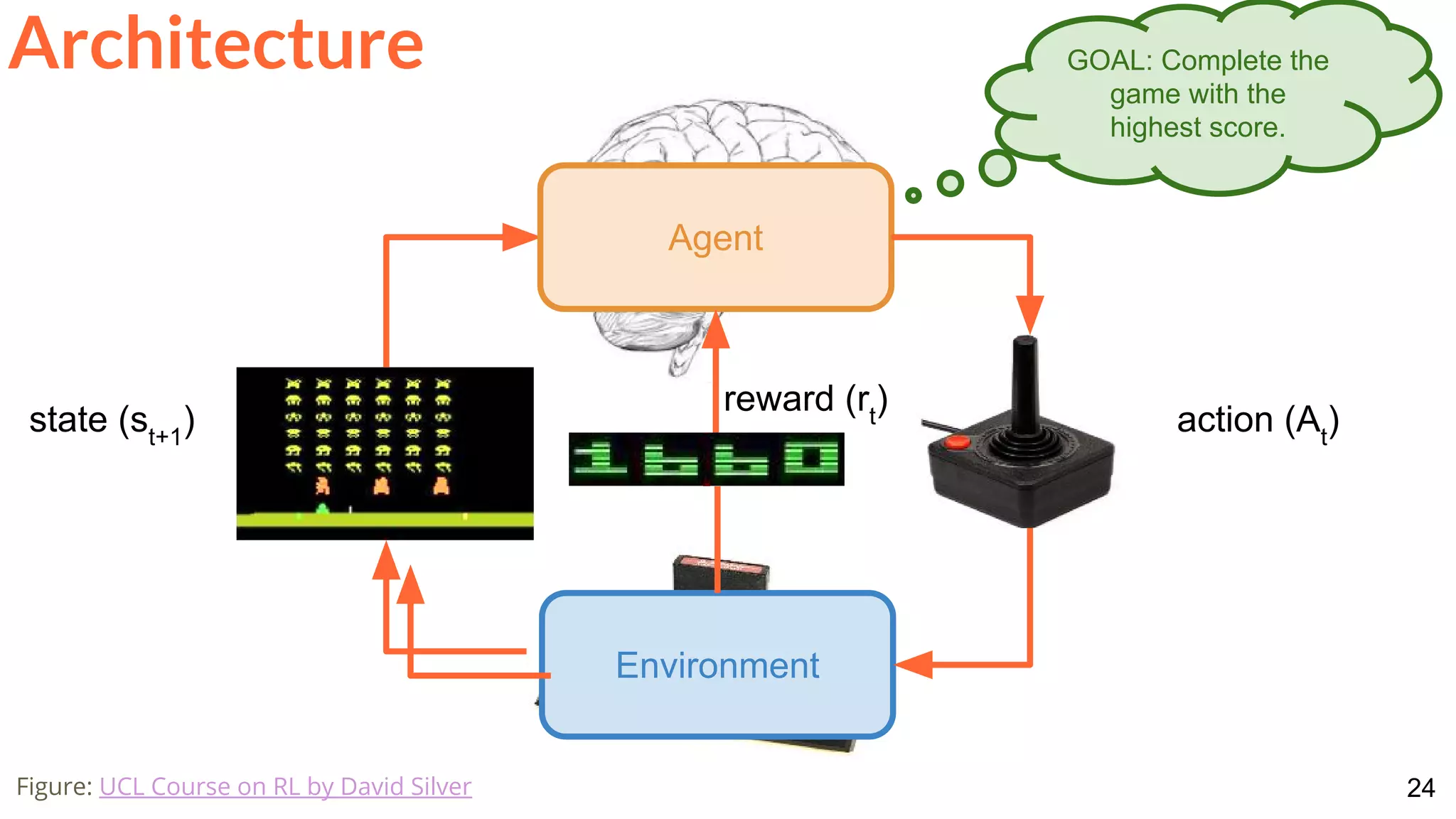
24Figure: UCL Course on RL by David Silver
Environment
Agent
action (At
)
reward (rt
)
state (st+1
)
Architecture GOAL: Complete the
game with the
highest score.
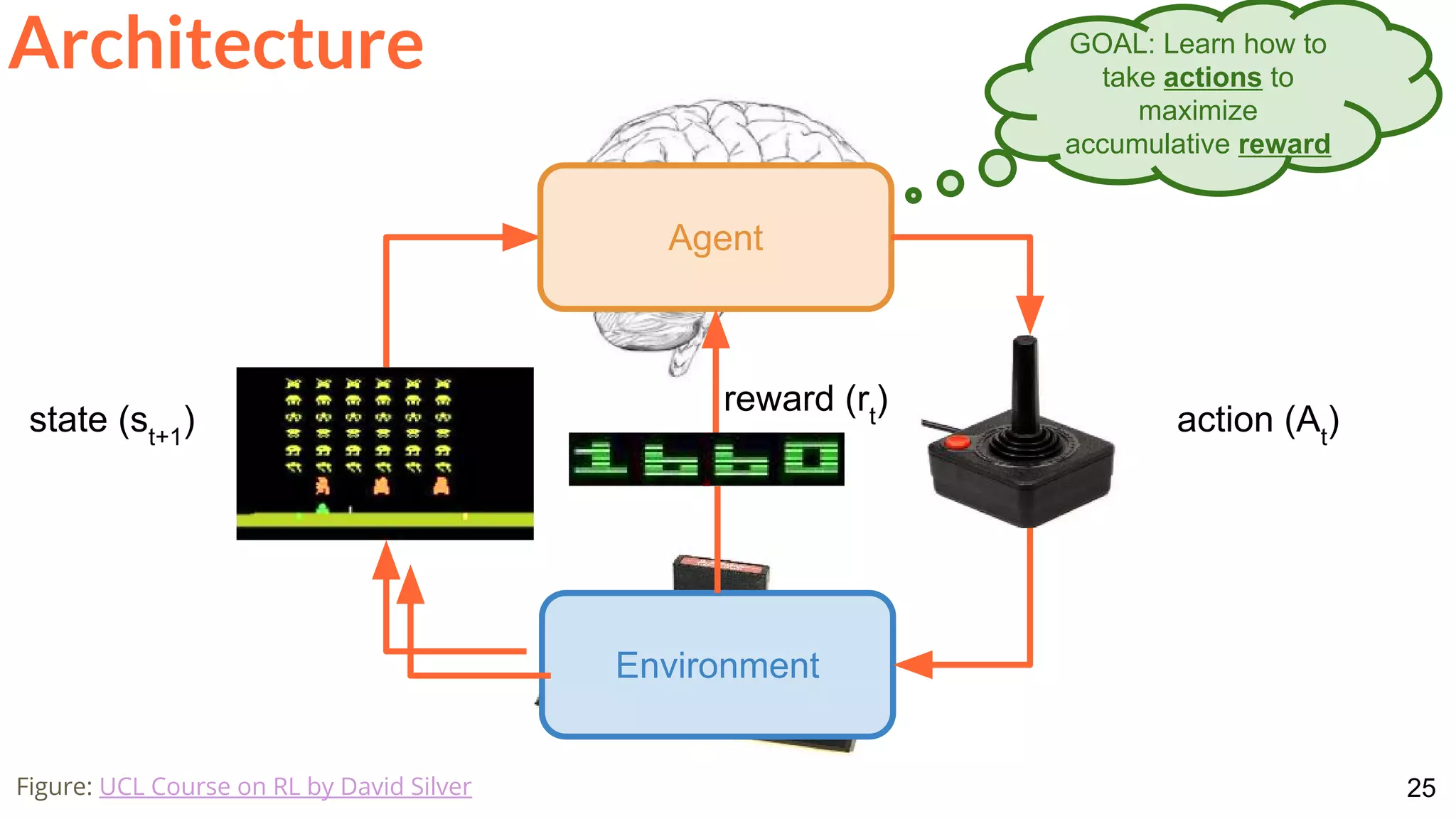
25Figure: UCL Course on RL by David Silver
Environment
Agent
action (At
)
reward (rt
)
state (st+1
)
Architecture GOAL: Learn how to
take actions to
maximize
accumulative reward
26
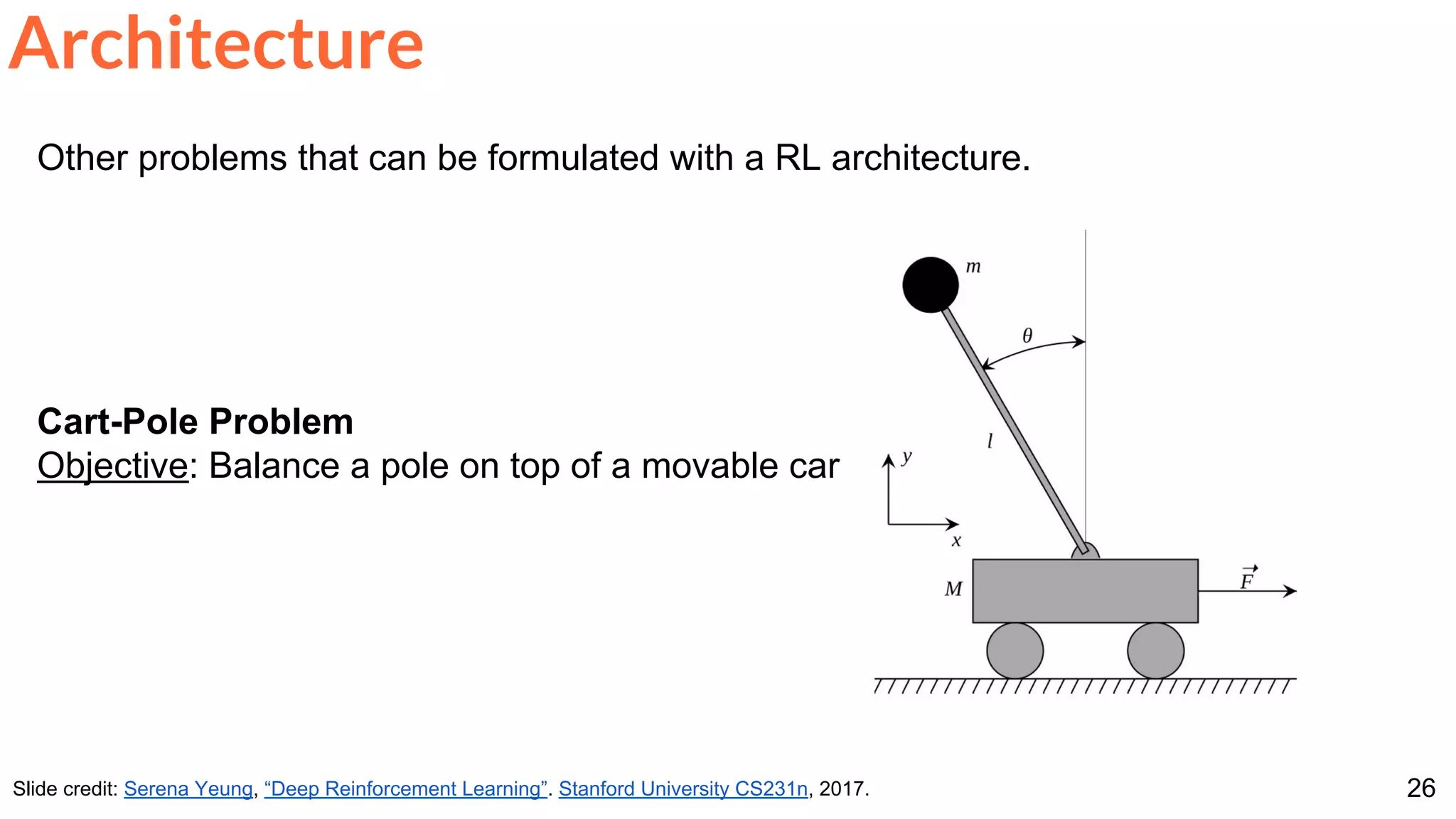
Other problems that can be formulated with a RL architecture.
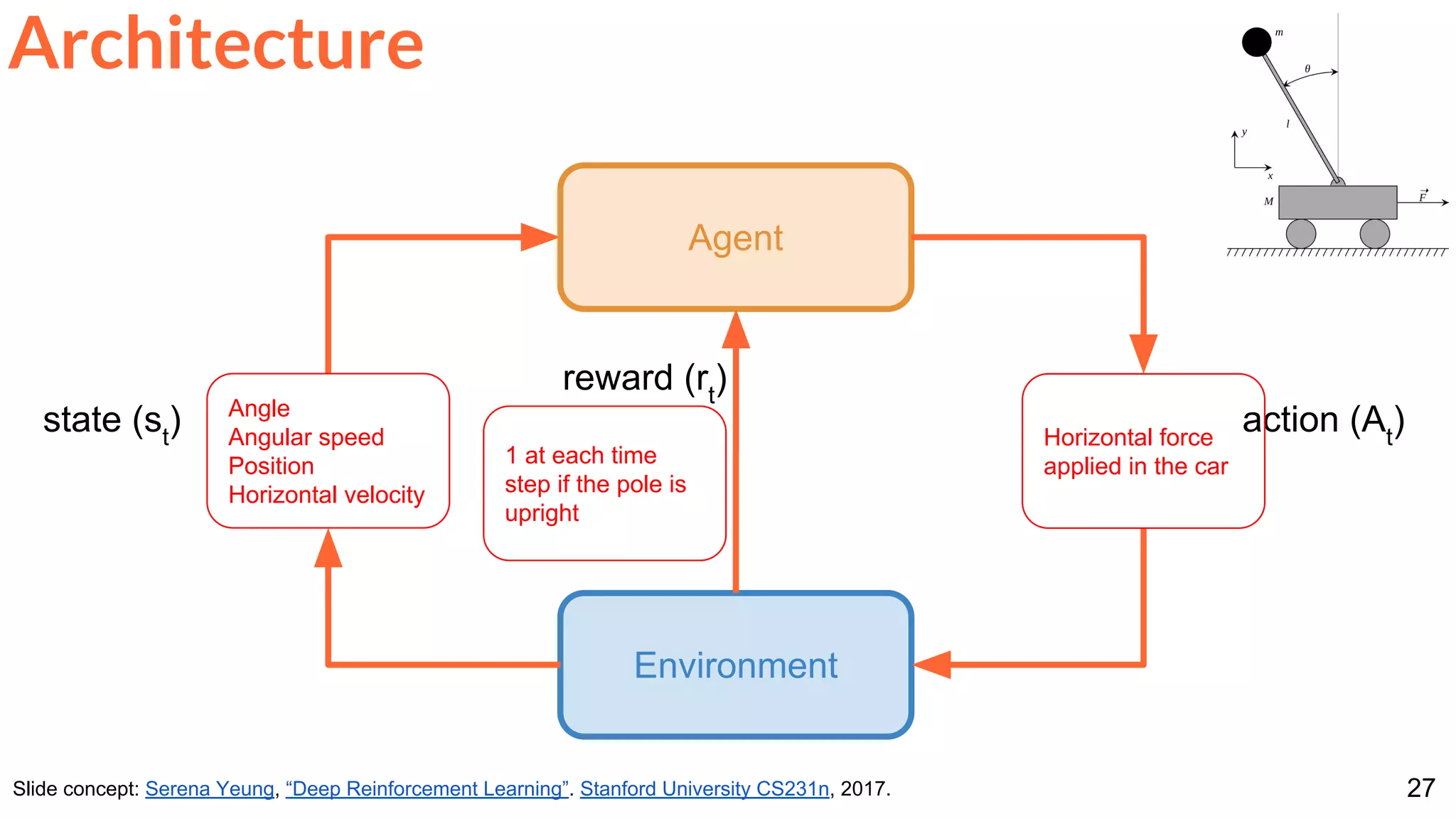
Cart-Pole Problem
Objective: Balance a pole on top of a movable car
Architecture
Slide credit: Serena Yeung, “Deep Reinforcement Learning”. Stanford University CS231n, 2017.
27
Architecture
Slide concept: Serena Yeung, “Deep Reinforcement Learning”. Stanford University CS231n, 2017.
Environment
Agent
action (At
)
reward (rt
)
state (st
) Angle
Angular speed
Position
Horizontal velocity
Horizontal force
applied in the car1 at each time
step if the pole is
upright
28
Other problems that can be formulated with a RL architecture.
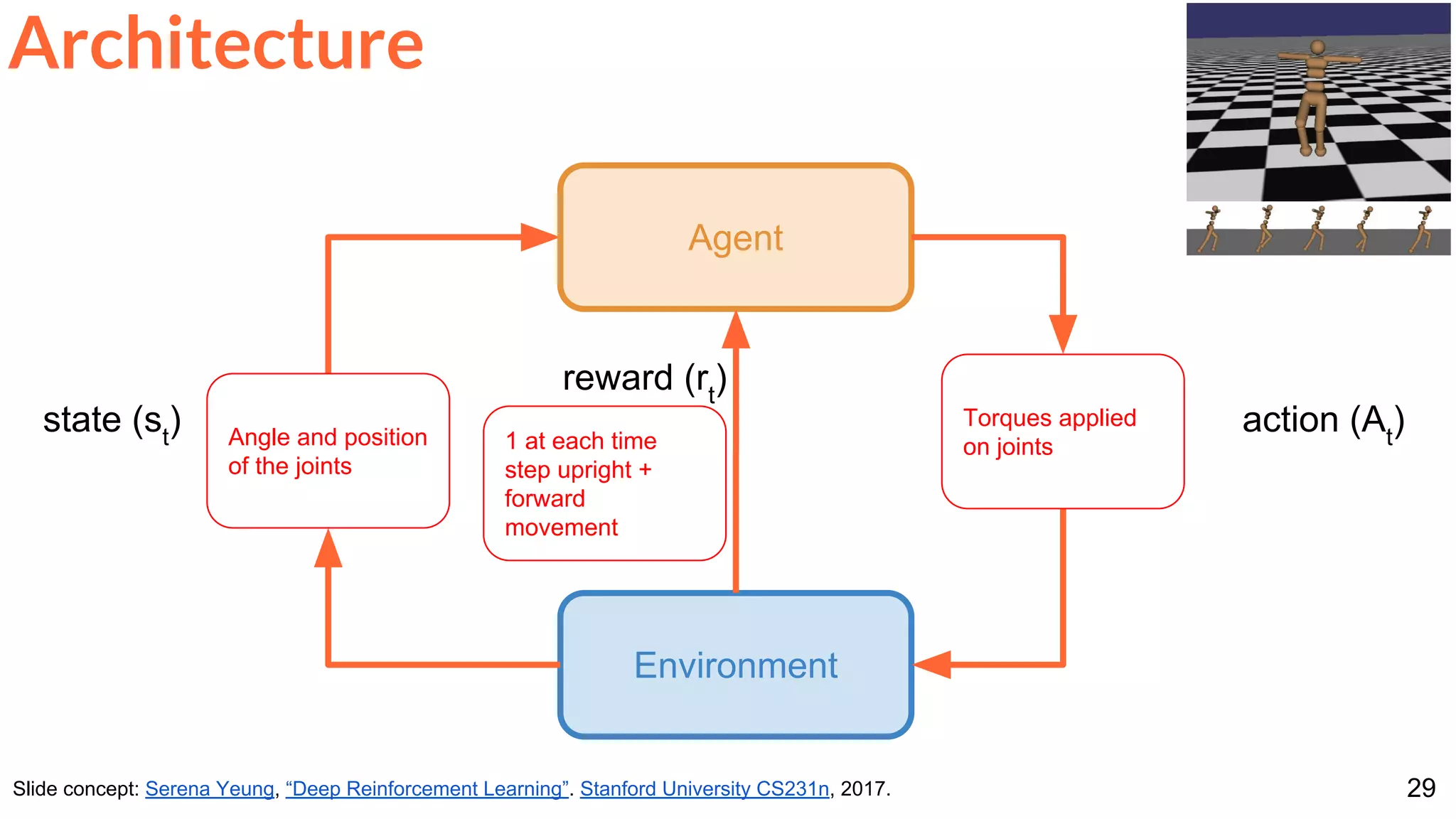
Robot Locomotion
Objective: Make the robot move forward
Architecture
Schulman, John, Philipp Moritz, Sergey Levine, Michael Jordan, and Pieter Abbeel. "High-dimensional continuous control using generalized
advantage estimation." ICLR 2016 [project page]
29
Architecture
Slide concept: Serena Yeung, “Deep Reinforcement Learning”. Stanford University CS231n, 2017.
Environment
Agent
action (At
)
reward (rt
)
state (st
) Angle and position
of the joints
Torques applied
on joints1 at each time
step upright +
forward
movement
30
Schulman, John, Philipp Moritz, Sergey Levine, Michael Jordan, and Pieter Abbeel. "High-dimensional continuous control using generalized
advantage estimation." ICLR 2016 [project page]
31
Outline
1. Motivation
2. Architecture
3. Markov Decision Process (MDP)
○ Policy
○ Optimal Policy
○ Value Function
○ Q-value function
○ Optimal Q-value function
○ Bellman equation
○ Value iteration algorithm
4. Deep Q-learning
5. RL Frameworks
6. Learn more
32
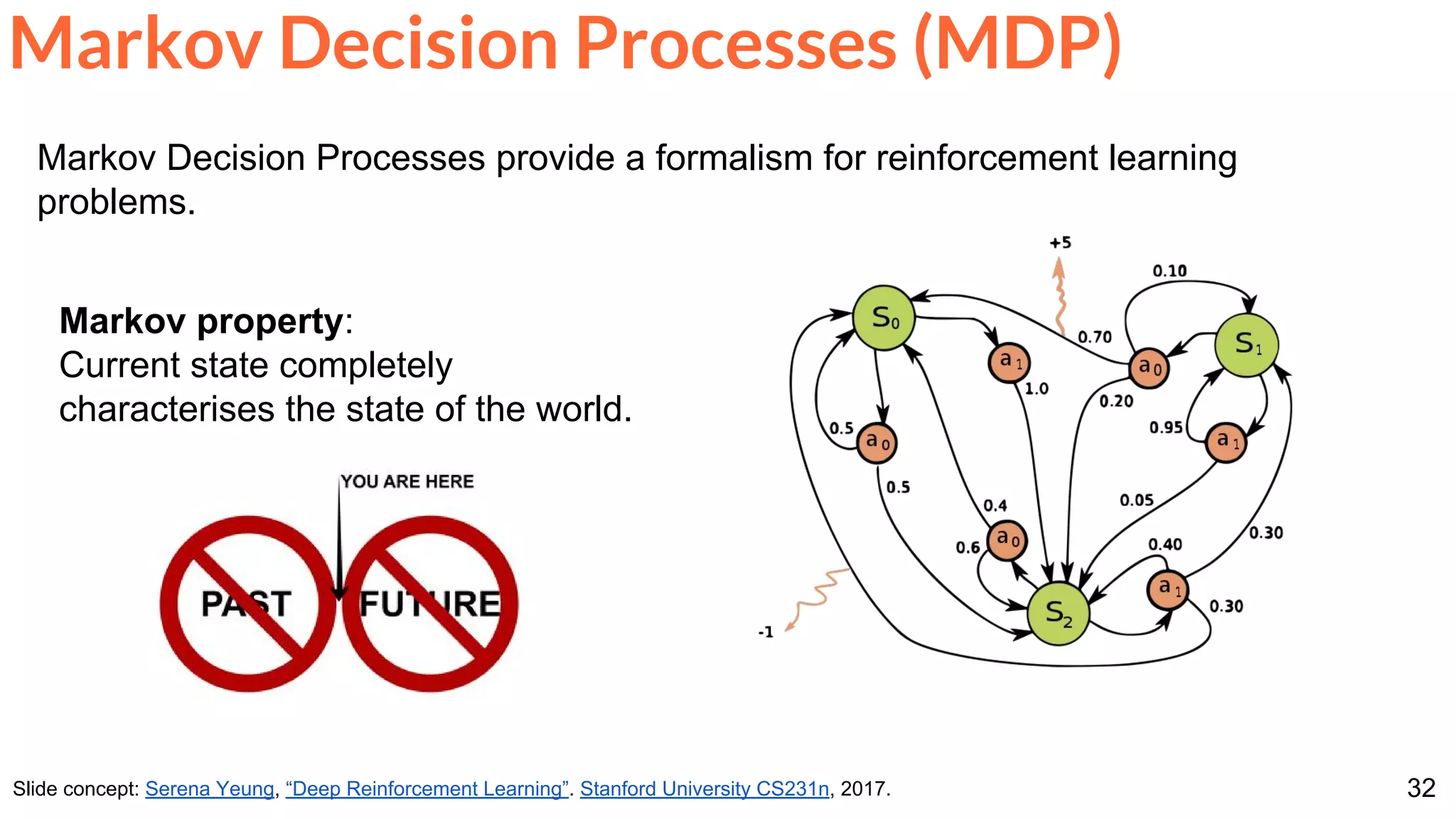
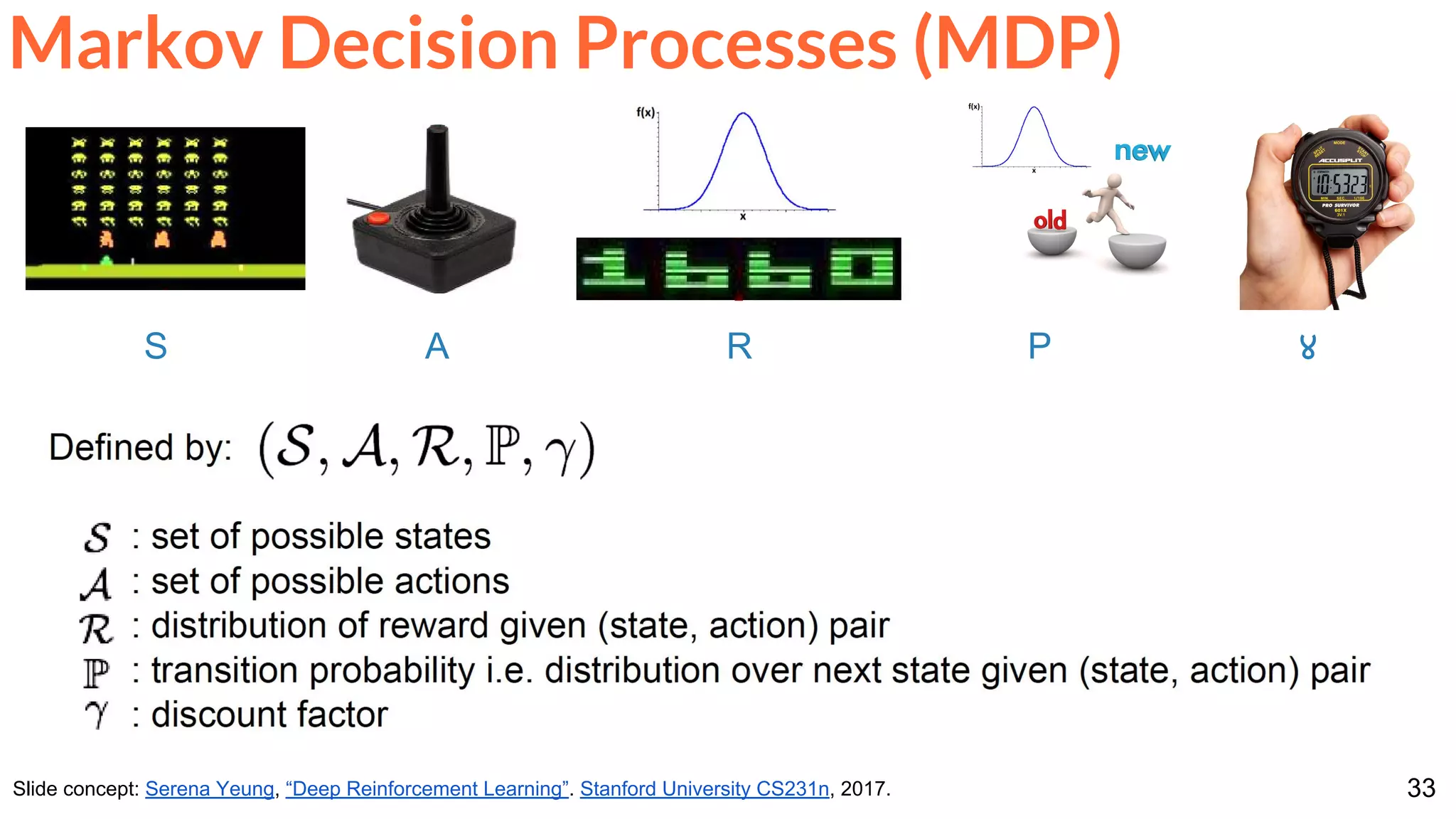
Markov Decision Processes (MDP)
Markov Decision Processes provide a formalism for reinforcement learning
problems.
Slide concept: Serena Yeung, “Deep Reinforcement Learning”. Stanford University CS231n, 2017.
Markov property:
Current state completely
characterises the state of the world.
33
Markov Decision Processes (MDP)
Slide concept: Serena Yeung, “Deep Reinforcement Learning”. Stanford University CS231n, 2017.
S A R P ४
34
Markov Decision Processes (MDP)
Slide concept: Serena Yeung, “Deep Reinforcement Learning”. Stanford University CS231n, 2017.
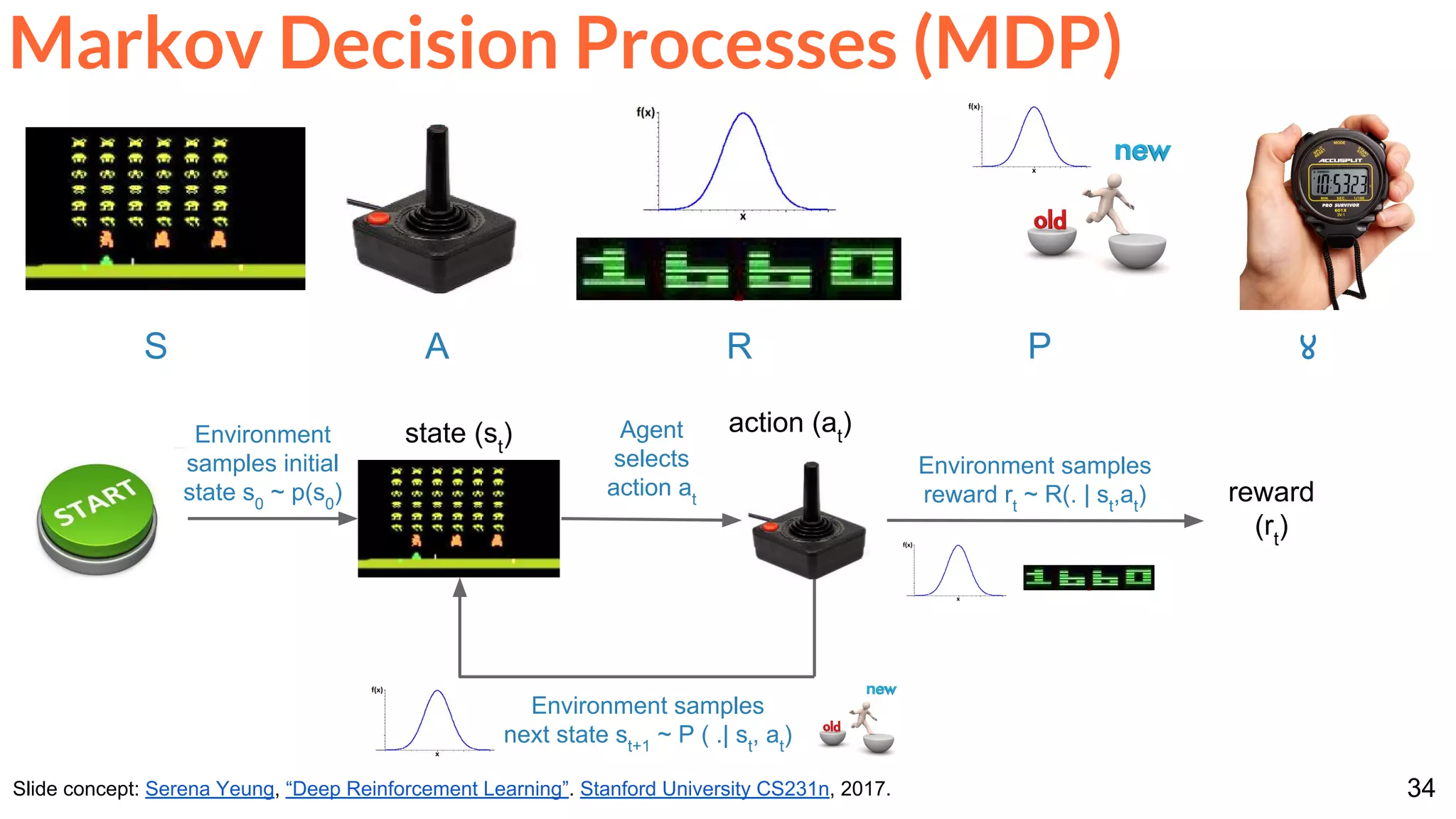
S A R P ४
Environment
samples initial
state s0
~ p(s0
)
Agent
selects
action at
Environment samples
next state st+1
~ P ( .| st
, at
)
Environment samples
reward rt
~ R(. | st
,at
) reward
(rt
)
state (st
) action (at
)
35
MDP: Policy
Slide concept: Serena Yeung, “Deep Reinforcement Learning”. Stanford University CS231n, 2017.
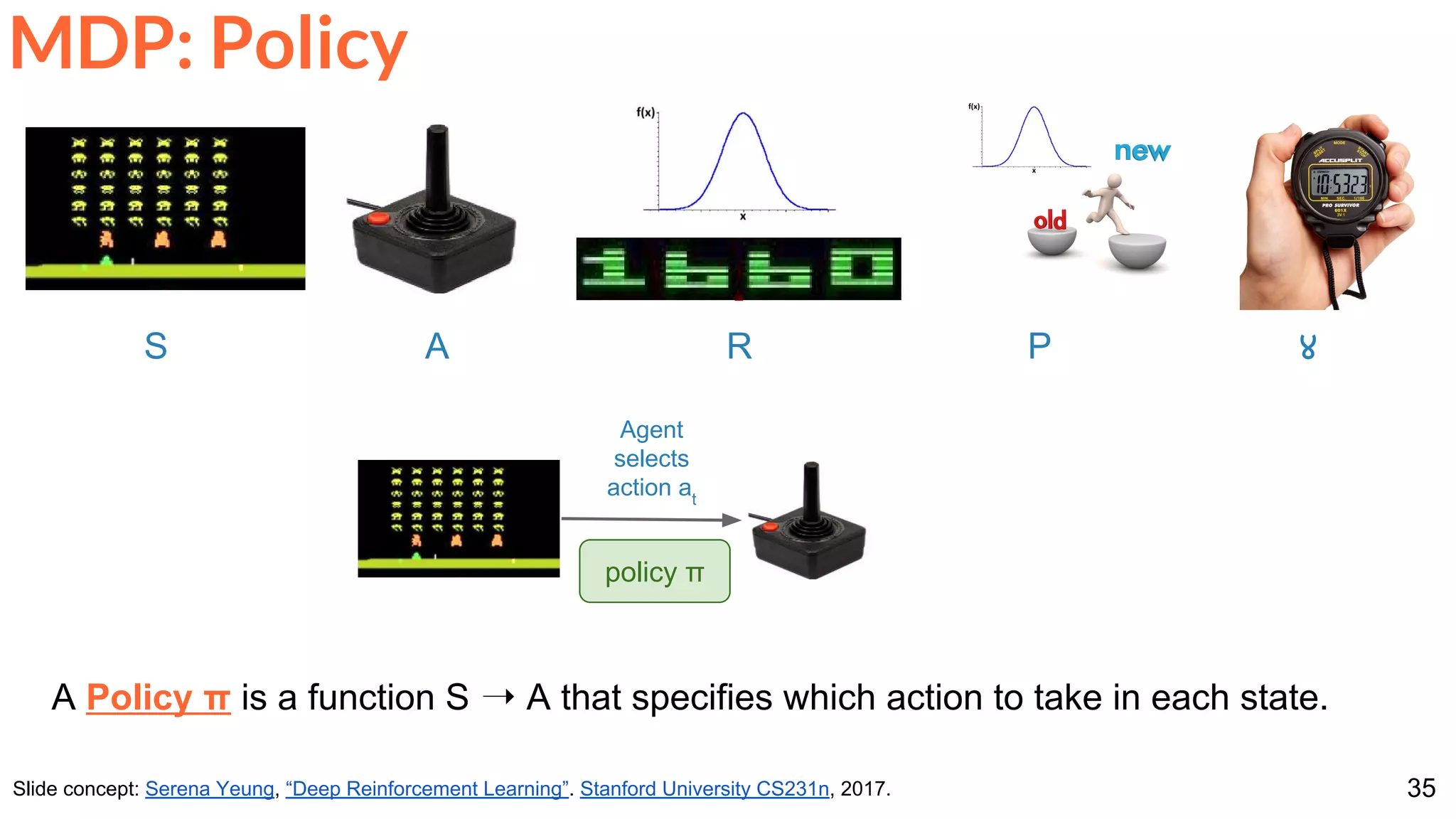
S A R P ४
Agent
selects
action at
policy π
A Policy π is a function S ➝ A that specifies which action to take in each state.
36
MDP: Policy
Slide concept: Serena Yeung, “Deep Reinforcement Learning”. Stanford University CS231n, 2017.
Agent
selects
action at
policy π
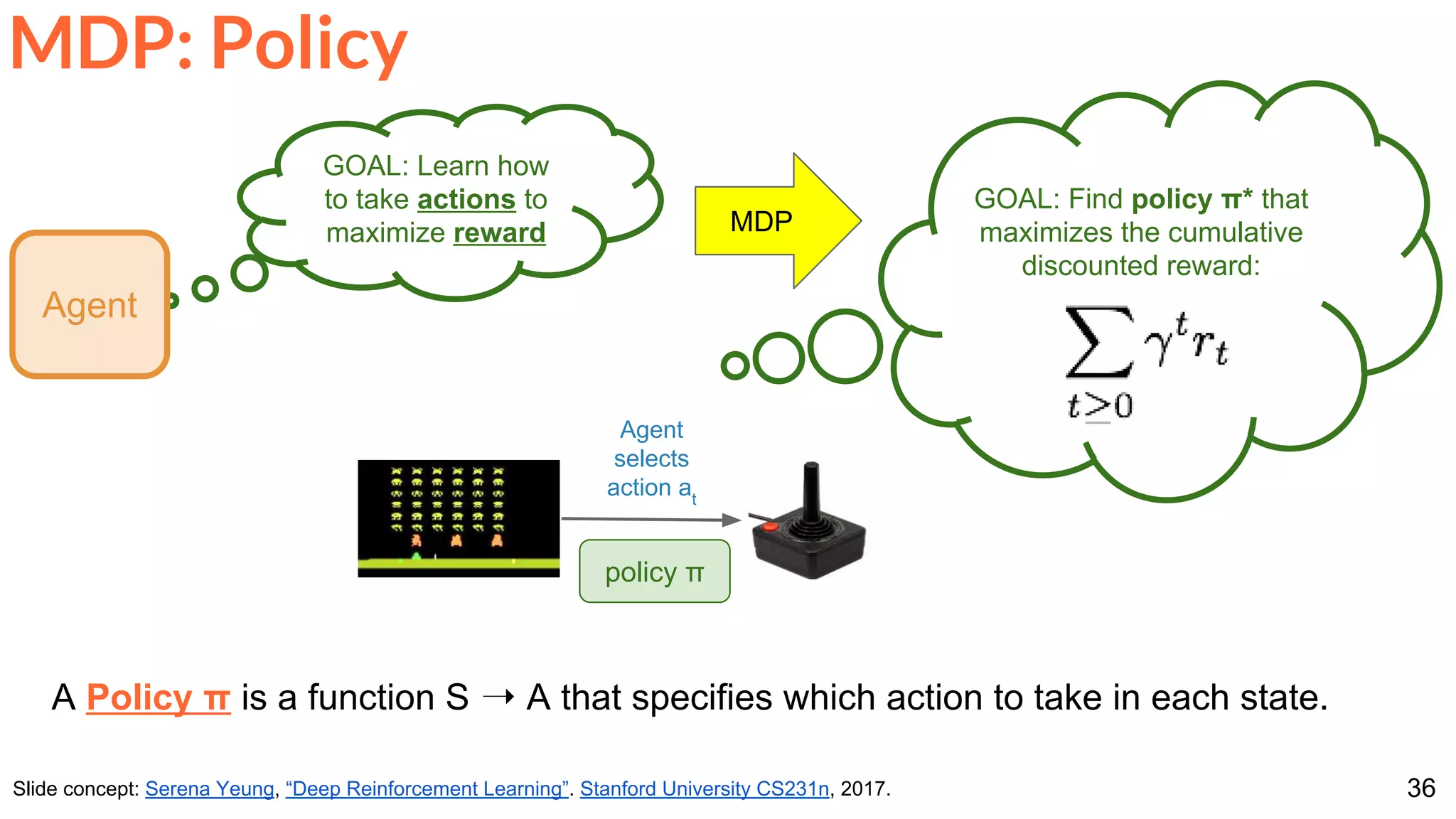
A Policy π is a function S ➝ A that specifies which action to take in each state.
GOAL: Learn how
to take actions to
maximize reward
Agent
GOAL: Find policy π* that
maximizes the cumulative
discounted reward:
MDP
37
Other problems that can be formulated with a RL architecture.
Slide concept: Serena Yeung, “Deep Reinforcement Learning”. Stanford University CS231n, 2017.
MDP: Policy
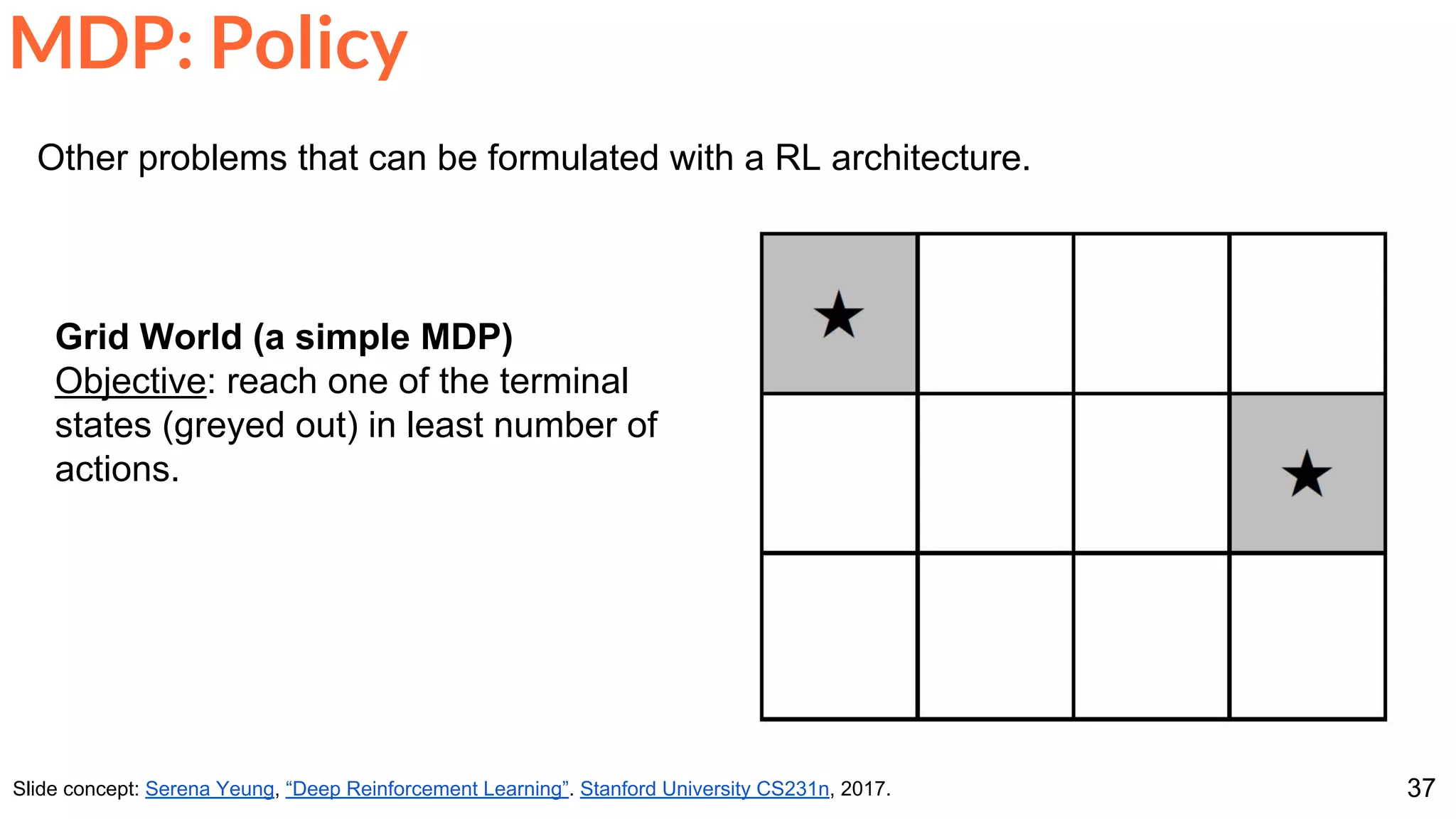
Grid World (a simple MDP)
Objective: reach one of the terminal
states (greyed out) in least number of
actions.
38Slide concept: Serena Yeung, “Deep Reinforcement Learning”. Stanford University CS231n, 2017.
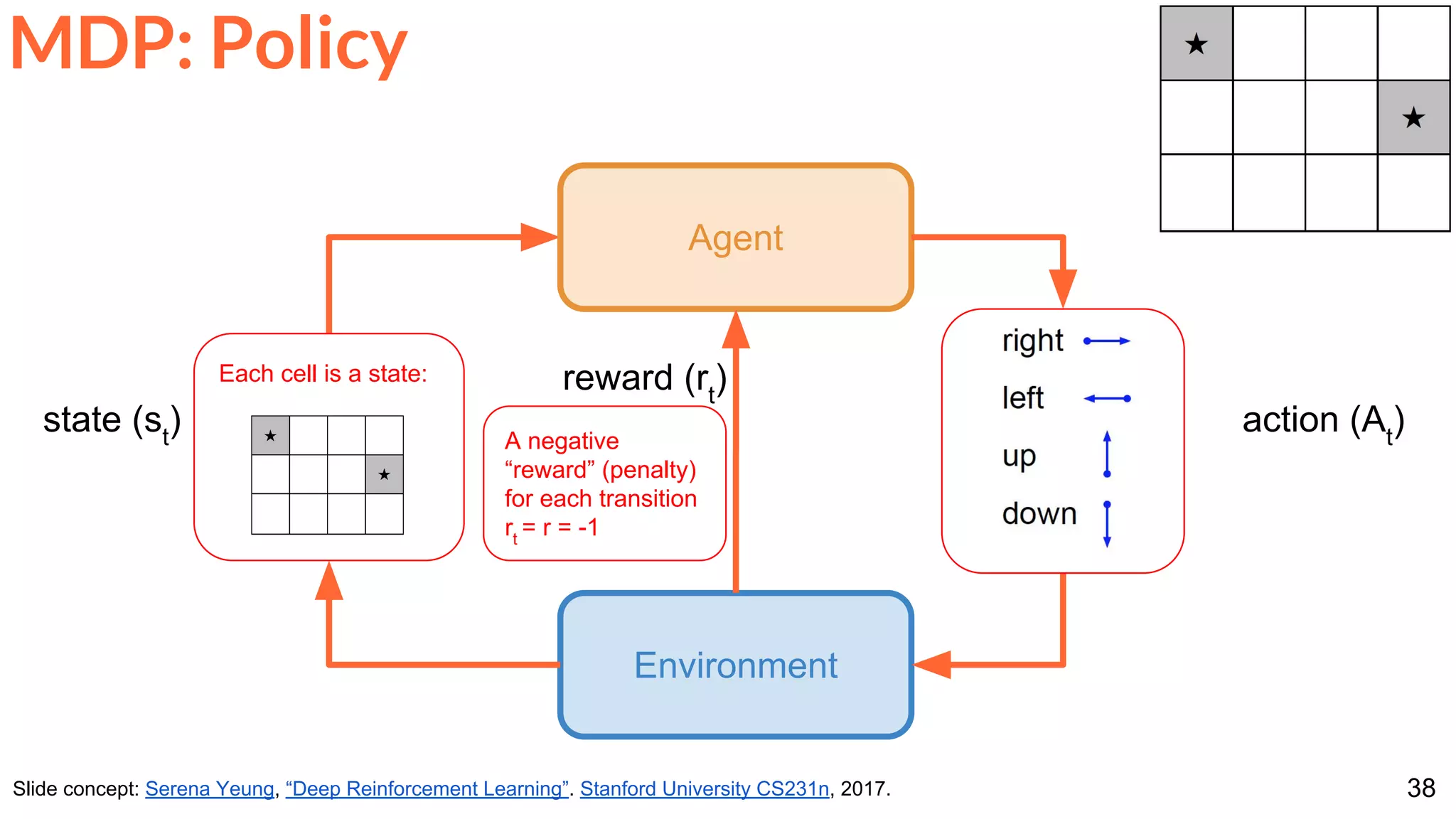
Environment
Agent
action (At
)
reward (rt
)
state (st
)
Each cell is a state:
A negative
“reward” (penalty)
for each transition
rt
= r = -1
MDP: Policy
39Slide concept: Serena Yeung, “Deep Reinforcement Learning”. Stanford University CS231n, 2017.
MDP: Policy
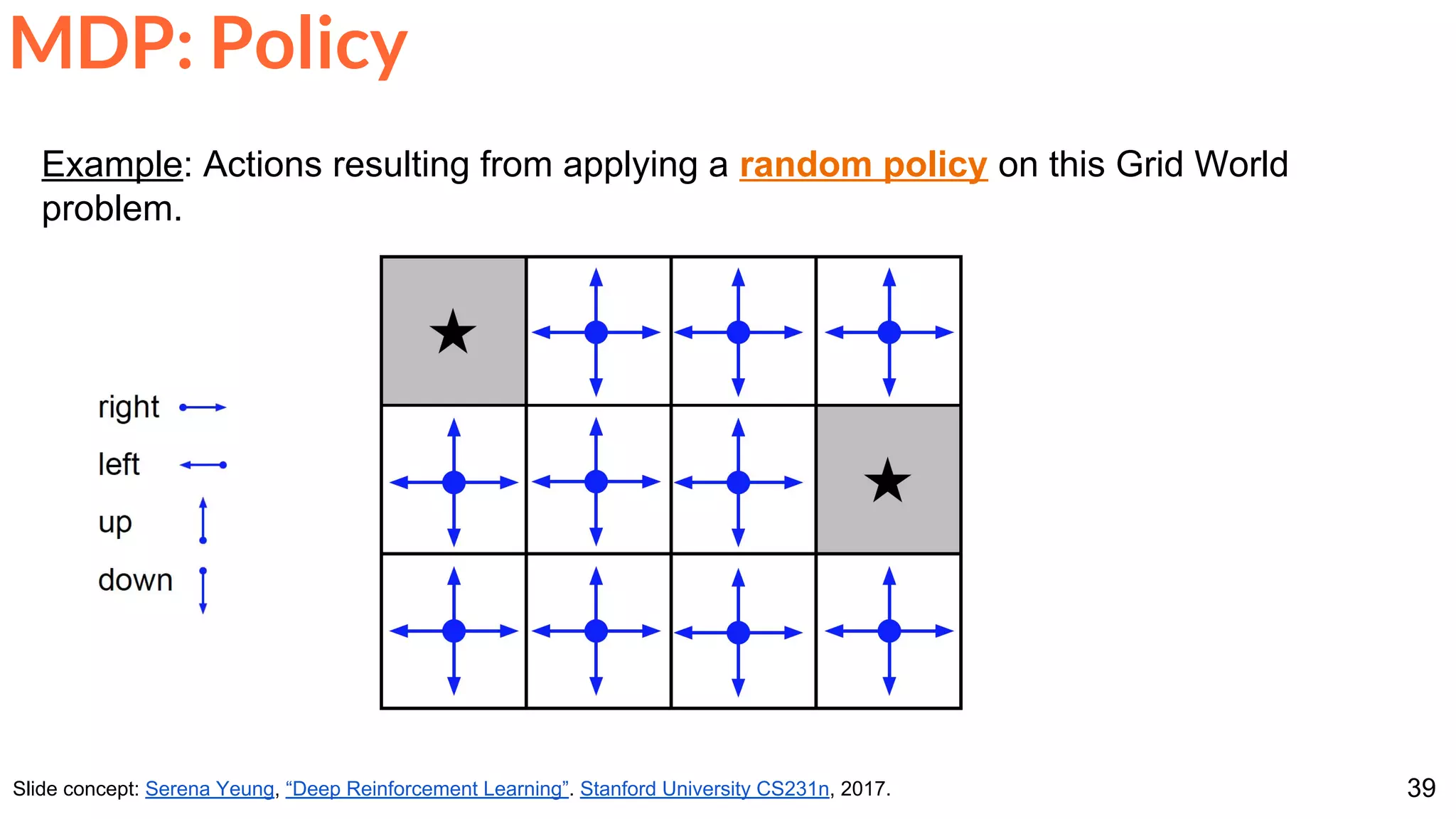
Example: Actions resulting from applying a random policy on this Grid World
problem.
40Slide concept: Serena Yeung, “Deep Reinforcement Learning”. Stanford University CS231n, 2017.
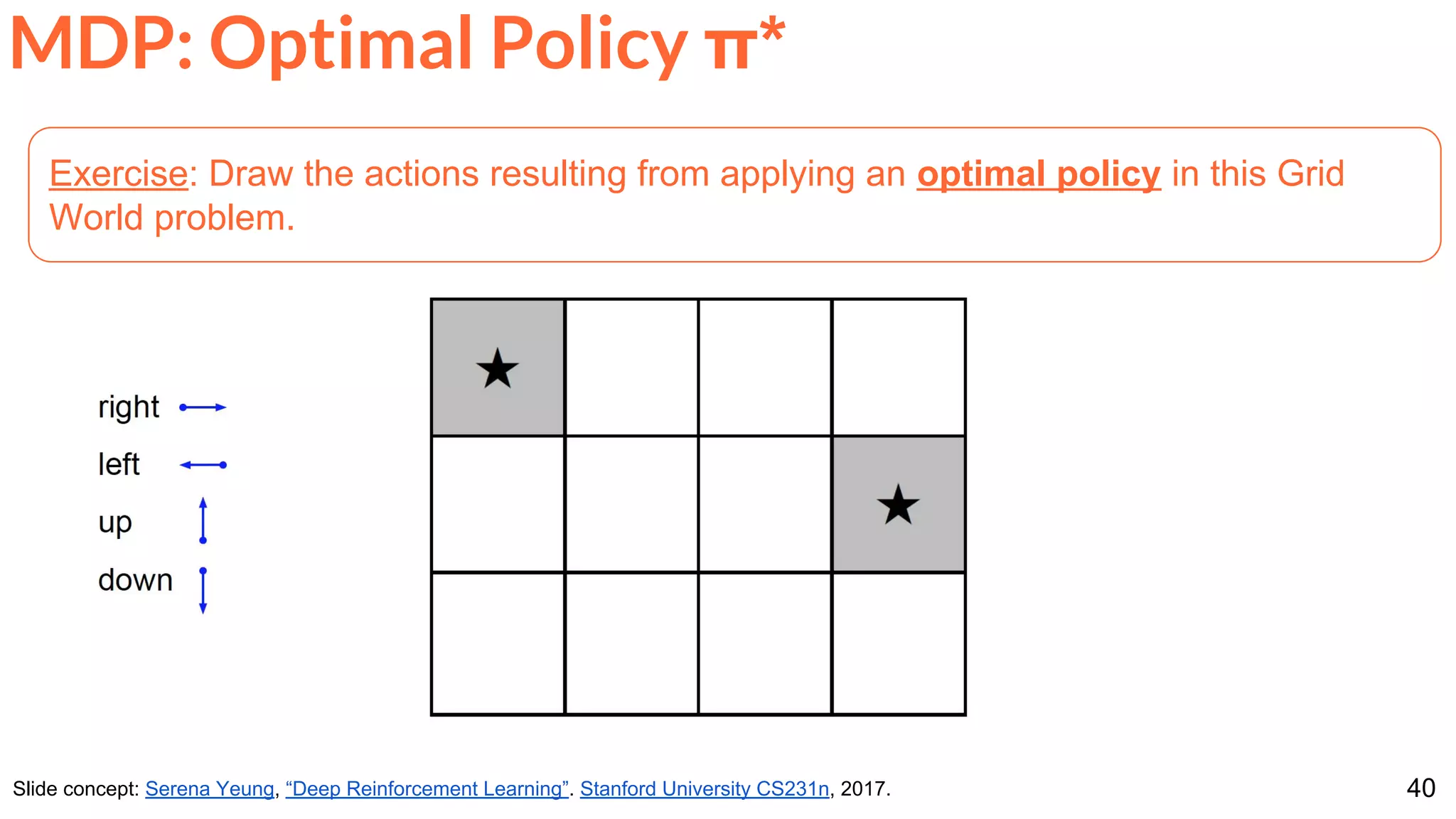
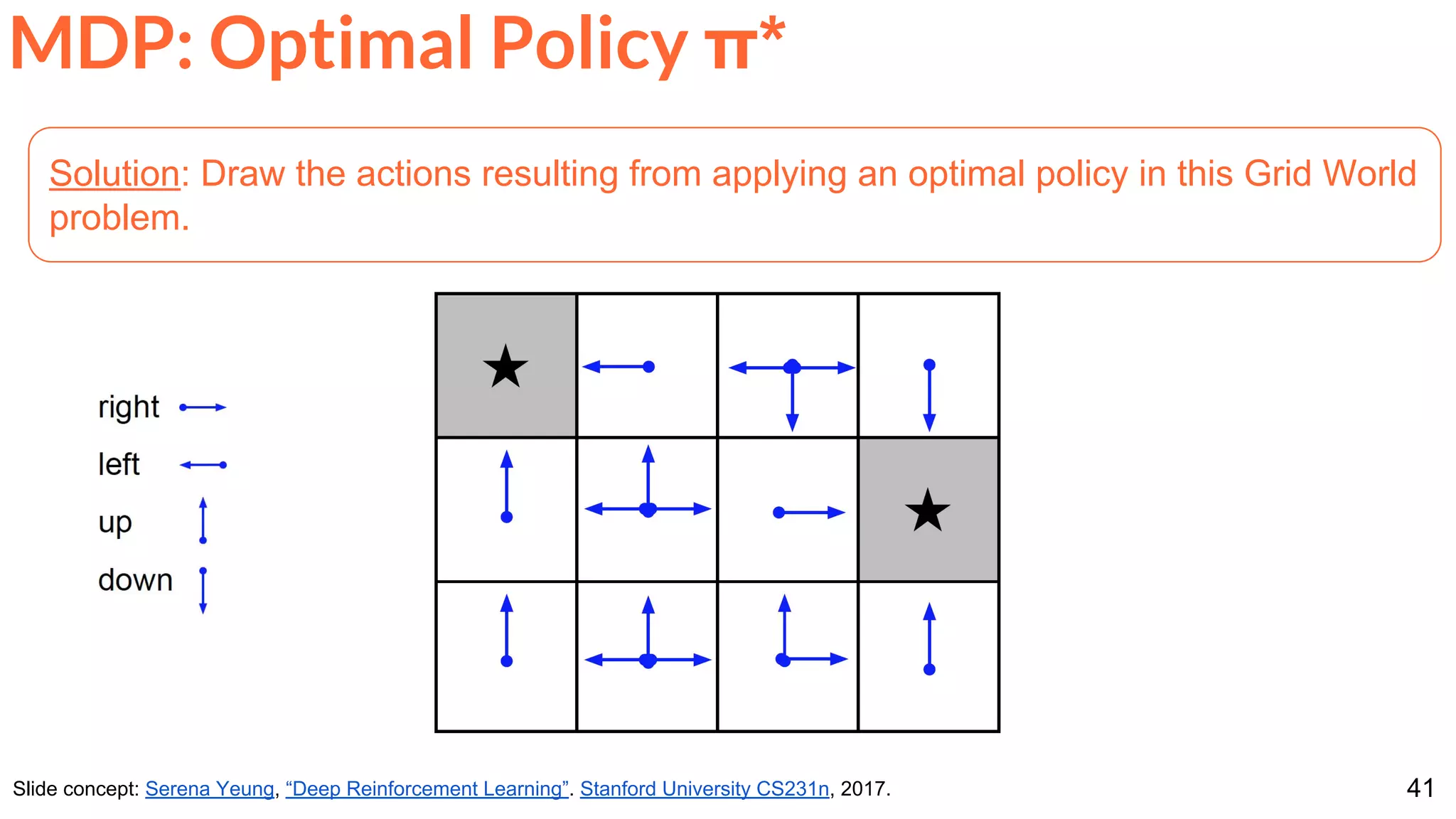
Exercise: Draw the actions resulting from applying an optimal policy in this Grid
World problem.
MDP: Optimal Policy π*
41Slide concept: Serena Yeung, “Deep Reinforcement Learning”. Stanford University CS231n, 2017.
Solution: Draw the actions resulting from applying an optimal policy in this Grid World
problem.
MDP: Optimal Policy π*
42
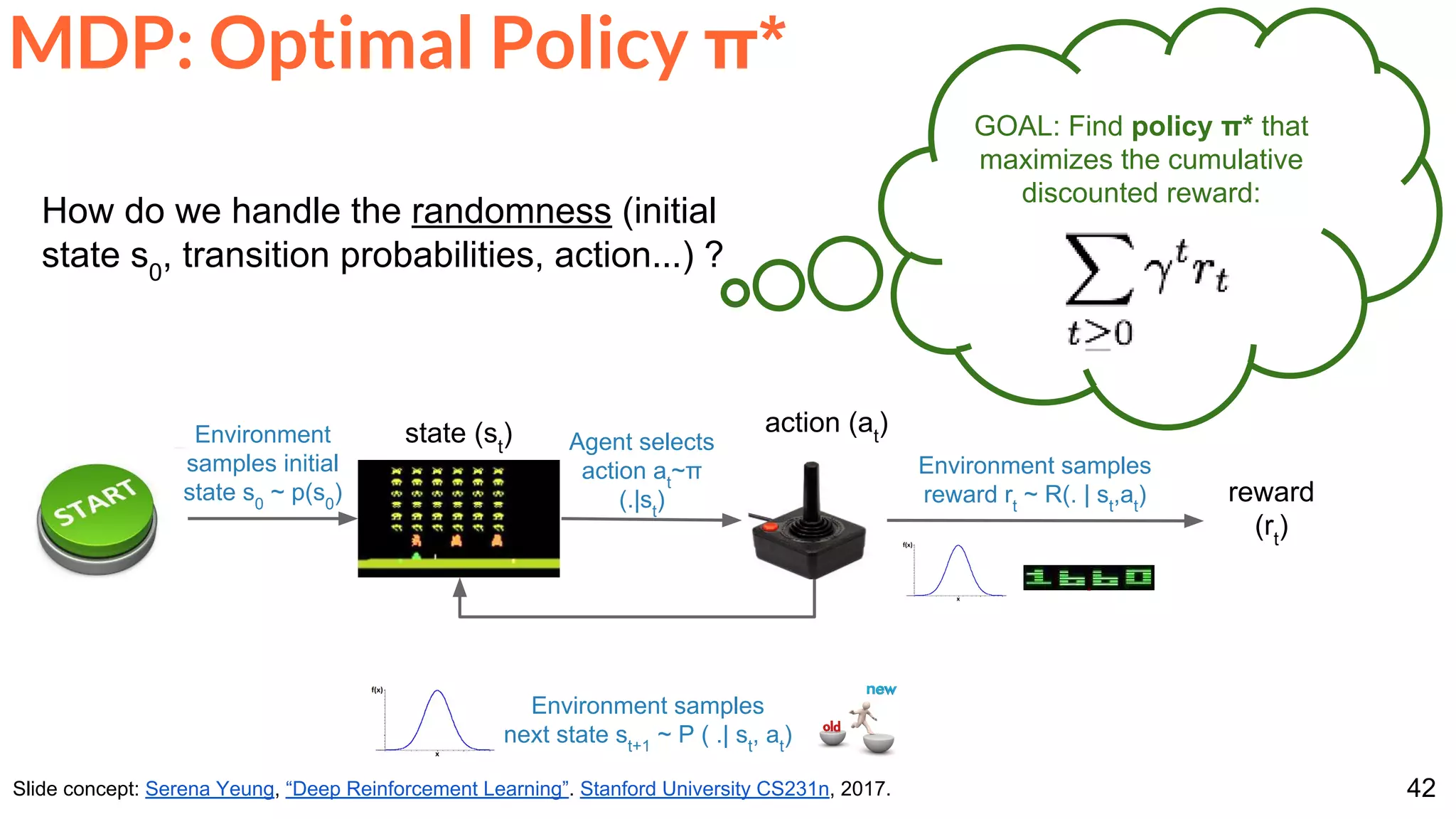
MDP: Optimal Policy π*
Slide concept: Serena Yeung, “Deep Reinforcement Learning”. Stanford University CS231n, 2017.
How do we handle the randomness (initial
state s0
, transition probabilities, action...) ?
GOAL: Find policy π* that
maximizes the cumulative
discounted reward:
Environment
samples initial
state s0
~ p(s0
)
Agent selects
action at
~π
(.|st
)
Environment samples
next state st+1
~ P ( .| st
, at
)
Environment samples
reward rt
~ R(. | st
,at
) reward
(rt
)
state (st
) action (at
)
43Slide concept: Serena Yeung, “Deep Reinforcement Learning”. Stanford University CS231n, 2017.
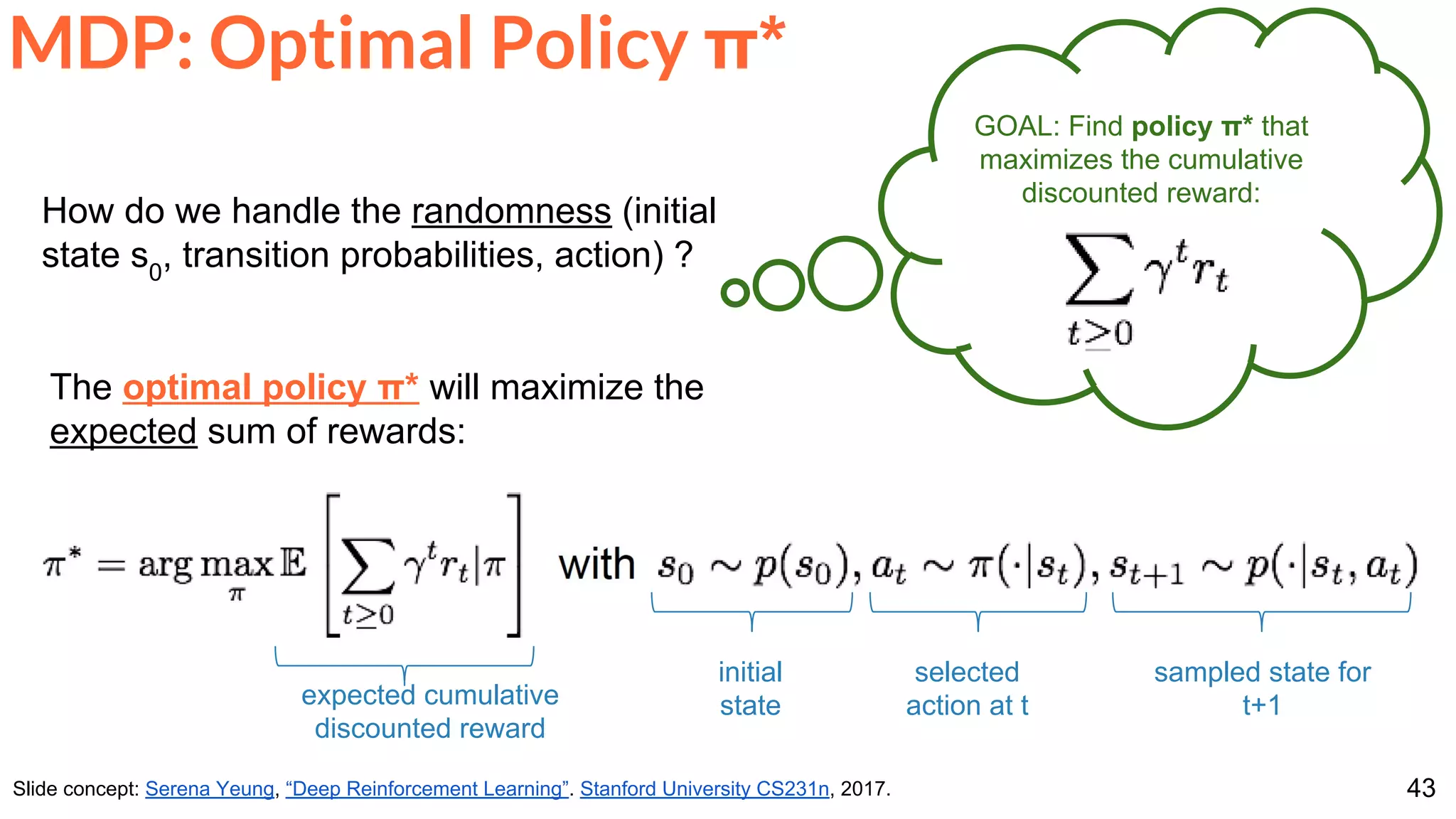
How do we handle the randomness (initial
state s0
, transition probabilities, action) ?
GOAL: Find policy π* that
maximizes the cumulative
discounted reward:
The optimal policy π* will maximize the
expected sum of rewards:
initial
state
selected
action at t
sampled state for
t+1expected cumulative
discounted reward
MDP: Optimal Policy π*
44
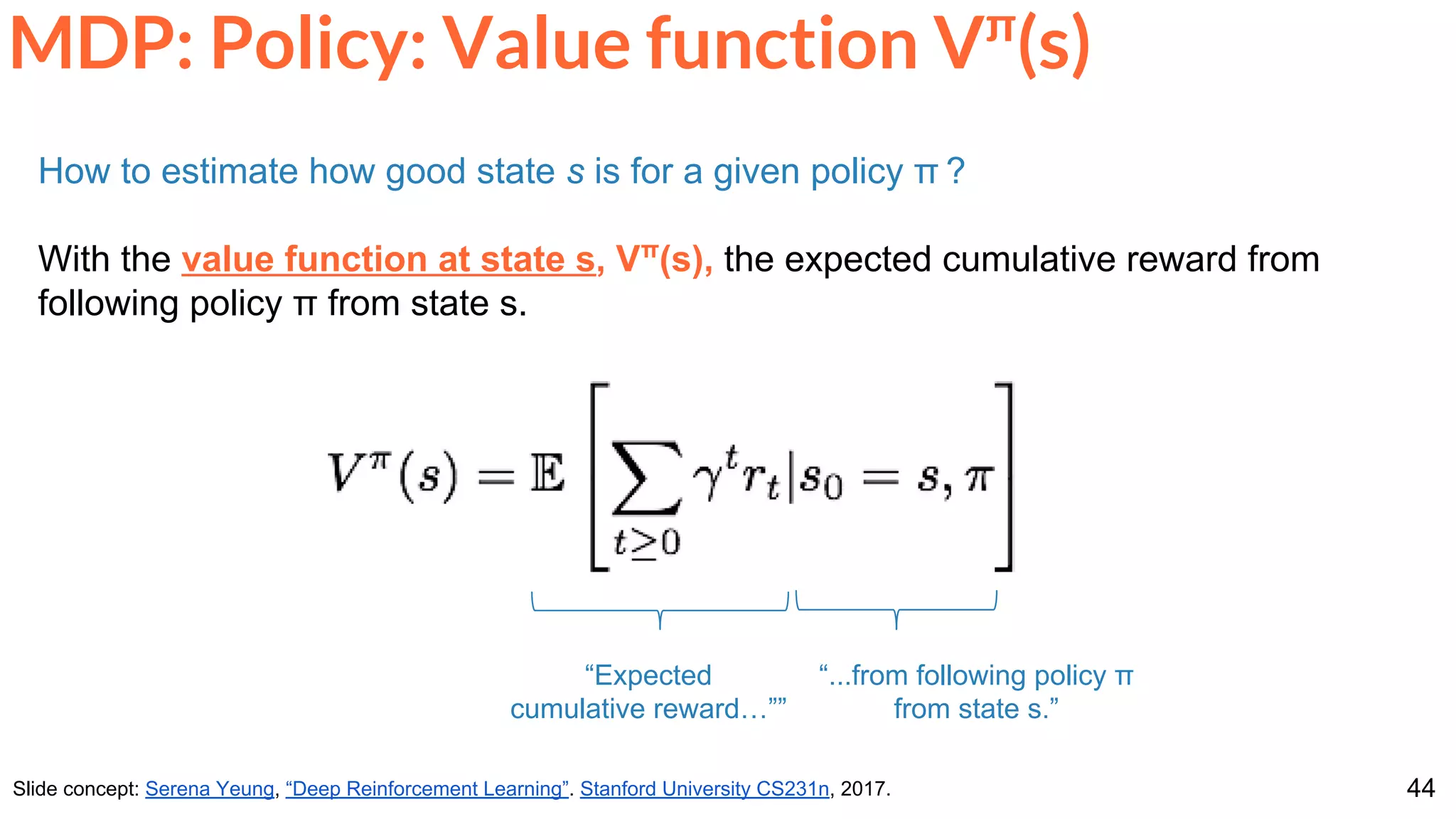
MDP: Policy: Value function Vπ
(s)
Slide concept: Serena Yeung, “Deep Reinforcement Learning”. Stanford University CS231n, 2017.
How to estimate how good state s is for a given policy π ?
With the value function at state s, Vπ
(s), the expected cumulative reward from
following policy π from state s.
“...from following policy π
from state s.”
“Expected
cumulative reward…””
45
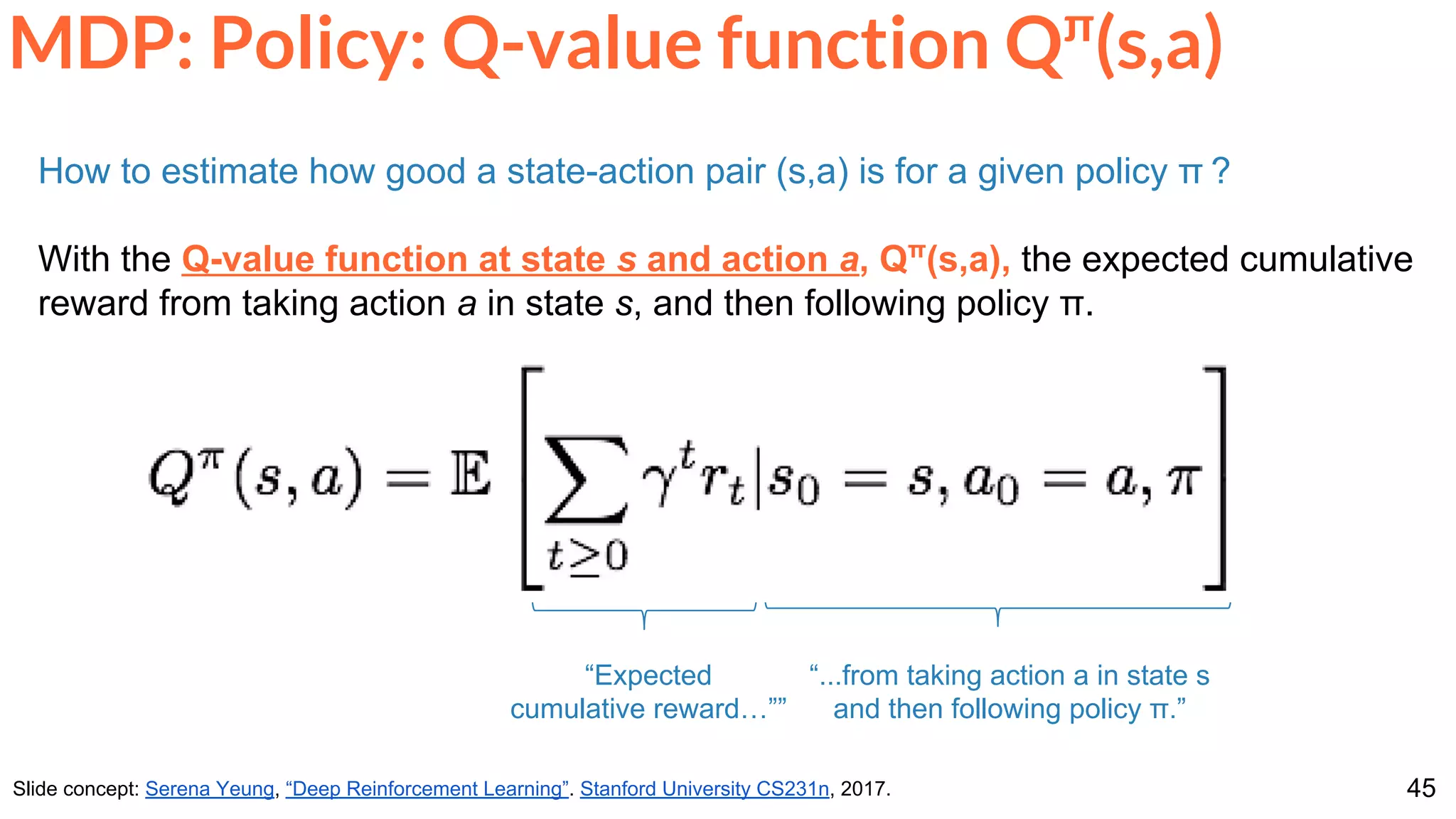
MDP: Policy: Q-value function Qπ
(s,a)
Slide concept: Serena Yeung, “Deep Reinforcement Learning”. Stanford University CS231n, 2017.
How to estimate how good a state-action pair (s,a) is for a given policy π ?
With the Q-value function at state s and action a, Qπ
(s,a), the expected cumulative
reward from taking action a in state s, and then following policy π.
“...from taking action a in state s
and then following policy π.”
“Expected
cumulative reward…””
46
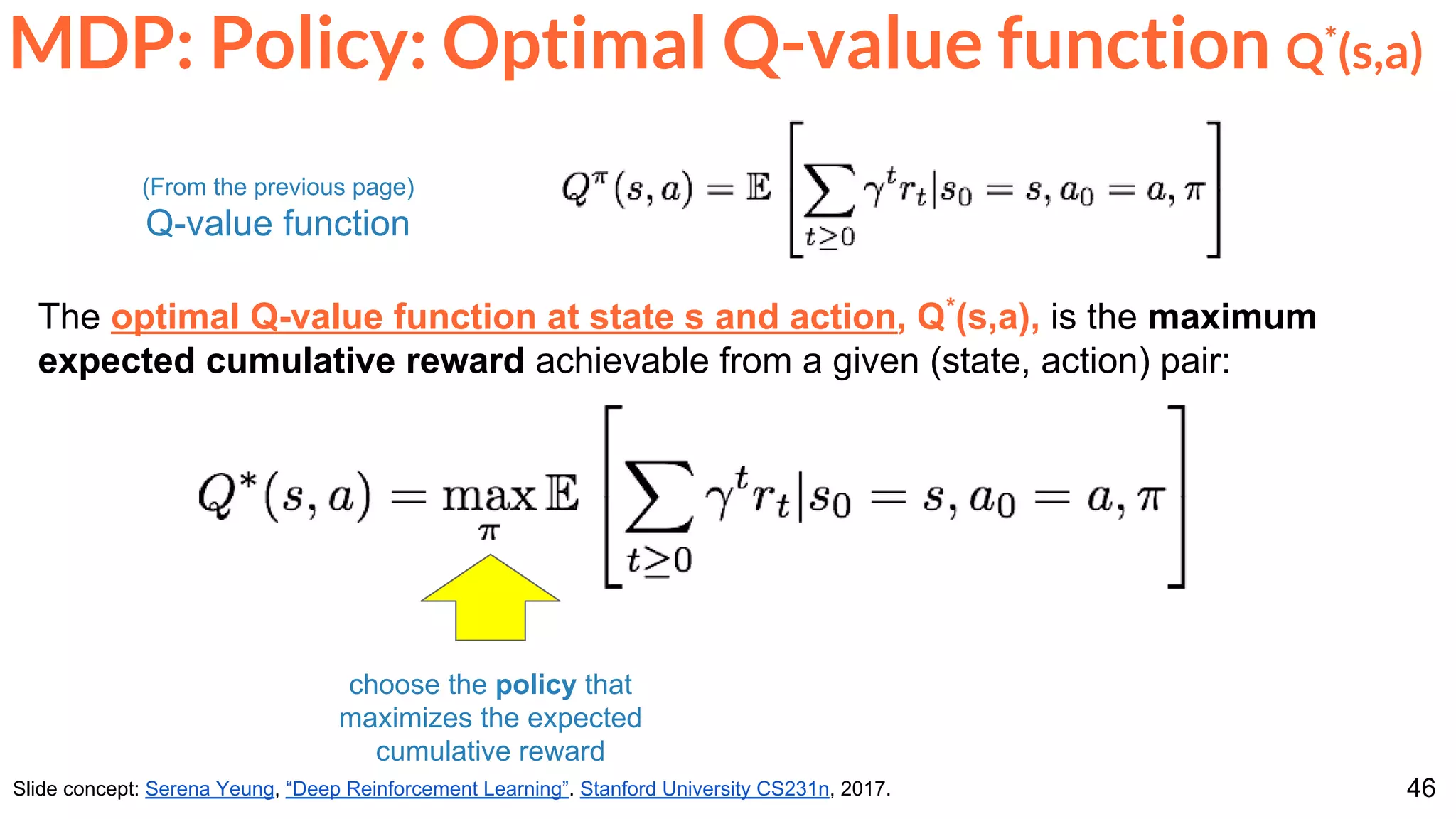
MDP: Policy: Optimal Q-value function Q*
(s,a)
Slide concept: Serena Yeung, “Deep Reinforcement Learning”. Stanford University CS231n, 2017.
The optimal Q-value function at state s and action, Q*
(s,a), is the maximum
expected cumulative reward achievable from a given (state, action) pair:
choose the policy that
maximizes the expected
cumulative reward
(From the previous page)
Q-value function
47
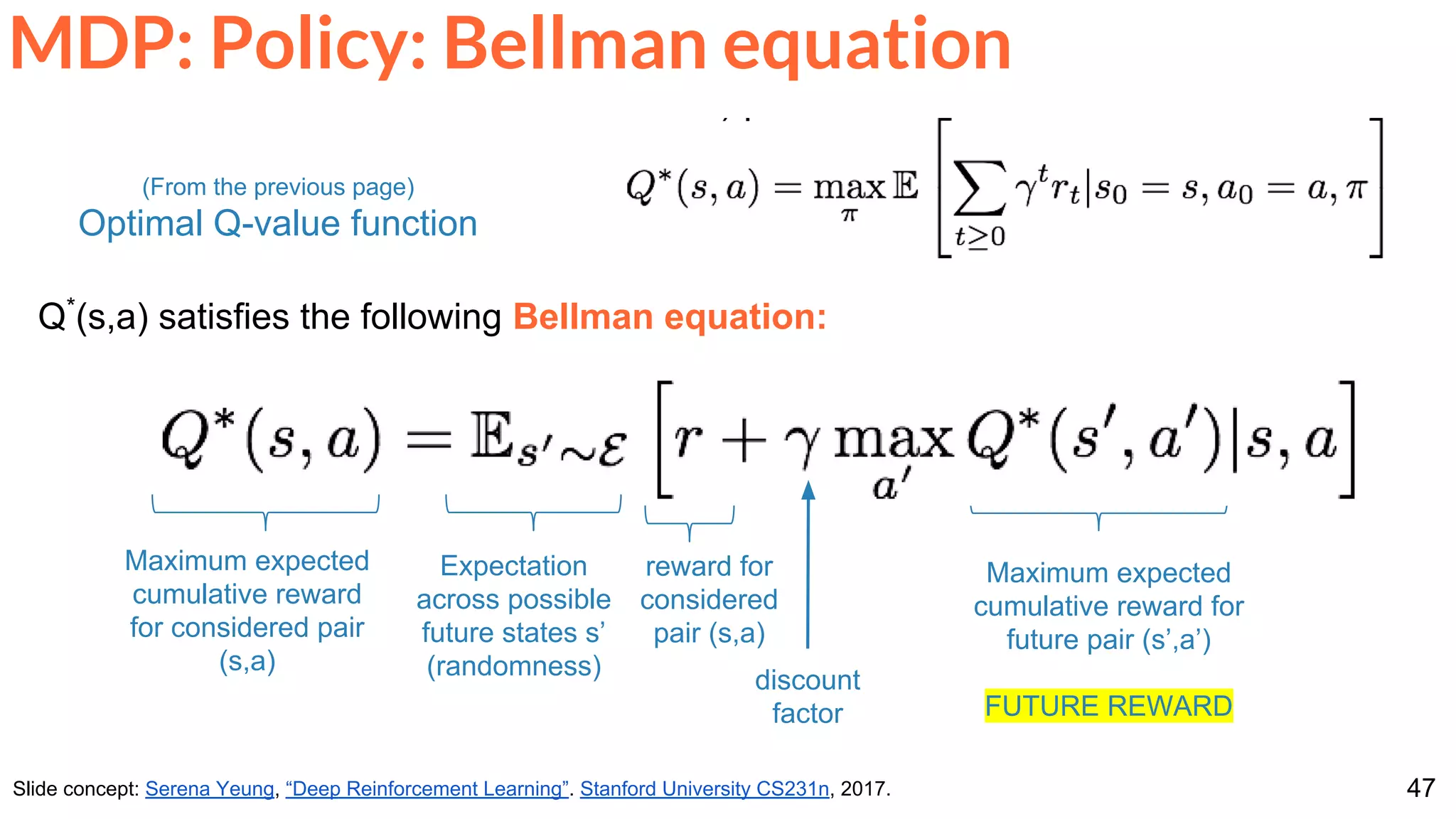
MDP: Policy: Bellman equation
Slide concept: Serena Yeung, “Deep Reinforcement Learning”. Stanford University CS231n, 2017.
Q*
(s,a) satisfies the following Bellman equation:
Maximum expected
cumulative reward for
future pair (s’,a’)
FUTURE REWARD
(From the previous page)
Optimal Q-value function
reward for
considered
pair (s,a)
Maximum expected
cumulative reward
for considered pair
(s,a)
Expectation
across possible
future states s’
(randomness) discount
factor
48
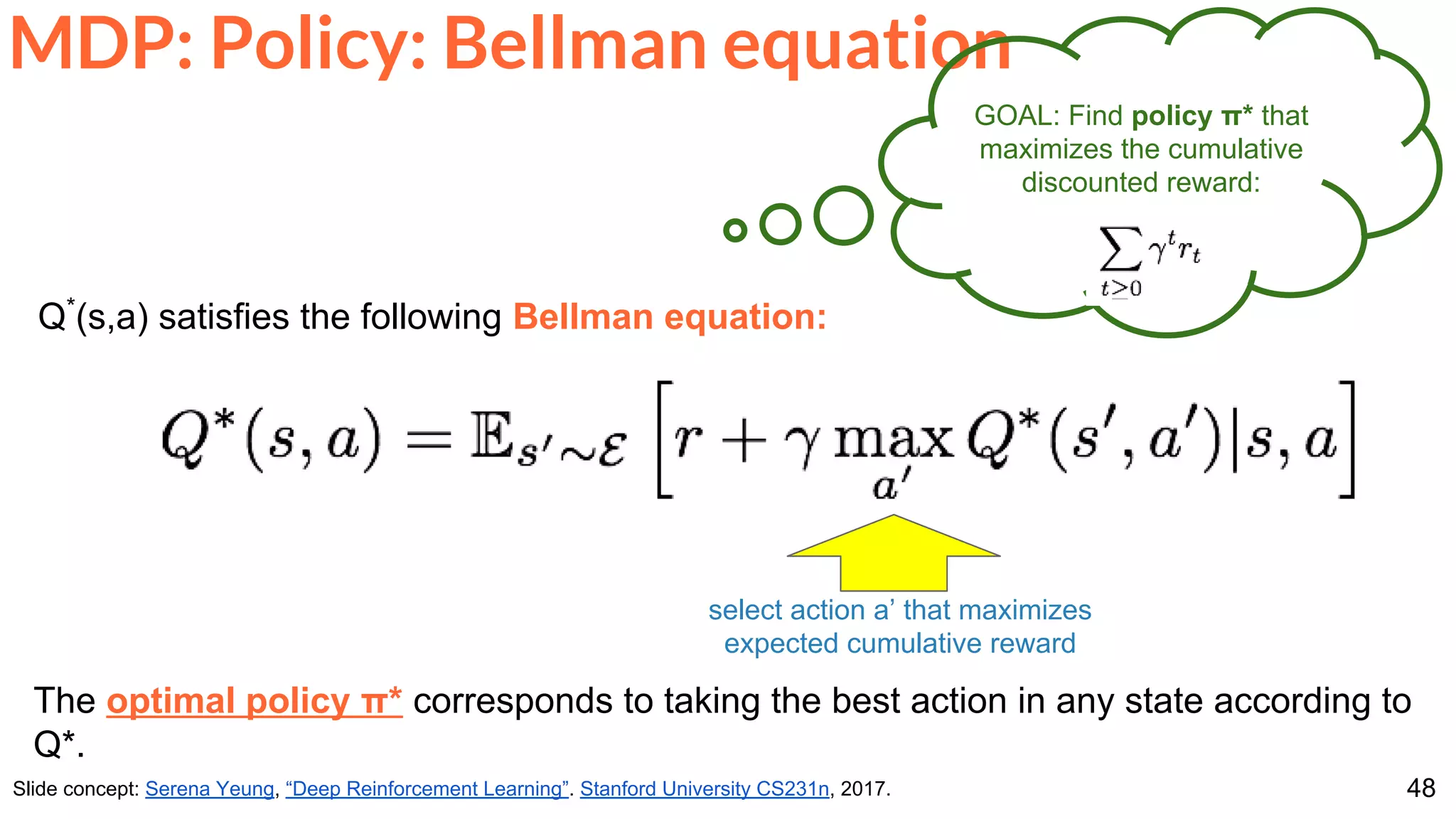
MDP: Policy: Bellman equation
Slide concept: Serena Yeung, “Deep Reinforcement Learning”. Stanford University CS231n, 2017.
Q*
(s,a) satisfies the following Bellman equation:
The optimal policy π* corresponds to taking the best action in any state according to
Q*.
GOAL: Find policy π* that
maximizes the cumulative
discounted reward:
select action a’ that maximizes
expected cumulative reward
49
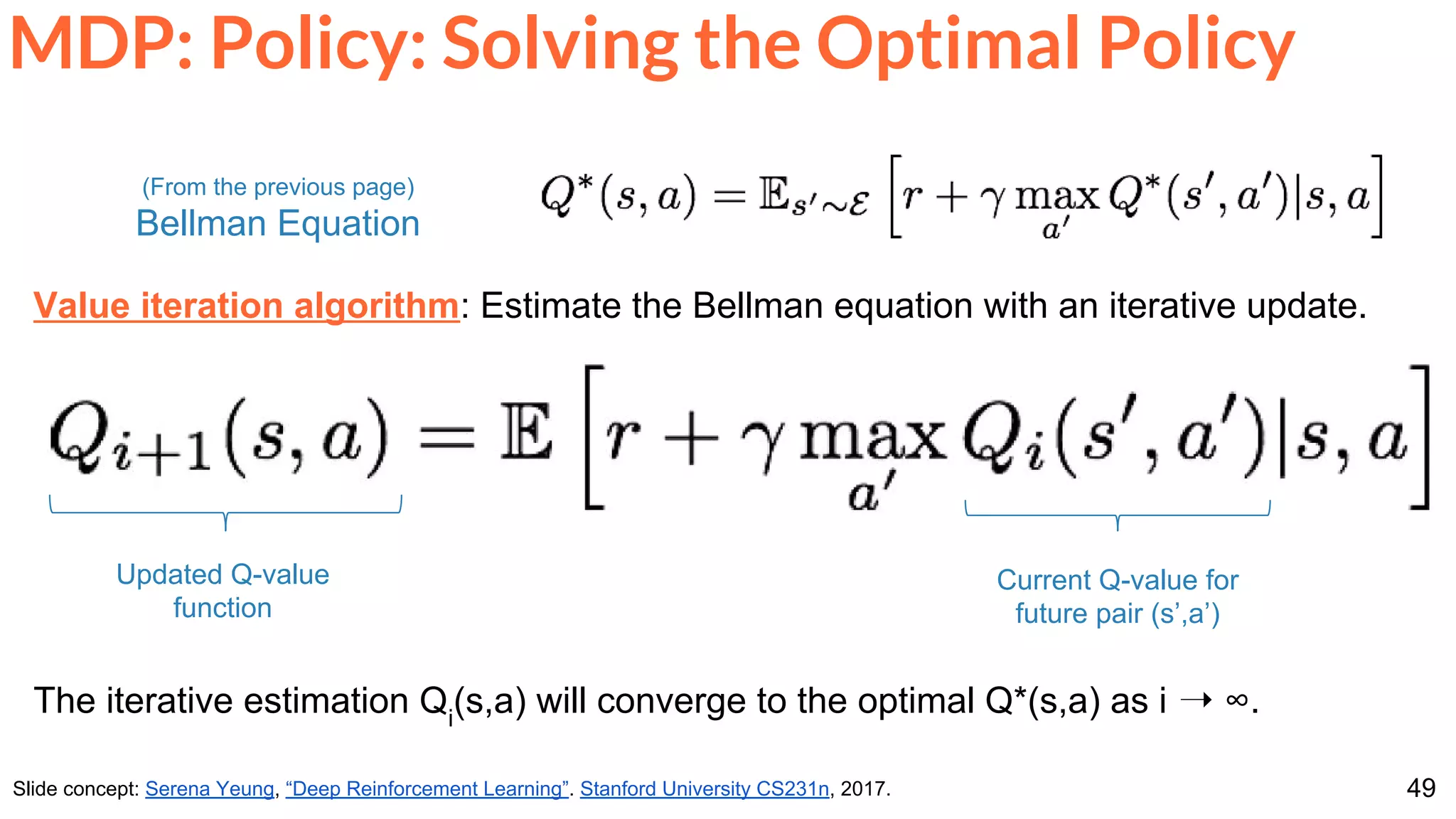
MDP: Policy: Solving the Optimal Policy
Slide concept: Serena Yeung, “Deep Reinforcement Learning”. Stanford University CS231n, 2017.
Value iteration algorithm: Estimate the Bellman equation with an iterative update.
The iterative estimation Qi
(s,a) will converge to the optimal Q*(s,a) as i ➝ ∞.
(From the previous page)
Bellman Equation
Updated Q-value
function
Current Q-value for
future pair (s’,a’)
50
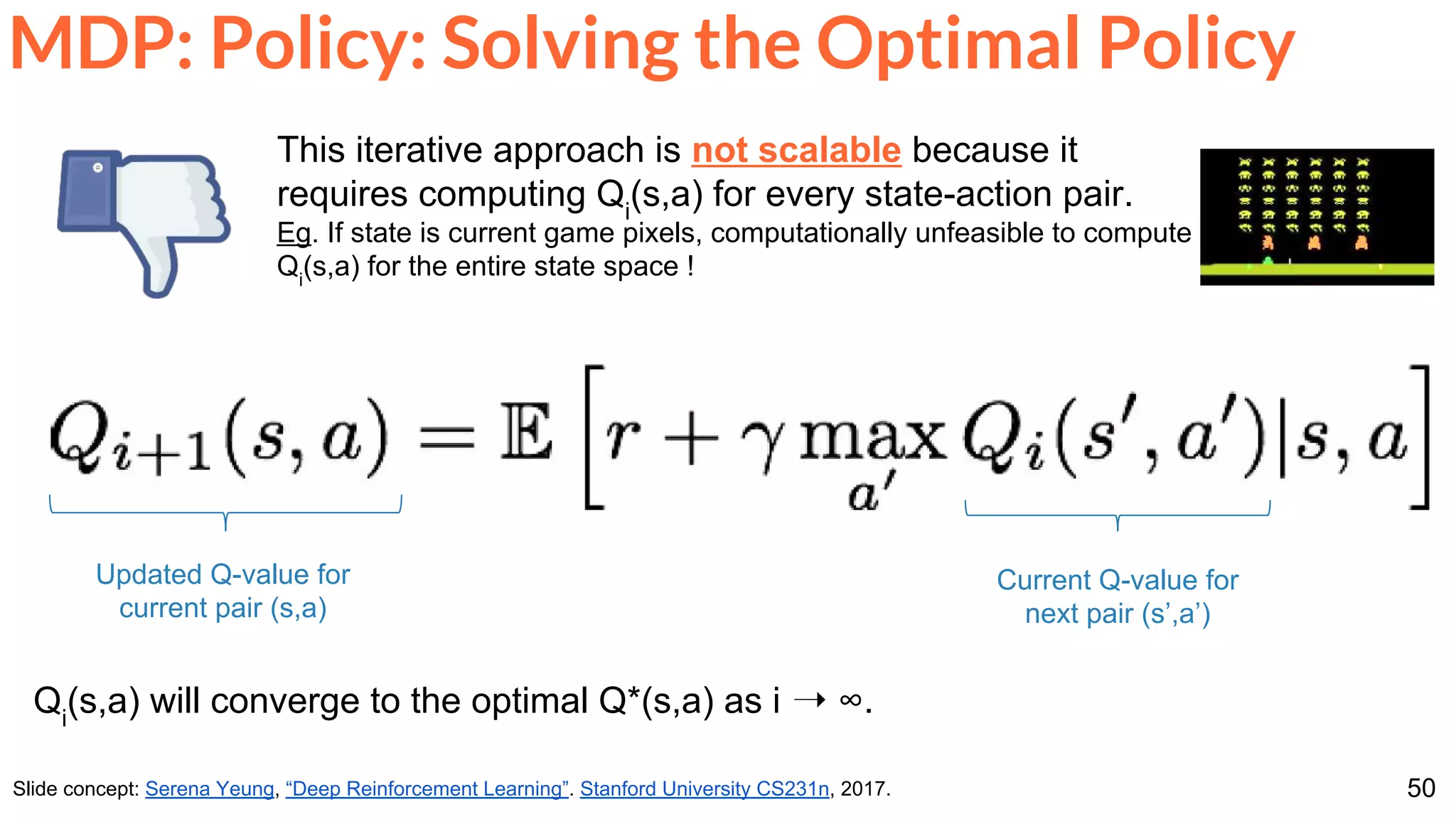
MDP: Policy: Solving the Optimal Policy
Slide concept: Serena Yeung, “Deep Reinforcement Learning”. Stanford University CS231n, 2017.
Qi
(s,a) will converge to the optimal Q*(s,a) as i ➝ ∞.
Updated Q-value for
current pair (s,a)
Current Q-value for
next pair (s’,a’)
This iterative approach is not scalable because it
requires computing Qi
(s,a) for every state-action pair.
Eg. If state is current game pixels, computationally unfeasible to compute
Qi
(s,a) for the entire state space !
51
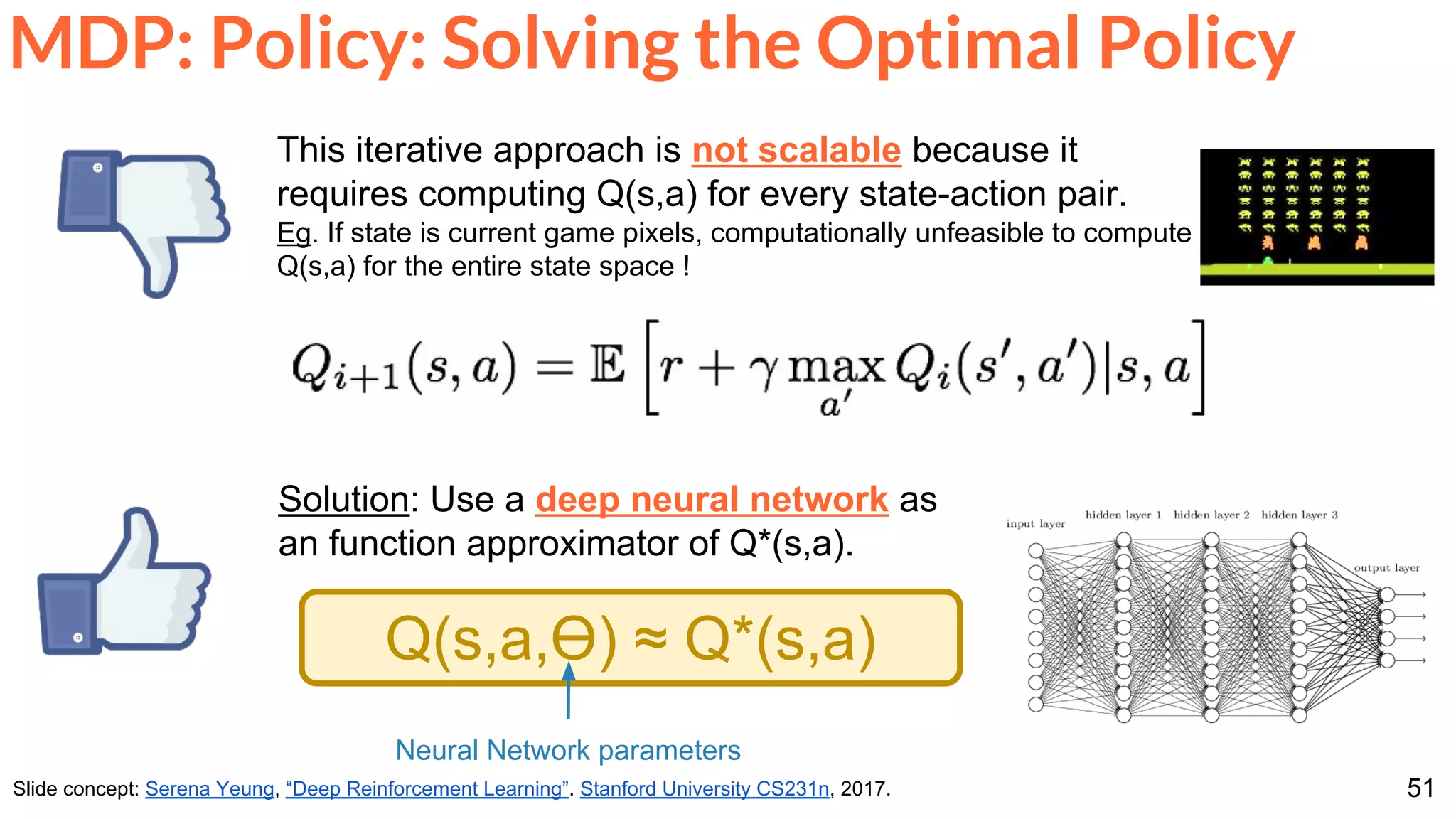
MDP: Policy: Solving the Optimal Policy
Slide concept: Serena Yeung, “Deep Reinforcement Learning”. Stanford University CS231n, 2017.
This iterative approach is not scalable because it
requires computing Q(s,a) for every state-action pair.
Eg. If state is current game pixels, computationally unfeasible to compute
Q(s,a) for the entire state space !
Solution: Use a deep neural network as
an function approximator of Q*(s,a).
Q(s,a,Ө) ≈ Q*(s,a)
Neural Network parameters
52
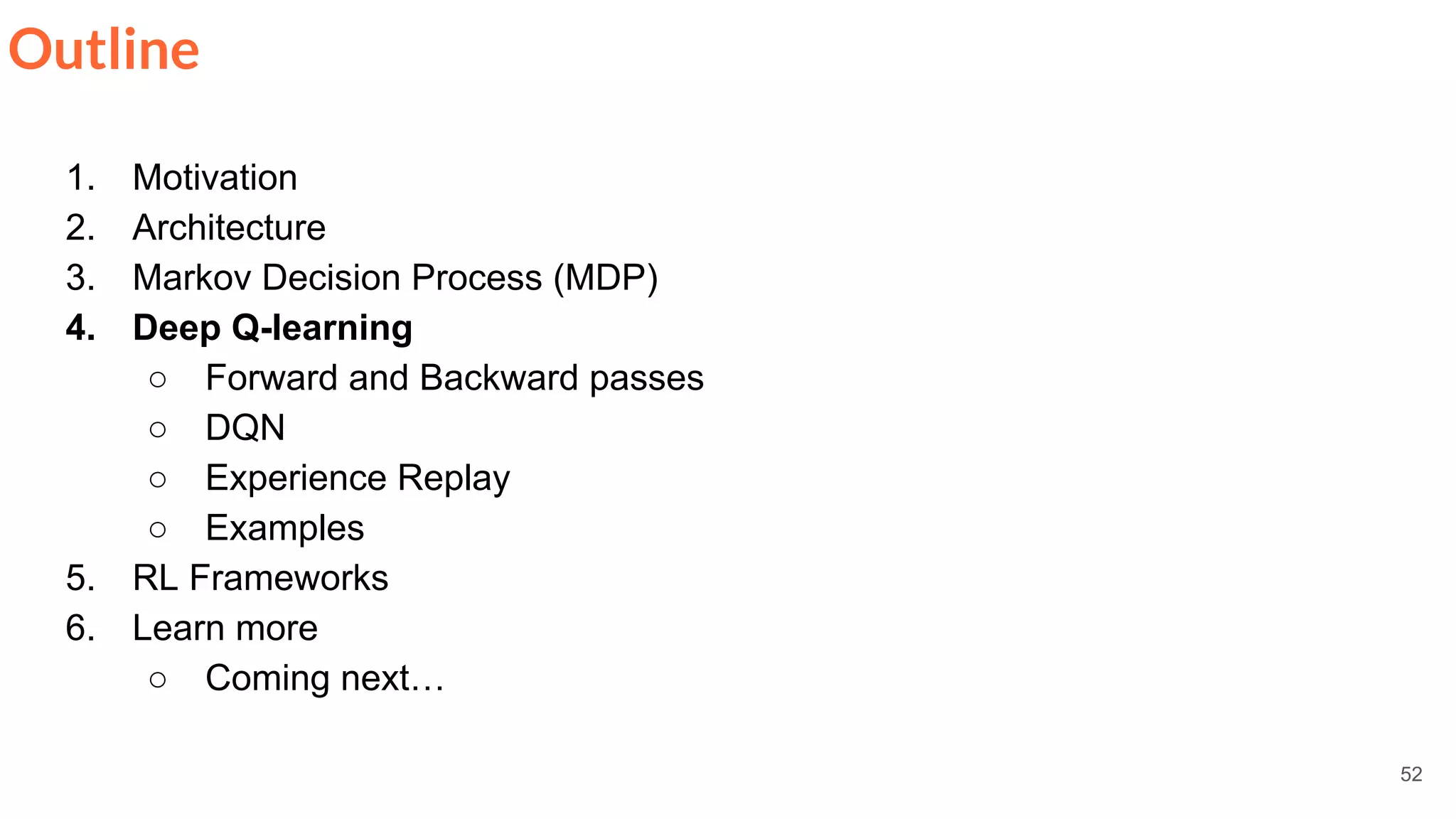
Outline
1. Motivation
2. Architecture
3. Markov Decision Process (MDP)
4. Deep Q-learning
○ Forward and Backward passes
○ DQN
○ Experience Replay
○ Examples
5. RL Frameworks
6. Learn more
○ Coming next…
53
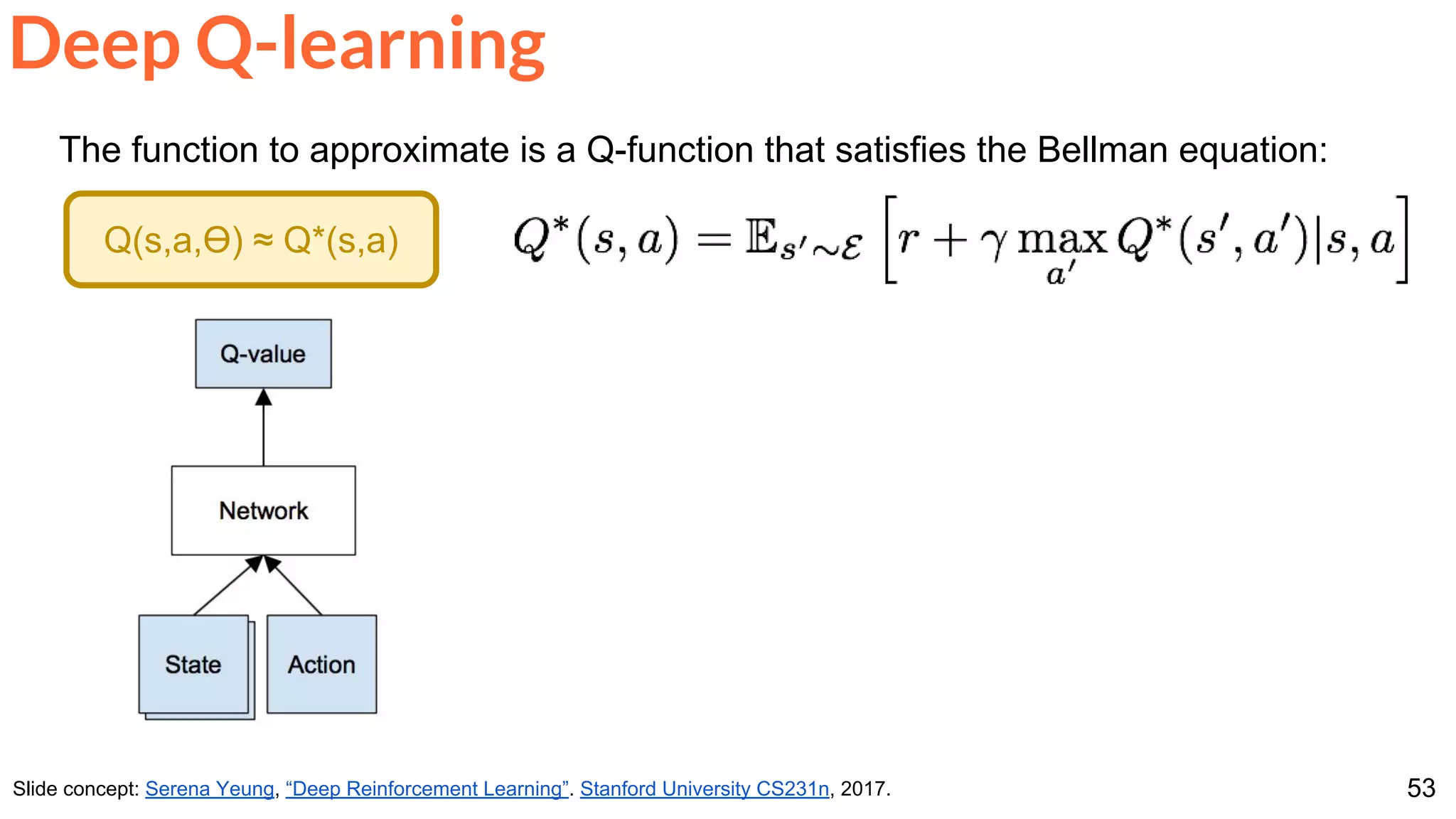
Deep Q-learning
Slide concept: Serena Yeung, “Deep Reinforcement Learning”. Stanford University CS231n, 2017.
The function to approximate is a Q-function that satisfies the Bellman equation:
Q(s,a,Ө) ≈ Q*(s,a)
54
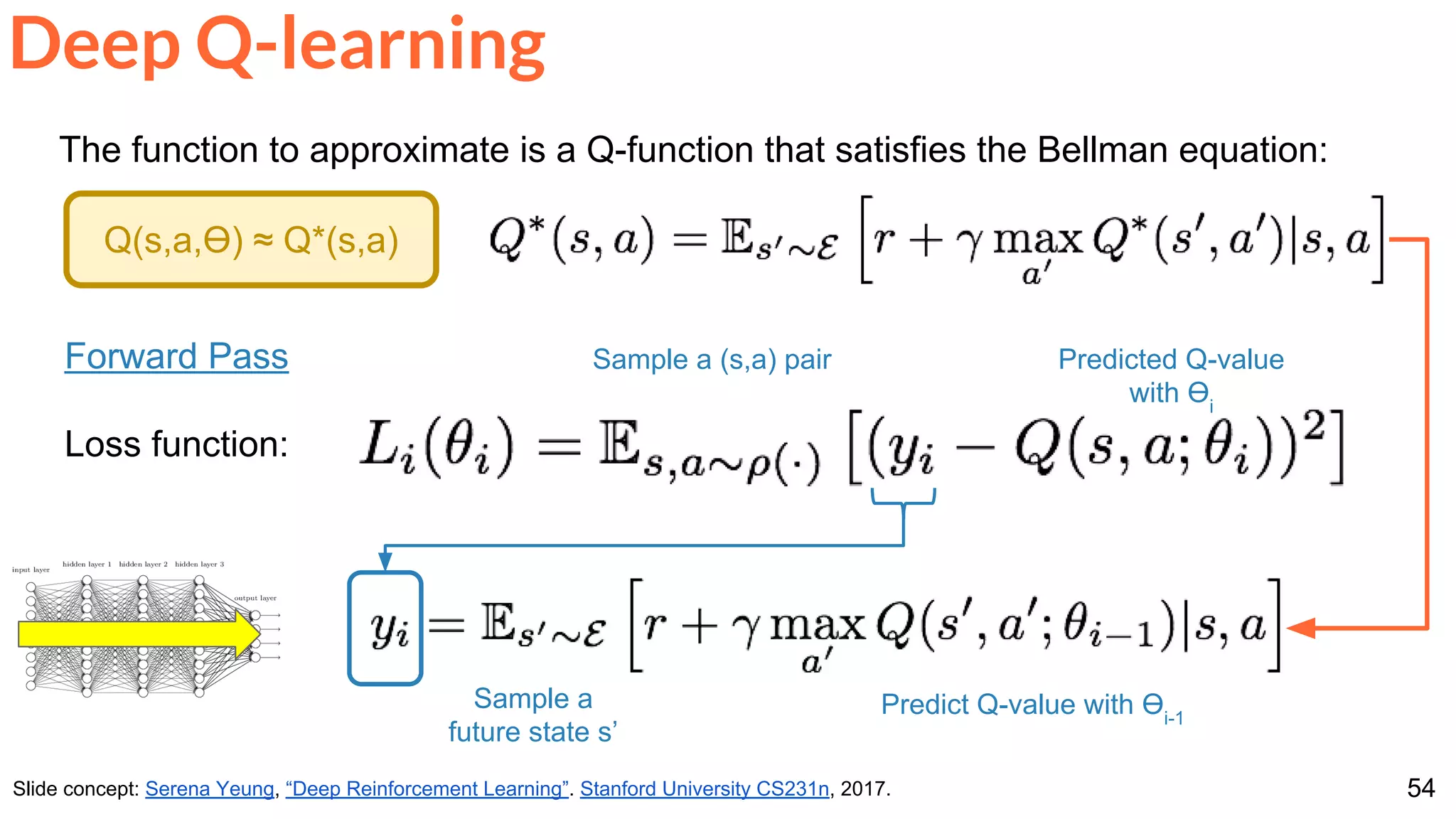
Deep Q-learning
Slide concept: Serena Yeung, “Deep Reinforcement Learning”. Stanford University CS231n, 2017.
The function to approximate is a Q-function that satisfies the Bellman equation:
Q(s,a,Ө) ≈ Q*(s,a)
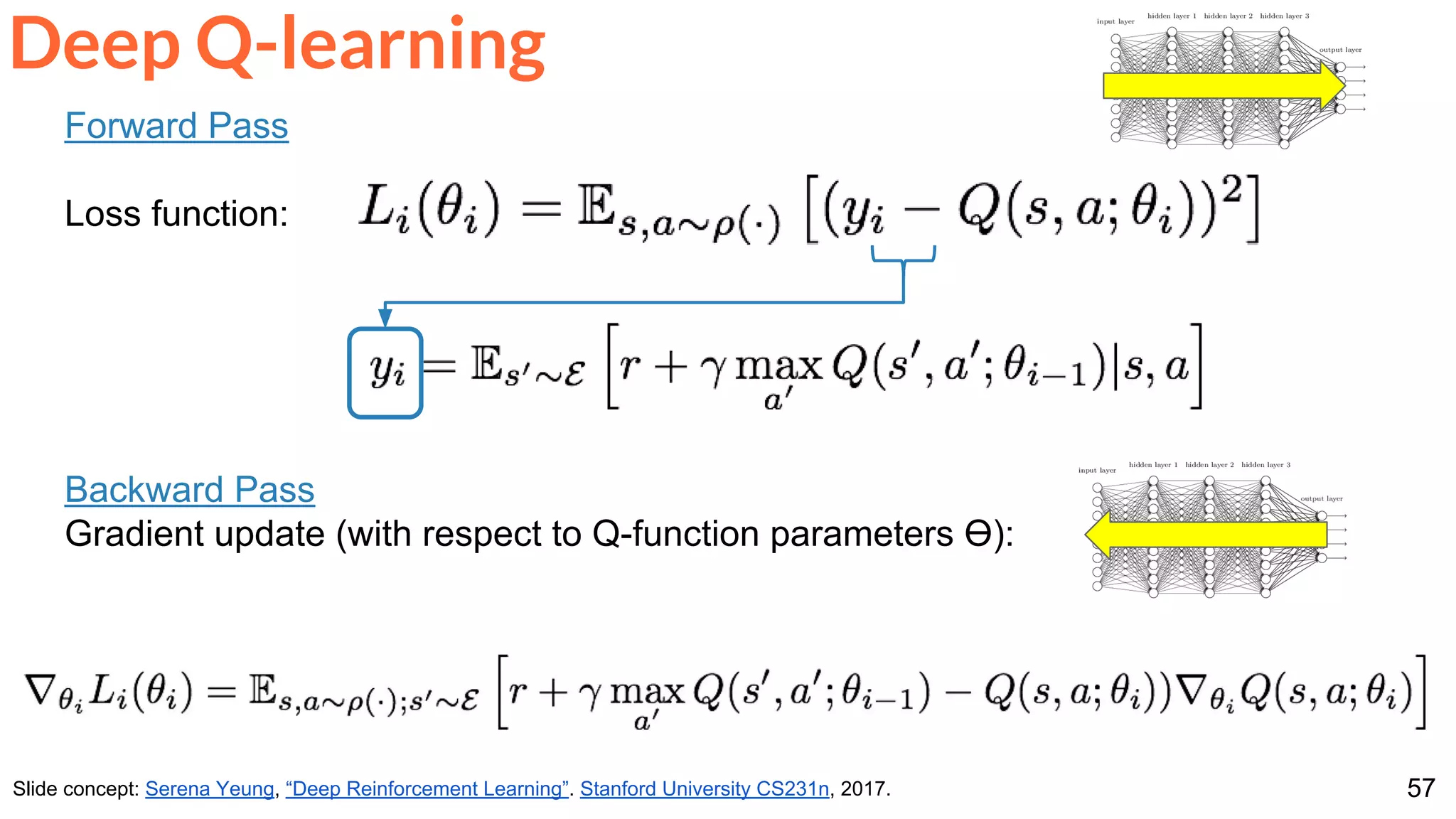
Forward Pass
Loss function:
Sample a (s,a) pair Predicted Q-value
with Өi
Sample a
future state s’
Predict Q-value with Өi-1
55
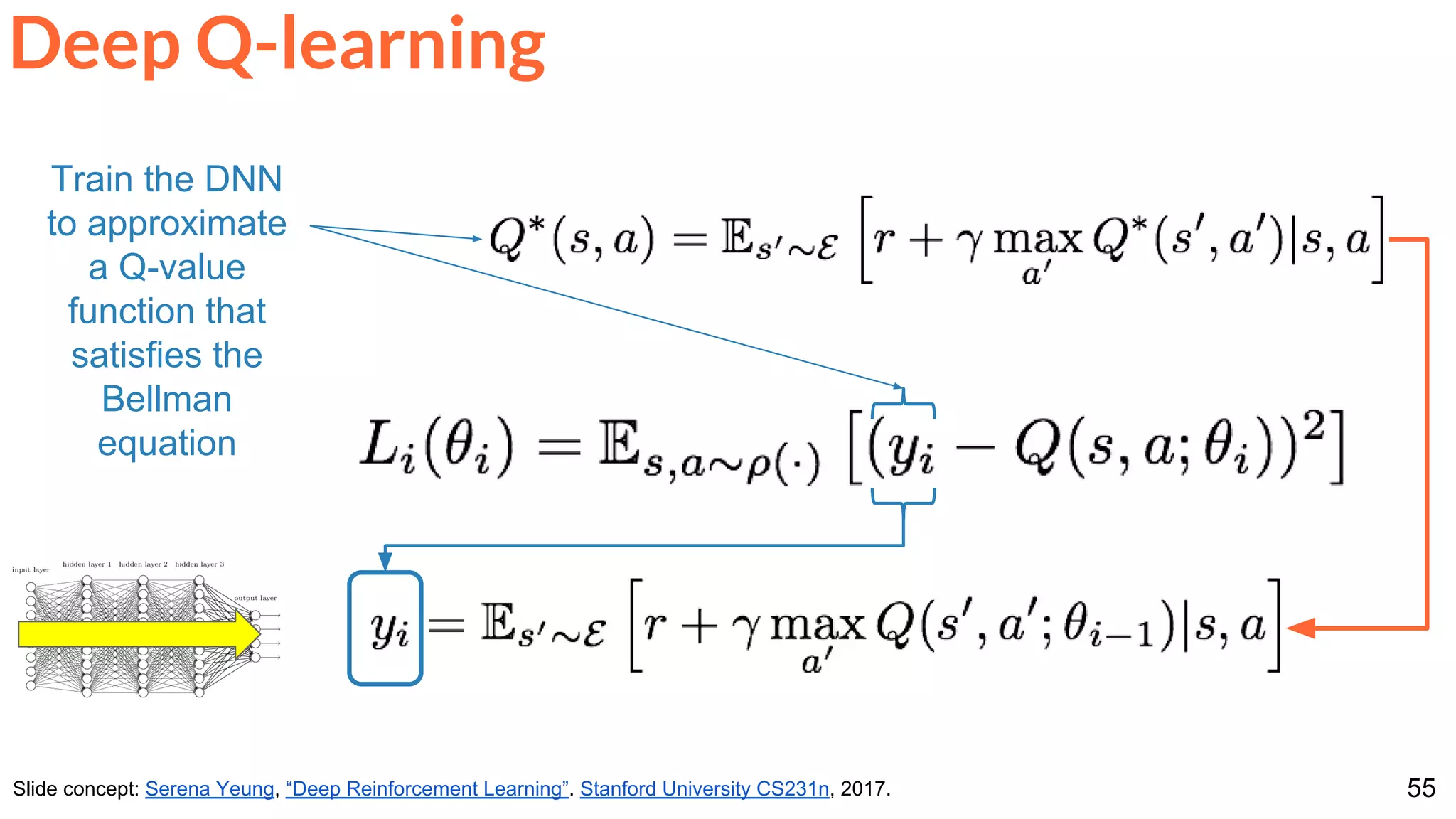
Deep Q-learning
Slide concept: Serena Yeung, “Deep Reinforcement Learning”. Stanford University CS231n, 2017.
Train the DNN
to approximate
a Q-value
function that
satisfies the
Bellman
equation
56
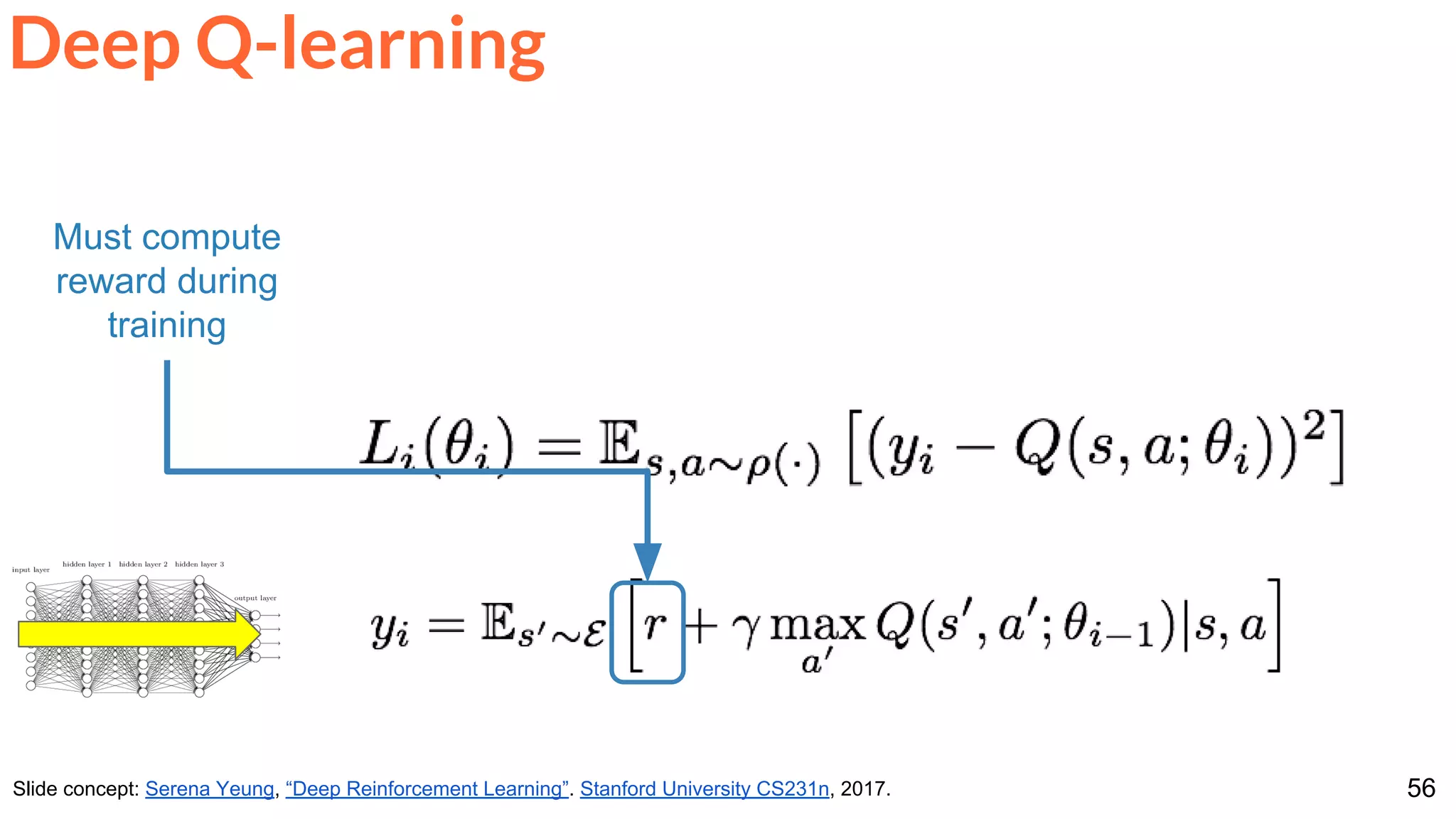
Deep Q-learning
Slide concept: Serena Yeung, “Deep Reinforcement Learning”. Stanford University CS231n, 2017.
Must compute
reward during
training
57
Deep Q-learning
Slide concept: Serena Yeung, “Deep Reinforcement Learning”. Stanford University CS231n, 2017.
Backward Pass
Gradient update (with respect to Q-function parameters Ө):
Forward Pass
Loss function:
58Source: Tambet Matiisen, Demystifying Deep Reinforcement Learning (Nervana)
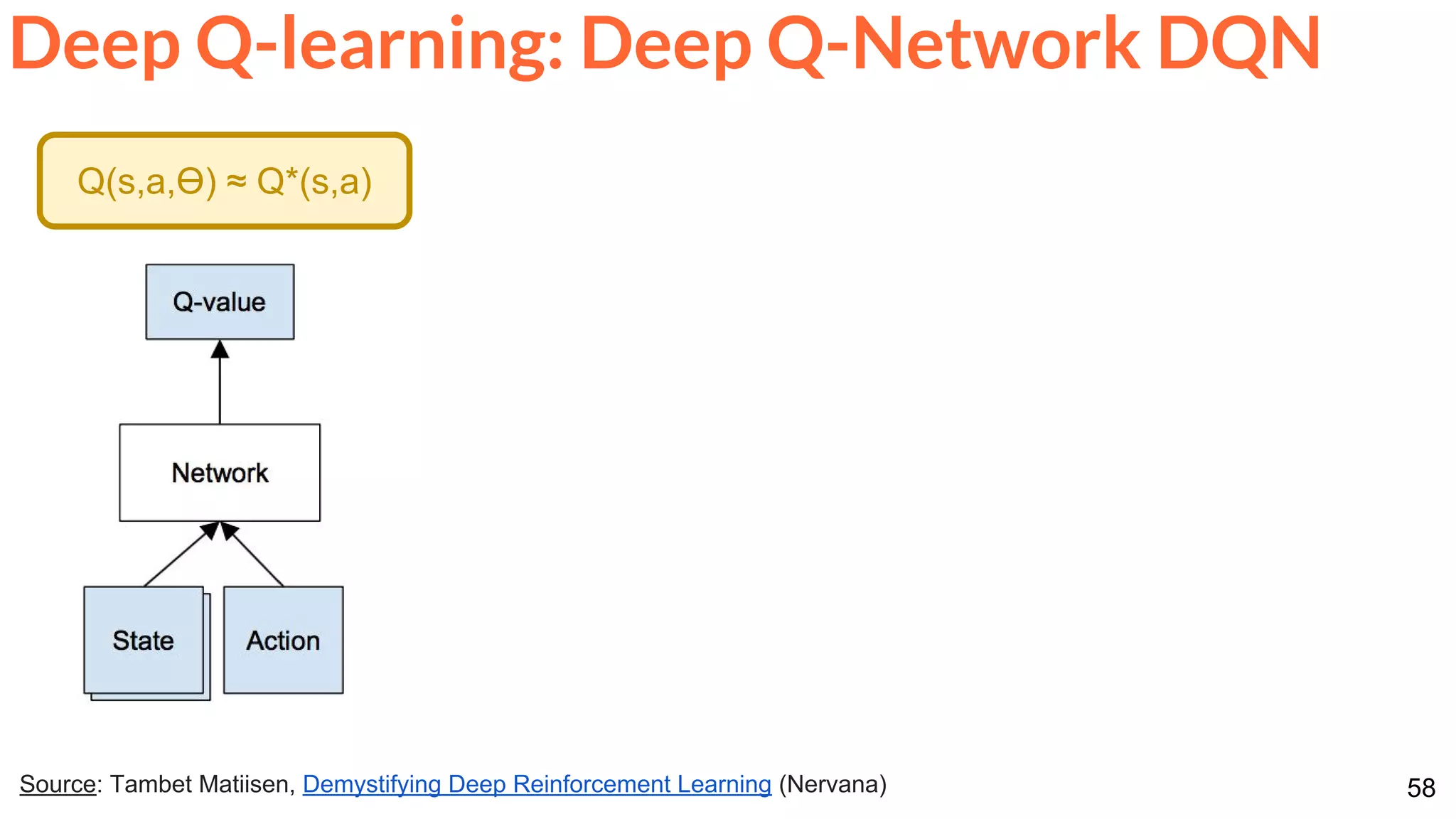
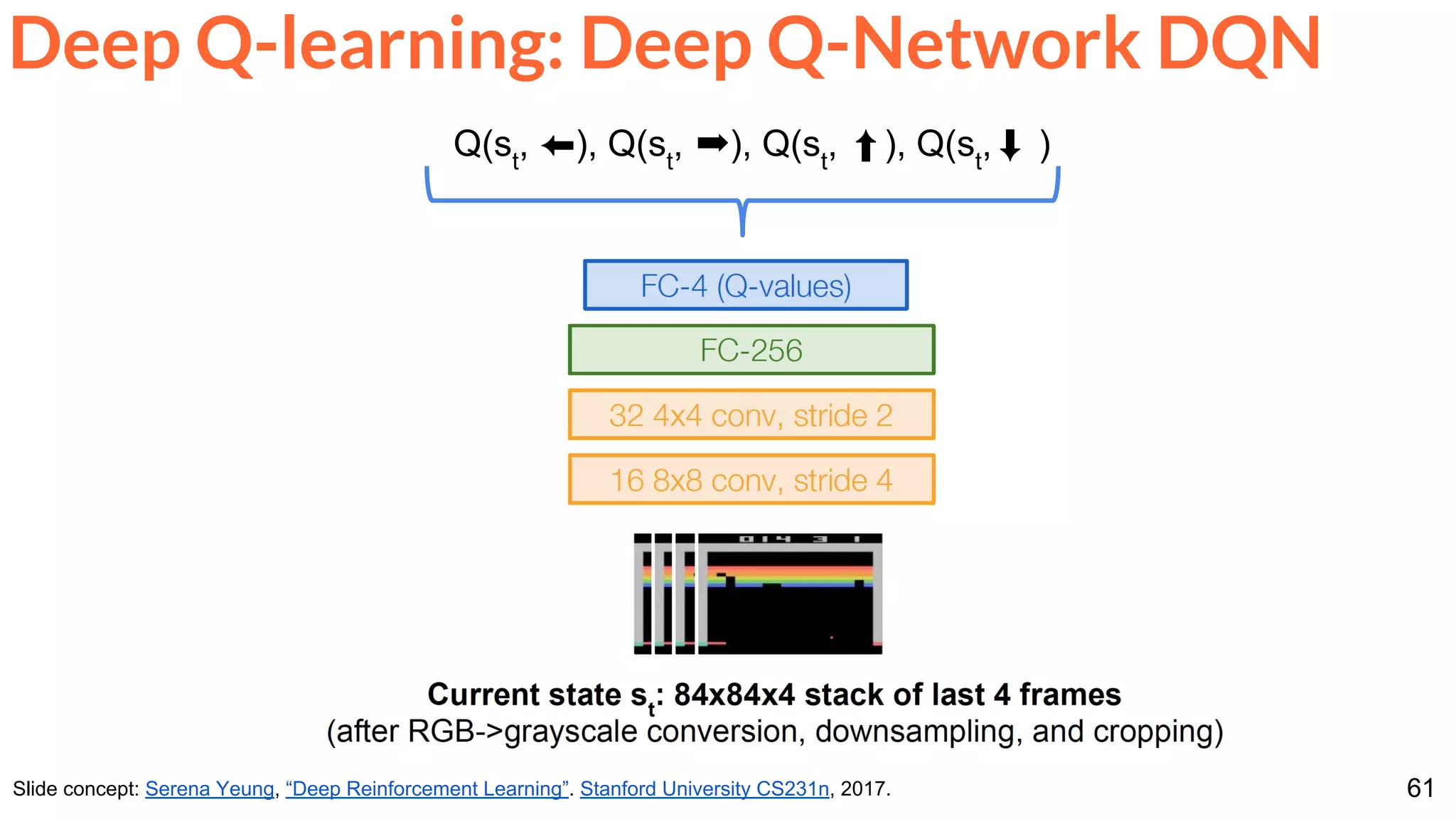
Deep Q-learning: Deep Q-Network DQN
Q(s,a,Ө) ≈ Q*(s,a)
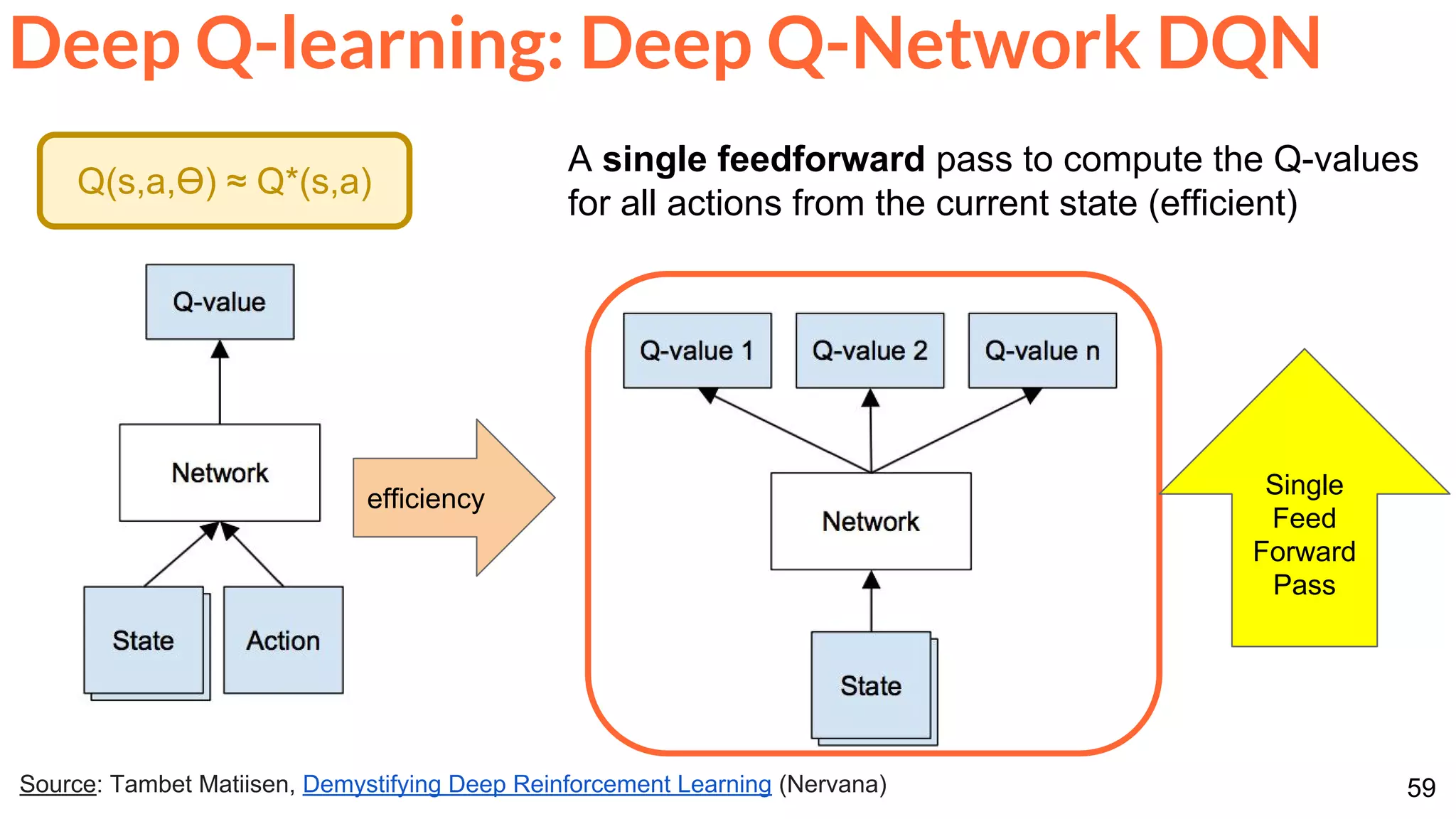
59Source: Tambet Matiisen, Demystifying Deep Reinforcement Learning (Nervana)
Deep Q-learning: Deep Q-Network DQN
Q(s,a,Ө) ≈ Q*(s,a)
efficiency Single
Feed
Forward
Pass
A single feedforward pass to compute the Q-values
for all actions from the current state (efficient)
60
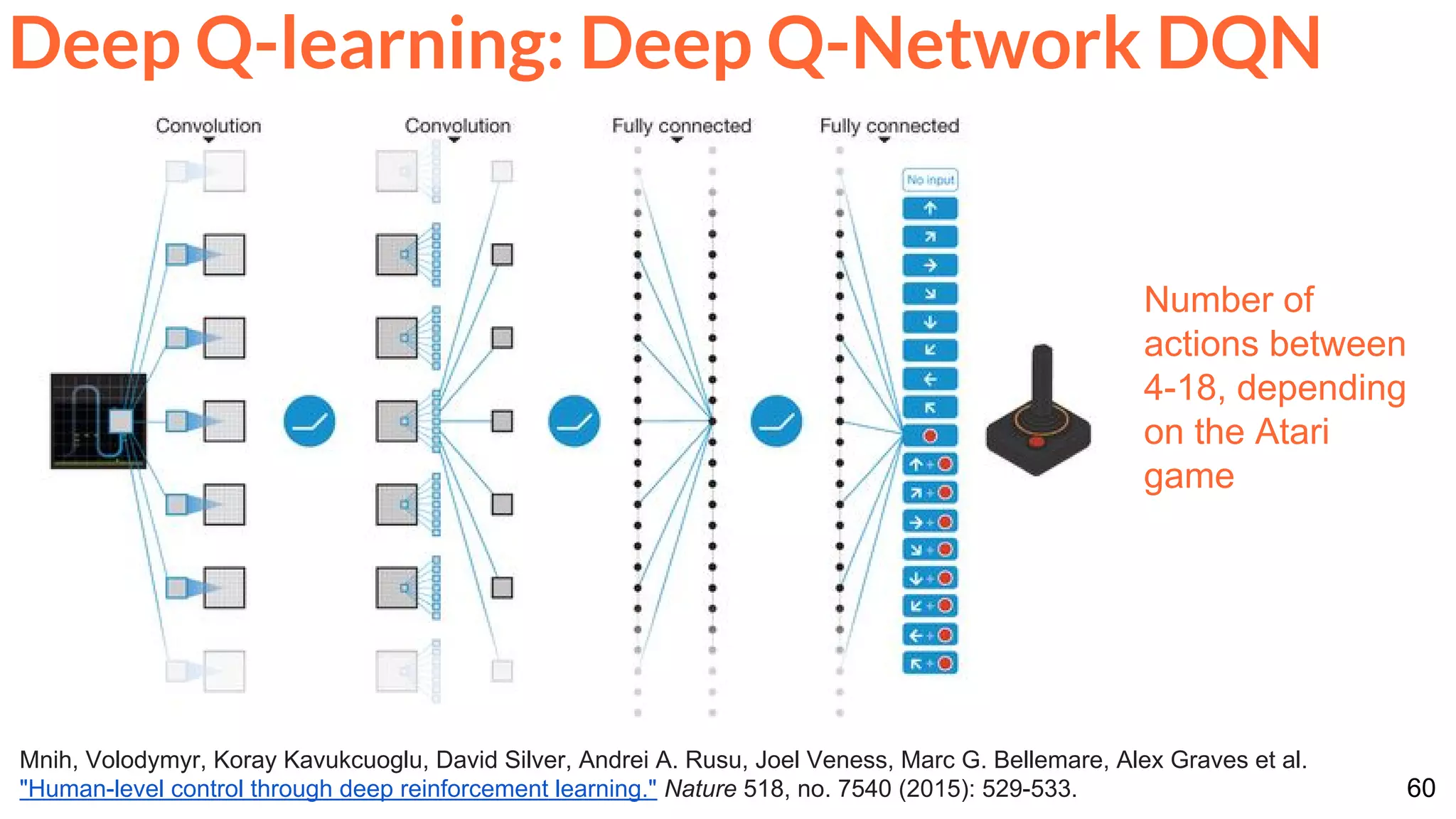
Mnih, Volodymyr, Koray Kavukcuoglu, David Silver, Andrei A. Rusu, Joel Veness, Marc G. Bellemare, Alex Graves et al.
"Human-level control through deep reinforcement learning." Nature 518, no. 7540 (2015): 529-533.
Deep Q-learning: Deep Q-Network DQN
Number of
actions between
4-18, depending
on the Atari
game
61
Deep Q-learning: Deep Q-Network DQN
Slide concept: Serena Yeung, “Deep Reinforcement Learning”. Stanford University CS231n, 2017.
Q(st
, ⬅), Q(st
, ➡), Q(st
, ⬆), Q(st
,⬇ )
62
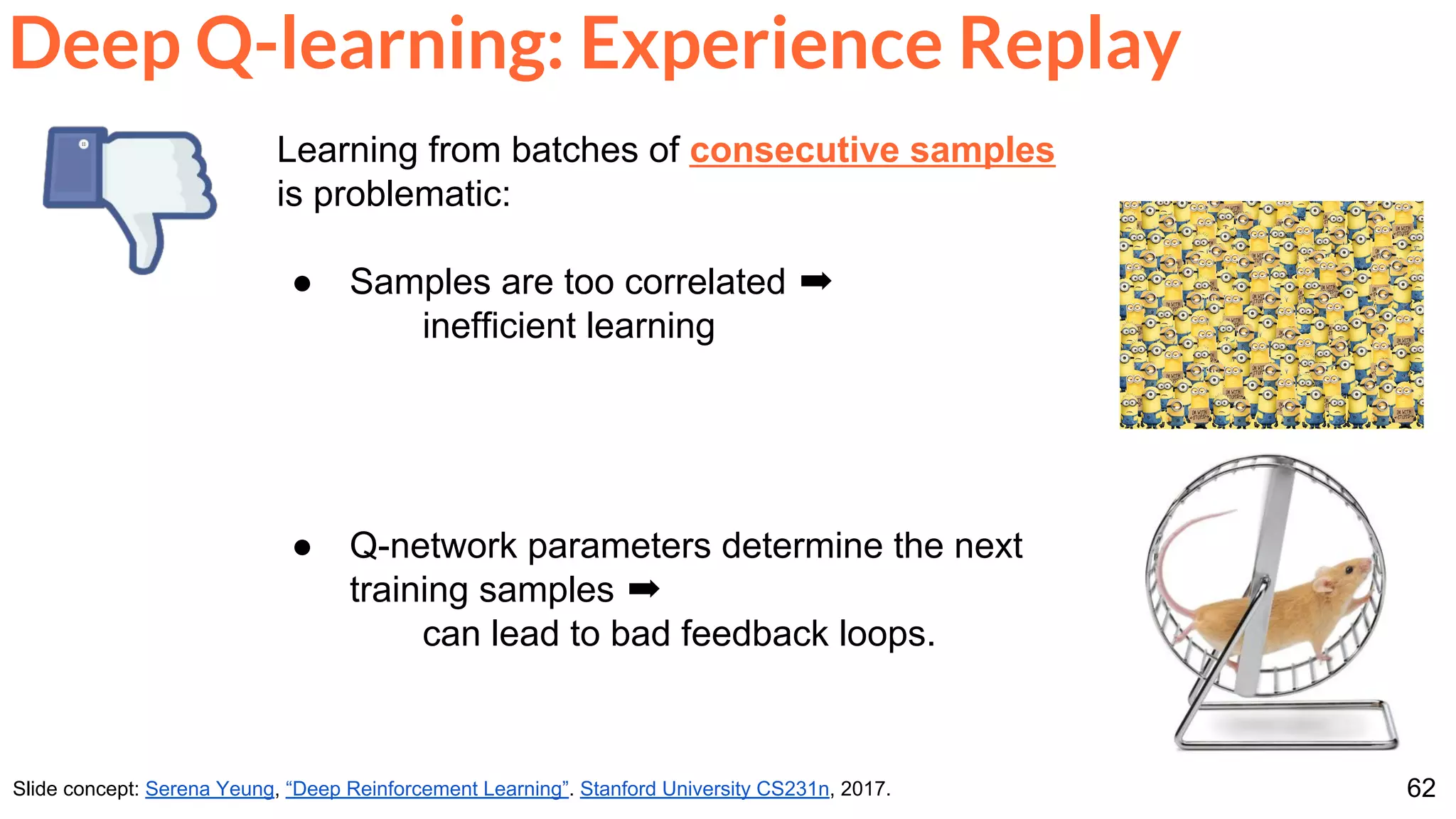
Deep Q-learning: Experience Replay
Slide concept: Serena Yeung, “Deep Reinforcement Learning”. Stanford University CS231n, 2017.
Learning from batches of consecutive samples
is problematic:
● Samples are too correlated ➡
inefficient learning
● Q-network parameters determine the next
training samples ➡
can lead to bad feedback loops.
63
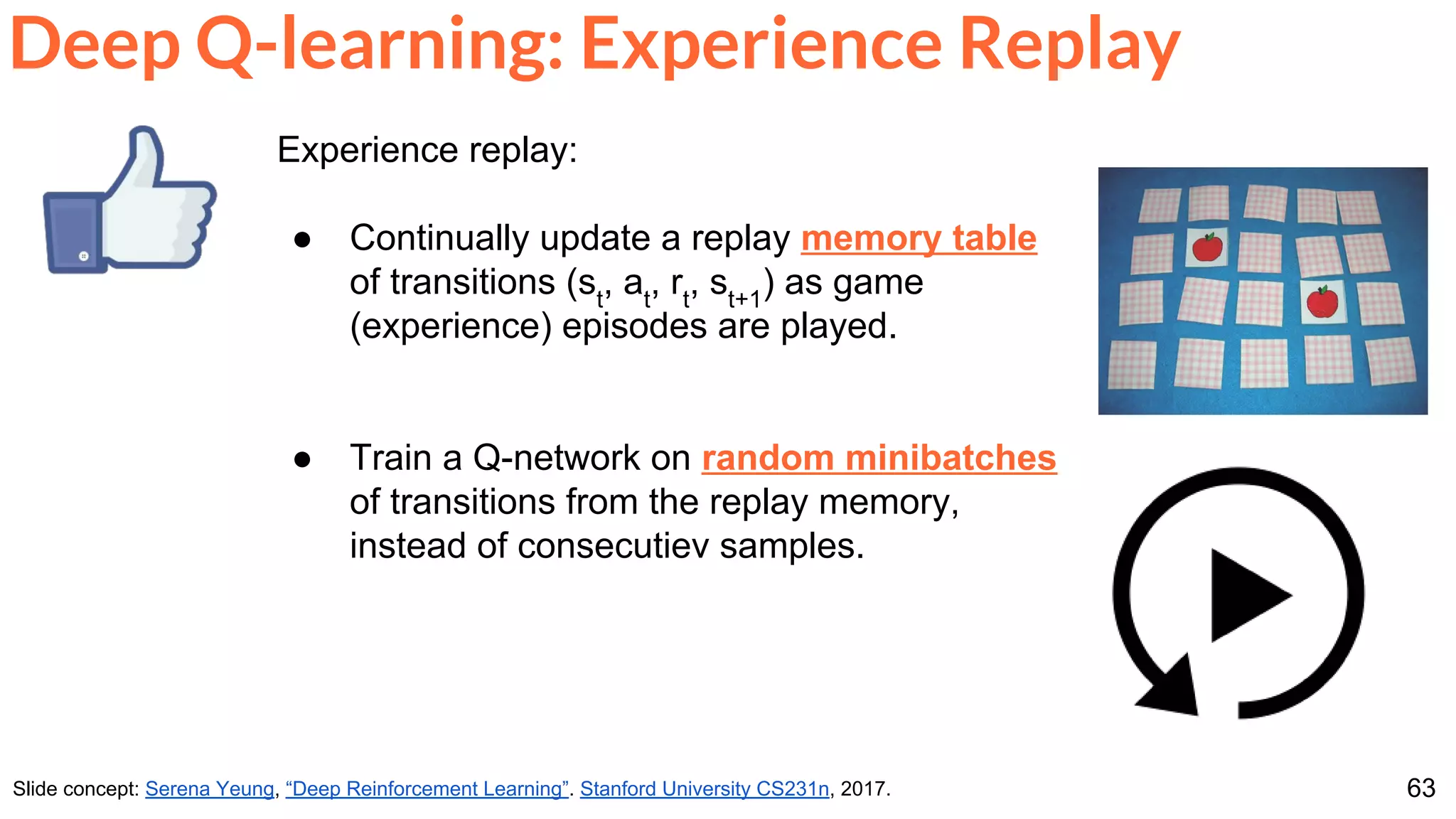
Deep Q-learning: Experience Replay
Slide concept: Serena Yeung, “Deep Reinforcement Learning”. Stanford University CS231n, 2017.
Experience replay:
● Continually update a replay memory table
of transitions (st
, at
, rt
, st+1
) as game
(experience) episodes are played.
● Train a Q-network on random minibatches
of transitions from the replay memory,
instead of consecutiev samples.
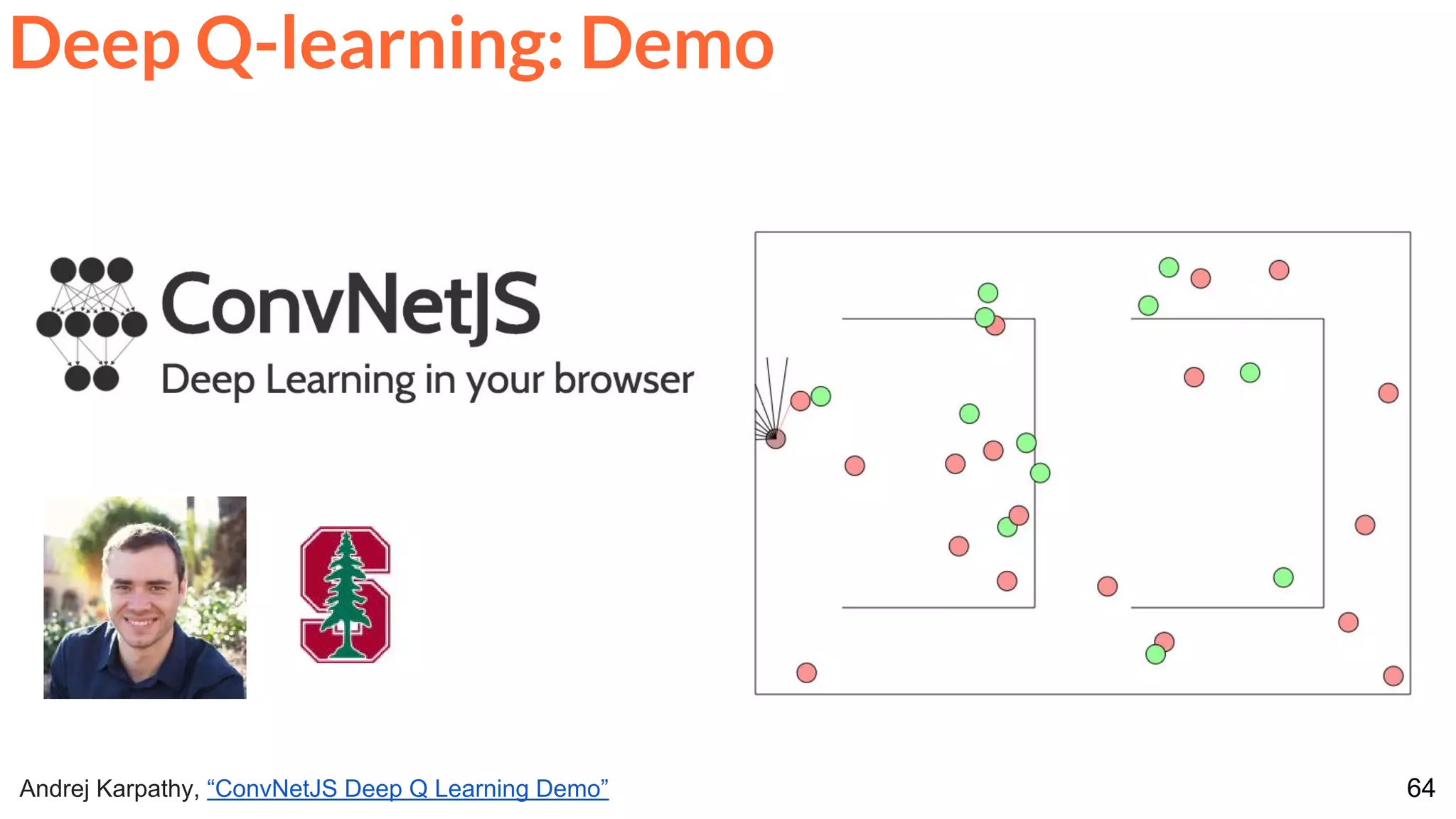
64Andrej Karpathy, “ConvNetJS Deep Q Learning Demo”
Deep Q-learning: Demo
65
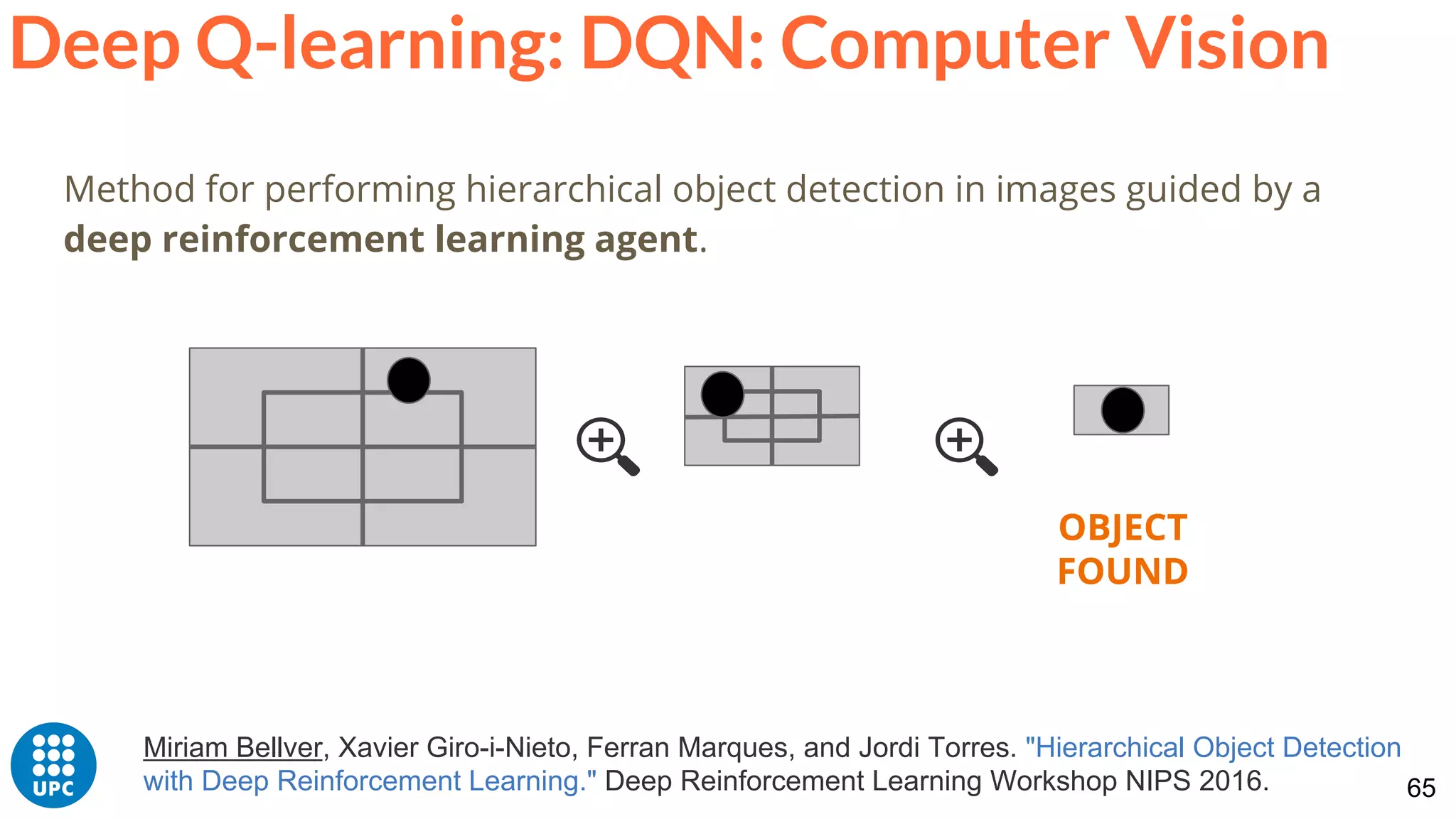
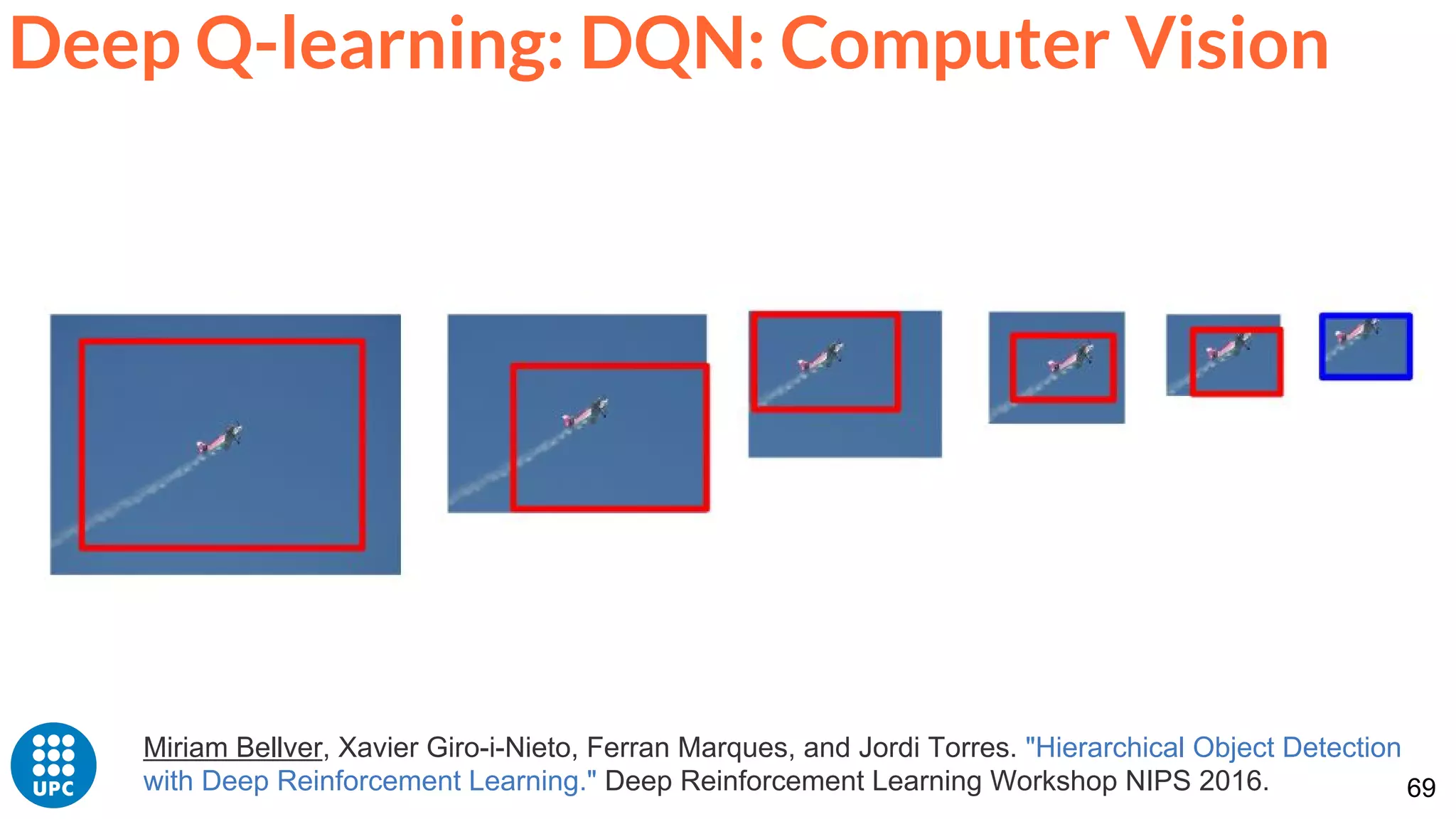
Miriam Bellver, Xavier Giro-i-Nieto, Ferran Marques, and Jordi Torres. "Hierarchical Object Detection
with Deep Reinforcement Learning." Deep Reinforcement Learning Workshop NIPS 2016.
Deep Q-learning: DQN: Computer Vision
Method for performing hierarchical object detection in images guided by a
deep reinforcement learning agent.
OBJECT
FOUND
66
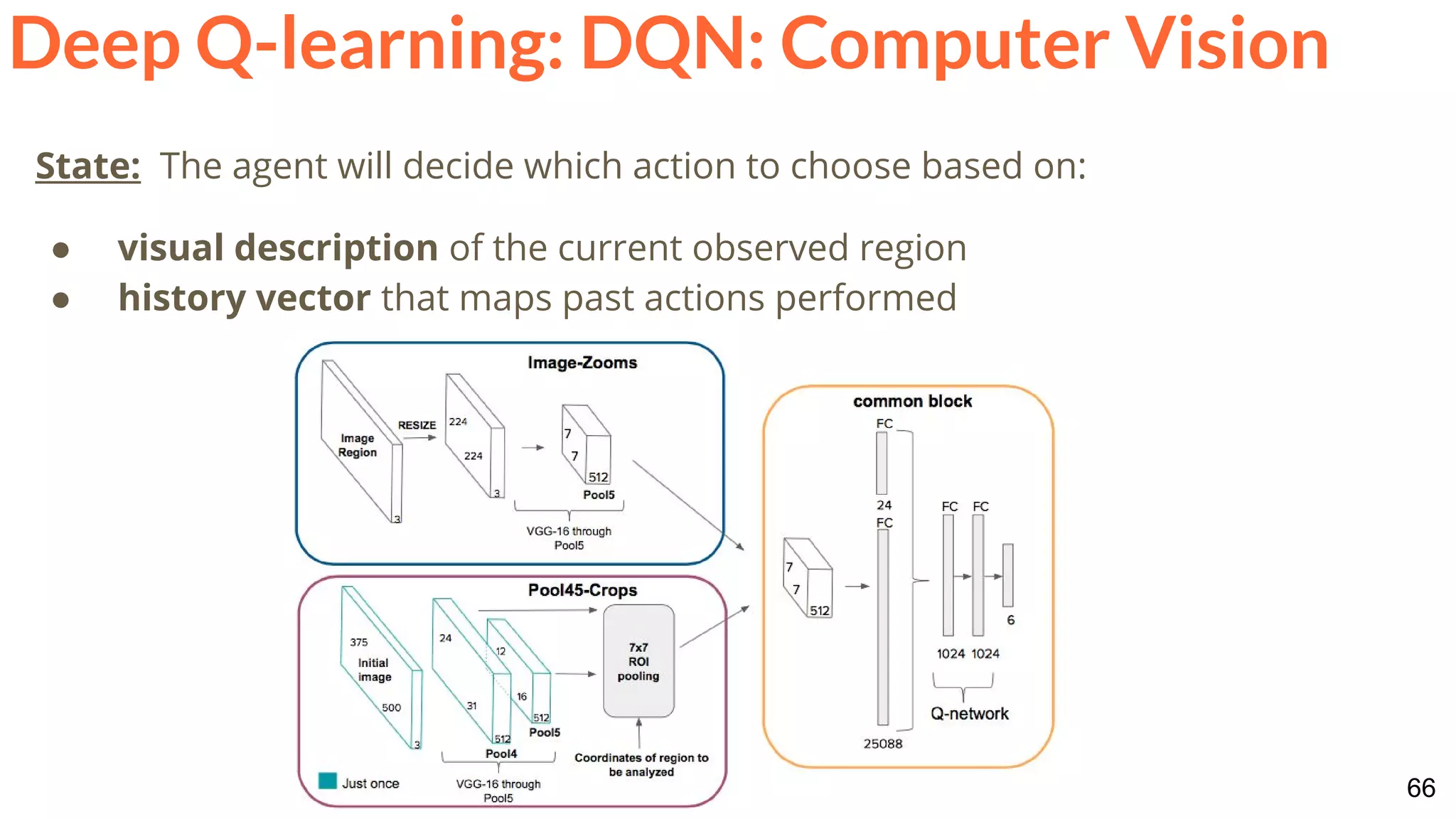
Deep Q-learning: DQN: Computer Vision
State: The agent will decide which action to choose based on:
● visual description of the current observed region
● history vector that maps past actions performed
67
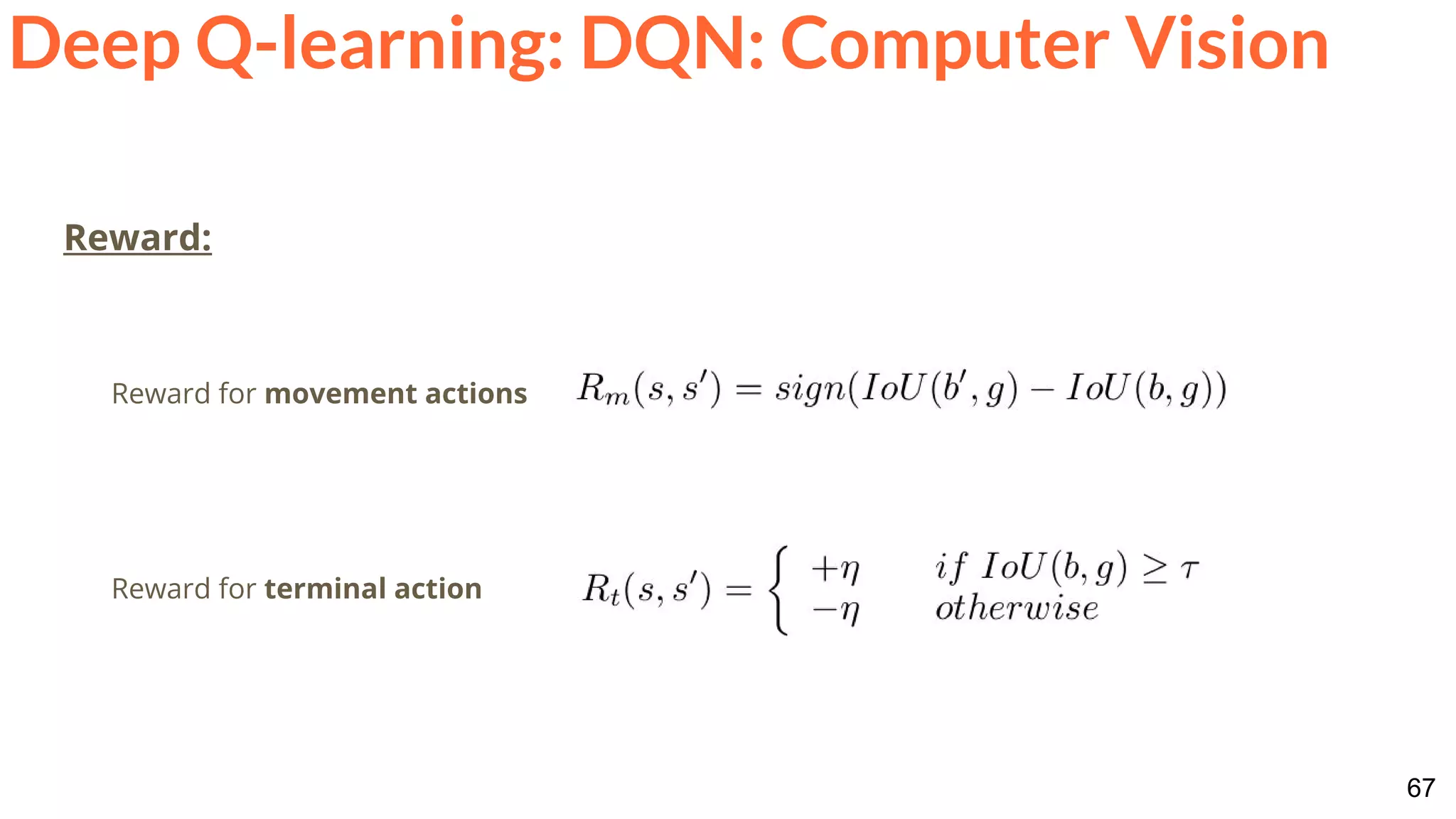
Deep Q-learning: DQN: Computer Vision
Reward:
Reward for movement actions
Reward for terminal action
68
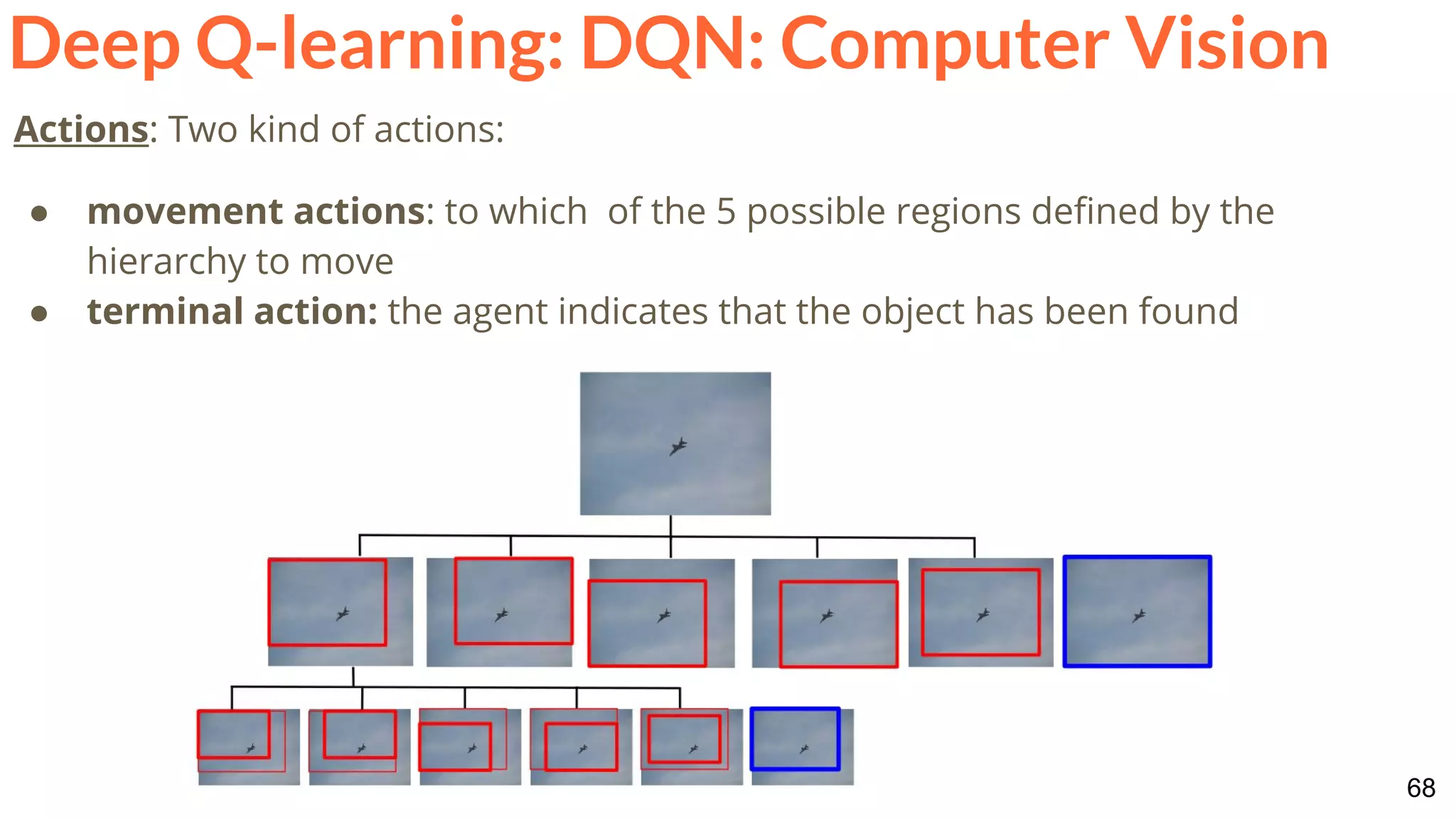
Deep Q-learning: DQN: Computer Vision
Actions: Two kind of actions:
● movement actions: to which of the 5 possible regions defined by the
hierarchy to move
● terminal action: the agent indicates that the object has been found
69
Miriam Bellver, Xavier Giro-i-Nieto, Ferran Marques, and Jordi Torres. "Hierarchical Object Detection
with Deep Reinforcement Learning." Deep Reinforcement Learning Workshop NIPS 2016.
Deep Q-learning: DQN: Computer Vision
70
Outline
1. Motivation
2. Architecture
3. Markov Decision Process (MDP)
4. Deep Q-learning
5. RL Frameworks
6. Learn more
71
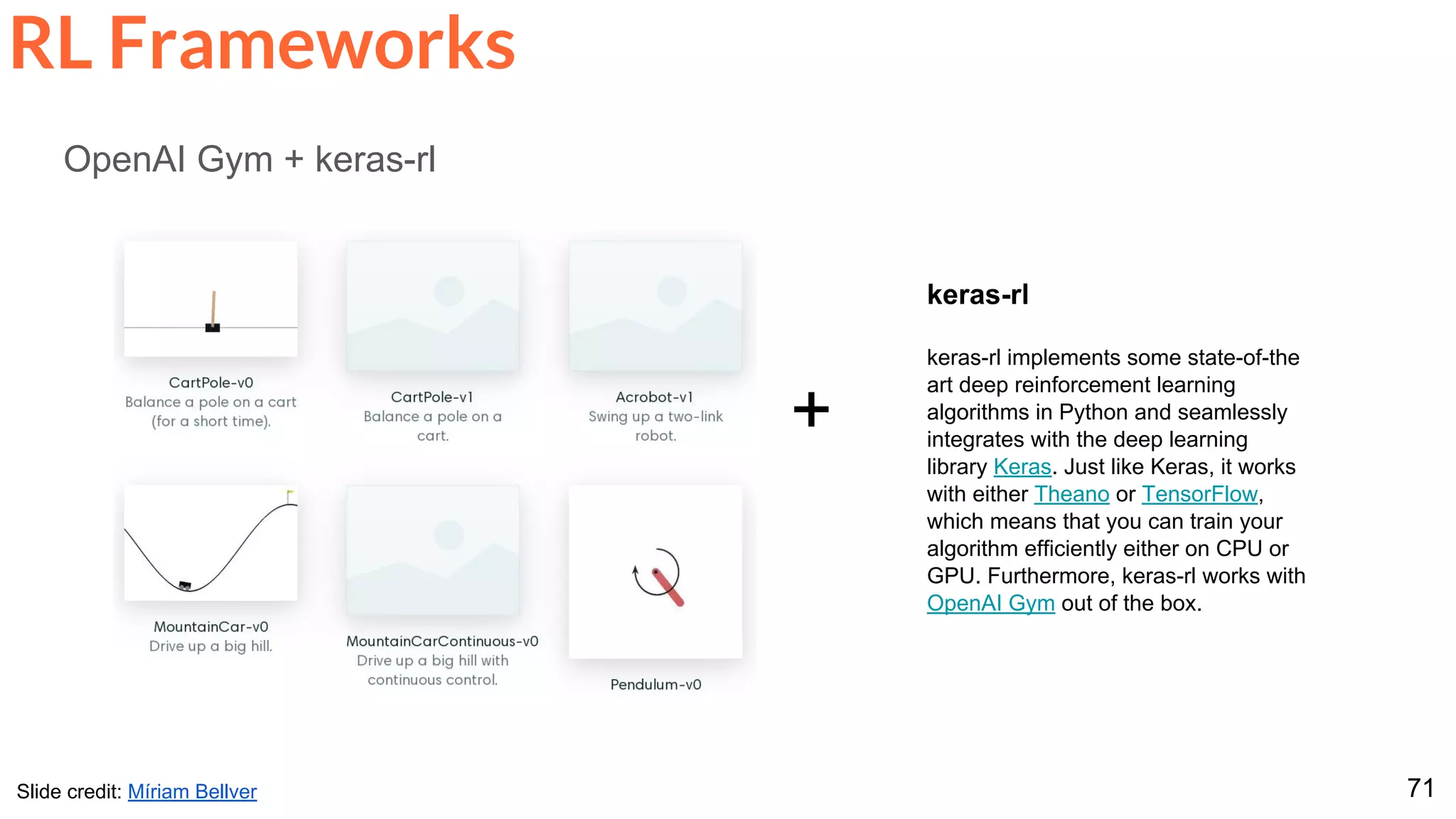
RL Frameworks
OpenAI Gym + keras-rl
+
keras-rl
keras-rl implements some state-of-the
art deep reinforcement learning
algorithms in Python and seamlessly
integrates with the deep learning
library Keras. Just like Keras, it works
with either Theano or TensorFlow,
which means that you can train your
algorithm efficiently either on CPU or
GPU. Furthermore, keras-rl works with
OpenAI Gym out of the box.
Slide credit: Míriam Bellver
72
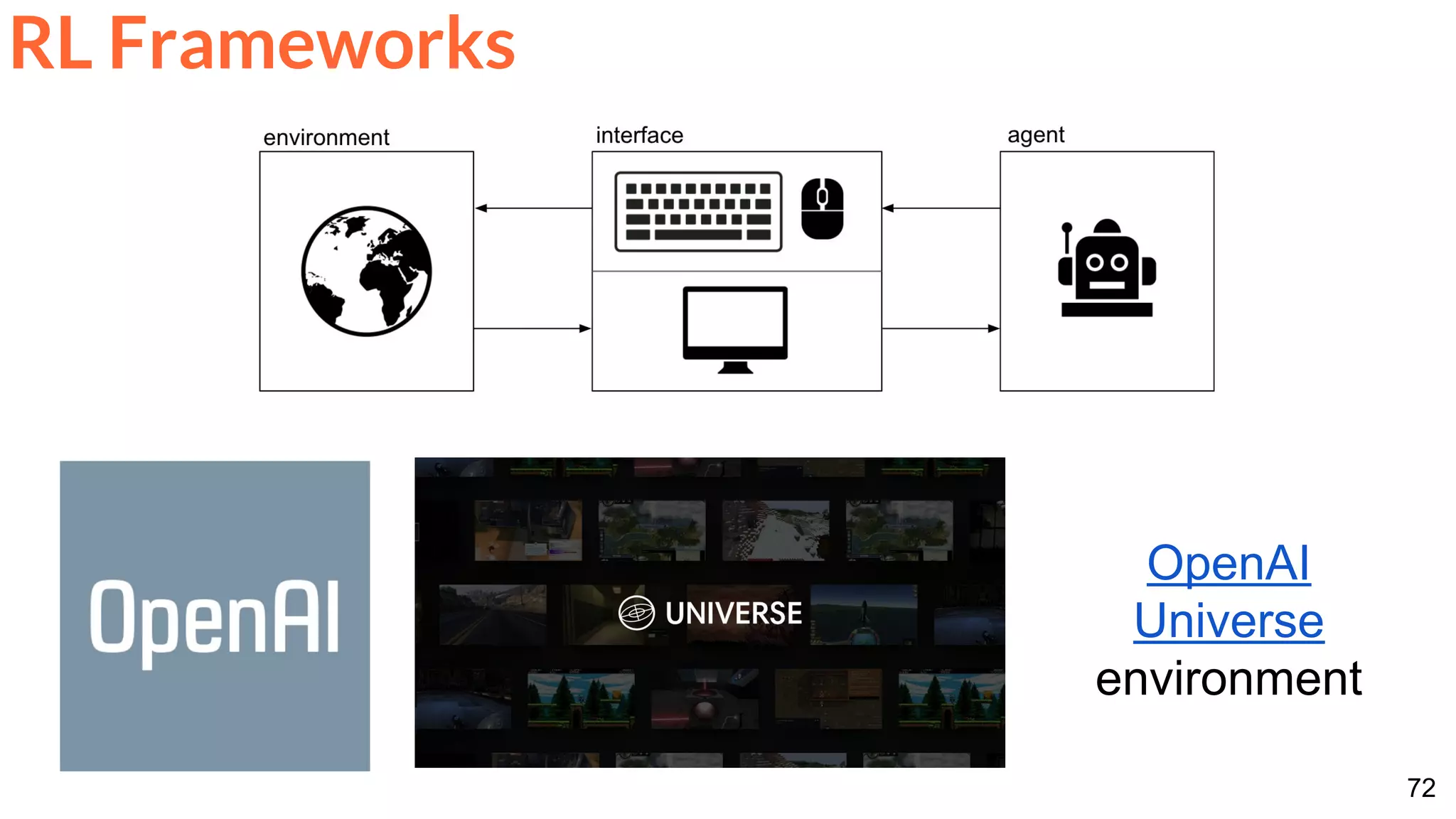
OpenAI
Universe
environment
RL Frameworks
73
Outline
1. Motivation
2. Architecture
3. Markov Decision Process (MDP)
4. Deep Q-learning
5. RL Frameworks
6. Learn more
74
Deep Learning TV,
“Reinforcement learning - Ep. 30”
Siraj Raval, Deep Q Learning for Video
Games
Learn more
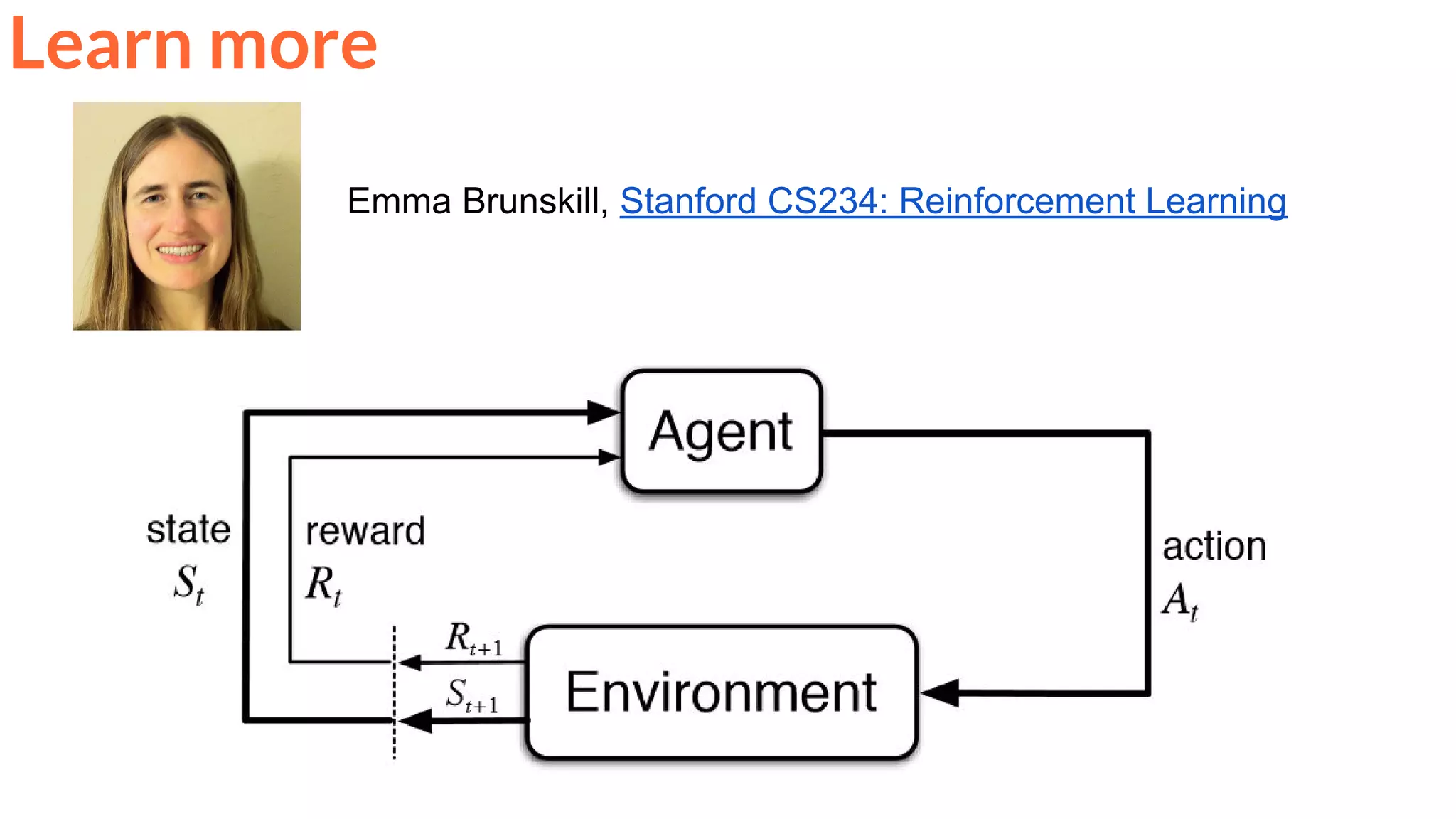
Emma Brunskill, Stanford CS234: Reinforcement Learning
Learn more
David Silver, UCL COMP050, Reinforcement Learning
Learn more
Nando de Freitas, “Machine Learning” (University of Oxford)
Learn more
78
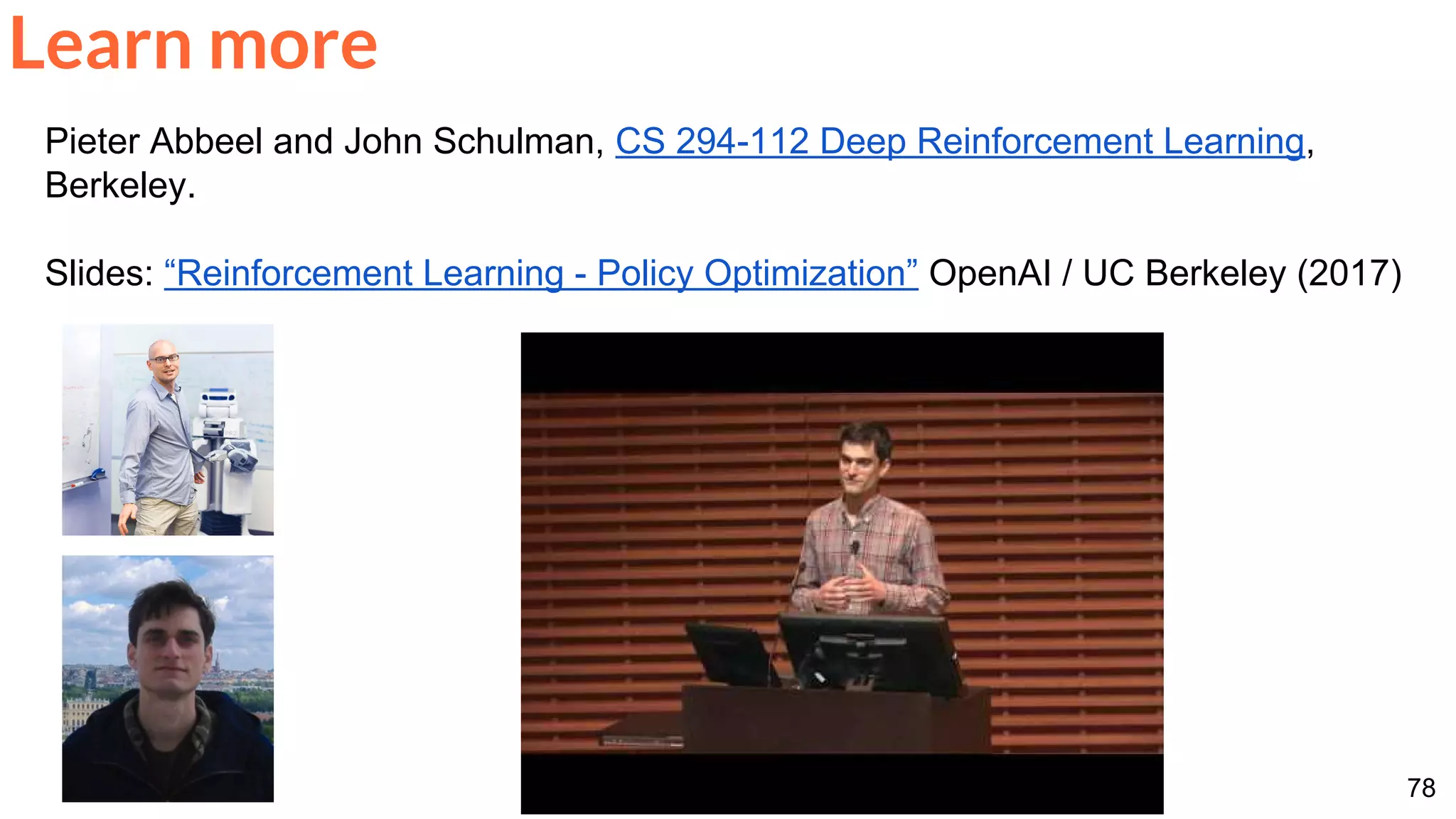
Pieter Abbeel and John Schulman, CS 294-112 Deep Reinforcement Learning,
Berkeley.
Slides: “Reinforcement Learning - Policy Optimization” OpenAI / UC Berkeley (2017)
Learn more
79
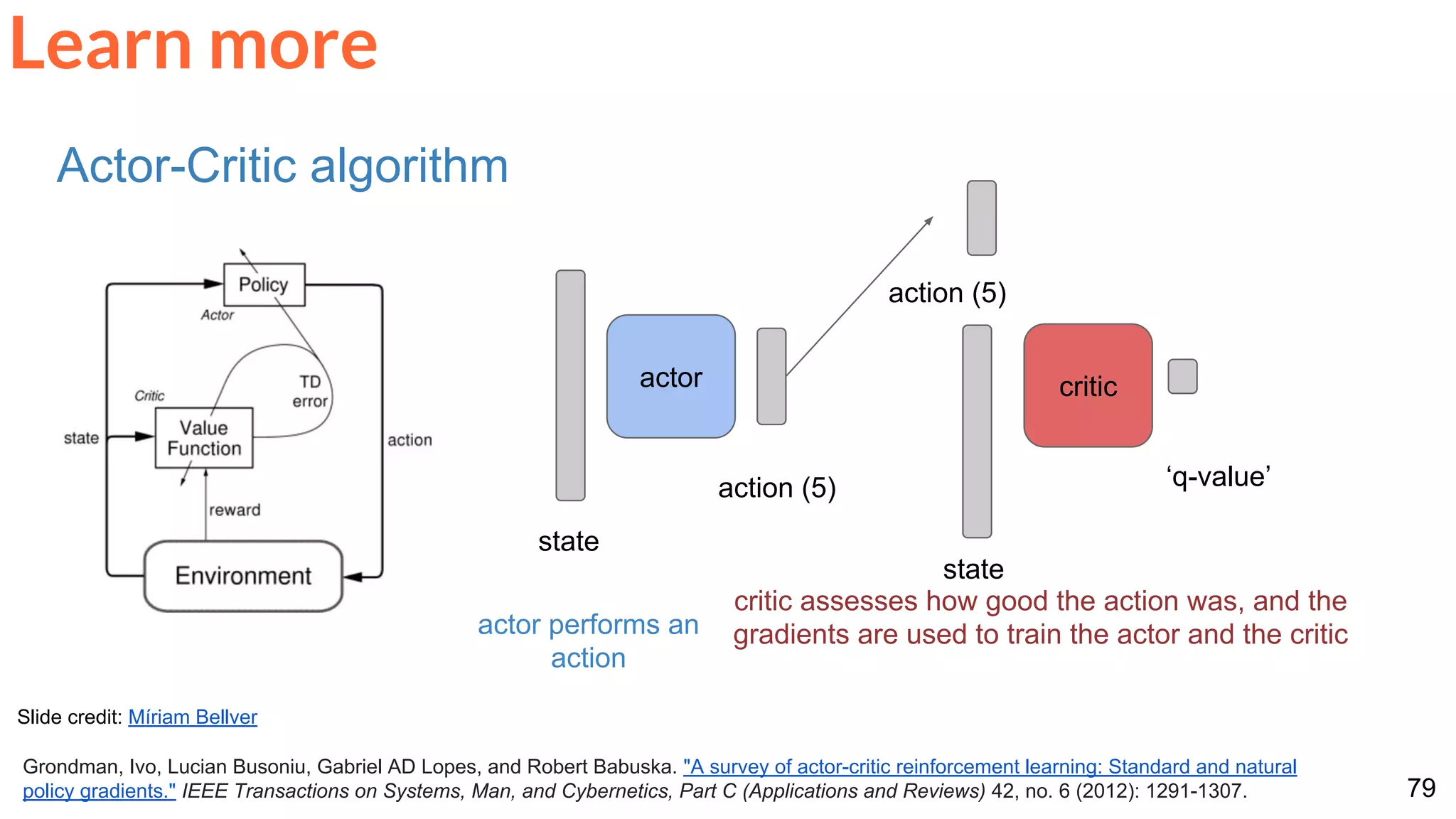
Learn more
Slide credit: Míriam Bellver
actor
state
critic
‘q-value’action (5)
state
action (5)
actor performs an
action
critic assesses how good the action was, and the
gradients are used to train the actor and the critic
Actor-Critic algorithm
Grondman, Ivo, Lucian Busoniu, Gabriel AD Lopes, and Robert Babuska. "A survey of actor-critic reinforcement learning: Standard and natural
policy gradients." IEEE Transactions on Systems, Man, and Cybernetics, Part C (Applications and Reviews) 42, no. 6 (2012): 1291-1307.
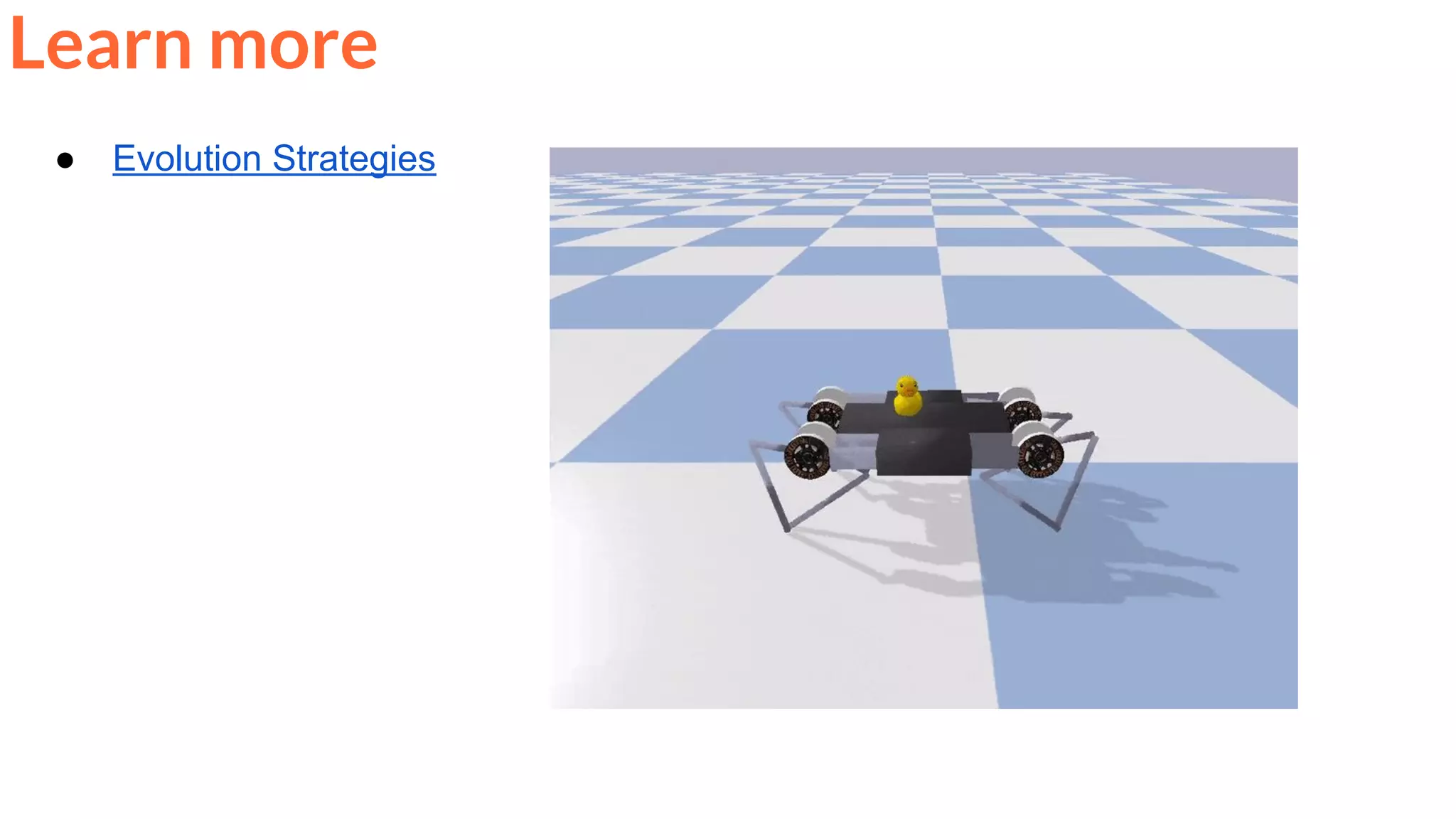
● Evolution Strategies
Learn more
81
Outline
1. Motivation
2. Architecture
3. Markov Decision Process (MDP)
○ Policy
○ Optimal Policy
○ Value Function
○ Q-value function
○ Optimal Q-value function
○ Bellman equation
○ Value iteration algorithm
4. Deep Q-learning
○ Forward and Backward passes
○ DQN
○ Experience Replay
○ Examples
5. RL Frameworks
6. Learn more
○ Coming next…
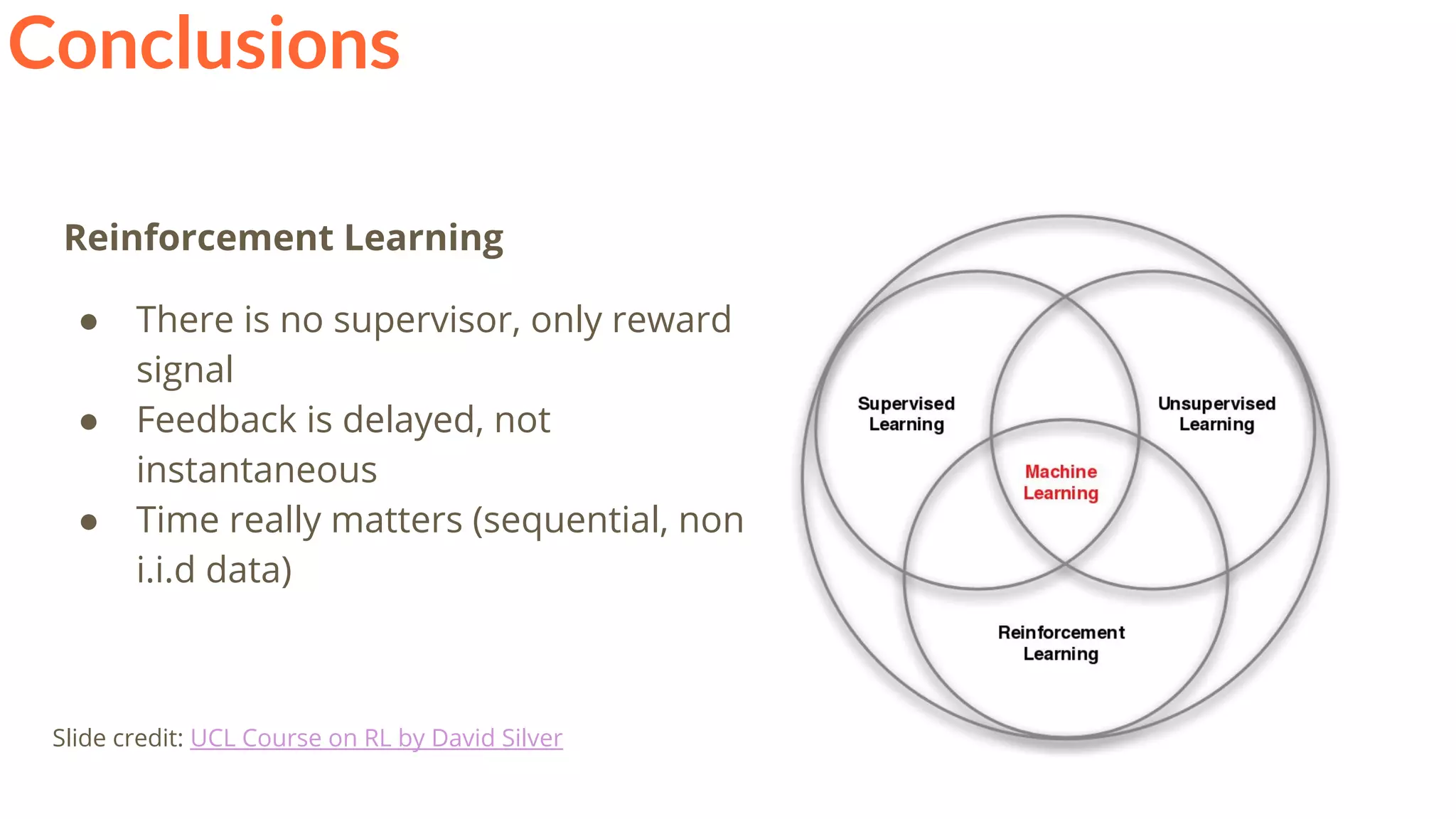
Conclusions
Reinforcement Learning
● There is no supervisor, only reward
signal
● Feedback is delayed, not
instantaneous
● Time really matters (sequential, non
i.i.d data)
Slide credit: UCL Course on RL by David Silver
83
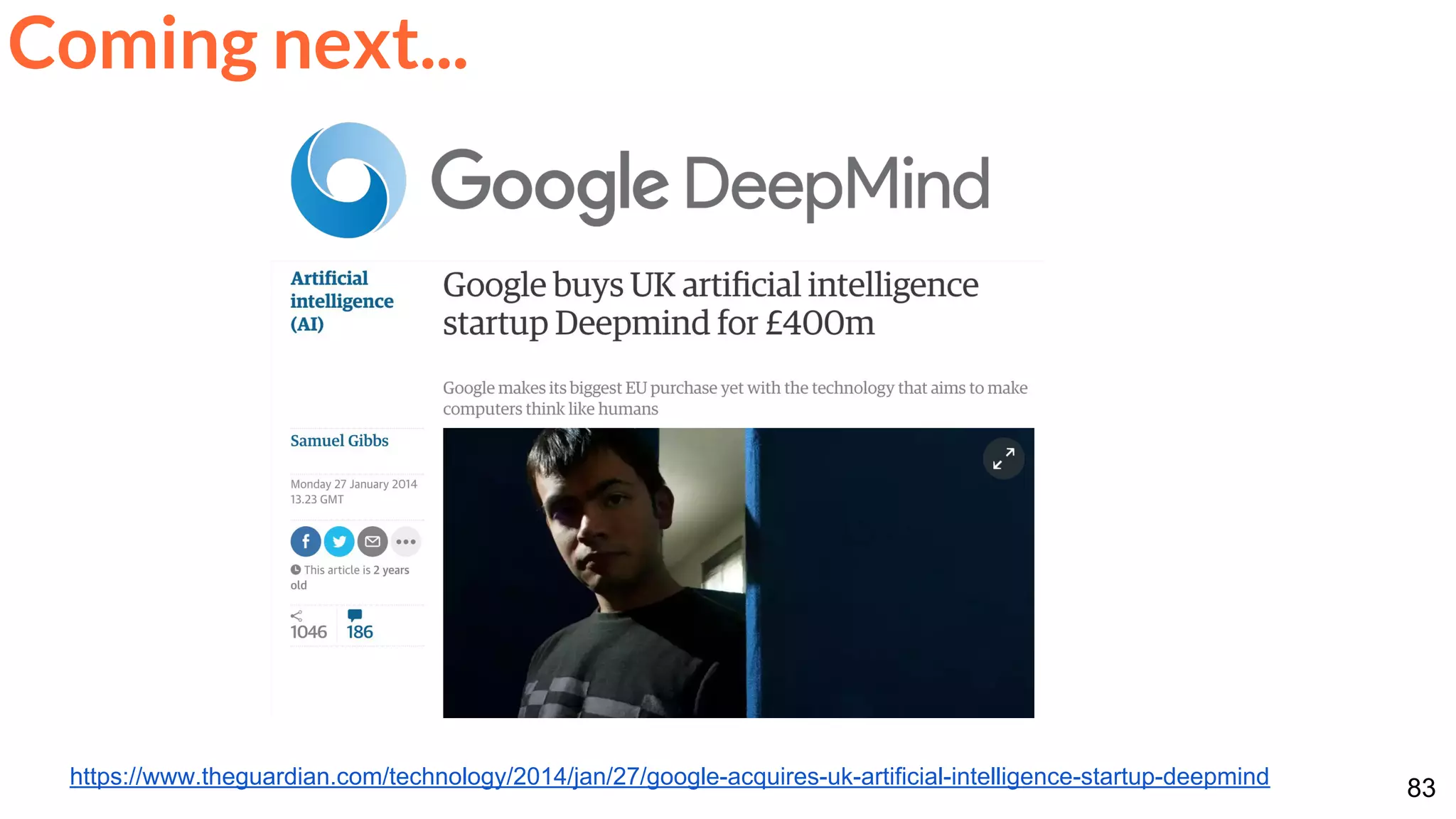
Coming next...
https://www.theguardian.com/technology/2014/jan/27/google-acquires-uk-artificial-intelligence-startup-deepmind
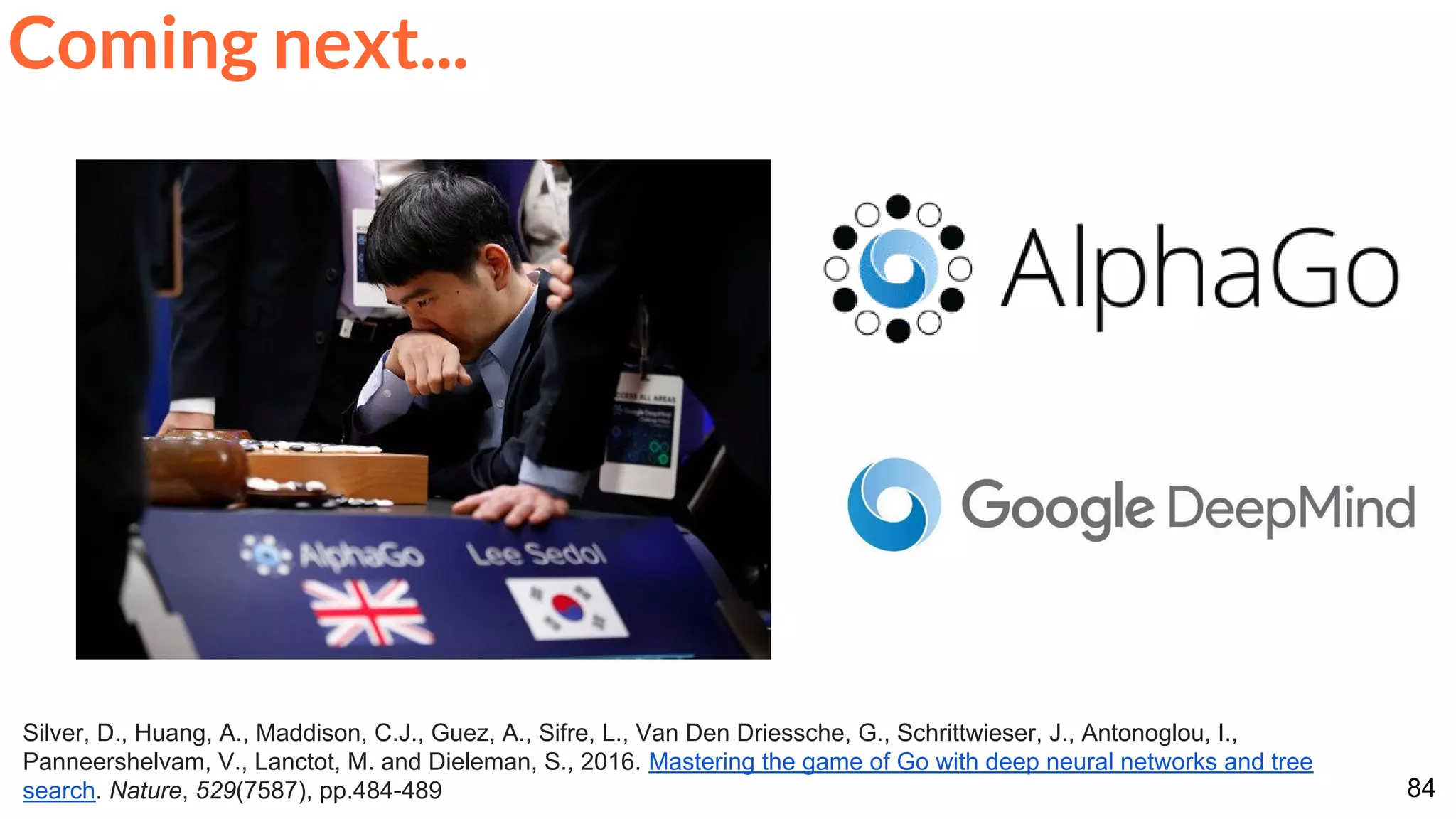
84
Silver, D., Huang, A., Maddison, C.J., Guez, A., Sifre, L., Van Den Driessche, G., Schrittwieser, J., Antonoglou, I.,
Panneershelvam, V., Lanctot, M. and Dieleman, S., 2016. Mastering the game of Go with deep neural networks and tree
search. Nature, 529(7587), pp.484-489
Coming next...
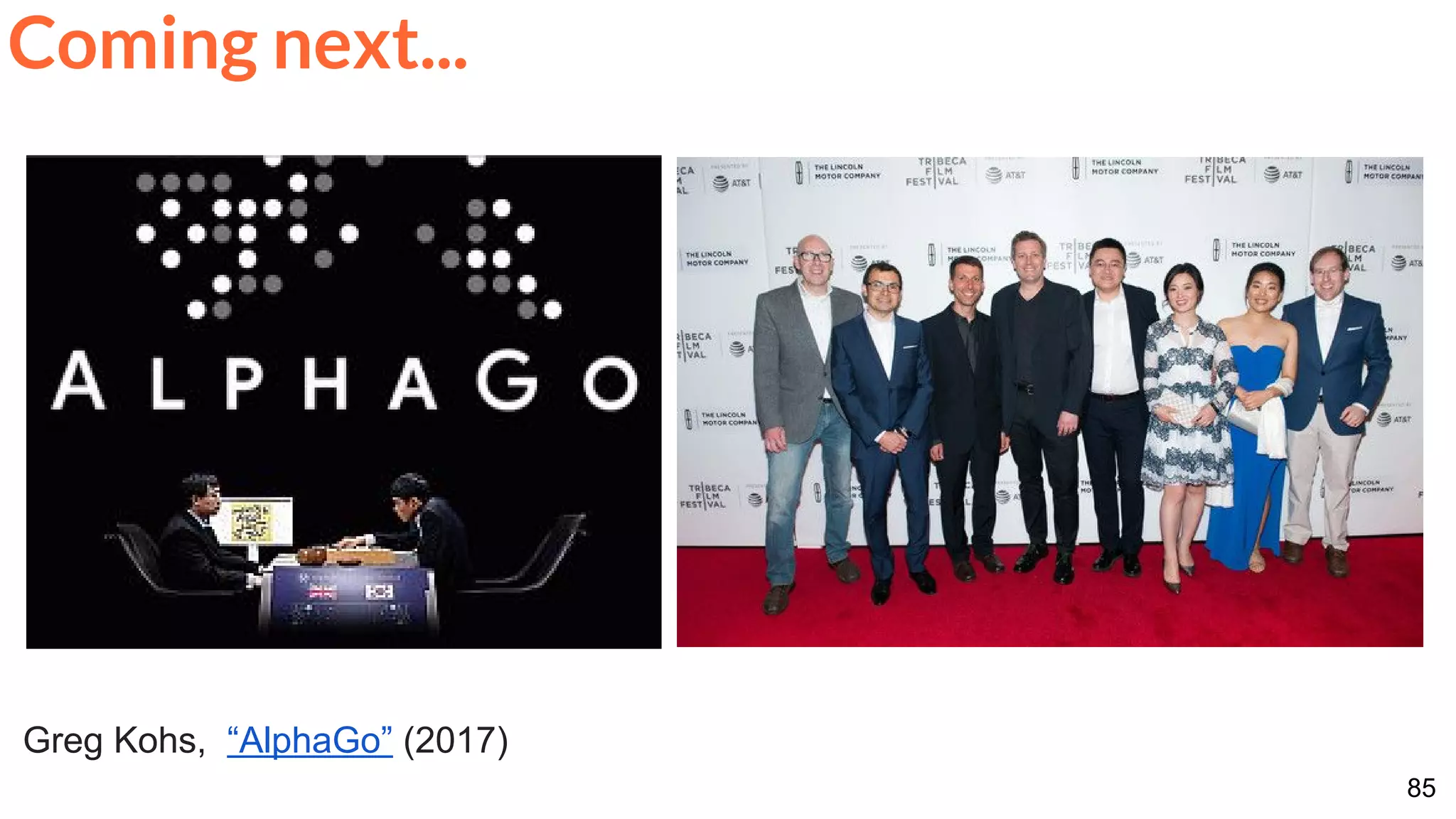
85
Greg Kohs, “AlphaGo” (2017)
Coming next...
86
Vinyals, O., Ewalds, T., Bartunov, S., Georgiev, P., Vezhnevets, A.S., Yeo, M., Makhzani, A., Küttler, H.,
Agapiou, J., Schrittwieser, J. and Quan, J., 2017. Starcraft ii: A new challenge for reinforcement learning.
arXiv preprint arXiv:1708.04782. [Press release]
Coming next...
87
Vinyals, O., Ewalds, T., Bartunov, S., Georgiev, P., Vezhnevets, A.S., Yeo, M., Makhzani, A., Küttler, H.,
Agapiou, J., Schrittwieser, J. and Quan, J., 2017. Starcraft ii: A new challenge for reinforcement learning.
arXiv preprint arXiv:1708.04782. [Press release]
Coming next...
88
Coming next...
Edifici Vèrtex (Auditori)

Reinforcement Learning (DLAI D7L2 2017 UPC Deep Learning for Artificial Intelligence)

  • 1.
    [course site] Xavier Giro-i-Nieto xavier.giro@upc.edu AssociateProfessor Universitat Politecnica de Catalunya Technical University of Catalonia Reinforcement Learning Day 7 Lecture 2 #DLUPC
  • 2.
    2 Acknowledegments Bellver M, Giró-i-NietoX, Marqués F, Torres J. Hierarchical Object Detection with Deep Reinforcement Learning. In Deep Reinforcement Learning Workshop, NIPS 2016. 2016.
  • 3.
    3 Acknowledegments Serena Yeung, “DeepReinforcement Learning”. Stanford University CS231n, 2017.
  • 4.
    4 Outline 1. Motivation 2. Architecture 3.Markov Decision Process (MDP) 4. Deep Q-learning 5. RL Frameworks 6. Learn more
  • 5.
    5 Outline 1. Motivation 2. Architecture 3.Markov Decision Process (MDP) 4. Deep Q-learning 5. RL Frameworks 6. Learn more
  • 6.
    6 Motivation What is ReinforcementLearning ? “a way of programming agents by reward and punishment without needing to specify how the task is to be achieved” [Kaelbling, Littman, & Moore, 96] Kaelbling, Leslie Pack, Michael L. Littman, and Andrew W. Moore. "Reinforcement learning: A survey." Journal of artificial intelligence research 4 (1996): 237-285.
  • 7.
    Yann Lecun’s BlackForest cake 7 Motivation
  • 8.
    We can categorizethree types of learning procedures: 1. Supervised Learning: = ƒ( ) 2. Unsupervised Learning: ƒ( ) 3. Reinforcement Learning (RL): = ƒ( ) 8 Predict label y corresponding to observation x Estimate the distribution of observation x Predict action y based on observation x, to maximize a future reward z Motivation
  • 9.
    We can categorizethree types of learning procedures: 1. Supervised Learning: = ƒ( ) 2. Unsupervised Learning: ƒ( ) 3. Reinforcement Learning (RL): = ƒ( ) 9 Motivation
  • 10.
    10 Outline 1. Motivation 2. Architecture 3.Markov Decision Process (MDP) 4. Deep Q-learning 5. RL Frameworks 6. Learn more
  • 11.
    11 Mnih, Volodymyr, KorayKavukcuoglu, David Silver, Alex Graves, Ioannis Antonoglou, Daan Wierstra, and Martin Riedmiller. "Playing atari with deep reinforcement learning." arXiv preprint arXiv:1312.5602 (2013).
  • 12.
    12Bernhard Schölkkopf, “Learningto see and act” Nature 2015. Motivation
  • 13.
    13 Outline 1. Motivation 2. Architecture 3.Markov Decision Process (MDP) ○ Policy ○ Optimal Policy ○ Value Function ○ Q-value function ○ Optimal Q-value function ○ Bellman equation ○ Value iteration algorithm 4. Deep Q-learning 5. RL Frameworks 6. Learn more
  • 14.
    14Figure: UCL Courseon RL by David Silver Architecture
  • 15.
    15Figure: UCL Courseon RL by David Silver Environment Architecture
  • 16.
    16Figure: UCL Courseon RL by David Silver Environment state (st ) Architecture
  • 17.
    17Figure: UCL Courseon RL by David Silver Environment state (st ) Architecture
  • 18.
    18Figure: UCL Courseon RL by David Silver Environment Agent state (st ) Architecture
  • 19.
    19Figure: UCL Courseon RL by David Silver Environment Agent action (At )state (st ) Architecture
  • 20.
    20Figure: UCL Courseon RL by David Silver Environment Agent action (At )state (st ) Architecture
  • 21.
    21Figure: UCL Courseon RL by David Silver Environment Agent action (At ) reward (rt ) state (st ) Architecture
  • 22.
    22Figure: UCL Courseon RL by David Silver Environment Agent action (At ) reward (rt ) state (st ) Architecture Reward is given to the agent delayed with respect to previous states and actions !
  • 23.
    23Figure: UCL Courseon RL by David Silver Environment Agent action (At ) reward (rt ) state (st+1 ) Architecture
  • 24.
    24Figure: UCL Courseon RL by David Silver Environment Agent action (At ) reward (rt ) state (st+1 ) Architecture GOAL: Complete the game with the highest score.
  • 25.
    25Figure: UCL Courseon RL by David Silver Environment Agent action (At ) reward (rt ) state (st+1 ) Architecture GOAL: Learn how to take actions to maximize accumulative reward
  • 26.
    26 Other problems thatcan be formulated with a RL architecture. Cart-Pole Problem Objective: Balance a pole on top of a movable car Architecture Slide credit: Serena Yeung, “Deep Reinforcement Learning”. Stanford University CS231n, 2017.
  • 27.
    27 Architecture Slide concept: SerenaYeung, “Deep Reinforcement Learning”. Stanford University CS231n, 2017. Environment Agent action (At ) reward (rt ) state (st ) Angle Angular speed Position Horizontal velocity Horizontal force applied in the car1 at each time step if the pole is upright
  • 28.
    28 Other problems thatcan be formulated with a RL architecture. Robot Locomotion Objective: Make the robot move forward Architecture Schulman, John, Philipp Moritz, Sergey Levine, Michael Jordan, and Pieter Abbeel. "High-dimensional continuous control using generalized advantage estimation." ICLR 2016 [project page]
  • 29.
    29 Architecture Slide concept: SerenaYeung, “Deep Reinforcement Learning”. Stanford University CS231n, 2017. Environment Agent action (At ) reward (rt ) state (st ) Angle and position of the joints Torques applied on joints1 at each time step upright + forward movement
  • 30.
    30 Schulman, John, PhilippMoritz, Sergey Levine, Michael Jordan, and Pieter Abbeel. "High-dimensional continuous control using generalized advantage estimation." ICLR 2016 [project page]
  • 31.
    31 Outline 1. Motivation 2. Architecture 3.Markov Decision Process (MDP) ○ Policy ○ Optimal Policy ○ Value Function ○ Q-value function ○ Optimal Q-value function ○ Bellman equation ○ Value iteration algorithm 4. Deep Q-learning 5. RL Frameworks 6. Learn more
  • 32.
    32 Markov Decision Processes(MDP) Markov Decision Processes provide a formalism for reinforcement learning problems. Slide concept: Serena Yeung, “Deep Reinforcement Learning”. Stanford University CS231n, 2017. Markov property: Current state completely characterises the state of the world.
  • 33.
    33 Markov Decision Processes(MDP) Slide concept: Serena Yeung, “Deep Reinforcement Learning”. Stanford University CS231n, 2017. S A R P ४
  • 34.
    34 Markov Decision Processes(MDP) Slide concept: Serena Yeung, “Deep Reinforcement Learning”. Stanford University CS231n, 2017. S A R P ४ Environment samples initial state s0 ~ p(s0 ) Agent selects action at Environment samples next state st+1 ~ P ( .| st , at ) Environment samples reward rt ~ R(. | st ,at ) reward (rt ) state (st ) action (at )
  • 35.
    35 MDP: Policy Slide concept:Serena Yeung, “Deep Reinforcement Learning”. Stanford University CS231n, 2017. S A R P ४ Agent selects action at policy π A Policy π is a function S ➝ A that specifies which action to take in each state.
  • 36.
    36 MDP: Policy Slide concept:Serena Yeung, “Deep Reinforcement Learning”. Stanford University CS231n, 2017. Agent selects action at policy π A Policy π is a function S ➝ A that specifies which action to take in each state. GOAL: Learn how to take actions to maximize reward Agent GOAL: Find policy π* that maximizes the cumulative discounted reward: MDP
  • 37.
    37 Other problems thatcan be formulated with a RL architecture. Slide concept: Serena Yeung, “Deep Reinforcement Learning”. Stanford University CS231n, 2017. MDP: Policy Grid World (a simple MDP) Objective: reach one of the terminal states (greyed out) in least number of actions.
  • 38.
    38Slide concept: SerenaYeung, “Deep Reinforcement Learning”. Stanford University CS231n, 2017. Environment Agent action (At ) reward (rt ) state (st ) Each cell is a state: A negative “reward” (penalty) for each transition rt = r = -1 MDP: Policy
  • 39.
    39Slide concept: SerenaYeung, “Deep Reinforcement Learning”. Stanford University CS231n, 2017. MDP: Policy Example: Actions resulting from applying a random policy on this Grid World problem.
  • 40.
    40Slide concept: SerenaYeung, “Deep Reinforcement Learning”. Stanford University CS231n, 2017. Exercise: Draw the actions resulting from applying an optimal policy in this Grid World problem. MDP: Optimal Policy π*
  • 41.
    41Slide concept: SerenaYeung, “Deep Reinforcement Learning”. Stanford University CS231n, 2017. Solution: Draw the actions resulting from applying an optimal policy in this Grid World problem. MDP: Optimal Policy π*
  • 42.
    42 MDP: Optimal Policyπ* Slide concept: Serena Yeung, “Deep Reinforcement Learning”. Stanford University CS231n, 2017. How do we handle the randomness (initial state s0 , transition probabilities, action...) ? GOAL: Find policy π* that maximizes the cumulative discounted reward: Environment samples initial state s0 ~ p(s0 ) Agent selects action at ~π (.|st ) Environment samples next state st+1 ~ P ( .| st , at ) Environment samples reward rt ~ R(. | st ,at ) reward (rt ) state (st ) action (at )
  • 43.
    43Slide concept: SerenaYeung, “Deep Reinforcement Learning”. Stanford University CS231n, 2017. How do we handle the randomness (initial state s0 , transition probabilities, action) ? GOAL: Find policy π* that maximizes the cumulative discounted reward: The optimal policy π* will maximize the expected sum of rewards: initial state selected action at t sampled state for t+1expected cumulative discounted reward MDP: Optimal Policy π*
  • 44.
    44 MDP: Policy: Valuefunction Vπ (s) Slide concept: Serena Yeung, “Deep Reinforcement Learning”. Stanford University CS231n, 2017. How to estimate how good state s is for a given policy π ? With the value function at state s, Vπ (s), the expected cumulative reward from following policy π from state s. “...from following policy π from state s.” “Expected cumulative reward…””
  • 45.
    45 MDP: Policy: Q-valuefunction Qπ (s,a) Slide concept: Serena Yeung, “Deep Reinforcement Learning”. Stanford University CS231n, 2017. How to estimate how good a state-action pair (s,a) is for a given policy π ? With the Q-value function at state s and action a, Qπ (s,a), the expected cumulative reward from taking action a in state s, and then following policy π. “...from taking action a in state s and then following policy π.” “Expected cumulative reward…””
  • 46.
    46 MDP: Policy: OptimalQ-value function Q* (s,a) Slide concept: Serena Yeung, “Deep Reinforcement Learning”. Stanford University CS231n, 2017. The optimal Q-value function at state s and action, Q* (s,a), is the maximum expected cumulative reward achievable from a given (state, action) pair: choose the policy that maximizes the expected cumulative reward (From the previous page) Q-value function
  • 47.
    47 MDP: Policy: Bellmanequation Slide concept: Serena Yeung, “Deep Reinforcement Learning”. Stanford University CS231n, 2017. Q* (s,a) satisfies the following Bellman equation: Maximum expected cumulative reward for future pair (s’,a’) FUTURE REWARD (From the previous page) Optimal Q-value function reward for considered pair (s,a) Maximum expected cumulative reward for considered pair (s,a) Expectation across possible future states s’ (randomness) discount factor
  • 48.
    48 MDP: Policy: Bellmanequation Slide concept: Serena Yeung, “Deep Reinforcement Learning”. Stanford University CS231n, 2017. Q* (s,a) satisfies the following Bellman equation: The optimal policy π* corresponds to taking the best action in any state according to Q*. GOAL: Find policy π* that maximizes the cumulative discounted reward: select action a’ that maximizes expected cumulative reward
  • 49.
    49 MDP: Policy: Solvingthe Optimal Policy Slide concept: Serena Yeung, “Deep Reinforcement Learning”. Stanford University CS231n, 2017. Value iteration algorithm: Estimate the Bellman equation with an iterative update. The iterative estimation Qi (s,a) will converge to the optimal Q*(s,a) as i ➝ ∞. (From the previous page) Bellman Equation Updated Q-value function Current Q-value for future pair (s’,a’)
  • 50.
    50 MDP: Policy: Solvingthe Optimal Policy Slide concept: Serena Yeung, “Deep Reinforcement Learning”. Stanford University CS231n, 2017. Qi (s,a) will converge to the optimal Q*(s,a) as i ➝ ∞. Updated Q-value for current pair (s,a) Current Q-value for next pair (s’,a’) This iterative approach is not scalable because it requires computing Qi (s,a) for every state-action pair. Eg. If state is current game pixels, computationally unfeasible to compute Qi (s,a) for the entire state space !
  • 51.
    51 MDP: Policy: Solvingthe Optimal Policy Slide concept: Serena Yeung, “Deep Reinforcement Learning”. Stanford University CS231n, 2017. This iterative approach is not scalable because it requires computing Q(s,a) for every state-action pair. Eg. If state is current game pixels, computationally unfeasible to compute Q(s,a) for the entire state space ! Solution: Use a deep neural network as an function approximator of Q*(s,a). Q(s,a,Ө) ≈ Q*(s,a) Neural Network parameters
  • 52.
    52 Outline 1. Motivation 2. Architecture 3.Markov Decision Process (MDP) 4. Deep Q-learning ○ Forward and Backward passes ○ DQN ○ Experience Replay ○ Examples 5. RL Frameworks 6. Learn more ○ Coming next…
  • 53.
    53 Deep Q-learning Slide concept:Serena Yeung, “Deep Reinforcement Learning”. Stanford University CS231n, 2017. The function to approximate is a Q-function that satisfies the Bellman equation: Q(s,a,Ө) ≈ Q*(s,a)
  • 54.
    54 Deep Q-learning Slide concept:Serena Yeung, “Deep Reinforcement Learning”. Stanford University CS231n, 2017. The function to approximate is a Q-function that satisfies the Bellman equation: Q(s,a,Ө) ≈ Q*(s,a) Forward Pass Loss function: Sample a (s,a) pair Predicted Q-value with Өi Sample a future state s’ Predict Q-value with Өi-1
  • 55.
    55 Deep Q-learning Slide concept:Serena Yeung, “Deep Reinforcement Learning”. Stanford University CS231n, 2017. Train the DNN to approximate a Q-value function that satisfies the Bellman equation
  • 56.
    56 Deep Q-learning Slide concept:Serena Yeung, “Deep Reinforcement Learning”. Stanford University CS231n, 2017. Must compute reward during training
  • 57.
    57 Deep Q-learning Slide concept:Serena Yeung, “Deep Reinforcement Learning”. Stanford University CS231n, 2017. Backward Pass Gradient update (with respect to Q-function parameters Ө): Forward Pass Loss function:
  • 58.
    58Source: Tambet Matiisen,Demystifying Deep Reinforcement Learning (Nervana) Deep Q-learning: Deep Q-Network DQN Q(s,a,Ө) ≈ Q*(s,a)
  • 59.
    59Source: Tambet Matiisen,Demystifying Deep Reinforcement Learning (Nervana) Deep Q-learning: Deep Q-Network DQN Q(s,a,Ө) ≈ Q*(s,a) efficiency Single Feed Forward Pass A single feedforward pass to compute the Q-values for all actions from the current state (efficient)
  • 60.
    60 Mnih, Volodymyr, KorayKavukcuoglu, David Silver, Andrei A. Rusu, Joel Veness, Marc G. Bellemare, Alex Graves et al. "Human-level control through deep reinforcement learning." Nature 518, no. 7540 (2015): 529-533. Deep Q-learning: Deep Q-Network DQN Number of actions between 4-18, depending on the Atari game
  • 61.
    61 Deep Q-learning: DeepQ-Network DQN Slide concept: Serena Yeung, “Deep Reinforcement Learning”. Stanford University CS231n, 2017. Q(st , ⬅), Q(st , ➡), Q(st , ⬆), Q(st ,⬇ )
  • 62.
    62 Deep Q-learning: ExperienceReplay Slide concept: Serena Yeung, “Deep Reinforcement Learning”. Stanford University CS231n, 2017. Learning from batches of consecutive samples is problematic: ● Samples are too correlated ➡ inefficient learning ● Q-network parameters determine the next training samples ➡ can lead to bad feedback loops.
  • 63.
    63 Deep Q-learning: ExperienceReplay Slide concept: Serena Yeung, “Deep Reinforcement Learning”. Stanford University CS231n, 2017. Experience replay: ● Continually update a replay memory table of transitions (st , at , rt , st+1 ) as game (experience) episodes are played. ● Train a Q-network on random minibatches of transitions from the replay memory, instead of consecutiev samples.
  • 64.
    64Andrej Karpathy, “ConvNetJSDeep Q Learning Demo” Deep Q-learning: Demo
  • 65.
    65 Miriam Bellver, XavierGiro-i-Nieto, Ferran Marques, and Jordi Torres. "Hierarchical Object Detection with Deep Reinforcement Learning." Deep Reinforcement Learning Workshop NIPS 2016. Deep Q-learning: DQN: Computer Vision Method for performing hierarchical object detection in images guided by a deep reinforcement learning agent. OBJECT FOUND
  • 66.
    66 Deep Q-learning: DQN:Computer Vision State: The agent will decide which action to choose based on: ● visual description of the current observed region ● history vector that maps past actions performed
  • 67.
    67 Deep Q-learning: DQN:Computer Vision Reward: Reward for movement actions Reward for terminal action
  • 68.
    68 Deep Q-learning: DQN:Computer Vision Actions: Two kind of actions: ● movement actions: to which of the 5 possible regions defined by the hierarchy to move ● terminal action: the agent indicates that the object has been found
  • 69.
    69 Miriam Bellver, XavierGiro-i-Nieto, Ferran Marques, and Jordi Torres. "Hierarchical Object Detection with Deep Reinforcement Learning." Deep Reinforcement Learning Workshop NIPS 2016. Deep Q-learning: DQN: Computer Vision
  • 70.
    70 Outline 1. Motivation 2. Architecture 3.Markov Decision Process (MDP) 4. Deep Q-learning 5. RL Frameworks 6. Learn more
  • 71.
    71 RL Frameworks OpenAI Gym+ keras-rl + keras-rl keras-rl implements some state-of-the art deep reinforcement learning algorithms in Python and seamlessly integrates with the deep learning library Keras. Just like Keras, it works with either Theano or TensorFlow, which means that you can train your algorithm efficiently either on CPU or GPU. Furthermore, keras-rl works with OpenAI Gym out of the box. Slide credit: Míriam Bellver
  • 72.
  • 73.
    73 Outline 1. Motivation 2. Architecture 3.Markov Decision Process (MDP) 4. Deep Q-learning 5. RL Frameworks 6. Learn more
  • 74.
    74 Deep Learning TV, “Reinforcementlearning - Ep. 30” Siraj Raval, Deep Q Learning for Video Games Learn more
  • 75.
    Emma Brunskill, StanfordCS234: Reinforcement Learning Learn more
  • 76.
    David Silver, UCLCOMP050, Reinforcement Learning Learn more
  • 77.
    Nando de Freitas,“Machine Learning” (University of Oxford) Learn more
  • 78.
    78 Pieter Abbeel andJohn Schulman, CS 294-112 Deep Reinforcement Learning, Berkeley. Slides: “Reinforcement Learning - Policy Optimization” OpenAI / UC Berkeley (2017) Learn more
  • 79.
    79 Learn more Slide credit:Míriam Bellver actor state critic ‘q-value’action (5) state action (5) actor performs an action critic assesses how good the action was, and the gradients are used to train the actor and the critic Actor-Critic algorithm Grondman, Ivo, Lucian Busoniu, Gabriel AD Lopes, and Robert Babuska. "A survey of actor-critic reinforcement learning: Standard and natural policy gradients." IEEE Transactions on Systems, Man, and Cybernetics, Part C (Applications and Reviews) 42, no. 6 (2012): 1291-1307.
  • 80.
  • 81.
    81 Outline 1. Motivation 2. Architecture 3.Markov Decision Process (MDP) ○ Policy ○ Optimal Policy ○ Value Function ○ Q-value function ○ Optimal Q-value function ○ Bellman equation ○ Value iteration algorithm 4. Deep Q-learning ○ Forward and Backward passes ○ DQN ○ Experience Replay ○ Examples 5. RL Frameworks 6. Learn more ○ Coming next…
  • 82.
    Conclusions Reinforcement Learning ● Thereis no supervisor, only reward signal ● Feedback is delayed, not instantaneous ● Time really matters (sequential, non i.i.d data) Slide credit: UCL Course on RL by David Silver
  • 83.
  • 84.
    84 Silver, D., Huang,A., Maddison, C.J., Guez, A., Sifre, L., Van Den Driessche, G., Schrittwieser, J., Antonoglou, I., Panneershelvam, V., Lanctot, M. and Dieleman, S., 2016. Mastering the game of Go with deep neural networks and tree search. Nature, 529(7587), pp.484-489 Coming next...
  • 85.
    85 Greg Kohs, “AlphaGo”(2017) Coming next...
  • 86.
    86 Vinyals, O., Ewalds,T., Bartunov, S., Georgiev, P., Vezhnevets, A.S., Yeo, M., Makhzani, A., Küttler, H., Agapiou, J., Schrittwieser, J. and Quan, J., 2017. Starcraft ii: A new challenge for reinforcement learning. arXiv preprint arXiv:1708.04782. [Press release] Coming next...
  • 87.
    87 Vinyals, O., Ewalds,T., Bartunov, S., Georgiev, P., Vezhnevets, A.S., Yeo, M., Makhzani, A., Küttler, H., Agapiou, J., Schrittwieser, J. and Quan, J., 2017. Starcraft ii: A new challenge for reinforcement learning. arXiv preprint arXiv:1708.04782. [Press release] Coming next...
  • 88.