Introduction of Reinforcement Learning
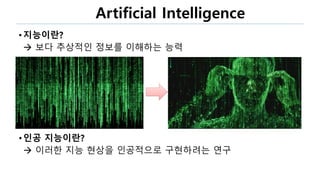
Artificial Intelligence
• 지능이란?
 보다 추상적인 정보를 이해하는 능력
•인공 지능이란?
 이러한 지능 현상을 인공적으로 구현하려는 연구
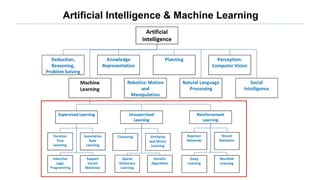
Artificial Intelligence & Machine Learning
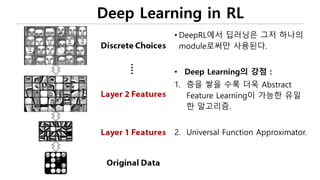
Deep Learning in RL
• DeepRL에서 딥러닝은 그저 하나의
module로써만 사용된다.
• Deep Learning의 강점 :
1. 층을 쌓을 수록 더욱 Abstract
Feature Learning이 가능한 유일
한 알고리즘.
2. Universal Function Approximator.
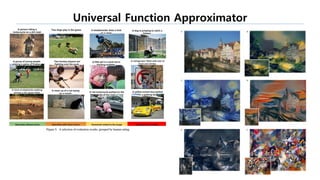
Universal Function Approximator
Reinforcement Learning이란?
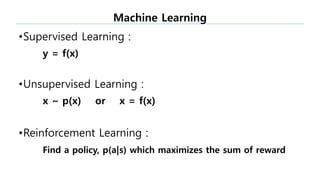
•Supervised Learning :
y = f(x)
•Unsupervised Learning :
x ~ p(x) or x = f(x)
•Reinforcement Learning :
Find a policy, p(a|s) which maximizes the sum of reward
Machine Learning
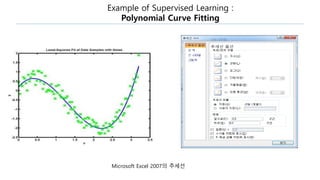
Example of Supervised Learning :
Polynomial Curve Fitting
Microsoft Excel 2007의 추세선
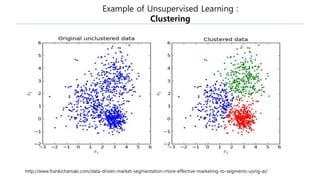
Example of Unsupervised Learning :
Clustering
http://www.frankichamaki.com/data-driven-market-segmentation-more-effective-marketing-to-segments-using-ai/
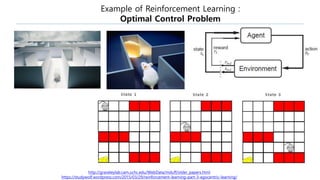
Example of Reinforcement Learning :
Optimal Control Problem
http://graveleylab.cam.uchc.edu/WebData/mduff/older_papers.html
https://studywolf.wordpress.com/2015/03/29/reinforcement-learning-part-3-egocentric-learning/
Markov Decision Processes(MDP)
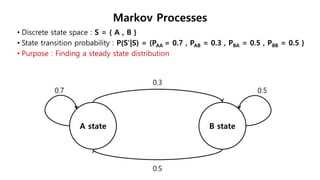
• Discrete state space : S = { A , B }
• State transition probability : P(S’|S) = {PAA = 0.7 , PAB = 0.3 , PBA = 0.5 , PBB = 0.5 }
• Purpose : Finding a steady state distribution
Markov Processes
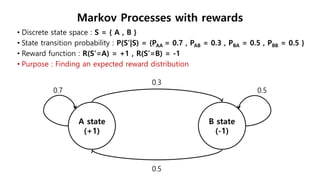
• Discrete state space : S = { A , B }
• State transition probability : P(S’|S) = {PAA = 0.7 , PAB = 0.3 , PBA = 0.5 , PBB = 0.5 }
• Reward function : R(S’=A) = +1 , R(S’=B) = -1
• Purpose : Finding an expected reward distribution
Markov Processes with rewards
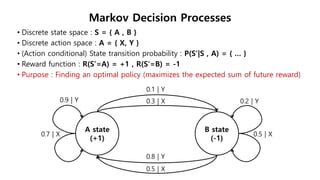
• Discrete state space : S = { A , B }
• Discrete action space : A = { X, Y }
• (Action conditional) State transition probability : P(S’|S , A) = { … }
• Reward function : R(S’=A) = +1 , R(S’=B) = -1
• Purpose : Finding an optimal policy (maximizes the expected sum of future reward)
Markov Decision Processes
•Markov decision processes :
a mathematical framework for modeling decision making.
• MDP are solved via dynamic programming and reinforcement learning.
• Applications : robotics, automated control, economics and manufacturing.
• Examples of MDP :
1) AlphaGo에서는 바둑을 MDP로 정의
2) 자동차 운전을 MDP로 정의
3) 주식시장을 MDP로 정의
Markov Decision Processes
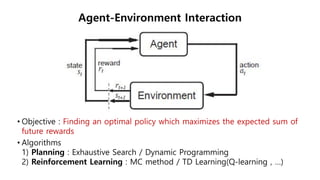
• Objective : Finding an optimal policy which maximizes the expected sum of
future rewards
• Algorithms
1) Planning : Exhaustive Search / Dynamic Programming
2) Reinforcement Learning : MC method / TD Learning(Q-learning , …)
Agent-Environment Interaction
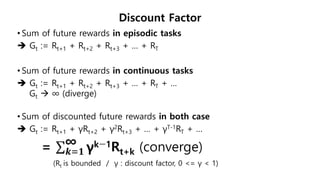
Discount Factor
• Sum of future rewards in episodic tasks
 Gt := Rt+1 + Rt+2 + Rt+3 + … + RT
• Sum of future rewards in continuous tasks
 Gt := Rt+1 + Rt+2 + Rt+3 + … + RT + …
Gt  ∞ (diverge)
• Sum of discounted future rewards in both case
 Gt := Rt+1 + γRt+2 + γ2Rt+3 + … + γT-1RT + …
= γk−1Rt+k
∞
𝒌=𝟏 (converge)
(Rt is bounded / γ : discount factor, 0 <= γ < 1)
Value-based Reinforcement Learning
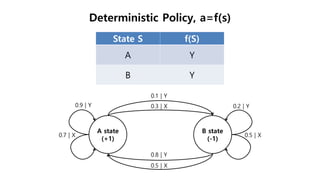
Deterministic Policy, a=f(s)
State S f(S)
A Y
B Y
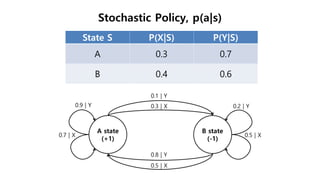
Stochastic Policy, p(a|s)
State S P(X|S) P(Y|S)
A 0.3 0.7
B 0.4 0.6
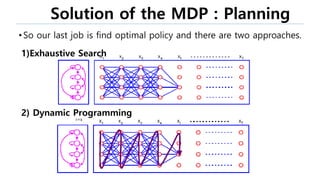
Solution of the MDP : Planning
• So our last job is find optimal policy and there are two approaches.
2) Dynamic Programming
1)Exhaustive Search
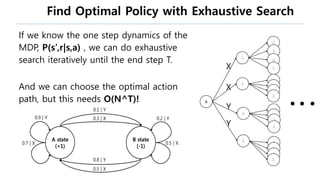
Find Optimal Policy with Exhaustive Search
If we know the one step dynamics of the
MDP, P(s’,r|s,a) , we can do exhaustive
search iteratively until the end step T.
And we can choose the optimal action
path, but this needs O(N^T)! A
A
(+1)
B
(-1)
A
(+1)
B
(-1)
A
(+1)
B
(-1)
A
(+1)
B
(-1)
A
(+1)
B
(-1)
A
(+1)
B
(-1)
X
X
Y
Y
A
(+1)
B
(-1)
A
(+1)
B
(-1)
A
(+1)
B
(-1)
A
(+1)
B
(-1)
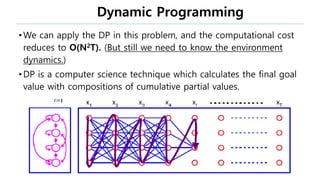
Dynamic Programming
• We can apply the DP in this problem, and the computational cost
reduces to O(N2T). (But still we need to know the environment
dynamics.)
• DP is a computer science technique which calculates the final goal
value with compositions of cumulative partial values.
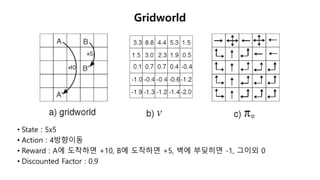
• State : 5x5
• Action : 4방향이동
• Reward : A에 도착하면 +10, B에 도착하면 +5, 벽에 부딪히면 -1, 그이외 0
• Discounted Factor : 0.9
Gridworld
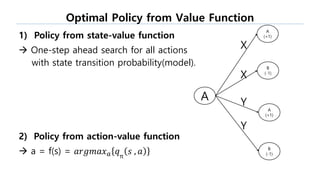
1) Policy from state-value function
 One-step ahead search for all actions
with state transition probability(model).
2) Policy from action-value function
 a = f(s) = 𝑎𝑟𝑔𝑚𝑎𝑥 𝑎 𝑞π
𝑠 , 𝑎
Optimal Policy from Value Function
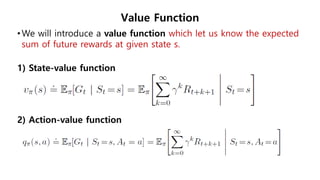
Value Function
•We will introduce a value function which let us know the expected
sum of future rewards at given state s.
1) State-value function
2) Action-value function
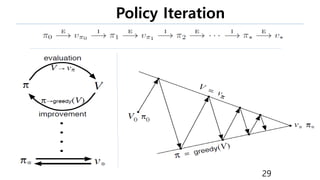
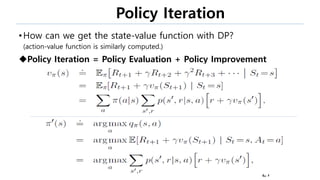
Policy Iteration
•How can we get the state-value function with DP?
(action-value function is similarly computed.)
Policy Iteration = Policy Evaluation + Policy Improvement
27
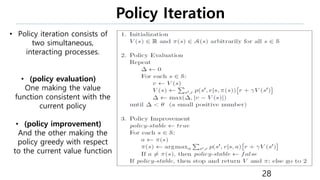
Policy Iteration
28
• Policy iteration consists of
two simultaneous,
interacting processes.
• (policy evaluation)
One making the value
function consistent with the
current policy
• (policy improvement)
And the other making the
policy greedy with respect
to the current value function
Policy Iteration
29
Solution of the MDP : Learning
•The planning methods must know the perfect dynamics of
environment, P(s’,r|s,a)
•But typically this is really hard to know and empirically impossible.
Therefore we will ignore this term and just calculate the mean of
reward with sampling method. This is the starting point of the
machine learning is embedded.
1) Monte Carlo Methods
2) Temporal-Difference Learning
(some kind of reinforcement learning)
30
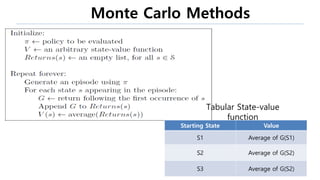
Monte Carlo Methods
31
Starting State Value
S1 Average of G(S1)
S2 Average of G(S2)
S3 Average of G(S2)
Tabular State-value
function
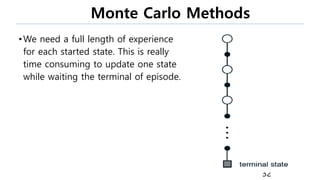
Monte Carlo Methods
32
•We need a full length of experience
for each started state. This is really
time consuming to update one state
while waiting the terminal of episode.
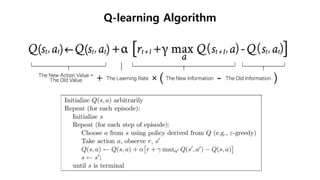
Q-learning (Temporal Difference Learning)
Temporal-Difference Learning
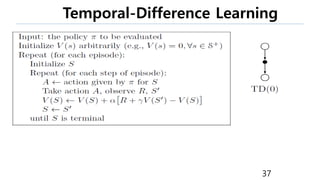
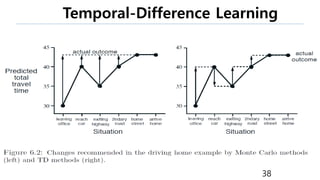
•TD learning is a combination of Monte Carlo ideas and dynamic
programming (DP) ideas.
•Like Monte Carlo methods, TD methods can learn directly from
raw experience without a model of the environment's dynamics.
•Like DP, TD methods update estimates based in part without
waiting for a final outcome (they bootstrap).
34
Bellman Equation
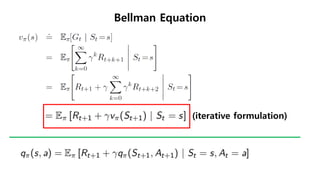
(iterative formulation)
Q-learning Algorithm
Temporal-Difference Learning
37
Temporal-Difference Learning
38
On policy / Off policy
• On policy : Target policy = Behavioral policy
there can be only one policy.
 This can learn a stochastic policy. Ex) Q-learning
• Off policy : Target policy != Behavioral policy
there can be several policies.
 Broad applications. Ex) SARSA
39
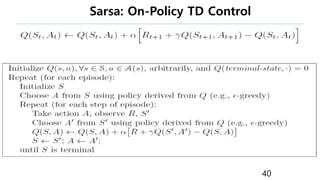
Sarsa: On-Policy TD Control
40
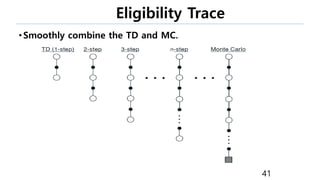
Eligibility Trace
41
•Smoothly combine the TD and MC.
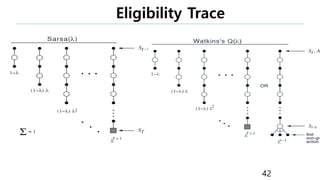
Eligibility Trace
42
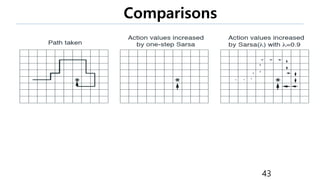
Comparisons
43
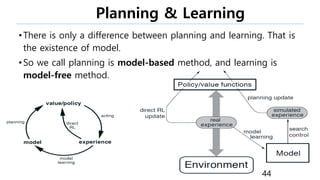
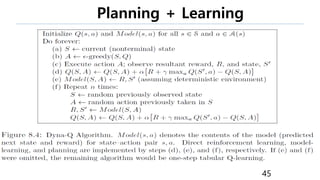
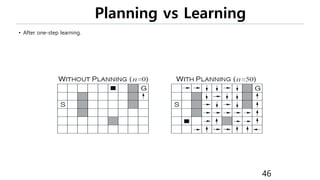
Planning & Learning
•There is only a difference between planning and learning. That is
the existence of model.
•So we call planning is model-based method, and learning is
model-free method.
44
Planning + Learning
45
Planning vs Learning
• After one-step learning.
46
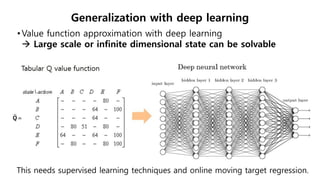
Deep Reinforcement Learning
•Value function approximation with deep learning
 Large scale or infinite dimensional state can be solvable
Generalization with deep learning
This needs supervised learning techniques and online moving target regression.
Appendix
• Atari 2600 - https://www.youtube.com/watch?v=iqXKQf2BOSE
• Super MARIO - https://www.youtube.com/watch?v=qv6UVOQ0F44
• Robot Learns to Flip Pancakes - https://www.youtube.com/watch?v=W_gxLKSsSIE
• Stanford Autonomous Helicopter - Airshow #2 -
https://www.youtube.com/watch?v=VCdxqn0fcnE
• OpenAI Gym - https://gym.openai.com/envs
• Awesome RL - https://github.com/aikorea/awesome-rl
• Udacity RL course
• TensorFlow DRL - https://github.com/nivwusquorum/tensorflow-deepq
• Karpathy rldemo -
http://cs.stanford.edu/people/karpathy/convnetjs/demo/rldemo.html
49
References
[1] Sutton, Richard S., and Andrew G. Barto. Reinforcement learning: An
introduction. MIT press, 1998.
50
감사합니다.

Reinforcement learning

  • 1.
  • 2.
    Artificial Intelligence • 지능이란? 보다 추상적인 정보를 이해하는 능력 •인공 지능이란?  이러한 지능 현상을 인공적으로 구현하려는 연구
  • 3.
    Artificial Intelligence &Machine Learning
  • 4.
    Deep Learning inRL • DeepRL에서 딥러닝은 그저 하나의 module로써만 사용된다. • Deep Learning의 강점 : 1. 층을 쌓을 수록 더욱 Abstract Feature Learning이 가능한 유일 한 알고리즘. 2. Universal Function Approximator.
  • 5.
  • 6.
  • 7.
    •Supervised Learning : y= f(x) •Unsupervised Learning : x ~ p(x) or x = f(x) •Reinforcement Learning : Find a policy, p(a|s) which maximizes the sum of reward Machine Learning
  • 8.
    Example of SupervisedLearning : Polynomial Curve Fitting Microsoft Excel 2007의 추세선
  • 9.
    Example of UnsupervisedLearning : Clustering http://www.frankichamaki.com/data-driven-market-segmentation-more-effective-marketing-to-segments-using-ai/
  • 10.
    Example of ReinforcementLearning : Optimal Control Problem http://graveleylab.cam.uchc.edu/WebData/mduff/older_papers.html https://studywolf.wordpress.com/2015/03/29/reinforcement-learning-part-3-egocentric-learning/
  • 11.
  • 12.
    • Discrete statespace : S = { A , B } • State transition probability : P(S’|S) = {PAA = 0.7 , PAB = 0.3 , PBA = 0.5 , PBB = 0.5 } • Purpose : Finding a steady state distribution Markov Processes
  • 13.
    • Discrete statespace : S = { A , B } • State transition probability : P(S’|S) = {PAA = 0.7 , PAB = 0.3 , PBA = 0.5 , PBB = 0.5 } • Reward function : R(S’=A) = +1 , R(S’=B) = -1 • Purpose : Finding an expected reward distribution Markov Processes with rewards
  • 14.
    • Discrete statespace : S = { A , B } • Discrete action space : A = { X, Y } • (Action conditional) State transition probability : P(S’|S , A) = { … } • Reward function : R(S’=A) = +1 , R(S’=B) = -1 • Purpose : Finding an optimal policy (maximizes the expected sum of future reward) Markov Decision Processes
  • 15.
    •Markov decision processes: a mathematical framework for modeling decision making. • MDP are solved via dynamic programming and reinforcement learning. • Applications : robotics, automated control, economics and manufacturing. • Examples of MDP : 1) AlphaGo에서는 바둑을 MDP로 정의 2) 자동차 운전을 MDP로 정의 3) 주식시장을 MDP로 정의 Markov Decision Processes
  • 16.
    • Objective :Finding an optimal policy which maximizes the expected sum of future rewards • Algorithms 1) Planning : Exhaustive Search / Dynamic Programming 2) Reinforcement Learning : MC method / TD Learning(Q-learning , …) Agent-Environment Interaction
  • 17.
    Discount Factor • Sumof future rewards in episodic tasks  Gt := Rt+1 + Rt+2 + Rt+3 + … + RT • Sum of future rewards in continuous tasks  Gt := Rt+1 + Rt+2 + Rt+3 + … + RT + … Gt  ∞ (diverge) • Sum of discounted future rewards in both case  Gt := Rt+1 + γRt+2 + γ2Rt+3 + … + γT-1RT + … = γk−1Rt+k ∞ 𝒌=𝟏 (converge) (Rt is bounded / γ : discount factor, 0 <= γ < 1)
  • 18.
  • 19.
  • 20.
    Stochastic Policy, p(a|s) StateS P(X|S) P(Y|S) A 0.3 0.7 B 0.4 0.6
  • 21.
    Solution of theMDP : Planning • So our last job is find optimal policy and there are two approaches. 2) Dynamic Programming 1)Exhaustive Search
  • 22.
    Find Optimal Policywith Exhaustive Search If we know the one step dynamics of the MDP, P(s’,r|s,a) , we can do exhaustive search iteratively until the end step T. And we can choose the optimal action path, but this needs O(N^T)! A A (+1) B (-1) A (+1) B (-1) A (+1) B (-1) A (+1) B (-1) A (+1) B (-1) A (+1) B (-1) X X Y Y A (+1) B (-1) A (+1) B (-1) A (+1) B (-1) A (+1) B (-1)
  • 23.
    Dynamic Programming • Wecan apply the DP in this problem, and the computational cost reduces to O(N2T). (But still we need to know the environment dynamics.) • DP is a computer science technique which calculates the final goal value with compositions of cumulative partial values.
  • 24.
    • State :5x5 • Action : 4방향이동 • Reward : A에 도착하면 +10, B에 도착하면 +5, 벽에 부딪히면 -1, 그이외 0 • Discounted Factor : 0.9 Gridworld
  • 25.
    1) Policy fromstate-value function  One-step ahead search for all actions with state transition probability(model). 2) Policy from action-value function  a = f(s) = 𝑎𝑟𝑔𝑚𝑎𝑥 𝑎 𝑞π 𝑠 , 𝑎 Optimal Policy from Value Function
  • 26.
    Value Function •We willintroduce a value function which let us know the expected sum of future rewards at given state s. 1) State-value function 2) Action-value function
  • 27.
    Policy Iteration •How canwe get the state-value function with DP? (action-value function is similarly computed.) Policy Iteration = Policy Evaluation + Policy Improvement 27
  • 28.
    Policy Iteration 28 • Policyiteration consists of two simultaneous, interacting processes. • (policy evaluation) One making the value function consistent with the current policy • (policy improvement) And the other making the policy greedy with respect to the current value function
  • 29.
  • 30.
    Solution of theMDP : Learning •The planning methods must know the perfect dynamics of environment, P(s’,r|s,a) •But typically this is really hard to know and empirically impossible. Therefore we will ignore this term and just calculate the mean of reward with sampling method. This is the starting point of the machine learning is embedded. 1) Monte Carlo Methods 2) Temporal-Difference Learning (some kind of reinforcement learning) 30
  • 31.
    Monte Carlo Methods 31 StartingState Value S1 Average of G(S1) S2 Average of G(S2) S3 Average of G(S2) Tabular State-value function
  • 32.
    Monte Carlo Methods 32 •Weneed a full length of experience for each started state. This is really time consuming to update one state while waiting the terminal of episode.
  • 33.
  • 34.
    Temporal-Difference Learning •TD learningis a combination of Monte Carlo ideas and dynamic programming (DP) ideas. •Like Monte Carlo methods, TD methods can learn directly from raw experience without a model of the environment's dynamics. •Like DP, TD methods update estimates based in part without waiting for a final outcome (they bootstrap). 34
  • 35.
  • 36.
  • 37.
  • 38.
  • 39.
    On policy /Off policy • On policy : Target policy = Behavioral policy there can be only one policy.  This can learn a stochastic policy. Ex) Q-learning • Off policy : Target policy != Behavioral policy there can be several policies.  Broad applications. Ex) SARSA 39
  • 40.
  • 41.
  • 42.
  • 43.
  • 44.
    Planning & Learning •Thereis only a difference between planning and learning. That is the existence of model. •So we call planning is model-based method, and learning is model-free method. 44
  • 45.
  • 46.
    Planning vs Learning •After one-step learning. 46
  • 47.
  • 48.
    •Value function approximationwith deep learning  Large scale or infinite dimensional state can be solvable Generalization with deep learning This needs supervised learning techniques and online moving target regression.
  • 49.
    Appendix • Atari 2600- https://www.youtube.com/watch?v=iqXKQf2BOSE • Super MARIO - https://www.youtube.com/watch?v=qv6UVOQ0F44 • Robot Learns to Flip Pancakes - https://www.youtube.com/watch?v=W_gxLKSsSIE • Stanford Autonomous Helicopter - Airshow #2 - https://www.youtube.com/watch?v=VCdxqn0fcnE • OpenAI Gym - https://gym.openai.com/envs • Awesome RL - https://github.com/aikorea/awesome-rl • Udacity RL course • TensorFlow DRL - https://github.com/nivwusquorum/tensorflow-deepq • Karpathy rldemo - http://cs.stanford.edu/people/karpathy/convnetjs/demo/rldemo.html 49
  • 50.
    References [1] Sutton, RichardS., and Andrew G. Barto. Reinforcement learning: An introduction. MIT press, 1998. 50
  • 51.