An introduction to miRNAs
and a brief overview of roles
of miRNAs in root
development in plants
Presented by:
Sarbesh D. Dangol
(PhD student, Agricultural Genetic Engineering)
3/30/2016
Sarbesh D. Dangol, PhD Agricultural Genetic
Engineering
What is miRNA?
• A microRNA (miRNA) is a 21–24 nucleotide
(nt) dsRNA.
• Small RNA that is the final product of a non-
coding RNA gene.
• miRNA genes contain introns.
• miRNA genes are capped, spliced and
polyadenylated.
3/30/2016
Sarbesh D. Dangol, PhD Agricultural Genetic
Engineering
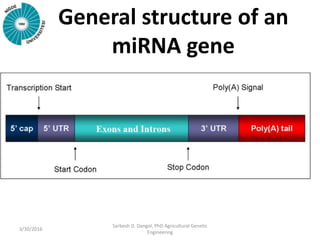
General structure of an
miRNA gene
In Eukaryotes
3/30/2016
Sarbesh D. Dangol, PhD Agricultural Genetic
Engineering
Functions of miRNAs
Control of gene expression by regulating:
• Transcription factors
• Stress response proteins
• Proteins that impact development, growth
and physiology of plants.
3/30/2016
Sarbesh D. Dangol, PhD Agricultural Genetic
Engineering
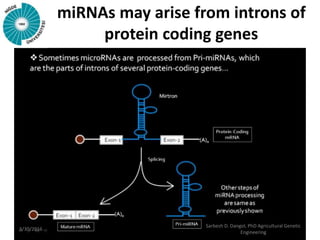
miRNAs may arise from introns of
protein coding genes
3/30/2016
Sarbesh D. Dangol, PhD Agricultural Genetic
Engineering
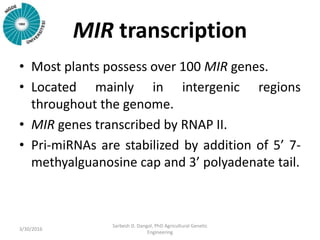
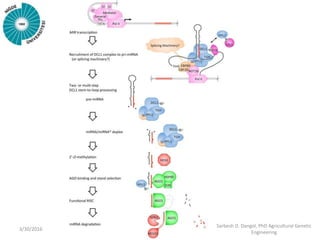
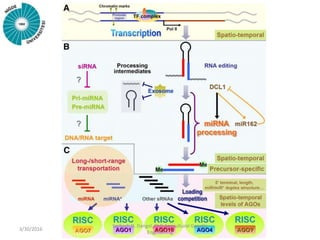
MIR transcription
• Most plants possess over 100 MIR genes.
• Located mainly in intergenic regions
throughout the genome.
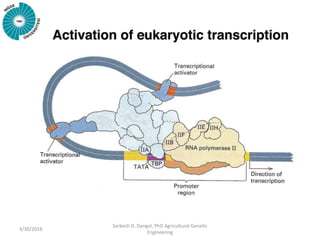
• MIR genes transcribed by RNAP II.
• Pri-miRNAs are stabilized by addition of 5’ 7-
methyalguanosine cap and 3’ polyadenate tail.
3/30/2016
Sarbesh D. Dangol, PhD Agricultural Genetic
Engineering
3/30/2016
Sarbesh D. Dangol, PhD Agricultural Genetic
Engineering
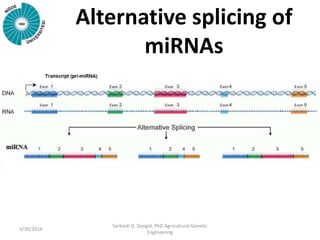
Alternative splicing of
miRNAs
3/30/2016
Sarbesh D. Dangol, PhD Agricultural Genetic
Engineering
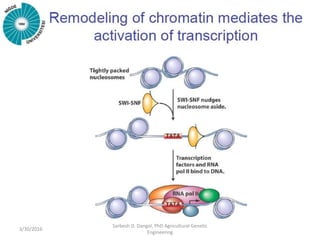
3/30/2016
Sarbesh D. Dangol, PhD Agricultural Genetic
Engineering
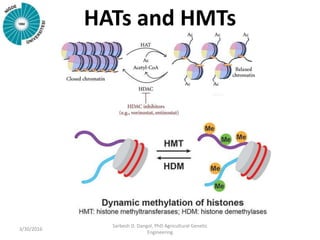
HATs and HMTs
3/30/2016
Sarbesh D. Dangol, PhD Agricultural Genetic
Engineering
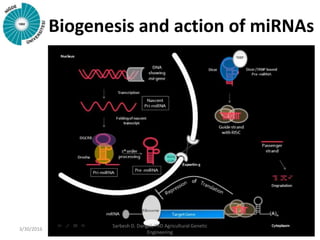
Biogenesis and action of miRNAs
3/30/2016
Sarbesh D. Dangol, PhD Agricultural Genetic
Engineering
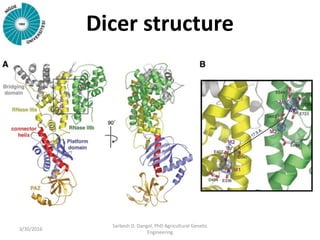
Dicer structure
3/30/2016
Sarbesh D. Dangol, PhD Agricultural Genetic
Engineering
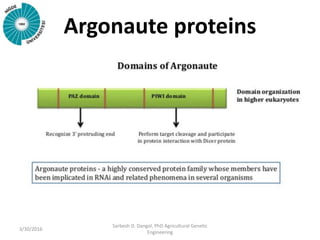
Argonaute proteins
3/30/2016
Sarbesh D. Dangol, PhD Agricultural Genetic
Engineering
Pri-miRNA processing
• pri-miRNA stem loops are processed into
miRNA:miRNA* strands.
• 2-nts 3’ overhangs created by DCL RNase III
endonucleases.
• Initial cleavage near the base of the stem.
• Subsequent cleavages at ~21-nts intervals
along the stem.
3/30/2016
Sarbesh D. Dangol, PhD Agricultural Genetic
Engineering
Sizes of miRNAs and its roles
• Predominately 21-nts.
• But DCL members can generate sRNAs with
distinct sizes:
a) 21-nts for DCL1 and DCL4
b) 22-nts for DCL2
c) 24-nts for DCL3
• Intramolecular spacing between RNaseIII
active site and 3’overhang binding pocket of
PAZ domain determine length.
• 22-nts miRNAs can trigger production of
siRNAs from target mRNAs.3/30/2016
Sarbesh D. Dangol, PhD Agricultural Genetic
Engineering
NOT2b in miRNA regulation
• In Arabidopsis, NOT2b interacts with pol II CTD
for effcient transcription of MIR and protein
coding genes.
• NOT2b interacts with several pri-miRNA
processing factors.
• Acts as a scaffold for assembly of larger
transcription/splicing/processing complexes.
3/30/2016
Sarbesh D. Dangol, PhD Agricultural Genetic
Engineering
3/30/2016
Sarbesh D. Dangol, PhD Agricultural Genetic
Engineering
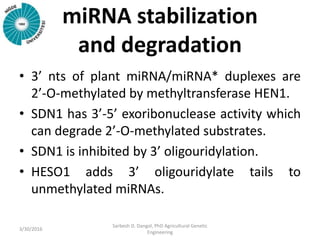
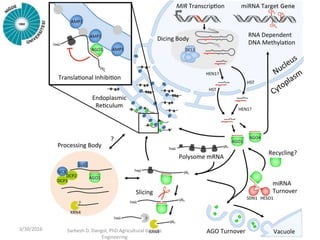
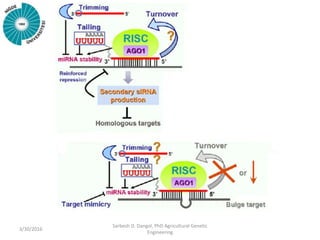
miRNA stabilization
and degradation
• 3’ nts of plant miRNA/miRNA* duplexes are
2’-O-methylated by methyltransferase HEN1.
• SDN1 has 3’-5’ exoribonuclease activity which
can degrade 2’-O-methylated substrates.
• SDN1 is inhibited by 3’ oligouridylation.
• HESO1 adds 3’ oligouridylate tails to
unmethylated miRNAs.
3/30/2016
Sarbesh D. Dangol, PhD Agricultural Genetic
Engineering
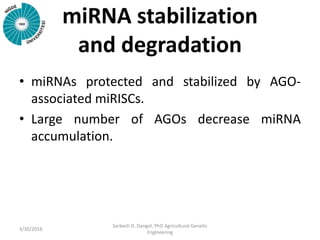
miRNA stabilization
and degradation
• miRNAs protected and stabilized by AGO-
associated miRISCs.
• Large number of AGOs decrease miRNA
accumulation.
3/30/2016
Sarbesh D. Dangol, PhD Agricultural Genetic
Engineering
3/30/2016 Sarbesh D. Dangol, PhD Agricultural Genetic
Engineering
3/30/2016
Sarbesh D. Dangol, PhD Agricultural Genetic
Engineering
3/30/2016
Sarbesh D. Dangol, PhD Agricultural Genetic
Engineering
miRNA expression
• Tissue- or stage-specific manner.
• Induced by external stimuli.
• Highly variable at distinct developmental
stages.
3/30/2016
Sarbesh D. Dangol, PhD Agricultural Genetic
Engineering
Regulation of miRNAs
• siRNA antisense to miRNA precursor able to
deplete generation of mature miRNAs.
• miRNAs* could bind to their complementary sites
on their precursors to exert cleavage.
• Two or more AGOs compete for one miRNA and
other sRNA thrive to incorporate into specific
AGO complex.
• Many targets of endogenous miRNA upregulated
on siRNA transfection (again competition of
siRNA with miRNA).
3/30/2016
Sarbesh D. Dangol, PhD Agricultural Genetic
Engineering
miRNA diffusion
• miRNAs and siRNAs are also implicated in
long-distance transport through phloem
rather than just cell to cell movement.
3/30/2016
Sarbesh D. Dangol, PhD Agricultural Genetic
Engineering
3/30/2016
Sarbesh D. Dangol, PhD Agricultural Genetic
Engineering
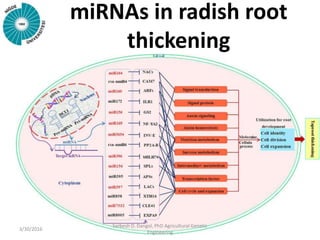
miRNAs in taproot thickening of
radish
• 98 differentially expressed miRNAs identified
in radish taproot (Yu et al., 2015).
• Differentiallly expressed miRNAs might play
crucial regulatory roles during taproot
thickening.
3/30/2016
Sarbesh D. Dangol, PhD Agricultural Genetic
Engineering
miRNAs in radish root
thickening
3/30/2016
Sarbesh D. Dangol, PhD Agricultural Genetic
Engineering
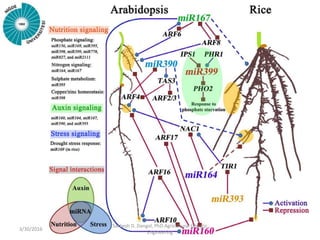
miRNAs in root development
• miR160: root cap formation in Arabidopsis by
targeting ARFs (Auxin Response Factor).
• miR164: Normal lateral root development in
Arabidopsis by targeting NAC1.
• miR167: In adventitious rooting by targeting ARFs.
• miR390: Involved in auxin signaling pathways.
• miR393: In anti-bacterial resistance by repressing
auxin signaling.
• miR398: Cu/Zn homeostasis.
• miR399: In response to phosphate starvation.
• miR169: In response to drought.3/30/2016
Sarbesh D. Dangol, PhD Agricultural Genetic
Engineering
miRNA roles during symbiosis
• Repression of plant defense during symbiosis.
• miRNAs trigger formation of mycorrhized
roots and nitogen-fixing nodules.
• miR160, miR164, miR167 and miR393 were
regulated when inoculated with rhizobia.
• miR166 and miR169 involved in controlling
nodulation.
3/30/2016
Sarbesh D. Dangol, PhD Agricultural Genetic
Engineering
References
1. Yan Z. et al. (2016). Identification and functional characterization of soybean
root hair microRNAs expressed in response to Bradyrhizobium japonicum
infection. Plant Biotechnology Journal. 14: 332–341.
2. Ruang Y. et al. (2015). Transcriptome profiling of root microRNAs reveals
novel insights into taproot thickening in radish (Raphanus sativus L.). BMC
Plant Biol. 15:30.
3. Rogers K. and Chen X. (2013). Biogenesis, turnover, and mode of action of
plant MicroRNAs. The Plant Cell. 25: 2383-2399.
4. Bazin J. et al. (2012). Complexity of miRNA-dependent regulation in root
symbiosis. Phil Trans R Soc B. 367: 1570-1579.
5. Meng Y. et al. (2011). The regulatory activities of Plant MicroRNAs: A More
Dynamic Perspective. Plant Physiology. 157: 1583-1595.
6. Meng Y. et al. (2010). MicroRNA-mediated signaling involved in plant root
development. Biochemical and Biophysical Research Communications. 393:
345-349.
3/30/2016
Sarbesh D. Dangol, PhD Agricultural Genetic
Engineering
Thank you. 
3/30/2016
Sarbesh D. Dangol, PhD Agricultural Genetic
Engineering

Micro RNA in plants and roots

  • 1.
    An introduction tomiRNAs and a brief overview of roles of miRNAs in root development in plants Presented by: Sarbesh D. Dangol (PhD student, Agricultural Genetic Engineering) 3/30/2016 Sarbesh D. Dangol, PhD Agricultural Genetic Engineering
  • 2.
    What is miRNA? •A microRNA (miRNA) is a 21–24 nucleotide (nt) dsRNA. • Small RNA that is the final product of a non- coding RNA gene. • miRNA genes contain introns. • miRNA genes are capped, spliced and polyadenylated. 3/30/2016 Sarbesh D. Dangol, PhD Agricultural Genetic Engineering
  • 3.
    General structure ofan miRNA gene In Eukaryotes 3/30/2016 Sarbesh D. Dangol, PhD Agricultural Genetic Engineering
  • 4.
    Functions of miRNAs Controlof gene expression by regulating: • Transcription factors • Stress response proteins • Proteins that impact development, growth and physiology of plants. 3/30/2016 Sarbesh D. Dangol, PhD Agricultural Genetic Engineering
  • 5.
    miRNAs may arisefrom introns of protein coding genes 3/30/2016 Sarbesh D. Dangol, PhD Agricultural Genetic Engineering
  • 6.
    MIR transcription • Mostplants possess over 100 MIR genes. • Located mainly in intergenic regions throughout the genome. • MIR genes transcribed by RNAP II. • Pri-miRNAs are stabilized by addition of 5’ 7- methyalguanosine cap and 3’ polyadenate tail. 3/30/2016 Sarbesh D. Dangol, PhD Agricultural Genetic Engineering
  • 7.
    3/30/2016 Sarbesh D. Dangol,PhD Agricultural Genetic Engineering
  • 8.
    Alternative splicing of miRNAs 3/30/2016 SarbeshD. Dangol, PhD Agricultural Genetic Engineering
  • 9.
    3/30/2016 Sarbesh D. Dangol,PhD Agricultural Genetic Engineering
  • 10.
    HATs and HMTs 3/30/2016 SarbeshD. Dangol, PhD Agricultural Genetic Engineering
  • 11.
    Biogenesis and actionof miRNAs 3/30/2016 Sarbesh D. Dangol, PhD Agricultural Genetic Engineering
  • 12.
    Dicer structure 3/30/2016 Sarbesh D.Dangol, PhD Agricultural Genetic Engineering
  • 13.
    Argonaute proteins 3/30/2016 Sarbesh D.Dangol, PhD Agricultural Genetic Engineering
  • 14.
    Pri-miRNA processing • pri-miRNAstem loops are processed into miRNA:miRNA* strands. • 2-nts 3’ overhangs created by DCL RNase III endonucleases. • Initial cleavage near the base of the stem. • Subsequent cleavages at ~21-nts intervals along the stem. 3/30/2016 Sarbesh D. Dangol, PhD Agricultural Genetic Engineering
  • 15.
    Sizes of miRNAsand its roles • Predominately 21-nts. • But DCL members can generate sRNAs with distinct sizes: a) 21-nts for DCL1 and DCL4 b) 22-nts for DCL2 c) 24-nts for DCL3 • Intramolecular spacing between RNaseIII active site and 3’overhang binding pocket of PAZ domain determine length. • 22-nts miRNAs can trigger production of siRNAs from target mRNAs.3/30/2016 Sarbesh D. Dangol, PhD Agricultural Genetic Engineering
  • 16.
    NOT2b in miRNAregulation • In Arabidopsis, NOT2b interacts with pol II CTD for effcient transcription of MIR and protein coding genes. • NOT2b interacts with several pri-miRNA processing factors. • Acts as a scaffold for assembly of larger transcription/splicing/processing complexes. 3/30/2016 Sarbesh D. Dangol, PhD Agricultural Genetic Engineering
  • 17.
    3/30/2016 Sarbesh D. Dangol,PhD Agricultural Genetic Engineering
  • 18.
    miRNA stabilization and degradation •3’ nts of plant miRNA/miRNA* duplexes are 2’-O-methylated by methyltransferase HEN1. • SDN1 has 3’-5’ exoribonuclease activity which can degrade 2’-O-methylated substrates. • SDN1 is inhibited by 3’ oligouridylation. • HESO1 adds 3’ oligouridylate tails to unmethylated miRNAs. 3/30/2016 Sarbesh D. Dangol, PhD Agricultural Genetic Engineering
  • 19.
    miRNA stabilization and degradation •miRNAs protected and stabilized by AGO- associated miRISCs. • Large number of AGOs decrease miRNA accumulation. 3/30/2016 Sarbesh D. Dangol, PhD Agricultural Genetic Engineering
  • 20.
    3/30/2016 Sarbesh D.Dangol, PhD Agricultural Genetic Engineering
  • 21.
    3/30/2016 Sarbesh D. Dangol,PhD Agricultural Genetic Engineering
  • 22.
    3/30/2016 Sarbesh D. Dangol,PhD Agricultural Genetic Engineering
  • 23.
    miRNA expression • Tissue-or stage-specific manner. • Induced by external stimuli. • Highly variable at distinct developmental stages. 3/30/2016 Sarbesh D. Dangol, PhD Agricultural Genetic Engineering
  • 24.
    Regulation of miRNAs •siRNA antisense to miRNA precursor able to deplete generation of mature miRNAs. • miRNAs* could bind to their complementary sites on their precursors to exert cleavage. • Two or more AGOs compete for one miRNA and other sRNA thrive to incorporate into specific AGO complex. • Many targets of endogenous miRNA upregulated on siRNA transfection (again competition of siRNA with miRNA). 3/30/2016 Sarbesh D. Dangol, PhD Agricultural Genetic Engineering
  • 25.
    miRNA diffusion • miRNAsand siRNAs are also implicated in long-distance transport through phloem rather than just cell to cell movement. 3/30/2016 Sarbesh D. Dangol, PhD Agricultural Genetic Engineering
  • 26.
    3/30/2016 Sarbesh D. Dangol,PhD Agricultural Genetic Engineering
  • 27.
    miRNAs in taprootthickening of radish • 98 differentially expressed miRNAs identified in radish taproot (Yu et al., 2015). • Differentiallly expressed miRNAs might play crucial regulatory roles during taproot thickening. 3/30/2016 Sarbesh D. Dangol, PhD Agricultural Genetic Engineering
  • 28.
    miRNAs in radishroot thickening 3/30/2016 Sarbesh D. Dangol, PhD Agricultural Genetic Engineering
  • 29.
    miRNAs in rootdevelopment • miR160: root cap formation in Arabidopsis by targeting ARFs (Auxin Response Factor). • miR164: Normal lateral root development in Arabidopsis by targeting NAC1. • miR167: In adventitious rooting by targeting ARFs. • miR390: Involved in auxin signaling pathways. • miR393: In anti-bacterial resistance by repressing auxin signaling. • miR398: Cu/Zn homeostasis. • miR399: In response to phosphate starvation. • miR169: In response to drought.3/30/2016 Sarbesh D. Dangol, PhD Agricultural Genetic Engineering
  • 30.
    miRNA roles duringsymbiosis • Repression of plant defense during symbiosis. • miRNAs trigger formation of mycorrhized roots and nitogen-fixing nodules. • miR160, miR164, miR167 and miR393 were regulated when inoculated with rhizobia. • miR166 and miR169 involved in controlling nodulation. 3/30/2016 Sarbesh D. Dangol, PhD Agricultural Genetic Engineering
  • 31.
    References 1. Yan Z.et al. (2016). Identification and functional characterization of soybean root hair microRNAs expressed in response to Bradyrhizobium japonicum infection. Plant Biotechnology Journal. 14: 332–341. 2. Ruang Y. et al. (2015). Transcriptome profiling of root microRNAs reveals novel insights into taproot thickening in radish (Raphanus sativus L.). BMC Plant Biol. 15:30. 3. Rogers K. and Chen X. (2013). Biogenesis, turnover, and mode of action of plant MicroRNAs. The Plant Cell. 25: 2383-2399. 4. Bazin J. et al. (2012). Complexity of miRNA-dependent regulation in root symbiosis. Phil Trans R Soc B. 367: 1570-1579. 5. Meng Y. et al. (2011). The regulatory activities of Plant MicroRNAs: A More Dynamic Perspective. Plant Physiology. 157: 1583-1595. 6. Meng Y. et al. (2010). MicroRNA-mediated signaling involved in plant root development. Biochemical and Biophysical Research Communications. 393: 345-349. 3/30/2016 Sarbesh D. Dangol, PhD Agricultural Genetic Engineering
  • 32.
    Thank you.  3/30/2016 SarbeshD. Dangol, PhD Agricultural Genetic Engineering