Regulatory impact
assessment using socio-
economic analysis
Tomas Öberg
Chairman of the Committee
for Socio-Economic Analysis
European Chemicals Agency
EFSA second scientific conference,
Milan, 14-16 October, 2015.
2
Impact assessment
 Regulatory impact analysis since
1980s (EC impact assessment
system 2003)
 Socio-economic analysis (SEA) is
a tool to assess impacts:
 What are the benefits of a
regulatory action?
 What are the corresponding
costs?
 How do benefits and costs
compare?
3
REACH*
* Regulation (EC) No 1907/2006 of the European Parliament and of the
Council of 18 December 2006 concerning the Registration, Evaluation,
Authorisation and Restriction of Chemicals (REACH)
 REACH = Regulatory framework for
the safe management of chemicals
 Objectives of REACH:
 Protect human health and the
environment
 Promote alternatives to animal testing
 Ensure functioning of the internal
market
 Enhance competitiveness and
innovation
4
Two REACH processes where socio-
economic analysis is instrumental
 Authorisation
 after a given date uses of a
substance are banned unless
specifically authorised
 Restriction
 full ban of a substance or
 ban of specified uses and/or
 condition on the specified uses
5
Basis for regulatory decisions
 Decision to restrict/authorise the
use of substances shall consider:
 Whether risk to human health and/or
environment is adequately controlled
 Appropriateness of the proposal to
reduce/control the risk
 Socio-economic impact of the
proposed restriction/authorisation and
availability of alternatives
 In authorisations: a driver for
substitution of SVHC
6
Socio-economic analysis (SEA) – I.
 Principles of SEA:
 input for regulatory decision making
 always case-specific
 relates to the risk assessment
 Actors (in REACH):
 Dossier submitters and applicants
prepare the SEA
 The Committee for Socio-economic
Analysis (SEAC) reviews the SEA
 Where does SEA feed in?
 Restriction proposals
 Applications for authorisation
7
Socio-economic analysis (SEA) – II.
 Aims and scope:
 Compare different impacts
qualitatively or quantitatively (in
money terms)
 Compare distribution of impacts
 Conduct uncertainty analysis
 Types of impact:
 Human health and environmental
impacts
 Economic impacts
 Social impacts
 Trade, competition and economic
development impacts
8
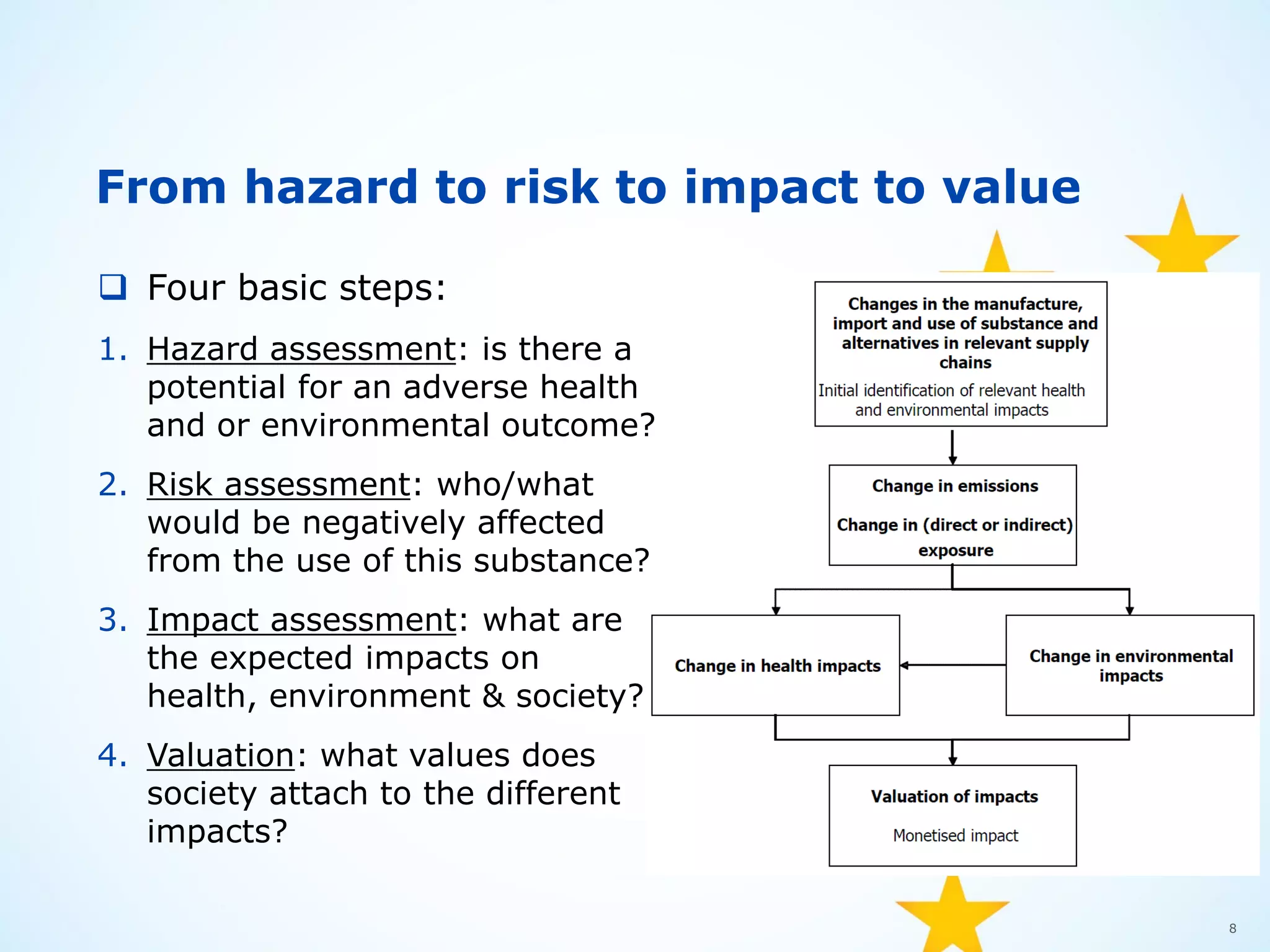
From hazard to risk to impact to value
 Four basic steps:
1. Hazard assessment: is there a
potential for an adverse health
and or environmental outcome?
2. Risk assessment: who/what
would be negatively affected
from the use of this substance?
3. Impact assessment: what are
the expected impacts on
health, environment & society?
4. Valuation: what values does
society attach to the different
impacts?
9
Comparison with EFSA’s risk-benefit
assessment paradigm
HOW?!
10
Key difference: valuing impacts
 SEA under REACH seeks to value
impacts whenever possible
 Tangible impacts monetised
based on market prices
 Intangible impacts monetised
based on the concept of WTP:
how much is society willing to
spend on reducing/avoiding a
specific impact?
 Impacts that occur in the future
are discounted to reflect
preferences of both current and
future generations
11
Using money as common denominator
 Pro’s:
 yields common denominator for
balancing different impacts
 facilitates transparency: figures can
be challenged
 helps spotting inequity in the
distribution of risk
 Con’s:
 adds another layer of uncertainty
 might trigger resistance based on
moral grounds
 reduces “flexibility” for the
policymaker
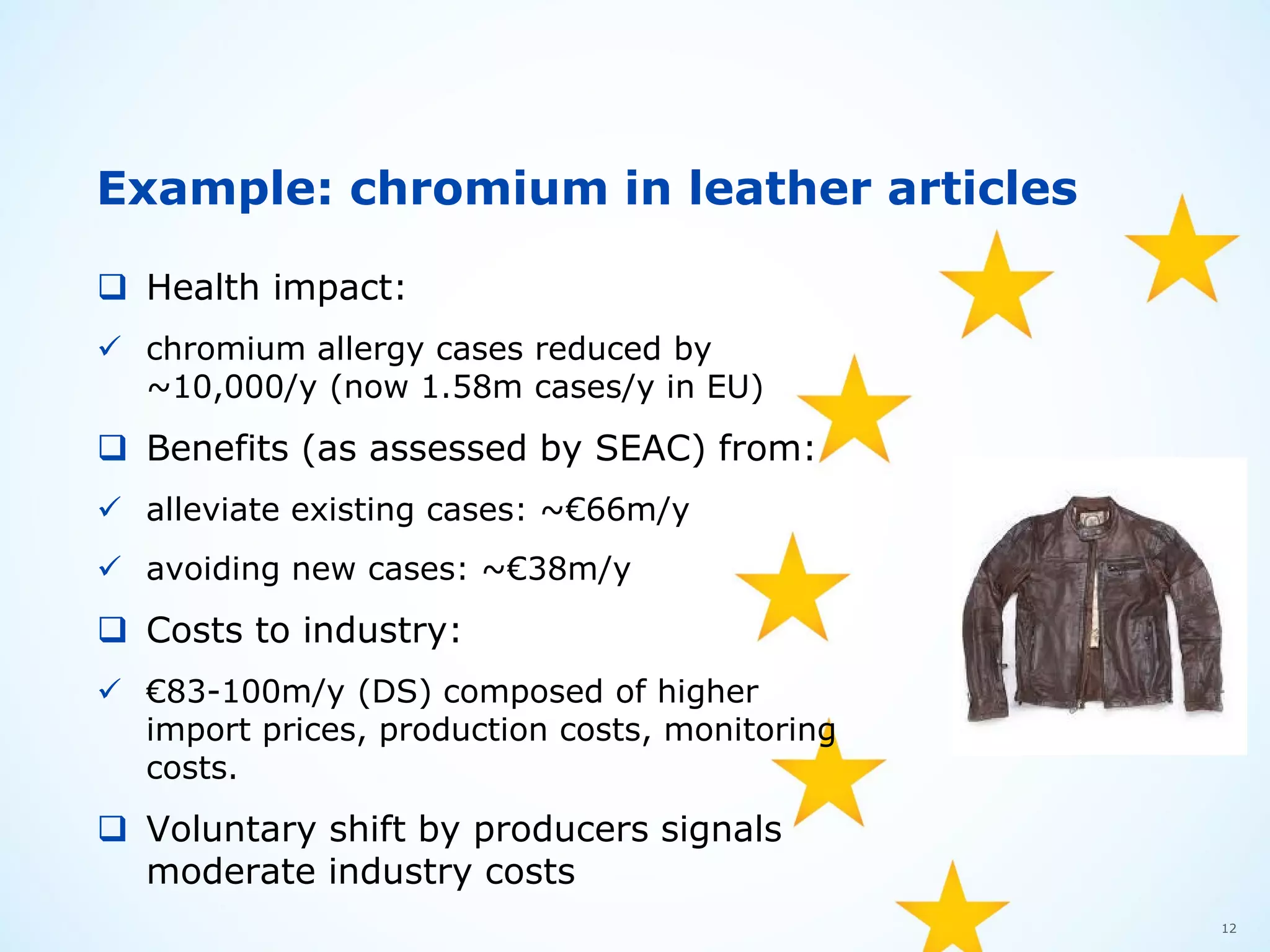
Example: chromium in leather articles
 Health impact:
 chromium allergy cases reduced by
~10,000/y (now 1.58m cases/y in EU)
 Benefits (as assessed by SEAC) from:
 alleviate existing cases: ~€66m/y
 avoiding new cases: ~€38m/y
 Costs to industry:
 €83-100m/y (DS) composed of higher
import prices, production costs, monitoring
costs.
 Voluntary shift by producers signals
moderate industry costs
12
Example: lead and its compounds – I.
 Targeting at lead-containing consumer
products that children could place in
their mouth
 Restriction considered most appropriate
EU-wide measure conditional on:
 Concentration of lead > 0.05% of weight
 Derogation on crystal glass, (semi-)
precious stones, enamels, keys & locks,…
 Transition period.
13
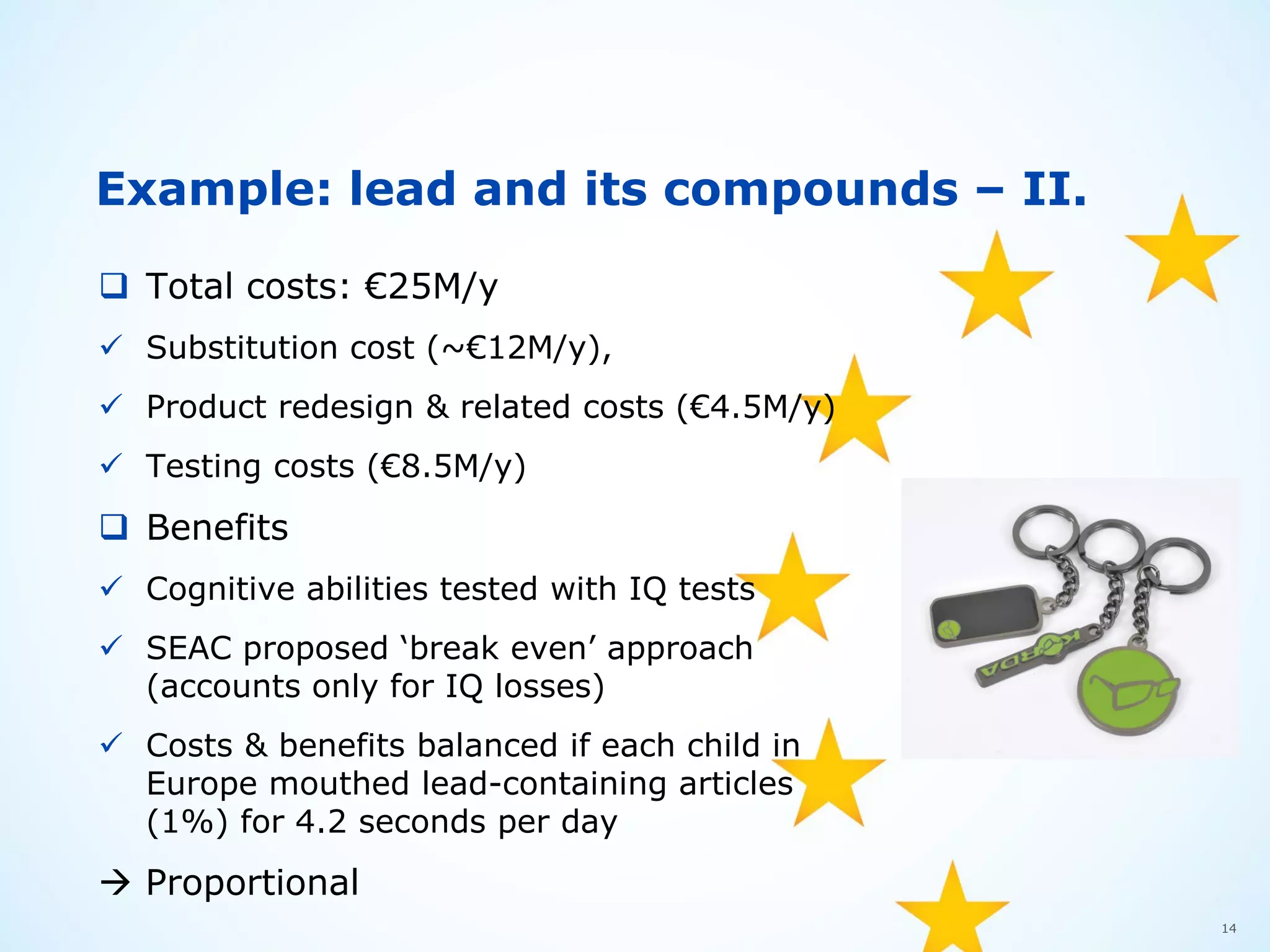
Example: lead and its compounds – II.
 Total costs: €25M/y
 Substitution cost (~€12M/y),
 Product redesign & related costs (€4.5M/y)
 Testing costs (€8.5M/y)
 Benefits
 Cognitive abilities tested with IQ tests
 SEAC proposed ‘break even’ approach
(accounts only for IQ losses)
 Costs & benefits balanced if each child in
Europe mouthed lead-containing articles
(1%) for 4.2 seconds per day
 Proportional
14
15
Example: authorisation cases
 Industry has burden of proof
Direct costs of non-use generally known
Indirect costs to society (unemployment,
price increases,…) much less known
Costs of alternative(s) sometimes known
 Difficult cases:
benefits of authorisation outweigh the
monetised health impacts,
but also involve large health risks
 Might lead to:
additional risk management measures and
monitoring requirements
authorisation with a short review period
Specific considerations
 Industry usually have relevant
information about costs and feasibility
of alternatives
 Asymmetric information: when
preparing (assessing) restriction
dossiers MS/ECHA rely on industry
information
 Benefits generally difficult to quantify
due to externalities and public good
characteristics
 Acceptability of discounting is often an
issue
 Risks of alternatives are less well-
known
16
17
General conclusions
 Knowing the risk is not enough
 Potential harms need to be
quantified AND
 …compared to all the benefits
society gets from using the
substance
 Balancing regulatory impacts
requires that they be measured in
one common unit
 Money lends itself as that unit,
but other metrics are conceivable
as well…
18
Outlook
 Socio-economic analysis is
challenging.
 There is room for improvement:
SEA methodology to be refined
in close collaboration with the
scientific community.
 But overall, SEA under REACH
works and gives a balanced
view on the various impacts of
regulatory actions.
 Would other regulatory areas in
the EU also benefit from a
scientific view on the impacts?
Thank you
Tomas Öberg
Tomas.OBERG@echa.europa.eu
The author is Chairman of the Committee for Socio-
economic Analysis at the European Chemicals
Agency. The views expressed are solely his own
and do not represent a position of the Agency.
Acknowledgement
I like to thank my colleagues Christoph Rheinberger
and Jukka Peltola for help in preparing the slides,
and Matti Vainio for borrowing some of his .

Regulatory impact assessment using socio-economic analysis

  • 1.
    Regulatory impact assessment usingsocio- economic analysis Tomas Öberg Chairman of the Committee for Socio-Economic Analysis European Chemicals Agency EFSA second scientific conference, Milan, 14-16 October, 2015.
  • 2.
    2 Impact assessment  Regulatoryimpact analysis since 1980s (EC impact assessment system 2003)  Socio-economic analysis (SEA) is a tool to assess impacts:  What are the benefits of a regulatory action?  What are the corresponding costs?  How do benefits and costs compare?
  • 3.
    3 REACH* * Regulation (EC)No 1907/2006 of the European Parliament and of the Council of 18 December 2006 concerning the Registration, Evaluation, Authorisation and Restriction of Chemicals (REACH)  REACH = Regulatory framework for the safe management of chemicals  Objectives of REACH:  Protect human health and the environment  Promote alternatives to animal testing  Ensure functioning of the internal market  Enhance competitiveness and innovation
  • 4.
    4 Two REACH processeswhere socio- economic analysis is instrumental  Authorisation  after a given date uses of a substance are banned unless specifically authorised  Restriction  full ban of a substance or  ban of specified uses and/or  condition on the specified uses
  • 5.
    5 Basis for regulatorydecisions  Decision to restrict/authorise the use of substances shall consider:  Whether risk to human health and/or environment is adequately controlled  Appropriateness of the proposal to reduce/control the risk  Socio-economic impact of the proposed restriction/authorisation and availability of alternatives  In authorisations: a driver for substitution of SVHC
  • 6.
    6 Socio-economic analysis (SEA)– I.  Principles of SEA:  input for regulatory decision making  always case-specific  relates to the risk assessment  Actors (in REACH):  Dossier submitters and applicants prepare the SEA  The Committee for Socio-economic Analysis (SEAC) reviews the SEA  Where does SEA feed in?  Restriction proposals  Applications for authorisation
  • 7.
    7 Socio-economic analysis (SEA)– II.  Aims and scope:  Compare different impacts qualitatively or quantitatively (in money terms)  Compare distribution of impacts  Conduct uncertainty analysis  Types of impact:  Human health and environmental impacts  Economic impacts  Social impacts  Trade, competition and economic development impacts
  • 8.
    8 From hazard torisk to impact to value  Four basic steps: 1. Hazard assessment: is there a potential for an adverse health and or environmental outcome? 2. Risk assessment: who/what would be negatively affected from the use of this substance? 3. Impact assessment: what are the expected impacts on health, environment & society? 4. Valuation: what values does society attach to the different impacts?
  • 9.
    9 Comparison with EFSA’srisk-benefit assessment paradigm HOW?!
  • 10.
    10 Key difference: valuingimpacts  SEA under REACH seeks to value impacts whenever possible  Tangible impacts monetised based on market prices  Intangible impacts monetised based on the concept of WTP: how much is society willing to spend on reducing/avoiding a specific impact?  Impacts that occur in the future are discounted to reflect preferences of both current and future generations
  • 11.
    11 Using money ascommon denominator  Pro’s:  yields common denominator for balancing different impacts  facilitates transparency: figures can be challenged  helps spotting inequity in the distribution of risk  Con’s:  adds another layer of uncertainty  might trigger resistance based on moral grounds  reduces “flexibility” for the policymaker
  • 12.
    Example: chromium inleather articles  Health impact:  chromium allergy cases reduced by ~10,000/y (now 1.58m cases/y in EU)  Benefits (as assessed by SEAC) from:  alleviate existing cases: ~€66m/y  avoiding new cases: ~€38m/y  Costs to industry:  €83-100m/y (DS) composed of higher import prices, production costs, monitoring costs.  Voluntary shift by producers signals moderate industry costs 12
  • 13.
    Example: lead andits compounds – I.  Targeting at lead-containing consumer products that children could place in their mouth  Restriction considered most appropriate EU-wide measure conditional on:  Concentration of lead > 0.05% of weight  Derogation on crystal glass, (semi-) precious stones, enamels, keys & locks,…  Transition period. 13
  • 14.
    Example: lead andits compounds – II.  Total costs: €25M/y  Substitution cost (~€12M/y),  Product redesign & related costs (€4.5M/y)  Testing costs (€8.5M/y)  Benefits  Cognitive abilities tested with IQ tests  SEAC proposed ‘break even’ approach (accounts only for IQ losses)  Costs & benefits balanced if each child in Europe mouthed lead-containing articles (1%) for 4.2 seconds per day  Proportional 14
  • 15.
    15 Example: authorisation cases Industry has burden of proof Direct costs of non-use generally known Indirect costs to society (unemployment, price increases,…) much less known Costs of alternative(s) sometimes known  Difficult cases: benefits of authorisation outweigh the monetised health impacts, but also involve large health risks  Might lead to: additional risk management measures and monitoring requirements authorisation with a short review period
  • 16.
    Specific considerations  Industryusually have relevant information about costs and feasibility of alternatives  Asymmetric information: when preparing (assessing) restriction dossiers MS/ECHA rely on industry information  Benefits generally difficult to quantify due to externalities and public good characteristics  Acceptability of discounting is often an issue  Risks of alternatives are less well- known 16
  • 17.
    17 General conclusions  Knowingthe risk is not enough  Potential harms need to be quantified AND  …compared to all the benefits society gets from using the substance  Balancing regulatory impacts requires that they be measured in one common unit  Money lends itself as that unit, but other metrics are conceivable as well…
  • 18.
    18 Outlook  Socio-economic analysisis challenging.  There is room for improvement: SEA methodology to be refined in close collaboration with the scientific community.  But overall, SEA under REACH works and gives a balanced view on the various impacts of regulatory actions.  Would other regulatory areas in the EU also benefit from a scientific view on the impacts?
  • 19.
    Thank you Tomas Öberg Tomas.OBERG@echa.europa.eu Theauthor is Chairman of the Committee for Socio- economic Analysis at the European Chemicals Agency. The views expressed are solely his own and do not represent a position of the Agency. Acknowledgement I like to thank my colleagues Christoph Rheinberger and Jukka Peltola for help in preparing the slides, and Matti Vainio for borrowing some of his .