Download as PDF, PPTX


![ERA ≠ ECOLOGICAL RESEARCH
Both address problems and test hypotheses
BUT
Different problem selection
Different types of hypotheses
Different testing of hypotheses
Confusion ineffective ERA & inadequate research
[Raybould 2008, 2010]
≠](https://image.slidesharecdn.com/1512224smith-161013121224/85/ERA-vs-ecological-research-4-320.jpg)
![ERA ≠ ECOLOGICAL RESEARCH
Research
• Problem - objective
(from analysis of prior problems)
• Hypotheses - interesting
(make precise predictions)
• Testing - aims to falsify
hypothesis
(corroborated by presence of
phenomena in field studies)
ERA
• Problem - subjective
(from definitions of harm)
• Hypotheses - useful
(predict no harm)
• Testing - aims to falsify
hypothesis
(corroborated by absence of
phenomena in lab studies)
[Raybould 2008, 2010]
Essential to have clearly defined problem so that risk assessors can
conclude with some certainty that particular harms will not eventuate](https://image.slidesharecdn.com/1512224smith-161013121224/85/ERA-vs-ecological-research-5-320.jpg)
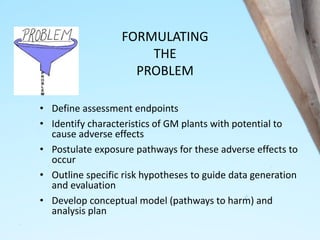
![PROBLEM FORMULATION
WHAT IS IT?
‘…the first step in ERA where policy goals, scope,
assessment endpoints, and methodology are distilled
to an explicitly stated problem and approach for
analysis’
• Improved consistency and focus of ERAs
• Enhances relevance and utility for regulatory
decision-making
[Wolt et al, 2010]](https://image.slidesharecdn.com/1512224smith-161013121224/85/ERA-vs-ecological-research-6-320.jpg)

![RISK ANALYSIS PROCESS
INCORPORATING PROBLEM FORMULATION
[Wolt et al, 2010]](https://image.slidesharecdn.com/1512224smith-161013121224/85/ERA-vs-ecological-research-9-320.jpg)

![• Canola parent (B napus) – exotic, annual/biennial, natural toxicants,
weed in agricultural but not undisturbed habitats
• Activities – as for commercial non-GM canola; widespread cultivation
for oil, meal production
• Traits - herbicide tolerance
increased competitiveness in presence of herbicides
• Receiving environment – biotic and abiotic factors,
agricultural practices, related plants, related proteins
• Previous releases – field trials, commercial, overseas
CONTEXT FOR HT CANOLA
[Commercial release]
Source: OGTR](https://image.slidesharecdn.com/1512224smith-161013121224/85/ERA-vs-ecological-research-11-320.jpg)


This document discusses the importance of problem formulation in ecological risk assessment (ERA) for genetically modified (GM) crops. It notes that ERA and ecological research have different goals, with ERA aiming to predict no harm rather than make discoveries. Proper problem formulation in ERA involves considering legislation, the risk analysis process, risk context, and protection goals to identify only credible risks. This ensures the ERA focuses on relevant data and regulatory decisions can be made with certainty. The document provides examples of risk scenarios and contextual factors to consider in ERA for GM cotton and canola. It stresses the importance of data quality, sufficiency and relevance for credible ERA conclusions.


