Does REACH authorisation work?
Helsinki Chemicals Forum
Matti Vainio, Ph.D. (Econ)
Head of Risk Management Unit
European Chemicals Agency
23 May 2019
2
Risks reduced
• 1/3 of companies improved risk management measures
• SVHC uses have become significantly safer
System costs ~€25m/year (for 50 applications/yr)
~1/3 on applications, 1/3 on risk control and 1/3 on decision making
Source: REACH Review of the Commission (2017)
How effective is authorisation to improve the handling of
SVHCs?
3
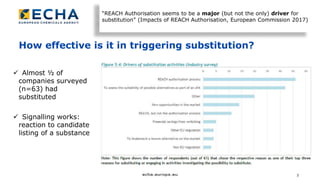
How effective is it in triggering substitution?
 Almost ½ of
companies surveyed
(n=63) had
substituted
 Signalling works:
reaction to candidate
listing of a substance
“REACH Authorisation seems to be a major (but not the only) driver for
substitution” (Impacts of REACH Authorisation, European Commission 2017)
4
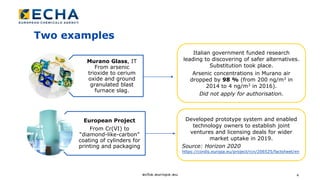
Two examples
Murano Glass, IT
From arsenic
trioxide to cerium
oxide and ground
granulated blast
furnace slag.
European Project
From Cr(VI) to
“diamond-like-carbon”
coating of cylinders for
printing and packaging
Italian government funded research
leading to discovering of safer alternatives.
Substitution took place.
Arsenic concentrations in Murano air
dropped by 98 % (from 200 ng/m3 in
2014 to 4 ng/m3 in 2016).
Did not apply for authorisation.
Developed prototype system and enabled
technology owners to establish joint
ventures and licensing deals for wider
market uptake in 2019.
Source: Horizon 2020
https://cordis.europa.eu/project/rcn/206525/factsheet/en
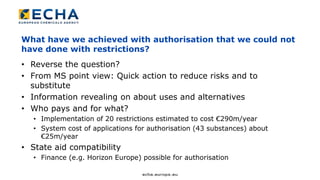
What have we achieved with authorisation that we could not
have done with restrictions?
• Reverse the question?
• From MS point view: Quick action to reduce risks and to
substitute
• Information revealing on about uses and alternatives
• Who pays and for what?
• Implementation of 20 restrictions estimated to cost €290m/year
• System cost of applications for authorisation (43 substances) about
€25m/year
• State aid compatibility
• Finance (e.g. Horizon Europe) possible for authorisation
6
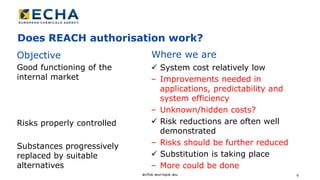
Does REACH authorisation work?
Good functioning of the
internal market
Risks properly controlled
Substances progressively
replaced by suitable
alternatives
 System cost relatively low
– Improvements needed in
applications, predictability and
system efficiency
– Unknown/hidden costs?
 Risk reductions are often well
demonstrated
– Risks should be further reduced
 Substitution is taking place
‒ More could be done
Where we areObjective
7
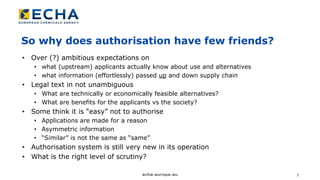
So why does authorisation have few friends?
• Over (?) ambitious expectations on
• what (upstream) applicants actually know about use and alternatives
• what information (effortlessly) passed up and down supply chain
• Legal text in not unambiguous
• What are technically or economically feasible alternatives?
• What are benefits for the applicants vs the society?
• Some think it is “easy” not to authorise
• Applications are made for a reason
• Asymmetric information
• “Similar” is not the same as “same”
• Authorisation system is still very new in its operation
• What is the right level of scrutiny?
Thank you!
Subscribe to our news at
echa.europa.eu/subscribe
Follow us on Twitter
@EU_ECHA
Follow us on Facebook
Facebook.com/EUECHA
matti.vainio@echa.europa.eu

HCF 2019 Panel 1: Matti Vainio

  • 1.
    Does REACH authorisationwork? Helsinki Chemicals Forum Matti Vainio, Ph.D. (Econ) Head of Risk Management Unit European Chemicals Agency 23 May 2019
  • 2.
    2 Risks reduced • 1/3of companies improved risk management measures • SVHC uses have become significantly safer System costs ~€25m/year (for 50 applications/yr) ~1/3 on applications, 1/3 on risk control and 1/3 on decision making Source: REACH Review of the Commission (2017) How effective is authorisation to improve the handling of SVHCs?
  • 3.
    3 How effective isit in triggering substitution?  Almost ½ of companies surveyed (n=63) had substituted  Signalling works: reaction to candidate listing of a substance “REACH Authorisation seems to be a major (but not the only) driver for substitution” (Impacts of REACH Authorisation, European Commission 2017)
  • 4.
    4 Two examples Murano Glass,IT From arsenic trioxide to cerium oxide and ground granulated blast furnace slag. European Project From Cr(VI) to “diamond-like-carbon” coating of cylinders for printing and packaging Italian government funded research leading to discovering of safer alternatives. Substitution took place. Arsenic concentrations in Murano air dropped by 98 % (from 200 ng/m3 in 2014 to 4 ng/m3 in 2016). Did not apply for authorisation. Developed prototype system and enabled technology owners to establish joint ventures and licensing deals for wider market uptake in 2019. Source: Horizon 2020 https://cordis.europa.eu/project/rcn/206525/factsheet/en
  • 5.
    What have weachieved with authorisation that we could not have done with restrictions? • Reverse the question? • From MS point view: Quick action to reduce risks and to substitute • Information revealing on about uses and alternatives • Who pays and for what? • Implementation of 20 restrictions estimated to cost €290m/year • System cost of applications for authorisation (43 substances) about €25m/year • State aid compatibility • Finance (e.g. Horizon Europe) possible for authorisation
  • 6.
    6 Does REACH authorisationwork? Good functioning of the internal market Risks properly controlled Substances progressively replaced by suitable alternatives  System cost relatively low – Improvements needed in applications, predictability and system efficiency – Unknown/hidden costs?  Risk reductions are often well demonstrated – Risks should be further reduced  Substitution is taking place ‒ More could be done Where we areObjective
  • 7.
    7 So why doesauthorisation have few friends? • Over (?) ambitious expectations on • what (upstream) applicants actually know about use and alternatives • what information (effortlessly) passed up and down supply chain • Legal text in not unambiguous • What are technically or economically feasible alternatives? • What are benefits for the applicants vs the society? • Some think it is “easy” not to authorise • Applications are made for a reason • Asymmetric information • “Similar” is not the same as “same” • Authorisation system is still very new in its operation • What is the right level of scrutiny?
  • 8.
    Thank you! Subscribe toour news at echa.europa.eu/subscribe Follow us on Twitter @EU_ECHA Follow us on Facebook Facebook.com/EUECHA matti.vainio@echa.europa.eu