Preparing for
probation
assessment

Regine Hampel
Director for Postgraduate Studies
Centre for Research in Education and Educational
Technology

Developing as a Researcher, 19–20 March 2013
Your expectations
Activity:
Note down three things that you expect to get out of
this session on a post-it note.
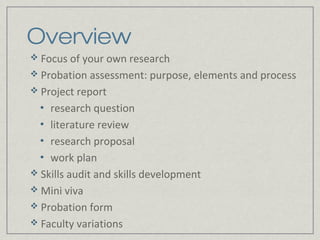
Overview
 Focus of your own research
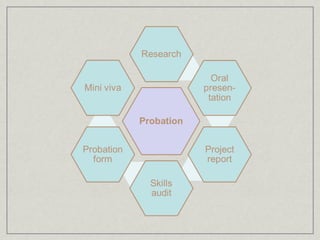
 Probation assessment: purpose, elements and process
 Project report
  • research question
  • literature review
  • research proposal
  • work plan
 Skills audit and skills development
 Mini viva
 Probation form
 Faculty variations
Elevator pitch
Activity: Explain yourself and your
research to a potential funder
who knows nothing about your
research. Try to get the main
points across clearly and
succinctly.

5 minutes: preparation time
2 minutes (each): pair work with partner 1
2 minutes (each): pair work with partner 2
Purpose of probation
assessment
 To confirm that you have made satisfactory
  progress and to make a recommendation
  regarding the upgrade to a PhD degree
 To get feedback from two independent assessors
  on research done as well as planned
 To assess your research skills
 Important step on the way to the PhD
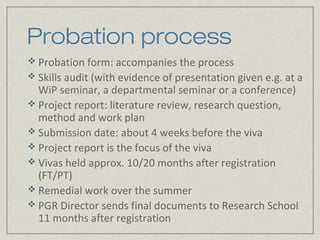
Probation process
 Probation form: accompanies the process
 Skills audit (with evidence of presentation given e.g. at a
  WiP seminar, a departmental seminar or a conference)
 Project report: literature review, research question,
  method and work plan
 Submission date: about 4 weeks before the viva
 Project report is the focus of the viva
 Vivas held approx. 10/20 months after registration
  (FT/PT)
 Remedial work over the summer
 PGR Director sends final documents to Research School
  11 months after registration
Project report
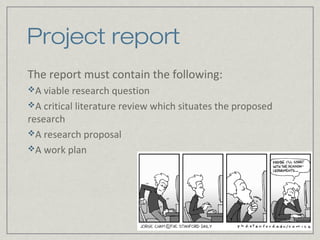
The report must contain the following:
A viable research question
A critical literature review which situates the proposed
research
A research proposal
A work plan
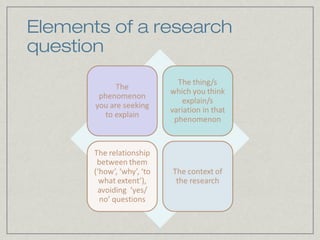
Elements of a research
question
An example research
question
“How do the personal narratives and stories of career
development processes amongst South African
distance learners vary and to what extent are elements
of previous disadvantage the source of that
difference?”

Activity (5 minutes): Discuss the following questions
with your partner
What is the phenomenon this thesis is trying to explain?
What may cause the variation in that phenomenon?
What is the relationship between them (‘how’, ‘why’, ‘to
what extent’)?
What is the context of the research?
Your research question
Activity (10 minutes):
Write down your (main) research question(s) on a
post-it note. Explain it/them to the other students in
your group, focusing on the following:
Why is this question relevant?
How does it relate to the literature?
How does it inform your methodology and your methods?
Small group activity:
feedback
 Were there any general observations/questions/
  issues that arose in your group?
 What is the link between the research question, the
  literature review and the methodology?
Literature review

“A critical literature review which situates the
proposed research” (Probation form)

Activity (5-10 minutes): Turn to your partner and
discuss how you would evaluate a literature review.
Make a note of some possible criteria.
Literature review:
criteria
 Does it take a critical stance in terms of
  methodology, validity, conceptual framework?
 What does it cover, i.e. where are the boundaries –
  inclusions/exclusions?
 Does it show developments over time?
 Is there a sustained analytical argument?
 What is the significance of the research problem?
 What about the accuracy (including the
  bibliography)?
Literature review
“A literature review offers an overview of the relevant and
significant literature on a research area. It reviews the critical points
of current knowledge on a particular topic – i.e. a survey of articles,
books, conference papers, theses etc. It […] should include a
description, summary and critical evaluation of the materials
presented. A literature review is not a list describing or summarising
one piece of literature after another.
The purpose of a literature review is: to demonstrate your ability to
identify the relevant information and outline existing knowledge;
identify the ‘gap’ in the research that your work will address;
produce a rationale or justification for your study.
Remember: There is no one single correct method to writing a
literature review.” (UCD Library)
Research proposal

“A research proposal, including an outline of
proposed method(s), a critical justification for them,
and where appropriate, preliminary data and
analysis” (Probation form)

Group (and plenary) discussion: Which methods are
you going to use and why?
Work plan

“A work plan for the project with a detailed timetable
of dates for completion of component parts and
thesis submission” (Probation form)
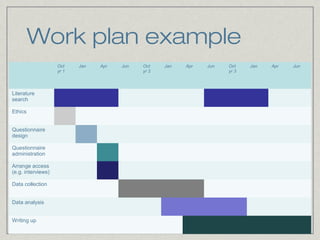
Work plan example
                    Oct    Jan   Apr   Jun   Oct    Jan   Apr   Jun   Oct    Jan   Apr   Jun
                    yr 1                     yr 2                     yr 3


Literature
search

Ethics


Questionnaire
design

Questionnaire
administration

Arrange access
(e.g. interviews)

Data collection


Data analysis


Writing up
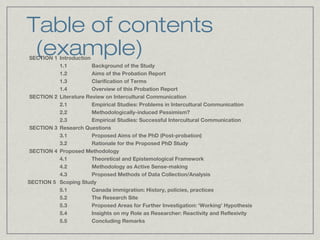
Table of contents
 (example)
 SECTION 1 Introduction
           1.1          Background of the Study
           1.2          Aims of the Probation Report
           1.3          Clarification of Terms
           1.4          Overview of this Probation Report
 SECTION 2 Literature Review on Intercultural Communication
           2.1          Empirical Studies: Problems in Intercultural Communication
           2.2          Methodologically-induced Pessimism?
           2.3          Empirical Studies: Successful Intercultural Communication
 SECTION 3 Research Questions
           3.1          Proposed Aims of the PhD (Post-probation)
           3.2          Rationale for the Proposed PhD Study
 SECTION 4 Proposed Methodology
           4.1          Theoretical and Epistemological Framework
           4.2          Methodology as Active Sense-making
           4.3          Proposed Methods of Data Collection/Analysis
SECTION 5 Scoping Study
           5.1          Canada immigration: History, policies, practices
           5.2          The Research Site
           5.3          Proposed Areas for Further Investigation: ‘Working’ Hypothesis
           5.4          Insights on my Role as Researcher: Reactivity and Reflexivity
           5.5          Concluding Remarks
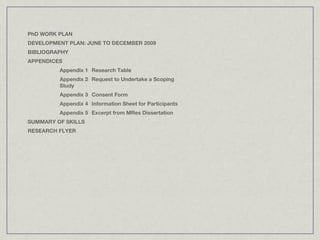
PhD WORK PLAN
DEVELOPMENT PLAN: JUNE TO DECEMBER 2009
BIBLIOGRAPHY
APPENDICES
         Appendix 1 Research Table
         Appendix 2 Request to Undertake a Scoping
         Study
         Appendix 3 Consent Form
         Appendix 4 Information Sheet for Participants
         Appendix 5 Excerpt from MRes Dissertation
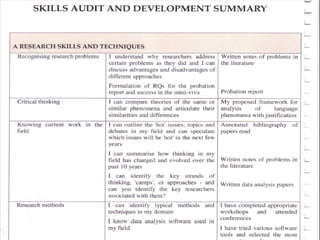
SUMMARY OF SKILLS
RESEARCH FLYER
 
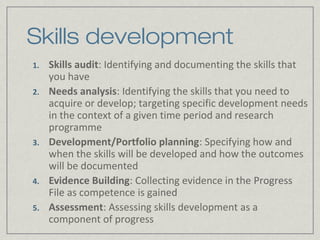
Skills development
1.   Skills audit: Identifying and documenting the skills that
     you have
2.   Needs analysis: Identifying the skills that you need to
     acquire or develop; targeting specific development needs
     in the context of a given time period and research
     programme
3.   Development/Portfolio planning: Specifying how and
     when the skills will be developed and how the outcomes
     will be documented
4.   Evidence Building: Collecting evidence in the Progress
     File as competence is gained
5.   Assessment: Assessing skills development as a
     component of progress
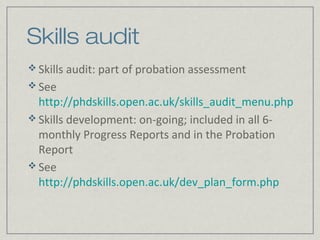
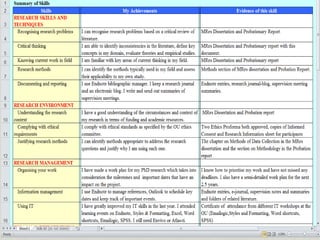
Skills audit
 Skills audit: part of probation assessment
 See
  http://phdskills.open.ac.uk/skills_audit_menu.php
 Skills development: on-going; included in all 6-
  monthly Progress Reports and in the Probation
  Report
 See
  http://phdskills.open.ac.uk/dev_plan_form.php
Skills audit
Skills audit
Mini-viva
 Centres on the probation report
 Panel:
 •   2 independent internal assessors
 •   Supervisor as observer
 •   Panel chair (usually PGR Director)
 10-minute presentation
 30-minute discussion
 Feedback by the assessors
 Can also be done online or on the telephone (PT
  only)
Mini-viva
The mini-viva is designed to assess the following:
Your understanding of what you are doing
The relationship of what you are doing to other work in
the area
Whether the project design is robust
Whether your project is achievable within the time
Whether you are capable of achieving it
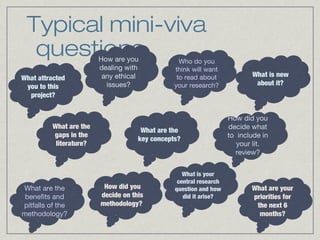
Typical mini-viva
  questions              How are you              Who do you
                         dealing with           think will want
What attracted            any ethical            to read about             What is new
 you to this               issues?              your research?              about it?
  project?


                                                                    How did you
          What are the                                              decide what
                                      What are the
          gaps in the                                               to include in
                                     key concepts?
           literature?                                                 your lit.
                                                                      review?


                                                   What is your
                                                 central research
What are the              How did you           question and how           What are your
 benefits and            decide on this            did it arise?           priorities for
pitfalls of the          methodology?                                       the next 6
methodology?                                                                 months?
Possible outcomes
 Confirm registration for PhD
 Require you do specific further work before you
  can register for a Phd
 Terminate registration
Probation form
 The probation assessment is accompanied by the
  Probation form
 •   Sections A and B are completed by the student in
     consultation with the supervisors
 •   Section C is completed by the supervisors
 •   Section D is completed by the mini viva assessors
 •   Section E is completed by the Associate Dean Research
     or PGR Director
 Sections A, B and C are completed prior to the
  mini viva
 Replaces the October Progress Report
Variations by faculty:
 HSC
  3,000–4,000 word report; a revised research
  proposal and timetable
 7,000–10,000 piece which indicates critical and
  writing ability (literature, methodology or policy
  review)
 Skills audit (should include a presentation)
 Submit documents 2 weeks prior to viva
 Mini viva about 10 months (FT) and 20 months (PT)
  into registration
 Remedial work over the summer if necessary
 For more information, contact Lindsay O’Dell
Business and Law
 One report: critical literature review; research
  question; proposed method; timetable
 Skills audit (including presentation at PhD day)
 Submit work 2 weeks before the viva
 Vivas held in first two weeks of July
 Remedial work over the summer following
  feedback meeting with DRD
 For more information, contact Anne Smith
CREET (FELS and IET)
 One report: literature review, research question,
  method and work plan
 Skills audit (with evidence of presentations given,
  e.g. in WiP seminars)
 Submit work 3–4 weeks before viva
 Vivas held in late June and July
 Remedial work over the summer
 For more information, contact Regine Hampel
KMI
 One report: literature review; research proposal
  including workplan; description of a piece of
  completed (pilot) work (e.g. software that has
  been developed or experiment that has been
  conducted)
 The report is submitted at least 1 week before the
  viva
 The viva is held in around month 9 or 10
 Remedial work is conducted after the viva as
  necessary
 For more information, contact Paul Mulholland
Social Science
 One report
 Skills audit (including presentation)
 Submit work 2 weeks before the viva
 Please check with your PG Co-ordinator for the
  timing of vivas
 Remedial work over the summer
 For more information, contact Deborah Talbot
Opportunity to look at
previous probation
reports from various
faculties
Thanks for listening and
      taking part!


    Look back at your
expectations on the post-it
 note – what has not been
         covered?

Regine Hampel Probation Assessment-2013

  • 1.
    Preparing for probation assessment Regine Hampel Directorfor Postgraduate Studies Centre for Research in Education and Educational Technology Developing as a Researcher, 19–20 March 2013
  • 2.
    Your expectations Activity: Note downthree things that you expect to get out of this session on a post-it note.
  • 3.
    Overview  Focus ofyour own research  Probation assessment: purpose, elements and process  Project report • research question • literature review • research proposal • work plan  Skills audit and skills development  Mini viva  Probation form  Faculty variations
  • 4.
    Elevator pitch Activity: Explainyourself and your research to a potential funder who knows nothing about your research. Try to get the main points across clearly and succinctly. 5 minutes: preparation time 2 minutes (each): pair work with partner 1 2 minutes (each): pair work with partner 2
  • 5.
    Purpose of probation assessment To confirm that you have made satisfactory progress and to make a recommendation regarding the upgrade to a PhD degree  To get feedback from two independent assessors on research done as well as planned  To assess your research skills  Important step on the way to the PhD
  • 7.
    Probation process  Probationform: accompanies the process  Skills audit (with evidence of presentation given e.g. at a WiP seminar, a departmental seminar or a conference)  Project report: literature review, research question, method and work plan  Submission date: about 4 weeks before the viva  Project report is the focus of the viva  Vivas held approx. 10/20 months after registration (FT/PT)  Remedial work over the summer  PGR Director sends final documents to Research School 11 months after registration
  • 8.
    Project report The reportmust contain the following: A viable research question A critical literature review which situates the proposed research A research proposal A work plan
  • 9.
    Elements of aresearch question
  • 10.
    An example research question “Howdo the personal narratives and stories of career development processes amongst South African distance learners vary and to what extent are elements of previous disadvantage the source of that difference?” Activity (5 minutes): Discuss the following questions with your partner What is the phenomenon this thesis is trying to explain? What may cause the variation in that phenomenon? What is the relationship between them (‘how’, ‘why’, ‘to what extent’)? What is the context of the research?
  • 12.
    Your research question Activity(10 minutes): Write down your (main) research question(s) on a post-it note. Explain it/them to the other students in your group, focusing on the following: Why is this question relevant? How does it relate to the literature? How does it inform your methodology and your methods?
  • 13.
    Small group activity: feedback Were there any general observations/questions/ issues that arose in your group?  What is the link between the research question, the literature review and the methodology?
  • 14.
    Literature review “A criticalliterature review which situates the proposed research” (Probation form) Activity (5-10 minutes): Turn to your partner and discuss how you would evaluate a literature review. Make a note of some possible criteria.
  • 15.
    Literature review: criteria  Doesit take a critical stance in terms of methodology, validity, conceptual framework?  What does it cover, i.e. where are the boundaries – inclusions/exclusions?  Does it show developments over time?  Is there a sustained analytical argument?  What is the significance of the research problem?  What about the accuracy (including the bibliography)?
  • 16.
    Literature review “A literaturereview offers an overview of the relevant and significant literature on a research area. It reviews the critical points of current knowledge on a particular topic – i.e. a survey of articles, books, conference papers, theses etc. It […] should include a description, summary and critical evaluation of the materials presented. A literature review is not a list describing or summarising one piece of literature after another. The purpose of a literature review is: to demonstrate your ability to identify the relevant information and outline existing knowledge; identify the ‘gap’ in the research that your work will address; produce a rationale or justification for your study. Remember: There is no one single correct method to writing a literature review.” (UCD Library)
  • 17.
    Research proposal “A researchproposal, including an outline of proposed method(s), a critical justification for them, and where appropriate, preliminary data and analysis” (Probation form) Group (and plenary) discussion: Which methods are you going to use and why?
  • 18.
    Work plan “A workplan for the project with a detailed timetable of dates for completion of component parts and thesis submission” (Probation form)
  • 19.
    Work plan example Oct Jan Apr Jun Oct Jan Apr Jun Oct Jan Apr Jun yr 1 yr 2 yr 3 Literature search Ethics Questionnaire design Questionnaire administration Arrange access (e.g. interviews) Data collection Data analysis Writing up
  • 20.
    Table of contents (example)  SECTION 1 Introduction 1.1 Background of the Study 1.2 Aims of the Probation Report 1.3 Clarification of Terms 1.4 Overview of this Probation Report  SECTION 2 Literature Review on Intercultural Communication 2.1 Empirical Studies: Problems in Intercultural Communication 2.2 Methodologically-induced Pessimism? 2.3 Empirical Studies: Successful Intercultural Communication  SECTION 3 Research Questions 3.1 Proposed Aims of the PhD (Post-probation) 3.2 Rationale for the Proposed PhD Study  SECTION 4 Proposed Methodology 4.1 Theoretical and Epistemological Framework 4.2 Methodology as Active Sense-making 4.3 Proposed Methods of Data Collection/Analysis SECTION 5 Scoping Study 5.1 Canada immigration: History, policies, practices 5.2 The Research Site 5.3 Proposed Areas for Further Investigation: ‘Working’ Hypothesis 5.4 Insights on my Role as Researcher: Reactivity and Reflexivity 5.5 Concluding Remarks
  • 21.
    PhD WORK PLAN DEVELOPMENTPLAN: JUNE TO DECEMBER 2009 BIBLIOGRAPHY APPENDICES Appendix 1 Research Table Appendix 2 Request to Undertake a Scoping Study Appendix 3 Consent Form Appendix 4 Information Sheet for Participants Appendix 5 Excerpt from MRes Dissertation SUMMARY OF SKILLS RESEARCH FLYER  
  • 22.
    Skills development 1. Skills audit: Identifying and documenting the skills that you have 2. Needs analysis: Identifying the skills that you need to acquire or develop; targeting specific development needs in the context of a given time period and research programme 3. Development/Portfolio planning: Specifying how and when the skills will be developed and how the outcomes will be documented 4. Evidence Building: Collecting evidence in the Progress File as competence is gained 5. Assessment: Assessing skills development as a component of progress
  • 23.
    Skills audit  Skillsaudit: part of probation assessment  See http://phdskills.open.ac.uk/skills_audit_menu.php  Skills development: on-going; included in all 6- monthly Progress Reports and in the Probation Report  See http://phdskills.open.ac.uk/dev_plan_form.php
  • 24.
  • 25.
  • 26.
    Mini-viva  Centres onthe probation report  Panel: • 2 independent internal assessors • Supervisor as observer • Panel chair (usually PGR Director)  10-minute presentation  30-minute discussion  Feedback by the assessors  Can also be done online or on the telephone (PT only)
  • 27.
    Mini-viva The mini-viva isdesigned to assess the following: Your understanding of what you are doing The relationship of what you are doing to other work in the area Whether the project design is robust Whether your project is achievable within the time Whether you are capable of achieving it
  • 28.
    Typical mini-viva questions How are you Who do you dealing with think will want What attracted any ethical to read about What is new you to this issues? your research? about it? project? How did you What are the decide what What are the gaps in the to include in key concepts? literature? your lit. review? What is your central research What are the How did you question and how What are your benefits and decide on this did it arise? priorities for pitfalls of the methodology? the next 6 methodology? months?
  • 29.
    Possible outcomes  Confirmregistration for PhD  Require you do specific further work before you can register for a Phd  Terminate registration
  • 30.
    Probation form  Theprobation assessment is accompanied by the Probation form • Sections A and B are completed by the student in consultation with the supervisors • Section C is completed by the supervisors • Section D is completed by the mini viva assessors • Section E is completed by the Associate Dean Research or PGR Director  Sections A, B and C are completed prior to the mini viva  Replaces the October Progress Report
  • 31.
    Variations by faculty: HSC  3,000–4,000 word report; a revised research proposal and timetable  7,000–10,000 piece which indicates critical and writing ability (literature, methodology or policy review)  Skills audit (should include a presentation)  Submit documents 2 weeks prior to viva  Mini viva about 10 months (FT) and 20 months (PT) into registration  Remedial work over the summer if necessary  For more information, contact Lindsay O’Dell
  • 32.
    Business and Law One report: critical literature review; research question; proposed method; timetable  Skills audit (including presentation at PhD day)  Submit work 2 weeks before the viva  Vivas held in first two weeks of July  Remedial work over the summer following feedback meeting with DRD  For more information, contact Anne Smith
  • 33.
    CREET (FELS andIET)  One report: literature review, research question, method and work plan  Skills audit (with evidence of presentations given, e.g. in WiP seminars)  Submit work 3–4 weeks before viva  Vivas held in late June and July  Remedial work over the summer  For more information, contact Regine Hampel
  • 34.
    KMI  One report:literature review; research proposal including workplan; description of a piece of completed (pilot) work (e.g. software that has been developed or experiment that has been conducted)  The report is submitted at least 1 week before the viva  The viva is held in around month 9 or 10  Remedial work is conducted after the viva as necessary  For more information, contact Paul Mulholland
  • 35.
    Social Science  Onereport  Skills audit (including presentation)  Submit work 2 weeks before the viva  Please check with your PG Co-ordinator for the timing of vivas  Remedial work over the summer  For more information, contact Deborah Talbot
  • 36.
    Opportunity to lookat previous probation reports from various faculties
  • 37.
    Thanks for listeningand taking part! Look back at your expectations on the post-it note – what has not been covered?

Editor's Notes

  • #5 The name " Elevator Pitch " reflects the idea that it should be possible to deliver the summary in the time span of an elevator ride, or approximately thirty seconds to two minutes. The term itself comes from a scenario of an accidental meeting with someone important in the elevator. If the conversation inside the elevator in those few seconds is interesting and value adding, the conversation will continue after the elevator ride or end in exchange of business card or a scheduled meeting