



Data Collection and Fieldwork
6 May 2017
Samar Almoossa
Session Outline
• Fieldwork essentials
• Fieldwork preparation
• Conducting fieldwork
• Post fieldwork
A little bit about you
• When are you planning to do field work?
• For how long are you going to be in the field?
• What do you want to gain from this session?
Fieldwork itself is humanly demanding, as a
fieldworker will need to give proof of all the good
qualities in life: patience, endurance, stamina,
perseverance, flexibility, adaptability, empathy,
tolerance, the willingness to lose a battle in order
to win a war, creativity, humour and wit,
diplomacy, and being happy about very small
achievements. Put that in a job advertisement and
you will never find a suitable candidate. - Blommaert
Planning your fieldwork
• What would you do to prepare yourself for the fieldwork?
• What would you do when you got there?
• What would you do when you got back?
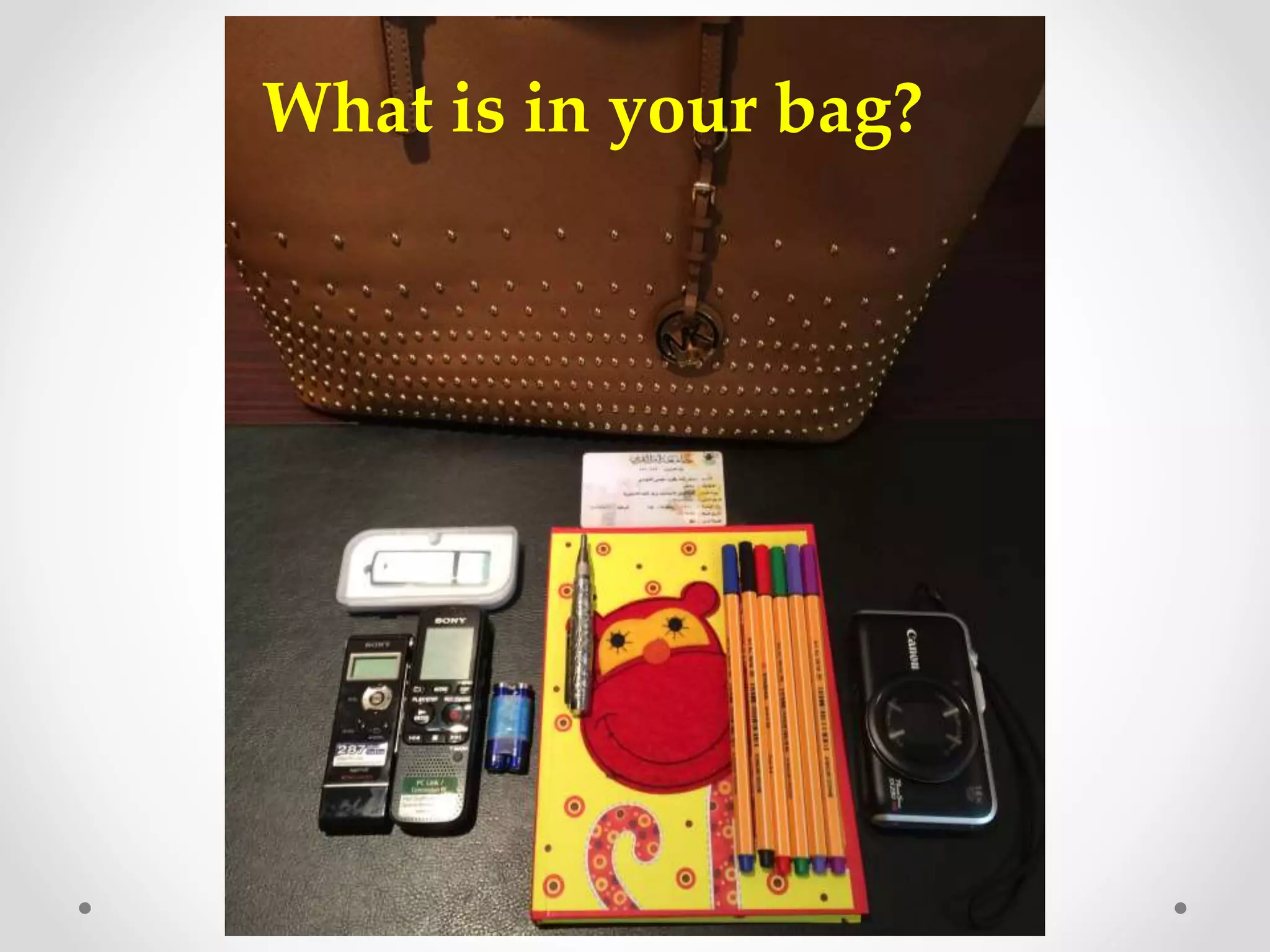
What is in your bag?
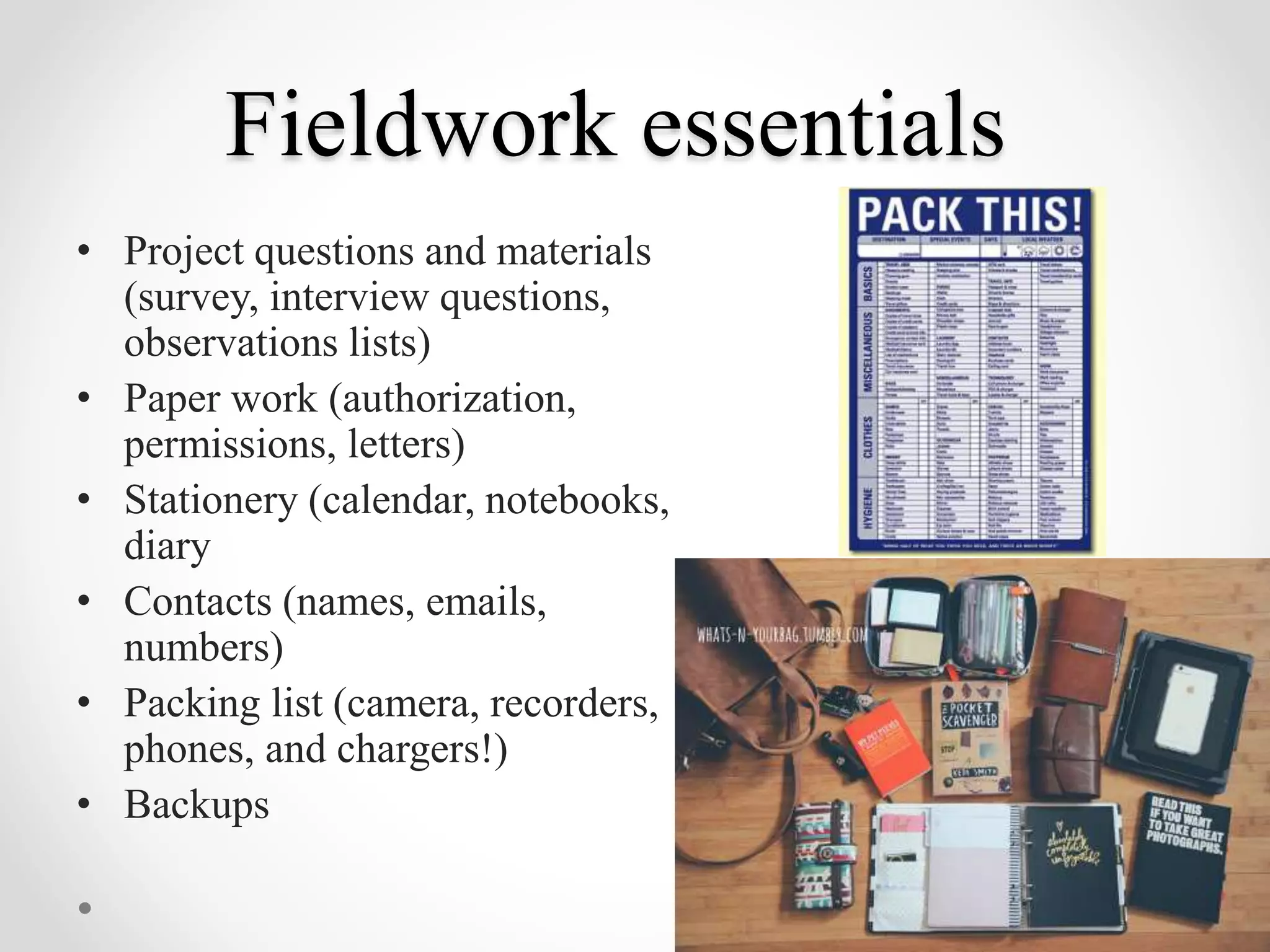
Fieldwork essentials
• Project questions and materials
(survey, interview questions,
observations lists)
• Paper work (authorization,
permissions, letters)
• Stationery (calendar, notebooks,
diary
• Contacts (names, emails,
numbers)
• Packing list (camera, recorders,
phones, and chargers!)
• Backups
Conducting fieldwork
• Entering the community
• Connecting with participants
• Managing your project
• Thinking about ethics
Scenarios
• I arrived and nobody knew who I was.
• I arranged to meet the manager at 10 am but he did not show
up.
• The students were too shy to talk to me.
• I am trying to interview the teachers but it seems they are
always busy.
• I am perceived as an outsider. The participants did not warm
up to me.
• I distributed my surveys but I did not get enough responses.
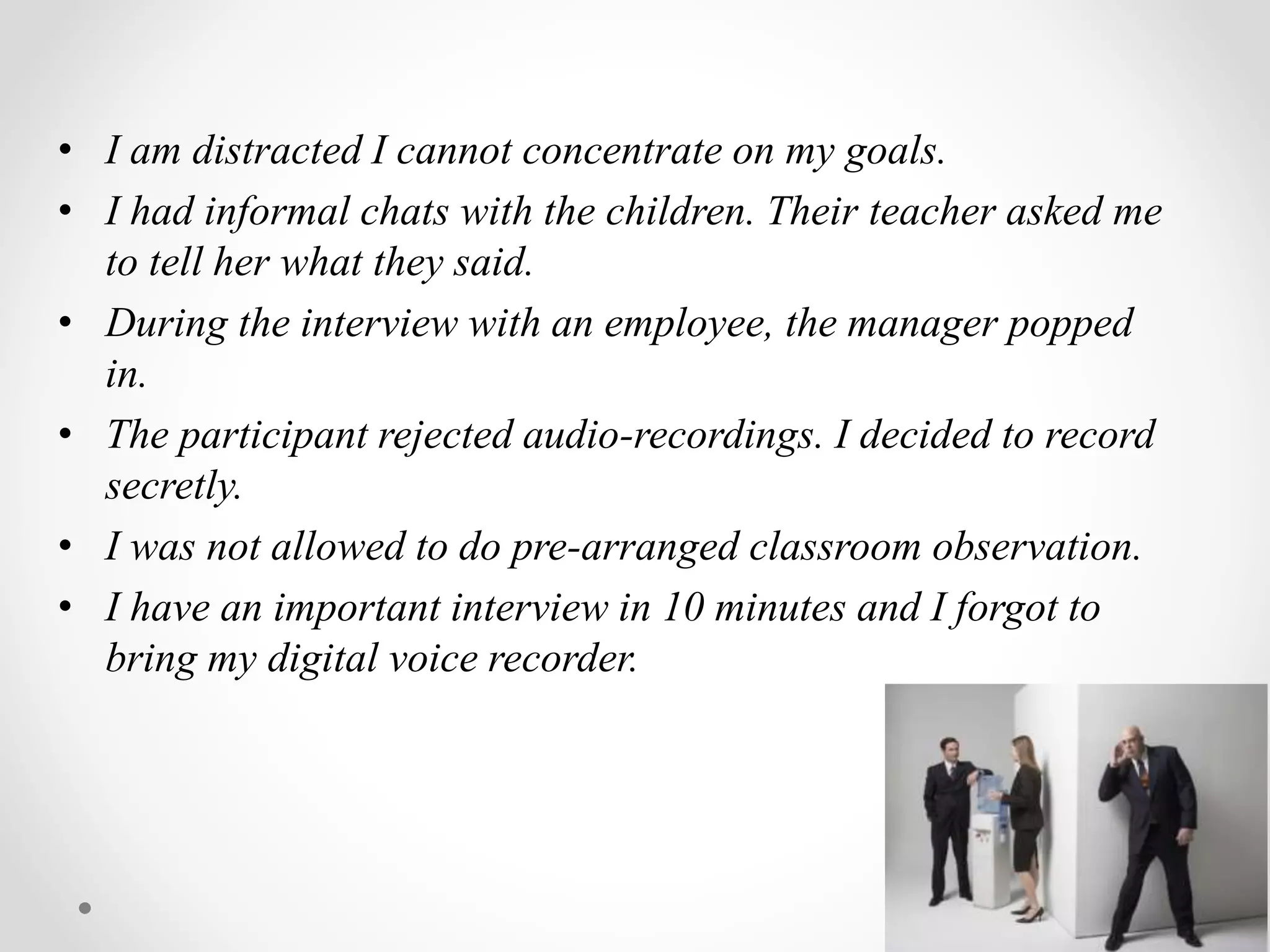
• I am distracted I cannot concentrate on my goals.
• I had informal chats with the children. Their teacher asked me
to tell her what they said.
• During the interview with an employee, the manager popped
in.
• The participant rejected audio-recordings. I decided to record
secretly.
• I was not allowed to do pre-arranged classroom observation.
• I have an important interview in 10 minutes and I forgot to
bring my digital voice recorder.
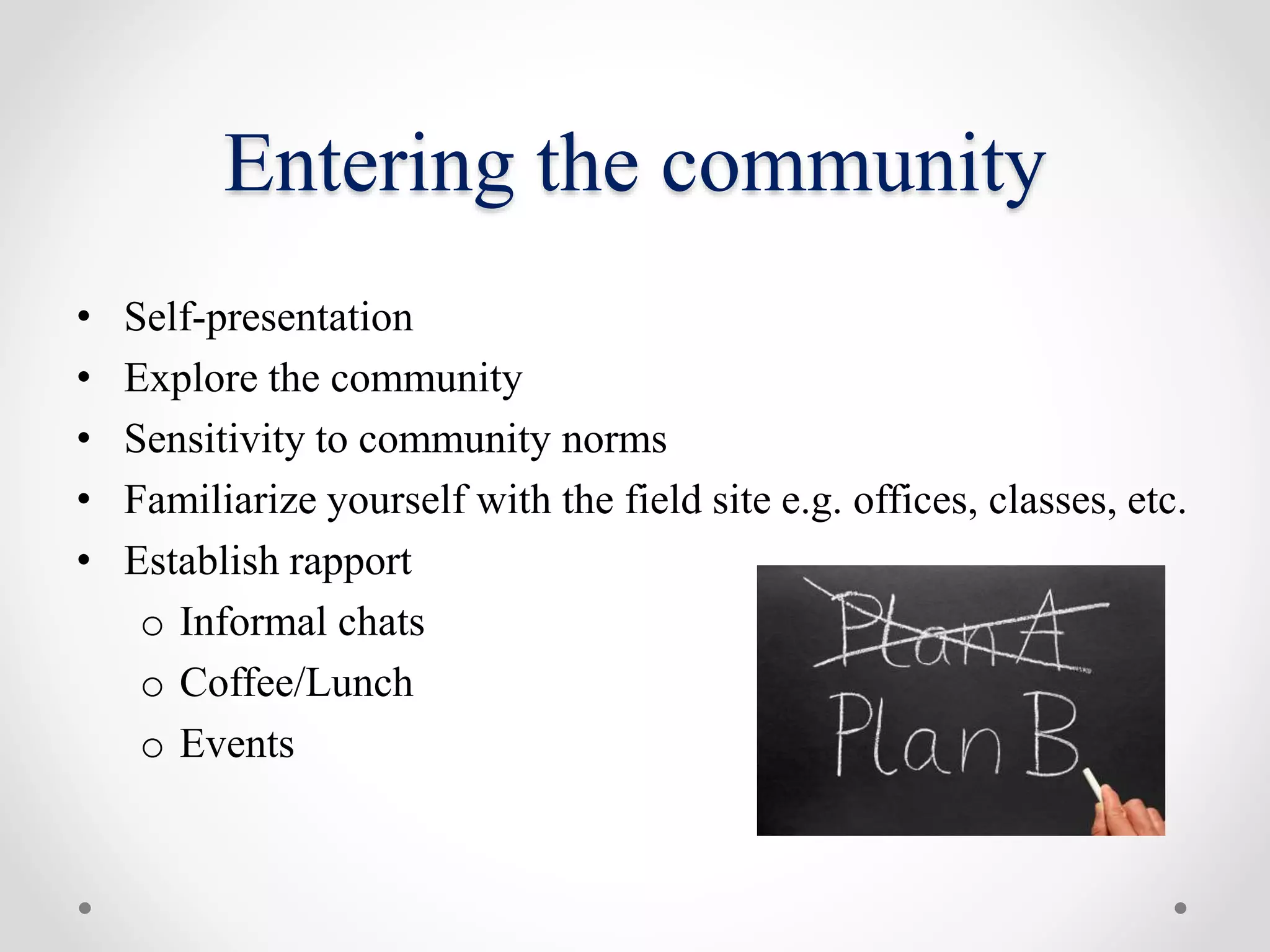
Entering the community
• Self-presentation
• Explore the community
• Sensitivity to community norms
• Familiarize yourself with the field site e.g. offices, classes, etc.
• Establish rapport
o Informal chats
o Coffee/Lunch
o Events
Connecting with the participants
• Contact the gatekeeper to inform them of your exact date of arrival
• Contact the participants and simply explain what you want to do
• Send the documents to the participants in advance
o Ethics forms e.g. information sheet and consent form
o Interview questions
o Survey questions
• Check important dates with the participants
o Term-time, working hours, exam periods
o Holidays and breaks
o Availability and preference
Working with participants
• Expect the unexpected
• Simplify your goals
• Be patience
o Suspicion of researchers
o Rejections, cancellations, indefinite postponements
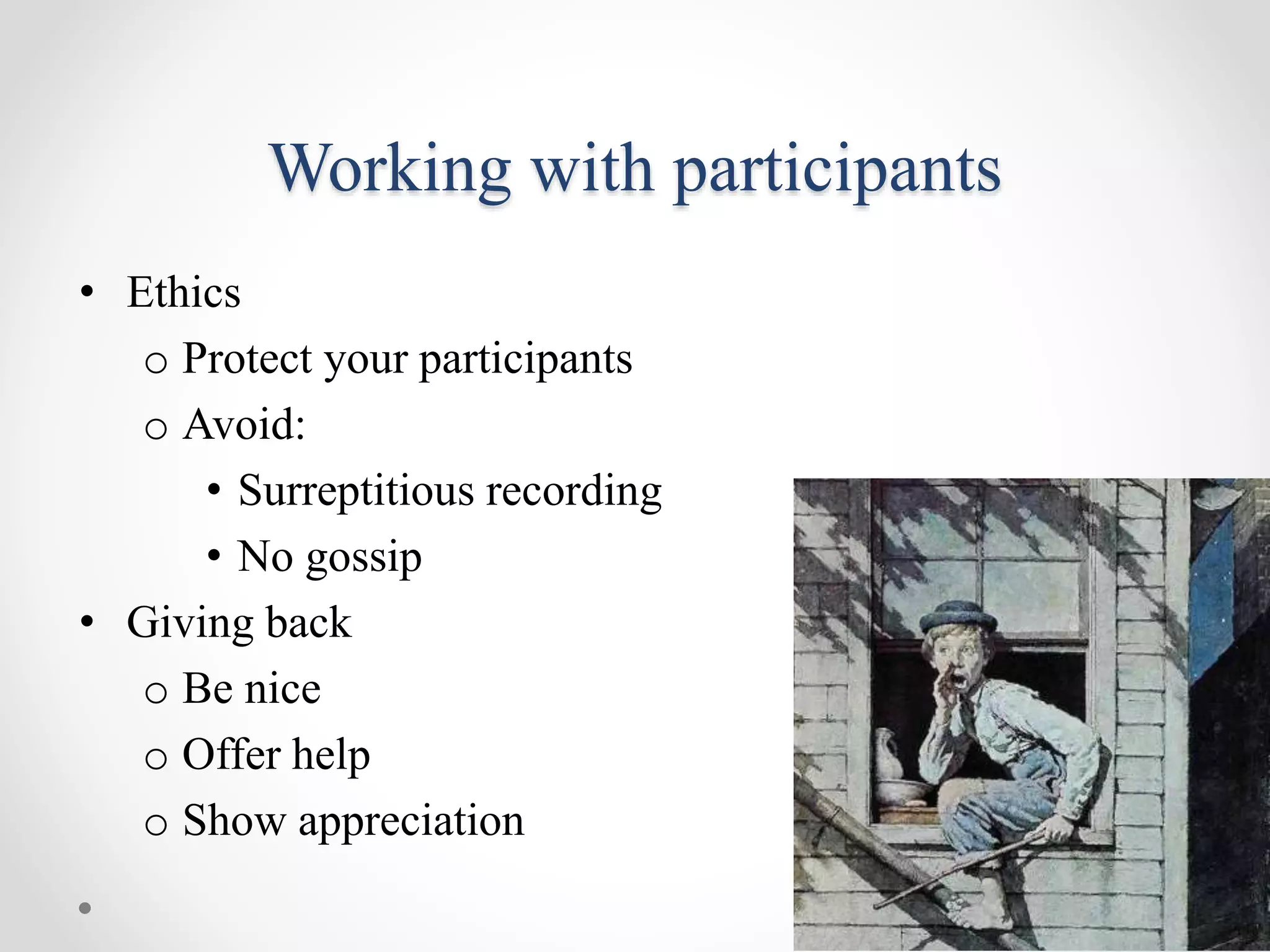
• Ethics
o Protect your participants
o Avoid:
• Surreptitious recording
• No gossip
• Giving back
o Be nice
o Offer help
o Show appreciation
Working with participants
On the go
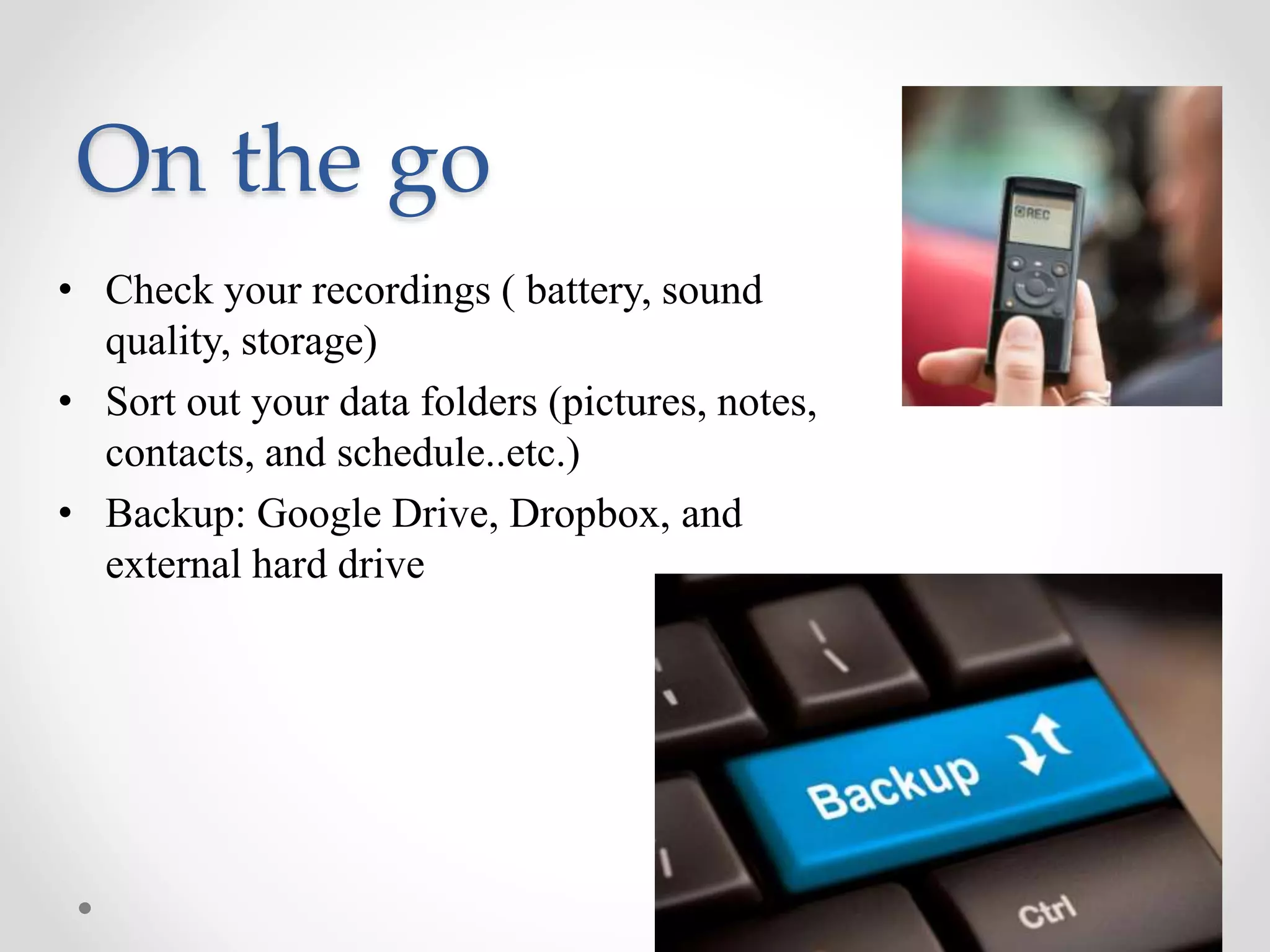
• Check your recordings ( battery, sound
quality, storage)
• Sort out your data folders (pictures, notes,
contacts, and schedule..etc.)
• Backup: Google Drive, Dropbox, and
external hard drive
• Keep your researcher hat on
o Write daily field notes or record voice notes when possible
o Keep a research diary to record your thoughts
• Dedicate time to go through your data
o Check your data e.g.: listen to audio samples from the data,
read your field notes
o Evaluate your performance e.g. interviewing strategies, note-
taking, etc.
• Stay connected with
o Supervisors
o Family
o Friends
On the go
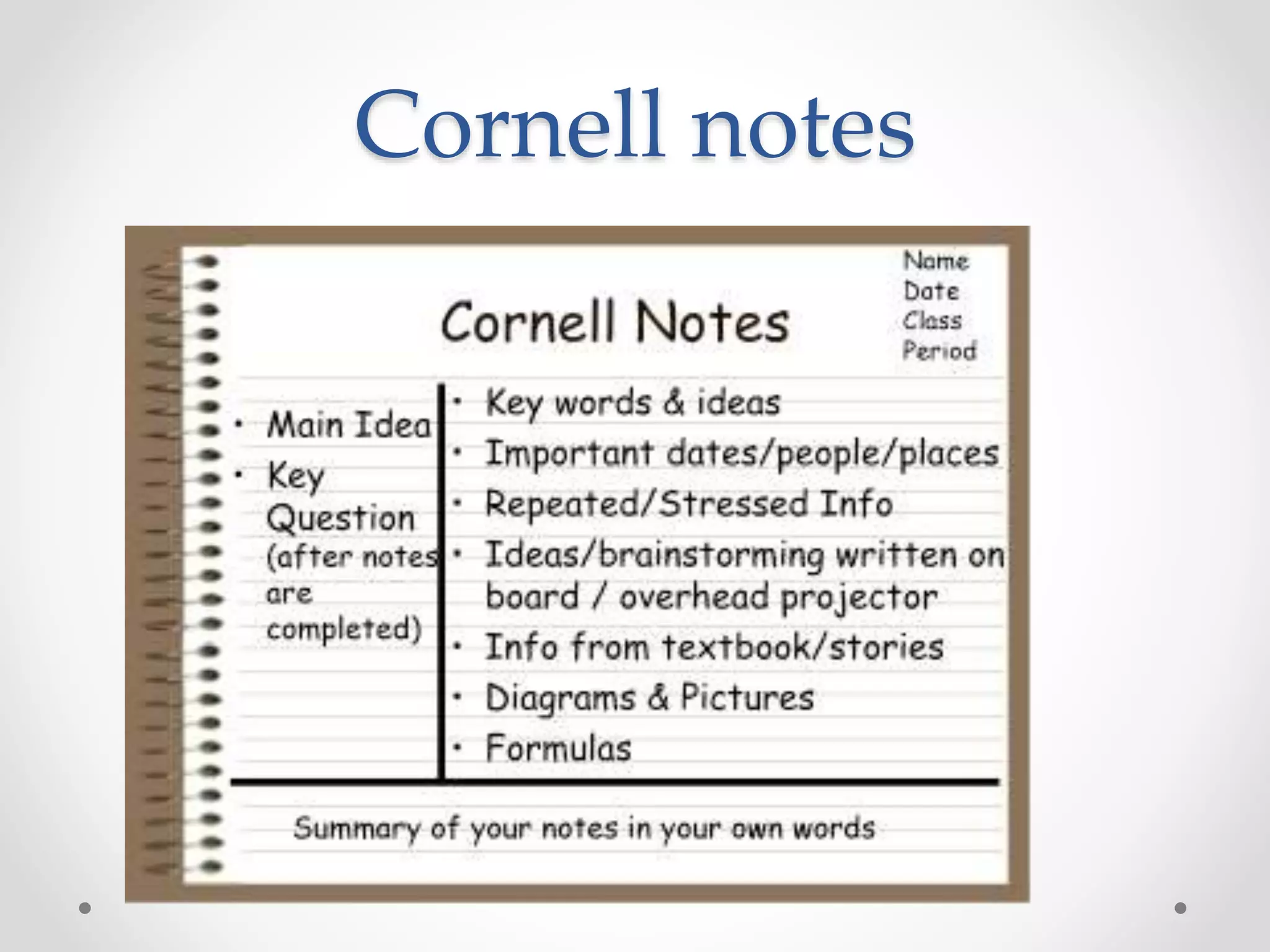
Cornell notes
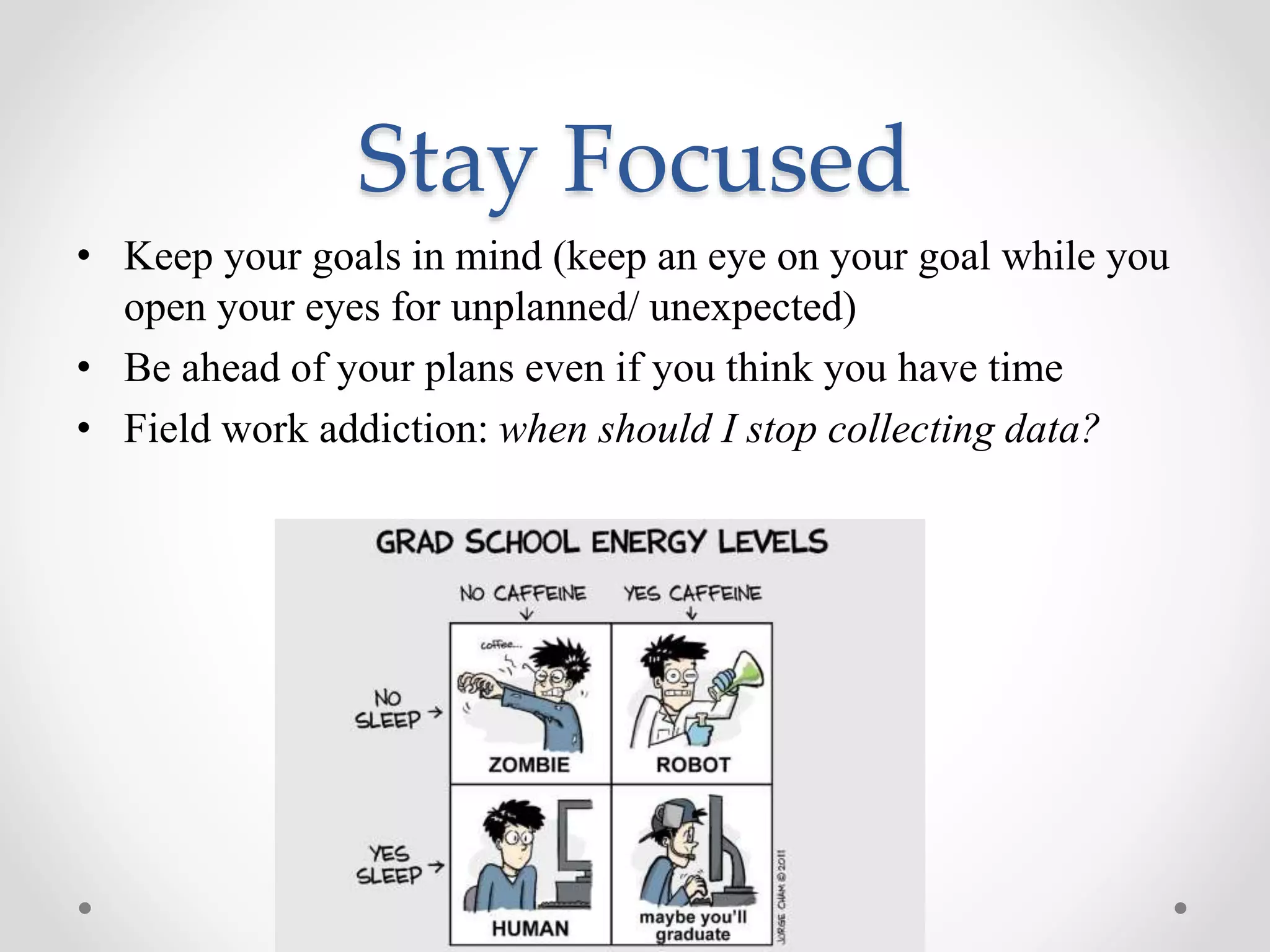
Stay Focused
• Keep your goals in mind (keep an eye on your goal while you
open your eyes for unplanned/ unexpected)
• Be ahead of your plans even if you think you have time
• Field work addiction: when should I stop collecting data?
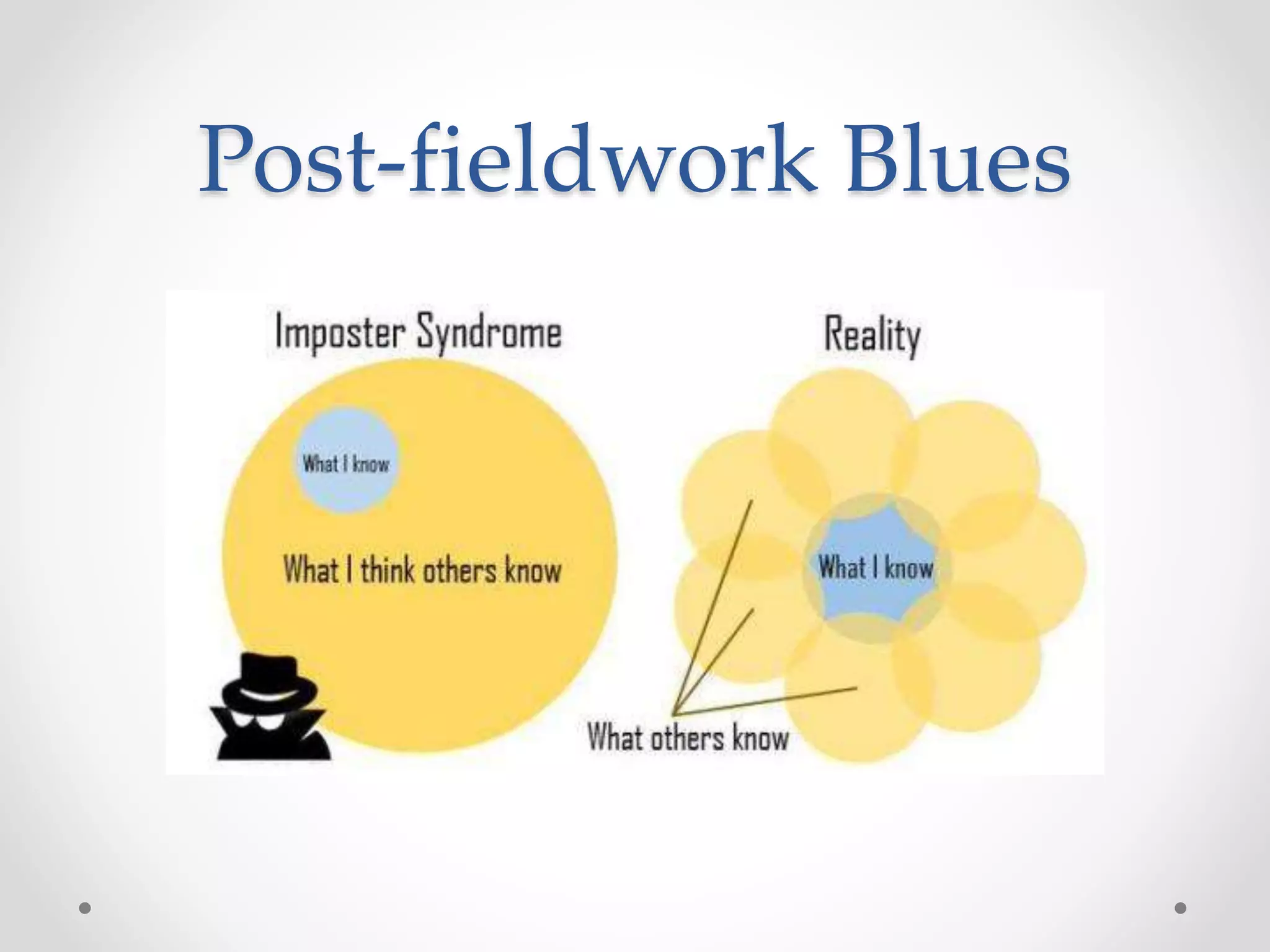
Post-fieldwork Blues
What is next ?
This too shall pass
References
Arthur, J. (Ed.). (2012). Research methods and methodologies in education.
Sage publications.
Bryman, A. (2015). Social research methods. Oxford university press.
Cohen, L., Manion, L., & Morrison, K. (2013). Research methods in education.
Routledge.
Creswell, J. W. (2013). Research design: Qualitative, quantitative, and mixed
methods approaches. Sage publications.
Creswell, J. W., & Clark, V. L. P. (2007). Designing and conducting mixed
methods research.
Silverman, D. (2013). Doing qualitative research: A practical handbook. SAGE
Publications Limited.
Silverman, D. (Ed.). (2010). Qualitative research. Sage.
Silverman, D. (2006). Interpreting qualitative data: Methods for analyzing talk,
text and interaction. Sage.
Useful Blog posts
• 10 tips for doing fieldwork in South Asia
http://southasiainstitute.harvard.edu/2014/03/10-tips-for-
doing-fieldwork-in-south-asia/ …
Ethnographic fieldwork: A beginner’s guide
https://www.jyu.fi/hum/laitokset/kielet/tutkimus/hankkeet/paatt
yneet-hankkeet/fidipro/en/courses/fieldwork-text …
• The other side of fieldwork: experiences and challenges of
conducting research
http://www.anthropologymatters.com/index.php/anth_matters/
article/view/17/23 …
10 Tips for Surviving Anthropological Fieldwork
https://netnographicencounters.com/2014/04/07/10-tips-for-
surviving-anthropological-fieldwork/ …
Contact
Samar.almoossa@kcl.ac.uk
symossa@uqu.edu.sa

DATA COLLECTION AND FIELDWORK – WHAT TO EXPECT AND HOW TO OVERCOME DIFFICULTIES by Samar Almoossa

  • 1.
    Data Collection andFieldwork 6 May 2017 Samar Almoossa
  • 2.
    Session Outline • Fieldworkessentials • Fieldwork preparation • Conducting fieldwork • Post fieldwork
  • 4.
    A little bitabout you • When are you planning to do field work? • For how long are you going to be in the field? • What do you want to gain from this session?
  • 5.
    Fieldwork itself ishumanly demanding, as a fieldworker will need to give proof of all the good qualities in life: patience, endurance, stamina, perseverance, flexibility, adaptability, empathy, tolerance, the willingness to lose a battle in order to win a war, creativity, humour and wit, diplomacy, and being happy about very small achievements. Put that in a job advertisement and you will never find a suitable candidate. - Blommaert
  • 6.
    Planning your fieldwork •What would you do to prepare yourself for the fieldwork? • What would you do when you got there? • What would you do when you got back?
  • 7.
    What is inyour bag?
  • 8.
    Fieldwork essentials • Projectquestions and materials (survey, interview questions, observations lists) • Paper work (authorization, permissions, letters) • Stationery (calendar, notebooks, diary • Contacts (names, emails, numbers) • Packing list (camera, recorders, phones, and chargers!) • Backups
  • 9.
    Conducting fieldwork • Enteringthe community • Connecting with participants • Managing your project • Thinking about ethics
  • 10.
    Scenarios • I arrivedand nobody knew who I was. • I arranged to meet the manager at 10 am but he did not show up. • The students were too shy to talk to me. • I am trying to interview the teachers but it seems they are always busy. • I am perceived as an outsider. The participants did not warm up to me. • I distributed my surveys but I did not get enough responses.
  • 11.
    • I amdistracted I cannot concentrate on my goals. • I had informal chats with the children. Their teacher asked me to tell her what they said. • During the interview with an employee, the manager popped in. • The participant rejected audio-recordings. I decided to record secretly. • I was not allowed to do pre-arranged classroom observation. • I have an important interview in 10 minutes and I forgot to bring my digital voice recorder.
  • 12.
    Entering the community •Self-presentation • Explore the community • Sensitivity to community norms • Familiarize yourself with the field site e.g. offices, classes, etc. • Establish rapport o Informal chats o Coffee/Lunch o Events
  • 13.
    Connecting with theparticipants • Contact the gatekeeper to inform them of your exact date of arrival • Contact the participants and simply explain what you want to do • Send the documents to the participants in advance o Ethics forms e.g. information sheet and consent form o Interview questions o Survey questions • Check important dates with the participants o Term-time, working hours, exam periods o Holidays and breaks o Availability and preference
  • 14.
    Working with participants •Expect the unexpected • Simplify your goals • Be patience o Suspicion of researchers o Rejections, cancellations, indefinite postponements
  • 15.
    • Ethics o Protectyour participants o Avoid: • Surreptitious recording • No gossip • Giving back o Be nice o Offer help o Show appreciation Working with participants
  • 16.
    On the go •Check your recordings ( battery, sound quality, storage) • Sort out your data folders (pictures, notes, contacts, and schedule..etc.) • Backup: Google Drive, Dropbox, and external hard drive
  • 17.
    • Keep yourresearcher hat on o Write daily field notes or record voice notes when possible o Keep a research diary to record your thoughts • Dedicate time to go through your data o Check your data e.g.: listen to audio samples from the data, read your field notes o Evaluate your performance e.g. interviewing strategies, note- taking, etc. • Stay connected with o Supervisors o Family o Friends On the go
  • 18.
  • 19.
    Stay Focused • Keepyour goals in mind (keep an eye on your goal while you open your eyes for unplanned/ unexpected) • Be ahead of your plans even if you think you have time • Field work addiction: when should I stop collecting data?
  • 20.
  • 22.
  • 23.
  • 24.
    References Arthur, J. (Ed.).(2012). Research methods and methodologies in education. Sage publications. Bryman, A. (2015). Social research methods. Oxford university press. Cohen, L., Manion, L., & Morrison, K. (2013). Research methods in education. Routledge. Creswell, J. W. (2013). Research design: Qualitative, quantitative, and mixed methods approaches. Sage publications. Creswell, J. W., & Clark, V. L. P. (2007). Designing and conducting mixed methods research. Silverman, D. (2013). Doing qualitative research: A practical handbook. SAGE Publications Limited. Silverman, D. (Ed.). (2010). Qualitative research. Sage. Silverman, D. (2006). Interpreting qualitative data: Methods for analyzing talk, text and interaction. Sage.
  • 25.
    Useful Blog posts •10 tips for doing fieldwork in South Asia http://southasiainstitute.harvard.edu/2014/03/10-tips-for- doing-fieldwork-in-south-asia/ … Ethnographic fieldwork: A beginner’s guide https://www.jyu.fi/hum/laitokset/kielet/tutkimus/hankkeet/paatt yneet-hankkeet/fidipro/en/courses/fieldwork-text … • The other side of fieldwork: experiences and challenges of conducting research http://www.anthropologymatters.com/index.php/anth_matters/ article/view/17/23 … 10 Tips for Surviving Anthropological Fieldwork https://netnographicencounters.com/2014/04/07/10-tips-for- surviving-anthropological-fieldwork/ …
  • 26.