Probation
assessment
Regine Hampel
Director for Postgraduate Studies
Centre for Research in Education and Educational
Technology
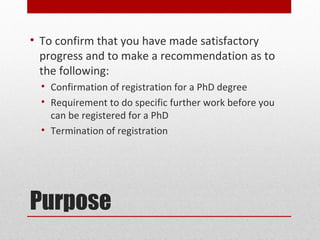
• To confirm that you have made satisfactory
  progress and to make a recommendation as to
  the following:
  • Confirmation of registration for a PhD degree
  • Requirement to do specific further work before you
    can be registered for a PhD
  • Termination of registration


Purpose
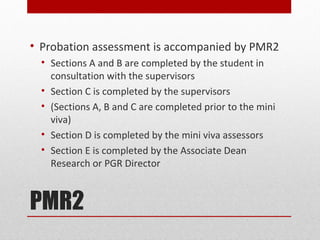
• Probation assessment is accompanied by PMR2
  • Sections A and B are completed by the student in
    consultation with the supervisors
  • Section C is completed by the supervisors
  • (Sections A, B and C are completed prior to the mini
    viva)
  • Section D is completed by the mini viva assessors
  • Section E is completed by the Associate Dean
    Research or PGR Director


PMR2
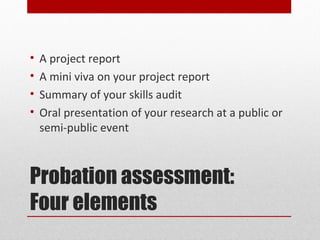
•   A project report
•   A mini viva on your project report
•   Summary of your skills audit
•   Oral presentation of your research at a public or
    semi-public event


Probation assessment:
Four elements
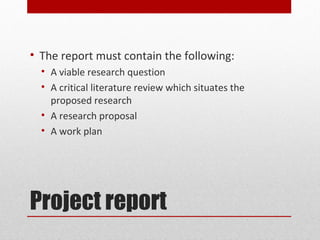
• The report must contain the following:
  • A viable research question
  • A critical literature review which situates the
    proposed research
  • A research proposal
  • A work plan


Project report
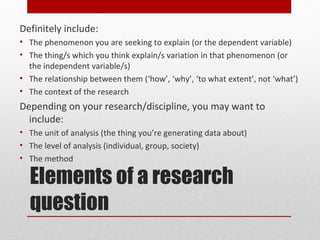
Definitely include:
• The phenomenon you are seeking to explain (or the dependent variable)
• The thing/s which you think explain/s variation in that phenomenon (or
  the independent variable/s)
• The relationship between them (‘how’, ‘why’, ‘to what extent’, not ‘what’)
• The context of the research
Depending on your research/discipline, you may want to
  include:
• The unit of analysis (the thing you’re generating data about)
• The level of analysis (individual, group, society)
• The method

  Elements of a research
  question
How do the personal narratives and stories of career
development processes amongst South African distance
learners vary and to what extent are elements of previous
disadvantage the source of that difference?


An example research
question
How do the personal narratives and stories of career
development processes amongst South African distance
learners vary and to what extent are elements of previous
disadvantage the source of that difference?


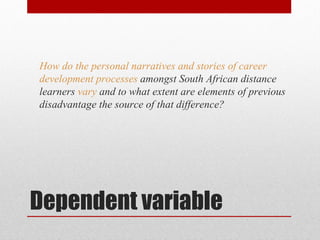
Dependent variable
How do the personal narratives and stories of career
development processes amongst South African distance
learners vary and to what extent are elements of previous
disadvantage the source of that difference?


Independent variables
How do the personal narratives and stories of career
 development processes amongst South African distance
 learners vary and to what extent are elements of previous
 disadvantage the source of that difference?


The relationship between
them
How do the personal narratives and stories of career
 development processes amongst South African distance
 learners vary and to what extent are elements of previous
 disadvantage the source of that difference?


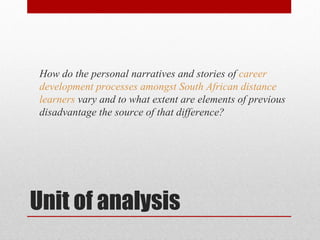
Unit of analysis
How do the personal narratives and stories of career
 development processes amongst South African distance
 learners vary and to what extent are elements of previous
 disadvantage the source of that difference?


Level of analysis
How do the personal narratives and stories of career
development processes amongst South African distance
learners vary and to what extent are elements of previous
disadvantage the source of that difference?


Method
How do the personal narratives and stories of career
development processes amongst South African distance
learners vary and to what extent are elements of previous
disadvantage the source of that difference?


Context
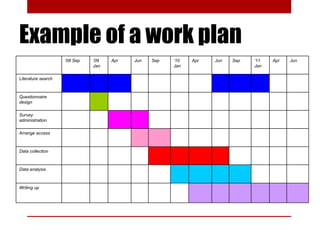
Example of a work plan
                    ‘08 Sep   ‘09   Apr   Jun   Sep   ‘10   Apr   Jun   Sep   ‘11   Apr   Jun
                              Jan                     Jan                     Jan

Literature search


Questionnaire
design

Survey
administration

Arrange access


Data collection


Data analysis


Writing up
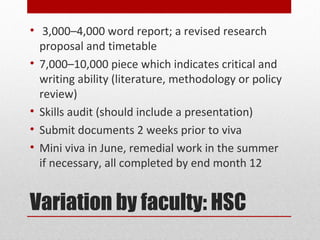
• 3,000–4,000 word report; a revised research
  proposal and timetable
• 7,000–10,000 piece which indicates critical and
  writing ability (literature, methodology or policy
  review)
• Skills audit (should include a presentation)
• Submit documents 2 weeks prior to viva
• Mini viva in June, remedial work in the summer
  if necessary, all completed by end month 12


Variation by faculty: HSC
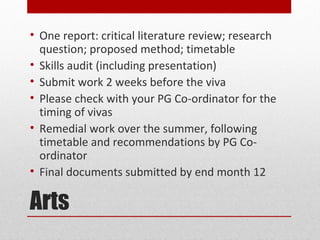
• One report: critical literature review; research
  question; proposed method; timetable
• Skills audit (including presentation)
• Submit work 2 weeks before the viva
• Please check with your PG Co-ordinator for the
  timing of vivas
• Remedial work over the summer, following
  timetable and recommendations by PG Co-
  ordinator
• Final documents submitted by end month 12

Arts
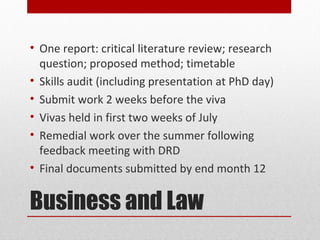
• One report: critical literature review; research
  question; proposed method; timetable
• Skills audit (including presentation at PhD day)
• Submit work 2 weeks before the viva
• Vivas held in first two weeks of July
• Remedial work over the summer following
  feedback meeting with DRD
• Final documents submitted by end month 12


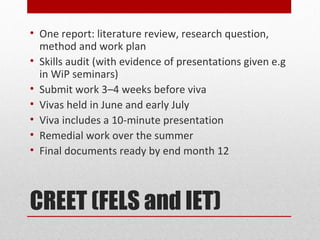
Business and Law
• One report: literature review, research question,
  method and work plan
• Skills audit (with evidence of presentations given e.g
  in WiP seminars)
• Submit work 3–4 weeks before viva
• Vivas held in June and early July
• Viva includes a 10-minute presentation
• Remedial work over the summer
• Final documents ready by end month 12


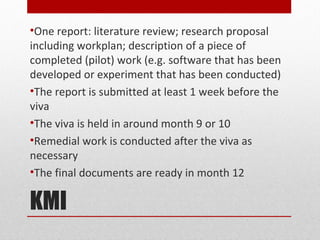
CREET (FELS and IET)
•One report: literature review; research proposal
including workplan; description of a piece of
completed (pilot) work (e.g. software that has been
developed or experiment that has been conducted)
•The report is submitted at least 1 week before the
viva
•The viva is held in around month 9 or 10
•Remedial work is conducted after the viva as
necessary
•The final documents are ready in month 12

KMI
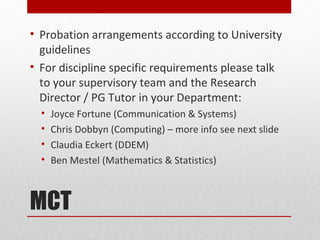
• Probation arrangements according to University
  guidelines
• For discipline specific requirements please talk
  to your supervisory team and the Research
  Director / PG Tutor in your Department:
  •   Joyce Fortune (Communication & Systems)
  •   Chris Dobbyn (Computing) – more info see next slide
  •   Claudia Eckert (DDEM)
  •   Ben Mestel (Mathematics & Statistics)


MCT
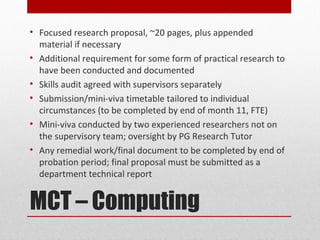
• Focused research proposal, ~20 pages, plus appended
  material if necessary
• Additional requirement for some form of practical research to
  have been conducted and documented
• Skills audit agreed with supervisors separately
• Submission/mini-viva timetable tailored to individual
  circumstances (to be completed by end of month 11, FTE)
• Mini-viva conducted by two experienced researchers not on
  the supervisory team; oversight by PG Research Tutor
• Any remedial work/final document to be completed by end of
  probation period; final proposal must be submitted as a
  department technical report


MCT – Computing
• One report
• Skills audit (including presentation)
• Submit work 2 weeks before the viva
• Please check with your PG Co-ordinator for the
  timing of vivas
• Remedial work over the summer
• Final documents submitted by end month 12


Social Science
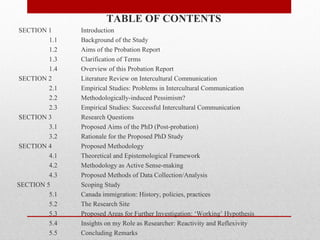
TABLE OF CONTENTS
SECTION 1      Introduction
         1.1   Background of the Study
         1.2   Aims of the Probation Report
         1.3   Clarification of Terms
         1.4   Overview of this Probation Report
SECTION 2      Literature Review on Intercultural Communication
         2.1   Empirical Studies: Problems in Intercultural Communication
         2.2   Methodologically-induced Pessimism?
         2.3   Empirical Studies: Successful Intercultural Communication
SECTION 3      Research Questions
         3.1   Proposed Aims of the PhD (Post-probation)
         3.2   Rationale for the Proposed PhD Study
SECTION 4      Proposed Methodology
         4.1   Theoretical and Epistemological Framework
         4.2   Methodology as Active Sense-making
         4.3   Proposed Methods of Data Collection/Analysis
SECTION 5      Scoping Study
         5.1   Canada immigration: History, policies, practices
         5.2   The Research Site
         5.3   Proposed Areas for Further Investigation: ‘Working’ Hypothesis
         5.4   Insights on my Role as Researcher: Reactivity and Reflexivity
         5.5   Concluding Remarks
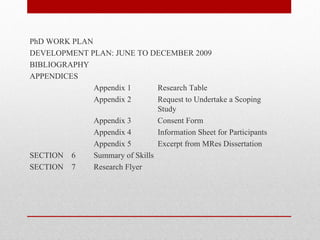
PhD WORK PLAN
DEVELOPMENT PLAN: JUNE TO DECEMBER 2009
BIBLIOGRAPHY
APPENDICES
              Appendix 1        Research Table
              Appendix 2        Request to Undertake a Scoping
                                Study
              Appendix 3        Consent Form
              Appendix 4        Information Sheet for Participants
              Appendix 5        Excerpt from MRes Dissertation
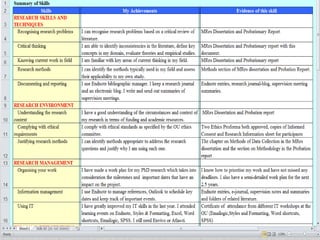
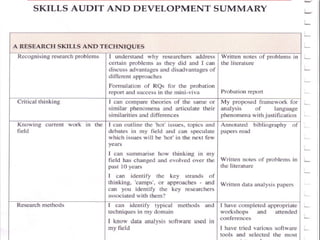
SECTION 6     Summary of Skills
SECTION 7     Research Flyer
•   Skills audit: Identifying and documenting the skills that students
    have.
•   Needs analysis: Identifying the skills that students need to
    acquire or develop. Targeting specific development needs in the
    context of a given time period and research programme.
•   Development/Portfolio planning: Specifying how and when the
    skills will be developed and how the outcomes will be
    documented.
•   Evidence Building: Collecting evidence in the Progress File as
    competence is gained.
•   Assessment: Assessing skills development as a component of
    progress.

    Skills development
Skills audit
Skills audit
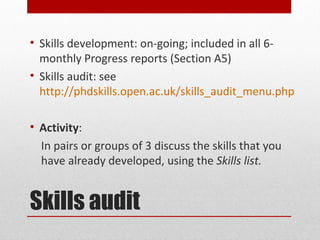
• Skills development: on-going; included in all 6-
  monthly Progress reports (Section A5)
• Skills audit: see
  http://phdskills.open.ac.uk/skills_audit_menu.php

• Activity:
  In pairs or groups of 3 discuss the skills that you
  have already developed, using the Skills list.


Skills audit
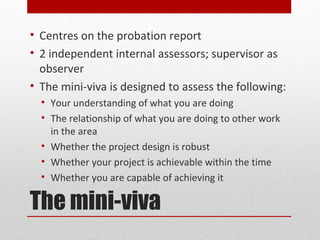
• Centres on the probation report
• 2 independent internal assessors; supervisor as
  observer
• The mini-viva is designed to assess the following:
  • Your understanding of what you are doing
  • The relationship of what you are doing to other work
    in the area
  • Whether the project design is robust
  • Whether your project is achievable within the time
  • Whether you are capable of achieving it

The mini-viva
•   What attracted you to this project?
•   What do you think the main contribution of this work will be?
•   Who do you think will want to read about your research?
•   What is new about it?
•   Can you summarise the field of … as it stands?
•   What are the key concepts?
•   What are the gaps in the literature?
•   How did you decide what to include and what not to include in your
    literature review?
•   What are the benefits and pitfalls of the methodological approach you
    intend to adopt?
•   How did you decide to adopt this particular methodological approach?
•   What is your central research question and how did you derive it?
•   What are the priorities in your research plan?


Typical mini-viva questions
• Confirm registration for PhD
• Require you do specific further work before you
  can register for a Phd
• Terminate registration


Outcomes
• Questions and comments?


Many thanks!

Preparing for Probation Review (2012) - Regine Hampel

  • 1.
    Probation assessment Regine Hampel Director forPostgraduate Studies Centre for Research in Education and Educational Technology
  • 2.
    • To confirmthat you have made satisfactory progress and to make a recommendation as to the following: • Confirmation of registration for a PhD degree • Requirement to do specific further work before you can be registered for a PhD • Termination of registration Purpose
  • 3.
    • Probation assessmentis accompanied by PMR2 • Sections A and B are completed by the student in consultation with the supervisors • Section C is completed by the supervisors • (Sections A, B and C are completed prior to the mini viva) • Section D is completed by the mini viva assessors • Section E is completed by the Associate Dean Research or PGR Director PMR2
  • 4.
    A project report • A mini viva on your project report • Summary of your skills audit • Oral presentation of your research at a public or semi-public event Probation assessment: Four elements
  • 5.
    • The reportmust contain the following: • A viable research question • A critical literature review which situates the proposed research • A research proposal • A work plan Project report
  • 6.
    Definitely include: • Thephenomenon you are seeking to explain (or the dependent variable) • The thing/s which you think explain/s variation in that phenomenon (or the independent variable/s) • The relationship between them (‘how’, ‘why’, ‘to what extent’, not ‘what’) • The context of the research Depending on your research/discipline, you may want to include: • The unit of analysis (the thing you’re generating data about) • The level of analysis (individual, group, society) • The method Elements of a research question
  • 7.
    How do thepersonal narratives and stories of career development processes amongst South African distance learners vary and to what extent are elements of previous disadvantage the source of that difference? An example research question
  • 8.
    How do thepersonal narratives and stories of career development processes amongst South African distance learners vary and to what extent are elements of previous disadvantage the source of that difference? Dependent variable
  • 9.
    How do thepersonal narratives and stories of career development processes amongst South African distance learners vary and to what extent are elements of previous disadvantage the source of that difference? Independent variables
  • 10.
    How do thepersonal narratives and stories of career development processes amongst South African distance learners vary and to what extent are elements of previous disadvantage the source of that difference? The relationship between them
  • 11.
    How do thepersonal narratives and stories of career development processes amongst South African distance learners vary and to what extent are elements of previous disadvantage the source of that difference? Unit of analysis
  • 12.
    How do thepersonal narratives and stories of career development processes amongst South African distance learners vary and to what extent are elements of previous disadvantage the source of that difference? Level of analysis
  • 13.
    How do thepersonal narratives and stories of career development processes amongst South African distance learners vary and to what extent are elements of previous disadvantage the source of that difference? Method
  • 14.
    How do thepersonal narratives and stories of career development processes amongst South African distance learners vary and to what extent are elements of previous disadvantage the source of that difference? Context
  • 15.
    Example of awork plan ‘08 Sep ‘09 Apr Jun Sep ‘10 Apr Jun Sep ‘11 Apr Jun Jan Jan Jan Literature search Questionnaire design Survey administration Arrange access Data collection Data analysis Writing up
  • 16.
    • 3,000–4,000 wordreport; a revised research proposal and timetable • 7,000–10,000 piece which indicates critical and writing ability (literature, methodology or policy review) • Skills audit (should include a presentation) • Submit documents 2 weeks prior to viva • Mini viva in June, remedial work in the summer if necessary, all completed by end month 12 Variation by faculty: HSC
  • 17.
    • One report:critical literature review; research question; proposed method; timetable • Skills audit (including presentation) • Submit work 2 weeks before the viva • Please check with your PG Co-ordinator for the timing of vivas • Remedial work over the summer, following timetable and recommendations by PG Co- ordinator • Final documents submitted by end month 12 Arts
  • 18.
    • One report:critical literature review; research question; proposed method; timetable • Skills audit (including presentation at PhD day) • Submit work 2 weeks before the viva • Vivas held in first two weeks of July • Remedial work over the summer following feedback meeting with DRD • Final documents submitted by end month 12 Business and Law
  • 19.
    • One report:literature review, research question, method and work plan • Skills audit (with evidence of presentations given e.g in WiP seminars) • Submit work 3–4 weeks before viva • Vivas held in June and early July • Viva includes a 10-minute presentation • Remedial work over the summer • Final documents ready by end month 12 CREET (FELS and IET)
  • 20.
    •One report: literaturereview; research proposal including workplan; description of a piece of completed (pilot) work (e.g. software that has been developed or experiment that has been conducted) •The report is submitted at least 1 week before the viva •The viva is held in around month 9 or 10 •Remedial work is conducted after the viva as necessary •The final documents are ready in month 12 KMI
  • 21.
    • Probation arrangementsaccording to University guidelines • For discipline specific requirements please talk to your supervisory team and the Research Director / PG Tutor in your Department: • Joyce Fortune (Communication & Systems) • Chris Dobbyn (Computing) – more info see next slide • Claudia Eckert (DDEM) • Ben Mestel (Mathematics & Statistics) MCT
  • 22.
    • Focused researchproposal, ~20 pages, plus appended material if necessary • Additional requirement for some form of practical research to have been conducted and documented • Skills audit agreed with supervisors separately • Submission/mini-viva timetable tailored to individual circumstances (to be completed by end of month 11, FTE) • Mini-viva conducted by two experienced researchers not on the supervisory team; oversight by PG Research Tutor • Any remedial work/final document to be completed by end of probation period; final proposal must be submitted as a department technical report MCT – Computing
  • 23.
    • One report •Skills audit (including presentation) • Submit work 2 weeks before the viva • Please check with your PG Co-ordinator for the timing of vivas • Remedial work over the summer • Final documents submitted by end month 12 Social Science
  • 24.
    TABLE OF CONTENTS SECTION1 Introduction 1.1 Background of the Study 1.2 Aims of the Probation Report 1.3 Clarification of Terms 1.4 Overview of this Probation Report SECTION 2 Literature Review on Intercultural Communication 2.1 Empirical Studies: Problems in Intercultural Communication 2.2 Methodologically-induced Pessimism? 2.3 Empirical Studies: Successful Intercultural Communication SECTION 3 Research Questions 3.1 Proposed Aims of the PhD (Post-probation) 3.2 Rationale for the Proposed PhD Study SECTION 4 Proposed Methodology 4.1 Theoretical and Epistemological Framework 4.2 Methodology as Active Sense-making 4.3 Proposed Methods of Data Collection/Analysis SECTION 5 Scoping Study 5.1 Canada immigration: History, policies, practices 5.2 The Research Site 5.3 Proposed Areas for Further Investigation: ‘Working’ Hypothesis 5.4 Insights on my Role as Researcher: Reactivity and Reflexivity 5.5 Concluding Remarks
  • 25.
    PhD WORK PLAN DEVELOPMENTPLAN: JUNE TO DECEMBER 2009 BIBLIOGRAPHY APPENDICES Appendix 1 Research Table Appendix 2 Request to Undertake a Scoping Study Appendix 3 Consent Form Appendix 4 Information Sheet for Participants Appendix 5 Excerpt from MRes Dissertation SECTION 6 Summary of Skills SECTION 7 Research Flyer
  • 26.
    Skills audit: Identifying and documenting the skills that students have. • Needs analysis: Identifying the skills that students need to acquire or develop. Targeting specific development needs in the context of a given time period and research programme. • Development/Portfolio planning: Specifying how and when the skills will be developed and how the outcomes will be documented. • Evidence Building: Collecting evidence in the Progress File as competence is gained. • Assessment: Assessing skills development as a component of progress. Skills development
  • 27.
  • 28.
  • 29.
    • Skills development:on-going; included in all 6- monthly Progress reports (Section A5) • Skills audit: see http://phdskills.open.ac.uk/skills_audit_menu.php • Activity: In pairs or groups of 3 discuss the skills that you have already developed, using the Skills list. Skills audit
  • 30.
    • Centres onthe probation report • 2 independent internal assessors; supervisor as observer • The mini-viva is designed to assess the following: • Your understanding of what you are doing • The relationship of what you are doing to other work in the area • Whether the project design is robust • Whether your project is achievable within the time • Whether you are capable of achieving it The mini-viva
  • 31.
    What attracted you to this project? • What do you think the main contribution of this work will be? • Who do you think will want to read about your research? • What is new about it? • Can you summarise the field of … as it stands? • What are the key concepts? • What are the gaps in the literature? • How did you decide what to include and what not to include in your literature review? • What are the benefits and pitfalls of the methodological approach you intend to adopt? • How did you decide to adopt this particular methodological approach? • What is your central research question and how did you derive it? • What are the priorities in your research plan? Typical mini-viva questions
  • 32.
    • Confirm registrationfor PhD • Require you do specific further work before you can register for a Phd • Terminate registration Outcomes
  • 33.
    • Questions andcomments? Many thanks!