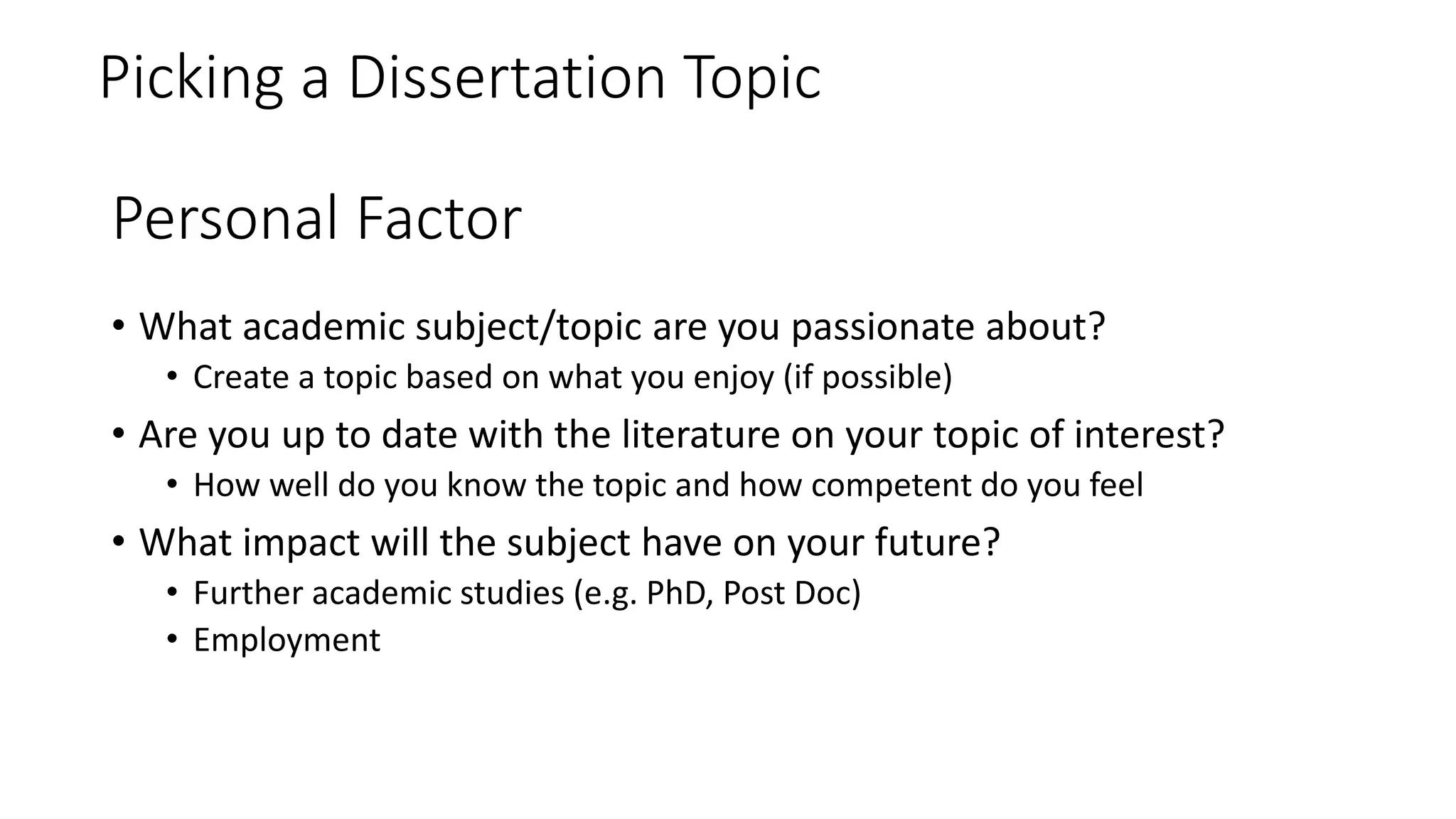
Personal Factor
• What academic subject/topic are you passionate about?
• Create a topic based on what you enjoy (if possible)
• Are you up to date with the literature on your topic of interest?
• How well do you know the topic and how competent do you feel
• What impact will the subject have on your future?
• Further academic studies (e.g. PhD, Post Doc)
• Employment
Picking a Dissertation Topic
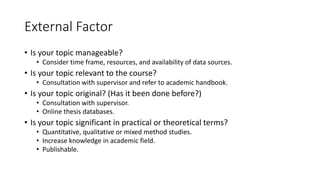
External Factor
• Is your topic manageable?
• Consider time frame, resources, and availability of data sources.
• Is your topic relevant to the course?
• Consultation with supervisor and refer to academic handbook.
• Is your topic original? (Has it been done before?)
• Consultation with supervisor.
• Online thesis databases.
• Is your topic significant in practical or theoretical terms?
• Quantitative, qualitative or mixed method studies.
• Increase knowledge in academic field.
• Publishable.
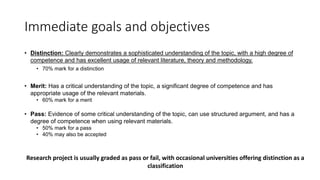
Immediate goals and objectives
• Distinction: Clearly demonstrates a sophisticated understanding of the topic, with a high degree of
competence and has excellent usage of relevant literature, theory and methodology.
• 70% mark for a distinction
• Merit: Has a critical understanding of the topic, a significant degree of competence and has
appropriate usage of the relevant materials.
• 60% mark for a merit
• Pass: Evidence of some critical understanding of the topic, can use structured argument, and has a
degree of competence when using relevant materials.
• 50% mark for a pass
• 40% may also be accepted
Research project is usually graded as pass or fail, with occasional universities offering distinction as a
classification
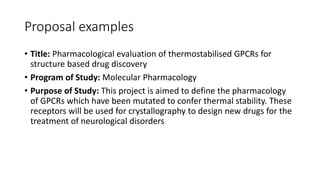
• Title: Pharmacological evaluation of thermostabilised GPCRs for
structure based drug discovery
• Program of Study: Molecular Pharmacology
• Purpose of Study: This project is aimed to define the pharmacology
of GPCRs which have been mutated to confer thermal stability. These
receptors will be used for crystallography to design new drugs for the
treatment of neurological disorders
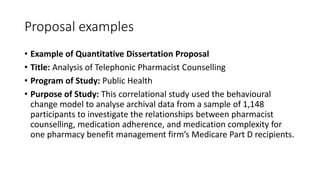
Proposal examples
Proposal examples
• Example of Quantitative Dissertation Proposal
• Title: Analysis of Telephonic Pharmacist Counselling
• Program of Study: Public Health
• Purpose of Study: This correlational study used the behavioural
change model to analyse archival data from a sample of 1,148
participants to investigate the relationships between pharmacist
counselling, medication adherence, and medication complexity for
one pharmacy benefit management firm’s Medicare Part D recipients.
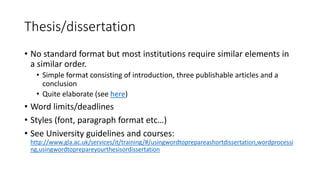
Thesis/dissertation
• No standard format but most institutions require similar elements in
a similar order.
• Simple format consisting of introduction, three publishable articles and a
conclusion
• Quite elaborate (see here)
• Word limits/deadlines
• Styles (font, paragraph format etc…)
• See University guidelines and courses:
http://www.gla.ac.uk/services/it/training/#/usingwordtoprepareashortdissertation,wordprocessi
ng,usingwordtoprepareyourthesisordissertation
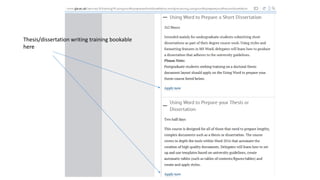
Thesis/dissertation writing training bookable
here
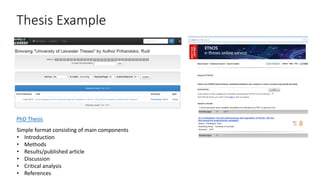
Thesis Example
PhD Thesis
Simple format consisting of main components
• Introduction
• Methods
• Results/published article
• Discussion
• Critical analysis
• References
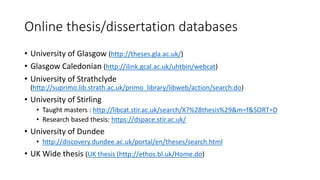
Online thesis/dissertation databases
• University of Glasgow (http://theses.gla.ac.uk/)
• Glasgow Caledonian (http://ilink.gcal.ac.uk/uhtbin/webcat)
• University of Strathclyde
(http://suprimo.lib.strath.ac.uk/primo_library/libweb/action/search.do)
• University of Stirling
• Taught masters : http://libcat.stir.ac.uk/search/X?%28thesis%29&m=f&SORT=D
• Research based thesis: https://dspace.stir.ac.uk/
• University of Dundee
• http://discovery.dundee.ac.uk/portal/en/theses/search.html
• UK Wide thesis (UK thesis (http://ethos.bl.uk/Home.do)
Good Luck !

Dissertation Topic; Slide

  • 1.
    Personal Factor • Whatacademic subject/topic are you passionate about? • Create a topic based on what you enjoy (if possible) • Are you up to date with the literature on your topic of interest? • How well do you know the topic and how competent do you feel • What impact will the subject have on your future? • Further academic studies (e.g. PhD, Post Doc) • Employment Picking a Dissertation Topic
  • 2.
    External Factor • Isyour topic manageable? • Consider time frame, resources, and availability of data sources. • Is your topic relevant to the course? • Consultation with supervisor and refer to academic handbook. • Is your topic original? (Has it been done before?) • Consultation with supervisor. • Online thesis databases. • Is your topic significant in practical or theoretical terms? • Quantitative, qualitative or mixed method studies. • Increase knowledge in academic field. • Publishable.
  • 3.
    Immediate goals andobjectives • Distinction: Clearly demonstrates a sophisticated understanding of the topic, with a high degree of competence and has excellent usage of relevant literature, theory and methodology. • 70% mark for a distinction • Merit: Has a critical understanding of the topic, a significant degree of competence and has appropriate usage of the relevant materials. • 60% mark for a merit • Pass: Evidence of some critical understanding of the topic, can use structured argument, and has a degree of competence when using relevant materials. • 50% mark for a pass • 40% may also be accepted Research project is usually graded as pass or fail, with occasional universities offering distinction as a classification
  • 4.
    • Title: Pharmacologicalevaluation of thermostabilised GPCRs for structure based drug discovery • Program of Study: Molecular Pharmacology • Purpose of Study: This project is aimed to define the pharmacology of GPCRs which have been mutated to confer thermal stability. These receptors will be used for crystallography to design new drugs for the treatment of neurological disorders Proposal examples
  • 5.
    Proposal examples • Exampleof Quantitative Dissertation Proposal • Title: Analysis of Telephonic Pharmacist Counselling • Program of Study: Public Health • Purpose of Study: This correlational study used the behavioural change model to analyse archival data from a sample of 1,148 participants to investigate the relationships between pharmacist counselling, medication adherence, and medication complexity for one pharmacy benefit management firm’s Medicare Part D recipients.
  • 6.
    Thesis/dissertation • No standardformat but most institutions require similar elements in a similar order. • Simple format consisting of introduction, three publishable articles and a conclusion • Quite elaborate (see here) • Word limits/deadlines • Styles (font, paragraph format etc…) • See University guidelines and courses: http://www.gla.ac.uk/services/it/training/#/usingwordtoprepareashortdissertation,wordprocessi ng,usingwordtoprepareyourthesisordissertation
  • 7.
  • 8.
    Thesis Example PhD Thesis Simpleformat consisting of main components • Introduction • Methods • Results/published article • Discussion • Critical analysis • References
  • 9.
    Online thesis/dissertation databases •University of Glasgow (http://theses.gla.ac.uk/) • Glasgow Caledonian (http://ilink.gcal.ac.uk/uhtbin/webcat) • University of Strathclyde (http://suprimo.lib.strath.ac.uk/primo_library/libweb/action/search.do) • University of Stirling • Taught masters : http://libcat.stir.ac.uk/search/X?%28thesis%29&m=f&SORT=D • Research based thesis: https://dspace.stir.ac.uk/ • University of Dundee • http://discovery.dundee.ac.uk/portal/en/theses/search.html • UK Wide thesis (UK thesis (http://ethos.bl.uk/Home.do)
  • 10.