Research Proposal
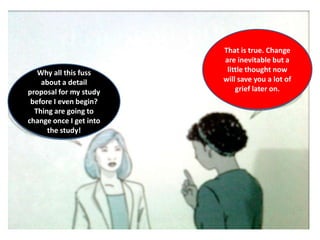
Why all this fuss
I. Title
about a detail
proposal for my study
before I even begin?
Thing are going to
II. Introduction
change once I get into
the study!

III. Literature Review

That is true. Change
are inevitable but a
little thought now
will save you a lot of
grief later on.

V. Bibliography

VI. Appendix

IV. Method

*

*
RESEARCH PROPOSAL

MRS K. RATH
Asst. Prof, (KIIT-DU)
What is a research proposal?
A blue print of future activities of a research project.
Some sort of preconceived framework for starting
the activities.
It deals with ideas of researcher about what research
he/she wants to do, what objectives and methodology
he/she has set, how much time and resources are
required to complete it, how the research finding are
to be reported, and so on.
DEFINITION
• It is a document written by a researcher that
provides a detailed description of the proposed
program.
• It is the outline of the entire research process.
• It is a written document specifying what the
investigator proposes to study.
NEED
• It is prerequisite for degree.
• Needs approval from the committee to start
the work.
• It conceives the project.
• It impresses the senior as a potential
researcher.
• It serves as a contract between the
researcher and funder.
• Personal interest.
PURPOSES
• It gives an opportunity to think through the project.
• Provides an outline to guide through the research
process.
• Let department or faculty know about the plan
• Helps the department to choose an appropriate
supervisor.
Cont….
– Gives an opportunity to receive feedback
from academic community as well as
possible funder.

• Undergraduate and graduate students
submit proposal to their dissertation
committees for approval.
How to translate your written notes into a
paper
• Write an introduction
– This section is like a mini literature review.
– Written in present tense

• Write a method section
– This section deals with how you will collect data or
information.
– Written in future tense
Cont….
• Write a results section
– This section deals with how you will analyze your
result.
– Written in future tense.
Important information for writing
•
•
•
•
•
•
•
•

Always structure the work in advance.
Know what you want to say before writing.
Every sentence must contain one idea only.
Each sentence must follow logically from the
before: chain of ideas.
Write in a way that is easy to read.
Use simple language.
Check spelling and grammar.
Do not cut and paste from articles.
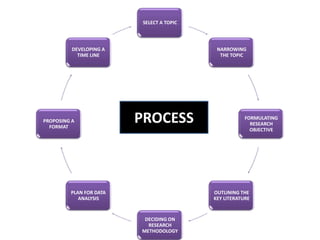
SELECT A TOPIC

DEVELOPING A
TIME LINE

PROPOSING A
FORMAT

NARROWING
THE TOPIC

PROCESS

PLAN FOR DATA
ANALYSIS

FORMULATING
RESEARCH
OBJECTIVE

OUTLINING THE
KEY LITERATURE

DECIDING ON
RESEARCH
METHODOLOGY
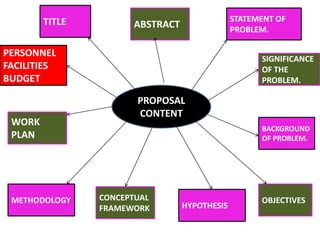
TITLE

STATEMENT OF
PROBLEM.

ABSTRACT

PERSONNEL
FACILITIES
BUDGET

WORK
PLAN

METHODOLOGY

SIGNIFICANCE
OF THE
PROBLEM.

PROPOSAL
CONTENT
BACKGROUND
OF PROBLEM.

CONCEPTUAL
FRAMEWORK

HYPOTHESIS

OBJECTIVES
Title
 It must be specific & concise (<20 words).
 It includes variable , population and
research question.
EXAMPLE:“Effectiveness of SIM on management of
pre-eclampsia of staff nurses working in
maternity ward of PBMH”.
ABSTRACT
•
•
•
•

This includes an outline of your proposal,
Frame of reference for the reviewers.
Research questions or hypothesis, Research
methods and sample.
It should be brief(within 200 words).
STATEMENT OF PROBLEM
• Identified early in the proposal.
• Problem should be realistic, practical,
feasible and significant.
• A broad and complex problem must be
avoided.
Significance of the problem
 Why is this work important?
What are the implications of doing it?
How does it link to other knowledge?
BACKGROUND OF STUDY
• A review of relevant literature.
• Background material should strengthen
author’s argument.
• Orient the reader to what is already known
about the problem.
• Demonstrate the researchers command on
current knowledge.
OBJECTIVE
• It should be specific, realistic &achievable.
• Objective stated as research hypothesis to be
preferred.
• Objectives stated in specific model to be
tested are preferred.
•
METHOD
Research
Approach.

Setting for the
study.

Sample &
sampling
Technique.

Population
under study.

Pilot study.
METHOD
Data
collection.

Data analysis.

Dissemination
of result.

Result
Presentation.

Ethical
Consideration.
WORK PLAN
• It is a sequence of task.
• Step by step plan within time frame.
• It is usually presented in tabular or graphic
form.
PERSONNEL
• Key project personnel should be
described.
• Research competencies of project director
should be stated.
FACILITIES
• Document the facilities required for the
project.
• Physiologic instrumentation, libraries,
computers.
• Willingness of institution.
• Special documents and record.
BUDGET
• Translate the project activities into monitory
term.
• Allocation of expenses in different activities
• Well conceived work plan facilitates
preparation of budget.
FORMAT
• Front page: Title, name of the researcher,
department.
• Second page: content
• Third page: Abstract:
• Fourth – sixth page: with bold
headingsintroduction, Literature review;
hypothesis, methods and materials; data
analysis
• Last page: References: Not more than 10.
DOs and DO NOTs
• DO
 Produce/prepare a professional looking proposa.l
 Make it interesting.
 Make it informative, meaningful.
 Write easy way to read.
 Present content in a page.
 Use clear headings/sub-headings.
 Be concise, precise.
 Check spelling, grammar.
 Present in accurate/acceptable format.
DO NOTs
Use no ward which you do not understand.
Use of difficult ward unimpressive to the
readers/supervisor/authority.
THANK
U

RESEARCH PROPOSAL.

  • 1.
    Research Proposal Why allthis fuss I. Title about a detail proposal for my study before I even begin? Thing are going to II. Introduction change once I get into the study! III. Literature Review That is true. Change are inevitable but a little thought now will save you a lot of grief later on. V. Bibliography VI. Appendix IV. Method * *
  • 2.
    RESEARCH PROPOSAL MRS K.RATH Asst. Prof, (KIIT-DU)
  • 3.
    What is aresearch proposal? A blue print of future activities of a research project. Some sort of preconceived framework for starting the activities. It deals with ideas of researcher about what research he/she wants to do, what objectives and methodology he/she has set, how much time and resources are required to complete it, how the research finding are to be reported, and so on.
  • 4.
    DEFINITION • It isa document written by a researcher that provides a detailed description of the proposed program. • It is the outline of the entire research process. • It is a written document specifying what the investigator proposes to study.
  • 5.
    NEED • It isprerequisite for degree. • Needs approval from the committee to start the work. • It conceives the project. • It impresses the senior as a potential researcher. • It serves as a contract between the researcher and funder. • Personal interest.
  • 6.
    PURPOSES • It givesan opportunity to think through the project. • Provides an outline to guide through the research process. • Let department or faculty know about the plan • Helps the department to choose an appropriate supervisor.
  • 7.
    Cont…. – Gives anopportunity to receive feedback from academic community as well as possible funder. • Undergraduate and graduate students submit proposal to their dissertation committees for approval.
  • 8.
    How to translateyour written notes into a paper • Write an introduction – This section is like a mini literature review. – Written in present tense • Write a method section – This section deals with how you will collect data or information. – Written in future tense
  • 9.
    Cont…. • Write aresults section – This section deals with how you will analyze your result. – Written in future tense.
  • 10.
    Important information forwriting • • • • • • • • Always structure the work in advance. Know what you want to say before writing. Every sentence must contain one idea only. Each sentence must follow logically from the before: chain of ideas. Write in a way that is easy to read. Use simple language. Check spelling and grammar. Do not cut and paste from articles.
  • 11.
    SELECT A TOPIC DEVELOPINGA TIME LINE PROPOSING A FORMAT NARROWING THE TOPIC PROCESS PLAN FOR DATA ANALYSIS FORMULATING RESEARCH OBJECTIVE OUTLINING THE KEY LITERATURE DECIDING ON RESEARCH METHODOLOGY
  • 12.
  • 13.
    Title  It mustbe specific & concise (<20 words).  It includes variable , population and research question. EXAMPLE:“Effectiveness of SIM on management of pre-eclampsia of staff nurses working in maternity ward of PBMH”.
  • 14.
    ABSTRACT • • • • This includes anoutline of your proposal, Frame of reference for the reviewers. Research questions or hypothesis, Research methods and sample. It should be brief(within 200 words).
  • 15.
    STATEMENT OF PROBLEM •Identified early in the proposal. • Problem should be realistic, practical, feasible and significant. • A broad and complex problem must be avoided.
  • 16.
    Significance of theproblem  Why is this work important? What are the implications of doing it? How does it link to other knowledge?
  • 17.
    BACKGROUND OF STUDY •A review of relevant literature. • Background material should strengthen author’s argument. • Orient the reader to what is already known about the problem. • Demonstrate the researchers command on current knowledge.
  • 18.
    OBJECTIVE • It shouldbe specific, realistic &achievable. • Objective stated as research hypothesis to be preferred. • Objectives stated in specific model to be tested are preferred. •
  • 19.
    METHOD Research Approach. Setting for the study. Sample& sampling Technique. Population under study. Pilot study.
  • 20.
  • 21.
    WORK PLAN • Itis a sequence of task. • Step by step plan within time frame. • It is usually presented in tabular or graphic form.
  • 22.
    PERSONNEL • Key projectpersonnel should be described. • Research competencies of project director should be stated.
  • 23.
    FACILITIES • Document thefacilities required for the project. • Physiologic instrumentation, libraries, computers. • Willingness of institution. • Special documents and record.
  • 24.
    BUDGET • Translate theproject activities into monitory term. • Allocation of expenses in different activities • Well conceived work plan facilitates preparation of budget.
  • 25.
    FORMAT • Front page:Title, name of the researcher, department. • Second page: content • Third page: Abstract: • Fourth – sixth page: with bold headingsintroduction, Literature review; hypothesis, methods and materials; data analysis • Last page: References: Not more than 10.
  • 26.
    DOs and DONOTs • DO  Produce/prepare a professional looking proposa.l  Make it interesting.  Make it informative, meaningful.  Write easy way to read.  Present content in a page.  Use clear headings/sub-headings.  Be concise, precise.  Check spelling, grammar.  Present in accurate/acceptable format.
  • 27.
    DO NOTs Use noward which you do not understand. Use of difficult ward unimpressive to the readers/supervisor/authority.
  • 29.