RESEARCH METHODS
Course Outline
Role of research
›  Meaning of RESEARCH?
Meaning of Research
›  Research is:
›  Search / inquisitive for knowledge
›  Systematic scientific investigation on a
specific topic.
›  Systematic effort to gain new knowledge
›  Voyage of discovery
“……………Search for knowledge through objective &
systematic method of finding a solution to a problem”
Meaning of Research
›  Research comprises:
²  Defining & redefining problems
²  Formulating hypothesis or suggested solutions
²  Collecting, organizing & evaluating data
²  Making deductions & reaching conclusions
²  Carefully testing the conclusions to establish
whether they fit to the hypothesis.
Objectives of Research
›  The purpose of research is to discover:
v  Answers to questions through the application of
scientific procedures
²  New knowledge (novelty)
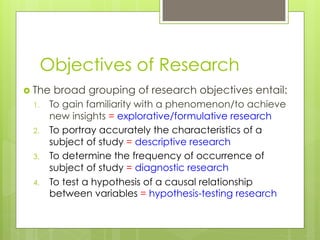
Objectives of Research
›  The broad grouping of research objectives entail:
1.  To gain familiarity with a phenomenon/to achieve
new insights = explorative/formulative research
2.  To portray accurately the characteristics of a
subject of study = descriptive research
3.  To determine the frequency of occurrence of
subject of study = diagnostic research
4.  To test a hypothesis of a causal relationship
between variables = hypothesis-testing research
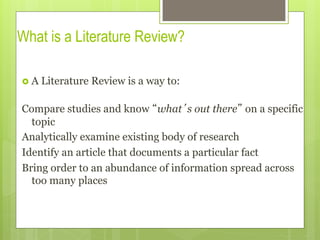
What is a Literature Review?
›  A Literature Review is a way to:
Compare studies and know “what’s out there” on a specific
topic
Analytically examine existing body of research
Identify an article that documents a particular fact
Bring order to an abundance of information spread across
too many places
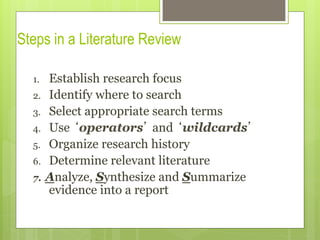
Steps in a Literature Review
1.  Establish research focus
2.  Identify where to search
3.  Select appropriate search terms
4.  Use ‘operators’ and ‘wildcards’
5.  Organize research history
6.  Determine relevant literature
7.  Analyze, Synthesize and Summarize
evidence into a report
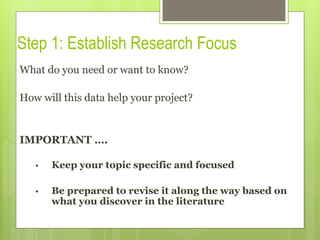
Step 1: Establish Research Focus
What do you need or want to know?
How will this data help your project?
IMPORTANT ….
•  Keep your topic specific and focused
•  Be prepared to revise it along the way based on
what you discover in the literature
Exercise 1
Consider the research topics below and answer the following
questions for each topic:
1. Would you revise this topic?
2. Why or why not? If yes, how?
Research Topics
›  Technology and the youth
›  Homeless youth
›  Emotional distress and mental health service use among adolescents.
Step 2a: Identify Where to Search
›  Academic Literature
›  Books, scholarly journal articles
›  Dissertations
›  Government documents
›  Policy reports
›  Grey Literature
›  Papers published by professional societies
›  Internet search engines: Google.ca or Yahoo.ca
›  Online databases: PsychInfo, Social Service Abstracts,
Medline, ERIC, etc.
Step 2b: Identify Relevant Search Engines
›  Why?
›  To save time and stay focused.
› 
›  Sample sources?:
Step 2c: Secure Database Access
Certain publications are not readily accessible to the public
To secure access to databases you need:
1.  To establish a partnership with a university that has access
to the database
OR
2.  Pay a database search fee
Step 3: Select Appropriate Search Terms
A search term is a term used to find information on your topic
Search terms can include:
•  Key words
Example: For a literature review on
“ Impact of technology on society”
possible key words may include: technology effects,
society, media effects, …… others???
•  Author
•  Title
•  Journal or publication
•  Other descriptors
Where to Find Key Words
›  Reference Books
› 
›  Abstracts
›  Scientific journals
›  Government reports
›  Electronic databases
Focusing Your Key Words
›  Be specific .… expect numerous results!
›  Example:
›  Technology effects (999,000 items)
›  Media reports (898,000 items)
Exercise 2: Key Words
›  You have been asked to design a technology assessment
program. Your search question is:
›  “What are the determinants and consequences
of technology adoption by the youth?
›  What Search Engines and / or databases would you use?
›  Working individually, list 10 key words to search
information on the “determinants and consequences”
for youth who are addicted to technology.
›  Share your answers.
Step 4: Using ‘Operators’ & ‘Wildcards’
›  ‘Wildcards’ are symbols that expand the scope of your
search
›  e.g. (*) patent* -- retrieves patent, patents, patentable,
patented
›  ‘Operators’ define the relationships between words or
groups of words
›  Note:
›  Operators and wildcards vary by search engine to check each database’s Help
section
Examples of ‘Operators’
›  Sample operators:
›  Use AND to narrow search and retrieve records
containing all of the words it separates.
›  Use OR to broaden search and retrieve records
containing any of the words it separates.
›  Use NOT to narrow search and retrieve records that do
not contain the term following it.
›  Use ( ) to select a phrase or groups of words
-  Phrase - (participatory action research)
-  Groups of words – (determinants and consequences) AND
(technology or youth)
Exercise 3: Operators & Wildcards
› Generate a total of 6 operators and 2
wildcards using the search terms you came
up with for the topic of “technology and
youth development”
Step 5: Organizing Your Research
Document your search process:
•  Keep record of all materials examined
•  Keep a record of all Web searches
•  Set a bookmark of the Universal Resource Locator(URL)
for commonly used web sites
•  Record key words used for electronic searches
•  Print home pages of the web sites
•  Photocopy journal articles, book chapters and other
materials
•  Organize information using a “Review Matrix”
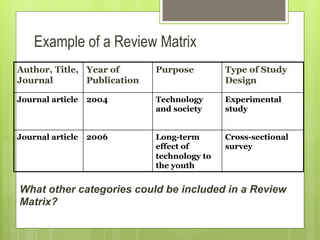
Example of a Review Matrix
Author, Title,
Journal
Year of
Publication
Purpose Type of Study
Design
Journal article 2004 Technology
and society
Experimental
study
Journal article 2006 Long-term
effect of
technology to
the youth
Cross-sectional
survey
What other categories could be included in a Review
Matrix?
Step 6: Determine Relevant Literature
›  To determine what is relevant literature:
›  Check article abstracts for summaries of research design and
findings instead of reading entire article
›  Consider type of measurement and analysis
›  Consider contribution of the article/research to the field
›  Does it help you know what to do or what not to do in your
study?
Exercise 4: Review of Abstract
› Using the sample abstract entitled, “Technology
adoption …..”.
Review the abstract and answer the questions below:
›  1. What were the issues discussed by the
researchers?
›  2. What methods did they use?
›  3. What were the results?
›  4. Are there any missing or inadequate topics?
Step 7: Analyze, Synthesize & Summarize Evidence
into a Report
›  Briefly summarize findings
›  Synthesize literature by identifying common themes
›  Differentiate b/w what is “known” and “not known”
›  Identify topics of debate
›  Evaluate and analyze findings
›  Identify relevance of data to your research project
›  Remember:
Reference all citations & create a bibliography
Ways to Structure Your Review
›  Chronological
›  Topical or thematic organization
›  Inverted pyramid organization (broad to narrow)
What is a Good Literature Review?
›  A good literature review:
›  Includes a clear research question or purpose
›  Makes an argument for the necessity of your research
and/or service, program, etc.
›  Explains methods and theories if review is to be used for
a larger study or program
›  Describes search methodology
- databases, search terms, etc.
›  Is thorough (include classic studies and a range of
literature, not just studies that make your point)
›  Is well-organized, clear and concise
Final Tip!
›  Last but not least…
›  Get help when you need it...
›  Librarians are an excellent & amazing resource:
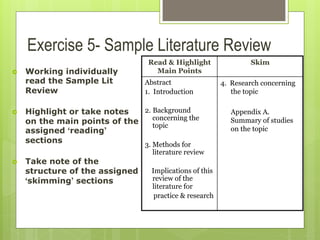
Exercise 5- Sample Literature Review
›  Working individually
read the Sample Lit
Review
›  Highlight or take notes
on the main points of the
assigned ‘reading’
sections
›  Take note of the
structure of the assigned
‘skimming’ sections
Read & Highlight
Main Points
Skim
Abstract
1. Introduction
2. Background
concerning the
topic
3. Methods for
literature review
Implications of this
review of the
literature for
practice & research
4. Research concerning
the topic
Appendix A.
Summary of studies
on the topic
Exercise 5- Sample Literature Review Cont’d …
› Once previous steps are complete, answer the following
questions for your ‘assigned section’ *. Be prepared to
present your findings to the class.
1.  How is your section organized?
2.  What are the key points?
3.  How does it fit in with the rest of the literature
review?
4.  Was it clear and understandable?
5.  Other thoughts about it?
› 
Debrief of the Literature Review
›  What did you think of the literature review overall?
›  Any surprises?
›  What are its strengths? What could be improved?
›  In what ways do you think your own literature review
would be similar or different from this one?
Review of Lesson Objectives
›  Upon completion of this lesson you will be able to:
›  Explain the value and purpose of a literature review
›  Describe the steps involved in doing a Literature
Review
›  Identify the sources of “literature”
›  Use various techniques to conduct an efficient &
concise search
›  Synthesize your findings to produce a report /
literature review

Research methods l1 3

  • 1.
  • 2.
    Role of research › Meaning of RESEARCH?
  • 3.
    Meaning of Research › Research is: ›  Search / inquisitive for knowledge ›  Systematic scientific investigation on a specific topic. ›  Systematic effort to gain new knowledge ›  Voyage of discovery “……………Search for knowledge through objective & systematic method of finding a solution to a problem”
  • 4.
    Meaning of Research › Research comprises: ²  Defining & redefining problems ²  Formulating hypothesis or suggested solutions ²  Collecting, organizing & evaluating data ²  Making deductions & reaching conclusions ²  Carefully testing the conclusions to establish whether they fit to the hypothesis.
  • 5.
    Objectives of Research › The purpose of research is to discover: v  Answers to questions through the application of scientific procedures ²  New knowledge (novelty)
  • 6.
    Objectives of Research › The broad grouping of research objectives entail: 1.  To gain familiarity with a phenomenon/to achieve new insights = explorative/formulative research 2.  To portray accurately the characteristics of a subject of study = descriptive research 3.  To determine the frequency of occurrence of subject of study = diagnostic research 4.  To test a hypothesis of a causal relationship between variables = hypothesis-testing research
  • 7.
    What is aLiterature Review? ›  A Literature Review is a way to: Compare studies and know “what’s out there” on a specific topic Analytically examine existing body of research Identify an article that documents a particular fact Bring order to an abundance of information spread across too many places
  • 8.
    Steps in aLiterature Review 1.  Establish research focus 2.  Identify where to search 3.  Select appropriate search terms 4.  Use ‘operators’ and ‘wildcards’ 5.  Organize research history 6.  Determine relevant literature 7.  Analyze, Synthesize and Summarize evidence into a report
  • 9.
    Step 1: EstablishResearch Focus What do you need or want to know? How will this data help your project? IMPORTANT …. •  Keep your topic specific and focused •  Be prepared to revise it along the way based on what you discover in the literature
  • 10.
    Exercise 1 Consider theresearch topics below and answer the following questions for each topic: 1. Would you revise this topic? 2. Why or why not? If yes, how? Research Topics ›  Technology and the youth ›  Homeless youth ›  Emotional distress and mental health service use among adolescents.
  • 11.
    Step 2a: IdentifyWhere to Search ›  Academic Literature ›  Books, scholarly journal articles ›  Dissertations ›  Government documents ›  Policy reports ›  Grey Literature ›  Papers published by professional societies ›  Internet search engines: Google.ca or Yahoo.ca ›  Online databases: PsychInfo, Social Service Abstracts, Medline, ERIC, etc.
  • 12.
    Step 2b: IdentifyRelevant Search Engines ›  Why? ›  To save time and stay focused. ›  ›  Sample sources?:
  • 13.
    Step 2c: SecureDatabase Access Certain publications are not readily accessible to the public To secure access to databases you need: 1.  To establish a partnership with a university that has access to the database OR 2.  Pay a database search fee
  • 14.
    Step 3: SelectAppropriate Search Terms A search term is a term used to find information on your topic Search terms can include: •  Key words Example: For a literature review on “ Impact of technology on society” possible key words may include: technology effects, society, media effects, …… others??? •  Author •  Title •  Journal or publication •  Other descriptors
  • 15.
    Where to FindKey Words ›  Reference Books ›  ›  Abstracts ›  Scientific journals ›  Government reports ›  Electronic databases
  • 16.
    Focusing Your KeyWords ›  Be specific .… expect numerous results! ›  Example: ›  Technology effects (999,000 items) ›  Media reports (898,000 items)
  • 17.
    Exercise 2: KeyWords ›  You have been asked to design a technology assessment program. Your search question is: ›  “What are the determinants and consequences of technology adoption by the youth? ›  What Search Engines and / or databases would you use? ›  Working individually, list 10 key words to search information on the “determinants and consequences” for youth who are addicted to technology. ›  Share your answers.
  • 18.
    Step 4: Using‘Operators’ & ‘Wildcards’ ›  ‘Wildcards’ are symbols that expand the scope of your search ›  e.g. (*) patent* -- retrieves patent, patents, patentable, patented ›  ‘Operators’ define the relationships between words or groups of words ›  Note: ›  Operators and wildcards vary by search engine to check each database’s Help section
  • 19.
    Examples of ‘Operators’ › Sample operators: ›  Use AND to narrow search and retrieve records containing all of the words it separates. ›  Use OR to broaden search and retrieve records containing any of the words it separates. ›  Use NOT to narrow search and retrieve records that do not contain the term following it. ›  Use ( ) to select a phrase or groups of words -  Phrase - (participatory action research) -  Groups of words – (determinants and consequences) AND (technology or youth)
  • 20.
    Exercise 3: Operators& Wildcards › Generate a total of 6 operators and 2 wildcards using the search terms you came up with for the topic of “technology and youth development”
  • 21.
    Step 5: OrganizingYour Research Document your search process: •  Keep record of all materials examined •  Keep a record of all Web searches •  Set a bookmark of the Universal Resource Locator(URL) for commonly used web sites •  Record key words used for electronic searches •  Print home pages of the web sites •  Photocopy journal articles, book chapters and other materials •  Organize information using a “Review Matrix”
  • 22.
    Example of aReview Matrix Author, Title, Journal Year of Publication Purpose Type of Study Design Journal article 2004 Technology and society Experimental study Journal article 2006 Long-term effect of technology to the youth Cross-sectional survey What other categories could be included in a Review Matrix?
  • 23.
    Step 6: DetermineRelevant Literature ›  To determine what is relevant literature: ›  Check article abstracts for summaries of research design and findings instead of reading entire article ›  Consider type of measurement and analysis ›  Consider contribution of the article/research to the field ›  Does it help you know what to do or what not to do in your study?
  • 24.
    Exercise 4: Reviewof Abstract › Using the sample abstract entitled, “Technology adoption …..”. Review the abstract and answer the questions below: ›  1. What were the issues discussed by the researchers? ›  2. What methods did they use? ›  3. What were the results? ›  4. Are there any missing or inadequate topics?
  • 25.
    Step 7: Analyze,Synthesize & Summarize Evidence into a Report ›  Briefly summarize findings ›  Synthesize literature by identifying common themes ›  Differentiate b/w what is “known” and “not known” ›  Identify topics of debate ›  Evaluate and analyze findings ›  Identify relevance of data to your research project ›  Remember: Reference all citations & create a bibliography
  • 26.
    Ways to StructureYour Review ›  Chronological ›  Topical or thematic organization ›  Inverted pyramid organization (broad to narrow)
  • 27.
    What is aGood Literature Review? ›  A good literature review: ›  Includes a clear research question or purpose ›  Makes an argument for the necessity of your research and/or service, program, etc. ›  Explains methods and theories if review is to be used for a larger study or program ›  Describes search methodology - databases, search terms, etc. ›  Is thorough (include classic studies and a range of literature, not just studies that make your point) ›  Is well-organized, clear and concise
  • 28.
    Final Tip! ›  Lastbut not least… ›  Get help when you need it... ›  Librarians are an excellent & amazing resource:
  • 29.
    Exercise 5- SampleLiterature Review ›  Working individually read the Sample Lit Review ›  Highlight or take notes on the main points of the assigned ‘reading’ sections ›  Take note of the structure of the assigned ‘skimming’ sections Read & Highlight Main Points Skim Abstract 1. Introduction 2. Background concerning the topic 3. Methods for literature review Implications of this review of the literature for practice & research 4. Research concerning the topic Appendix A. Summary of studies on the topic
  • 30.
    Exercise 5- SampleLiterature Review Cont’d … › Once previous steps are complete, answer the following questions for your ‘assigned section’ *. Be prepared to present your findings to the class. 1.  How is your section organized? 2.  What are the key points? 3.  How does it fit in with the rest of the literature review? 4.  Was it clear and understandable? 5.  Other thoughts about it? › 
  • 31.
    Debrief of theLiterature Review ›  What did you think of the literature review overall? ›  Any surprises? ›  What are its strengths? What could be improved? ›  In what ways do you think your own literature review would be similar or different from this one?
  • 32.
    Review of LessonObjectives ›  Upon completion of this lesson you will be able to: ›  Explain the value and purpose of a literature review ›  Describe the steps involved in doing a Literature Review ›  Identify the sources of “literature” ›  Use various techniques to conduct an efficient & concise search ›  Synthesize your findings to produce a report / literature review