Level 3: Independent Study Writing Your Proposal
Today’s Session Purposes of the ISPs Core elements and criteria for success Research Questions in ISPs Literature Reviews in ISPs Methodologies in ISPs Time Frames
Why a research proposal? To convince your supervisor and/or external examiner of the value of the study To demonstrate initial expertise To demonstrate competency To serve as a ‘contract’ To assist  you  as a planning tool
Core components A description of the research question/problem/creative enterprise An indication of why this is important/relevant to communication A preliminary survey/review of relevant literature A description of the proposed methodology A time frame
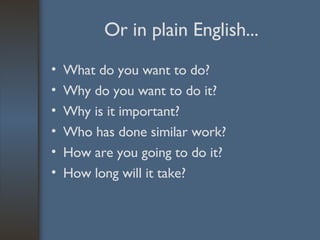
Or in plain English... What do you want to do? Why do you want to do it? Why is it important? Who has done similar work? How are you going to do it? How long will it take?
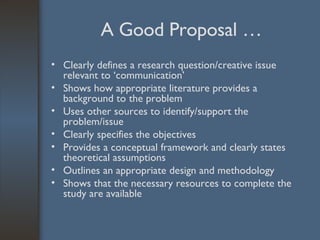
A Good Proposal … Clearly defines a research question/creative issue relevant to ‘communication’ Shows how appropriate literature provides a background to the problem Uses other sources to identify/support the problem/issue Clearly specifies the objectives Provides a conceptual framework and clearly states theoretical assumptions Outlines an appropriate design and methodology Shows that the necessary resources to complete the study are available
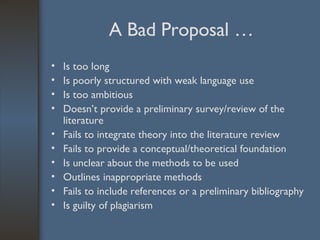
A Bad Proposal … Is too long Is poorly structured with weak language use Is too ambitious Doesn’t provide a preliminary survey/review of the literature Fails to integrate theory into the literature review Fails to provide a conceptual/theoretical foundation Is unclear about the methods to be used  Outlines inappropriate methods Fails to include references or a preliminary bibliography Is guilty of plagiarism
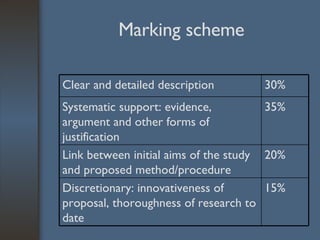
Marking scheme 15% Discretionary: innovativeness of proposal, thoroughness of research to date 20% Link between initial aims of the study and proposed method/procedure 35% Systematic support: evidence, argument and other forms of justification 30% Clear and detailed description
Finding a Question Observation of the world Concern with theory Previous research Practical concerns Personal interest
Choosing a Question A broad area of study is not a research question Draw up a list of possible questions Examine the advantages and disadvantages of each Show evidence in the proposal that you have considered the issues
Strategies The question interests you It is neither too extensive nor too limited to be of value You have the resources/skills to explore it You are aware of the theoretical background which informs the question It is ‘researchable’
Limiting a Question: Definitions Define your terms Define the use of those terms in different disciplines Think about your reader Don’t provide ‘dictionary’ definitions
Limiting a Question: Boundaries Make it clear what you  are  going to study and what you are  not  going to study Specify limits to space, time, size, approach etc.
Why Review the Literature? A preliminary review positions your study in a conceptual framework It provides an overview of the area for the reader It may clarify the research question/area Shows evidence of reading  ->  interest  ->   commitment to the study
How to do the review Survey a range of relevant literature in the general area of your study This literature should be academic not journalistic to add to the credibility of your study Select from that survey literature which informs your research question/problem/issue Show you have understood the issues by synthesing the findings into the proposal A good review provides an argument
How  not  to do the review Show no evidence of reading Fail to include a preliminary bibliography Describe a number of books/articles you have read without showing how they connect to each other or to your study Plagiarize from the back cover of books or from Amazon
Why a methodology? It shows the reader what you are going to do in order to answer your research question/explore your issue including materials and methods It shows you are considering the nature of appropriate methodology for the question you are interested in It demonstrates that you are capable of answering the question
How to write the methodology Think about the question and how it might be answered  Think about how the artifact you make reflects on the nature of the issues you identified Examine the ways that data could be generated Examine the ways that such data could be analysed
Why a Time Frame? It helps you to plan It helps you to stay focused It acts as a disciplinary mechanism It acts as part of the contract between you and your supervisor But remember there is a tendency to be over-ambitious. Time frames change. Showing how you deal with such changes is a measure of your research competence.
How to do a Time Frame? Month by month plan Tasks list Updated lists Logs Link to research diary Note: non-submission of the research diary will incur a 30% penalty. In conjunction with your supervisor.
Using a Blog as a Research Diary Web logs (known as blogs) are free online journals which can be used to: Make notes Develop arguments Exchange ideas Stick & paste thoughts/links Some advantages Chronological archive Immediate response Community of learners – network of resources Examples http:// cmcgoun.wordpress.com
Conclusion Word length – 1500 words The proposal contributes  10%  of your final mark for the Independent Study Submission is a requirement for the successful completion of the unit. See Calendar  for the   submission date for the proposal  See Calendar  for the submission date for the completed Independent Study project See supervisors pages  for information on who is available and what their research interests are
To do … Identify possible supervisors Arrange preliminary tutorials – present your work to date – record feedback, suggestions Complete and submit the supervision agreement form  (See Calendar)  to the Inter-professional Programmes Office

Writing The Proposal

  • 1.
    Level 3: IndependentStudy Writing Your Proposal
  • 2.
    Today’s Session Purposesof the ISPs Core elements and criteria for success Research Questions in ISPs Literature Reviews in ISPs Methodologies in ISPs Time Frames
  • 3.
    Why a researchproposal? To convince your supervisor and/or external examiner of the value of the study To demonstrate initial expertise To demonstrate competency To serve as a ‘contract’ To assist you as a planning tool
  • 4.
    Core components Adescription of the research question/problem/creative enterprise An indication of why this is important/relevant to communication A preliminary survey/review of relevant literature A description of the proposed methodology A time frame
  • 5.
    Or in plainEnglish... What do you want to do? Why do you want to do it? Why is it important? Who has done similar work? How are you going to do it? How long will it take?
  • 6.
    A Good Proposal… Clearly defines a research question/creative issue relevant to ‘communication’ Shows how appropriate literature provides a background to the problem Uses other sources to identify/support the problem/issue Clearly specifies the objectives Provides a conceptual framework and clearly states theoretical assumptions Outlines an appropriate design and methodology Shows that the necessary resources to complete the study are available
  • 7.
    A Bad Proposal… Is too long Is poorly structured with weak language use Is too ambitious Doesn’t provide a preliminary survey/review of the literature Fails to integrate theory into the literature review Fails to provide a conceptual/theoretical foundation Is unclear about the methods to be used Outlines inappropriate methods Fails to include references or a preliminary bibliography Is guilty of plagiarism
  • 8.
    Marking scheme 15%Discretionary: innovativeness of proposal, thoroughness of research to date 20% Link between initial aims of the study and proposed method/procedure 35% Systematic support: evidence, argument and other forms of justification 30% Clear and detailed description
  • 9.
    Finding a QuestionObservation of the world Concern with theory Previous research Practical concerns Personal interest
  • 10.
    Choosing a QuestionA broad area of study is not a research question Draw up a list of possible questions Examine the advantages and disadvantages of each Show evidence in the proposal that you have considered the issues
  • 11.
    Strategies The questioninterests you It is neither too extensive nor too limited to be of value You have the resources/skills to explore it You are aware of the theoretical background which informs the question It is ‘researchable’
  • 12.
    Limiting a Question:Definitions Define your terms Define the use of those terms in different disciplines Think about your reader Don’t provide ‘dictionary’ definitions
  • 13.
    Limiting a Question:Boundaries Make it clear what you are going to study and what you are not going to study Specify limits to space, time, size, approach etc.
  • 14.
    Why Review theLiterature? A preliminary review positions your study in a conceptual framework It provides an overview of the area for the reader It may clarify the research question/area Shows evidence of reading -> interest -> commitment to the study
  • 15.
    How to dothe review Survey a range of relevant literature in the general area of your study This literature should be academic not journalistic to add to the credibility of your study Select from that survey literature which informs your research question/problem/issue Show you have understood the issues by synthesing the findings into the proposal A good review provides an argument
  • 16.
    How not to do the review Show no evidence of reading Fail to include a preliminary bibliography Describe a number of books/articles you have read without showing how they connect to each other or to your study Plagiarize from the back cover of books or from Amazon
  • 17.
    Why a methodology?It shows the reader what you are going to do in order to answer your research question/explore your issue including materials and methods It shows you are considering the nature of appropriate methodology for the question you are interested in It demonstrates that you are capable of answering the question
  • 18.
    How to writethe methodology Think about the question and how it might be answered Think about how the artifact you make reflects on the nature of the issues you identified Examine the ways that data could be generated Examine the ways that such data could be analysed
  • 19.
    Why a TimeFrame? It helps you to plan It helps you to stay focused It acts as a disciplinary mechanism It acts as part of the contract between you and your supervisor But remember there is a tendency to be over-ambitious. Time frames change. Showing how you deal with such changes is a measure of your research competence.
  • 20.
    How to doa Time Frame? Month by month plan Tasks list Updated lists Logs Link to research diary Note: non-submission of the research diary will incur a 30% penalty. In conjunction with your supervisor.
  • 21.
    Using a Blogas a Research Diary Web logs (known as blogs) are free online journals which can be used to: Make notes Develop arguments Exchange ideas Stick & paste thoughts/links Some advantages Chronological archive Immediate response Community of learners – network of resources Examples http:// cmcgoun.wordpress.com
  • 22.
    Conclusion Word length– 1500 words The proposal contributes 10% of your final mark for the Independent Study Submission is a requirement for the successful completion of the unit. See Calendar for the submission date for the proposal See Calendar for the submission date for the completed Independent Study project See supervisors pages for information on who is available and what their research interests are
  • 23.
    To do …Identify possible supervisors Arrange preliminary tutorials – present your work to date – record feedback, suggestions Complete and submit the supervision agreement form (See Calendar) to the Inter-professional Programmes Office