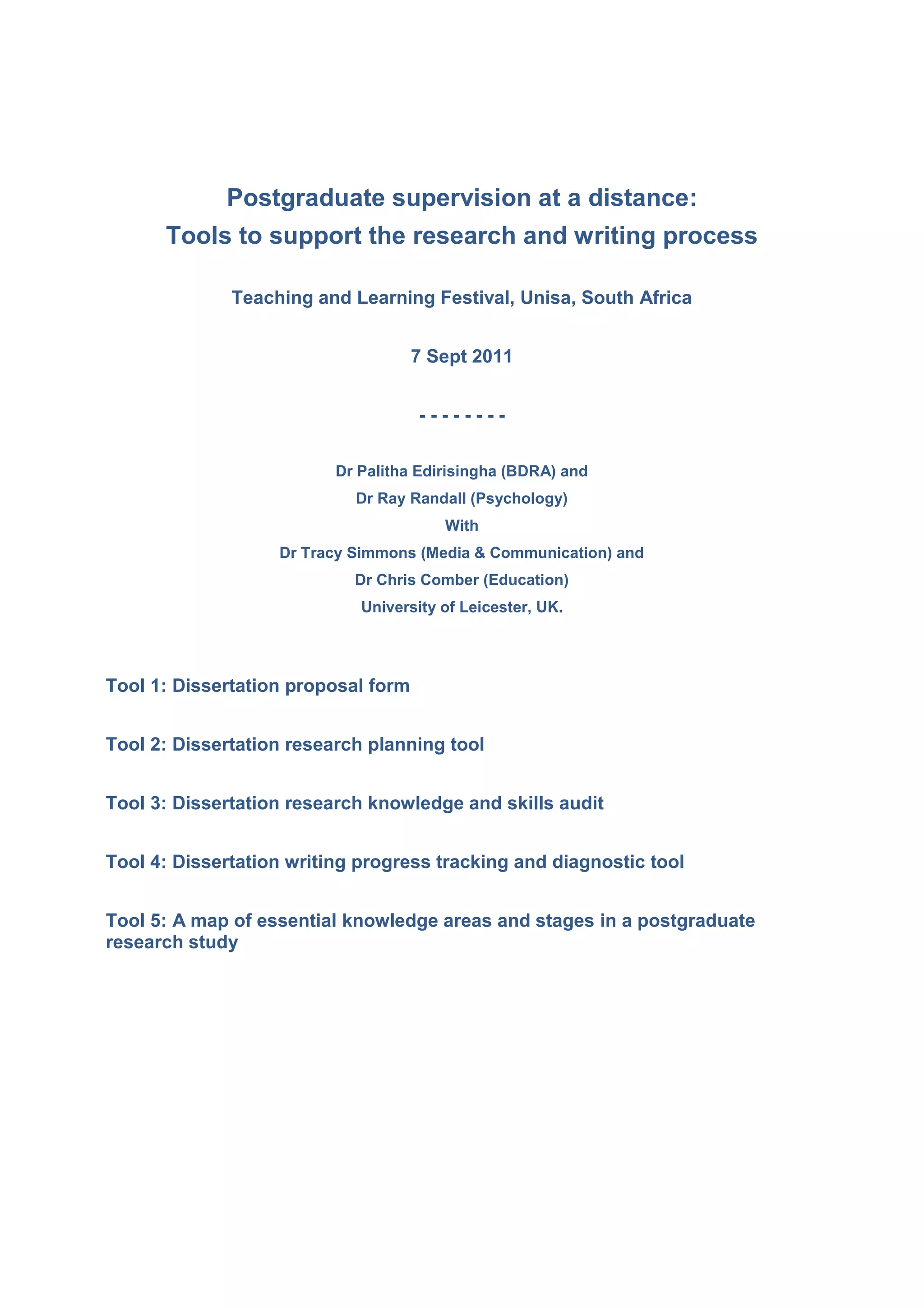
Postgraduate supervision at a distance:
      Tools to support the research and writing process

              Teaching and Learning Festival, Unisa, South Africa


                                     7 Sept 2011


                                     --------

                          Dr Palitha Edirisingha (BDRA) and
                            Dr Ray Randall (Psychology)
                                        With
                   Dr Tracy Simmons (Media & Communication) and
                            Dr Chris Comber (Education)
                             University of Leicester, UK.


Tool 1: Dissertation proposal form


Tool 2: Dissertation research planning tool


Tool 3: Dissertation research knowledge and skills audit


Tool 4: Dissertation writing progress tracking and diagnostic tool


Tool 5: A map of essential knowledge areas and stages in a postgraduate
research study
Tool 1: Dissertation Proposal Form


                                     <course / programme title>


                                     Dissertation Proposal Form
                          Please complete this form and send it to your tutor.
                         Deadline for Submission of Proposal [date as relevant]
                        This must be accompanied by the Ethical Approval Form


Rationale for the study
Personal professional: (Why
is this area of study
important/relevant to you?)


Educational: (What is the
nature and importance of the
educational problem/issue
that you wish to investigate?)


Academic: (What is the ‘gap
in the literature’ that the
study seeks to fill?)


Provisional Research
Questions: (normally three
or four)


Key educational concepts
on which your assignment
will draw


Key texts to be used


Key educational
theories/concepts on
which your dissertation
will draw
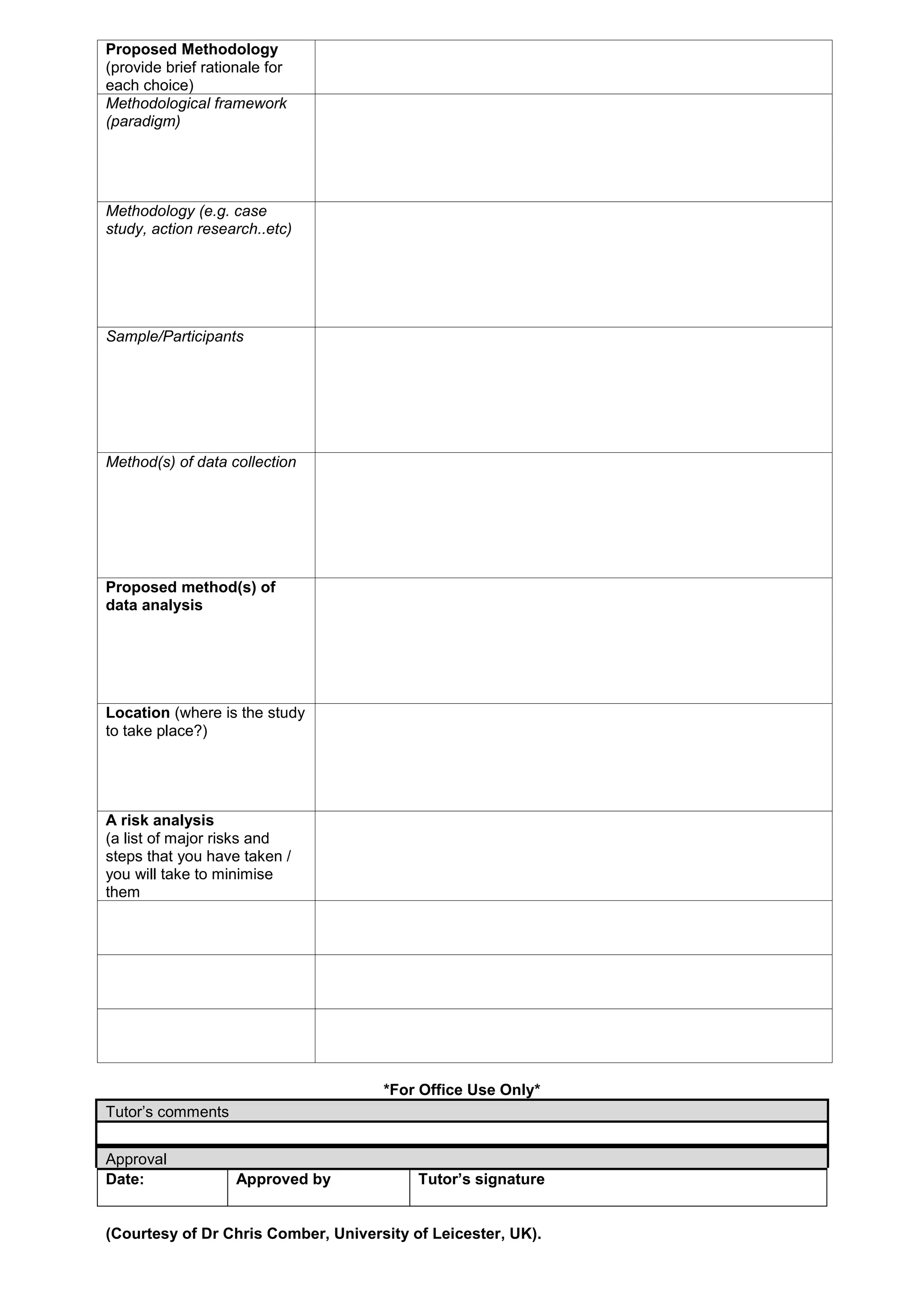
Proposed Methodology
(provide brief rationale for
each choice)
Methodological framework
(paradigm)


Methodology (e.g. case
study, action research..etc)


Sample/Participants


Method(s) of data collection


Proposed method(s) of
data analysis


Location (where is the study
to take place?)


A risk analysis
(a list of major risks and
steps that you have taken /
you will take to minimise
them


                                     *For Office Use Only*
Tutor’s comments


Approval
Date:               Approved by           Tutor’s signature


(Courtesy of Dr Chris Comber, University of Leicester, UK).
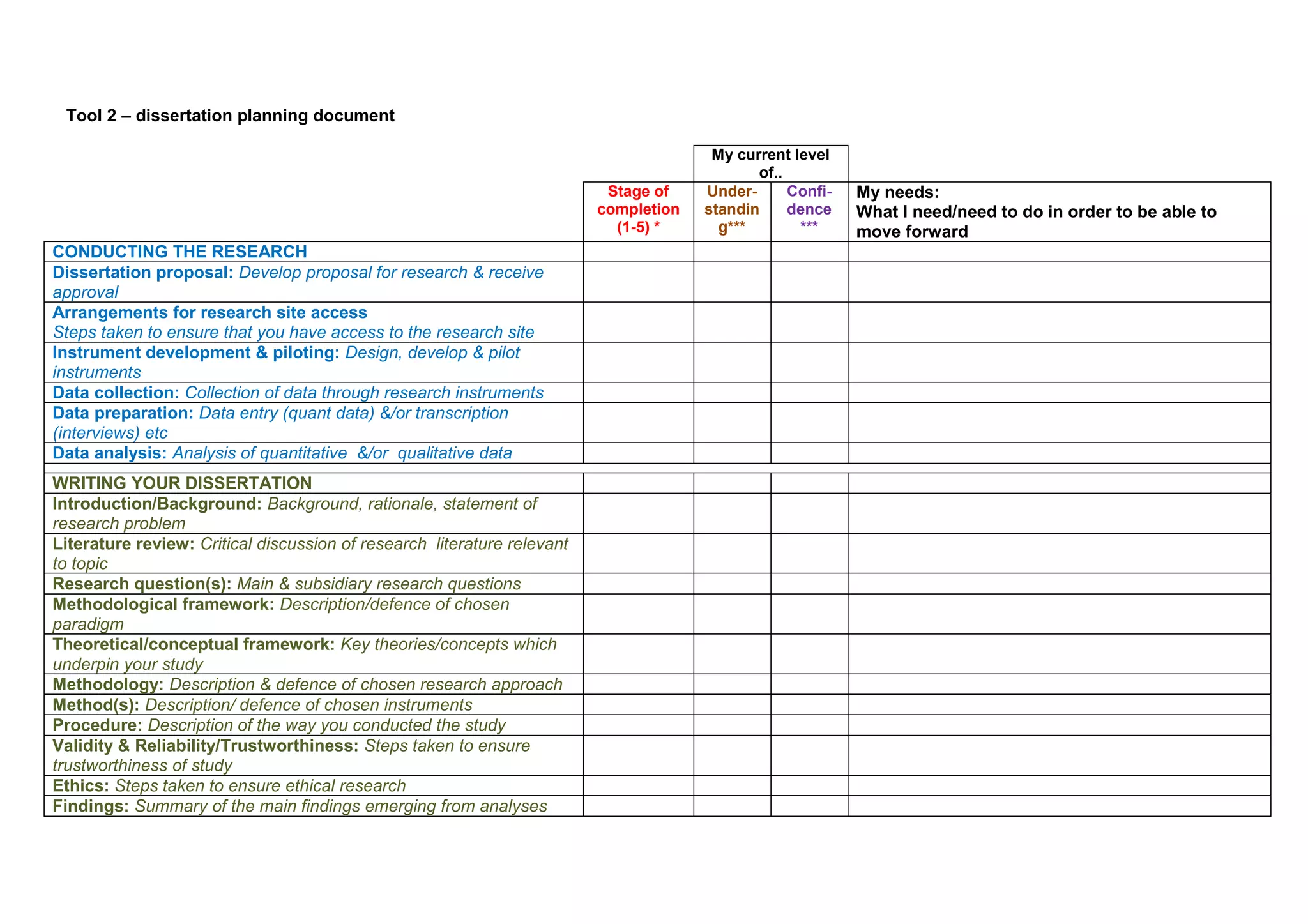
Tool 2 – dissertation planning document

                                                                                       My current level
                                                                                             of..
                                                                          Stage of    Under-      Confi-   My needs:
                                                                         completion   standin     dence    What I need/need to do in order to be able to
                                                                           (1-5) *      g***       ***     move forward
CONDUCTING THE RESEARCH
Dissertation proposal: Develop proposal for research & receive
approval
Arrangements for research site access
Steps taken to ensure that you have access to the research site
Instrument development & piloting: Design, develop & pilot
instruments
Data collection: Collection of data through research instruments
Data preparation: Data entry (quant data) &/or transcription
(interviews) etc
Data analysis: Analysis of quantitative &/or qualitative data
WRITING YOUR DISSERTATION
Introduction/Background: Background, rationale, statement of
research problem
Literature review: Critical discussion of research literature relevant
to topic
Research question(s): Main & subsidiary research questions
Methodological framework: Description/defence of chosen
paradigm
Theoretical/conceptual framework: Key theories/concepts which
underpin your study
Methodology: Description & defence of chosen research approach
Method(s): Description/ defence of chosen instruments
Procedure: Description of the way you conducted the study
Validity & Reliability/Trustworthiness: Steps taken to ensure
trustworthiness of study
Ethics: Steps taken to ensure ethical research
Findings: Summary of the main findings emerging from analyses
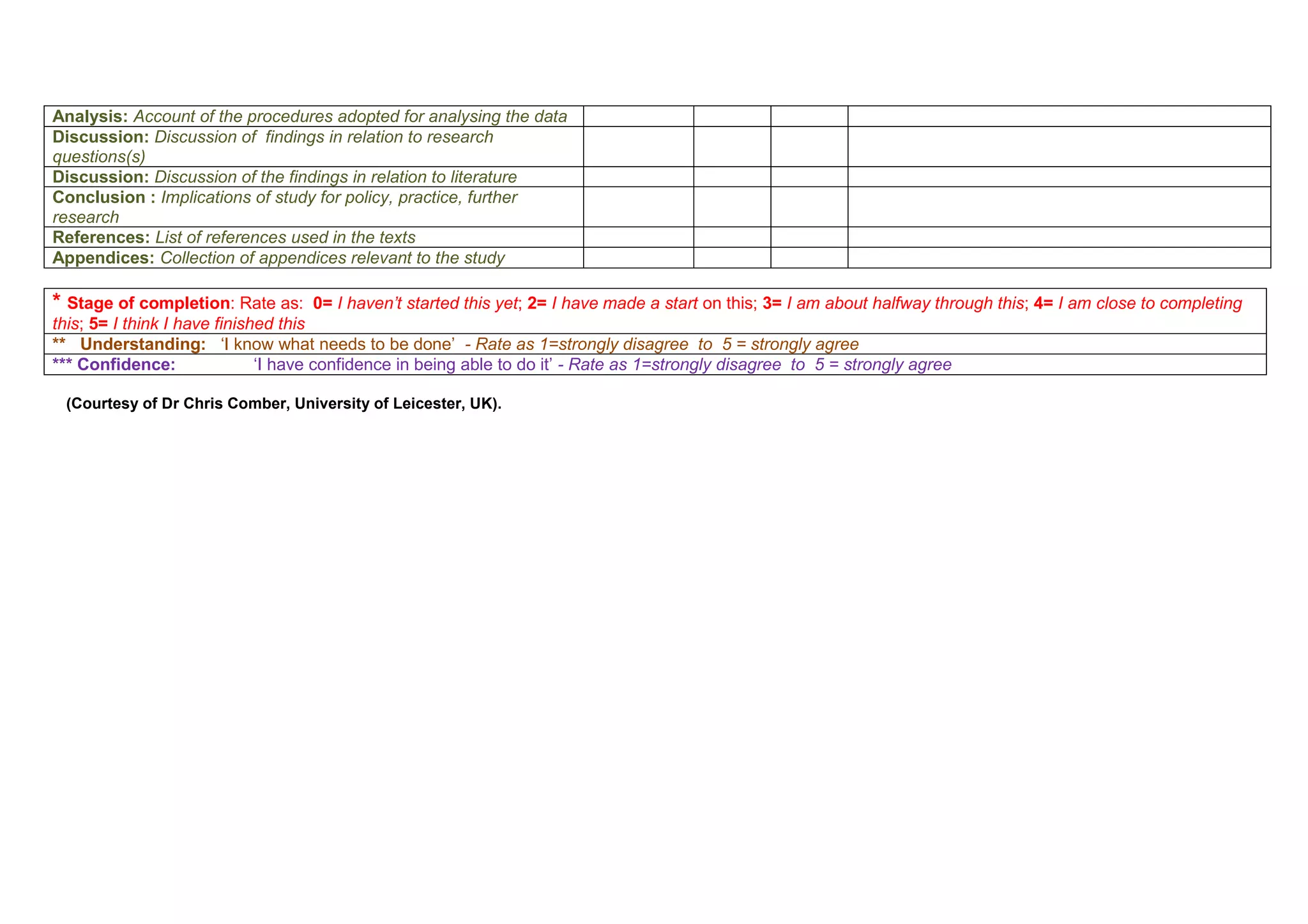
Analysis: Account of the procedures adopted for analysing the data
Discussion: Discussion of findings in relation to research
questions(s)
Discussion: Discussion of the findings in relation to literature
Conclusion : Implications of study for policy, practice, further
research
References: List of references used in the texts
Appendices: Collection of appendices relevant to the study

* Stage of completion: Rate as:    0= I haven’t started this yet; 2= I have made a start on this; 3= I am about halfway through this; 4= I am close to completing
this; 5= I think I have finished this
** Understanding: ‘I know what needs to be done’ - Rate as 1=strongly disagree to 5 = strongly agree
*** Confidence:               ‘I have confidence in being able to do it’ - Rate as 1=strongly disagree to 5 = strongly agree

 (Courtesy of Dr Chris Comber, University of Leicester, UK).
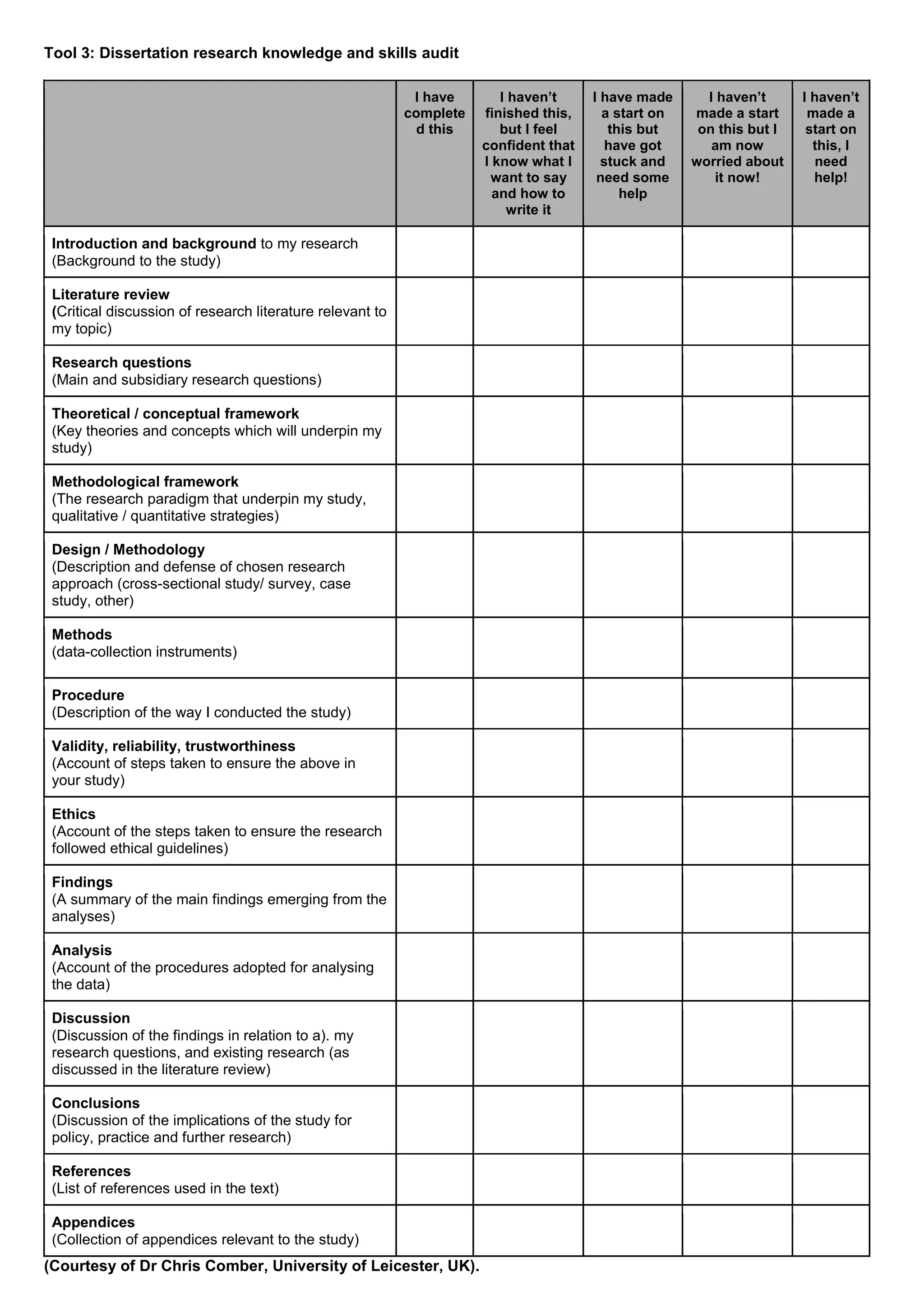
Tool 3: Dissertation research knowledge and skills audit

                                                            I have       I haven’t     I have made      I haven’t      I haven’t
                                                           complete   finished this,     a start on   made a start      made a
                                                             d this      but I feel       this but     on this but I    start on
                                                                      confident that      have got       am now          this, I
                                                                      I know what I      stuck and    worried about       need
                                                                       want to say      need some        it now!         help!
                                                                        and how to          help
                                                                          write it

 Introduction and background to my research
 (Background to the study)

 Literature review
 (Critical discussion of research literature relevant to
 my topic)

 Research questions
 (Main and subsidiary research questions)

 Theoretical / conceptual framework
 (Key theories and concepts which will underpin my
 study)

 Methodological framework
 (The research paradigm that underpin my study,
 qualitative / quantitative strategies)

 Design / Methodology
 (Description and defense of chosen research
 approach (cross-sectional study/ survey, case
 study, other)

 Methods
 (data-collection instruments)

 Procedure
 (Description of the way I conducted the study)

 Validity, reliability, trustworthiness
 (Account of steps taken to ensure the above in
 your study)

 Ethics
 (Account of the steps taken to ensure the research
 followed ethical guidelines)

 Findings
 (A summary of the main findings emerging from the
 analyses)

 Analysis
 (Account of the procedures adopted for analysing
 the data)

 Discussion
 (Discussion of the findings in relation to a). my
 research questions, and existing research (as
 discussed in the literature review)

 Conclusions
 (Discussion of the implications of the study for
 policy, practice and further research)

 References
 (List of references used in the text)

 Appendices
 (Collection of appendices relevant to the study)
(Courtesy of Dr Chris Comber, University of Leicester, UK).
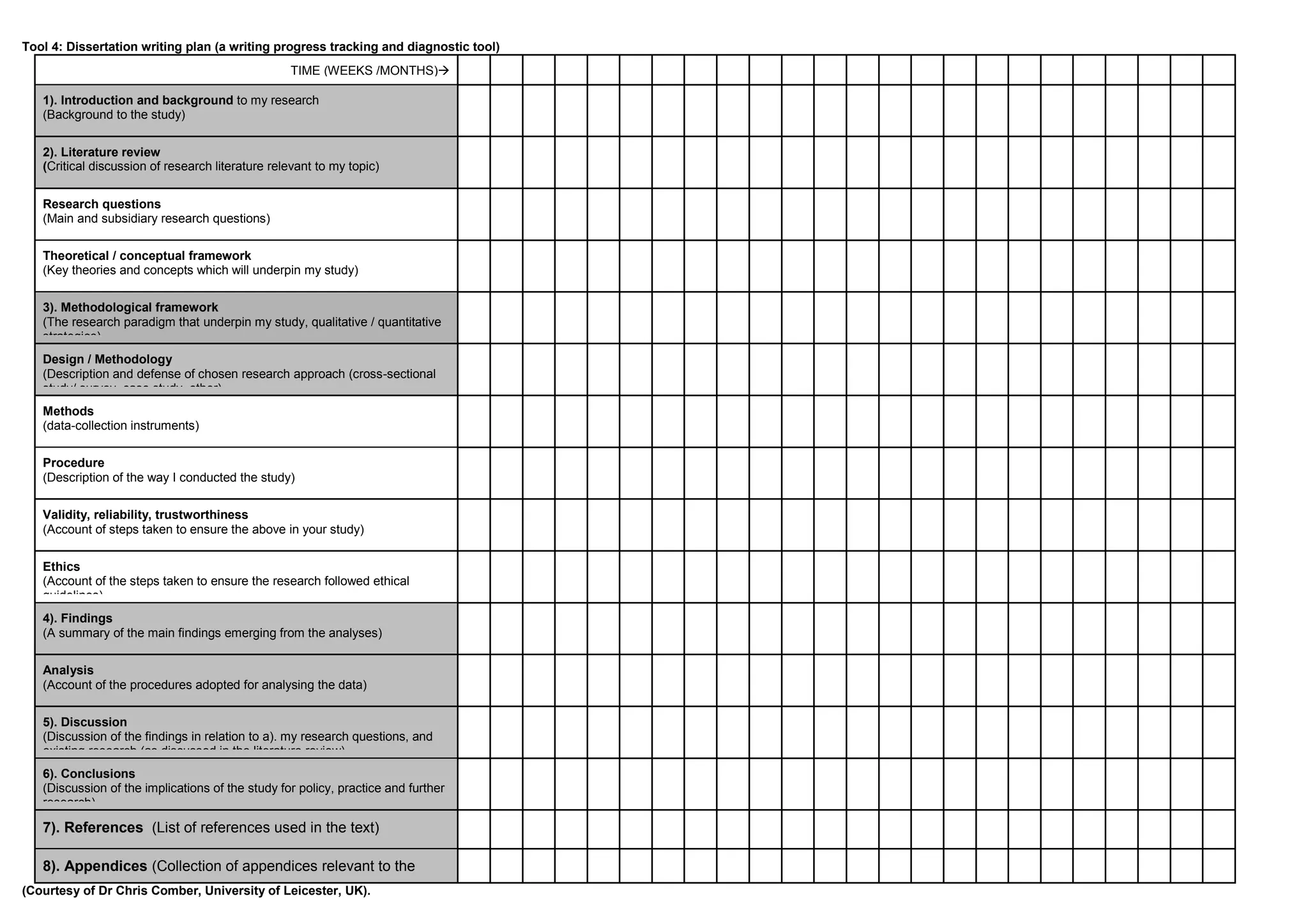
Tool 4: Dissertation writing plan (a writing progress tracking and diagnostic tool)
                                                  TIME (WEEKS /MONTHS)

   1). Introduction and background to my research
   (Background to the study)


   2). Literature review
   (Critical discussion of research literature relevant to my topic)


   Research questions
   (Main and subsidiary research questions)

   Theoretical / conceptual framework
   (Key theories and concepts which will underpin my study)

   3). Methodological framework
   (The research paradigm that underpin my study, qualitative / quantitative
   strategies)
   Design / Methodology
   (Description and defense of chosen research approach (cross-sectional
   study/ survey, case study, other)
   Methods
   (data-collection instruments)

   Procedure
   (Description of the way I conducted the study)

   Validity, reliability, trustworthiness
   (Account of steps taken to ensure the above in your study)

   Ethics
   (Account of the steps taken to ensure the research followed ethical
   guidelines)
   4). Findings
   (A summary of the main findings emerging from the analyses)

   Analysis
   (Account of the procedures adopted for analysing the data)

   5). Discussion
   (Discussion of the findings in relation to a). my research questions, and
   existing research (as discussed in the literature review)
   6). Conclusions
   (Discussion of the implications of the study for policy, practice and further
   research)

   7). References (List of references used in the text)

   8). Appendices (Collection of appendices relevant to the
   study)
(Courtesy of Dr Chris Comber, University of Leicester, UK).
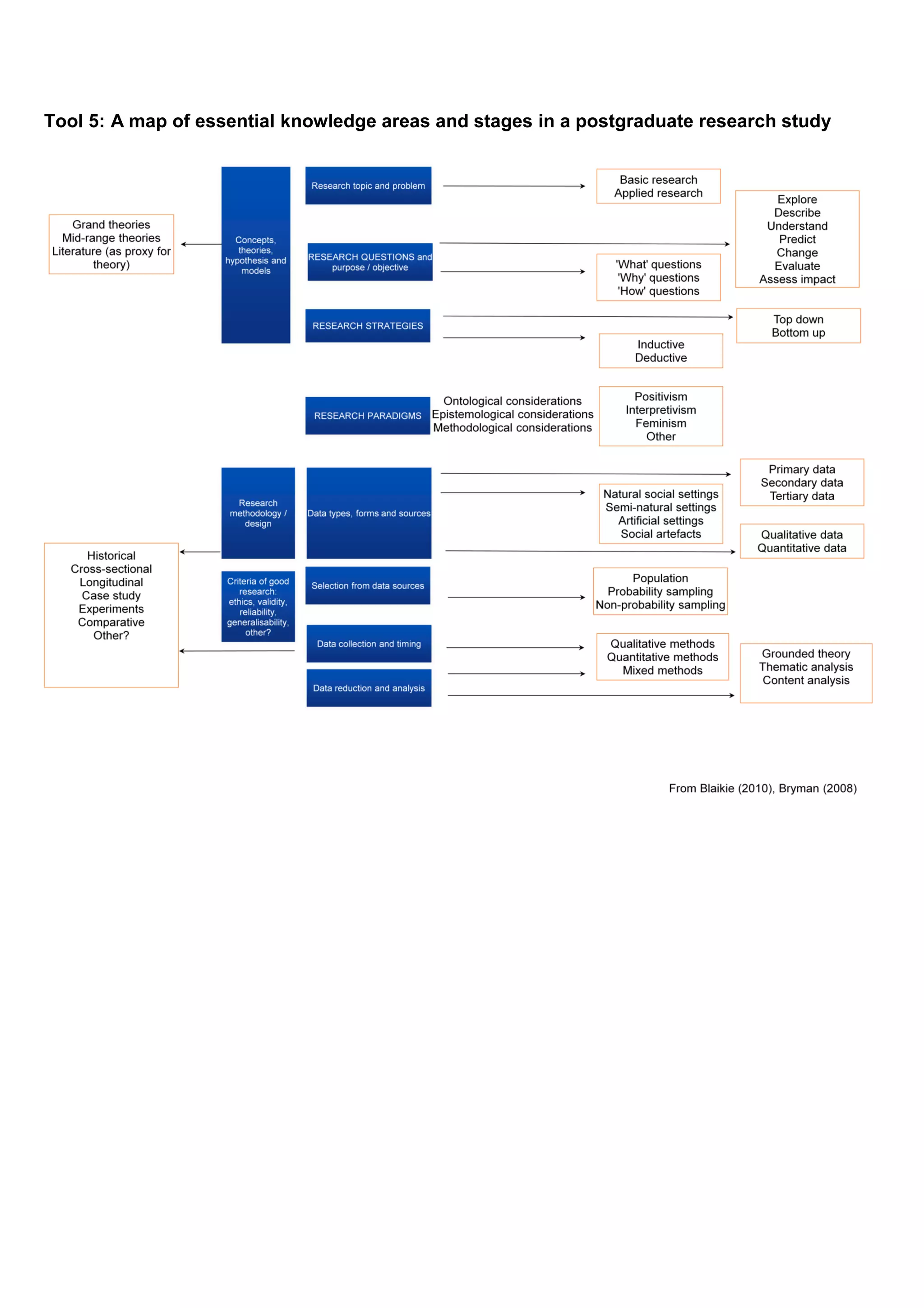
Tool 5: A map of essential knowledge areas and stages in a postgraduate research study

Tools for supporting research: dissertations and theses

  • 1.
    Postgraduate supervision ata distance: Tools to support the research and writing process Teaching and Learning Festival, Unisa, South Africa 7 Sept 2011 -------- Dr Palitha Edirisingha (BDRA) and Dr Ray Randall (Psychology) With Dr Tracy Simmons (Media & Communication) and Dr Chris Comber (Education) University of Leicester, UK. Tool 1: Dissertation proposal form Tool 2: Dissertation research planning tool Tool 3: Dissertation research knowledge and skills audit Tool 4: Dissertation writing progress tracking and diagnostic tool Tool 5: A map of essential knowledge areas and stages in a postgraduate research study
  • 2.
    Tool 1: DissertationProposal Form <course / programme title> Dissertation Proposal Form Please complete this form and send it to your tutor. Deadline for Submission of Proposal [date as relevant] This must be accompanied by the Ethical Approval Form Rationale for the study Personal professional: (Why is this area of study important/relevant to you?) Educational: (What is the nature and importance of the educational problem/issue that you wish to investigate?) Academic: (What is the ‘gap in the literature’ that the study seeks to fill?) Provisional Research Questions: (normally three or four) Key educational concepts on which your assignment will draw Key texts to be used Key educational theories/concepts on which your dissertation will draw
  • 3.
    Proposed Methodology (provide briefrationale for each choice) Methodological framework (paradigm) Methodology (e.g. case study, action research..etc) Sample/Participants Method(s) of data collection Proposed method(s) of data analysis Location (where is the study to take place?) A risk analysis (a list of major risks and steps that you have taken / you will take to minimise them *For Office Use Only* Tutor’s comments Approval Date: Approved by Tutor’s signature (Courtesy of Dr Chris Comber, University of Leicester, UK).
  • 4.
    Tool 2 –dissertation planning document My current level of.. Stage of Under- Confi- My needs: completion standin dence What I need/need to do in order to be able to (1-5) * g*** *** move forward CONDUCTING THE RESEARCH Dissertation proposal: Develop proposal for research & receive approval Arrangements for research site access Steps taken to ensure that you have access to the research site Instrument development & piloting: Design, develop & pilot instruments Data collection: Collection of data through research instruments Data preparation: Data entry (quant data) &/or transcription (interviews) etc Data analysis: Analysis of quantitative &/or qualitative data WRITING YOUR DISSERTATION Introduction/Background: Background, rationale, statement of research problem Literature review: Critical discussion of research literature relevant to topic Research question(s): Main & subsidiary research questions Methodological framework: Description/defence of chosen paradigm Theoretical/conceptual framework: Key theories/concepts which underpin your study Methodology: Description & defence of chosen research approach Method(s): Description/ defence of chosen instruments Procedure: Description of the way you conducted the study Validity & Reliability/Trustworthiness: Steps taken to ensure trustworthiness of study Ethics: Steps taken to ensure ethical research Findings: Summary of the main findings emerging from analyses
  • 5.
    Analysis: Account ofthe procedures adopted for analysing the data Discussion: Discussion of findings in relation to research questions(s) Discussion: Discussion of the findings in relation to literature Conclusion : Implications of study for policy, practice, further research References: List of references used in the texts Appendices: Collection of appendices relevant to the study * Stage of completion: Rate as: 0= I haven’t started this yet; 2= I have made a start on this; 3= I am about halfway through this; 4= I am close to completing this; 5= I think I have finished this ** Understanding: ‘I know what needs to be done’ - Rate as 1=strongly disagree to 5 = strongly agree *** Confidence: ‘I have confidence in being able to do it’ - Rate as 1=strongly disagree to 5 = strongly agree (Courtesy of Dr Chris Comber, University of Leicester, UK).
  • 6.
    Tool 3: Dissertationresearch knowledge and skills audit I have I haven’t I have made I haven’t I haven’t complete finished this, a start on made a start made a d this but I feel this but on this but I start on confident that have got am now this, I I know what I stuck and worried about need want to say need some it now! help! and how to help write it Introduction and background to my research (Background to the study) Literature review (Critical discussion of research literature relevant to my topic) Research questions (Main and subsidiary research questions) Theoretical / conceptual framework (Key theories and concepts which will underpin my study) Methodological framework (The research paradigm that underpin my study, qualitative / quantitative strategies) Design / Methodology (Description and defense of chosen research approach (cross-sectional study/ survey, case study, other) Methods (data-collection instruments) Procedure (Description of the way I conducted the study) Validity, reliability, trustworthiness (Account of steps taken to ensure the above in your study) Ethics (Account of the steps taken to ensure the research followed ethical guidelines) Findings (A summary of the main findings emerging from the analyses) Analysis (Account of the procedures adopted for analysing the data) Discussion (Discussion of the findings in relation to a). my research questions, and existing research (as discussed in the literature review) Conclusions (Discussion of the implications of the study for policy, practice and further research) References (List of references used in the text) Appendices (Collection of appendices relevant to the study) (Courtesy of Dr Chris Comber, University of Leicester, UK).
  • 7.
    Tool 4: Dissertationwriting plan (a writing progress tracking and diagnostic tool) TIME (WEEKS /MONTHS) 1). Introduction and background to my research (Background to the study) 2). Literature review (Critical discussion of research literature relevant to my topic) Research questions (Main and subsidiary research questions) Theoretical / conceptual framework (Key theories and concepts which will underpin my study) 3). Methodological framework (The research paradigm that underpin my study, qualitative / quantitative strategies) Design / Methodology (Description and defense of chosen research approach (cross-sectional study/ survey, case study, other) Methods (data-collection instruments) Procedure (Description of the way I conducted the study) Validity, reliability, trustworthiness (Account of steps taken to ensure the above in your study) Ethics (Account of the steps taken to ensure the research followed ethical guidelines) 4). Findings (A summary of the main findings emerging from the analyses) Analysis (Account of the procedures adopted for analysing the data) 5). Discussion (Discussion of the findings in relation to a). my research questions, and existing research (as discussed in the literature review) 6). Conclusions (Discussion of the implications of the study for policy, practice and further research) 7). References (List of references used in the text) 8). Appendices (Collection of appendices relevant to the study) (Courtesy of Dr Chris Comber, University of Leicester, UK).
  • 8.
    Tool 5: Amap of essential knowledge areas and stages in a postgraduate research study